Home / Historical Figures / Zhou Dynasty
Laozi
老子
Lao Dan, c. 6th – 5th century BC · The keeper of the Zhou archives who wrote five thousand characters and vanished
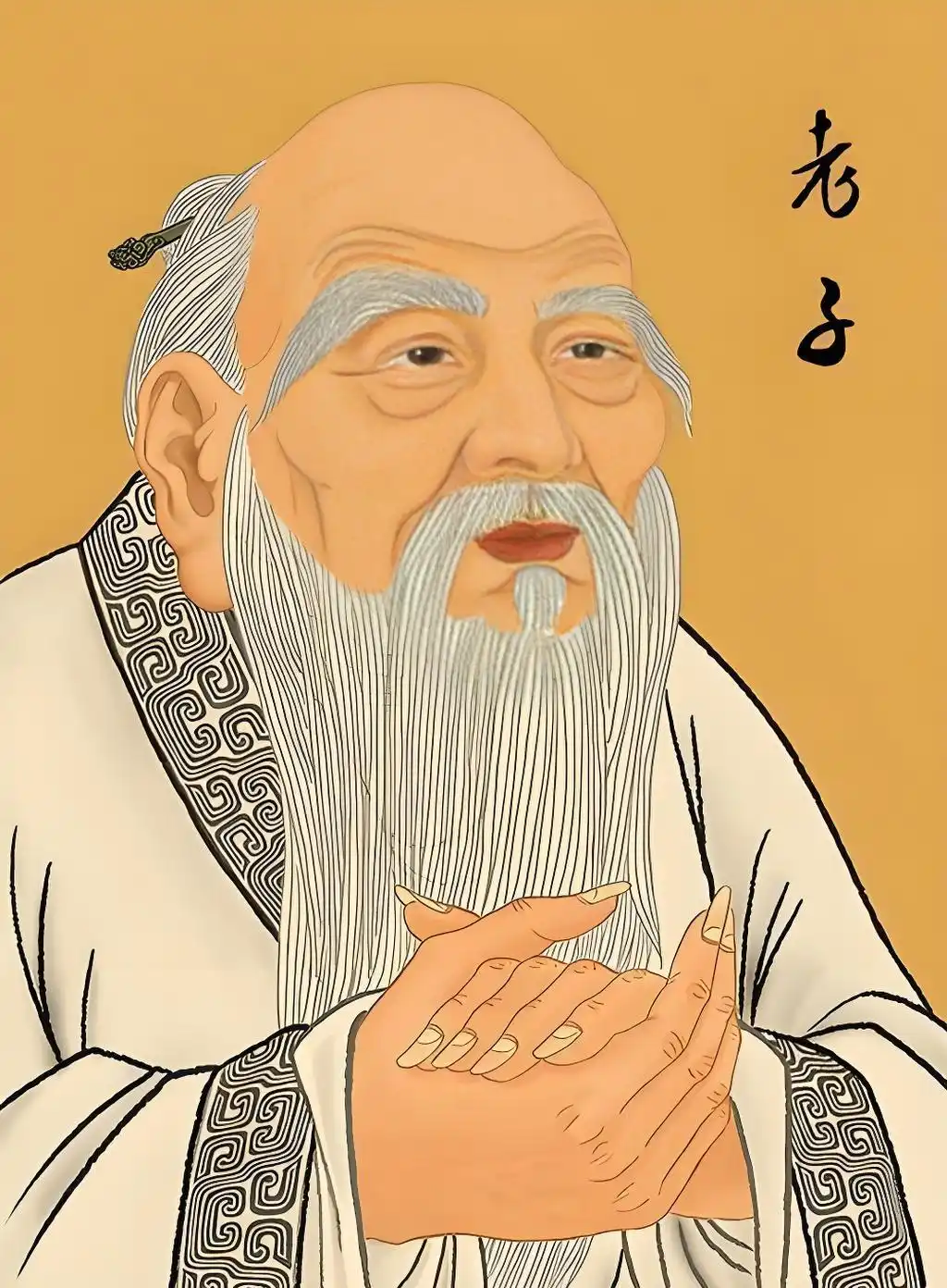
The most influential philosopher in Chinese history left almost no biography. He is said to have been an archivist at the royal court of Zhou, to have met Confucius and rebuked him, to have ridden west on a black ox when the dynasty decayed, and to have written a book of some five thousand characters at the request of a frontier guard before disappearing forever. Nothing about that story is secure. The man who told it first — Sima Qian, writing in the first century BC, some four hundred years after the supposed events — said so himself.
This is what makes Laozi a different problem from every other figure in this series. With Confucius or Mencius or Sima Qian, the question is what a documented life meant. With Laozi, the first question is whether there was a life to document at all, and the second is whether the book that carries his name was written by the man who carried it. The tradition answers both questions confidently. The evidence answers them slowly and with many qualifications. This essay takes the qualifications as its subject, because they are not a footnote to Laozi — they are the most interesting thing about him.
And yet there is a hard core under all the doubt. A book exists, and it is one of the strangest and most durable works of antiquity: eighty-one short chapters that refuse to argue, that speak in paradox and reversal, that describe a Way no one can name, and that have been read for twenty-five centuries as philosophy, as statecraft, as religion, and as poetry. Whatever Laozi was, the Daodejing is real, and its existence — attested in manuscripts buried before 278 BC — is the one fact that no skepticism can dissolve.
1. The Man Who May Not Have Existed
The oldest description of Laozi is barely a description. The Records of the Grand Historian, in its chapter on Laozi and Han Feizi, devotes to him some four hundred and fifty characters, and most of those characters are not about him. It names him, places him, gives him one office, and then tells two stories, one of which it concedes it cannot verify.
His surname, the Records says, was Li; his given name Er; his courtesy name Dan. He was a native of Quren village, in Li township, of Ku county, in the state of Chu — a place that sits, awkwardly, near the old territory of Chen, which Chu had swallowed. And his office was one that explains everything about him and nothing about his life: he was the keeper of the Zhou archives. He was, in other words, the librarian of a dying dynasty. He had charge of the records of a royal house that had already lost its power; he spent his working life among documents that told him, in great detail, how states rise and fall.
That single fact is the best thing the tradition gives us, because it is the one detail that makes the book intelligible. The Daodejing reads like the work of a man who has seen the inside of government and lost his faith in it. It is full of counsel addressed to rulers — how to govern, how to fight, how to avoid fighting — and its advice is consistently to do less. Whoever wrote it had been close enough to power to know how it corrupts and how it exhausts, and had stepped back.
The name itself is a title, not a name. Laozi means "the Old Master," and the tradition had a story to explain the adjective: that he had been carried in his mother's womb for decades — sixty-two years in one telling, seventy-two in another, eighty-one in a third — and emerged already old, with white hair, hence "the Old Master." The story is legend, and it is legend of a particular kind: it does not describe a birth so much as an absence of one, as if the tradition could not imagine him young. The two names attached to him point the same way: Er means "ear," Dan means "long-eared," and both are features of the folk image of the ancient sage — the man who hears everything and has grown old doing it.
There is a further complication that Sima Qian, to his credit, did not hide. The Records does not present one Laozi. It presents three men who might be him. The first is Lao Dan, the archivist and Confucius's senior contemporary. The second is Lao Laizi, a recluse of Chu who is said to have written fifteen chapters on the Way and is mentioned elsewhere as a man who lived to a great age. The third is the Grand Historian Dan, an astrologer who appears in the Records centuries later, in 374 BC, meeting the Duke Xian of Qin and delivering a prophecy about the rise of a western power. Sima Qian lays these three candidates side by side and then writes, in effect, that no one knows which is true. It is one of the most honest passages in ancient historiography. The father of Chinese history, faced with the father of Chinese quietism, declined to manufacture a life for him.
So the first thing to say about Laozi is what the tradition's own principal witness said: that his story cannot be confirmed. Everything that follows in this essay should be read against that admission. The biography is a tradition, and the tradition knows it is a tradition.
It is worth being precise about how unusual this is. Sima Qian had, by the standards of his age, a great deal of material on the founding of the Zhou and on Confucius; for those subjects he wrote long, confident narratives. For Laozi he had almost nothing, and rather than invent the missing life he did something no ancient historian was obliged to do: he recorded his own uncertainty in the text. The result is a biography that is really a description of an absence — three candidates, several stories, one office, and a note that the world does not know which of them is true. If the Daodejing had not survived, Laozi would be a footnote. Because it did survive, this thin record became the seed of a legend that has been growing ever since, and every generation has added to it in the conviction that a book so important must have had an author, and that the author must have been a man worth remembering.
The further irony is that the book itself seems to have anticipated the problem. It distrusts names, dismisses teaching, and warns against the accumulation of knowledge — and then it lost its own author so completely that the two most basic facts a biography requires, when he was born and when he died, are unknown and probably unknowable. The Daodejing says that the Way that can be named is not the constant Way. Its author's life is the same kind of object: the more effort is spent pinning it down, the more it slips, until what remains is the book and the direction in which someone rode off.
2. The Meeting the Confucians Remembered
The one episode that ties Laozi to a datable person is his supposed meeting with Confucius, and it is worth taking seriously for a reason that has nothing to do with whether it happened: it is remembered by the Confucian side, not the Daoist one. The episode itself is told elsewhere in this series, from Confucius's side, and need not be retold here. What matters from Laozi's side is not the dialogue but the frame around it.
Notice first who preserved it. The Records of the Grand Historian is a Confucian book by a Confucian author, and the meeting survives inside it as an anecdote about Confucius — the young master humbled by an older man — not as a founding legend of Daoism. The dragon image by which Confucius is said to have described him comes from that side of the record too. If Daoists had invented the encounter to score a point, they would hardly have let Confucius, the man whose tradition they spent centuries opposing, be the one who reports the only description of Laozi that anyone remembered. The safest reading is the dullest: an archivist at the Zhou court was known, in circles that also knew Confucius, as a man with sharp things to say about self-importance, and the story survived because it was too good to lose.
The dating is the harder question, and here the doubt is not modern squeamishness but ancient. Many scholars, ancient and modern, have doubted that the archivist who met Confucius and the author of the Daodejing were the same man — the Song philosopher Zhu Xi, who thought about it for years, could never settle whether there were two Lao Dans or one. The doubt is not a problem to be solved. It is the shape of the evidence.
What the episode does establish, even if it never happened, is that the Chinese tradition understood Laozi and Confucius as a pair of opposites from the beginning. Confucius is the man who knows the rules and tries to restore them; Laozi is the man who says the rules are the corpse of a dead generation and that only a fool tries to revive them. That the two great traditions could be pictured as meeting, and as parting with mutual respect, is a fact about China that outlives any question of whether the meeting occurred.
It is also, for the purposes of this essay, the last datable thing about the man. After the meeting the tradition gives us only the departure.
3. The Departure Through the Pass
The one story Sima Qian tells at length is the end of the life, and it is an ending designed to withhold everything an ending usually gives.
Laozi, the Records says, cultivated the Way and its Virtue, and his teaching took self-effacement and namelessness as its business. He lived long in Zhou. He saw the dynasty decline. And he left. He came to the pass — traditionally the Hangu Pass, the great gate in the mountains between the central plain and the western lands — and there the guardian of the pass, a man named Yin Xi, recognized him for what he was. You are about to withdraw from the world, Yin Xi said. You must write something for me. So Laozi wrote a book in two sections, speaking of the Way and its Virtue, of more than five thousand characters, and then he went on. And the Records closes the story with five characters that are the truest epitaph in Chinese literature: no one knows where he ended.
That refusal is the whole point. Every other founder in the tradition dies at a place, is buried in a tomb, leaves a lineage and a grave that can be visited. Laozi leaves a book and a direction — west — and no grave. He does not die; he exits. The tradition even supplies the animal for the exit, though the Records does not: a black ox, or water buffalo, on which he is always pictured riding westward, the bearded old man and the patient beast, disappearing into the mountains. It is the most recognizable image in Chinese art and it is entirely legend. It is also exactly right as an emblem of the man the tradition made: someone who did not stay to be questioned.
What lies beyond the pass is where the legend stops being harmless. Later Daoist tradition developed the story that Laozi did not simply vanish but went west to India, and that there he became — or became the teacher of — the Buddha. This is the doctrine known as "Laozi converts the barbarians," and it was not innocent. It was a weapon in a long war between Daoists and Buddhists over which religion was older, produced as a polemic in roughly the third or fourth century AD and repeatedly suppressed by emperors who preferred not to offend the Buddhists. It is a useful illustration of how the empty ending of Laozi's life became a space into which later ages poured whatever they needed. The Records says only that no one knows where he went. Within a few centuries, half of Asia had been recruited to fill the gap.
The tradition also gave him a death, of a kind, in the form of extreme longevity. He was said to have lived more than one hundred and sixty years, or two hundred, depending on the account — the Records mentions the claim and does not endorse it. The numbers are legend, and they are legend in the service of a particular idea: that a man who had found the Way would not be subject to the ordinary terms of a human life. But the truest version of his ending remains the shortest. He wrote, and he left, and no one knows where he ended.
4. Five Thousand Characters
If the life is a shadow, the book is a monument. The Daodejing — "the Classic of the Way and its Virtue" — runs to roughly five thousand Chinese characters, which is to say shorter than almost any other work of world philosophy that has mattered as much. It is not an argument. It does not address the reader, does not prove, does not build. It states, and it withdraws, and it leaves the reader to work out the connection.
Its organizing term is the Way — Dao — and the first thing the book says about it is that it cannot be said. The Way that can be spoken is not the constant Way; the name that can be named is not the constant name. Having opened by disqualifying language, the book then spends five thousand characters using it, in the full knowledge of the paradox. This is not an evasion but a method. The Daodejing is written on the assumption that the most important things cannot be captured in propositions, and that the best a text can do is circle them, repeat them from different angles, and then fall silent.
What the circling discloses is a philosophy of a particular shape. At the bottom of things lies the Way, which is not a god and not a substance but a pattern: the way things happen when nothing forces them. Chapter 25 says that man follows earth, earth follows heaven, heaven follows the Way, and the Way follows spontaneity — the last clause being the crucial one, because it refuses to ground the Way in anything beyond itself. Chapter 42 gives the generative formula: the Way produces the One, the One produces the Two, the Two produce the Three, and the Three produce the ten thousand things. The book is full of such formulae, and it is characteristic of them that they explain everything and prove nothing, which is exactly what the author intends.
The book's attitude to language is not incidental to its philosophy; it is the beginning of it. The Daodejing holds that the deepest things cannot be said, and it holds this not as a limitation to be lamented but as a fact to be respected. "Those who know do not speak; those who speak do not know." A teacher who believed that would have no school and no students, and the Daodejing accordingly has neither — it addresses no one by name, tells no anecdotes about its author, and never says where or when it was written. It is a philosophy delivered without a philosopher, which is why it was possible, centuries later, to fill the vacancy with whoever the tradition needed. The book's silence about its own origin is not an accident of transmission. It is the book's method, carried to its logical end.
From this metaphysics follows an ethic, and the ethic can be summed up in a word: wuwei. The word is usually translated "non-action," and the translation is misleading, because the Daodejing does not recommend doing nothing. It recommends acting without forcing — acting so lightly, so far ahead of the crisis, so free of strain, that the action is barely visible as an action. "By non-action nothing is left undone," the book says, and the paradox is the point. The ruler who governs by wuwei does not abdicate; he governs in such a way that the governed feel they have governed themselves. "I do nothing and the people transform themselves," the text says. "I love stillness and the people correct themselves."
Water is the book's central image for this, and it recurs: nothing in the world is softer than water, and nothing is better at wearing down the hard. Water benefits the ten thousand things and does not contend with them; it seeks the low places that men despise; it yields to every obstacle and arrives anyway. To be like water is the Daodejing's ideal — not weak, but unresisting, and therefore unstoppable. "The soft overcomes the hard; the weak overcomes the strong." The book is confident that this is not a metaphor but a law of how power actually behaves, and the whole of its statecraft follows from it: the ruler should stand below the people, not above them; should speak rarely and act sparingly; should "rule a great state as you would cook a small fish" — that is, without endlessly turning it over.
Running through all of it is the theme of reversal. The Daodejing is fascinated by the way things turn into their opposites. Beauty is defined only against ugliness; being and non-being give rise to each other; the high is measured by the low. Disaster is what good fortune leans on; good fortune is what disaster hides in. Whatever is forced to its peak begins to decline — the tree that grows stiff breaks, the army that is too strong is defeated, the state that is too aggressive exhausts itself. From this the book draws its practical counsel, which is always to stay below, to stay soft, to stay unfinished, to stop before the peak. "Reversal is the movement of the Way." For a book so short, that single sentence does a great deal of work: it is at once cosmology, ethics, and a manual for surviving in a violent age.
The book's politics follow the same logic, and they are more radical than its reputation suggests. Its ideal community, sketched in chapter 80, is the "small state with few people" — a place where the inhabitants are so content with what they have that they never travel, where boats and carts go unused, where neighboring villages are within sight of each other and the sound of their dogs and cocks carries across the fields, and yet the people grow old and die without ever visiting one another. To a modern reader this can look like a fantasy of isolation. To the Daodejing it is the logical conclusion of its own argument: if desire and comparison are the roots of conflict, then the state that eliminates the occasion for desire is the state at peace. The book's hostility to war runs just as deep. Weapons, it says, are inauspicious instruments, to be used only when there is no alternative and then mourned rather than celebrated — because to celebrate a victory is to take pleasure in killing, and a ruler who takes pleasure in killing will never win the world. Even the book's most famous political passages carry this anti-coercive edge: the people starve because their rulers tax too much, and a people pushed to the point of not fearing death cannot be governed by the threat of death.
This is why the Daodejing cannot be reduced to a handbook of private retreat. It is a book about how power works, written by someone who had watched it work and wanted to change how it was held. Its counsel to rulers is not to renounce power but to hold it the way water holds the rock — by yielding, by persisting, by going where the resistance is least. The image appears in nearly every chapter that addresses a ruler directly. The greatest state is the low-lying one, the place where all the waters gather. The best general wins without fighting. "The best soldier does not attack." "The greatest conqueror does not meet his enemy in the field." For a text composed in an age of unending war, this is not naïveté but observation: the most durable power is the power that never has to be exercised, and every ruler who has to prove his strength has already begun to lose it.
5. The Book That Was Never Finished
There is a reason so much of this is stated rather than argued, and it is not only that the author dislikes argument. It is that the book as we have it is not the work of a single moment. It is the product of centuries of copying, editing, and rearrangement, and the modern account of how it came to be is one of the great detective stories of Chinese scholarship.
The received text — the version that has been read for most of the last two thousand years, the sixty-two-character-a-chapter classic in eighty-one chapters — goes back to the third-century commentator Wang Bi, working around 240 AD, and to a tradition of imperial and scholarly editing that shaped it further. It divides the book into a "Way" section of thirty-seven chapters and a "Virtue" section of forty-four. But the received text is not the oldest text, and the way we know that is one of the triumphs of twentieth-century archaeology.
In 1973, workmen excavating a Han tomb at Mawangdui, near Changsha in Hunan, opened a chamber that had been sealed around 168 BC and found, among the grave goods, two copies of the Laozi written on silk. They were the oldest complete copies anyone had ever seen, and they differed from the received text in one startling way: the order of the two halves was reversed. Where the received text begins with the Way and then proceeds to Virtue, the silk texts put Virtue first and the Way second. If the silk texts are closer to the original, then the received book is, strictly speaking, not a Daodejing — a Way-and-Virtue Classic — but a Dedejing, a Virtue-and-Way Classic. Some scholars have argued exactly that. The two silk copies also lack the eighty-one-chapter division entirely; that, too, is a later imposition. The oldest Laozi had no chapters.
Twenty years later came an even bigger surprise. In 1993, a tomb was excavated at Guodian, near Jingmen in Hubei, and it contained the oldest Laozi fragments known — three bundles of bamboo slips, written before the tomb was sealed, which the archaeologists date to before 278 BC. Together the three bundles run to about eighteen hundred characters, roughly a third of the received text, in thirty-one passages. They are not a complete book; they are selections, copied by different hands, and the selections differ among themselves, which suggests that even at this early date scribes were working from more than one older source. But their date was decisive in an old argument.
The argument was about whether the Daodejing was early or late. For most of the twentieth century, a powerful school of Chinese and Western scholars — including figures as eminent as Liang Qichao and Feng Youlan — had argued that the book was a late composition, put together after the Zhuangzi, perhaps in the third century BC or even the early Han, and that the figure of a single author Laozi was a later invention. The Guodian find made that position much harder to hold. Whatever Laozi the man was, a Laozi text existed by the early fourth century BC, in a form that already contained passages recognizable in the received book. The "Laozi was written late" thesis survives in a weakened form — the book was clearly still being edited and rearranged for centuries after — but it can no longer deny that the text's core is early.
A third find, in 2009, filled in the middle of the story. The University of Peking acquired a cache of bamboo slips from a tomb of the early reign of Emperor Wu of Han, and among them was a copy of the Laozi more complete than either the Guodian fragments or the silk manuscripts — some two hundred and twenty-one slips, roughly five thousand three hundred characters, missing only a few dozen. It, too, puts Virtue before the Way, confirming that the order of the silk texts was not an accident of one copying house but the order in which the book was read in the early Han. Between the three finds, a rough chronology of the text emerges: a fluid collection of sayings circulating by the fourth century BC; a two-part book, Virtue first, by the early Han; and the received eight-one-chapter arrangement — Way first, divided into chapters — established still later, by the commentators of the third century AD.
So the honest description of the Daodejing is neither "a book by Laozi" nor "a late compilation" but something in between, and the in-between is what the evidence supports. The core sayings are old — old enough to have circulated before 278 BC, old enough to be quoted and paraphrased for centuries. But the book as a book took shape over time, was rearranged, was divided into chapters, had passages added and reordered, and was edited into the form we read by Han and post-Han scholars. The manuscripts do not settle the question of who wrote it. They replace that question with a better one: how did a collection of old sayings become a classic?
A single detail makes the editors visible. In one passage, the received text discusses how people are affected by the Way, and it plays on the words for "gain" and "loss." In the received version, the text speaks of de — virtue — and the passage becomes opaque, because virtue does not pair with loss. In the silk manuscripts, the character is de meaning "gain," a homophone that makes the passage plain. Later editors, reading de as "virtue" and wanting the passage to match the book's other great theme, inserted extra lines to make the pairing work — and in doing so turned a simple statement about gain and loss into a knot that readers have been untangling ever since. The manuscripts let us watch the knot being tied.
6. The Old Man the Legalists Claimed
One measure of a book's power is who wants to own it. The Daodejing attracted a reader from the least likely direction: the Legalists, the hard-headed theorists of law and punishment who stand at the opposite pole from everything Laozi seems to say.
Han Feizi, the greatest of the Legalist writers, who died in 233 BC, wrote the earliest commentaries on the Laozi that survive — two chapters of his work, "Explaining Laozi" and "Illustrating Laozi," that work through the text passage by passage. And there is a detail in them that tells us something about what he was reading: the order in which Han Feizi's "Explaining Laozi" takes up the text matches the silk manuscripts, Virtue before the Way. He was reading a version closer to the ancient one than the version that became standard.
What Han Feizi found in Laozi was not quietism but technique. A ruler who says nothing cannot be manipulated; a ruler who shows no preferences cannot be flattered or bribed; a ruler who stays in the background lets his ministers expose themselves and can then judge them by their results. Han Feizi read the Daodejing's counsels of non-action and non-contention as a manual for a ruler who wants to keep his own counsel and let others do the work — and to be punished if the work fails. It is a reading that makes most modern lovers of Laozi wince, and it is hard to prove that Han Feizi was wrong. The same sentences that comfort the mystic can arm the autocrat.
The strangeness of the pairing is worth dwelling on, because it shows how little the Daodejing belonged to any one faction. Han Feizi was the theorist of law and punishment, the man who argued that a state should be governed by published rules and impartial penalties rather than by the moral example of a good king; and yet he was the first person in recorded history to write a sustained commentary on Laozi. He did not read the book as ethics. He read it as a theory of the ruler's position — the reason a king should keep his face blank is that any expression is information, and any information is a lever for the men around him. Behind Han Feizi's reading stands a genuinely disturbing observation about the Daodejing: its counsel to conceal, to yield, and to stay in the background can be read as a technique of control, and a ruler who follows it is not thereby made wise or gentle. The book's own silence about the character of the ruler who uses its methods has troubled its readers ever since.
The Legalist reading belongs to a broader current in early Han thought known as Huang-Lao — "the Yellow Emperor and Laozi" — in which the Daodejing's preference for minimal government was fused with the political theory of the day. The early Han found the combination congenial because it had just emerged from the violent unification of the Qin, whose regime had been as activist and as harsh as any in Chinese history. The reaction against Qin rigor was a turn toward restraint, and for a period of some decades the court's guiding idea was that the best government interferes least. The era of Emperor Wen and Emperor Jing, remembered as the "Rule of Wen and Jing," is conventionally credited to this laissez-faire spirit: low taxes, light regulation, and the state deliberately keeping out of the way. The empire recovered its strength largely because it was left alone. The tradition long remembered that the greatest patron of this policy at court was the Empress Dowager Dou, who is said to have held to Huang-Lao teaching with such conviction that she required the whole court to read the Laozi, and who outlived the emperors who might have moved the empire back toward Confucian activism.
The phrase that later ages used to describe this stance — "use Huang-Lao within, display the Confucian arts without" — is a much later formula, and it should be treated as such: a retrospective description of a style of rule, not a doctrine anyone announced at the time. But the underlying insight is real, and it is one of Laozi's central legacies. The Daodejing is the first sustained argument in Chinese thought that the best government is the one that does the least, and that a state which solves its problems by leaving the people to their own devices will often outlast a state that solves them by decree.
7. Return, Softness, and the Art of Not Being Everything
If the book has one idea that it returns to more than any other, it is the idea of return — the conviction that the movement of the world is cyclical, and that the way to live well is to place oneself where the cycle is coming back rather than where it is going out.
The Daodejing is full of images for this. The valley, low and receptive, is honored above the mountain. The uncarved block — the raw material before it is shaped into anything — is honored above the finished vessel, because a finished thing has used up its possibilities. The infant, soft and weak and full of potential, is honored above the strong adult who is already hardening toward death. "The ten thousand things flourish and each returns to its root," the book says; and "returning to the root" is the definition of stillness, and stillness is the definition of the Way. To be at the beginning, or at the low point, or in the moment of turning back, is to be where the power is.
This is why the book values the feminine over the masculine, the dark over the bright, the yielding over the aggressive — not because it thinks they are morally better, but because it thinks they are strategically and cosmically earlier. The book speaks of the "mysterious female" as the gate of all things. It says that "knowing the masculine, keeping to the feminine" is the way to become the valley of the world. The ancients who understood the Way, it says, did not try to enlighten the people but to keep them simple, because a people who know too many tricks are hard to govern — a passage that has embarrassed liberal readers for two thousand years and that turns out to be perfectly consistent with the book's logic. If the good life is the unforced one, then the elaborate cleverness of civilization is not an achievement but a fall from grace.
There is a critique of knowledge and desire running through the whole book, and it is worth stating plainly because it is the part most often softened. The Daodejing does not simply counsel humility; it counsels the deliberate reduction of learning and appetite. "Cut off sageliness, discard wisdom, and the people will profit a hundredfold." "In pursuit of learning, one gains daily; in pursuit of the Way, one loses daily." This is not a metaphor for modesty. It is a program, and it is a radical one: it proposes that most of what a sophisticated society counts as progress is a form of interference with the natural pattern, and that the cure is subtraction. A modern reader can accept the diagnosis — that appetite and cleverness breed conflict — while balking at the prescription. Laozi offers no such comfort. He means it.
It matters, though, that the book is not only a counsel of withdrawal, and that its most-quoted sayings are addressed to people with power rather than to hermits. The critique of knowledge and desire is not aimed at the individual seeking serenity; it is aimed at the ruler whose appetites become the state's, and whose cleverness becomes the people's burden. That is the setting in which the Daodejing's political program makes sense, and it is a program, not a mood: a state that does little, a ruler who speaks late and acts less, a people left to their own devices because their own devices are, on the whole, better than the ones a court would supply. The quietism of the Daodejing is not the quietism of the dropout. It is the quietism of the official who has concluded that most official activity does harm.
There is one more turn in the argument, and it is the one that keeps the book alive. A text that distrusts language, denies teaching, and refuses to name its author ought, by its own logic, to be impossible — and yet here it is, five thousand characters of exactly what it says cannot be said. The Daodejing does not resolve this contradiction; it performs it. It uses words to point past words, tells stories to argue against stories, and leaves every reader to decide how much of it is instruction and how much is bait. That unfinishable quality is why the same book has served as a manual for emperors and for hermits, for revolutionaries and for reactionaries, and why men who would have disagreed about everything else have all found their own face in it. A text with no author and no doctrine has no owner either, and a book that belongs to everyone cannot wear out.
8. The God in the Temple
Everything above describes a philosopher. What the tradition made of him is a different order of thing entirely, and the transformation began not long after the book was written.
In 142 AD, in the mountains of Sichuan, a man named Zhang Daoling founded the first organized Daoist church, the Way of the Celestial Masters, and gave it a scripture: the Daodejing, read through a commentary that treated it not as philosophy but as revelation. In that reading, the Way of the book was not an impersonal pattern but a person — a god — and the god had a name: Lord Lao. Laozi the archivist became Taishang Laojun, "the Most High Lord Lao," and eventually one of the Three Pure Ones at the summit of the Daoist pantheon, the Heavenly Worthy of the Way and its Virtue. The book was retitled the Daode Zhenjing, the True Scripture of the Way and its Virtue, and read as a liturgy. A text that had opened by saying the Way cannot be named ended up being recited as the speech of a god who had one.
The mechanics of that transformation are worth spelling out, because they show how thoroughly a philosophy can be re-founded as a religion. The Celestial Masters did not simply honor Laozi; they made his book a rule of life, and the reading they gave it turned its abstractions into instructions. Where the Daodejing speaks of the Way as a pattern to be followed, the commentary speaks of the Way as a lord to be served, and it reads the book's counsels about governing and about desire as commandments for a community of believers. The book's demand that the sage do nothing and desire nothing became, in this reading, a program of ritual purity and moral discipline; its warnings against excess became rules about conduct; its talk of the mysterious female and the valley spirit fed the tradition's later elaborations on the cultivation of life. Nothing in the text had changed. Everything in the text had been enrolled in a church.
The god found his most enthusiastic patron in the Tang dynasty, and for a reason that had nothing to do with philosophy. The Tang imperial house was surnamed Li, and Laozi's traditional surname was Li, and so the emperors decided that the founder of Daoism was their ancestor. The claim was too useful to be examined closely. The dynasty built him a shrine, made Daoism the favored religion of the state, and progressively promoted his titles: in 666 AD the emperor Gaozong honored him as the Most High Mystery-Origin Emperor, and in 735 another emperor, Xuanzong, wrote his own imperial commentary on the book. It is a perfect illustration of how the Chinese state absorbed any tradition it could use. The man who had walked out of the archives when the dynasty decayed was made the ancestor of a new dynasty, and the book that counseled rulers to do less was bound in imperial silk.
Alongside the imperial cult grew the folk one, which mattered more. Laozi became a figure of popular religion — the bearded sage of the stone statues, the object of pilgrimage, the patron of longevity and of healing. Temples and mountains across China carry his name: the Taiqing Palace at Luyi in Henan, which claims to be his birthplace; the great mountain of Laojun; the enormous Song-dynasty statue of him carved into the rock at Qingyuan Mountain in Fujian. In these places, the philosopher of the nameless Way is asked for children, for health, for relief from trouble — the ordinary business of Chinese religion — and he answers, or does not, in the manner of all the other gods the tradition keeps. The two readings, skeptic and devotee, have coexisted for nearly two thousand years and show no sign of resolving.
9. Why He Cannot Be Caught
It is tempting, at the end, to resolve Laozi — to decide whether he was a man or a myth, a philosopher or a god, a single author or a school. The evidence will not permit the resolution, and the most honest thing this essay can do is explain why the refusal to resolve is itself the point.
The tradition made Laozi do something no other figure in the series is asked to do: it asked him to be a philosophy without a life. Confucius has a biography; we can follow him from state to state and watch him fail. Sima Qian has a biography, and his suffering is recorded in detail. Laozi has an office, a rebuke, a departure, and no grave. Everything else about him was supplied later, by people who needed a founder and found only a name. The book gave them a philosophy, and the name gave them a person to hang it on, and the silence at the center gave them room to build.
Sima Qian understood this, and his handling of Laozi is the model for how to read the whole tradition. He recorded what he was told. He named the contradictions. He listed the three candidates and did not choose among them. And then he gave his subject the one ending that is beyond dispute: the man wrote a book and vanished. It is the least biographical ending in Chinese history, and it is perfectly appropriate, because the Daodejing is a book that distrusts biography — that distrusts, in fact, everything that can be pinned down, named, and made into a story. The book says the Way cannot be spoken. The fate of its author is the book's first demonstration.
What survives the doubt, then, is not the man but the mind — and the mind is unmistakable. There is nothing else in ancient Chinese thought like the Daodejing. It has no interest in argument, no patience with proof, no faith in the accumulation of learning. It offers instead a way of looking at the world that has proved endlessly useful: a preference for the soft over the hard, the low over the high, the returning over the advancing; a suspicion of force and of the noise that force makes; and a conviction, radical in any age, that the greatest power is the power that does not need to be used. Whether a single old archivist wrote these things or a hundred hands assembled them over centuries, the vision is coherent, and it has been read as philosophy, as statecraft, as religion, and as poetry by every generation since.
Sima Qian, writing four hundred years after the supposed events, could only say that no one knew whether the story was true. It is a remark that most historians would consider a failure, and that Laozi's readers have always taken as a gift. The founder of Chinese quietism is the one great figure of the tradition who declined to be captured — who left an office, a book, and a direction, and no body for anyone to own. The Daodejing's first sentence says that the Way that can be spoken is not the constant Way. Its author made the same point with his life. Whatever else Laozi was, he was the only Chinese sage who understood that the surest way to survive for twenty-five hundred years is to leave nothing behind that can be pinned down.