Home / Historical Figures / Zhou Dynasty
Sun Wu
孙武
Sun Wu, fl. late 6th century BC · The strategist of Wu who wrote the world's shortest great book on war
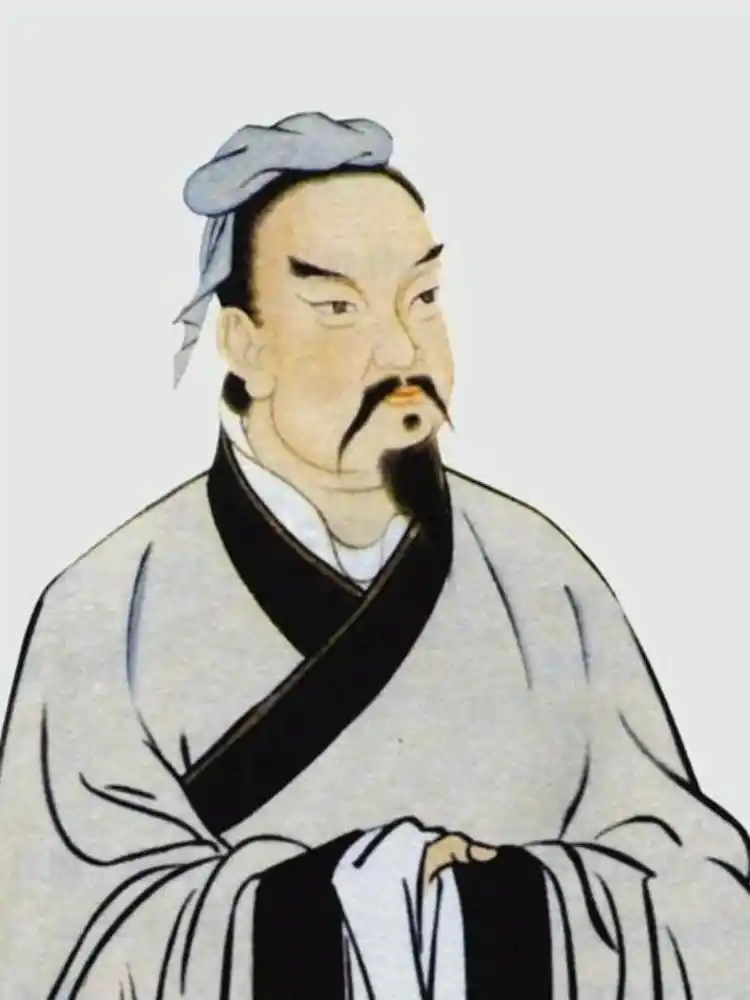
The most widely read book about war ever written has no biography. It is thirteen short chapters, a little under six thousand characters, and it begins not with a battle but with a warning: war is a matter of life and death for the state, and a ruler who does not think about it carefully will lose what he rules. It says that the best general wins without fighting. It says that knowing yourself and your enemy is worth more than a hundred victories. It says these things so compactly, and with so little narrative, that readers have spent twenty-five centuries arguing about who wrote it, when, and whether the man the tradition calls its author existed at all.
His name in the tradition is Sun Wu, and his honorific is Sunzi — "Master Sun." The English world knows him as Sun Tzu, a spelling that preserves an older romanization of the same two syllables, which is why the name in a Western boardroom looks different from the name in a Chinese textbook while being exactly the same name. He is said to have lived in the last decades of the Spring and Autumn period, in roughly the same generation as Confucius, in the state of Qi in what is now northern Shandong. He is said to have fled a civil war among the great families of Qi and traveled south to the state of Wu, where a new and ambitious king had just taken the throne. He is said to have written the book before he was ever given a command, and to have demonstrated to that king, with a drill on a company of palace women, that a text about discipline was not the same thing as discipline.
Almost every part of that story comes from one source. The Records of the Grand Historian, written by Sima Qian in the first century BC, gives Sun Wu a biography of a few hundred characters — shorter than many of the lives in the same volume, and far shorter than his influence would justify. The Zuo Commentary, the principal narrative history of the period and the source that tells the story of the war Sun Wu is supposed to have won, does not mention him anywhere. The name "Sun Wu" does not appear in any text that survives from before Sima Qian. For a man whose book is read in military academies on five continents, the documentary record is startlingly thin, and the thinness is the first thing an honest account has to explain.
And yet the book is not thin at all. It is the earliest sustained treatise on strategy in any language that has come down to us more or less intact, and it has been read continuously for two and a half thousand years — by generals, by emperors, by revolutionaries, and lately by executives who have never commanded anything. This essay takes that disproportion as its subject: the extreme, durable solidity of the text set against the extreme, durable uncertainty of the man.
1. The Problem of Sun Wu
The deepest trouble is not that the sources are few. It is that the one detailed account of his career describes a war that a better-informed source describes without him in it.
Sima Qian's account is brief and oddly specific. Sun Wu, he says, was a man of Qi who came to the attention of King Helü of Wu by presenting him with a book of thirteen chapters. The king read it, was impressed, and asked whether its author could actually train troops. He gave him one hundred and eighty women from his palace, and Sun Wu divided them into two companies, appointing the king's two favorite concubines as their officers. When the women laughed at his orders — and they did, twice, after being told twice — he had the two concubines executed, over the king's protest, with the sentence that has outlived everything else in the anecdote: a general in the field does not accept every order from his king. After that the women drilled in silence, and the king, however angry, made Sun Wu his general.
The problem with this story is not that it is improbable. It is that nothing in it can be checked. The Zuo Commentary narrates the Wu campaigns of these years in considerable detail, names dozens of officers and advisors, and never once mentions Sun Wu. The two names that dominate its account of Wu's rise are those of the king and of Wu Zixu, the refugee nobleman from Chu who had fled to Wu after his father and brother were killed and who spent his life steering its policy toward the destruction of Chu. If Sun Wu commanded Wu's armies at the battle that broke Chu, the Zuo Commentary did not think it worth saying so.
From this silence the skeptics built their case, and they built it early. Already in the Song dynasty, the scholar Ye Shi pointed out that a text as detailed as the Zuo Commentary could hardly have omitted a general of Sun Wu's supposed importance. Later scholars noticed something else: the name itself may be an invention. "Sun Wu" can be read as a descriptive epithet rather than a personal name — Sun related to a word for a fugitive, Wu a term for martial virtue — so that "Sun Wu" would mean something like "the fugitive warrior," which is precisely the role the figure plays in the story of Wu Zixu. It is a suggestive reading rather than a proven one, but it points at a real possibility: that the biography of Sun Wu was assembled after the fact, out of the needs of a story that already existed.
Against this, defenders of the tradition make an argument that deserves a hearing. The book itself, they say, is too coherent to be a committee product. It has a consistent vocabulary, a consistent set of concerns, and a style — clipped, parallel, wholly uninterested in anecdote — that reads like the work of one mind. Technical concepts in it, such as a system for classifying terrain, appear in other Warring States military texts in forms that suggest they were borrowed from it rather than the reverse, which would give it priority over texts composed in the fourth century BC and after. And the Zuo Commentary is not, in fact, a complete record of everything: it is a selection, made for its own purposes, and the omission of a military advisor from a war chronicle is not the same as proof that no such advisor existed.
The fairest statement of the situation is that a military text of great age and coherence exists, that someone wrote it, and that the tradition attaches it to a man whose name may or may not have belonged to a real officer at the court of Wu. The question is not whether there was a "Master Sun." The book is the Master Sun. The question is whether there was a Sun Wu behind the book — and the honest answer is that we do not know, that the sources disagree in a way the sources cannot settle, and that this uncertainty has been part of the book's life from the beginning.
2. The War He Is Said to Have Won
Whatever the truth about the man, the war is real, and it is one of the most consequential campaigns of the Spring and Autumn period. Understanding what Sun Wu is supposed to have done requires understanding the Wu–Chu rivalry that framed it.
Wu was a young state on the lower Yangtze, and Chu was the giant of the south — the largest, richest, and most aggressive power of the age, a state that had swallowed more of its neighbors than any other and that treated the smaller states along its northern border as a source of tribute and hostages. Wu's rise had been sponsored by Chu's enemies further north, and by the 510s BC the two states had been fighting on and off for decades. In 515 BC a prince of Wu named Guang seized the throne from his cousin and took the name King Helü. Among the men who shaped his policy were Wu Zixu and Bo Pi, two refugees from Chu with a private grievance against the state they had left — and, if the tradition is to be believed, Sun Wu as well.
The first years of cooperation were cautious, and this is one of the details in the traditional account that has the ring of truth precisely because it is unflattering. In 512 BC, with two small states subdued, Helü proposed a full-scale invasion of Chu. Sun Wu — on the tradition's own telling — talked him out of it. Chu, he argued, was still too strong, and Wu's troops were tired after a season of campaigning. Wu Zixu proposed a different approach, and it was Wu Zixu's proposal that shaped the next six years: divide the army into three parts and rotate them. When one contingent struck into Chu, the defenders would mobilize; when Chu's army arrived, the contingent would withdraw; and when Chu's army went home, the next contingent would strike somewhere else. For six years Wu raided the northern approaches of Chu in this fashion, striking the border towns of Yi, Qian, and Liu in relays, forcing Chu to answer every alarm and exhausting its treasury and its patience. The strategy is usually credited to Wu Zixu, and the credit should stay with him. Sun Wu's part in it, according to the sources, was subordinate.
The opportunity came when Chu made itself hated. The chief minister of Chu, a man named Zichang, had detained the rulers of two small states, Cai and Tang, for three years and extorted their treasuries. In 507 BC both states defected and allied themselves with Wu and with Jin. In the spring of 506 BC a coalition of eighteen states met at Shaoling to plot a campaign against Chu; in the autumn Chu besieged Cai, and Wu entered the war on the pretext of relieving it.
What followed is the part of the story that made Sun Wu's name, and it is worth describing accurately because the traditional account and the historical one differ in emphasis. Wu put three thousand five hundred picked troops in the van and marched an army of thirty thousand — its whole strength — westward up the Huai River, then suddenly abandoned its boats at a point called Huairui and turned south, through three narrow passes in the mountains on the Chu border, to come out on the Han River facing the Chu capital. The move was a strategic surprise of the first order. An army that had come upriver in boats, whose reputation was for river fighting, appeared unexpectedly in the enemy's rear on foot.
Chu's chief minister made the mistake that decided the campaign. One of his subordinates, a general named Shen Yinxu, proposed a sound plan: hold the west bank of the Han in strength, while he himself took a detachment north to burn Wu's abandoned boats and cut its line of retreat, and then crush it between them. Zichang agreed — and then, as a junior officer pointed out that the plan would let Shen Yinxu take all the credit, changed his mind, crossed the river with the main body, and attacked. Wu's commanders, on the traditional account, did exactly what the book recommends in this situation: they retreated to draw him on, let his army exhaust itself pursuing a force that refused to be caught, beat him three times in a series of engagements between the hills of Xiaobie and Dabie, and then met him at a place called Boju.
The battle of Boju was decided by a subordinate acting on his own initiative. Helü's younger brother, Fugai, argued that the Chu commander was hated by his own men and that a sudden attack would break the whole army; when Helü refused permission, Fugai attacked anyway with five thousand men of his own command, and he was right. The Chu line collapsed. Zichang abandoned his army and fled to the neighboring state of Zheng; the Wu force pursued what was left of it, caught it half-way across a river and destroyed half of it, ate the food the Chu soldiers had cooked before fleeing, and reached the Chu capital of Ying after five victories in ten days.
This is, on any reading, a brilliant campaign, and it destroyed the myth of Chu's invulnerability. It did not destroy Chu. Within a year, Chu's appeal to Qin brought an army of five hundred chariots to its rescue; the state of Yue attacked Wu from the south while its own army was far from home; and Helü's brother Fugai, fresh from his victory at Boju, rebelled and claimed the throne. Wu withdrew, its conquest intact in reputation and undone in fact, and Chu survived, wounded and for a long time diminished.
What the campaign does not do is prove that Sun Wu commanded it. The Zuo Commentary gives the credit for the tactics at Boju to Fugai and the strategic direction to Wu Zixu, and never mentions Sun Wu at all. Sima Qian, four hundred years later, attaches him to the campaign with a formula that is careful almost to the point of evasion: "Wu broke a strong Chu in the west, entered Ying, and overawed Qi and Jin in the north, making its name among the states — Sunzi had a hand in it." A hand in it. The phrase is the earliest statement of Sun Wu's military career, and it is the work of a historian who, writing about a man whose biography he could not verify, chose his words with the caution of a witness who does not want to testify.
What happened to him afterward is, in the sources, nothing at all. Sima Qian moves directly from the victory to a sentence about Wu Zixu's death and the succession of kings, and thereafter Sun Wu simply is not mentioned again: no death, no burial, no final posting, no list of descendants beyond the descent of the name to Sun Bin a century later. The tradition, unwilling to leave so distinguished a career without an ending, supplied one — that after Wu's fortunes turned and his friend Wu Zixu was forced to take his own life, Sun Wu withdrew from the court and retired to the countryside, where he revised his book and died in obscurity. It is a satisfying story, and it has the merit of matching the book's own advice about the man who survives by not being found. It also has no basis in anything a modern reader would accept as evidence. The most that can be said is what Sima Qian said: he was at Boju, or near it, and then he was gone.
3. The Book and Its Shape
If the life is a question mark, the book is a monument, and it is a monument of a very particular kind: it is the shortest classic in the tradition and possibly the least like the other classics.
The Art of War is thirteen chapters, and the order in which they come is itself an argument. It begins with assessment and ends with espionage. The first chapter is about whether to fight at all — it lays out five factors (the moral alignment of ruler and people, the weather, the terrain, the quality of the commander, the rigor of the system) and seven comparisons between one's own condition and the enemy's, and instructs the reader to make this calculation before anything else. The last chapter is about spies, and it is the reason the book keeps its reputation for honesty: Sun Wu says plainly that the most valuable intelligence does not come from omens or from the gods, but from people, and that the ruler who wants to know the enemy must pay for knowledge. Between those two chapters lies the whole of his thought: decide carefully whether to fight, and if you fight, fight on information.
What is most striking about the book to a modern reader, and what was most striking to its earliest Chinese readers, is what it refuses to admire. It does not celebrate courage. It does not praise heroic defense or glorious death. It treats war as a transaction whose purpose is the preservation of the state, and it measures success by what was saved rather than by what was destroyed. Its most famous sentence — that the supreme excellence is to subdue the enemy without fighting — is not pacifism; Sun Wu never doubts that force is sometimes necessary and never suggests that a state can survive without it. It is cost accounting. A general who wins a hundred battles has, on the book's logic, done something wrong somewhere: he has paid a hundred times for what he ought to have achieved by position, timing, and the enemy's own confusion. The book measures a commander the way a merchant measures a trader — by the ratio of result to expense — and it applies that measure to the most expensive activity a state can undertake.
This is why the book opens where it does, with a warning about expense. A long war, it says, exhausts the state that wages it and enriches no one; there is no instance of a country benefiting from prolonged warfare. Armies must be fed, and feeding them from home is ruinous, so a competent commander lives off the country he invades. Speed is worth more than elegance: "I have heard of a clumsy speed, but never of a skillful delay." And because war is expensive, deception is cheap — the cheapest way to defeat an enemy is to make him defeat himself, by moving against a position he must defend, or by appearing strong where he is planning to be weak, or by arranging to be somewhere he cannot have foreseen.
The book's famous doctrine of deception follows from this logic rather than preceding it. "All warfare is based on deception" is not a boast about cunning; it is a statement about economy. If a general can appear weak and thus draw his enemy into a bad position, he has bought a victory with a gesture. If he can appear to be attacking where he is not, he has forced the enemy to divide against a threat that does not exist. Throughout the book, the enemy is treated less as an adversary to be beaten and more as a system to be manipulated — a set of assumptions that can be fed false information until it does the work of its own destruction.
The first chapter deserves more attention than its opening line usually gets, because the list it contains is where the book's argument actually begins. Sun Wu says that the outcome of a war can be assessed before it is fought, by comparing the two sides on five factors. The first is the alignment between ruler and people — whether the population will follow the ruler into danger, and whether the ruler's cause is one the people can be made to own. The second is the sky: seasons, weather, the cycle of heat and cold. The third is the ground: distance, terrain, the difference between a road that can be marched and a road that can only be defended. The fourth is the commander: whether he has the five qualities Sun Wu requires of a general, which he lists as wisdom, credibility, benevolence, courage, and strictness. And the fifth is the system: the organization of the army, the clarity of its regulations, the fairness of its rewards and punishments.
Seven further comparisons follow — which ruler has the people's confidence, which commander is abler, which side has the better ground and weather, whose orders are actually carried out, whose troops are stronger, whose soldiers are better trained, whose rewards and punishments are clearer — and the reader is told to compute them all before deciding anything. This is the famous "reckoning in the temple," the pre-war calculation that the tradition took as the book's central method. Its premise is not exotic: it is that war is a comparison, not an event, and that most of the work of winning is done before the first arrow is shot.
The fourth factor is the one that tells us most about the book's view of command. A general is not, in Sun Wu's account, primarily a man who fights. He is a man who is trusted, who sees clearly, who is feared without being hated, and who knows when not to move. The book is explicit that the general's authority must be protected from the ruler's interference: it is the commander in the field, not the king in the capital, who sees the ground, and the book treats a ruler who issues orders from a distance as one of the five ways an army is ruined. This is the principled version of the advice Sun Wu is said to have given when he executed the king's concubines — the anecdote about the drill is a story about command authority, and the sentence at its center, "a general in the field does not accept every order from his king," is the same doctrine in its most dramatic form.
On the treatment of soldiers the book is careful and unsentimental in equal measure. It tells commanders to treat their troops as their own children — to share their hardships, to care for their wounds, to be present when they are afraid — and then it warns that affection alone produces an army that cannot be used. "If you are indulgent but cannot command, if you are kind but cannot enforce, if you are confused and cannot govern, then your soldiers will be like spoiled children: useless." The ideal is a commander whose men trust him enough to follow him into a position from which there is no retreat, and who has arranged the position so that retreat is not, in fact, the better option. The most quoted line of this doctrine is the coldest: "Put them in a place of death, and they will survive; put them in a place of no escape, and they will live." It is the theory behind the later Chinese tactic of the "back-to-the-water" battle, in which a commander deliberately destroys his own army's means of retreat and relies on desperation to win. It works, when it works, exactly because the men have no better choice — which is why Sun Wu attaches it to the same book that tells you, in its first chapter, not to fight unless the calculation favors it.
4. The Commander Who Does Not Move
The last of the book's major ideas is the one that most clearly separates it from the heroic tradition of Western military writing, and it concerns the emotions of the man in charge.
Sun Wu is emphatic that a ruler must not go to war out of anger, and that a general must not accept battle out of resentment. "Anger can turn back to joy, and resentment can turn back to pleasure; but a state that has been destroyed cannot be restored, and a man who has died cannot be brought back to life." The sentence is one of the very few places where the book raises its voice, and what it is raising it about is not tactics but temperament. A war that begins as a response to insult or slight may be the most expensive decision a state ever makes, and the decision will have been made by a man who was, at the moment of deciding, not thinking about the state at all.
The same discipline is applied to the general in the field. The book's ideal commander is patient to the point of apparent inertia — he does not move until there is an advantage to be gained, does not fight unless the position is critical, does not use his troops unless there is something worth taking. "Do not move unless there is profit; do not fight unless the position is critical." The image the book gives for the ideal moment of action is a hawk striking: perfect stillness, followed by a single motion from which there is no recovery. Most of the general's skill, on this account, is expressed in what he declines to do, and the commander who is always in motion, always responding, always fighting, is not a man in control of a campaign but a man being controlled by one.
5. The Art of Knowing and the Art of Not Being Known
Underlying all of it is a theory of knowledge, and it is probably the most philosophical thing in the book. Sun Wu is not interested in strength as such. He is interested in the asymmetry of information, because he believes that in war the side that knows more about the other will usually win, and the side that the other knows least about will usually lose.
"Know the enemy and know yourself," the book says, "and in a hundred battles you will never be in danger. If you know yourself but not the enemy, you will win one and lose one. If you know neither, you will be in danger in every battle." The sentence is famous enough to have become a proverb in half a dozen languages, and it is usually quoted as a piece of common sense. In its own setting it was closer to a technical doctrine. Sun Wu's world was one in which decisions were routinely supposed to come from divination — from reading cracks in bone or the movements of the sky — and a commander who insisted on knowing the enemy's dispositions rather than the gods' intentions was making a specific and contested argument about where knowledge comes from. His chapter on spies is startling for its time precisely because it says that prophecy is useless and that the state's money is better spent on informants.
From this follows the book's most distinctive strategic idea, which is that the ideal commander is invisible. If knowledge is decisive, then the side whose intentions can be read is at a disadvantage, and the side that can hide its intentions has an advantage that no amount of strength can offset. "Be extremely subtle, even to the point of formlessness. Be extremely mysterious, even to the point of soundlessness. Then you can be the director of your opponent's fate." The metaphor the book keeps returning to is water — water takes the shape of the ground it crosses, avoids what is high, fills what is low, and arrives at the sea by no route that can be predicted from the route it took yesterday. An army disciplined this way is not a machine with a plan; it is a fluid with a tendency. The book's advice to a commander facing a superior enemy is not to be stronger but to be unreadable, and its advice to a commander facing an inferior one is not to press the advantage but to give the enemy no reason to concentrate.
It is worth pausing here on a comparison that the tradition itself made. The Art of War and the Daodejing share the image of water, and they share a vocabulary of yielding and reversal — and yet they mean almost opposite things by it. For the author of the Daodejing, water is the image of a metaphysical principle: the soft overcoming the hard, weakness as the secret form of strength, passivity as the deepest kind of power. For Sun Wu, water is the image of a practical method: adaptability, the refusal to be committed to a fixed position, the exploitation of the ground rather than the imposition of a form. The Daoist generalizes; the strategist operationalizes. The closeness of the vocabulary has persuaded some readers that the two are the same tradition, and the difference in intention — one describing how the world is, the other how a campaign should be run — shows why they are not.
6. The Doctrine of the Costs
There is one more layer in the book, and it is the layer that has made it respectable in settings far from any battlefield: a persistent argument that the greatest victories are those that do not have to be won.
The book's hierarchy of methods is explicit. The best way to deal with an enemy is to attack his strategy — to make his plans unworkable before they are executed. The next best is to attack his alliances — to separate him from his friends. Next comes attacking his army; and the worst, by a wide margin, is attacking his cities, because a siege is expensive, slow, and destructive to the besieger as well as the besieged, and because a city taken by storm is a city ruined. The four-part sequence runs from the least violent option to the most, and the book means it as a ranking, not a menu. It is telling the reader that the general who gets to the bottom of the list has already failed — or, more precisely, that a state which finds itself besieging cities has already been outthought.
This is the source of the book's reputation for indirectness, and it is also where its realism shows through. Sun Wu does not say that force is unnecessary. He says that force is expensive, that its use should be calibrated, and that the best strategy is the one that makes force unnecessary. The book that begins with "war is a matter of life and death" is a long argument for taking fewer wars and fighting them better, and its most humane recommendation is also its most strategically cold: the victory that costs nothing is the best victory because it costs nothing.
Underneath its reputation for ruthlessness, then, there is something that is not ruthless at all, and it is not a modern projection onto an old text. Sun Wu's concern is not with the honor of war but with its cost — with the men who will die, the families that will not be supported, the fields that will not be planted, the state that will be weakened by a victory it cannot afford. The hierarchy of methods that puts strategy above battle and battle above siege is, in the end, a statement about who pays for a war and how much. And the fact that its author is supposed not to have lost a single one of the wars he did fight is, on the book's own terms, the least interesting thing about him: a commander who has to demonstrate his skill is a commander who has already been forced into a fight he should have avoided.
7. The Tomb That Settled the Argument
For a thousand years, the question of who wrote the Art of War was not a matter of scholarly curiosity. It was a dispute, and it was settled by an accident.
The dispute had two versions. The milder one held that the book was not the work of a single hand: that its core came from Sun Wu, that it was completed or revised by a descendant, and that it is best understood as the distilled experience of two centuries of war rather than the thought of one man. Sun Bin — Sun Wu's descendant according to Sima Qian, a general of the state of Qi who lived a hundred years later and who was mutilated under the punishment called bin, the cutting out of the kneecaps that left its victim unable to walk or ride — was the usual candidate for the completing hand. The harsher version held that Sun Wu himself was a fiction, and that the text attributed to him was written in the Warring States period and attached to a convenient name.
The reason the dispute could not be settled was that the evidence for Sun Bin's existence had been lost. The Han dynasty catalogue listed two books: the Wu Sunzi, or "Master Sun of Wu," which is the Art of War as we know it, and the Qi Sunzi, or "Master Sun of Qi," which is the work of Sun Bin. The first had survived continuously; the second had vanished, probably before the end of the Han. All that was left of Sun Bin was his biography in the Records of the Grand Historian and a single famous mention in Sima Qian's own letter of self-defence, where the historian, listing the works that men had produced out of suffering, names the mutilated Sun among his examples — the line that later readers would mistake for a reference to the author of the Art of War, though the man who suffered the bin punishment was Sun Bin, not Sun Wu. The disappearance of the Qi Sunzi made the two masters indistinguishable: with nothing but a name and a story, a skeptic could argue that there had been only one Master Sun, that the two biographies were one biography confused, and that the book was later than it claimed.
In April 1972, workers digging a foundation for an office building on a hill outside Linyi, in Shandong, uncovered two tombs of the early Han dynasty. They contained nearly five thousand bamboo slips, written in ink in an early form of the clerical script, and among them, in the same burial, were copies of both books: the Art of War — with enough of the text preserved to confirm all thirteen chapters — and the Art of War of Sun Bin, in sixteen chapters, a work that had not been seen for roughly two thousand years. The slips had been buried in the middle of the second century BC, which both dated them and proved that the two books had circulated as separate works at a time when the distinction could still be checked. The two texts were written by different hands, and their strategic ideas, while related, were distinct. The argument was over. Sun Wu and Sun Bin were two men, a hundred years apart, related by descent, each with a book of his own.
The finds did something else as well, and this part is less often told. The Linyi slips are the oldest text of the Art of War in existence, and they do not always agree with the version that has come down to us through a millennium of copying. In one passage about the balance of offense and defense, the received text — the one that has been printed and translated and quoted for centuries — says that a commander takes the defensive posture when his forces are insufficient and the offensive when they are abundant. The slip text says the opposite: that with the same number of troops, defense leaves a surplus and attack leaves a deficit. The two readings are not variants of phrasing; they say different things, and the older one is the more interesting, because it makes the point that a defensive posture is cheaper than an offensive one, which is exactly the kind of economic reasoning the book is built on. The transmitted text had been smoothed, somewhere in the long passage from bamboo to paper to print, into a sentence that made easier sense and less of a point.
This is the pattern that makes the archaeological record so valuable for a text like this one, and so unsettling for anyone who wants to treat the received version as the author's own words. The book has been copied, edited, reordered, and annotated for two thousand years, and its author has been a subject of argument for at least a thousand. What the Linyi tomb gives us is not certainty about who wrote the book. It gives us an earlier text, a datable text, and a demonstration that the transmission of the book was itself a process — one that occasionally changed the meaning of the very sentences that later generations read as ancient wisdom.
8. The Nameless Author and the Book That Outlived Him
The Art of War survived its author's obscurity, and the story of how it did so is the story of Chinese military culture.
Its earliest admirers were not generals but philosophers. Han Fei, the great Legalist of the late Warring States period and a man who had no patience for most ancient texts, noted with irritation that by his own time the book was everywhere — "within the borders every family has a copy of the military writings of Sun and Wu" — and drew from it the pessimistic conclusion that reading about war does not make a state strong. Sima Qian, writing the first history of China a century after Han Fei, put Sun Wu and Wu Qi together as the two founding masters of the military art and treated their books as standard texts that everyone knew. By the Han dynasty, the pairing of "Sun and Wu" — Sun Wu and Wu Qi — had become the conventional way to refer to the whole tradition of military thought, in the same way that "Confucius and Mencius" names a school.
The soldiers came later, and they came in force. Cao Cao, the warlord of the third century AD and one of the most successful commanders of Chinese antiquity, wrote the first surviving systematic commentary on the book, and said in it that of all the military works he had read, Sun Wu's was the deepest. Tang Taizong, whose reign is remembered as the high point of Chinese military power, said that none of the military books he had read went beyond Sun Wu, and that within Sun Wu none of the thirteen chapters went beyond the chapter on weakness and strength. In the Song dynasty the book was made the first of the seven canonical military texts, the Seven Military Classics that every officer was expected to know, and the same dynasty conferred on its author the posthumous title of marquis and a place among the seventy-two worthies of the military pantheon — the counterpart, in the military temple, of the place Confucius occupied in the civil one. And the criticism kept pace with the praise: Qi Jiguang, the sixteenth-century general who actually fought the pirates and the Japanese and knew what it took to make an army work, admired the book's grasp of principle while noting that it stopped entirely short of the practical detail — "the great framework is there, but not a single item of the detailed procedure." It was, he said, like the highest teaching of Chan Buddhism: profound, and no use whatever to a man who needed to know what to do on Monday morning. Zhu Yuanzhang, the founding emperor of the Ming, was blunter: the book was a patchwork of ancient stratagems rather than a pure doctrine, and a ruler who relies on technique will perish by technique.
The modern world's relationship to the book is stranger than either its ancient or its medieval readers'. The first Europeans to meet it were Jesuit missionaries in the eighteenth century, who translated it into French as a curiosity of Chinese thought and whose version, though widely repeated as fact, has no evidence of ever having been read by Napoleon. Serious military attention came much later, with Lionel Giles's English translation of 1910 and decisively with Samuel Griffith's Oxford edition of 1963, whose preface by the British strategist B. H. Liddell Hart credited Sun Wu as the source of his own theory of the indirect approach and thus introduced the book to a generation of professional officers. The Cold War did the rest. American officers who fought in Korea and Vietnam against opponents whose tactics did not come from the Western tradition began to ask what tradition they did come from, and the answer, in a great many cases, was Sun Wu: Ho Chi Minh and Võ Nguyên Giáp were both serious students of the book, and Giáp used its logic in the campaign that broke French power in Indochina. The United States Marine Corps put it on its professional reading list; West Point and Sandhurst placed it on their syllabi.
What happened after that has made Sun Wu famous in a way no ancient strategist would recognize. In the 1980s the book migrated into business, where its principles of deception, intelligence, and the exploitation of the enemy's weakness turned out to translate, more or less gracefully, into the language of corporate competition. Books with titles like The Art of War for Executives proliferated; business schools assigned it; Japanese firms made it required reading for their executives. There is nothing wrong with this, and quite a lot of it is shallow. Serious students of the text have pointed out that the gap between "know your enemy" as a requirement of military intelligence and "know your competitor" as a piece of managerial advice is wider than the business literature usually admits — that a general who fails to understand an opponent may lose an army, while a company that fails to understand a rival loses a quarter, and that a book written for a world where defeat means annihilation loses something essential when it is applied to a world where defeat means a write-down.
A modern reader who comes to Sun Wu through the business shelf will find something different in the original: a book about the cost of violence, written by a man who had seen states ruined by wars they should not have fought, in an age when the states around him were fighting each other to extinction. Its central claim — that the best victory is the one that costs nothing — was not a business insight. It was the conclusion of someone who had watched the alternative, and who understood that in the long run the state that learns to win cheaply outlasts the state that wins gloriously. That the same book now sits on the shelf beside the management titles, and that its author may never have existed, are both facts about how long an idea can outlive the world that produced it. The book that teaches you how to win without fighting has won, in the end, the longest fight of all — the one against being forgotten.
9. Why He Slips Away
The strangest thing about Sun Wu is not that his biography is thin. Most ancient lives are thin. The strangest thing is that the thinness has been so productive — that a man who may not have existed, whose supposed exploits are credited to other men by the sources that describe them, left a book so exact that two and a half thousand years of readers have found in it something they wanted, and that each generation has found something different.
The Daoists claimed the water. The Legalists found the discipline. The Tang emperors found the theory of command. The Song state made him canonical. The Ming general found him profound and useless in equal measure. Mao Zedong quoted him while arguing the opposite of his advice on speed. American officers read him to understand an enemy, and American executives read him to understand a competitor, and neither reading has much to do with the Spring and Autumn period.
None of this would have been possible if the book had a clear author and a clear occasion. The obituary that Sun Wu never received is the reason his book is still alive. A man whose life story can be pinned down becomes a period piece — interesting to historians, instructive to nobody in particular. A man whose life story cannot be pinned down can become whatever the reader needs, which is a strange kind of immortality and, for a writer, an unusually durable one. There is a line in the book about the ideal commander, that he should be formless, that his opponent should be unable to find him, that he should be able to direct the fate of others precisely because his own cannot be predicted. It was written as a maxim of strategy. Read against the record of its author's life, it reads like a description of the author's fate: a man so hard to find that after twenty-five centuries we are still not certain he was ever there, and a book so precisely formed that we have never needed him to be.