Home / Historical Figures / Zhou Dynasty
Jiang Ziya
姜子牙
Jiang Ziya (Lü Shang), c. 1128 – 1015 BC · The architect of the Zhou conquest, founder of the state of Qi, and the deified Martial Sage of China
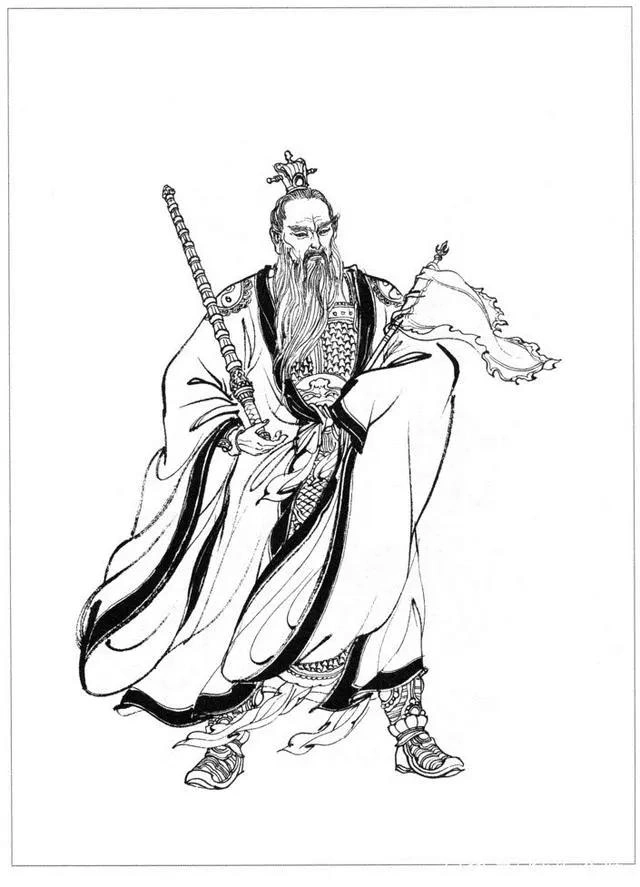
No figure in the Chinese founding memory is quite so multiplied as the old man who fished with a straight hook. He is Jiang Ziya and Lü Shang, Taigong Wang and Shi Shangfu, the Duke of Qi and the Martial Completion King. One of these names belonged to a historical counselor of the late second millennium BC; most of them were added by later centuries that needed a founder, a general, a sage, and finally a god. The challenge of writing him is to keep the man and the myth in the same frame without letting the myth swallow the man. What survives the scrutiny of the ancient historians is already large: a strategist who helped end the Shang dynasty and begin the Zhou, who planted the seed of a state that would outlast every other bronze-age polity in the region, and whose reputation was still growing two thousand years after his death. The rest — the white-haired fisherman, the centenarian warrior, the old man who appointed the gods — is the part that China told about itself.
This essay treats the two layers as one story, because they were never separate in the Chinese mind. It follows the documented life where documents exist, names the legend where legend takes over, and tries to say, at each step, which is which. The result is a portrait of a man who was real enough to change a dynasty and useful enough to be remade by every dynasty that came after.
The difficulty is that the sources themselves do not draw the line the way a modern reader would. The Records of the Grand Historian, our principal witness, is writing eight hundred years after the events, and it folds together court annals, clan traditions, and folk stories without always marking which is which. The Intrigues of the Warring States and the military treatises preserve anecdotes meant to make a point rather than to record a fact. The Book of Songs preserves a hymn composed to praise, not to report. To write his life, then, is partly an exercise in sorting: to notice where a detail is load-bearing across independent sources, and where it is an ornament that a later age added because it liked the shape of it. The sorting is not pedantry. It is the only way to see the man at all, because the myth, left to itself, is so much brighter than the life that it will otherwise be the only thing visible.
1. A Man of Many Names
The man we call Jiang Ziya was born into a family that had once been great and had long since fallen. His surname was Jiang, the clan name Lü, his given name Shang and his courtesy name Ziya; later writers also called him Wang, and shortened the courtesy name to Ya. The surname tied him to the line of Emperor Yan, the mythical flame sovereign, and the clan name recorded a much older reward: an ancestor had helped Yu the Great tame the floods and had been enfeoffed at Lü, and so the descendants carried Lü as their branch designation. By the time this particular descendant was born, sometime in the twelfth century BC, the distinction was a memory. He was, in the dry phrasing of the histories, a commoner of fallen family.
The sheer number of his names is itself a piece of evidence, and it is worth setting out how they multiply. Pair the two surnames with the three given names and you get a whole family of forms — Jiang Shang, Jiang Wang, Jiang Ya, Lü Shang, Lü Wang, Lü Ya — any of which a text may use for the same man. The variety is not confusion so much as an accident of grammar: the surname and the clan name were interchangeable in address, and the given name and courtesy name were interchangeable in writing, so six combinations were always available and the sources help themselves freely. It is only the two great titles, Taigong Wang and Shi Shangfu, that carry a story, because both were conferred rather than inherited, and both were conferred by a king.
Where he was born is the first thing the records cannot agree on. The Records of the Grand Historian calls him a man of the eastern sea, and Mencius, writing centuries later, places him on the eastern shore. A Han dynasty geographer makes him a native of Donglüli in Haiqu, in what is now Rizhao on the coast of Shandong; another tradition, citing the compiler of a river classic, puts him inland at Jixian, in modern Henan. The dispute is still alive between the two localities, each claiming the founder as its own. What the disagreement conceals is probably the truth: this was a man of the eastern coastal world, the borderland between the Zhou heartland and the peoples the Zhou called the eastern barbarians, and such a man could be claimed from either side.
The names he gathered in life came from the two rulers he served. When the lord of Zhou, the future King Wen, met him and decided he was the sage his grandfather had prophesied, he gave him the title Taigong Wang — the Hope of the Grand Duke, because the grand duke of the house had long hoped for such a man. The title is really a sentence with an ellipsis in it. Wen's grandfather, the elder Danfu, had foretold that a sage would come to Zhou and that the house would rise through him, and when Wen found the old fisherman at the river he said, in effect, that this was the man his grandfather had hoped for; the words congealed into a name. It was that name, Taigong Wang, that stuck, and that shrank into Jiang Taigong, the Old Duke Jiang, by which folk memory knows him best. When Wen's son, the future King Wu, took him on, he addressed him as Shi Shangfu, the Master-Father Shang, a title that combined the reverence due a teacher with the affection due a father. After the conquest, when he was enfeoffed in the east, he became Qi Taigong, the Grand Duke of Qi, and that is how the annals list him. Three names, three relationships: the hoped-for sage, the master-father, the founding lord.
What he became after death is a different inventory altogether. Later tradition would make him the Daoists' founder, the military schools' ancestor, and the claimed forebear of the Confucians, the Legalists, and the diplomatic strategists alike, until a later phrase summed it up as the Patriarch of the Hundred Schools. The claim was not that he had written their books — no one believed the Daoists took their metaphysics from a Zhou general — but that he had been the first to do, in practice, what each of them would later theorize. For the diplomat he was the man who won allies without battles; for the Legalist he was the man who executed the pious talker; for the military writer he was the man who had actually commanded. Each school found in him the ancestor it preferred. And the Tang dynasty would place him in a temple as the Martial Completion King, the martial counterpart to Confucius himself. To tell his story is therefore to watch a single historical person become a library of titles, each added by a generation that needed something he could be made to represent.
2. The Long Obscurity
Before he was any of those things, he was poor, and the stories of his poverty are too consistent across too many sources to be pure invention. The Intrigues of the Warring States calls him a discarded husband and a failed butcher of Chaoge, the Shang capital's satellite town; a military treatise of the same era says that at seventy he was still butchering oxen at Chaoge and selling food at Jijin, the river crossing south of the capital. The two trades did not have to be taken one after another. A man of the eastern coast who could kill and sell meat, who could keep a stall at a busy ford, was a man of the roads and the markets, and the picture that emerges is of a life spent in the commercial borderland where the Shang world met the rising Zhou — exactly the vantage point from which a patient observer could learn how both powers actually worked.
He had served, it seems, as a minor retainer to some lord, and been dismissed for failing to court the right patrons. One tradition makes him a live-in son-in-law — a zhui xu, a dependent husband taken into his wife's household for want of means — who was thrown out by her family for his inability to keep a household; another says more simply that his wife left him. The domestic detail matters less than what the tradition is doing with it. It presents the future founder of a state as a man so marginal that he could not hold a place even inside his own marriage, and it does so without embarrassment, because the reversal that follows is the whole point. Whether or not any of these particulars is true, they describe a life that had not yet found its use, and they describe it with a frankness that later, more reverent ages would blur.
What he was doing in that long interval was, by the same account, studying. The fisherman of legend is also a man who had taught himself astronomy and geography, the art of war and the art of ruling, against the day a ruler worth serving appeared — a self-taught general in an age when generals were born to the work. And the legend of how the ruler appeared is the most famous single scene in his life. He is said to have fished in the Wei River at a place called Panxi, in the hills of what is now Baoji in Shaanxi, using a hook that was straight and baited with nothing, and to have announced that he was fishing for the one who came of his own will. The phrase that grew from this — Jiang Taigong fishes, and the willing take the bait — has outlived every campaign he ever fought. The hook is a joke and a philosophy at once: it says that a ruler worth serving cannot be hooked, he can only choose, and that the fisherman's patience is the mirror of the counselor's.
The meeting itself is told with the symmetry of a founding myth. King Wen, going out to hunt, had consulted an oracle that promised him not a dragon or a tiger but a helper in the making of a hegemony. At the river he found the old fisherman, spoke with him, and came away convinced that this was the sage his house had been promised. What passed between them is reported as a discourse on the great words of the age — benevolence and virtue, righteousness and the Way — the old man talking and the lord of Zhou recognizing, in the talk, the man he had been sent to find. He took him back in his own carriage and made him grand preceptor, and he gave him the name that explains the whole episode: my grand duke hoped for you, he said, and so you are the Hope of the Grand Duke. The age at which this happened is given as seventy, eighty, or ninety depending on the source, and that very spread of numbers is the tell that the scene is polished rather than reported. What is not in doubt is the relationship it establishes: the rising house of Zhou acquired, late in the old man's life, the counselor it needed. The whole encounter is a parable of merit outrunning birth — the ruler who takes a commoner from a riverbank and calls him father — and it is the reason the story was told for three thousand years.
There is a second, grittier version of how he came to Zhou, preserved in a strategist's handbook of the Warring States. It says that Lü Shang served King Wen three times and entered the Shang court three times, unable to make his counsel tell, before he finally committed to Zhou. The pattern of three and three is the handbook's way of saying that he had tried every door and found all of them shut, and that his eventual loyalty to Zhou was not a conversion but a consequence — he had exhausted the alternatives. There is also a tradition that he was drawn in during King Wen's imprisonment at Youli, when two of Wen's own officials, seeking the king's release, sought out the famous wise man to help them assemble the gifts that would buy the prisoner's freedom. In that version the first service he rendered was not a battle plan but a ransom. These accounts need not cancel the fishing story; they may simply describe the same recruitment from different angles, the poetic and the procedural. What they share is the conviction that this was no ordinary hire, that the fortunes of a state turned on whether this particular man could be brought into its service — and, taken together, they suggest that the Zhou did not stumble on him at a riverbank so much as seek him out with the same deliberation they brought to everything else.
3. The Strategist of the Rising Zhou
Once inside the Zhou counselors' circle, Taigong Wang became the principal author of the strategy that would bring down a dynasty. The plan had two movements, and he is credited with both. At home he and King Wen set about making Zhou a state that could be believed in: they cultivated virtue, restrained the powerful, relieved the people, and trained an army. Abroad they worked to detach the Shang king's wavering vassals, so that the tyrant in his capital grew complacent while his periphery drifted away. And when the time came for war, Taigong directed campaigns against the tribes and small states that lay between Zhou and any eastern ambition — the Quanrong and the Mixu to the west, the Li and the Yu and the Chong closer in — and he oversaw the building of Fengyi, the new Zhou capital that served as a forward base for the strike to come.
That list of names is easy to skim and worth slowing down for, because each one was a decision. The Quanrong and the Mixu were the western and northern peoples whose raids threatened the Zhou homeland; breaking them secured the base. The Li and the Yu and the Chong were the nearer client states, and the choice to subjugate them rather than court them turned the approaches to the Shang heartland into Zhou ground. The Chong in particular was the state whose lord had been the tyrant's ally in the old days, and its fall removed a Shang outpost within striking distance of the Zhou capital. Fengyi, the new seat, was the geographic expression of the whole design: moved eastward from the old Zhou base, it stood closer to the Shang and closer to the frontier states, a staging ground disguised as a capital. In the grammar of the account, each campaign was one more place from which the final march could begin.
The Records of the Grand Historian, in its account of the house of Qi, makes a sweeping claim that belongs to this phase: that of the realm's three shares, two had already turned toward Zhou before the final blow fell, and that this was mostly the work of Taigong's planning. The number is rhetorical, but the underlying fact is not. By the end of King Wen's reign the Shang king was isolated, his own relatives and ministers alienated, his outer clients drifting, and the western power across the Wei valley was a real rival rather than a subject. Taigong's contribution was to have made that rival ready, and to have made the Shang vulnerable, without a single decisive battle. The claim is the earliest surviving statement of a doctrine that would run through Chinese military thought for the next two thousand years: that the decisive work of war is done before the fighting, in the alignment of allies and the cultivation of one's own credibility, and that a commander who has done that work can win with a march and a defection rather than a massacre. He is credited with winning the war, in other words, chiefly by winning it in advance.
Then King Wen died, probably around 1050 BC, and the work passed to his son. The new ruler, King Wu, kept the old counselor and raised his title to Shi Shangfu, the master-father whose word carried the weight of a teacher's and a father's. The first test of the new reign was a feint. Some two or three years into it, around 1048 or 1047, Wu led an army to the Mengjin ford on the Yellow River, and there, with Taigong holding the yellow axe and the white banner of command — the axe the emblem of the power to kill, the banner the emblem of the power to lead — the troops were sworn in and the allied lords assembled. They urged the king to cross and fight; he declined, and went home, having learned what he needed to know: that the allies would answer, and that the moment was not yet ripe. The two men are said to have composed the great oath of that occasion together, the Taishi, and the expedition that did not happen was the rehearsal for the one that would, down to its wording and its ritual.
The refusal mattered as much as the later victory. It established a discipline that runs through the whole Zhou founding story: wait for the enemy to destroy himself, then strike. When reports came that the Shang king had killed his own upright kinsman, driven his wise counselor into prison, and silenced his people with terror, Taigong judged the realm ripe. The evil, he said, had outrun remedy, and the time had come. It is a recurring note in his portrait — patience as a weapon, and the reading of a society's decay as a military plan. The same counselor who had told a young king to go home when the signs were wrong was the one who told him to march when the signs had turned, and the consistency between the two refusals of haste is what made his advice worth taking.
4. The Battle That Ended an Age
The campaign that followed is dated, by the modern chronology project that has tried to pin the ancient years, to 1046 BC — a reconstruction, like the date of Wen's death, and one that some older reckonings put a year or two later. King Wu marched with a force the traditional accounts size at some forty-five thousand armored men; at the head of it went a vanguard Taigong led in person, three hundred chariots and three thousand tiger-guards. The Shang, they say, could field perhaps one hundred seventy thousand, many of them pressed soldiers and slaves with no stake in the regime. The numbers are the kind that later ages love and that the battlefield itself does not confirm, but the shape of what happened is consistent across the sources: a small, coherent, well-led army meeting a much larger one that did not want to fight for the man who had sent it.
At Muye, on the plain before the Shang capital, Taigong led that vanguard into the fight. He took the front of the army with his chariots and his guards, exactly as he had held the axe and banner at the ford, and the Shang line, already hollow, came apart. The troops that the last Shang king had sent against Zhou turned their weapons and went over, or simply melted away; the king fled to his own burning tower, the Lutai, and ended his life in its flames. By the end of the day a dynasty that had ruled the central plain for generations was finished, and a new one had begun. The Da Ming hymn in the Book of Songs captures the moment in a line that has never lost its edge: the master-father Shang was like a soaring eagle, and with him King Wu struck down great Shang and brought the morning clear. That a hymn composed to praise a king should pause to praise his general is the measure of how the Zhou themselves wanted the victory remembered — as a partnership, not a solo.
What Taigong did in the hours after the battle is as telling as what he did in it. He helped distribute the dead king's hoarded wealth from the Lutai and his grain from the Jiaoqiao granary to the people of the capital, so that victory fed the defeated rather than only enriched the victors. He saw to the honor of Bi Gan's tomb — Bi Gan, the kinsman the tyrant had killed for speaking plainly — and to the release of Ji Zi, the wise man the tyrant had imprisoned for the same crime of honesty. And he took part in the solemn transfer of the Nine Cauldrons, the bronze symbols of royal authority, from the old capital to the new Zhou seat at Haojing. These were not mere gestures. They were the announcement that the new order would legitimate itself by relieving the old order's victims and carrying off its sacred things, and Taigong was among those who staged that announcement. Read together, the four acts are a miniature political program: feed the hungry, honor the murdered upright, free the imprisoned wise, and take possession of the symbols of legitimacy. Every one of them was cheaper than a battle and worth more.
There is a small human detail that the sources preserve and that is worth keeping, because it shows how the man was imagined even by his own side. When the allied lords first gathered at Mengjin and pressed for an immediate attack, it was Taigong who, by one account, steadied the young king's nerve against an inauspicious oracle and a storm, insisting that the omens of heaven bowed to the will of men who were right. Later, at the battle itself, the same tradition has him at the front of the line, axe and banner in hand, leading rather than advising. The image of the old counselor silencing the doubters and dragging a hesitant prince into his destiny is the emotional core of the founding legend, and it is as much a statement about the kind of advisor he was supposed to be as it is a record of what happened. He is the counselor who does not flinch. That he is drawn doing both jobs — overruling the diviners before the fight and leading the charge during it — tells us what the tradition most wanted from him: not a bookish planner but a man who could hold a man's nerve and a line's nerve at the same time, which are two different skills that rarely meet in one person.
5. Lord of Qi
For his part in the conquest, Taigong was the first of the great beneficiaries to be enfeoffed, and the grant was a deliberate placement. He received Qi, with its capital at Yingqiu in the east, in what is now the Linzi district of Zibo in Shandong, and the purpose was to plant a loyal wall against the unsubdued eastern peoples. The enfeoffment was also, in the logic of the new dynasty, a form of frontier defence outsourced to a trusted man: the Zhou had conquered far more territory than they could garrison, and the only way to hold the east was to give it to someone who would hold it for them.
The journey to take possession became its own story. His party, weary from the road, made a leisurely camp and settled in to sleep; someone warned him that the men who slept soundly now were exactly the men who would miss the moment, and he roused them and marched through the night. At dawn they reached the Zi River to find the army of the neighboring state of Lai already moving to seize Yingqiu for itself. Taigong fought and beat them, and only then took the seat that was his by grant. The episode is more than an anecdote: it shows that the eastern peoples were not waiting to be governed, that the nearest neighbor was ready to contest the prize, and that the first act of the founder of Qi was a battle not against the Shang but against a fellow eastern power. The state was born fighting for its own ground, and never forgot it.
The harder work was to make Qi hold and prosper, and here the man and the myth part ways in an instructive way. The histories credit him with a founding policy captured in two phrases. The first is to follow the local customs and simplify the rites — to govern the eastern peoples without forcing the full weight of Zhou ritual on them. The second is to honor the worthy and value actual achievement — to bring the local talent, including the native Dongyi, into the ruling class regardless of blood. Both were pragmatic: Zhou ritual was a foreign imposition in this coastal world, and the quickest way to lose the place was to insist on it. The two phrases also had a cost that the histories do not hide, for a policy of honoring merit regardless of birth is a standing threat to any hereditary order, and the men who administered Qi in its first decades understood that they were building a state on different terms from the ones their cousins were building in the west.
A later administrative geography makes the difficulty plain, describing the Qi coast as briny and poor in grain and thin in people — exactly the kind of ground where a light hand was the only one that would work. Taigong seems to have read the map correctly. He did not try to make a grain province out of salt flats; he made a trading province instead, and let the grain come in by boat.
The light hand had an edge. Taigong is said to have executed the superintendent of crimes who preached a soft and empty benevolence while taking bribes and harming the people, and to have put to death two recluse brothers, Kuang Yu and Hua Shi, who refused all office and taught others to do the same. Order, in his view, required that a ruler's law mean something, and that men who urged quietism while the state was being built not be allowed to undermine it. The two executions are the most controversial acts attributed to him, and they are the reason later Legalists could claim him as their ancestor: the man who killed the pious talker and the conscientious objector is a man who believed that in a young state, law had to be seen to bite. The speed with which he reported success tells the tale: when, after only five months, he went to the regent Duke of Zhou and accounted for his new state, the Duke asked in astonishment why he had settled it so fast. Taigong's answer was that he had simplified the rites and kept the customs, and had therefore needed no long struggle to bend the people to his will.
The economic policy was the part that made Qi last. Where the land would not easily grow grain, he turned to what it could do: he promoted agriculture where it was possible, but he built on the coast's real gifts, the fish and the salt, and on its position for trade. He encouraged handicrafts and commerce and opened Qi's goods to the other states, so that its caps and sashes and cloth traveled everywhere and its salt moved across the rivers and borders. The phrase the histories use is to promote the three treasures of farming, craft, and trade together and to make convenient the profit of fish and salt. Salt is the key to the whole design, because salt could not be produced everywhere and everyone needed it; a state that controlled a salt coast held, in effect, a tax on the entire interior. Add fish, add cloth, add the trade routes that carried them, and a poor and remote grant began to generate wealth faster than any grain-growing fief on the plain. The result, within a generation, was that the eastern march became the richest state in the east, and the house he founded ruled Qi for more than seven centuries, longer than any rival line.
6. The Old Man Who Saved the Dynasty
Taigong did not simply retire to his eastern estate. He spent much of the following decades at the Zhou royal court at Haojing as the dynasty's grand preceptor, and his eldest son, the future Ding Gong, served there as commander of the royal guard, while a younger son held Yingqiu in the founder's absence. That dual residence — the lord in the east, the family at the center — was how the early Zhou held together a conquest that was far larger than the conquerors. A state that had just swallowed a much older and more populous kingdom could not rule it by force alone; it ruled by placing trusted kin and allies in the conquered spaces, and the Taigong family, with one foot at court and one in the east, was the model of that arrangement. And when the conquest nearly came apart, it was Taigong, by then an old man by any honest count, who helped put it back together.
King Wu died, conventionally around 1043 BC, and left a child on the throne, the future King Cheng, under the regency of the king's brother, the Duke of Zhou. The arrangement did not hold. Wu's own brothers, the lords of Guan, Cai, and Huo — the three supervisors set to watch the surrendered Shang — turned against the regent, and they joined with Wu Geng, the son of the last Shang king, and with the eastern and Huai peoples in open revolt. The rebels had a plausible case: a child king under a brother's regency offended every instinct the Zhou had about proper succession, and the sons of the Shang, given a Zhou prince to lead them, could present the rising as a restoration. The rebellion is the most dangerous moment in the early Zhou, the moment when the whole conquest might have unspooled. The Duke of Zhou led the great eastern campaign to crush it, and Taigong campaigned at his side.
When the fighting ended, the court gave Taigong a grant that measured how far east its authority now reached, or hoped to. He was authorized to punish on his own authority from the sea in the east to the Yellow River in the west, to Muling in the south and Wudi in the north, the five marquises and the nine earls of the unsubdued east. It was, in effect, a commission to complete the conquest of the coastlands that the Zhou center could not itself reach, and it made Qi the armed frontier of the dynasty. The commission was also a transfer of trust: the court at Haojing was conceding that the east would be governed from the east, by a man it had reason to trust, rather than from the center that could never spare the armies to hold it. That this commission went to a man who was by then past any ordinary working life is the clearest evidence of how much the founders trusted him, and how much the dynasty still needed him.
His family sealed the alliance between the new house and the old counselor in the most literal way. His daughter Yi Jiang became King Wu's principal wife and bore the future King Cheng, and also Tang Shu Yu, the founder of the line that would become Jin. Through her, the blood of the founding strategist ran in the veins of the Zhou kings themselves — the strategist's grandson would be king, and another grandson would found one of the great states of the future. It is a detail that later writers treasured, because it made Taigong not merely the servant of the dynasty but its kin, and it anchored him in the genealogy of the ruling house as well as in its memory. The Zuozhuan tradition preserves the marriage as a matter of record, which suggests it was remembered as a political act and not only a domestic one: the Zhou bound the man who had made them by marrying his daughter, and by doing so made his grandchildren their own.
He died, on the reckoning of the ancient Bamboo Annals, in the sixth year of King Kang, which the modern chronology project places at 1015 BC — a reconstruction, not a record, and the exact year should be held as loosely as every other date in his life. What the Records of the Grand Historian says is both less precise and more telling: that he died at over a hundred years old. Sima Qian would not commit to a number, and the refusal is itself the most reliable thing in the whole dossier. Later tradition, less cautious, settled on 113 years if one counts from 1128 BC, or 139 if one counts from 1156; modern scholars treat the extremes as legend and place a plausible lifespan somewhere in the high nineties to just past a hundred, which is quite long enough to explain the legend without requiring a miracle. The longevity is worth pausing over, because it is the hinge on which his whole legend turns: a man who met his king at seventy or eighty and then lived to serve two more reigns has to be made of unusual stuff, and the number is the tradition's way of saying that his usefulness was not an accident of timing. He was buried at Haojing, the Zhou capital; a clothing tomb was later raised for him at Linzi, in the state he had founded, so that the east could mourn him too. The double burial is a small parable of the life: the man belonged to the court that made him and to the coast that he made.
7. The Book and the Making of a Martial Sage
Almost everything that made Taigong a sage rather than a statesman was added after his death, and the first and largest addition was a book. The Liu Tao, the Six Secret Teachings, is a military classic cast as a series of questions from Kings Wen and Wu and answers from Taigong, divided into six sections — the Civil and Martial Strategies, and then the four animals of war, the Dragon, the Tiger, the Leopard, and the Dog — and running to some sixty chapters. It is traditionally ascribed to him, but the scholarly consensus is that it is a composition of the Warring States or even the early Han, written in his name by men who wanted the authority of the founder behind their strategy. The six names are a small anthology of early Chinese military thought in themselves: dragon for the grand strategy of manoeuvre, tiger for the shock of battle, leopard for the skirmish and the raid, dog for the terrain and the camp. What the attribution shows is not authorship but inheritance: by the middle of the first millennium BC, to argue about war was already to argue in his voice. He was not the only text to borrow that voice; the bibliographies also record a lost Taigong's Art of War and a Taigong's Golden Casket, both attributed to him and neither surviving, so that the founder's name became a shelf as well as a signature.
The book earned its place in the canon in 1080 AD, when the Song emperor Shenzong gathered the seven military classics that would define the official art of war, and the Liu Tao was among them. By then Taigong was already the head of the martial pantheon in a more public sense. In the mid-eighth century the Tang emperor Suzong, amid the crises of his reign, established a temple to the Martial Completion King and set Jiang Taigong at its head, pairing the martial cult with the Confucian temple of the civil sage — the sources give the founding a few years either side of 757, and the precision hardly matters next to the symmetry. A state that honored Confucius as the model of the civil servant needed a model for the soldier, and Taigong, the strategist who had ended a dynasty, was the obvious candidate. A later Song emperor, Zhenzong, would add the epithet Illustrious to the title, making him the Illustrious and Martial Completion King. For several centuries a student of war and a student of Confucius could each bow toward an official altar, and the two altars were meant to balance: the one teaching how to govern, the other how to defend.
The displacement came from the other end of the tradition. The Ming founder Zhu Yuanzhang reorganized the state's martial cult and elevated Guan Yu, the loyal general of the later Han, into the officially sanctioned martial sage, and over the late imperial centuries Guan Yu took the place that Taigong had held. The reasons were as much political as religious. Guan Yu was a figure of undivided loyalty to a single lord, a virtue a dynasty of conquest prized above the strategic independence that Taigong's legend carried; and a god of loyalty was safer for a throne than a god of strategy. It is a useful reminder that these cults were instruments of government, raised and lowered as the throne saw fit, and that the godhood of a founder was always partly a policy.
Taigong lost the official altar and gained something stranger: a novel. In the Investiture of the Gods, a Ming romance compiled and printed in the Wanli era at the end of the sixteenth century and attributed to Xu Zhonglin, he became the mortal charged by heaven with appointing the gods after the Shang-Zhou war, the commander of the divine roll itself. The novel took the bare bones of the conquest — the tyrant, the rebellion, the old counselor — and filled them with immortals, magic, and a celestial bureaucracy, and Taigong became the clerk of that bureaucracy, the one who writes each spirit's name and office into the register. The folk charm that still invokes him — Jiang Taigong is here, all taboos stand aside — is the echo of that novel, and of a people who found it easier to pray to the old counselor than to the distant emperor. The charm is a small masterpiece of folk logic: because Taigong had appointed the gods, he outranked them, and wherever he stood, their prohibitions could not apply.
8. Why He Endures
What is worth keeping from all of this is not the god but the shape of the man the god was built on. He is the type of the late-blooming counselor, the advisor who comes to a ruler late and changes everything, and the type of the founder who governs a conquered people by letting them keep what they are. The two ideas reinforce each other. The patience of the fisherman is the same patience that told a young king to wait for a realm to rot before striking it; the pragmatism of the eastern lord is the same pragmatism that told a new dynasty to reward merit over blood and to tax a coast by its salt rather than by its grain. A tradition even records Confucius praising him as one who benefited all under heaven, and whether or not Confucius said exactly that — the line survives only through Liu Xiang's much later collection of anecdotes, and is best treated as a tradition rather than a quotation — the praise fits the reputation: a man useful to every succeeding school because he had stood, first, for the bare competence of ruling well.
There is a further reason he endured that is harder to state and easier to feel. Taigong is the rare hero of Chinese antiquity who is not a martyr, not a victim, and not a wonder child. He did not die young for a principle, did not rise from nothing through a single spectacular stroke, and did not restore a fallen dynasty out of loyalty. He was a late starter who got his chance at the end of a long and undistinguished life, and who then did the work with patience and without drama. That is a shape to which ordinary people can attach themselves, which is why the folk tradition kept him and the philosophers kept quoting him and the fortune-tellers kept invoking him. He is the patron of everyone who arrives late.
He endures because the Chinese founded state after state on the pattern he helped set: a conquest legitimated by relief of the people, a frontier governed by accommodation rather than imposition, a merit that could rise against birth. Qi, the state he planted, became the great eastern power of the Spring and Autumn and the Warring States periods, the home of the seafaring traders and the free thinkers, and it lasted until the unification that ended all the old houses. The martial schools kept his name as their origin; the strategists kept his patience as their first lesson; the folk kept his straight hook as their proverb. Sima Qian, writing roughly nine hundred years after the conquest, could only say that he died at over a hundred years old, and left it at that, and the restraint is itself a kind of tribute — the historian admitting that the man had passed into a size the records could no longer measure.
So the many names turn out to name one fact. Jiang Ziya was real enough to help end the Shang and begin the Zhou, and useful enough, afterward, to be made everything else. The straight-hook fisherman is a story, and the centenarian general is a story, and the old man who wrote down the names of the gods is a story, but they are stories told about a counselor who actually did the harder and quieter thing: he helped a small western state become the center of a civilization, and he taught it to govern what it conquered without breaking it. That is the part that needed no embellishment, and it is the part that lasted.