Home / Historical Figures / Zhou Dynasty
Confucius
孔子
Confucius, 551 – 479 BC · Teacher of Lu, founder of the Ru tradition
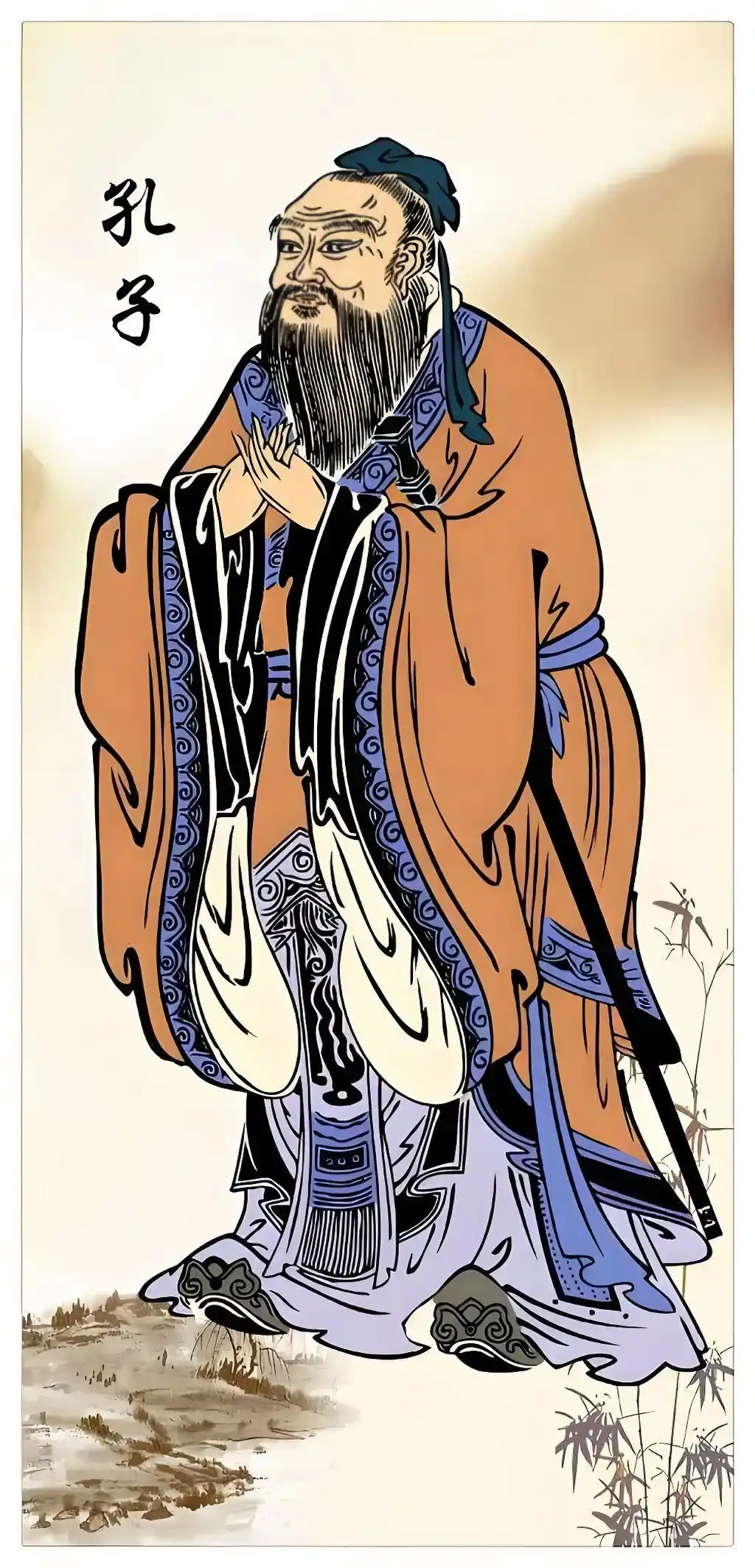
Few lives have been as consequential, and as poorly documented, as that of the man the world calls Confucius. He was born Kong Qiu in the small state of Lu, in what is now Shandong, in 551 BC, and he died there in 479, having held real office for only a few years and never for long, having spent more than a decade walking from one court to the next in search of a ruler who would listen, and having failed, by any ordinary measure, to persuade anyone who mattered of anything. He wrote no book and founded no institution. When he described himself at all he reached for the smallest description available: a man who loved the old things and trusted them, who handed on what he had received and invented nothing of his own.
And yet within three centuries of his death his sayings were the common curriculum of Chinese public life, and within five they were the examined orthodoxy of a unified empire. The tradition that grew up around him and took his name ordered education, family life and government in China for two thousand years, and travelled from there to Korea, Japan and Vietnam. It also did things to him that he would not have recognised: it made him a sage without flaw, then a king without a throne, then an object of sacrifice, and finally, in the twentieth century, the symbol of everything a modernising China wanted rid of. The gap between the exaltation and the repudiation is where the interest lies, because both were performed on a man about whom we know remarkably little.
1. A Family in Decline
There is exactly one continuous life of Confucius, and it was written about four hundred years after he died. Sima Qian gave him a chapter of the Records of the Grand Historian — not among the biographies of officials, where a man of his rank belonged, but among the hereditary houses. Everything later biography knows comes out of that chapter, out of dated entries in the chronicles of Lu, and out of the Analects, which is not a biography at all. By that account he was descended at a distance from the ruling house of Song, and behind it from the Shang kings the Zhou had overthrown; a great-grandfather had left Song in the general disorder and settled in Lu at a place called Zou, near the present-day town of Qufu. That the pedigree was already a public fact in his lifetime is suggested by a small scene: in 518 BC a grandee of Lu named Meng Xizi was dying, and he told his son that the Kong family were the descendants of sages and that a line like that does not fail to produce someone, and instructed him to go and study ritual with the young man. The son did.
His father was Shuliang He, a fighting man of Zou with a reputation for strength rather than for wealth or rank. His mother is given in the tradition as a woman of the Yan family, and the tradition adds that the match was irregular, that the couple had gone to pray for a son at a hill called Ni, and that the child was therefore named Qiu, "hill". These stories are too neat to be trusted and too old to be discarded; what is not in doubt is what came after. His father died while he was still small, and his mother would not tell him where the grave was. In his teens he put on the mourning band and went to a banquet that the great Ji family were giving for retainers, and was turned away at the door by their steward, a man named Yang Hu. That is the first recorded event in the life of the man who would become the teacher of China: a boy at a door being told he does not belong inside. Some years later his mother died, and because she had never told him where his father lay he could not bury them together; he left her coffin standing in the street until an old woman of Zou came and told him where the grave was.
Once grown he took the work available to a gentleman's son without a gentleman's estate. He kept accounts for the Ji family and looked after their herds; the Mencius gives the titles of the two posts and reports that of the first he said only that the accounts had to balance, and of the second that the beasts had to thrive. Looking back on it later he put the whole period in six words that do not ask for pity: I was young and of low station, and so I am skilled in many menial things. The world he had been born into was coming apart in slow motion: real authority had passed from the kings of Zhou to the great states, and inside the states to the great families, and inside the families to their own stewards. He spent his life asking how the old order had been built and why it had come apart, and the answer he arrived at he never afterwards modified: the Zhou looked back to the two dynasties before them, and how rich in form it was; I follow Zhou. The man he dreamed about — literally, and the dreams stopped in old age and the stopping troubled him — was the Duke of Zhou, who was supposed to have designed the ceremonies, the titles and the music of the whole system. He thought he was holding on to something that was being dropped, and the irony of his career is that the act of holding on is what changed China.
2. The Making of a Teacher
He had no single master, and the Records preserves a list of men he is supposed to have learned from, one for each state he passed through, which is less a curriculum than a way of saying that he would sit at the feet of anyone who had something he lacked. He questioned an officer of the small state of Tan about the ancient names of offices and went to the capital of Zhou to ask about ritual, a journey made with one carriage, two horses and a servant boy. There, by the tradition, he met the keeper of the royal archives, Lao Dan, the man the Daoists would later claim as their founder. Confucius came home and told his disciples that he had seen a dragon and could not follow it, and afterwards, the Records says, more students began to come.
At about thirty he began to teach, and without knowing it he had begun the most radical act of his life. Learning in his century belonged to the state. Instruction in ritual, music and the old texts was the business of hereditary specialists attached to a court or a great house; the knowledge was a form of property, and like other property it passed down inside families. Confucius took students from wherever they could be found. The fee he is said to have asked was a bundle of dried meat, which a poor household could manage, and the formula he used for the admission rule is one of the five or six most quoted sentences in the language: in teaching there are no kinds of people. He took a man who had been in prison and gave him a daughter in marriage, and when people objected to one of his students on the grounds of the boy's father, he said that if the calf of a plough ox has good red hair and good horns then it is wanted for the sacrifice, whatever anyone says about its mother.
The students who came were as mixed as the offer implied, and they are the reason the enterprise outlived him. Zilu arrived by the worst possible route: the Records says he came from a village in Bian, was given to courage and violence, wore a cap of cock's feathers and carried a sword ornamented with boar's skin, and began by bullying Confucius — who answered not with anger but with the gradual application of ritual and music, until Zilu put on scholar's clothing and asked to be taken on. Yan Hui came thirty years younger, a poor man in a mean alley with a bowl of rice and a gourd of water, and was the one Confucius loved. Zigong came a merchant, with a talent for speech and a talent for money. The Records says the students were probably three thousand, of whom seventy-two understood the six arts; the Mencius, written earlier, says seventy. Neither figure is evidence of anything except the appetite of a tradition for round numbers, and the Records itself hedges with the word "probably". What can be said is the shape of the thing: a school with no building, no endowment and no office, held together by nothing but the students' conviction that this man was worth walking after.
He said he did not open a thing up for a student who was not already struggling with it, and did not say the second half of a thought to a man who could not produce the first. Zilu asked whether a good man should put a good principle into practice as soon as he hears it, and was told he had a father and an elder brother to consider; Ran Qiu asked exactly the same question and was told to do it immediately; and when a third disciple wanted to know what was going on, Confucius said: Ran Qiu holds back, so I urged him forward; Zilu goes at things as though he were twice a man, so I held him back.
3. In the Service of Lu
His first attempt to find a ruler came in his mid-thirties and ended in the polite refusal that would become the pattern of his life. In 517 BC the duke of Lu took the side of a nobleman who had quarrelled with the head of the Ji family over a cockfight, attacked the Ji, was beaten by the three great families acting together, and fled the state. Confucius followed him to Qi, where he heard for the first time the music of Shun; he said it left him unable to taste meat for three months. The duke asked him about government and got the answer a ruler might most want to hear and least want to obey: let the prince be a prince, the minister a minister, the father a father and the son a son. He was impressed enough to offer Confucius a grant of land, and his minister Yan Ying talked him out of it, on the grounds that men of this sort make a virtue of lavish funerals until a state has beggared itself burying its parents, and that their learning takes more than a lifetime to exhaust. The duke said he was too old to use Confucius, and the Qi grandees began to look at him in a way he did not like, and he went home.
Then came sixteen years in which he did nothing the histories bothered to date except teach. The Records has one line for it: he withdrew and put the Songs and the Documents, the ritual and the music, into order, and his disciples multiplied until they were coming from every direction. Meanwhile Lu was governed by the chief steward of the Ji family, Yang Hu, who had made himself master of the state by taking his own employer prisoner, and who very much wanted the most famous teacher in the country to serve him. Yang Hu sent him a gift of a suckling pig, which etiquette required him to acknowledge in person; Confucius arranged to be out when he called. They met on the road anyway, and Yang Hu asked whether a man could be called benevolent who kept his treasure in his own pocket while his country went astray, and whether he understood that the days and months were passing and the years did not wait for anybody. Confucius said, yes, I will take office. He did not take it. Soon afterwards a rebel held the fortified town of Fei and invited him to come and govern, and he half wanted to go, and Zilu was disgusted, and Confucius asked whether he looked like a gourd, to be hung up on a wall and never eaten. He never went, but the temptation is in the record, and it is evidence: this was not a man who thought power was beneath him.
The state finally came to him in 501 BC, when Yang Hu was driven out and Confucius, at fifty-one, was made governor of the town of Zhongdu. He was there one year and the Records says the whole region took its rules from him; on the strength of that he was promoted to minister of works and then to minister of crime, the office later ages remembered him by. In 500 BC the dukes of Lu and Qi met at a place called Jigu to make a covenant, and Confucius went as master of ceremonies and had made sure, as the Guliang Commentary puts it, that a civil occasion had its military preparation. The men of Qi had brought armed men from the eastern marches to seize the duke of Lu during the entertainment and found the Lu party ready; Confucius took his duke back down from the platform and ordered the officers to use their weapons on the armed foreigners. When the covenant came to be drawn up the men of Qi added a clause requiring Lu to supply three hundred chariots if Qi went to war, and Confucius had his envoy answer that if Qi did not first return the fields north of the Wen river, Lu would answer the summons in a manner befitting that covenant. The fields came back.
The second episode is the reform that destroyed him. The three great families of Lu held between them three fortified towns — Hou, Fei and Cheng — each the seat of a branch of the family, walled against the central authority of the duke. Confucius argued that by the old rules no great house might keep its own armour and no city might have walls over a certain height, and persuaded the Ji and the Shu families to dismantle theirs. The Shu did it and lost nothing. The Ji agreed, whereupon their own governor in Fei — the man who had invited Confucius to come and govern two years earlier — revolted and marched on the capital; the duke and the three family heads took refuge on a tower, and Confucius sent two officers out with troops, and the men of Fei broke. Then the third town, Cheng, raised the question that ended the business. Its governor told his master, the head of the Meng family, that without Cheng there would be no Meng family, and asked him to pretend to know nothing while he held it; in the twelfth month the duke besieged Cheng and failed to take it. The arithmetic is worth seeing: the reform would have strengthened the ruling house and, incidentally, the man advising it; it depended on the cooperation of the very men whose power it was taking away; and it broke against the one fortress that had become identical with the existence of one of those men.
The end came in 497 BC, and it came out of a gift. The men of Qi, alarmed at what a well-run Lu might do, sent their neighbours eighty good-looking girls dressed for dancing, and thirty teams of fine horses. The head of the Ji family went out to inspect them in plain clothes, several times, and then took them; he and the duke stopped attending to business, and the Analects says simply that three days went by without a court. Zilu said to his master: we can go now. Confucius said, wait — the suburban sacrifice is coming, and if they send the sacrificial meat round to the great officers as they are supposed to, I can still stay. They did not send it, and he left. He spent the first night of his exile at a place called Tun, and an officer named Shiji came out to see him off. Confucius said, may I sing? And he sang about the tongues of women, that a man may have to leave because of them and be ruined because of them. Shiji repeated the song to the head of the Ji family, who said: so he holds me responsible for a crowd of slave girls.
4. Fourteen Years on the Road
The Records closes the account of his wanderings with a formula repeated ever since: from the time Confucius left Lu until he came back to it, fourteen years went by. The arithmetic takes a moment. His departure is usually dated to 497 BC and his return to 484, and 497 minus 484 is thirteen; the old chronicles counted the years a man lived through rather than the distance between two dates, and the year of the departure is itself disputed, some accounts putting it a year or two later. So the figure is traditional rather than computed, and it is safest to say he was away somewhere between twelve and fourteen years.
He went first, and for most of the time, to Wei, the state immediately north-west of Lu, whose duke, Ling, received him with the courtesy every ruler extended to a famous man and with the salary that went with it. Duke Ling asked him directly what he had been paid in Lu; he answered, sixty thousand measures of grain, and was given sixty thousand measures of grain. Ten months later somebody spoke against him to the duke, and the duke set a man with a weapon to watch him, openly, coming and going. Confucius understood the message and left before he could be arrested. The road out of Wei took him through Ku, a place that had suffered once at the hands of Yang Hu, and Confucius looked enough like him for the people of Ku to take him for the man who had ravaged them. They surrounded his party in the open country and held it five days. His disciples were frightened and he was not, and what he said is the nearest thing in the record to a claim about himself: after King Wen died, is the culture not here, in me? If Heaven means to destroy this culture then I cannot stand in its way; and if Heaven does not mean to destroy it, the men of Ku can do nothing to me. When the party got out and Yan Hui arrived last, having been separated from them, Confucius said he had thought him dead, and Yan Hui said: while you are alive, how would I dare die?
From Ku he went to Pu, where a local strongman had rebelled against Wei and the men of Pu would not let him through unless he swore not to go back to Wei. He swore, and went straight back. Zigong, who took oaths seriously, asked whether a sworn agreement could be broken, and Confucius said that an agreement made under duress is one the gods do not hear: the obligation was to the truth of the thing and not to the ceremony extracted by force. In Wei he met the duke's famous wife, a woman named Nanzi, who sent him word that any gentleman who wished to be on terms with her husband came to see her first. He refused, and then went; the audience was conducted through a curtain of beads, and the beads clicked as she returned his salutation. Zilu was furious, and Confucius swore at him in the language of the street: if I have done anything wrong, may Heaven loathe me. What ended his stay in Wei, in the end, was a carriage. Duke Ling and his wife rode out together with a eunuch on the box beside them and put Confucius in the second carriage, and drove through the marketplace so that the city could see them. The duke looked at his wife, and Confucius said: I have never yet seen a man who loved virtue as much as he loved a pretty face.
He went west to Song, where he and his disciples practised the rites under a great tree and where an officer named Huan Tui sent men to pull the tree down and let it be understood that worse would follow. The disciples told him to move quickly. He said: Heaven gave me this virtue; what can Huan Tui do to me? Then he went south towards Zheng, where he lost his disciples in the crowd and stood alone at the east gate while they looked for him. Someone told Zigong that there was a man at the east gate whose forehead was like the sage-king Yao's and whose neck was like the minister Gao Yao's, and who was, in the man's phrase, like a dog that has lost its master. Zigong found him and told him the whole of it, including the last part. Confucius laughed and said: my looks, that is nothing much. But a stray dog — oh, yes. Oh, yes. He was, incidentally, a notably large man; the Records says he stood nine feet six inches by the measure of his own time and that people used to call him the Tall Man and stare at him, though the conversion between a Zhou foot and a modern one is exactly the sort of arithmetic that should not be trusted.
5. The Siege Between Chen and Cai
He spent the middle of his exile in the small southern state of Chen, and he was still there when, in 489 BC, the state of Wu attacked Chen and Chu moved its army to Chen's rescue. The king of Chu had heard that the most famous teacher of the age was sitting in the neighbourhood and sent an envoy to hire him. The great officers of Chen and Cai worked out what that would mean. Confucius, they said, is a man whose criticisms all land on the real diseases of a state; if the great state of Chu starts using him, we who run these small states are finished. So they sent out labourers and had the party surrounded in open country, and the party could not move, and the food ran out. The tradition settled on seven days without cooked food, though that figure comes from Xunzi and Zhuangzi and not from the Analects or the Records.
Confucius kept teaching and kept singing to his lute. That is the whole physical picture of the episode: an old man in a siege, playing an instrument, with the students lying on the ground around him. Zilu came in angry and asked the question they must all have been asking: does a gentleman have to be reduced to this? Confucius said: the gentleman is indeed reduced to this; it is the small man who, when reduced, becomes reckless. Then he quoted the Songs at his disciples — not a rhinoceros, not a tiger, and yet we are driven across the wilderness — and asked whether his way was wrong and what he was doing in that place. Zilu said that perhaps they were not benevolent and so people did not trust them; and Confucius answered that if benevolence guaranteed trust there would have been no Boyi and Shuqi, and if wisdom guaranteed success there would have been no Prince Bigan, which is to say that the good are promised nothing. Zigong said that the Master's way was so great the world could not contain it, and asked whether he might not take it down a little; and Confucius told him that a good farmer can sow but cannot guarantee the harvest, and that a man who does not cultivate his way but asks only to be accepted has ambitions that do not reach far. Then Yan Hui answered, and gave the position that became the school's answer to every century afterwards: the Master's way is great, so the world cannot contain it; but if you push it and carry it, what harm is there in not being accepted? It is precisely in not being accepted that the gentleman is shown.
They got out because Zigong was sent to Chu and the army of Chu came and escorted them away. And then came the closest Confucius ever came to real power, and the way it ended tells you most of what you need to know about why he never got any. The king of Chu wanted to give him an estate of seven hundred square li, with the villages that went with it — a small state of his own, with his students holding the offices. His chief minister, Zi Xi, asked him four questions. Do you have an envoy anywhere as good as Zigong? Do you have a counsellor as good as Yan Hui? Do you have a general as good as Zilu? Do you have an officer as good as Zai Yu? The king said he had none of them. Then consider, said Zi Xi: our ancestors were enfeoffed by the house of Zhou with fifty square li of land and became great, and Kings Wen and Wu came to rule the whole world starting from a hundred. If Kong Qiu is given land and those disciples assist him, it will not be good for Chu. The king stopped. That autumn the king of Chu died in camp at Chengfu, and the offer died with him. Confucius was a man of sixty-odd who had been looking for exactly this for thirty years, and he lost it because his students were too good.
It was during these years that the Analects puts him repeatedly in the road of men who had given up, and these are among the best chapters in the book, because the book is honest enough to record the case against him. A man from Chu known as the Madman of Chu went past his carriage singing about the phoenix, the bird that comes only when the world is well-governed, and asking how its virtue could have decayed so far; Confucius got down from the carriage to talk with him and the man hurried away. Then there were the two farmers, Changju and Jieni, who told Zilu that the whole world was like a flood and that nobody was going to change it, and asked him why he followed a man who avoided one ruler after another instead of one who avoided the world altogether. When Zilu reported it, Confucius was downcast, and said the sentence that is his real answer to every quietist who has ever lived: we cannot herd with birds and beasts. If I am not to be with these people, then who is it that I am to be with? If the world were in order, I would not be trying to change it. It was Zilu who supplied the school's answer to him: to refuse office is to be without what is right.
He came home in 484 BC because the government of Lu finally had a reason to want him, and the reason was a battle. A Qi army invaded that spring, and the left wing of the Lu defence was commanded by Ran Qiu, who had been his disciple and was now steward of the Ji family. Ran Qiu won. The head of the family asked him where he had learned to command troops. From Confucius, said Ran Qiu, and then gave the tribute that did more for his master than any speech in the Analects: if you use him he will give you a name for it; his teaching can be spread among the people and put to the test before the spirits without anything to be ashamed of; and if you offered me a thousand households I would not take them in exchange for his way of doing things. The Ji family sent three officers with presents to fetch him. He came back.
6. The Return, the Texts, and the End
He had five years left, and he spent them as the state's elder, which in practice meant that the rulers of Lu asked his opinion and did not take it. In 484 the head of the Ji family wanted to replace the old levy on produce with a levy on land, and sent Ran Qiu to consult the retired elder. Confucius said he did not understand the question. Ran Qiu asked three times, and Confucius finally said that a gentleman takes generously, undertakes what is proportionate, and collects lightly — do it that way and there will be enough. They did it. And Confucius, who had loved Ran Qiu, said the hardest thing in the Analects about any of his students: this man is no disciple of mine; boys, beat the drum and attack him, that is permitted. In 481 a minister of Qi murdered his duke, and Confucius, who was seventy-one, fasted three days and three times petitioned the duke of Lu to send an army. The duke told him Lu was too weak and to go and speak to the head of the Ji family. Confucius refused, saying he had asked because he held the rank of a retired officer and did not dare keep silent. Nothing came of it. It was the last political act of his life.
His real work in those years was with books, and this is the part of his life hardest to write about, because the tradition has made it enormous and the evidence will not carry the weight. What we have from his own mouth is one sentence: after I returned from Wei to Lu, the music was put right, and the odes and the hymns each found their place. That is a modest claim — a man correcting a musical text — and it is the only claim he made. The tradition built something much larger on it. Sima Qian says that in antiquity there had been three thousand poems and that Confucius kept three hundred and five, every one of which he set to music; and that he ordered the Documents, the Rites and the Music, gave the Changes its commentaries, and compiled the Spring and Autumn Annals out of the chronicles of Lu, writing what he wrote and striking out what he struck out so exactly that the best of his disciples could not add a word. Modern scholarship has discounted most of this: the Songs is an anthology assembled over centuries, the Changes commentaries were composed long after him and by more than one person, the Book of Music was lost and possibly never existed, and the Annals was a state chronicle that certainly existed before him. What is left is still substantial. He taught these texts so insistently that they became the school's curriculum and eventually the empire's; he read the Changes so hard that the leather thongs holding the bamboo strips together broke three times and had to be replaced; and he used the Annals of his own state as a book of moral judgment, which is what Mencius meant when he had him say that those who understood him would understand him through the Annals, and those who condemned him would condemn him through the Annals too.
The deaths came in a cluster. His son Kong Li died first, in his fiftieth year, before his father — a fact the Records gives in five characters and which is almost the only thing it says about him. Then, in 481, Yan Hui died, thirty years younger than his master and the only disciple of whom he ever said that his heart did not stray from benevolence for as long as three months at a stretch. Confucius wailed. His followers told him he was going too far, and he said: am I going too far? If I do not wail for this man, then for whom? In the spring of that same year the duke of Lu hunted in the west and his beaters took a strange animal and nobody could say what it was. The tradition says it was a qilin, the beast that appears only in the reign of a true king, and that it was killed by men who did not know what they had caught. Confucius, told it was a qilin, wiped his face with his sleeve and the tears soaked his robe, and said that his way had come to an end. Then, in 480, the news came from Wei. Zilu was in the capital there as a retainer of one of the contenders in a succession fight between a father and a son, and when the fighting came he was one of the last men standing; a halberd cut the cord of his cap, and he said that a gentleman does not die without his cap, and tied it, and died. When the news reached him he said: ah, You is dead.
He dreamed, at the end, that he was sitting between the two pillars of a hall, receiving offerings. He told Zigong about it and explained it himself: the men of Xia lay out their dead by the eastern steps, the men of Zhou by the western, and the men of Yin between the two pillars; I am a man of Yin, and last night I saw myself set out between the pillars. Then he stood at the door leaning on his staff and sang a short song: the great mountain is crumbling, the beam is breaking, the wise man is withering. Seven days later he died. The date is one of the few things about him that is not tradition but record: the chronicle of Lu says that in the fourth month, on the day ji-chou, Kong Qiu died, and the Commentary of Zuo repeats it with the dating formula complete. Sima Qian adds his age, seventy-three by the reckoning of the old tables. The duke of Lu wrote a eulogy, calling him Father Ni and lamenting that Heaven had left him with no model, and Zigong, hearing it pronounced over the body of his teacher, criticised it in front of the court on two counts. My master held that when ritual is lost a man is confused and when names are lost a man errs: you could not use my master while he lived, and now that he is dead you have a dirge composed for him, which is a failure against ritual; and you call yourself the One Man, which is the king of Zhou's phrase and no duke's, which is a failure against names. The disciples observed mourning for three years; Zigong built a hut by the grave and stayed six. More than a hundred households moved to the ground around it to be near him, and the place came to be called Kong village. The house he had lived in was turned into a temple, and it is on that site, rebuilt many times, that the sacrifices are still made.
7. Benevolence, Ritual, and the Gentleman
He left no system, and it is worth saying what that means. There is no treatise, no chain of argument, no definitions — only about five hundred short passages, assembled by other people after he died. But four words carry most of the weight, and the centre of the four is ren. It is the hardest word in Chinese to translate: benevolence, humaneness, goodness, love, human-heartedness, all compromises. Asked once to define it, he said: to love others. Asked for a single word that could be practised for a lifetime, he said: is not reciprocity such a word? Do not do to others what you do not want done to yourself. Elsewhere he put it positively: a benevolent man, wanting to establish himself, establishes others. And in the sentence that makes it a religious claim rather than a moral one — benevolence is not far off; if a man wants it, it is there — he is not saying that people are naturally good, but that the capacity is not a scarce commodity distributed to a fortunate few, and that the only thing required to start is the decision to start. Zeng Shen, asked what the Master's way amounted to, said it was loyalty and reciprocity and nothing else.
And yet he would not hand the word out. A disciple asked about a statesman of great ability and was told the man was honest and public-spirited and not benevolent — he did not know. When his own best students were named he listed their talents one by one and refused to say that any of them was benevolent. Of Yan Hui alone he said that his heart did not leave benevolence for three months at a time, and that the others managed it for a day or a month. And when someone asked whether he himself was a sage or a good man, he said: sage, no; benevolence, I would not dare; what I do is work at it without being tired of it and teach others without giving up on them. This is not modesty for the sake of form; it is the shape of the doctrine. Benevolence is not a rank you are awarded but a direction you face.
The second word is li, and it covers ritual, ceremony, manners, propriety, the whole elaborate grammar of bows, gifts, titles and observances that held the old society together. He has a reputation as a man obsessed with it, and the reputation is deserved but misleading. He was appalled when the head of a great family had eight rows of dancers perform in his courtyard, an arrangement reserved to the duke, and said that if a man can bear to do this, what will he not be able to bear. But he was not a formalist: when a disciple wanted to spare the sheep that had to be sacrificed at the announcement of the new month, Confucius said, you grudge the sheep, I grudge the rite — the form was to be maintained even where the meaning had drained out of it, because the form is what keeps the place open until the meaning comes back. Asked about the root of ritual he said that in ritual it is better to be sparing than lavish, and in mourning better to be genuinely grieved than merely correct. Nor were the rites a way of reaching another world. He refused to talk about prodigies and feats of strength and disorder and spirits; asked about serving the spirits, he said that a man who cannot serve other men is in no position to serve the dead; and he told a disciple that to respect the spirits and keep them at a distance may be called wisdom. What the rites were for was making respect physical, and therefore habitual, and therefore real: they turned an intention into a movement of the body, and the body did not forget.
Third, the family, which in his teaching is the school in which everything else is learned. Asked what filial piety was, he said that the young should serve their parents with the appropriate forms — but that a dog or a horse is also fed, and that the distinction between those and a parent is respect; asked again, he said that the hard part is the face you wear. He thought it was a son's duty to remonstrate with a father who was doing wrong, gently, and then to go on being a son even if the remonstrance failed, and he defended the three-year mourning period on the grounds that a child is three years before it is out of its parents' arms. The passage that has embarrassed readers for twenty-five centuries is the one in which a man boasts that when his father stole a sheep he testified against him, and Confucius answers that in his part of the world the father shields the son and the son shields the father, and uprightness is found in that. He left no room for a loyalty that overrides the family, and the tradition that inherited this built an imperial state on the family and then spent two thousand years arguing about what it had done.
The last of the four is the one that did the most work in Chinese history. Junzi literally means the son of a lord. Confucius took the word and quietly emptied the birth out of it: in his usage the gentleman is not the man of good family but the man of developed character, and if a gentleman is made by what he does rather than by who his father was, then anyone can become one. He understands what is right where the small man understands what is profitable; he is at ease with others without being in the same camp as them; he looks for the fault in himself rather than in other people; he is slow to speak and quick to act; he is not a vessel, meaning he cannot be used for one function only; and he is a mixture of substance and ornament, because it is the mixture that makes him. And the discipline of it all was study, which for him was not the acquisition of information but the practice of becoming a certain sort of person: to learn something and at intervals actually do it, which is the first sentence of the book; to be stirred by poetry, established by ritual, completed by music; to look inside oneself when one meets a bad man; and not to leave a fault uncorrected once one knows about it, since that, he said, is the only real fault.
8. Government by Example
His politics are not a set of policies and it is a mistake to look for them. What he offers is a claim about where order comes from, and it is stated in two sentences that Chinese statesmen quoted for two thousand years. The first is an image: he who governs by virtue is like the pole star, which stays where it is while the other stars turn toward it. The second is a contrast: govern the people by regulations and keep them in line with punishments, and they will evade the punishments and lose their sense of shame; govern them by virtue and keep them in line with ritual, and they will have a sense of shame and will correct themselves. Order is produced by the character of the people who rule and the habits of the people who are ruled, and the apparatus of law is a confession of failure — which is why he thought that the goal of a judicial officer was that litigation should become unnecessary. He laid out a sequence for the people of a state: make them numerous, then make them rich, then teach them; an unusually honest order of priorities from a man whose whole life was teaching.
His most characteristic political idea is the one that sounds most like a pedant's complaint and turns out to be the sharpest thing he said. A disciple once asked what he would do first if the ruler of Wei put him in charge of the government — the state where a son had set himself up as his father's rival and the titles had stopped describing anything real — and he said: what is necessary is to get the names right. Zilu told him he was wide of the mark. Confucius told Zilu he was uncultivated, and then explained: if names are not correct, speech does not square with things; if speech does not square with things, affairs cannot be carried through; if affairs cannot be carried through, ritual and music do not flourish; if ritual and music do not flourish, punishments miss their mark; and if punishments miss their mark, the people do not know how to move hand or foot. It is a theory of language with a political payload, and in that particular state at that particular moment it was a pointed remark: the ruler of Wei called himself a ruler and was a rebel, and Confucius was saying that you cannot govern with a title that lies. The famous formula — let the prince be a prince, the minister a minister, the father a father and the son a son — is the same argument in five words. Each name is a standard, and the person who holds the name must be what the name says, or the name stops working, and then nothing works.
From that follows the part of his teaching that has travelled furthest. Government is a branch of ethics. Asked what government was, he said: to be correct. He said that if a ruler is himself upright things get done without orders, and that a ruler who corrects his own person has no difficulty in government while a man who cannot correct himself has no business correcting others. Asked how to deal with thieves, he told the head of the Ji family that if he himself did not want things, the people would not steal even if they were paid to; asked whether he would not simply kill the men who had no way, he said that if the ruler is good the people will be good, because the virtue of the gentleman is wind and the virtue of the small man is grass, and grass bends when the wind passes over it. Within that frame he was practical: a state should be managed with attention to business and good faith, economy in spending and care for people, and should employ the labour of the peasants only in the seasons when they are not in the fields; do not want to go fast and do not look at small profits, because wanting to go fast is how you fail to arrive. Asked what a government needs, he said food, arms and the trust of the people; told that he must give one up, he gave up the arms; told he must give up another, he gave up the food, because death has always been the lot of men, but a state that has lost the trust of its people does not stand.
All this presupposes that he might be allowed to try. He was, on the evidence of his own sayings, perfectly clear that he would not be, and the vocabulary he left for that situation is one of the most useful things in the book: if you are used, act; if you are set aside, keep it to yourself; when the way prevails in the world, show yourself, and when it does not, hide. But the limits of the teaching are as visible as its force. Faced with the great states, which were the actual problem of his century, he had nothing to offer but the hope that their rulers would improve; he took no interest in strategy, and when the duke of Wei asked him about the ordering of troops he answered that he had heard about the arrangement of sacrificial vessels and had never studied the ordering of armies. And there is the exchange with a disciple who asked how to grow grain and how to grow vegetables: he told him he was no farmer and no gardener, and when the man had gone he called him a small man. It is a real failure of sympathy, and it was noticed at the time, because Fan Chi was asking about the one thing most of the population did all day. His politics were addressed entirely to the small number of men who governed, and his whole wager was that those men could be made better than they were.
9. The Man in the Analects
The reason the Analects has been read for twenty-five centuries is not that it contains a doctrine. It is that it contains a person, and the person is visible in small things. One whole chapter of it, the tenth, is nothing but the record of how he carried himself: how he spoke in his home village, hesitantly, as though he could not talk; how he stood in the court; how he walked through the gate of the ruler's palace; how he ate — he was particular about food, would not eat grain that had gone sour or fish that had spoiled, or anything that did not have the right sauce, and would not sit on a mat that was not straight. He was also, in ways the tradition has not always known what to do with, extremely kind. The stable burned down and when he came back from court he asked whether anyone had been hurt, and did not ask about the horses. He fished with a rod and not with a net, and shot at birds in flight and not at birds sitting on the nest, because the indiscriminate methods were the wrong way to take a life. Once a blind court musician named Mian came to see him: as the man reached the steps Confucius said, here are the steps; as he came to the mat, here is the mat; and when everyone had sat down he went round the room telling him who was present. It is one of the most ordinary passages in the book, and it shows most clearly what he thought the rites were for.
He was also funny, and tired, and the book preserves both. A disciple described him at rest as relaxed and cheerful, and he liked to sing with other people, insisting that anyone with a good voice go through it again so that he could come in on the second round. Asked by a man from a village called Daxiang how he could be so learned and yet have no particular skill, he told his disciples he would have to take something up: driving a chariot, or archery? He would drive. When a disciple produced a figure of speech about a jade and asked whether it should be put in a box or sold, Confucius said: sell it, sell it, I am the one waiting to be bought.
But the same book records him giving way to something close to despair, in language that does not sound like a sage. He said he had grown very weak, because he had not dreamed of the Duke of Zhou for a long time. Standing by a river with his students, he said that everything passes like this, without stopping, day and night. And in the most revealing of the late sayings: if I were given a few more years, I would study the Changes and be free of serious error. When he was ill and thought he was dying, Zilu arranged for the students to dress and behave as if they were his official retainers, so that the funeral would be dignified; Confucius, recovering, asked him what he thought he was doing. I have no retainers, and to pretend that I do — whom do I think I am deceiving? Heaven? What he wanted to be remembered as is the opposite of what he became. He said he was not a man who was born knowing things but a man who loved the old and went after it hard; he said that he transmitted and did not invent, and that he trusted and loved the ancients. Asked by a man of rank to describe him for a stranger, and told that the disciple who had been asked had been unable to answer, he supplied the description himself: he is the sort of man who forgets to eat when he is working and forgets his worries when he is happy, and does not notice that he is getting old. The two portraits the tradition left of him, from the two disciples who knew him longest, are at odds in a way that is probably accurate: Yan Hui said he was so far ahead that he could not keep up, and Zigong, defending him against detractors, compared him to the sun and the moon, which no one can climb over.
10. Two Thousand Years of Confucius
The book that carried him was made by other people. The Analects is a collection of about five hundred short passages in twenty books, and the Han catalogue gives the plain account of how it came to exist: the disciples each kept their own notes of what the Master said, and after he died the students compared and edited them. After the Qin burning of books and the wars that followed, three versions came back into circulation: a Lu text in twenty books, a Qi text in twenty-two, and a text in twenty-one books said to have been found in the wall of Confucius's own house when a Han prince demolished it. At the end of the Western Han a scholar named Zhang Yu merged the Lu and the Qi versions into one; a commentary by Zheng Xuan in the second century fixed the text; and in 1190 Zhu Xi put the Analects at the head of a set of four books that became the core of Chinese education and, from the fourteenth century, the syllabus of the imperial examinations. For most of the first millennium, though, the Analects was not one of the canonical five classics. It was a schoolbook, put into a boy's hands early, while the weight of orthodoxy sat on the Rites, the Documents and above all the Spring and Autumn Annals, the book Confucius was supposed to have written. The Confucius who governs Chinese memory is largely the creation of the twelfth century, working on a text compiled in the first.
What the empire did with him is a story in two parts and they pull in opposite directions. The first is elevation. In 195 BC the founder of the Han, on his way back from putting down a rebellion, passed through Lu and sacrificed to Confucius with the full ceremony of an ox, a sheep and a pig — the first emperor to do it, and the same man who was famous for having once used a scholar's hat as a chamber pot. In 136 BC the Han established academic chairs for the five classics; in 124 BC it created the imperial academy with fifty students; by 146 AD there were thirty thousand of them, and by the middle of the first century sacrifice to Confucius was required in the state schools. From the Tang onwards the examination system turned the books he had taught into the ladder by which a farmer's son could become a minister, and the state kept raising his titles: a duke in the first year of the Christian era, a sage in 628, a king in 739, the ultimate sage and king in 1012, the great completer in 1307. Then, in 1530, the Ming took the kingship away again, on the argument that a teacher is not a king and that to call him one insulted the office rather than honouring the man, and he has been the Ultimate Sage and Teacher ever since. His descendants were given a hereditary dukedom in the eleventh century and held it until the Republic abolished it in 1935, so that the man who could never get a post saw his family become the most privileged lineage in China. He had said that wealth and honour obtained improperly were as far from him as the clouds. The state that made him a god had not read that part carefully.
To Korea, Japan and Vietnam he went as part of a package, and in each place the package was unpacked differently. Korea adopted the sacrifice to him as early as the period of the Three Kingdoms and performs it twice a year in the county schools as well as the capital. Japan holds that the Analects arrived from the Korean peninsula in the fifth century, and in the Tokugawa period Confucian teaching became the official doctrine of a warrior government. Vietnam took the examination system and the temple together, with a temple to Confucius at Hanoi in 1070 and the first examinations five years later. Further west he arrived much later and in Latin, carried by Jesuit missionaries who were not sure whether to call him a philosopher or a saint. And in 1949 Karl Jaspers, asking why so many of the world's traditions produced their decisive teachers at about the same time, gave the name Axial Age to the century in which the Buddha, Socrates, the Hebrew prophets and Confucius had lived.
The fall was swift and total. From the middle of the nineteenth century, when the examination empire found it could not defend itself against European guns, everything wrong with China began to be traced to him: the rigidity, the ancestor-worship, the subordination of the young, the position of women, the belief that memorising a text was the same as understanding a country. The New Culture movement of 1919 made him the emblem of the enemy, and after 1949 the campaigns came in waves, culminating in a movement in 1974 with his name in it, in which schoolchildren were taught that the ancient teacher was a reactionary. The slogan everyone knows, Down with the Confucian shop, is not a quotation from anyone in 1919. What Hu Shi actually wrote, in a 1921 preface to the essays of a Sichuan iconoclast, was that Wu Yu was the old hero who had single-handedly beaten the Confucian shop. The extra character — the word that turns beating into overthrowing — was added in the nineteen-thirties by a party ideologist with a slightly inexact memory, and then it went into the textbooks, where it is still often quoted as the voice of the May Fourth generation.
He is back now, in the complicated way that everything comes back. The temple at Qufu was repaired, the sacrifice was revived in the nineteen-eighties, and in 2004 the state opened a Confucius Institute in Seoul, since when several hundred have followed, teaching Chinese abroad and being read elsewhere as an instrument of soft power. Meanwhile the philosophers, who spent most of the twentieth century reading him as the opposite of a philosopher, have begun to read him as one: the Analects is now taught in Western universities as ethics and political theory, and the questions that get asked about it are the ones he actually asked — whether character can be taught, whether a state can be governed by example, whether a person's life is a single thing that has to be held together. What is left, if you clear away the worship and the abuse, is much smaller, and it is not a philosophy at all. It is a conviction that the state of the world is a function of what the people in it are like; that what people are like is made by habit and can be made by teaching; that the habits are formed at home before they are formed anywhere else; that a life is measured by whether you can go on doing it when nobody is listening; and a tone of voice — patient, ironical, unhurried, refusing to be interested in what he did not know, and refusing to be bitter. The most accurate sentence ever said about him was said by a gatekeeper who had no interest in him and probably wanted to get back to his bed. At the stone gate of the capital of Wei, when Zilu was passing through at night, the man asked where he was from. From the school of Confucius, said Zilu. Ah, said the gatekeeper. The one who knows it cannot be done, and does it anyway.