Home / Emperors / Jin Dynasty
Emperor Xiaowu of Jin
晋孝武帝
Sima Yao, 362 – 396 · ninth emperor of the Eastern Jin
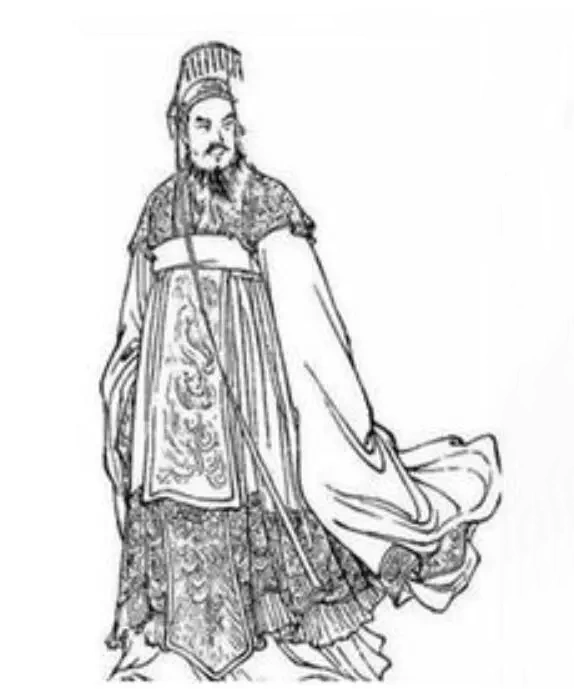
Late in 383 a rider came up the road from the Huai to Jiankang with word that the army of the Former Qin had broken at the Fei river. The court had been waiting for the worst. The emperor, Sima Yao, was twenty-two by the count of his court. He had not commanded in the battle, had not chosen the ground, and had not seen the enemy. The men who had done those things were his chancellor, Xie An, and Xie An's nephew Xie Xuan, who commanded the troops raised at Guangling six years earlier. The victory was the greatest the Eastern Jin ever won. It saved the dynasty for a generation.
He reigned from 372 to 396, twenty-four years, longer than any other emperor of the Eastern Jin. The first thirteen years belonged to Xie An, the last to his younger brother, Sima Daozi. Between them lay the Fei river, usually treated as the central event of the reign and the finest hour of the dynasty. This account treats it as a turning point of a different kind. The victory was the last thing the great families did together. Once the northern threat was broken, the coalition that had met it had no reason to continue, and the court returned to the business it understood: the division of office among the houses, the balance of the upper and lower river, and the cultivation of a civilisation that was admired by everyone and defended by no one.
1. The Child in the Weaving Workshop
Sima Yao was born in 362, in the household of the prince of Kuaiji. His father, Sima Yu, was forty-three by the count of his court, a prince of the imperial house who had spent most of his life in the cultivated leisure of the capital and had acquired a reputation as the finest conversationalist of his generation. His mother was not a princess. Li Lingrong was a servant in the weaving workshop of the princely establishment, a woman the Book of Jin describes in four characters that later writers never forgot: tall, and dark of skin. The other women of the workshop called her Kunlun, a name the age gave to the dark-skinned servants of southern or western origin. She had no family of consequence and no rank.
The story of how she came to the prince's bed is preserved in her biography. Sima Yu had had three sons, and all three had died; for nearly ten years no child was born to him. A diviner said that a woman in his household would bear two noble sons, one of whom would make the house of Jin great, and a physiognomist, brought to look at the servants, chose Li Lingrong. She bore Sima Yao, and two years later Sima Daozi, and a daughter. The story is a foundation myth, written down nearly three centuries after the event; what it preserves is the ordinary fact that a great house without sons looked down its household hierarchy until a servant gave it one.
He was named Yao, and given the courtesy name Changming, which means bright dawn. The annal says that the eastern sky was just lightening when he was born, and that the name was taken from the hour. The boy was named for the dawn.
In 365, at four by the count of his court, he was made prince of Kuaiji, the title his father had held. It was the second title of the imperial house and marked him as a possible heir, though not the obvious one. His father became emperor in 371, in the transaction that belongs to another account, and the boy's position changed without any act of his. In the seventh month of 372 he was made crown prince. His father died the same day. The officials brought him to the throne before the day was out, and the edict issued in his name spoke of an orphan, a heavy charge, and the ministers on whom the late emperor had relied. He was eleven by the count of his court, ten by the western count that begins at birth. The article uses the court count throughout.
One scene from those days belongs to him. At his father's death he did not go to the coffin until late in the afternoon, and when the attendants reminded him that the rites required him to wail at the proper hour, he said: "When grief comes, one wails. What fixed rule is there?" The sentence is preserved in the annal, and Xie An, who heard it, is said to have remarked that the boy's grasp of principle was not inferior to his father's. It can be read as precocity, or as the calm of a child who had been raised by attendants and had not known his father well. Either reading is consistent with what followed. He was a boy with a quick tongue and no experience of the world, placed at the centre of a court in which every adult had a design.
The country he inherited was not peaceful. In the same year a drought in the three Wu commanderies, the rich lake country south of the capital, starved many. In the eleventh month a magician named Lu Song walked into the palace courtyard at dawn with a band of followers and was arrested by the guards. A man with a following and no office had reached the door of the imperial palace in the first year of a child emperor. The court's control of the capital was thinner than its ceremonies suggested.
2. The Testament and the Curtain
The testament of 372 is the business of the reign before this one, and it is enough here to say that it existed. It gave Huan Wen the conduct of the government after the precedents of Zhuge Liang and Wang Dao, not the regency, and it left the court with a general who had spent the previous decade demonstrating that he could remove an emperor when he chose. Huan Wen had deposed the Duke of Haixi in 371 and installed Sima Yu in his place. When Sima Yu died after eight months, the general was in his camp at Gushu, upstream from the capital, and the boy on the throne was the son of the man he had made emperor.
In the second month of 373 Huan Wen came to Jiankang. The city expected a deposition or a massacre. The court sent Xie An and Wang Tanzhi to meet him at Xinting, the landing stage outside the walls, and the sources describe what happened there in a scene that later writers could not leave alone. Huan Wen had soldiers behind the screens of his reception hall. The officials who came to greet him were trembling. Wang Tanzhi, a man of high family and considerable courage, was sweating so heavily that he held his tablet upside down. Xie An sat down, looked at the screens, and said that he had heard that a feudal lord kept his guard at the four borders, not behind the curtains of his own hall. Huan Wen laughed, dismissed the soldiers, and talked with him for a long while.
The scene is preserved in the biographies of the two men and repeated in the Comprehensive Mirror seven centuries later. The political fact behind it is simpler. Huan Wen came to the capital, was received, did not attempt a coup, and went back to Gushu. He was ill. He died there in the seventh month, at sixty-two by the count of his court. The honours he had asked for were still in draft. The court buried him with the ceremony of a chancellor and gave his duchy to his five-year-old son, Huan Xuan, a name that will return at the end of the dynasty.
The settlement that followed was made in a few weeks and lasted, in its essentials, for a decade. Huan Huo, the late general's younger brother, was confirmed in the command of Jing province at Jiangling. Huan Chong, the youngest brother, was made general of the central army, commander of the military affairs of Yang, Yu and Jiang provinces, inspector of Yang province, and stationed at Gushu. The lower river, not the upper, was his first inheritance. At court, Xie An became vice president of the department of state affairs, Wang Biaozhi its president, and Wang Tanzhi the president of the secretariat. The two men who had faced Huan Wen at Xinting were now the government, with Wang Biaozhi beside them.
The most important decision of that year was not about a province. It was about the curtain. Xie An asked the empress dowager Chu Suanzi, the widow of Emperor Kang, to take charge of the court. She was the senior surviving empress of the dynasty, the woman who had signed the order deposing the Duke of Haixi, and the only person whose authority could stand above the Huan and the Xie alike. Wang Biaozhi objected. The emperor, he said, was just past eleven and approaching capping and marriage; a sister-in-law ruling for a boy who was not her son was not the ancient pattern; and a court that put a woman behind a screen would advertise the throne's weakness. Xie An overrode him. The empress dowager took the curtain, and the edicts of the next three years came from behind it.
The arrangement was a compromise, and it worked because each party needed it. The Huan had the upper river but Huan Chong was not his brother: he had less appetite for the throne and no wish to test the court's hold on his brother's officers. The Xie had the court's confidence but no army. The empress dowager had prestige and no faction. None could govern alone, and the emperor was the point on which the balance rested.
3. The Government of Quiet
Xie An was fifty-four in 373. He had spent twenty years refusing office, had become the most famous private man in the south, and had entered the government in 360 as Huan Wen's chief of staff because his family needed a senior office and the court would not give him an army. He was a superb conversationalist, a patron of music, and a man who understood that in a state of great families the first task of a chancellor is not to administer but to keep the families from one another's throats. His biography says that he steadied the age with harmony and governed with long calculation, that he did not probe small faults but held the great lines, and that contemporaries compared him to Wang Dao while saying that he was more refined. The comparison was exact. Wang Dao had built the dynasty by reconciling the northern émigrés with the southern gentry. Xie An held it together by reconciling the families that had grown strong enough to destroy it.
The method had a price. A government of reconciliation cannot punish its own members, and a government that does not punish cannot collect taxes from them. The registers of the great houses were full of clients who should have paid, and the estates of Kuaiji were worked by tenants who were not on the rolls. Xie An did not attack these arrangements. He kept the tolls low, kept the courts quiet, appointed men from both the Huan and the Xie, and let the provinces alone. The result was a decade without a civil war, a decade of low taxes at the centre and rising rents in the countryside, and a court that seemed, to itself, to be governing.
The provincial settlement was the visible part of the method. In 375 Huan Chong gave up the inspectorate of Yang province to Xie An and took the inspectorate of Xu at Jingkou. In 376 the court wanted the empress's father, Wang Yun, to have a frontier command, and Huan Chong gave up Xu as well, moving to Gushu. In 377 Huan Huo died, and Huan Chong went to Jiangling as inspector of Jing province and commander of seven provinces. The sequence looks like a design, and in part it was: Xie An was moving the Huan family upstream and putting the court's own men on the lower river. It was also a series of small concessions, each made by a man who did not want a quarrel.
In the first month of 376 the emperor was capped, the empress dowager returned the government, the era was changed to Taiyuan, and he held court himself. He was fifteen by the count of his court. The ceremony was the formal end of the regency and the beginning of the reign that gives the period its name. The edicts that followed made Xie An supervisor of the secretariat and of the department of state affairs, confirmed Huan Huo as grand general who conquers the west, and made Huan Chong general of chariots and cavalry. The emperor was now the source of authority. The men who had governed in his name continued to govern, with his seal on their documents.
The first public act that belongs to him rather than to a minister is a lecture. In 375, in the last year of Ningkang, he expounded the Classic of Filial Piety in the Taiji hall. Xie An sat beside him; a row of senior ministers held the text; the court attended. The scene is recorded as a cultural occasion, and it was one. It was also a statement about the throne. A boy of fourteen, raised in a regency, was being presented as the heir of the classical tradition, the prince who could expound the canon that made filial submission the foundation of political order. The lecture was arranged by his ministers, and its text was chosen for him. But the role was his.
The following year the north finished uniting. The Former Qin destroyed the Former Liang in the eighth month and the Dai state in the twelfth, and Fu Jian became the master of the whole plain from the Yellow River to the deserts. The court at Jiankang had watched the process for six years, since the fall of the Former Yan in 370, and had done nothing to prevent any of it. The Qin was now a single state with a single army and a single command, and the south was a coalition of families with two armies and no command.
The government of Xie An was good at what it attempted, and what it attempted was limited. It kept the peace among the families, kept the taxes low, and kept the emperor in the role of a ritual figure. It did not create a central administration, a national army, or a treasury that could reach the estates of the great houses. When the north ceased to be divided, the south discovered that its virtues were peacetime virtues. The test came in 383, and the government passed it with an army that had been raised six years earlier by the chancellor's nephew.
4. The Army at Guangling
In the eighth month of 377 Huan Huo died at Jiangling, and the upper river passed to his younger brother. Huan Chong was fifty by the count of his court. He had held Yang province, then Xu, then the camp at Gushu, and he had spent four years being moved, by a series of polite decisions, away from the capital and towards the frontier he was best suited to defend. He took the inspectorate of Jing, the command of seven provinces, and the seat at Jiangling. The Huan family had held the middle Yangzi since 345, and it would hold it, in one form or another, until the end of the dynasty.
The court now had a chancellor, a frontier command, and no army. This was not an oversight. The Eastern Jin had survived by giving the provinces to the families that could raise troops. The palace guard was ceremonial; the capital's garrison was small; the only mobile forces were the provincial armies of Jing and the local levies of the lower river. If the Qin attacked, the court would depend on Huan Chong, and if he failed, on his nephews. A government that had just spent a decade balancing the Huan could not be comfortable with that dependence.
Xie An's answer was to create a second army without taking the first one away. In 377 he had Xie Xuan made inspector of Yan province, commander of the northern frontier, and resident at Guangling, on the north bank of the Yangzi opposite Jingkou. Xie Xuan was thirty-five by the count of his court, the son of Xie An's elder brother, and a man who had grown up in the shadow of his family's reputation without yet having a command of his own. His instructions were to recruit.
The recruits came from the refugee settlements of Xu, Yan, Qing and Ji, the counties north of the Huai that had emptied into the south over the previous sixty years. These were families that had crossed the river after the fall of the north, had been given no land in the crowded commanderies of the lower Yangzi, and had settled in the border country around Jingkou, Guangling and Jinling. They were registered as refugees, which meant that they were not on the regular tax rolls and that their status was uncertain. Military service was one of the few paths to a livelihood and a legal place. The court gave Xie Xuan the right to enlist them, and the response was large enough to create a standing force.
The force was called the Northern Garrison army. The name came from the northern headquarters at Jingkou, the command at Jingkou known as the Beifu. The recruits were not from Jingkou alone, and the headquarters had changed hands many times, but the name stuck to the troops raised in its orbit. The histories do not give a strength for the first levy. What they show is a force of a new kind: its soldiers were refugees with no estates and no gentry status, and its officers were professionals, men whose families had served in the border commands for generations. Liu Laozhi, the most famous of them, came from a family of garrison officers in Pengcheng. He was not a great lord. He was a soldier.
This composition is the key to everything that followed. The Northern Garrison was a family's army in its command and a refugee army in its ranks. Xie Xuan raised it, officered it, and led it; the court paid for it and gave it its legitimacy. Its men owed their pay and their land to the commander who had enlisted them. In 383 that made it the sharpest instrument the south had. After 386, when the commander had been recalled and the pay was uncertain, it made it the most dangerous formation in the state: a body of professional soldiers who could be bought by the next man with a treasury.
The same year brought a fiscal reform that paid for the army. The household levy was replaced by a poll levy of three measures of grain on every person below the rank of prince, with those on active service exempt, and the registers of the three Wu commanderies were cleaned. The measure was an attempt to tax people rather than estates, and therefore to reach the tenants whom the great houses had kept off the rolls. The Book of Jin's economic chapter says that by the end of Taiyuan the countryside was peaceful and the granaries full. The claim is official and rosy, but it is evidence that the reforms were remembered as a success.
By the end of 377 the south had two armies and two commands. Huan Chong at Jiangling watched the Han river and the middle Yangzi. Xie Xuan at Guangling watched the Huai and the northern road to the capital. The court at Jiankang sat between them, with the revenues of the richest provinces and no troops of its own. The arrangement was the best the dynasty had ever had. It was also a balance of two men who were not the emperor, and it depended on their willingness to remain in their places. The Qin came anyway, six years later, with a force that was supposed to make geometry irrelevant.
5. Xiangyang and the Huai
The first blow fell in the fourth month of 378. Fu Jian sent his son Fu Pi with seventy thousand men against Xiangyang, the old city on the Han river that had been the northern gate of the middle Yangzi since the fall of the Western Jin. The defender was Zhu Xu, inspector of Liang province, a man in his fifties who had spent his career on the frontier and knew that the city could not be relieved quickly. The siege lasted into the following year. The figure of seventy thousand is the kind of round number the histories use for a campaign, and it is plausible for an army that had to invest a walled city and hold the roads behind it.
Xiangyang fell in the second month of 379. Zhu Xu was taken to Chang'an. Fu Jian, who had a taste for magnanimity, made him a minister of finance and kept him at court. The conquest gave the Qin the Han river road: an army could now move from Xiangyang down the Han to Jiangling, or east across the Huai, without fighting through the passes. Huan Chong's line was pushed back to the middle Yangzi, and the court at Jiankang began to think about the lower river.
In the fifth month of the same year the Qin attacked the Huai frontier. The generals Ju Nan and Peng Chao took Xuyi and pressed on Huaiyin, and the Jin relief under Xie Xuan moved north from Guangling. The sources are thin on the details. What they show is a war of raids and counter-raids, in which the Qin could take a county and the Jin could take it back, and neither side could hold the other's ground. In 379 Xie Xuan relieved San'a, a town south of the Huai and a hundred li north of Guangling, and broke the Qin army that was besieging it. It was the first time the Northern Garrison had beaten a large Qin force in the field, and it was enough to settle the frontier into an uneasy quiet: the Qin had learned that the lower river was defended, and the Jin that its new army could fight.
The quiet years were not empty. In 381 the monk Huiyuan, a disciple of Dao'an and one of the most learned men of the age, came to Mount Lu in the south, and the community he gathered there became the centre of southern Buddhism. In the same year, according to the annal, the emperor for the first time professed the Buddhist faith. He built a residence for monks inside the palace and brought them to live there. The two facts belong to different worlds, the mountain and the palace, and they are part of the same history. The war had driven men to the frontier and to the monastery; the court, unable to control the frontier, was beginning to invest in the institution that promised a kind of order the state could not provide.
By the summer of 383 the Qin had a unified north, a veteran army, and a choice. The south had two armies, a young emperor, a chancellor who had held the government for a decade, and a frontier that had been tested but not broken. The war that followed is usually told as a single battle. It was a campaign of three months, with a siege, a river crossing, a night march, a betrayal and a pursuit, and its outcome depended on decisions made by men who could not see the whole field.
6. The Fei River
The decision was made at Chang'an in the summer of 383. Fu Jian had unified the north in 376 and had spent the years since consolidating a state that was still a coalition of conquered peoples. His court was divided. His brother Fu Rong, his generals Quan Yi and Shi Yue, and most of the men who had fought in the north advised against a campaign in the south. The one voice that urged him on was Murong Chui, the Yan prince whose family had lost a state to Fu Jian and who had reasons of his own for wanting the Qin army to march. The old chancellor Wang Meng, who had died in 375, had left a warning: the Jin was the legitimate heir of the Chinese order, and the real enemies of the Qin were the subject peoples inside its borders. Fu Jian had heard the warning and had not accepted it.
His confidence is preserved in a sentence that the Book of Jin puts in his mouth. With a host like mine, he said, if I throw the whips of my soldiers into the river, the current will stop. The sentence is a literary set piece, written down two hundred and sixty-five years later, and it has the overreach of a tragedy. It also states the logic of the campaign: the Qin did not need to defeat the Jin army in a battle, because it could bury it under numbers. Fu Jian had built the strongest state in the north by conquest and patronage, and he had reason to think that the south, divided among its great families, would not fight to the end. What he underestimated was the difficulty of moving a coalition army across a river in the presence of an enemy.
The mobilization is given in the Qin record as six hundred thousand foot and horse and two hundred and seventy thousand cavalry, a total of eight hundred and seventy thousand, with the columns stretching a thousand li from Chang'an to the front. Modern readers suspect the arithmetic double-counts the cavalry, which the source lists inside the larger figure; the total is a roll of the households liable for service, not an army on a road. The forward army under Fu Rong is given as three hundred thousand and reached Yingkou, on the Huai. Fu Jian stayed at Xiangcheng with the main body, then rode forward to Shouyang with eight thousand cavalry. No source gives the number of men who actually formed on the bank of the Fei. The front was a fraction of the three hundred thousand, and the rest was strung out behind it, on roads that could not feed it.
The Jin army was eighty thousand. It is the number the sources report, and it is plausible: it was the largest force the south had put into the field since the 350s, and it was built around the Northern Garrison. Xie Shi, Xie An's younger brother, was commander-in-chief; Xie Xuan commanded the advance; Xie Yan, Xie An's son, and Huan Yi, the inspector of Yu province, commanded divisions. The emperor was twenty-two by the count of his court. He performed the sacrifices, issued the edicts, and waited in the palace. He did not go to the front. The conduct of the war belonged to the chancellor and the generals.
Huan Chong, at Jiangling, was certain that the capital would fall. He sent three thousand picked troops down the river to reinforce it. Xie An sent them back, with a message that the court had made its dispositions, that the capital had enough men, and that the western frontier should keep its soldiers. Huan Chong told his staff that Xie An had the breadth of a statesman and no understanding of strategy, that the enemy was at the door and the chancellor was still talking, and that the south was lost. The exchange is recorded by men who knew how the story ended. It also records a real fact: the two halves of the southern command did not trust each other.
The first phase went to the Qin. Fu Rong took Shouyang, and the Jin relief force under Hu Bin, five thousand men, was cut off at Xiashi and ran out of grain. Hu Bin sent a messenger to Xie Shi to ask for supplies; the messenger was captured, and Fu Rong learned that the Jin army was short of food. He sent word to Fu Jian that the enemy was small and could be taken quickly, but that he feared they would escape, and asked him to come forward. Fu Jian left Xiangcheng with eight thousand cavalry and reached Shouyang. The main body stayed behind. It was the decisive command decision of the campaign, and it was made by a man who thought the war was already won.
Zhu Xu was at Shouyang. The defender of Xiangyang had been a prisoner of the Qin for four years, and Fu Jian had made him a minister and kept him near the court. He was sent to the Jin camp to persuade Xie Shi to surrender. Instead he told him the truth. If the whole Qin army arrived, he said, it could not be resisted; the Jin should attack now, while the enemy was still concentrating; if the forward was broken, the rest would lose heart. Xie Shi hesitated. Xie Yan argued for the attack. The decision was taken. Zhu Xu returned to the Qin camp and waited. His motives are not recorded, and the sources present him as a loyal subject who had been waiting for his chance. What is certain is that he gave the Jin the information that made an attack possible.
The attack came at the Luojian, a stream east of Shouyang, where the Qin general Liang Cheng had camped with a force the histories put at twenty or fifty thousand, depending on the source. Liu Laozhi, the Northern Garrison officer, crossed with five thousand picked men and attacked at once. Liang Cheng and his brother were killed; the Qin lost fifteen thousand by the count in the histories; the rest fled to the Huai, and the Jin took the baggage and the stores. The victory was out of proportion to its size. It gave the Jin army its first proof that the Qin front could be broken, and it gave the Qin the first sign that the men on the other bank were not the frightened provincials they had expected.
The two armies now faced each other across the Fei, with the Qin lines before Shouyang and the Jin on the eastern bank. The Qin was still arriving; the Jin was concentrated. Xie Xuan sent a message to Fu Rong: you have come deep into our country and set your lines against the water; this is a plan for a long war, not for a quick decision. If you move back a little, let our army cross, and we will settle it. The Qin generals wanted to hold the bank, where their numbers would tell and the water would protect them. Fu Jian wanted to let the Jin cross halfway and then attack with cavalry. Fu Rong agreed. The order was given to withdraw.
The plan was sound in theory and impossible in that army. The withdrawal was a maneuver, and a maneuver requires officers who understand it, soldiers who trust them, and a rear that knows what is happening. The Qin had none of the three. The men in the forward lines did not know why they were moving; the men behind them saw a retreat; the contingents of the conquered peoples had no reason to stand and die for a state that had conquered them. Zhu Xu, in the rear, shouted that the Qin army had been beaten. The line broke before the Jin had crossed.
Xie Xuan, Xie Yan and Huan Yi led the crossing. Fu Rong rode into the collapsing lines to steady them; his horse fell, and he was killed. Fu Jian was hit by an arrow and fled alone to the north bank. The army dissolved. The men trampled one another, the dead filled the river, and the histories say that the water did not flow. The figure that seven or eight in ten of the Qin died is a historian's proportion, not a count; it conveys the scale of a rout, not the result of a census. The Jin pursued, took Shouyang, and recovered the Huai line. The war was over in a day.
The pursuit produced the two images that everyone remembers. The first is the grass and the trees on Mount Bagong. Fu Jian and Fu Rong, looking north from the wall of Shouyang before the battle, saw the Jin lines in good order and then saw the trees on the mountain as the shapes of men; Fu Jian said that these too were a strong enemy, and asked how anyone could call them few. The second is the wind and the cranes. The fugitives marched at night, heard the wind and the cries of cranes, and took them for the pursuing army; they slept in the open among the grass, and cold and hunger killed more than the swords. Both scenes are in the Book of Jin, the first in the record of Fu Jian and the second in the life of Xie Xuan. The book was compiled in 648, two hundred and sixty-five years after the battle. The scenes are literature, not field reports, and the fact that they became proverbs is a fact about memory, not about the battle.
The explanation is not a single cause. The Qin army was a coalition of recently conquered peoples, its forward was crowded with men who had no stake in the war, its command was divided, and its plan depended on a withdrawal its troops could not perform. The Jin was a small, cohesive force on its own ground, and it had the one thing a smaller army needs: information. Zhu Xu gave it the timing, Liu Laozhi gave it the first victory, and the rest was accident.
The north broke within a year. Murong Chui raised the Yan standard in 384; Yao Chang turned against his master in the same year; Fu Jian was killed in 385, and the Qin state divided into the Later Qin, the Later Yan and a crowd of successor states. The south had won the war and had not planned the peace. It had eighty thousand men on the Huai, a chancellor in the capital, and a frontier that would soon run to the Yellow River. It also had an emperor of twenty-two who had performed the sacrifices, and a court in which the men who had won the battle were about to become the problem.
7. The Settlement of the Victory
The news reached Jiankang while Xie An was playing chess with a guest. He read the letter, put it on the couch, and went on with the game. The guest asked what had happened. He said that the young men had beaten the enemy. Then he went inside, and on the threshold he was so pleased that he broke the heel of his wooden clog without noticing. The scene is in his biography, and it is a portrait of a man who had trained himself to keep his feelings off his face. It is also a portrait of a government. The chancellor could not celebrate a victory won by his own family without appearing to claim the state.
The rewards were carefully distributed. Xie An was made grand guardian, Xie Shi president of the secretariat, and Xie Xuan confirmed in the command of the north with seven provinces. The emperor issued the edicts in his own name. The victory was his in the ritual order, and not in the political one: he had not chosen the generals, and he could not control them.
The court's problem was visible within a year. The Xie family now had the prestige of the victory, the only mobile army in the state, and a chancellor who was also its head. The emperor was twenty-three. He had an ambitious younger brother, Sima Daozi, and a court full of men who had spent the war in the capital and now wanted a share of the peace. The balance of the previous decade had depended on the Huan and the Xie holding each other in place; the Huan were weaker, and the Xie were stronger than any family since the founding.
In the fourth month of 384 Xie An asked for the northern command and left the capital for Guangling, to a camp called Xincheng at Buqiu. The move is usually explained as a retreat from the court's intrigues: Wang Guobao, Xie An's son-in-law, had been working on Daozi against him. It was also a real command. The north was open, and someone had to direct the campaign. The chancellor who had won the war left the capital within a year of the victory, and the men who had not won it stayed.
Huan Chong died at Jiangling early in the same year, at fifty-seven by the count of his court. His last months had been bitter: he had sent three thousand men to defend the capital, had been told they were not needed, and had lived to see the victory won without him. The upper river passed to his nephews, Huan Shimin and Huan Shiqian, competent soldiers and not the equals of their uncles. The Huan kept Jing, but ceased to be the decisive power in the state.
Xie Xuan's campaign was the last great offensive of the dynasty. In the eighth month of 384 he crossed the Huai, took Pengcheng, and recovered Yan and Qing. In the tenth month the Qin inspector of Qing, Fu Lang, surrendered at Guanggu. In 385 Xie Xuan advanced into Hebei, took Liyang, and the local leaders of the three Wei submitted. The court gave him the command of seven provinces and he camped at Pengcheng, with his front on the Yellow River. For a few months the Eastern Jin held the line it had lost in 316. It was the largest recovery since the 350s, and it was made by the army raised at Guangling eight years earlier.
Then the settlement turned. Xie An died at Jiankang in the eighth month of 385, aged sixty-six by the count of his court. He had returned from Guangling ill, and the court gave him the posthumous name Wenjing. His death removed the one man who could hold the Xie and the Sima together. Within weeks Sima Daozi was made inspector of Yang province, supervisor of the department of state affairs, holder of the staff of authority, and commander of military affairs at home and abroad. The staff of Xie An's military office was transferred to Daozi's household. The machinery of the chancellorship did not pass to another chancellor; it passed to the emperor's brother.
In 386 the court decided that the long campaign had to end. The armies had been in the field for three years and the treasury was empty. Xie Xuan was ordered back to Huaiyin. In the same year the Dingling leader Zhai Liao revolted at Liyang, the Jin hold north of the Yellow River collapsed, and Xie Xuan asked to be relieved on grounds of illness. In 387 the court formally ended the northern campaign. In 388 Xie Xuan died, aged forty-six by the count of his court. The three men who had won the Fei, Xie An, Huan Chong and Xie Xuan, were all dead within five years of the battle.
The political meaning is not that the emperor betrayed his generals. It is that the coalition had no institutional form. The victory had been won by a chancellor's diplomacy, a nephew's army and a brother's frontier command, held together by the emperor's legitimacy and the fear of the north. When the fear went, the coalition had nothing to hold it. The emperor and Daozi used the imperial house to cut the Xie down to size, and the instrument they used, the office of the chancellor's brother, became the government. The Northern Garrison survived because it was an institution, not a family: its officers kept their commissions, its soldiers kept their land, and its next commander would be chosen by whoever controlled the court.
8. The Brother's Court
Sima Daozi was two years younger than the emperor and shared his mother. He had been prince of Langya since 372, minister of education since 380, and a member of the government since 383, when he was put in charge of the six sections of the department of state affairs. He was not a tyrant. The Book of Jin describes him as a man of easy manners, fond of company, generous with other people's money, and incapable of sustained attention. He drank with his brother, patronised monks, collected favourites, and left the details of government to his household. His weakness was not cruelty but the inability to say no to anyone who amused him.
The household around him became the government. Wang Guobao, the son of Wang Tanzhi and the son-in-law of Xie An, had been refused promotion by his father-in-law, who thought him unprincipled. He attached himself to Daozi and used the position to attack the Xie. Zhao Ya, an entertainer from Wuxing, built Daozi a mansion with artificial hills, ponds and grottoes at a cost the histories call enormous. Ru Qianqiu, a former thief-catcher from Qiantang, became Daozi's manager of appointments and sold offices to anyone who could pay. The three names are examples of a method: the court's business was done by men whose qualification was access to the emperor's brother.
The emperor's own life is recorded in a few brutal sentences. The annal says that he gave himself to wine and women, that he held long nights of drinking, and that he was seldom sober. The Book of Jin's life of Daozi says that the emperor did not attend to the ten thousand affairs, that he and Daozi made singing and drinking their business, that old nurses and nuns were especially close to them, and that appointments went by bribery while the courts of law fell into disorder. The Book of Wei gives the same picture from outside: Changming was sunk in wine, rarely received officials, and let a favourite concubine named Zhang rule the inner palace. The three accounts agree on the essential fact. The emperor drank.
One scene from the last years is preserved in the annal and is worth more than the moralising. A long-tailed comet appeared, and the emperor, who knew what such a sign was supposed to mean, went to the Hualin garden with a cup of wine, raised it to the sky, and said: "Long star, I advise you to drink a cup. Since antiquity, when has there been a son of heaven who lived ten thousand years?" The sentence is fatalism, humour and defiance at once, the voice of a man who had stopped believing that the heavens commented on his conduct.
The government's one attempt at correction came from below. The palace secretary Fan Ning memorialised on the disorder of the court, naming Wang Guobao and the favourites. The emperor was displeased with Daozi. Wang Guobao accused Fan Ning of factions, and Fan Ning was sent out as administrator of Yuzhang. A guard officer named Xu Rong then memorialised that clerks, guards, servants and freedmen were being made commandery administrators, and that nuns and nurses were pushing their relatives into office and taking bribes for appointments. The annal says that the emperor knew Xu Rong was upright and that he hated to hear it. The phrase is the whole history of the last decade. He knew, and he did not act.
The religious policy made the fiscal problem worse. In 381 the emperor had professed the Buddhist faith and built a residence for monks inside the palace. Daozi patronised them more lavishly. Monasteries and nunneries acquired land and labour, and their inhabitants were exempt from taxation and service. The court, unable to tax the estates of the great families, taxed the peasants who remained on the rolls, and the peasants who could not pay drifted into the households of the monasteries or the magnates. Xu Rong's complaint was not about religion. It was about a labour market in which the church and the great houses were competing with the state.
In 392 the emperor tried to build a counterweight. He made Wang Gong, his brother-in-law, inspector of Qing and Yan provinces and stationed him at Jingkou, with the lower river and the northern road in his hand. He made Yin Zhongkan inspector of Jing province at Jiangling, and Xi Hui inspector of Yong province at Xiangyang. He kept Wang Xun and Wang Ya at court. Daozi answered by making Wang Guobao president of the secretariat and commander of the palace guard. The two men now had their own men in the provinces and their own men in the palace, and neither could remove the other without a war.
The empress mother, Li Lingrong, held the balance. She had been honoured as empress dowager in 394 and lived in the Chongxun palace. Both sons depended on her favour, and she is said to have mediated between them. The sources do not record her words, only the effect: neither side moved while she lived. Modern historians have described the last years as a standoff between the palace and the chancellor's office, and the description fits. It was the most stable period of the reign, because two brothers who did not trust each other had agreed to wait.
The emperor was not a cipher. He appointed the provincial commanders, promoted his brother-in-law, tried to use the outer provinces against the court, and kept the empress mother in the middle. It was the method Xie An had used: balance the families, keep the centre empty, and let the ritual of the throne supply the legitimacy the government lacked. Xie An had made it work because he had no family army and no claim to the throne. The emperor's brother had both, and the balance tilted towards him with every year.
9. The Culture of Taiyuan
The same years that produced the sale of offices produced the national academy. In 384 the president of the secretariat, Xie Shi, memorialised that the schools had decayed and asked for the restoration of the national academy and the establishment of local schools. The emperor approved. In the second month of 385 the academy was founded, with a hall for Confucius beside it, and the court took sixty sons of ministers and sixty students of the grand academy. In 386 the descendant of Confucius was made marquis of the sagely offering, and a temple was built for the sacrifices. The academy was not a reform of the examination system, which did not yet exist. It was a statement that the dynasty possessed the classical tradition, and that the sons of the great families were its rightful heirs.
The reign's most original religious figure was not in the capital. Huiyuan came to Mount Lu in 381, at forty-eight by the count of his court, after a career as a Confucian scholar and a student of Dao'an. The community he gathered there became the centre of southern Buddhism: monks, laymen, translators, and a library. In 386 the inspector of Jiang province, Huan Yi, built the Donglin monastery for him. Huiyuan stayed on the mountain for the rest of his life and rarely came down. The monastery was a society of its own, with land, tenants, and a rule; it was also a place where the learning of the north was preserved after the north had broken.
The visual arts of the reign are remembered through two men. Gu Kaizhi, who had served on Huan Wen's staff and was then in his forties, painted portraits and figures and wrote about the difficulty of the eyes. The body, he said, has little to do with the essence; the spirit is transmitted through the eyes. A story in the New Account of Tales of the World, an anecdote collection of the fifth century and not a court record, says that when he painted Pei Kai he added three hairs to the cheek, and that the portrait became more alive than the man. The story is an anecdote about technique, and it is also a statement of the age's aesthetic: the surface is a medium, and the person is somewhere behind it.
Wang Xianzhi, the son of Wang Xizhi, was the finest calligrapher of the generation and died in 386, at forty-three by the count of his court. Xie An once asked him how his writing compared with his father's. He said that they were different. Xie An said that the opinion outside was not so. He answered: "How would the outsiders know?" The exchange is preserved in the New Account and in his biography, and it is the voice of a man who had stopped measuring himself by the approval of the court. The calligraphy of the period, like the painting and the poetry, was the work of the same families that governed the state, and it was produced in the intervals of office, on estates in Kuaiji, among friends who had known one another since childhood.
The culture of Taiyuan was not a compensation for political failure, and it was not a symptom of decay in the simple sense. It was the same social fact seen from another side. The families that could not agree on a state could agree on a style; the men who could not reform the tax system could write a letter that was copied for centuries. The emperor's patronage of the academy and the monastery bought prestige for the throne without giving it power. The things that outlasted the reign were the academy's texts, the monastery's library, the paintings and the calligraphy. The state that paid for them did not outlast them by much.
10. The Last Four Years
The standoff of 392 held because neither side could win. Wang Gong at Jingkou had the lower river and the northern road; Yin Zhongkan at Jiangling had the upper river; Xi Hui at Xiangyang had the Han. Daozi had the court, the department and the palace guard, and Wang Guobao had the secretariat. The emperor had the power to appoint and dismiss, and he used it to keep the pieces moving. By 395 he was thirty-four by the count of his court and in the twenty-fourth year of his reign, and had outlived every minister who had governed in his name except his brother.
The end came in the ninth month of 396, on the geng-shen day, which was the sixth of November. The emperor was drinking in the inner palace with Lady Zhang and a company of singers. She was nearly thirty. He said to her, as the annal records it, "By your age you ought to be dismissed." The Book of Wei and the Comprehensive Mirror add the second half of the sentence: "I have already given my favour to the younger women." She was angry and said nothing. The drinking went on. In the evening, when he was drunk, he died.
The Book of Jin's annal says only that: he was drunk, and in the evening he died suddenly. It adds that Daozi was muddled, that Yuanxian held the power, and that no one was ever brought to account for the death. The elaborated story belongs to other books. The Book of Wei, the northern history compiled in the 550s, says that Lady Zhang made the eunuchs drunk and sent them away, had her maids cover the emperor's face with a quilt and smother him, and then bribed the attendants to say that he had died of a nightmare. The Comprehensive Mirror, in 1084, repeats the story. The Song Book, compiled in the 480s under the Southern Qi, says that people at the time said the emperor had been killed by Lady Zhang.
The distinction matters. The quilt, the maids and the bribe are not in the Book of Jin's annal. They are in the northern history and in a compilation seven centuries later, and the earlier Song Book records only a suspicion. The received account is usually attributed to the Book of Jin and presented as a single, official record. It is neither in the annal nor single-source. What the annal gives is a sudden death after a drunken taunt, and a court that asked no questions. The rest is a story that filled the silence.
The silence is the political fact. Daozi and his son had the most to gain from the death and the most to lose from an inquiry. The crown prince, Sima Dezong, was fifteen by the count of his court, and the sources say that he could not speak and could not tell heat from cold. He was the emperor's eldest son and had been crown prince since 387; the succession was automatic. Daozi became regent, and Yuanxian, still in his teens, began to gather the offices his father neglected. Later writers have suspected Daozi of arranging the killing, because he benefited and because he did not investigate. There is no evidence. The suspicion is a reading of motive, not a record, and the article leaves it there.
The emperor was buried at the Longping tomb on the thirtieth of November. He was thirty-five by the count of his court. His posthumous name was Xiaowu, his temple name Liezong. He had reigned twenty-four years, longer than any other emperor of the Eastern Jin, and he left a state that was richer, more cultured, and more weakly governed than the one he had inherited. The north had been broken at the Fei and had broken itself afterwards. The south had an army that could win battles and a court that could not control it. The dynasty had twenty-four years left.
The Book of Jin's verdict is the place to begin the accounting. Its historians praise the men around the young emperor: Xie An could steady the manners of the age, Wang Biaozhi could correct the discipline of the court, Huan Chong served the royal house day and night, Xie Xuan was good at deciding military matters. Then the passage turns. Daozi disordered the government; Wang Guobao gathered petty men around him; offices and punishments were sold; the taxes rose year by year and the suffering of the people spread. The emperor knew that Xu Rong was upright and hated to hear him. He spent a morning drunk and a thousand cups through the long night. And then the sentence that closes the indictment: when Fu Jian met his calamity and threw away his host at the Fei, the emperor was given the name "martial". Was that not generous?
The encomium is shorter and colder: a singer at the imperial mat, wine advising the heavenly demon; the metal element did not flourish, human affairs withered first. The image is of a dynasty whose ritual and culture were intact and whose political substance had gone. The Tang scholar Yu Shinan, discussing the emperors with a nobleman, put the same judgment in a sentence: the emperor's defeat of the outer enemy was the work of Xie An, not of the sovereign. The judgment is harsh, and it is not unfair. The victory was won by a chancellor's diplomacy, a nephew's army and a frontier commander's nerve. The emperor's contribution was the legitimacy of the throne, which was real and which he could not translate into power.
The modern reading of the reign is less moral and more structural. In the Eastern Jin legitimacy came from the throne and armies came from the great families; the arrangement worked while each side needed the other. The Fei river was the last time they needed each other. The victory discredited the northern threat, strengthened the family that had won it, and left the emperor with a choice between a chancellor who was too strong and a brother who was too weak. He chose the brother, and the brother's household became the government. The army that had been created to defend the dynasty survived the choice, but it survived as a corps of professional officers whose loyalty could be bought by the next man with a treasury. The end of the dynasty was not caused by the Fei river. It was made possible by the peace that followed it.
Sima Yao was eleven when he came to the throne and thirty-five when he died. He was clever as a child, and the court remembered a sentence he had said at his father's coffin. He was a competent ritualist, a generous patron, and a drunk. He governed for twenty-four years through other men, and in the last decade he tried to govern through his brother and his brother's enemies. The attempt kept the peace and hollowed the throne. The academy he founded, the monastery he endowed, the painters and calligraphers he patronised, and the tomb he was buried in all survived him. The monarchy that had won the Fei did not survive him by much.
The annal preserves one last story. Before he was born, his father was said to have seen a prophecy that the mandate of Jin would end in Changming, and to have wept when he understood it. The boy was named for the dawn. The prophecy was wrong in its arithmetic: the dynasty lasted twenty-four years after his death, through two more emperors, and ended not in his name but in a surrender. It was right in its sense. The Jin did not end on the day he died. The government that could defend it did.