Home / Emperors / Jin Dynasty
Emperor Wu of Jin
晋武帝
Sima Yan, 236 – 290 · founding emperor of the Western Jin
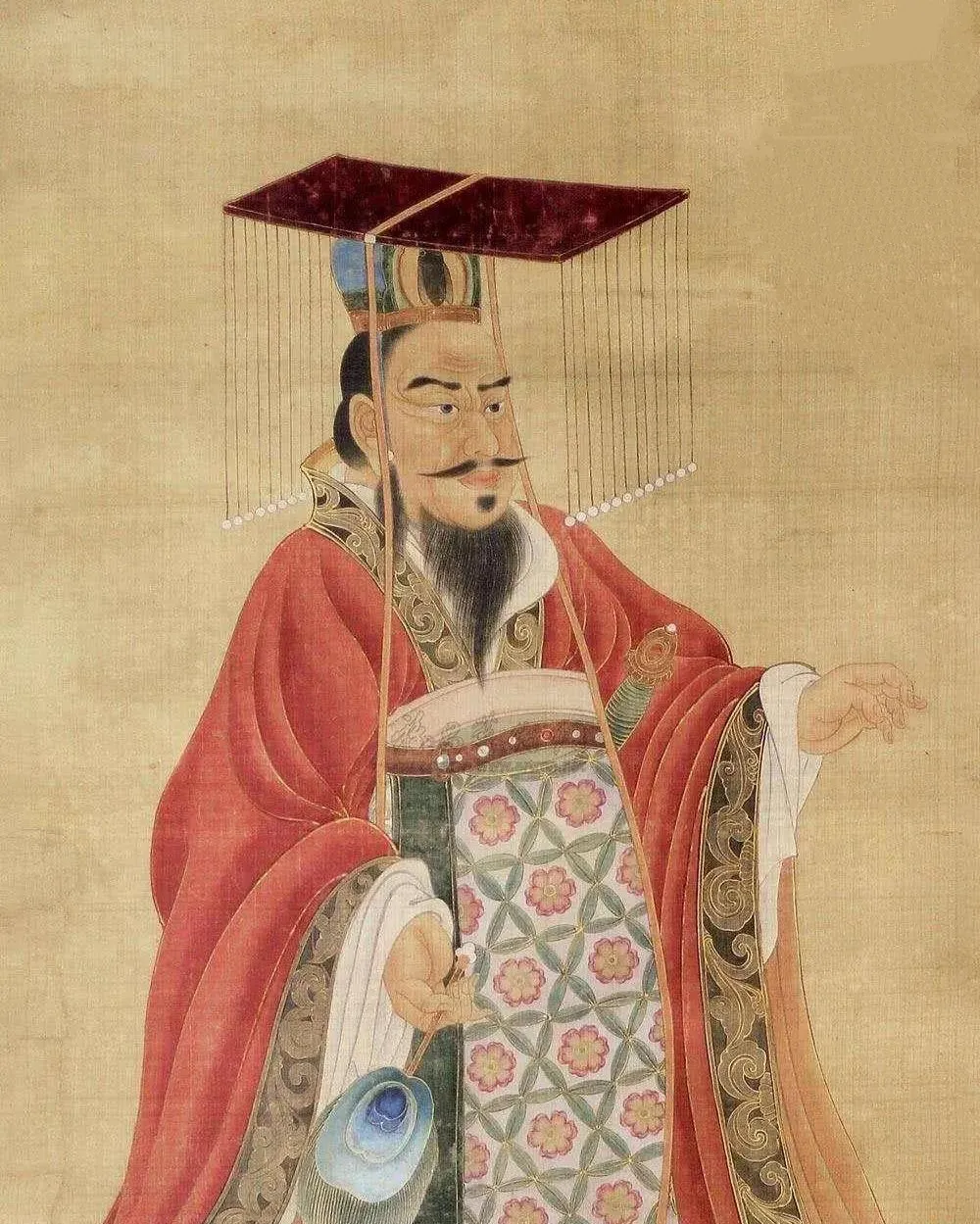
In the twelfth month of 265, Sima Yan received the abdication of the last emperor of Wei. He was twenty-nine years old. The document that transferred the throne had been drafted by men who had served his grandfather, the officers who kept order in Luoyang that winter had been appointed by his father, and the troops at the gates had been paid, for a decade, out of the revenues of a family that was not yet a dynasty. He had not won a battle, suppressed a revolt, or governed a province. What he brought to the throne was a name, an office, and the accumulated work of three generations who had spent forty years converting a ministerial household into a state.
He held the throne for twenty-five years, and in the fifteenth year after he took it his armies crossed the Yangzi and ended the division of China that had lasted since the fall of the Han. The registers of that year counted two and a half million households. The court that had been assembled to manage a coup became the government of a unified empire, and for a decade it governed well enough that later writers called the period the Great Peace and meant it. He died in 290, at fifty-five by the count of his court, leaving a grown son, a grandson, a wife's family in control of the palace, and a body of princes holding provincial commands. Within a year of his death the arrangement he had built began to consume the dynasty it was meant to protect.
The two facts are usually told as a contrast, the achievement and then the failure, as though the second were a punishment for the first. They belong together. The measures that made the conquest possible and the measures that made the collapse possible came out of the same understanding of how a state holds together, and the man who chose them was neither a fool nor a tyrant. He was an intelligent, patient, unusually even-tempered administrator who had watched a dynasty fall because its ruling house had no army, and who spent his reign making sure that his own house would never lack one. What he could not see was that the remedy and the disease were the same shape.
1. The Third Generation
He was born in 236, in Wen county in Henei, the eldest son of Sima Zhao and of Lady Wang Yuanji. The district had been the seat of his family's estates for generations, and the family's position in the north was old, comfortable, and entirely bureaucratic. His grandfather Sima Yi had been the chief commander of Wei and the winner of the coup of 249; his uncle Sima Shi had deposed one Wei emperor and died in 255 on the way back from a campaign; his father had taken the government in 255, destroyed a revolt in the Huai country in 258, and arranged the killing of the emperor Cao Mao in 260. By the time the boy was old enough to understand what his family did, the answer was simple. It governed.
The chain of dates that made him an emperor can be given in a single paragraph, because none of the scenes belong to him. In 249 his grandfather took the capital and executed his rivals. In 251 he died, and the command passed to his elder son. In 254 that son deposed the emperor and replaced him with a boy. In 255 he died, and the command passed to his younger brother. In 260 the younger brother's men killed an emperor who had tried to resist. In 263 a victory in the west raised the family's prestige to a height no minister had reached since Cao Cao. In 264 Sima Zhao took the title of king of Jin, and in 265 he died. The Sima did not seize the throne in one afternoon. They inherited the office that controlled it, four times, and then discovered that the office was the throne in everything but name.
His mother was the daughter of Wang Su, one of the most learned men of the Wei court, and she brought to the family the manners of the scholar's household rather than the camp. The histories describe her as frugal, exact in her mourning, and direct to the point of bluntness with her husband and her sons. She bore Sima Zhao several children, of whom two sons survived to adulthood: Sima Yan, and a younger brother, Sima You, born ten years later. Her death in 268, three years into her son's reign, is recorded with a deathbed sentence that matters more than any edict of the period. She told the emperor that his brother was impatient and that he, the elder, was not a kind brother, and that if she did not recover she was afraid the two of them would not be able to tolerate each other. She asked him to remember what she had said. He did remember it. He remembered it for fourteen years, and then he sent his brother out of the capital to die.
The household into which both boys were born had an unusual shape, and it explains much of what followed. Sima Shi had no surviving son. The family therefore gave him one: Sima You, the second son of Sima Zhao, was formally transferred to his uncle's line, so that the boy had two fathers in ritual and one mother in fact. He was, by law, the heir of the man who had founded the family's power; by blood, he was the emperor's younger brother. Sima Zhao was fond of him to a degree that the court noticed. He used to pat the seat beside him and call the boy by his childhood name, saying that this was the seat of Taofu, and the sources add that the succession was very nearly given to him several times. Whether that is true or a story told afterwards by the party that lost, it was believed at court, and belief is the material politics is made of.
Sima Yan was raised for the other role. He was given the standard education of a prince's heir, and then the standard offices of a man being prepared to govern: palace secretary, chief of the imperial carriages, general of the central rampart, attendant cavalier, and finally commander of the palace guards. The last was not a ceremonial post. In a capital where every change of government in the previous thirty years had begun with troops at a gate, control of the guard was the difference between an heir and a hostage. He held it in the years when his father was dying, and he held it when the abdication was arranged. He was also made general who Supports the Army and deputy to the chancellor, and in that office he handled the paperwork of the state while his father was ill. He was, in the phrase the historians use of him, a man of wide tolerance and deep calculation, and the calculation was the more visible of the two.
In the eighth month of 265 Sima Zhao died. His son succeeded him at once, and no one at court proposed another candidate. The government had been organised around a single office for twenty years, and that office passed to the heir as a matter of routine; the men who might have disputed it had been removed, bought, or were old. What was left was the last formality, and the formality required an emperor to give away what he no longer had. In the twelfth month the last Wei emperor did so. The ceremony, the altar, the patent, and the terms granted to the man who lost, are recorded on the Wei side and need not be described again. What belongs to this account is what the new court did with the fact.
2. The Mandate Taken
He proclaimed the era Taishi, the Great Beginning, and the years of that era are counted from 266. The name was a claim of the kind that every founder makes: that the count of years began again, that the sins of the previous house were cancelled, that the world had been given a new start. The court moved into the same palaces the Wei had used, kept the same officials at the same desks, and issued an amnesty in the same formula. The only thing that changed at the top was the surname on the documents, and the men who wrote them were careful to make the change look like the completion of a process rather than the interruption of one.
The first act of the new reign was to supply the dynasty with ancestors. Sima Yi was made emperor Xuan, with the temple name Gaozu; Sima Shi was made emperor Jing, with the temple name Shizong; Sima Zhao was made emperor Wen, with the temple name Taizu. The order repays a moment's attention. In the ritual language of the Chinese court, the temple name Taizu, the Grand Ancestor, belongs to the man who founded the house, and the founder of a dynasty is normally the first of its line. Here the first of the line, Sima Yi, was given the lesser name Gaozu, and the title of Grand Ancestor went to the son, the man who had taken the rank of king. The choice was not an oversight. A dynasty founded by abdication has two founders: the man who accumulated the power and the man who converted it into a title. The court chose the second, because it was the title, not the power, that the new house needed to inherit.
In the same weeks the emperor enfeoffed twenty-seven princes of the imperial house. The list in the chronicle runs from his great-uncle Sima Fu, made prince of Anping, through his father's brothers — Sima Gan prince of Pingyuan, Sima Liang prince of Fufeng, Sima Lun prince of Langye — down to his own younger brother, Sima You prince of Qi. Seventeen more were added in a single clause, and the clause is the point. This was not a reward for services. It was a reconstruction of the imperial clan as a political body, after two generations in which the Cao family had deliberately kept its princes far from office and from one another. The new court looked at the fall of Wei and drew the obvious lesson: a house with no relatives able to fight had no one to call on when the government was taken from it.
The princes were given more than titles. They were allowed to select the senior officials of their own fiefs, a concession that no previous dynasty had made so openly, and the chronicle notes that of all of them only Sima You, the prince of Qi, declined the privilege and asked permission for each appointment. The note is double-edged. It shows the emperor's generosity to his house, and it shows that one member of the house understood what the others did not: that a prince who appoints his own staff is a prince with a staff. Alongside the princes, the court filled the eight great offices at once: Sima Fu as grand preceptor, Zheng Chong as grand tutor, Wang Xiang as grand guardian, Shi Bao as grand marshal, He Zeng as grand commandant, Sima Wang as minister over the masses, Chen Qian as grand general, and Xun Yi as minister of works. Jia Chong and Wang Shen took the two cavalry commands. It was a coalition government wearing the costume of an ancient hierarchy, and for a few years it worked.
The tone of the first reign was set by a memorial rather than an edict. The emperor revived the office of remonstrance and appointed Fu Xuan and Huangfu Tao to it, and Fu Xuan used the appointment to deliver a diagnosis of the previous half-century. The Wei founders, he said, had loved method and law, and the empire had learned to value penal cleverness; the second Wei emperor had admired openness and ease, and the empire had learned to despise strict conduct. The result was a court without public opinion and a gentry without shame. What the new dynasty needed was not more laws but visible decency, men of distant ambition and correct manners, and the removal of the clever and the hollow from office. The emperor praised the memorial, had a draft edict prepared from it, and did not change very much. The gap between the diagnosis and the result is the first honest measure of the reign.
The frugality of those years was real and it was also staged. When the silk halter of the imperial ox broke, the emperor ordered it replaced with hemp. When a court physician presented him with a robe woven from pheasant feathers, he had it burned in front of the assembled officials and forbade the like again. The stories are small, and they were meant to be repeated. A court that had just taken power from a family accused of luxury needed to be seen to be economical, and the emperor, who had grown up in a household where display was a form of politics, understood the value of the gesture better than most of his ministers.
What the reign lacked was the one thing no ceremony could supply. A dynasty that takes the throne by abdication inherits the bureaucracy, the palaces, the ritual, and the precedent, and it inherits a question that no amount of ceremony answers: what has it done? The Wei had beaten the north and taken it from the Yuan; the Sima had taken the government from the Wei, and the taking was the whole of their record. The emperor knew this. It is the reason that the first decade of his reign is a search for a victory, and the reason that a commander on the middle Yangzi was allowed to spend nine years preparing one. What the dynasty lacked was the pair of things the sources call merit and virtue, the qualities that legitimise a house in the eyes of heaven and of the officials who write about heaven. He had the virtue, or the reputation for it. The merit was in the south.
3. The Men in the Hall
The government of the first decade was dominated by a man the emperor could neither trust nor dismiss. Jia Chong was the son of a Wei general, had served Sima Shi and Sima Zhao, and had been the officer who gave the order, or failed to prevent it, when the emperor Cao Mao was killed in 260. Everyone knew it. He was also the ablest fixer in the state, the man who knew where the files were and which of the great families could be moved by which argument, and the new dynasty could not be governed without him. The emperor made him general of the chariots and cavalry. Two of Jia Chong's daughters were married into the imperial house: one, Jia Bao, to his brother Sima You, the prince of Qi; the other, Jia Nanfeng, would later be given to his son. A man whose daughters were married to both possible heirs was a man who had insured against the future.
Against Jia Chong stood a group of officials who were, in the narrow sense, the better servants of the state. Ren Kai was a grand attendant and the director of appointments, a man of open manner and considerable courage; Yu Chun was a scholar of the classics and a senior official; Zhang Hua was the most capable administrator in the government; Shan Tao ran the personnel office for more than a decade. They were not a party in the modern sense. They were a set of men who had concluded that the court was being run by a household and wanted it run by an administration.
The quarrel became concrete in 271. A Xianbei revolt in Qin and Liang provinces had cut the road west, and Ren Kai and Yu Chun proposed that Jia Chong be sent to command the campaign. The proposal was dressed as an honour and understood as an exile. Jia Chong, who had spent his life in the capital and knew what a provincial command meant for a man with enemies, was alarmed. It was Xun Xu, the director of the secretariat, who found the answer. The crown prince's marriage was still unsettled, he said; if Jia Chong's daughter were betrothed to the prince, the father would have to remain in the capital for the ceremonies. The betrothal was arranged, the campaign was given to someone else, and Jia Chong stayed. The episode is worth keeping because it shows how the great decisions of the reign were actually made: not in a debate about policy, but in a manoeuvre about who would be in the room when the policy was decided.
Xun Xu and Feng Dan were the two men who made that manoeuvre possible, and they are the reign's true court politicians. Xun Xu had spent his career in the palace offices and knew every precedent, every genealogy, and every draft that had ever been suppressed; he was learned, industrious, and entirely without scruple in the service of his own position. Feng Dan was a grand attendant, a man of the inner room rather than the office, whose talent was for saying the thing the emperor already half believed. They were not ideologues. They were survivors of a court in which the wrong sentence could end a family, and they had learned to make themselves useful to whoever held the pen. The emperor used them, as he used everyone, and does not appear to have disliked them.
The third force in the government was the empress's family. Yang Yan had been his wife since before the accession, and she was the mother of his heir. She was also a woman of strong will and a clear sense of what her clan was owed, and her kinsmen held offices at court. Yang Jun became a general of the chariots and cavalry; his brothers Yang Yao and Yang Ji took the palace posts that gave access to the throne. The three Yang were not yet a government in the 270s. They were a household inside the household, waiting for the empress to die and for the emperor to grow tired, and both of those things happened on schedule.
The emperor's method with these men was consistent. He listened to all of them, promoted the able, protected the useful, and rarely destroyed anyone. In twenty-five years he executed very few senior officials, and the senior officials he did execute had committed offences that could not be overlooked. The restraint was genuine and it was also a technique. A ruler who does not kill his ministers can be told the truth by them, and a ruler who can be told the truth learns more than one who cannot. The cost of the technique was that the court never acquired a single centre of authority below the throne. The factions balanced because the emperor held the balance, and a balance held by one man is not an institution.
In 269 he sent Yang Hu to Jing province. The appointment looked routine: a senior official of one of the great families, a man of the same generation as the emperor, given the military command of the middle Yangzi. It was in fact the beginning of the war. Yang Hu had argued for years that the south could be taken, and the emperor had neither accepted nor rejected the argument. Sending him to Xiangyang was a way of keeping the question alive without deciding it. The new commander spent the first year reducing his garrison posts and opening military farms, and within a few years the farms were producing more than the army could eat. By the end of his tenure the frontier that had been a drain on the treasury had become a base.
4. The Heir
In the first month of 267 the emperor made his son Sima Zhong crown prince. The boy was nine years old. He was the eldest surviving son of the empress, his elder brother having died in infancy, and in the ordinary course of things his appointment would have been a formality. It was not. The child was slow. The court knew it before the court said it, and the men who had spent their lives watching the emperor's face began, very cautiously, to mention the problem.
The most famous of those mentions belongs to Wei Guan, the crown prince's tutor, who had been one of the great officers of the conquest of Shu. At a banquet on the Lingyun terrace he pretended to be drunk, knelt before the emperor, and said that he had something to report. He said it three times and stopped each time. When the emperor pressed him, he leaned forward and touched the imperial seat and said: this seat is a pity. The emperor understood him. He did not answer, and he did not change the succession. The scene is preserved in the biography of Wei Guan, which was written by men who thought the emperor should have listened, and it should be read with that in mind. But the hesitation it describes is confirmed from too many directions to be invention. He Qiao, a senior court official, told the emperor to his face that the crown prince had the honesty of high antiquity and would not be able to manage the affairs of a degenerate age. The emperor listened to that too, and did nothing.
Five years later the emperor married the boy to Jia Nanfeng. He had wanted a daughter of Wei Guan. The empress wanted a daughter of Jia Chong, and she had the support of Xun Yi and Xun Xu, who both praised Jia Chong's daughter as a model of virtue. The emperor objected in a sentence that the history preserves and that has been quoted ever since: the Wei family's daughters had five qualities, and the Jia family's had five defects; the Wei were fruitful, handsome, and tall, the Jia were jealous, short, and dark. The empress insisted. The betrothal was made. The first choice had been Jia Chong's younger daughter, Jia Wu, who was twelve and too small to be married; the elder, Jia Nanfeng, was fifteen, two years older than the prince, and the match was made with her instead.
The marriage was the payoff of the manoeuvre of 271. Jia Chong had been about to be sent to the western frontier; the betrothal kept him in Luoyang; and the price of keeping him was a crown princess from his house. The emperor knew what he was buying. He bought a minister who could run the government, and he paid with a daughter-in-law who would run the palace. In the event, the daughter-in-law outlasted the minister by eighteen years and the emperor by ten, and the palace she ran was the one from which the dynasty was governed after 290.
The doubt did not go away, and in the end he tested the boy. He summoned every official of the Eastern Palace to a banquet, sealed a set of unresolved documents, and sent them to the crown prince with instructions to decide them and send back the answers. The test was fair in form and cruel in substance, because the prince could not read well enough to understand what he was deciding. The crown princess, Jia Nanfeng, understood the danger at once. She found a secretary to draft the answers, and the draft came back full of classical quotations and precedents. A palace attendant named Zhang Hong pointed out the flaw: the prince did not study, and an answer quoting the classics would reveal that someone else had written it. Better, he said, to answer plainly, in the prince's own manner. Jia Nanfeng told him to write it, and promised him wealth if it worked. Zhang Hong wrote a plain, sensible set of decisions, the prince copied them in his own hand, and the emperor read them and was pleased. He showed the answers to Wei Guan before the assembled court. Wei Guan, who had already spoken against the prince, had nothing to say, and the hall cried out its congratulations.
The episode is usually told as a story of a father's self-deception. It is more precise to call it a story about the cost of a test. The emperor had asked a question whose answer he could not afford, and the court, which had also asked the question, was relieved to accept the answer it was given. Everyone in the room knew that the paper had been written by someone else. No one said so. The succession was settled not by an argument but by a document, and the document was a forgery that everyone agreed to treat as true.
It is worth saying what the sources do not quite say. In 272 Jia Nanfeng was fifteen. The portrait of her that has come down to us, jealous, cunning, cruel, was written after her fall, by historians who had no reason to be fair to her. Some of it is certainly true; the record of her later career is too detailed to be invented. But a fifteen-year-old girl who was married to a thirteen-year-old boy because her father needed a reason to stay in the capital is not yet the villain of the story. She was a piece on a board, and the hand that moved her was her father's.
The emperor's choice of his son over his brother was made in these years and never seriously reopened. It rested on three things: the empress's determination, the absence of any other son by her, and the fear that to pass over the son would be to admit that the whole settlement of 265 had been a mistake. The alternative was a man thirteen years older, trained in the administration, popular with the court, and legitimately the heir of the uncle who had made the family's fortune. To choose the brother would have been to choose ability over lineage, and to choose it would have made every future succession a competition. The emperor chose lineage, as founders usually do, and spent the rest of his life managing the consequences.
5. The Frontier at Xiangyang
The man who made the conquest possible spent nine years preparing it and did not live to see it. Yang Hu came from a family of the Tai Mountains that had produced officials for nine generations, and he had been one of the most admired men of the Wei court before he was one of the most useful men of the Jin. He was a scholar by training, a conversationalist of the kind the third century prized, and an administrator of unusual patience. In 269 the emperor gave him the military command of Jing province and sent him to Xiangyang, the city on the Han river that faced the Wu frontier in the middle Yangzi country. He was in his late forties. He would not return to the capital except to die.
What he did at Xiangyang was the opposite of what a frontier commander usually does. He reduced the number of watch posts, on the argument that a line held by too many small garrisons is a line that bleeds men and grain without holding anything. He opened military farms and put the soldiers to work on them. He made the border quiet enough that the villages on both sides stopped moving, and the men who came over to him were allowed to go back if they wished. The Wu commander opposite him, Lu Kang, was the ablest soldier of his generation, and he understood what the policy was doing. He warned his own court that the frontier was being lost without a battle. His court did not listen. The frontier, which had been a military problem for twenty years, became a demonstration.
The results were concrete. When Yang Hu arrived, the army at Xiangyang had less than a hundred days of grain. By the end of his tenure it had stores for ten years, and the farms were producing more than the garrison could eat. He did not boast of this, and the court did not notice it, because the court measured a frontier by the number of battles fought on it. The emperor noticed. Yang Hu's command was not a record of unbroken success: in 272 a Wu commander at Xiling defected to Jin, the relief expedition sent to support him was defeated, and Yang Hu was demoted for the failure. He stayed at Xiangyang and went on with the farms. The emperor had a use for a commander who did not need to be supplied, and he began to listen to the arguments that Yang Hu had been making since the beginning.
The first of those arguments was about the fleet. In 272 Yang Hu secretly recommended that Wang Jun, a former subordinate of his who had been languishing in a provincial post, be made inspector of Yi province, the old Shu country on the upper Yangzi. The recommendation was the beginning of the war. Wang Jun arrived in Chengdu, put the population to work on ships, and within a few years had built a fleet that the river had never seen. The largest of the vessels were a hundred and twenty paces on a side and carried two thousand men; they had wooden walls, towers, four gates, and decks broad enough for horses to gallop across. The timber and shavings from the yards drifted down the Yangzi for months, and the Wu officers at the frontier saw them and reported that the north was building a navy. The reports reached the Wu court and were filed.
The second argument was about timing, and it was aimed at the emperor personally. In 278 Yang Hu came to Luoyang, already ill, and put his case to Zhang Hua. What he said is preserved in his biography and it is the most revealing sentence of the reign. The present sovereign, he told Zhang Hua, has the beauty of a peaceful transfer but no merit. The Wu government is cruel beyond measure, and can be conquered without a battle. Unite the realm and promote learning, and the ruler will stand with Yao and Shun and the ministers with Ji and Xie. Let the opportunity pass, and if Sun Hao dies and the Wu put a capable man on the throne, then even a million soldiers will not cross the river. The argument was not primarily military. It was about the one thing the dynasty lacked, and the man making it had spent nine years making it possible.
The court resisted. Jia Chong, Xun Xu, and Feng Dan all argued that the northwest was unsettled, that the armies were tired, and that the river was a sufficient defence for any state that chose to hold it. Their objections were not foolish. The Xianbei revolt in Qin and Liang had been running for years, the treasury was not unlimited, and every previous northern attempt on the south since Cao Cao had failed. What they were defending was a policy of consolidation, and what Yang Hu was proposing was a gamble. The emperor listened to both and did not decide.
In the eighth month of 278 Yang Hu fell seriously ill and came to the capital. He died in the eleventh month, at fifty-eight, the age his biography gives. The emperor went into mourning in plain clothes and wept; it was the coldest part of the winter, and the histories say the tears froze on his beard. In Jing province the markets closed and the lanes filled with the sound of weeping, and the Wu officers on the far bank wept too, which is the strangest tribute in the record. Before he died he recommended Du Yu to succeed him. The emperor made Du Yu commander of the southern expedition and gave him the province. The people of Xiangyang later set up a stone tablet on the mountain where Yang Hu used to walk, and the men who read it wept, and Du Yu called it the tablet of falling tears.
The legacy was more than a monument. Yang Hu left behind a fleet on the upper river, a frontier that could supply itself, a plan of attack that used the river as a road, and a commander in Du Yu who understood the plan. He had also left the court with an argument it could not answer. The dynasty had taken the throne by a document; the only way to make the document mean something was to do what no one in the north had done for seventy years. The emperor waited a year, and then he moved.
6. The Six Roads
The decision was made in the eleventh month of 279, and the scene that the histories use to mark it is a game of Go. Du Yu's memorial for the campaign arrived while the emperor was playing at the board with Zhang Hua. Zhang Hua pushed the board aside and said that the emperor's military virtue and the country's wealth were sufficient, that the Wu ruler was cruel and his people exhausted, and that the expedition should be made. The emperor agreed. The gesture is a small one, and it has been remembered because it compresses the politics of the reign into a single motion: the emperor listening, the administrator deciding, the game abandoned.
The opposition did not disappear. Jia Chong, Xun Xu, and Feng Dan argued against the campaign to the end, and their argument had the merit of consistency: they had opposed it for ten years. What the emperor did with the opposition is the most revealing appointment of his reign. He made Jia Chong commander-in-chief of the expedition, with the yellow battle-axe and the authority to direct every column, and sent him to Xiangyang to take command. Jia Chong declined on the ground of age and illness. The emperor answered that if Jia Chong would not go, he would go himself. Jia Chong went.
The army that marched in the eleventh month was more than two hundred thousand men by the court's own count, and it moved on six roads. In the east, the prince of Langye, Sima Zhou, led a column through Tu Zhong toward the lower Yangzi. North of the river, Wang Hun advanced from the Huai country toward the crossing at Hengjiang. In the centre, Wang Rong moved on Wuchang, and Hu Fen on the mouth of the Han at Xiakou. In the west, Du Yu came out of Xiangyang against Jiangling. And from the far west, from the old Shu country, Wang Jun and Tang Bin brought the fleet down the river.
The plan was Yang Hu's, and its logic was simple. The Wu state was a river state; its army was distributed along the length of the river, and its capital depended on the upper reaches. If the northern columns pinned the Wu field army at the crossings, the fleet could pass the gorges and come down on the capital from above. The fleet was the decisive arm, and the fleet had been built in secret over seven years. Every other column was, in a sense, a diversion for the one that carried the ships.
The fighting lasted less than three months. In the first weeks of 280 Wang Jun's fleet broke the boom that the Wu had stretched across the river and came through the gorges. Du Yu took Jiangling. Wang Rong forced Wuchang. Wang Hun crossed at Hengjiang and defeated the Wu army in front of him. The reports reached Luoyang in a sequence that the court could hardly keep up with, and the emperor, who had spent fifteen years waiting for them, read them in the hall where he had read everything else.
In the third month Wang Jun's fleet reached the Stone City on the river west of Jianye. The Wu emperor sent his surrender. The details of that surrender, and the treatment he received afterwards, belong to his own story. What belongs here is the dispatch that reached Luoyang: a state of four provinces had ceased to exist, and the registers of the north and the south were now the registers of one empire.
The emperor changed the era to Taikang in the fourth month. He also did something that no edict required. He ordered that the victory be announced at the shrine of Yang Hu, and he gave Yang Hu's widow a fief of five thousand households. The gesture was personal, and it was also political. The man who had made the war possible had been dead for sixteen months, and the court that had resisted him for a decade was now invited to worship him. The emperor did not say that he had been right and the court wrong. He did not need to. The shrine said it.
What the conquest changed was not the map, which had been waiting to be unified since 208, but the standing of the dynasty. In 265 the Sima had taken the throne by a document. In 280 they had taken the south by an army, and the army had been sent by an emperor who had never commanded one. The legitimacy that the court had been unable to manufacture for fifteen years arrived in a single spring. The historians of the Tang, who had no love for the family, still record that the reign changed character at this point, and they are right, though not in the way they meant. The emperor had solved the problem of his house. He had not solved the problem of his succession, and the second problem was the one that mattered.
7. The Settlement of the South
The first thing the victory produced was a quarrel. Wang Hun, who had commanded the column north of the river, had expected to receive the surrender in person. Wang Jun, whose fleet had arrived first, had accepted it and sent the captive north to the capital. Wang Hun's response was a memorial accusing Wang Jun of disobeying orders and of failing to wait for the commander who had been appointed over him. The charge was serious: disobedience in the field was a capital matter, and the officials who examined it recommended that Wang Jun be handed to the imperial prison.
The emperor refused. He refused again when a second memorial accused Wang Jun of burning a hundred and thirty-five Wu ships after the amnesty. He referred the dispute over credit to Liu Song, the acting commandant of justice, who ruled that Wang Hun had the superior merit and Wang Jun the lesser. The emperor disagreed with the ruling and demoted Liu Song to a provincial governorship. Then he gave the rewards: Jia Chong an increase of eight thousand households, Wang Hun a dukedom, Wang Jun the title of marquis of Xiangyang with ten thousand households, Du Yu the marquisate of Dangyang, Wang Rong that of Anfeng, and Zhang Hua the marquisate of Guangwu with ten thousand households. Xun Xu, who had opposed the war, was given a marquisate for one of his sons on the ground of his service in drafting the orders. The distribution was not a judgment of merit. It was a settlement of every interest at court, and it was made by a man who knew exactly what each of them had done.
Wang Jun was not satisfied, and the record lets him say so. At every audience he recited his services and his grievances, and sometimes he became so angry that he left the hall without taking leave. The emperor tolerated it. When the court scholars began to petition on Wang Jun's behalf, he promoted him to general-in-chief who Guards the Army. The old general had been one of the two men who ended the war, and the emperor let him be a nuisance for the rest of his life rather than silence him. It was the same technique he had used with the censors and the remonstrance officials: a court in which men could complain was a court in which the emperor heard things.
The settlement of the south itself was generous in form and careful in substance. The harsher Wu taxes were remitted, and the Wu officials were told that they would be employed according to their abilities. The emperor also did a thing that the histories record with some surprise: he went looking for the men who had fought against him. One of them was Zhuge Jing, the son of the general Zhuge Dan, who had revolted against the Sima and been destroyed with his family in 258. Zhuge Jing had escaped to Wu and had served it for more than twenty years. After the surrender he hid in the household of his sister, who was the wife of the prince of Langye, the emperor's own uncle. The emperor went to the house, and Zhuge Jing ran into the privy. The emperor had him brought out and said that he had not expected to see him again in this life. Zhuge Jing answered that he had not been able to disfigure his face and hide his name, and that he was ashamed to look at the imperial countenance. The emperor offered him a post among the attendants. He refused it, went home, and never again sat facing the capital.
The story is small and it is the best thing in the record of the settlement. It shows what clemency could do and what it could not. The emperor could pardon a man whose father he had destroyed; he could give him an office; he could not make him forget. The same limit applied to the south as a whole. The Wu aristocracy kept its estates and its clients, its manners and its resentments, and the Jin state, which had just abolished the provincial armies, had no machinery for absorbing it. The south was conquered. It was not governed.
Du Yu went back to Xiangyang and did the work that conquest usually leaves undone. He reopened the irrigation channels, led the waters of the Zhi and Yu rivers onto ten thousand qing of fields, and cut a canal at Yangkou that opened the grain route to Lingling and Guiyang. He trained the garrison every autumn, on the argument that a state which has just won a war is the state most likely to forget one. He was a man who could not sit a horse and whose arrow could not pierce a coat of mail, and he was the best strategist in the empire. He also sent regular gifts to the great men at Luoyang, and when a friend asked why, he said that he was not trying to gain anything, only to avoid harm. The sentence is a fair description of how politics worked in the last decade of the reign.
In the tenth month of 280 the emperor abolished the provincial armies. The decree was presented as the completion of the peace: the empire was one, the wars were over, and the provinces no longer needed standing troops. Each commandery was to keep a hundred armed officials if it was large and fifty if it was small. The governor of Jiao province, Tao Huang, wrote to say that the far south could not be held under such a rule, and the vice-director of the department of state, Shan Tao, argued that the provincial garrisons were the only force that could check a local rebellion. The emperor listened, praised the argument, and issued the decree. By the time the consequences arrived, the men who had warned him were dead. The decision belongs to the next section, because it was not really a decision about the south. It was a decision about who in the empire would be allowed to keep an army.
8. The Years of Taikang
The economic settlement of 280 is contained in a schedule, and the schedule is worth setting out because it is the most concrete thing the reign produced. A man was entitled to hold seventy mu of land and a woman thirty. Within that holding, an adult man was assessed for tax on fifty mu and an adult woman on twenty; a younger man paid half, and a woman who was not of age paid nothing. A household headed by an adult man delivered three bolts of silk and three catties of raw silk a year; a household headed by a woman or a younger man delivered half. The rates were fixed, which was the more important part. A peasant who knew what he owed could plan.
The same legislation fixed what the great families might hold. An official of the first rank was allowed fifty qing of land, and each rank below him five qing less, down to ten qing for the ninth. He was also allowed to shelter relatives from taxation and labour service, in numbers that ran from nine degrees of kinship at the top to three generations at the bottom, and to keep a fixed number of clients and tenants who owed their labour to him and not to the state. The provisions are usually described as a concession to the aristocracy, and they were. They were also an attempt to draw a line. The great families had been accumulating clients and land for a century; the state could not abolish the practice, so it defined it, wrote the definition into law, and hoped that a written limit would be better than no limit at all.
Historians have argued for a century about what the schedule meant in practice. One reading is that it was a genuine land settlement, intended to put peasants on vacant land and to break up the great estates. Another is that it ratified an occupation that had already happened, and that the "entitlement" of seventy mu was a ceiling for the smallholder and a licence for the magnate. The text itself does not say, and the surviving evidence is too thin to settle it. What can be said is that the state now had a register, a rate, and a rule, and that a government with those three things can at least measure what it is losing.
The registers are the reign's most quoted statistic. The geography chapter of the Jin history gives, for the year 280, 2,459,840 households and 16,163,863 persons. Two years later a geographical record of 282, quoted by a later commentator, gives 3,770,000 households. The second figure cannot be a natural increase; no population grows by half in two years. The likeliest explanation is that the land settlement compelled a great many unregistered people to come forward in order to claim the land that the new schedule allowed them. The two numbers measure not the population of China but the reach of its government, and the reach was extending.
The description that the economic chapter gives of the period is famous and it is worth quoting with care. In the years of Taikang, it says, the empire had one script and one width for cart axles, cattle and horses filled the pastures, surplus grain lay in the fields, travellers slept in unguarded cottages, and the people met one another like kin; those who had nothing took what they needed from the road. The passage is the voice of the official class remembering a good time, and it was compiled by men who knew how the good time ended. It should not be read as a census. It should be read as evidence that a generation of officials believed they had seen a working state.
The other side of the same years is a record of consumption. He Zeng, one of the eight dukes and a man of enormous seniority, spent ten thousand cash a day on food and complained that there was nothing on the table he could put his chopsticks into. Wang Kai, the emperor's maternal uncle, competed with Shi Chong, the son of a founding general who had made his own fortune as inspector of Jing province, in a contest that the whole capital watched. Wang Kai washed his cooking pots with sugar water; Shi Chong used candles for firewood. Wang Kai stretched a screen of purple silk for forty li; Shi Chong answered with one of brocade for fifty. The emperor, who was told about the contest, gave his uncle a coral tree from the palace treasury. Shi Chong smashed it with an iron wand and produced six or seven of his own that were taller. The coral is from the anecdote collection and not from the official record, and it should be labelled as such, but the contest itself is in the official biography, and the emperor's participation in it is the part that matters. He was one of its patrons.
The most honest exchange of the reign is the one with Liu Yi, the inspector of the capital. The emperor asked him one day what sort of Han emperor he resembled. Liu Yi said: the emperors Huan and Ling. The emperor was taken aback. He said that he might not equal the ancients, but he had governed with restraint and had united the empire, and that the comparison was excessive. Liu Yi answered that Huan and Ling had sold offices and put the money in the public treasury, while the present emperor sold offices and put the money in his own household; by that measure, he said, the present reign was worse. The emperor laughed and said that in the time of Huan and Ling no one would have dared to say such a thing, and that the fact that he had a frank minister was itself a difference. The laughter is recorded, and it is the sound of a man who knows exactly what he is. He did not stop selling offices. He did not punish the man who said so.
What the reign produced, then, was a genuine recovery and a genuine rot, and the two were not in different parts of the country. The recovery was in the registers, the granaries, the canals, and the farms; the rot was in the court, the offices, and the habits of the class that ran them. A later historian, writing a generation after the fall of the north, described the result in a sentence that has been quoted ever since: those in office took emptiness for loftiness and laughed at diligence. He was describing the heirs of the Taikang settlement, not the men who made it. But the settlement had made them possible. A state that fixes its taxes and then stops asking questions will be governed, in the end, by men who find questions unnecessary.
9. The Princes and the Garrisons
The settlement of the imperial clan was made in the first week of the reign, and its details are more interesting than its intention. The twenty-seven princes were graded by the size of their fiefs. A great principality of twenty thousand households kept three armies and five thousand men; a principality of ten thousand kept two armies and three thousand; a small one of five thousand kept one army and fifteen hundred. The quotas were substantial, and they were written on paper, because the princes were not sent to their fiefs. They stayed in Luoyang, in palaces near the imperial palace, and the armies that the statute gave them existed only in the statute.
That changed in 277. In the third year of the Xianning era the emperor ordered the princes to go to their fiefs, and the order produced the most important administrative argument of the reign. Xun Xu objected. Most of the princes, he pointed out, now held military commands in the provinces; if they were sent to their fiefs, the court would lose the officers who actually controlled the provincial armies, and the fiefs themselves would have to be carved out of existing commanderies, which would move households and breed resentment. The emperor accepted the argument. He did not withdraw the order, but he adjusted the fiefs so that the territory of a prince who held a province lay near the province he commanded. The result was a hybrid that nobody had designed: a prince was at once the legal lord of a territory and the military governor of a province, and the two sources of authority reinforced each other.
By the 270s the great commands were in the hands of the imperial house. Sima Jun, the prince of Fufeng, held the northwest, with the command of Yong and Liang and the troops that faced the Qiang and the Xianbei. Sima Zhou, the prince of Langye, held Xu province on the eastern front. Sima Liang, the prince of Ru'nan, held Yu province in the centre. Sima Lun, the prince of Zhao, held a command in the north. These were not ceremonial postings. A commander of a province had the right to levy troops, to appoint subordinate officers, and to keep a staff, and in the last decades of the third century the provincial commands had become the real units of military power. The princes had been given the commands because they were trusted, and they were trusted because they were family. That was the whole of the calculation.
Then came the abolition of the provincial armies. The decree of the tenth month of 280 has already been described; what matters here is its place in the structure. Before 280 the empire had three kinds of troops: the central army at Luoyang, the provincial garrisons under the inspectors, and the commands of the princes. The provincial garrisons were small, but they were everywhere, and they were commanded by men who were not of the imperial house. After 280 they were replaced by a hundred or fifty armed officials in each commandery. The central army remained. The princes' commands remained. The middle layer, the one that had belonged to the ordinary bureaucracy, disappeared.
Shan Tao saw the consequence at once, and the emperor admired him for seeing it. When the emperor reviewed the troops at the Xuanwu ground, Shan Tao, who was ill and came in a sedan chair, argued with Lu Qin about the fundamentals of war and said that the provincial garrisons should not be abolished. The emperor called the argument a famous saying of the empire. He did not act on it. The reason is not difficult to reconstruct. The provincial armies had been the recurring instrument of regional challenges to the centre since the Han, and a dynasty that had just unified the country was not inclined to leave them in the hands of men outside the imperial house. What the emperor could not see was that the men he was replacing them with were members of his own family, and that a family is not a substitute for an institution. It is a set of people with their own ambitions, and the ambitions grow with the troops.
One of the last documents of the reign on the subject shows that the logic was still expanding when he died. In 289 Liu Song, the chancellor of Huainan, sent up a long memorial arguing that the princely fiefs were large in territory but small in military establishment, that they were organized like commanderies rather than like states, and that the court should reduce the civil staff and increase the troops. The memorial was not a warning. It was a proposal to complete the design, and its author believed the design was working. The emperor did not act on it, but he did not reject it either. The court was still thinking in the same direction in the last year of the reign, which is the clearest evidence that the danger was not a secret that someone had missed. It was the official policy.
The comparison with the previous dynasty is exact and it is the reason the policy was adopted. The Cao house had made a policy of keeping its princes weak: no commands, no troops, no meetings. That arrangement had made the transfer of 265 possible, and the men who made the Jin had watched it happen. The Jin reversed it, gave their princes armies and provinces, and congratulated themselves on having learned from history. What they had learned was the first half of the lesson. The second half was that a ruling house which is the only armed power in the state will eventually use its arms on itself.
10. The Brother
Sima You had been the second son of Sima Zhao and the adopted heir of Sima Shi, and in the household of the Sima he had been the favourite. His father used to pat the seat beside him and call him by his childhood name, and the phrase the sources use is that the succession came very close to him several times. When Sima Zhao was dying he took You's hand and gave it to his elder brother, which is either a request that the two of them look after each other or a warning that they would not be able to. Their mother, on her deathbed in 268, put it more plainly. She told the emperor that You was impatient and that he was not a kind brother, and that if she died she was afraid they would not tolerate each other. The emperor was in his early thirties. He had another twenty-two years to think about it.
You was not a rival in the ordinary sense. He held the office of minister of works and the post of grand attendant, he had been the prince of Qi since 265, and he was the most respected member of the imperial house after the emperor himself. He was strict with his household, careful with money, and famous for a small habit that tells you what kind of man he was: when he borrowed a book he would correct its errors in his own hand before returning it. He was also proud, and he did not hide his contempt for Xun Xu and Feng Dan, the two men who ran the inner court. They knew it. In the middle of the 270s they began to consider what would happen to them if You ever became regent, and the consideration became a policy.
The policy was made in a single conversation, and the conversation is preserved in You's biography. Xun Xu told the emperor that after his death the crown prince would not be able to take the throne. The emperor asked why. Because, Xun Xu said, every official inside and outside the court has given his heart to the prince of Qi, and a crown prince with no party cannot stand against a man with one. Test it, he said: order the prince of Qi to go to his fief, and see whether the whole court does not say that it cannot be done. Feng Dan added the second half: if the emperor meant to send the princes to their fiefs and complete the ancient system of ranks, he should begin with the nearest kin, and no one was nearer than the prince of Qi.
The order was issued in 282. You was made grand marshal and commander of the military affairs of Qing province, with the staff of authority, the right to keep a thousand men of his own guard, and an increase of ceremonial music. The title of grand marshal was the highest military office in the state. The province of Qing was on the eastern coast, far from the capital and from the armies that mattered. The court understood the combination at once. Memorials came up from the senior officials, from the scholars of the court, from the emperor's own relatives and from the husbands of his sisters, all saying that the prince of Qi should remain in the capital and assist the government. The emperor rejected them. Several of the men who signed were demoted, one was imprisoned, and the princesses who went to plead for their brother were refused an audience.
You delayed. He asked to be allowed to stay and tend the graves of his parents. The emperor refused. He fell ill, and the imperial physicians, who understood what their master wanted to hear, reported that there was no illness. The court kept pressing him to leave. In the fourth year of Taikang, 283, he forced himself to go to the palace to take leave. He was a man who had always carried himself well, and even ill he dressed and walked as he had been taught to; the emperor, watching him, concluded that the reports were true and that his brother was not sick. You left the hall, and within two nights he coughed blood and died. He was thirty-six by the count of his biography.
The emperor wept. It was, by every account, real grief, and it lasted until Feng Dan, standing beside him, said that the prince of Qi had been greater in reputation than in reality and that the world had turned to him, and that his death was a blessing for the state; the emperor stopped crying. Later he went to the mourning hall, and You's son told him that the physicians had lied. He had them executed. He gave his brother the posthumous name Xian, and buried him with the honours of a prince of the blood, with the music and the dances that the rites allowed. None of it undid the two nights.
What the episode means depends on where you stand. Read from the court, it was the removal of a man whose popularity had become a threat, and the threat was real: a regent with the civil service behind him and the memory of their mother's warning on his side would have been a power the crown prince could not have balanced. Read from the family, it was a younger brother hounded to death by an elder brother who could not bear to be compared with him, and the comparison was made by everyone. Both readings are in the record, and the record was written by men who had no reason to spare the father.
What is not in doubt is the cost. The emperor had chosen his son, and in choosing him he had removed the one man in the imperial house who was capable of holding the court together after his death. He had not replaced him with anything. The crown prince had no party of his own, the empress's family was beginning to build one, and the princes in the provinces had armies. In 283 the emperor was forty-eight. He had seven years left, and in those years he did what he had always done: he balanced the factions, rewarded the able, and postponed the question. The question was the succession, and it was the one question a founder cannot postpone.
11. The Last Years
The empress Yang Yan died in 274, at thirty-seven. She had been his wife since before the throne, the mother of his heir, and the one person at court whose preference he had never overruled on a matter that concerned her family. On her deathbed she asked him to take her kinswoman Yang Zhi as empress, and he did, two years later. Yang Zhi was eighteen. Her father Yang Jun became a general of the chariots and cavalry, her uncles Yang Yao and Yang Ji took the palace posts, and the three of them began to be spoken of as a single interest. The phrase the histories use, the three Yang, is a description of a household that had become a department of state.
Yang Yao was the most intelligent of the three and the most afraid. At some point in these years he asked the emperor to deposit a document in the ancestral temple releasing him from collective guilt if the family should ever fall. The emperor did it. The request is the clearest sign that the Yang knew what they were building and what it would cost, and it is also a sign of how the court worked: a family could see the danger, insure against it in writing, and go on doing exactly what it had been doing.
The household of the palace grew in the same years. After the conquest the women of the Wu palace were brought north, several thousand of them, and the histories say that the inner quarters came to hold close to ten thousand women. The emperor, according to the same passage, could not decide where to sleep, and took to riding in a small carriage drawn by a sheep and letting the animal choose; the women began to put bamboo leaves at their doors and sprinkle salt water on the paths to attract it. The story is an anecdote and it has the exaggeration of one, but the number is the number the history gives, and the household it describes was a machine for consuming the revenues of several provinces.
He was not a distant or a solemn man. One of his consorts, Hu Fang, the daughter of a general, once argued with him over a game of dice and broke his finger. He shouted at her that she was a soldier's daughter, and she shouted back that her father had fought the Gongsun in the north and the Zhuge in the west, and asked what else she could be. The emperor was embarrassed and said nothing. The scene is small, and it is one of the few in the record in which he is not the emperor. It also shows the limit of his authority: he could order an empire and could not win an argument with a woman over a game.
The public business of the last decade was thinner than the private. The Tang verdict says that after the conquest he tired of the technique of government and gave himself to the pleasures of the palace. The memorials of the last decade show a court still at work; they also show an emperor who intervened less often than he had. He continued to refuse the petitions for the great sacrifice on Mount Tai, which the court began to urge after the conquest; he said that the empire was not yet ready, and the refusal is one of the few clear signs of his sense of proportion. In 289 he enfeoffed a new generation of his sons, and the court treated it as a family matter of no great consequence. He was fifty-four by the Chinese count, and he had been on the throne for twenty-four years.
In the first month of 290 he changed the era to Taixi. In the third month he fell ill. The illness was serious, and the court began to arrange the government that would follow him. The first arrangement was a regency of two: the prince of Ru'nan, Sima Liang, the most senior of the imperial uncles, and Yang Jun, the father of the empress. Then Yang Jun asked to see the edict. He borrowed it from the secretariat, read it, and kept it. When the emperor briefly recovered and asked whether the prince of Ru'nan had come, the attendants said that he had not. The emperor's mind began to fail. The empress, who was Yang Jun's daughter, proposed that her father be given the sole regency. The emperor died in the fourth month, on the day Jiyou, in the Hanzhang hall, at fifty-five.
The rest was done in a few hours. The crown prince took the throne. Yang Zhi was made empress dowager, Jia Nanfeng empress, and Yang Jun regent, with the titles of grand commandant, commander of all military affairs, and supervisor of the department of state affairs. The prince of Ru'nan, named in the first version of the testament, was excluded from the government and ordered back to his command. The emperor was buried in the Junyang tomb north of Luoyang. Within a year the arrangement he had made began to eat itself, and the details of that eating belong to the reign of his son.
12. The Verdict of the Histories
The official verdict is printed at the end of his annals, and it was written in the Tang, three and a half centuries after his death, by a commission that had no reason to flatter him. It begins with praise. His capacity was large and generous, it says; in sudden decisions he was always humane; he accepted honest advice and never changed countenance before a critic; he was clear-sighted, good at planning, and able to decide great matters, and so he was able to keep the ten thousand states at peace. Coming after the harshness and extravagance of the Wei, when the people remembered the manners of antiquity, he corrected the age with frugality and taught it to want little. The passage is not ironic. It is the portrait of a good ruler, and it is recognisably the man the anecdotes describe.
Then the same text turns, and the turn is the whole of the later judgment. Prosperity, it says, bred in him a heart of pride and ease. He did not know that a wide territory must be governed with a narrow attention, or that a settled state must remember that it is not permanently settled. The favourites were allowed to gather power, the empress's family was allowed to entrench itself, and the officials were allowed to compete in display. The verdict names Jia Chong, whose ambition was covered by his usefulness, and Yang Jun, whose ambition was not covered by anything. Within a few years of his death, it says, the rules collapsed, the realm was thrown into turmoil, and the ancestral temples were moved. The cause was a failure of care at the beginning, which became a disaster at the end.
The other great early verdict is Gan Bao's, written a generation later, when the north had already been lost. Gan Bao was not interested in the emperor's character. He was interested in the class that had governed under him, and his diagnosis is sociological. The dynasty, he wrote, had risen faster and more completely than any of the three ancient houses; its founders had been soldiers and fixers, and they had never had time to build the habits of a ruling class. The result was a court with few men of solid virtue, a countryside without elders of single mind, and a public opinion in which shame had lost its object. Scholars took Laozi and Zhuangzi as their ancestors and dismissed the six classics; talkers valued emptiness and despised reputation; those in office took doing nothing for loftiness and laughed at diligence. The sentence about office is the one that has lasted, because it describes a style of government rather than a moral failing.
Both verdicts are written from the far side of a catastrophe, and both are shaped by it. Jin shu was compiled for a dynasty that had reunited the empire and wanted to know why the previous unification had failed. Gan Bao was writing for a court in exile that had to explain to itself how the north had been lost. The Tang historians had the advantage of distance and the disadvantage of a moral scheme: they needed a lesson, and they found it in the emperor's pride. Gan Bao had the advantage of having lived through the collapse and the disadvantage of writing for the survivors, who needed a culprit that was not themselves.
The modern argument has moved away from character and toward structure. The land settlement is read as a ratification of an occupation that had already happened, and the register of 280 as a measure of the state's reach rather than of the country's population. The provincial commands and the princely fiefs are read as a single system, and the abolition of the provincial armies as the moment the system lost its counterweight. The "foolish emperor" story is treated more cautiously than it used to be: the crown prince was certainly incapable of governing, but the anecdotes that make him a figure of fun were collected by men who needed to explain a catastrophe, and a court can make a fool of a man who is merely slow. What remains beyond argument is the institutional failure. A state that had just proved it could conquer the south could not transfer power from a father to a son.
The fairest summary is probably this. He was a good administrator of a state he had not built, and a poor architect of the state he was building. He inherited a machine that had been designed to take power, and he used it to take power and then to conquer; he did not redesign it for the ordinary work of holding a country together, because the ordinary work had never been his family's business. He governed with patience, listened to men who disagreed with him, refused the more extravagant forms of self-display, and kept a court of able and difficult people in balance for a quarter of a century. Then he died, and the balance died with him, because he had never turned it into a rule. The unification was real, and the peace was real too; the word Taikang still means a good time. What failed was the succession, and the succession was the one problem he could not bring himself to solve.