Home / Emperors / Jin Dynasty
The Duke of Haixi
海西公
Sima Yi, 342 – 386 · the only emperor deposed in the Eastern Jin
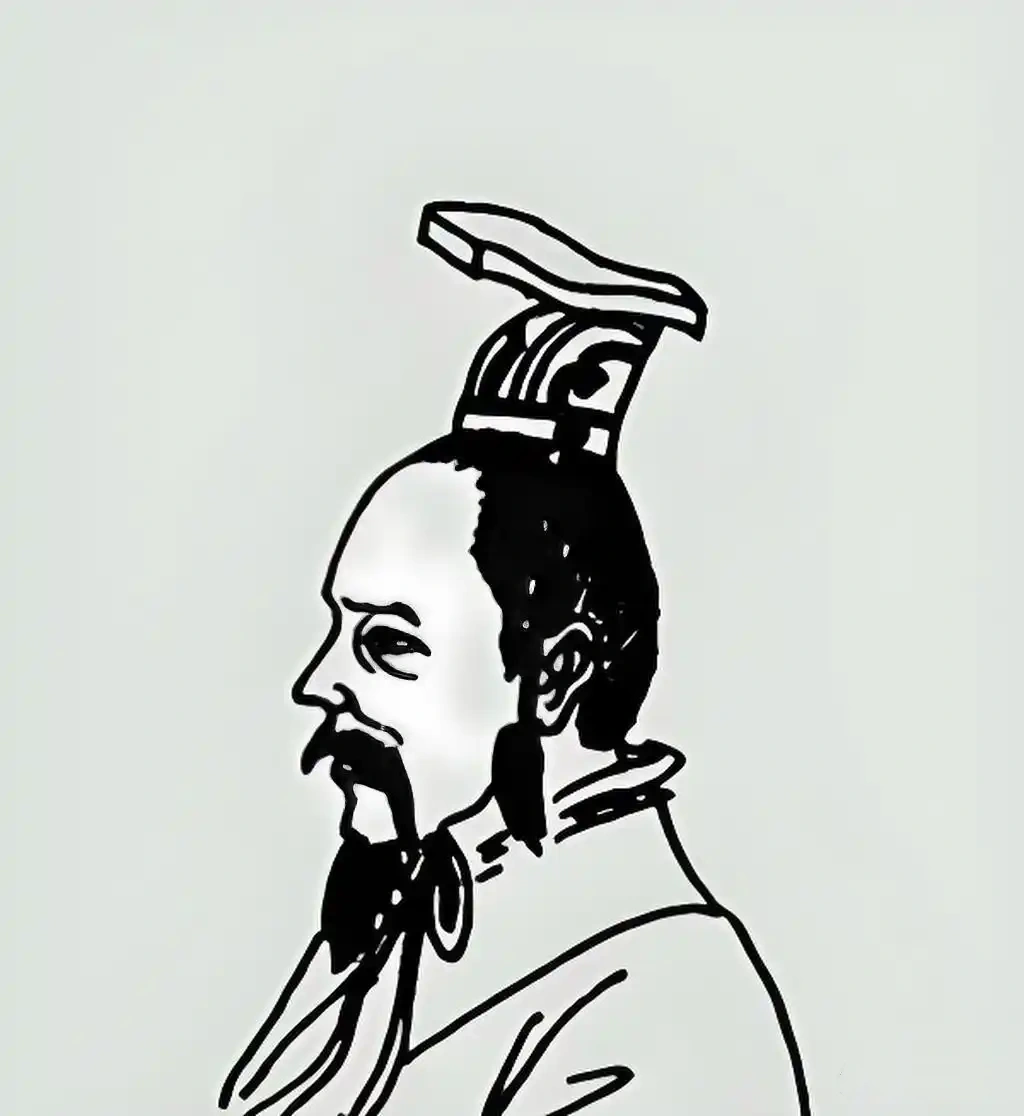
Ten of the eleven rulers of the Eastern Jin have a posthumous name. The eleventh has a fief. The Book of Jin files him in the imperial annals under the title Duke of Haixi; the first line of his section calls him the deposed emperor; neither is the name he was given. His name was Sima Yi. The Wei statesman whose name is spelled the same way in English, who died in 251 and whose descendants founded the dynasty, was his ancestor; the characters were different, and the two men are not to be confused. He was born in 342, the second son of Emperor Cheng, and he died in 386 in a lane in Wu county, a duke, without a temple name and without a posthumous name.
He reigned for six years and nine months, and the annals of the reign contain no act of government that the historians attribute to him. He was removed by an accusation about his body, one that he could neither escape nor answer. He then lived for nearly fifteen years in a lane in Wu county, and died there in 386. This is not the biography of a bad ruler or a weak one. It is an account of how a throne could be emptied in the Eastern Jin, and of what the man who had sat on it did with the rest of his life.
1. The Second Son
Sima Yi was born in 342, the second son of Emperor Cheng and the consort Zhou. His elder brother, Sima Pi, was a year old. In the sixth month of that year their father died at twenty-two by the count of the court, and the throne went to their father's brother, because the men who ran the court had decided that the state needed an adult. The infant was left with a title. He was made prince of Donghai in the same year, and for the next nineteen years the title was the steadiest fact about him. The two boys who were passed over in 342 would both be emperor before they were twenty-five, and neither would leave a son to succeed him.
The series of offices that followed marked the stations of a prince's life without giving him anything to do. In 352, in his eleventh year, he was made cavalier attendant and general of the garrison. In 360, in his nineteenth year, general of chariots and cavalry. In 361, when his brother became emperor, he was moved from Donghai to Langye. In 362 he was made palace attendant, grand general of the agile cavalry, and a minister with an autonomous staff.
Langye was the dynasty's oldest princely title, reserved for the prince nearest the throne. His brother had no sons. From 361, when the title passed to him, the court treated him as the heir presumptive, and he knew it. The sources do not say what he thought about it. They do not describe his education, his habits, his friends, or his health. The only quality they give him is in a sentence written to explain why he had to be destroyed: he kept to the way.
Their mother had been honoured as grand consort in 362 and died in the spring of 363 at the family mansion in the capital. He was in his twenty-second year. Two years later his brother died, childless, at twenty-five by the count of the court, and the empress dowager Chu, the widow of their uncle Emperor Kang, issued the order that made him emperor. The order is preserved: the prince of Langye is of bright virtue and close kin, he is the proper heir, let the great rites be performed quickly to quiet gods and men. The officials went to the Langye mansion to fetch him. He took the throne the same day and proclaimed an amnesty. He was twenty-three by the calendar and twenty-four by the count of the court.
In the seventh month he made his wife empress. She was Yu Daolian, a daughter of Yu Bing, the man who had made his uncle emperor in 342; the marriage had been arranged when he was prince of Donghai, in the years when the Yu family still decided such things. In the same month the title of Langye passed to his great-uncle, the prince of Kuaiji, Sima Yu, and Sima Yu's son Changming was made prince of Kuaiji. The arrangement was routine, and it meant that the man who would take his throne held his old title.
Luoyang, left with five hundred men in the ninth month of 364, fell in the third month of 365, and Shen Jin was taken and killed. The loss was the last of the old imperial cities the dynasty still held, and it was not his doing. It was also not the subject of any edict of his that survives.
The reign began with a court, a title, a wife, and no army.
2. The Reign Without Acts
The government he inherited was not one he could use. Huan Wen, the grand marshal, had held the military command of the whole empire since 363, when the court also granted him the supervision of the department of state affairs, which he declined in 364 while accepting the governorship of Yang province, the province of the capital. He had come as far as Zheqi, upstream from Jiankang, in 364 and built a town there; in 365 he moved down to Gushu, and from either place he refused every summons to court. The court sent envoys; he did not come. The pattern was established before Sima Yi took the throne and did not change while he held it.
At court the senior civil office was held by the emperor's great-uncle, Sima Yu, who became chancellor in 366. The departments were staffed by men of the old bureaucracy, Wang Biaozhi and Wang Shu among them. The provinces were held by Huan Wen's brothers and clients: Huan Huo in Jing, Huan Chong in Jiang, Xi Yin in Xu from 367, Yuan Zhen in Yu. The Huan family did not hold the palace. It did not need to.
The empress was dead, the emperor's mother was dead, and his brother was dead. The palace he lived in after 366 was a building with a staff and a ritual calendar and no family in it. The annals of the reign mention no favourite, no feast, no hunting party, no building programme, nothing that would give a picture of a man's days. What they give instead is the machinery around him: the envoys going upriver to Gushu and coming back without him, the departments issuing the routine decrees, the chancellor receiving visitors, the army moving north in the emperor's name.
An emperor in that structure had two functions. He dated documents and he performed the rites. The annals of the reign record both, and almost nothing else. In the first month of 366 the era was changed to Taihe and there was a general amnesty. In the fifth month the empress died. In the same month, in the west, the rebellion of a clansman ended: Sima Xun, inspector of Liang province, had declared himself prince of Chengdu in the winter and besieged the city; Huan Wen's officer Zhu Xu broke him, took him, and cut off his head. In the tenth month the great-uncle was made chancellor. In 367 a Yan raiding party reached Jingling and was beaten off, Wang Meng attacked Liang province and destroyed the army sent against him, and Xi Yin was given the four northern provinces. In 368 there was an eclipse, a hailstorm that broke trees, and the death of Wang Shu. In the sixth month of 371 the capital and five commanderies flooded.
These are events that happened to the state. None of them is an act of the sovereign. No edict of his is quoted; no appointment is attributed to his judgement; no policy is dated to his initiative. The one decision the annals give him is a consultation. Before the deposition he summoned a diviner named Hu Qian and asked about his future. The hexagram came out, and the answer was: the house of Jin is firm as a rock, and Your Majesty has the image of leaving the palace. The story is placed before the event by historians who knew the event. It is also the only scene in the reign in which he is the subject of a verb that is not ceremonial.
The silence of the record is not an accident of transmission. The Comprehensive Mirror, compiling the reign in the eleventh century from earlier records, some of which no longer survive, gives him no words and no acts. The one portrait it draws of a silent emperor on the throne belongs to the man who replaced him: it says of Jianwen that he sat with his hands folded and lived in constant fear of being deposed. What it records of Sima Yi is an omen: Mars stood at the gate of the imperial enclosure, and a month later he was deposed. The omen is all the record gives him, and the silence is its judgement. The sky was read as a timetable, and the man on the throne was given no chance to be anything else.
The empress's death is the one event of the reign that belongs to him rather than to the state. Yu Daolian had been his wife since the years in Donghai; she was empress for ten months. She died in the fifth month of 366 and was buried in the seventh month at Jingping, with the rank of an empress. Six years later her title was taken from her by an edict, and twenty years later her coffin was moved to Wu to lie beside his. The dead were subject to the same arithmetic as the living.
In the spring of 369 the court authorized a northern campaign. The authorization was in the emperor's name; the decision was Huan Wen's. The annals give the order in the usual form, with the grand marshal's titles and the number of troops, and no hint that anyone at court thought it a good idea. The court approved it because the court approved what Huan Wen asked for. The emperor's name went north with the army, and the army was not his.
3. Fangtou
In the fourth month of 369 Huan Wen marched from Gushu with fifty thousand infantry and cavalry, the figure the histories give. His plan was to go north by water: up the canal system to the Yellow River, then along the river into the plain. His aide Xi Chao told him at the start that the canals were shallow and the supply line would not hold. Huan Wen ignored him. At Jinxiang the drought had dried the channels, and he had a canal dug for a hundred miles to link the Wen and the Qing and bring the fleet through into the Yellow River. The boats stretched for miles.
The advance was a success at first. A detachment took Hulu and captured a Yan general. The Yan commander at Huangxu met him with twenty thousand men and was routed, and the prefect of Gaoping surrendered his commandery. The forward generals Deng Xia and Zhu Xu broke a Yan force at Linzhu. In the seventh month Huan Wen reached Wuyang, and a former Yan governor raised his clan in support. The Yan court panicked and discussed abandoning Ye for the old capital at Helong.
Then Murong Chui spoke. He was the ablest commander the Yan had, and he was not trusted by the court that now needed him. He asked for the army and said that if he failed, it would still be time to run. He was given fifty thousand men and sent south. The Former Qin, asked for help, sent twenty thousand more, on Wang Meng's advice that Yan should be saved from Huan Wen now and taken later.
Xi Chao had given Huan Wen two plans on the march, and both were rejected. The first was to throw the whole army at Ye, on the argument that the Yan court, hearing his name, would either flee north or come out and be destroyed in a single battle; the second was to camp on the Yellow River and the Ji, secure the canals, and wait until the next summer, when the stores would be full. Huan Wen chose neither. He advanced slowly, waiting for the Yan state to break from within, and the Yan state did not break. A Yan official, Shen Yin, predicted the defeat to his own court for a reason that had nothing to do with soldiers: Huan Wen's government did not want him to succeed, and a man whose court is against him cannot win a campaign abroad.
Huan Wen reached Fangtou in the ninth month. It was the gate to Ye, and he stopped there. The reason was supply. His route depended on a sluice at Shimen, where the canal met the river, and the sluice was held by the enemy. Yuan Zhen, the inspector of Yu province, had taken Qiao and Liang but could not open it. Murong De held it with ten thousand cavalry, Liu Dang with five thousand more, and Li Gui with five thousand cut the road behind. The grain did not come. Huan Wen had eight days at Fangtou. On the eighth he burned the boats, abandoned the baggage and the armour, and marched south.
Murong Chui did not follow at once. He let the retreat go for several days, until the men had lost their order and were marching hard, and then took eight thousand cavalry after them. At Xiangyi, Murong De's four thousand horsemen came out of a ravine in the east, and the two forces caught the Jin army between them. The Comprehensive Mirror gives thirty thousand killed. The Book of Jin's life of Huan Wen gives the same figure for the campaign. At Qiao the Qin cavalry caught the fugitives and killed more, in numbers the sources put at ten thousand and more. All these are round numbers, of the kind the histories use for a rout, and none of them can be checked.
Huan Wen came back to Shanyang in the tenth month with the remnant. He had lost the campaign, the boats, the stores, and the greater part of his army. He blamed Yuan Zhen for the sluice and had him reduced to commoner, and Yuan Zhen, who thought the blame unjust, surrendered Shouyang to Yan. The court did not answer his memorial. A general who could not punish his enemy punished his subordinate, and the subordinate took a province with him.
The political consequence was larger than the military one. The state Huan Wen had failed to conquer was destroyed the next year by the Former Qin, which took Ye in the eleventh month of 370 and captured the Yan emperor. The man who had promised to restore the north had been spared the trouble of doing it. In the first month of 371 he took Shouyang from the rebel he had made and killed the rebel's son and his clan. It was a real victory, and it was not enough. It had cost him more than a year and had been won against a rebel he had himself created. It could be presented as the recovery of a province, and it could not be presented as the recovery of the north. The man who had marched north with fifty thousand men in 369 had come back with a fragment of the Huai frontier and a reputation for blaming his officers.
After it he asked Xi Chao a question that the histories preserve: was this enough to wipe out the shame of Fangtou? Xi Chao said it was not enough to satisfy men who understood. That night, in Huan Wen's quarters, Xi Chao told him that a man in his position bore the responsibility of the empire, and that unless he performed the great act of deposition, the deed of Yi Yin and Huo Guang, he could not overawe the four seas. Huan Wen had long had the thought. Xi Chao was the first to say it aloud.
By the count of the court Huan Wen was fifty-eight that year.
4. The Bedchamber
The charge was constructed in the ordinary way of such charges, from a fact that could not be examined. The emperor, it was said, had suffered since his years as a prince from a wasting illness that left him incapable of fathering children. The condition predated his accession; therefore every child born to him after 365 was not his. Three favourites of the inner apartments, Xiang Long, Ji Hao and Zhu Lingbao, had access to the imperial bedchamber. Two women, Tian and Meng, had borne three sons. The eldest was about to be enfeoffed. The conclusion followed: the boys were the favourites' sons, and the emperor was about to put a stranger's blood on the throne.
The Book of Jin states the reasoning in a phrase that is the whole art of the operation: the palace is closed, and the bedchamber is easy to slander. There was no witness who could be called, no date that could be fixed, no fact that could be established. The accused could not prove his potency without exposing his household; the women could not speak; the favourites could be made to say anything. A charge of rebellion would have required evidence and invited an answer. A charge about the bed required only silence.
The timing was part of the charge. The eldest son was about to be made a prince, which in practice meant heir. Once that happened, the succession would be settled in the emperor's own line and the throne would be occupied for another generation. Huan Wen needed the throne vacant before the boy was named. The accusation was not a substitute for a reason to depose him. It was the reason, manufactured at the moment when a reason was needed.
The story was put into circulation before it was put into a document. The Comprehensive Mirror says that Huan Wen had it spread among the people, and that no one at the time could tell whether it was true. The order of operations is worth noticing. The public was prepared first, the empress dowager was approached second, the officials were told third. A deposition that began with a decree would have looked like a coup. One that began with a rumour looked like a scandal that the court had to clean up.
Xi Chao had proposed it; Huan Wen had the pen. He drafted the empress dowager's order himself and presented it to her for her approval. The woman was Chu Suanzi, the widow of Emperor Kang, the aunt by marriage of the man she was being asked to depose, and the person who had signed the order that made him emperor six years earlier. The Book of Jin puts her grief into the document: a widow's misfortune, all these sorrows, thinking of the living and the dead, my heart cut as I write, choked at the paper, what can I say. The sentences are the most human in the reign, and they are in the mouth of the person who ended it.
The order does not accuse him of rebellion. It accuses him of pollution. It calls the three boys the three misbegotten, whose fathers no one knows; it says that the way of human relations has decayed and the ugly report has spread; it says that now the misbegotten are growing he wants to establish an heir, deceiving the ancestors and overturning the foundation. The crime is not that he seized power. It is that his blood is not pure. The distinction mattered. A political charge would have been a matter between the emperor and his general. A charge about paternity made the throne itself the injured party, and made the empress dowager, the keeper of the palace, the only person who could speak.
The legal form was the precedent of Changyi. In 74 BC the regent Huo Guang had deposed the young emperor Liu He, prince of Changyi, with the authority of the empress dowager, after twenty-seven days and a long list of offences. The order of 371 borrows the phrase: he is to be prince of Donghai, returned to his mansion, with guard and escort as in the Han precedent. The analogy was the whole case. But Huan Wen was not a regent, and Sima Yi was neither a child nor a profligate; he had reigned six years, and no offence of his was alleged. The ceremony would have to supply what the facts did not.
The Book of Jin is explicit about why the charge took this form. Huan Wen feared the emperor because the emperor kept to the way, and a man who keeps to the way cannot be accused of misgovernment. The charge had to be one that would make the court avert its eyes. It did. The officials who heard it read out were being asked to believe that the man who had performed the rites for six years was a fraud in his own bed, and they were being asked in a hall, in public, by a general with an army outside the city. Belief was not the point. Silence was.
5. The Hall and the Ox Cart
At the end of the eleventh month Huan Wen moved from Guangling to Baishi, a camp within reach of the capital. Four days later he entered the palace. Two days after that he assembled the officials in the Taiji hall and had the empress dowager's order read to them. Six days had passed since he pitched his camp.
The court did not know how to do it. The Comprehensive Mirror says that no one knew the form, because it had never been done in Jin, and that Huan Wen himself changed colour. It was Wang Biaozhi, the vice president of the department of state affairs, who supplied the answer: you are the Yi Yin of this house, he said; you should rely on an earlier dynasty. Someone fetched the Book of Han and the life of Huo Guang, and the precedent was read out in front of the assembled court before the order was read. The ceremony began with a bibliography.
The order was read. The officials entered the hall. Officers took the seals and the ribbon. The emperor came down from the west hall in a plain white cap and a single robe, mounted a cart drawn by a calf, and went out by the Gate of the Divine Beast. The officials bowed their farewell, and every one of them wept. A hundred soldiers of the palace escort took him to the mansion of the prince of Donghai.
Two details in that sentence are the whole ritual. The cap and the single robe are the dress of a man with no rank, or of a man in mourning. The calf cart is not a carriage. He was not dragged. He was processed out of his office, in the correct costume, at the correct gate, with the correct escort. The hundred men were enough to stop a rescue and too few to be an army. The weeping was permitted. Objection was not: the annals name no one who objected, and no one who asked whether the charge was true.
The silence has a shape. The officials who might have spoken were the men whose offices depended on the man who had just taken over the court; the empress dowager was in the inner court with the order in front of her; the army was at Baishi. A protest would have had to be made by a person with a following, and the only person with an army at the capital that month was Huan Wen. The annals do not record a single voice, and the absence is not evidence that no one objected. It is evidence that objection had nowhere to go.
On the same day his great-uncle, the prince of Kuaiji, was brought from his mansion and made emperor. The era was changed to Xian'an before the month was out. One man went out of the Gate of the Divine Beast in a white cap and another came in, and the clerks dated the year twice.
Four days later Huan Wen killed the three boys and their mothers. The Comprehensive Mirror records it in one sentence; his own annals do not. The charge had done its work: once the children had been declared not the emperor's, killing them was not killing the imperial line. If the charge was true, they were the sons of favourites and had no claim. If it was false, they were the emperor's sons and were murdered. The document did not need to be believed. It needed only to be official.
The demotion continued by stages. Early in 372 he was made duke of Haixi, a county in Donghai. The empress dowager had asked that he be allowed to remain a prince; Huan Wen proposed a marquis; the settlement was a duke. In the fourth month of 372 he was moved to West Chai Lane in Wu county. The interior minister of Wu, Diao Yi, was ordered to guard him, and a censor, Gu Yun, to watch him.
The choice of title is worth a sentence. He had been prince of Donghai as an infant. He was now duke of Haixi, a county inside Donghai. The title became the name he is known by. It had gone from a kingdom to a county, and from a prince to a duke, and the name of the county was a place he had never governed. The descent from emperor to a man with a fief was made in three legal steps, and each step was smaller than the one before.
At the end of the year the king of Former Qin, in Chang'an, gave his verdict. Huan Wen had been beaten at Bashang and at Fangtou, he said, and instead of reflecting on his faults and humbling himself before the people, he had deposed his sovereign to explain himself. A man of nearly sixty who behaved like that, how could he show his face in the four seas? The proverb says: angry at his wife, he scowls at his father. The sentence is the sharpest in the whole record, and it was spoken by an enemy.
6. West Chai Lane
Wu county was not a prison. It was the seat of Wu commandery, one of the richest and most cultivated places in the south, the country of the Gu, Lu, Zhu and Zhang families, the landscape the refugees from the north had been writing poems about for two generations. The house in West Chai Lane was a house in a city, with a wall and a gate and a guard. The guard was there to keep him in and to keep others out.
The watching was divided between two officers. The interior minister of the commandery, Diao Yi, was responsible for defence; the censor, Gu Yun, for inspection. One watched the roads, the other watched the letters. The arrangement was not cruel. It was administrative. A deposed emperor was a name that other men could use, and the court's problem was not the man but the name.
The name was used within a year of the deposition. In the eleventh month of 372 a man came to the gate at dawn and said he carried a secret order from the empress dowager. His name was Xu Long, and he was a disciple of a man called Lu Song, who had a following and a plan. The duke was offered a restoration. He hesitated. His nurse told him not to go. He refused, and the refusal is the only decision the sources attribute to him after 371.
His answer is preserved: I have offended against this realm and been spared; how dare I act? And if the empress dowager had an order, she would send her officials, not you alone. You must be raising a rebellion. He called his attendants to seize the man; Xu Long ran. The answer is a calculation, not a speech of loyalty. He had been used once as a name. He would not be used twice.
After that he shut himself in. The Book of Jin says that he stopped his ears and eyes, thought of nothing, drank all day, gave himself to the women of his household, and did not raise children, in order to keep his life. The last phrase is the difficult one. It can mean that he had sons and did not rear them, which later readers have taken to mean that he prevented births; the text does not say how. What it does say is that the people pitied him and made a song about him, and that the court, seeing him content with humiliation, stopped guarding against him. The song is lost. The judgement is not: the court's watch ended because the man had made himself unwatchable.
The performance was a policy. A deposed emperor who corresponded, received visitors, or fathered sons was a candidate; a deposed emperor who drank and shut his gate was a man. The judgement that he was content may have been wrong. The drinking may have been despair, or it may have been theatre, and the sources do not distinguish. What they do say is that he did not raise children, which is the one act in the performance that cannot be explained by pleasure.
Huan Wen died in 373, a year after the great-uncle he had installed, and the duke outlived him by thirteen years. In 383 the news of the Fei river reached Wu and changed nothing in West Chai Lane.
He died in the tenth month of 386, aged forty-five by the count of the court. The annals give no cause. He was buried in Wu, and in the same year the coffin of Yu Daolian was brought from Jingping and laid beside him. The place is called the Wu tomb in the later records, a local name for a grave that was not an imperial mausoleum. No posthumous name was conferred. No temple name. No restoration.
Fifteen years is a long time to be a name that no one uses. He outlived the charge against him by fifteen years, and it was never withdrawn. What he had at the end was a lane, a wife's coffin, and a tomb with a local name.
7. The Chapter Without a Name
The Book of Jin was compiled in 648 by a commission under Fang Xuanling, two hundred and seventy-seven years after the deposition. Its eighth chapter of imperial annals covers three reigns: Emperor Mu, Emperor Ai, and the Duke of Haixi. The table of contents gives him the fief. His section begins: the deposed emperor, whose personal name was Yi. Two names for one man, and neither of them his.
His section is an imperial annal. It dates the years, records the eclipses and the floods, the appointments and the campaigns, and gives his death as a duke's death. Inside it, the narrative calls him emperor to the last paragraph: the emperor wished to follow Xu Long; the emperor said; the emperor knew that the mandate could not come twice. The verb at the end is not the one used for emperors. It is the one used for a prince.
The reason the chapter exists is bureaucratic. A reign has to be dated. The edicts issued in his name, the oaths sworn to him, the war fought in his era, the empress buried in his reign, all had to be filed somewhere, and the file had to have a heading. The court could take away the man's title but not the years. So the years were kept, under the name of a county.
The Tang verdict is in two parts. The historians' commentary says that the Duke of Donghai refused Xu Long's carriage and bent before the minister who had defied the mandate; this, it says, is what is meant by the soft overcoming the hard, and so he was allowed to complete his natural years. The encomium ends with a line that reads like the deposed man's answer to the ceremony: that man was no Yi Yin, and I was no prince of Changyi. The two verdicts are not the same, and the difference is the point. The commentary praises him for surviving. The encomium says the legal fiction was a fiction. Neither says he was a good emperor, and neither says he deserved what happened.
Two stories were preserved alongside the file. The first is the diviner's hexagram, which the Book of Jin places before the event: the house of Jin is firm as a rock, and Your Majesty has the image of leaving the palace. The second is Huan Wen's sentence, which the Book of Jin and the earlier New Account of Tales of the World both preserve. Lying among his staff, he said that to be this quiet was to be laughed at by the founders. Then he sat up and said that since he could not leave a good name to later ages, he could at least leave a bad one. The first story explains the fall by fate. The second explains it by a man's hunger. Neither is a judgement of the man who fell.
The Comprehensive Mirror, in the eleventh century, repeats the charge and the order without endorsing them, and then records the verdict of the king of Former Qin, the sharpest judgement by a contemporary that the sources preserve and the only one that names the sequence plainly: a general defeated twice, unwilling to blame himself, deposed his sovereign to explain himself. The northern history, the Book of Wei, files the Eastern Jin house under the illegitimate Jin and gives its rulers a collective chapter; from that side he is one reign in a usurping genealogy.
No restoration came. The Eastern Jin lasted another thirty-four years after his death, through three more reigns, and no court in that time proposed to give him back his title. The dynasty that replaced it had no reason to. The Tang historians, who had no stake in the quarrel, kept the chapter and the fief and left the rest as it was.
None of this makes Sima Yi a martyr. He had no programme, no faction, and no army; the annals give him no act of courage and one act of refusal. He was not a tyrant, and he was not a wise ruler. He was a man in a structure that had no place for him, and what he proved is narrow and exact: in the Eastern Jin, a minister with an army and a story could take the throne away from a man who had done nothing wrong. The proof did not need a bad emperor. It only needed an emperor who could be described.
The record takes away his throne, his sons, his title, and his name. It does not take away the word it used for him in the first line, and it uses it to the end. It only changes the verb. That is the whole of his monument: a chapter that could not decide what to call him, and a sentence that calls him emperor while it records that he died like a duke.