Home / Emperors / Jin Dynasty
Emperor Hui of Jin
晋惠帝
Sima Zhong, 259 – 307 · second emperor of the Western Jin
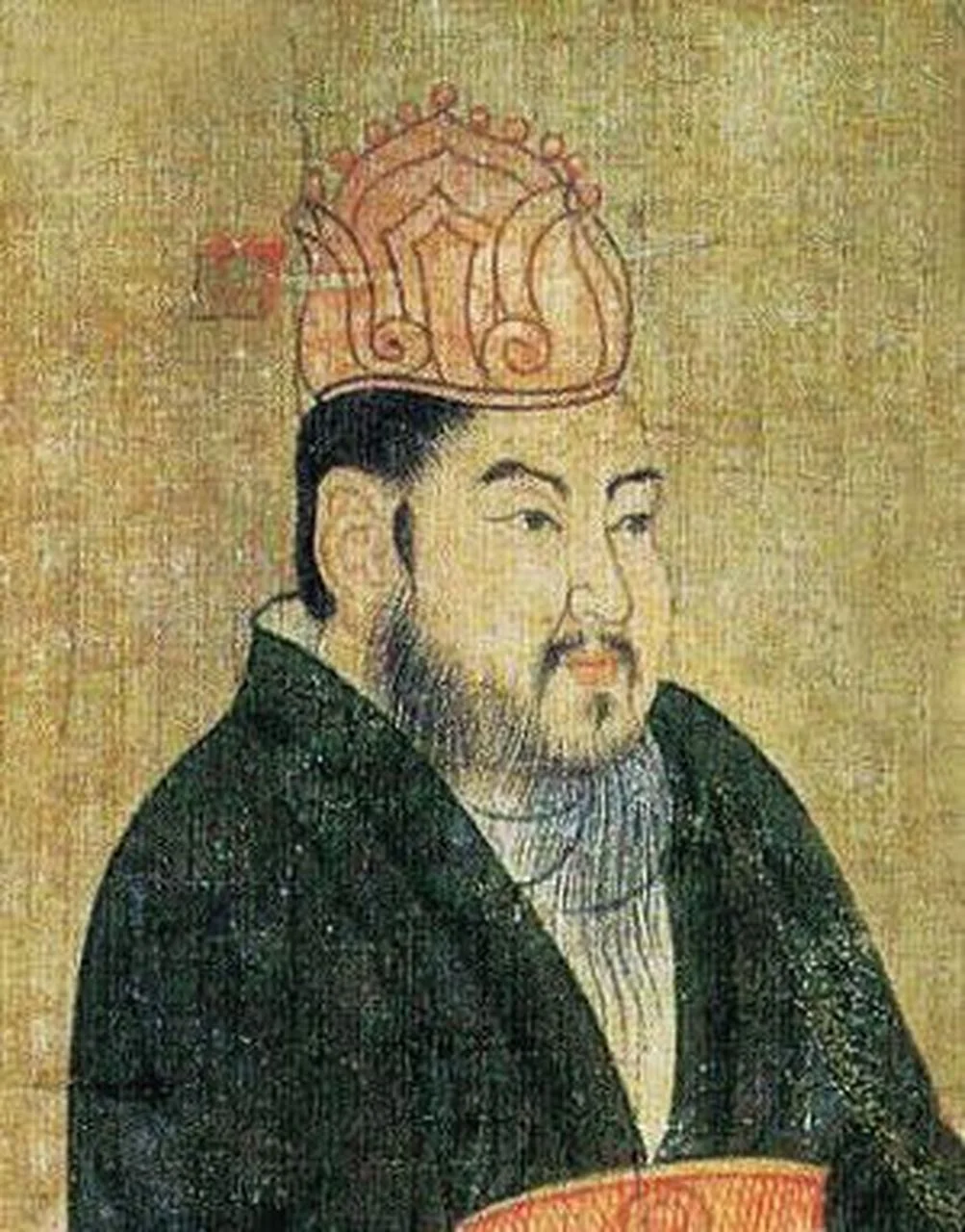
He is remembered for three sentences, and not one of them is a decision. In the seventeen years he sat on the throne of the Western Jin, no policy is attributed to him, no appointment, no campaign, no judgement of a case. The edicts of the reign were drafted by secretariats, sealed with his seal, and read out in his name; the armies marched under his tally; the men who killed one another in his capital did it by his authority. He was present at every great event of the age and absent from every decision that made it. What survives of him is a handful of words spoken in rooms he did not control, and the words are strange enough that historians have been arguing about them for seventeen hundred years.
The book that preserves them was made long after he was dead. The Book of Jin was compiled at the order of the Tang court in the 640s, more than three centuries after the fall of the dynasty, from earlier histories most of which have since been lost. Two of the three sentences stand in its annals of his reign, in a closing sketch of his character, undated, and are followed by the historian's verdict that his benightedness was all of this kind. The third stands in the life of a courtier, in a dated scene with witnesses. They are not evidence of the same weight, and this account will treat them as what they are. The question it asks is not what the emperor was. It is what a state does when the man at the centre of its documents cannot understand the documents, and what happens to the documents when everyone else can.
1. The Accession
In the fourth month of 290 his father, the emperor Wu, died in the Hanzhang hall. He was fifty-five. He had reigned for twenty-five years, had taken the throne of Wei by an abdication in 265, had conquered the southern state of Wu in 280, had tied the land to the mouths that farmed it, and had planted his kinsmen in armed commands along every road of the empire. His heir came into the hall the same day. There was no interregnum, no council of the great offices, no question raised in the antechambers: the crown prince was thirty-one years old, he had been heir for twenty-three years, and the machine of the court closed around him as it had been built to do.
What he inherited was not one government but three claims on one government. At the head of the first stood Yang Jun, father of the new empress dowager, who within days of the accession had been advanced to grand tutor and commander-in-chief with the yellow axe, who conducted the secretariat, and who had moved his own seat into the Taiji hall with a hundred guards at the doors. Behind him were his brothers Yang Yao and Yang Ji, the three Yangs, and behind them the whole connection of the Yang family, planted in the palace commands and the provincial garrisons. The second claim was the empress dowager herself, Yang Zhi, the late emperor's second wife, who was the new emperor's stepmother and also his mother's younger cousin, and who had been born in the same year as he was, so that the two of them were thirty-one together. The third was his wife.
Jia Nanfeng was two years older than her husband. She was the daughter of Jia Chong, the man who had managed the abdication of Wei for the house of Sima; her mother, Lady Guo, had arranged the marriage. The histories describe her as short, dark and plain, and they describe her temper in a way that has to be read with care, because the men who wrote it had every reason to blacken her: she is said to have killed servants with her own hands and to have thrown a halberd at a pregnant concubine. What can be said without the colouring is that she wanted the government and that Yang Jun stood in her way, and that she had spent eighteen years as the crown prince's wife learning exactly how much could be done with an edict and a gate.
The version of the testament that governed the court was not the version the dying man had dictated. The government the new emperor inherited had already been taken from him before he sat down, by a document he had not read, in a room he had not been in.
Jia Chong had died in 282, and the family's standing now rested on the daughter in the palace and on her mother, Lady Guo, who understood that a house without a man in office lives on borrowed time. The empress had no son. She had borne daughters, and the heir was another woman's child. Every calculation she made in 291 began from that.
His father had tested him once in front of the court, and the answers that came back had been written by other people. The court was told that the heir could govern, and the arrangement was so satisfactory that it was never revisited.
So the accession was quiet. An amnesty was proclaimed, the era was changed to Yongxi, and the titles that mattered were settled before the day was out. The histories do not record a single act of the new emperor in that first year which was not the act of another man. He was not incapable of speech or of movement; he was capable of being produced, which is a different thing and, for the men around him, a more useful one.
2. The Three Months
The blow fell in the third month of 291, at night, and it was prepared with a patience that the empress had not been thought to possess. She had her agents in the palace already: Meng Guan and Li Zhao among the gentlemen of the palace, and the eunuch Dong Meng, who carried messages and kept the accounts of who could be bought. Through Li Zhao she opened a correspondence with two princes. One was Sima Liang at Xuchang, who was cautious and did nothing. The other was the prince of Chu, Sima Wei, the late emperor's fifth son, who commanded troops in the south and who asked leave to come to the capital. Yang Jun did not dare refuse him. That was the first error, and it was made before anyone had drawn a weapon.
The emperor was made to issue an edict accusing the grand tutor of treason. The charge was that Yang Jun had raised a private army and intended to seize the throne; the proof was the guards he kept and the offices he had given his kinsmen. The prince of Dong'an, Sima Yao, a grandson of Sima Yi, took four hundred men of the palace garrison to the Yang mansion. Sima Wei camped at the Sima gate with the troops he had brought. The mansion was set on fire; the men who came out were shot from the towers; Yang Jun ran into the stables and was killed there by his own soldiers with a halberd. His brothers and the whole clan were taken and exterminated to the third degree. The histories put the dead in the thousands.
The empress dowager, in the palace, did the only thing left to her. She wrote on a piece of silk that a reward would be given to whoever saved the grand tutor, and had it shot over the wall on an arrow. The letter was picked up by the empress's men. It was produced before the council as proof that the dowager had been party to the treason: a daughter writing to save her father was now a conspirator against the throne. The council was asked to reduce her to commoner. Zhang Hua, who was then minister to the crown prince and the most respected scholar in the capital, argued against it. The Han had deposed an empress before, he said, and had taken her title without taking her person; the same could be done here, with a lesser title and a separate palace, and the family's name would be spared the worst. He was overruled. The empress dowager was deposed, put in a cart and taken to Jinyong city, the walled compound outside the north-west corner of Luoyang where the dynasty kept the people it could not kill openly.
Her mother was condemned next. The old lady had been allowed to stay with her daughter, and the council now demanded her execution; the emperor, who was asked to approve, is said to have refused twice and then given way. Before the execution the dowager came out and begged. She cut off her hair, knocked her forehead on the ground until it bled, and submitted a petition to the empress in which she called herself a concubine and asked only that her mother's life be spared. The petition was not answered. Her mother was killed. In the second month of 292 the attendants and the guards at Jinyong were withdrawn, and no food was sent. Eight days later she died, thirty-four years old, in the same compound where the woman who ordered it would die eight years afterward.
The annals of the reign record the edicts of those weeks and the names of the dead, and not one word that the emperor said. He had been on the throne for a year. The court had already learned that his silence was the most useful thing about him.
The title of empress dowager passed to no one. For the rest of the reign the palace had an empress and no elder, and the ritual check that a dowager could put on a daughter-in-law disappeared with the woman in Jinyong.
The reign had found its instrument, and the instrument was the emperor's name. Nobody had asked him whether Yang Jun should die; nobody had asked him whether the dowager should be starved. The edict that killed the grand tutor was issued in his voice, and the voice was the only thing of his that the government needed. The men who wrote it were not yet strong enough to govern without him, and they never would be. That is the fact that made the next fifteen years possible: the throne could not be taken, because whoever took it would be killed by the others. It could only be used. And to use it, a man had to hold the emperor, or the seal, or the hand that wrote.
3. The Edict in the Sleeve
By the sixth month the men who had destroyed the Yangs had fallen out over the profit. Sima Liang was made regent with the title of grand steward, and Wei Guan, the old general and jurist, was made his colleague with the record of the secretariat. Sima Wei, who had brought the troops and done the killing, was given the palace guard and no government; he was twenty-one and he thought he had been cheated. The prince of Dong'an, who had led the four hundred, talked too freely about deposing the empress, and Sima Liang had him dismissed and sent into exile in Daifang, on the Korean frontier. The alliance of the third month was already three men watching one another.
The empress moved first. She had the emperor write an edict in his own hand: the two regents intended the treason of Yi Yin and Huo Guang, the ancient regents who had deposed a king; the prince of Chu was to take the palace troops, remove them from office, and hold the gates. It was a handwritten order, not a sealed decree, and it was given to Sima Wei at night. He hesitated, and his officers Gongsun Hong and Qi Sheng told him that to wait was to be destroyed. He attacked before dawn.
Sima Liang was killed in his own house with his son. Wei Guan was killed with his sons and grandsons; he was seventy-two, and he had spent a lifetime in the service of the state, and he had held the regency for three months. The killings were done in the name of the emperor, and for a few hours the city believed that the emperor had ordered them.
Then the empress turned on the instrument. Zhang Hua, who had argued for the dowager's life and who understood what a second night of killing would do to the capital, sent word through Dong Meng that the prince of Chu had now killed two ministers without authority and could not be left holding the troops. The council was assembled, and the formula was found: the edict in Sima Wei's hand was a forgery; he had invented the emperor's command; he was a murderer. The declaration was enough. His soldiers, who had obeyed an order they believed to be imperial, heard the court say that the order was a lie, and they went home. Sima Wei was taken and executed in the market.
At the block he put his hand into his sleeve and took out the blue-paper edict. He showed it to the officer of justice and said that he had acted on the emperor's command, that he had done what the command required, and that he was now to die for it. The officer read it and did nothing. The paper was the only thing in the case that could not be argued with, and it was also the one thing nobody wanted to preserve. It is not recorded what became of it.
What the three months destroyed was not only three men. Sima Liang was the senior prince of the generation of the dynasty's founders, a man whom both the court and the provinces might have accepted as a balance; Wei Guan was the last minister whose authority came from service rather than from a faction. After them the only powers left in Luoyang were the empress and the man who kept her books. The princes outside the capital drew the obvious conclusion, which was that the capital could be taken by anyone willing to come with an army and a plausible edict.
The histories call the fifteen years that followed the war of the eight princes and count it from this summer, and the count is reasonable, because the grammar of everything afterward was established in these three months. An edict in the emperor's name could kill the highest men in the state. The same edict, the next week, could be declared a forgery by the men who had wanted the killing. The difference between a lawful act and a crime was not in the text. It was in who held the gates when the text was read. Some historians date the war proper from 300, on the ground that the eight years in between were orderly and were, by the sources' own account, well governed. The distinction matters: 291 was a killing inside a palace, and 300 was the beginning of a war between armies. What the two have in common is the instrument, and the instrument was forged in 291. The men who used it in 300 had learned its use from the empress.
4. The Quiet Years
The eight years that followed are the part of the reign that does not fit the story, and they are the part that explains it. By 292 the empress dowager was dead, the two regents were dead, the prince of Chu was dead, and Jia Nanfeng had the government without a rival. She was, by every account, a violent woman. And for eight years the government of the Western Jin worked.
It worked because three men ran it. The first was Zhang Hua. He was nearly sixty when the Yangs fell, a man of plain gentry origin from Fanyang, the most learned figure of the age, the author of a celebrated rhapsody on a wren and the editor of the court's books. He had no army, no great clan behind him, and no claim on the throne; he was, in the phrase the histories use, a man who could rise without threatening his sovereign and withdraw without losing the confidence of the educated. The second was Pei Wei, thirty-one in 298, son of the geographer Pei Xiu, connected to the Jia family by marriage, and the author of a short treatise called On the Primacy of Being, written against the fashionable doctrine that being came out of nothing. He was the intellectual of the regime and its conscience, in so far as it had one. The third was Jia Mo, the empress's elder cousin, who held the palace secretariat and who understood better than either of them how far his cousin could be managed.
The arrangement was not a cabinet. It was a bargain, and its terms were clear to all three. The empress needed men who could govern, because a woman who ruled through a husband everyone knew to be incapable could not afford a failure of administration; she also needed men of reputation, because reputation was the only thing that made her government acceptable to the provinces. Zhang Hua needed her protection, because a commoner with no troops could not hold the chancellery against the princes without the palace behind him. Pei Wei needed both, because his family's position depended on the court's. None of them could afford to destroy the others. In the language of the time, the empress had the throne and the ministers had the government, and each was the other's alibi.
The results were real. In 291 the government gave each office a plot of vegetable ground, ten qing of it, with ten labourers attached to the post, and a year's pay in cash for an officer who could not take up the land. It was a small reform of a large problem, the payment of a bureaucracy in a country without a proper treasury, and it was the first time the arrangement had been made uniform. In 297 the minister of personnel Liu Song created the nine grades of official rank, a scheme to slow promotion, fix tenure, and stop the endless sideways transfers by which officials accumulated rank without responsibility. The registers were kept, the provincial recommendations were processed, and the granaries of the capital were filled.
The histories say it plainly. Zhang Hua, his biographer wrote, did his utmost to support and mend; and though the age had a dark ruler and a violent empress, within the seas it was peaceful, and that was his work. Another hand, summarizing the same years, uses four characters: at court and in the countryside, quiet.
The quiet should not be mistaken for a moral recovery. In these same years the sale of office became so ordinary that the empire called the court a market, and three angry books were written about it: Wang Chen's On Explaining the Times, Lu Bao's Treatise on the God of Money, and Du Song's Spring and Autumn of the Sons of Officials. Lu Bao's essay gave money a biography and had it say that with it a man could be honoured without rank and feared without power. The men who wrote these pieces were not revolutionaries. They were officials describing a world in which the forms of the state had survived and its substance had been privatized.
Nor was the quiet universal. In 295 the arsenal in Luoyang caught fire. Zhang Hua, who was in the city, ordered the guards to their posts before he ordered the fire fought, because his first thought was that the fire was a coup; by the time the buckets came, the accumulated arms and treasures of the dynasty were gone. In 296 a Di leader named Qi Wannian rose in Guanzhong with seventy thousand men, and the drought and epidemics of the western commanderies brought the tribes of the frontier into the revolt. The court sent Zhou Chu against him, a general with a great name, under the command of the prince of Liang, who disliked him. Zhou Chu was given a token force and ordered to attack a force many times its size; he was not reinforced and he was not fed, and he died at Liumo with his officers around him. The revolt was not put down until 299, and by then the west had been ruined for a generation.
Inside the palace the violence went on. The empress's temper is described in the histories with a detail that no official would have invented, and the detail is not about policy. She is said to have killed people in her own apartments; she is said to have been jealous of every woman in the palace; she is said to have taken her sister's son and passed him off as her own, because she had borne only daughters. None of this touched the administration. That was the arrangement of the eight years. The empress's cruelty ran inward, into the household, and the ministers' competence ran outward, into the state, and the two did not meet. A court can survive a wicked ruler if the wickedness is spent on the people nearest to her.
What it cannot survive is a change in the succession. The arrangement of 291 had one unspoken term: that the heir would remain the heir. Sima Yu, the son of the emperor by a woman of the late emperor's palace, had been made crown prince at the accession. He was thirteen then. He was the reason the dynasty had a future, and he was the one person in it whose existence the empress could not tolerate. As long as he lived, her family's destruction was only a matter of time; the day he took the throne, the men who had killed the Yangs would come for the Jias. Every year he grew older, the bargain of the quiet years became harder to keep. In 299 the last of her three ministers, Jia Mo, lost her confidence and died of rage and grief. The brake was gone. The court was quiet, and the empress was alone with her fear.
5. The Heir
Sima Yu was born in 278, in the palace of the late emperor, and his birth was one of the odd arrangements of a court that had stopped asking whether arrangements were proper. His mother, Xie Jiu, had been a woman of Emperor Wu's own household. When the crown prince was to be married, the old emperor, worried that the boy was too young to know what marriage was for, sent Xie Jiu to the Eastern Palace to instruct him. She became pregnant, and returned to the Wu palace to bear the child, because the crown princess was jealous. The emperor did not know he had a son until the boy was three or four years old, and is said to have discovered it by taking him by the hand at court and telling him who his father was.
The child was clever. The old emperor liked him, said he resembled Sima Yi, and once remarked that this boy would raise the house. That remark did more for the father's prospects than any argument of the Jia faction, and it belongs to the previous reign. What matters here is what became of the boy. At the accession he was made crown prince, and the best men in the court were given to his household as tutors: He Shao, Wang Rong, Yang Ji, Pei Kai, Zhang Hua, He Jiao. It was the finest education the dynasty could provide.
It did not take. The prince grew up in a palace where his father was a name on documents and his stepmother was the government, and he learned the habits of a boy with no one to say no to him. He kept a stall in the palace market where he cut and sold meat, and another in the Western Garden where he sold goods for profit. He was fond of divination and of taboo, and he was careless of the scholars who tried to teach him. One of them, Du Xi, remonstrated with him once too often. The prince put needles in the mat where Du Xi sat, and when the man got up bleeding, asked him what had happened, and heard him say that he had been drunk and did not know. It is a small story and a true one, and it explains why the court's hope curdled.
The empress had no son. She had daughters, and a husband who was not going to give her another child, and a crown prince who was not hers. Her calculation was simple and, in the terms of her family's world, correct: if Sima Yu reigned, the Jia house would be exterminated, as the Yang house had been. She is said to have pretended to a pregnancy during the mourning for the late emperor, and to have produced her sister's son, a boy called Han Weizu, as the child she had borne. Whether the story is true or a later invention, it shows what the court believed she was capable of. And it shows the shape of the problem: she needed a son of her own, and the only way to get one was to destroy the son of another woman.
The destruction was done with documents, like everything else in the reign. In the twelfth month of 299 she had the prince brought into the palace on the pretext that his father was ill, and had him given wine until he was drunk. A draft was put in front of him, written by her client Pan Yue, which called on the emperor to settle the matter himself and said that if he did not, the prince would come in and settle it; it called on the empress to settle it herself, and said that if she did not, he would do it with his own hands. The prince copied it out. Where his hand failed, hers completed the characters.
The document was shown to the emperor at the Shigan hall, and the council was called. Zhang Hua and Pei Wei protested that the hand was not the prince's and that the deposition of a legitimate heir had always ended in disaster, from the Han onward. The empress insisted. The emperor, who had been shown a paper in his own palace, did what he was asked. The prince was reduced to commoner and confined in Jinyong, and then moved to the palace at Xuchang. His mother Xie Jiu and his concubine Jiang Jun were killed. His wife, Wang Huifeng, the daughter of Wang Yan, was divorced by her father, who wished to keep the family clear of the wreck; she wept and went home.
He lived a few months. In the third month of 300 the empress sent the eunuch Sun Lü to Xuchang with poison. The prince refused to drink it. Sun Lü had him held down and killed him with a medicine pestle. He was twenty-three.
This was the act that broke the machine, and it is important to see why. The murder of a minister could be absorbed; the murders of 291 had been absorbed, and the eight quiet years had followed them. The murder of the heir could not be absorbed, because the heir was the future of the seal. Every prince in the empire could now say that the government had destroyed the succession, and every prince had a lawful grievance in a system where law was whatever the strongest man called it. The empress had given them the one thing they lacked, which was a reason. Sun Xiu, the strategist of the prince of Zhao, is said to have advised his master to let her do it, and to wait. He did not have to wait long.
6. The Forty Days
Sima Lun was the ninth son of Sima Yi, born of a concubine, and therefore the emperor's great-uncle. He had been given a command in Guanzhong and had lost the confidence of the frontier tribes by his favouritism and his exactions; he had been recalled and had spent the years since in the capital, cultivating the empress and asking for offices. He had asked for the controller's place in the secretariat and then for its headship, and Zhang Hua and Pei Wei had refused him both. That refusal is the reason they died.
On a night in the fourth month of 300 the gates of Luoyang were taken by troops under Lun's command, with the help of the palace guard and of the prince of Qi, Sima Jiong, who held a colonelcy in the capital. The order they carried was forged in the emperor's name and addressed to the officers of the three guards: the empress and Jia Mi had murdered the crown prince; the troops were to enter the palace and depose her; those who obeyed would be made marquises, those who refused would have their families destroyed. It was the formula of 291, used by a new hand.
The empress was taken in the rear palace. She saw her husband's shadow in the doorway and called out to him that he had a wife and was letting men depose her, and that he would be deposed himself next. He said nothing. On the way to Jinyong she asked who had raised the thing, and was told the princes of Liang and Zhao. She said that a dog should be tied by the neck and not by the tail, and that she had only herself to blame. She was given gold-dust wine in the same compound where she had starved the empress dowager, and died there.
Jia Mi, Jia Wu, Han Shou and the whole connection were killed that night and the next day. Zhang Hua was brought before Zhang Lin and asked why he had not died when the crown prince was deposed. He answered that he had remonstrated, and that the record of the council would show it. He was asked why he had not resigned. He had no answer. He was executed with his kin to the third degree, at sixty-nine. Pei Wei was executed with him, at thirty-four. The two men who had governed the empire for eight years were killed in an afternoon by the man they had kept out of office.
Lun took the chancellorship of state and the nine bestowments, and governed in the emperor's name. He was not, by the standards of the family, a competent man. The histories say he could not read a book and that he consulted Sun Xiu on everything, and that Sun Xiu wrote the orders on slips of blue paper which were changed three or four times between morning and evening. He gave offices to his partisans without limit. When the palace ran short of the sable tails that trimmed the caps of the highest officials, the tails of dogs were used, and the city made a proverb of it. When the seals ran out, titles were written on white boards and handed out. Men who had been stable boys a month before stood in the audience hall among the ministers.
In the first month of 301 he took the last step. The abdication was staged in the manner the age had perfected: an edict in the emperor's name, a prince sent to take the seals, a chancellor who declined three times and then accepted. The prince of Yiyang went for the seals and the emperor held on to them, and the prince prised his fingers open one by one. The emperor was put into a mica-carriage and taken out by the west gate of the Hualin garden to Jinyong, which was renamed the Yongchang palace, and given the title of retired emperor.
The title is the most revealing thing in the whole reign. A retired emperor is a father who has given the throne to his son. Sima Lun was the emperor's great-uncle; he belonged to the generation of the emperor's grandfather; he had taken the throne from his grand-nephew and could think of no better name for him than the one that made him a father. The forms of the state had become detached from the persons they described. The emperor still existed, the title still existed, and the two had nothing to do with each other. He was lodged in the same walled compound that had held the empress dowager he had been made to depose and the empress who had ruled in his name. Three occupants in nine years, and the third was the emperor himself.
The reaction came in the third month. The prince of Qi, Sima Jiong, in Xuchang; the prince of Chengdu, Sima Ying, in Ye; and the prince of Hejian, Sima Yong, in Chang'an issued a call to arms, and the prince of Changsha, Sima Yi, the late emperor's sixth son, joined them. Their proclamation was not against the throne but for the restoration of its rightful holder: Lun had usurped, the emperor was imprisoned, and the princes were coming to put him back. It was the first time that an army had been raised in the provinces with the emperor's person as its stated object, and it would not be the last.
The war lasted about sixty days. Lun's generals were beaten in the field; the court in Luoyang turned; the left guard commander Wang Yu killed Sun Xiu and his household and brought the emperor back to the palace. The era was changed to Yongning. Lun was confined in Jinyong and given gold-dust wine, the same drink he had given the empress, and died saying that Sun Xiu had ruined him. The histories count the dead of those two months at nearly a hundred thousand.
The restoration taught the princes a lesson that shaped the next five years. Lun had taken the throne and had been destroyed by everyone else, because a usurper gives every other claimant a common cause. After 301 no one tried to be emperor. They tried to be regent. The emperor was worth more on the throne than off it, because whoever stood beside him could issue his edicts, and whoever issued his edicts commanded the state. The war that followed was not a war for the crown. It was a war for the position of the man who stood next to the man wearing it.
7. The Princes
The war is named for eight princes. Two of them, Liang and Wei, were dead before it was fairly begun; Lun was dead before the fighting became general; Jiong, Yi and Ying were dead before the emperor; Yong outlived him by a month; and Yue outlived them all. They were not a party and had no common programme. What they shared was a place in the imperial clan, a command on a frontier, and the conviction that the government in Luoyang could not be trusted to anyone else.
Sima Jiong had the best claim of any of them. He was the son of Sima You, the late emperor's younger brother, the prince whom the court had once wanted for the throne; he had been the first to answer the call against Lun; and he was, by the reckoning of the capital, the man who had restored the emperor. He was made grand marshal and regent, and the government was his. He made the Lady Yang Xianrong empress, and he made the crown prince's surviving son, a child called Sima Shang, the imperial grandson. He also built himself a mansion that rivaled the palace, pulled down the houses of private families to clear the ground, drank, and stopped going to court. The forms of the court, which men like Ji Shao had spent their lives defending, were not observed.
They could not. In the twelfth month of 302 the prince of Hejian, advised by his strategist Li Han, persuaded the prince of Changsha that Jiong had monopolized the government and that the dynasty would not be safe while he lived. The prince of Changsha attacked the regent's mansion at night with a few hundred men, killed him, and exposed his head to the six armies. Jiong had held the government for about a year.
The prince of Changsha was the emperor's half-brother, and the one regent of the whole period whom the army was willing to fight for. He was twenty-seven in 303 and he did the things a commander has to do: he slept in the camp, he shared the soldiers' ration, and he went to the wall himself. He also had the emperor's confidence, in so far as the emperor had confidence in anyone, and he treated him with the ceremony that no one else bothered with. For a year he held Luoyang.
In the eighth month of 303 the princes of Hejian and Chengdu raised troops against him on the charge that he had usurped the government. Zhang Fang came from the west with seventy thousand men and burned the gates of the city; the siege lasted through the autumn and winter. The price of grain in Luoyang reached ten thousand cash a picul, by the figure the histories give. Boys of thirteen were conscripted. Both sides called in the frontier peoples, and the war in the suburbs of the capital began to look like the wars beyond it.
The end came from inside. In the first month of 304 the prince of Donghai, Sima Yue, who held troops in the city, seized the prince of Changsha at night with a few hundred men and handed him to Zhang Fang. Zhang Fang had him roasted over a fire. He was twenty-eight. The soldiers who had fought for him were not consulted, and the city that had held out for six months was opened to the western army, which looted it and went home.
Sima Yue was not a close kinsman. He was a great-grandson of the dynasty's founding ancestor through a younger brother, a man of the imperial clan at the distance where kinship becomes a name rather than a claim. He had no army of his own at the start, and he had learned in 304 what the others had learned in 291: the way to power was not to fight the emperor's enemies but to hold the emperor. He would spend the next three years proving it.
The succession had by now become another office to be handed out by whoever held the capital. In the second month of 304 the empress Yang Xianrong was deposed, the crown prince Sima Tan was deposed, and Sima Ying, the prince of Chengdu, was made imperial younger brother and heir, though he stayed at Ye and governed the north from there. In the sixth month the empress Yang Xianrong and the crown prince were restored by a coup in the capital. In the seventh month they were deposed again. The heir to the throne had changed hands four times in six months, and the man whose son was at issue was not asked about any of it.
By the summer of 304 the board was set. Sima Ying held Ye and the north, and was heir. Sima Yong held Chang'an and the west. Sima Yue held the capital and the emperor, and had an army raised in the eastern provinces. The emperor was forty-five, had been on the throne fourteen years, and had never commanded anything. In the seventh month Sima Yue took him north at the head of a hundred thousand men to destroy the prince of Chengdu. It was the first time in the reign that the emperor had left Luoyang, and he left it in the middle of an army, in a carriage, with the seals of state, on a road that led to a place called Dangyin.
8. Dangyin
The army marched north in the seventh month of 304, and it marched badly. Sima Yue had called the provinces to him and had gathered a host the histories put at more than a hundred thousand, but a host of that size in that season moves at the speed of its slowest wagon, and the roads north of the Yellow River were not made for it. The emperor was in the carriage at the centre of it, with the seals of state and the officials who had not found excuses to stay in Luoyang. He was forty-five years old. It was the first time since his accession that he had left the capital, and he was leaving it to fight his own brother.
Sima Ying's general Shi Chao met them at Dangyin, south of Ye, with a picked force and the advantage of the ground. The engagement was short. The imperial army was strung out on the road, its officers were not agreed on who commanded, and the first shock broke the centre; the wings ran; the supply train was abandoned; and in a short time one of the largest armies the dynasty had put into the field since the conquest of Wu ceased to exist as an army. Sima Yue, who had staked everything on the campaign, rode south with a handful of men to his own territory. He did not come back for two years.
The emperor was left in the wreck. He was hit three times in the face by arrows, and the blood ran down into his collar. The officials and the guards had scattered into the fields; the carriage stood where it had been stopped; and the only man who did not run was the attendant Ji Shao.
Ji Shao was fifty-two. He was the son of Ji Kang, the poet and musician whom the house of Sima had executed forty-two years before, and he had spent his life in the service of the family that killed his father, which was not unusual in that age and was, in his case, entirely deliberate. Shan Tao had recommended him; Wang Rong had said that among a crowd he stood out like a crane among chickens; he had refused the friendship of Jia Mi when refusing it was dangerous, and had been restored to office by the court when the empress fell. Before the march a colleague had asked him whether he had a good horse. He said that a subject who guarded the imperial person had no business asking what horse he rode.
He put on his court dress and his cap, climbed onto the imperial carriage and stood in front of the emperor. The soldiers came up. The emperor said that this was a loyal minister and that they were not to kill him. They answered that they had the order of the imperial younger brother and that they were to harm no one but the emperor. They pulled Ji Shao down onto the shaft and killed him there, and the blood went over the imperial robe. The emperor fell out of the carriage into the grass. The seals of state rolled into the weeds and were lost.
He was found by Shi Chao's men and taken to Ye, where his brother received him with the forms of a subject and the authority of a conqueror. The court that had fled with him was reconstituted in the provincial palace. For a few weeks the empire was governed from Ye. Then Wang Jun, the governor of You province, brought the Xianbei cavalry of the Duan tribe down the road from the north, with the governor of Bing province, Sima Teng, and a coalition of the frontier commands behind him, and defeated Sima Ying's army outside the city. Ying did not wait for the siege. He took the emperor and a few dozen riders and went south.
The flight to Luoyang is one of the small, exact pictures the histories preserve. They went on an ox-cart, without money and without grain, and a eunuch who had sewn three thousand cash into his quilt bought food along the road. There were no dishes; they ate from coarse earthenware. At Wen county the emperor wanted to bow at the ancestral tombs, and he had lost his shoes in the flight, and a servant gave him his own. The party reached the Yellow River and was ferried across, and on the southern bank Zhang Fang's men were waiting for them.
Zhang Fang had brought the western army to Luoyang in the spring and had never left. He was a soldier of the frontier, a man of poor and obscure origin, and he held the capital the way a garrison holds a town: he stripped it. The palaces were emptied of their stores, the houses of the rich were plundered. When the emperor came back, the capital he came back to was already a shell. In the eleventh month Zhang Fang took him west, and Sima Ying went with him, and the court of the Western Jin became a court in a baggage train on the road to the passes.
9. Chang'an
Chang'an had been the western capital since the Han and had not been the seat of a government for a century. The palace was standing; the offices were not. Sima Yong, the prince of Hejian, governed from the old city with the title of grand steward and the command of all the armies, and the emperor lived in a wing of the palace with a household that shrank every month. The provinces stopped sending revenues. The registers were not updated. The appointments that were made in Chang'an were not honoured in the east, and the appointments made in the east were not honoured in Chang'an, and the men who held both began to choose which of the two to obey.
In the twelfth month of 304 Sima Yong deposed Sima Ying as heir and put in his place the emperor's youngest half-brother, Sima Chi, the prince of Yuzhang, who was twenty-one. The choice was not made for the emperor's sake. Sima Chi was young, had no party, and had spent his life in the palace; he was the safest possible heir for a regent who intended to keep the government. The emperor was asked to approve, and approved.
A court without its capital is still a court, and the ceremonies went on. The emperor gave audiences, the appointments were sealed, the amnesties were proclaimed. But the business that reached him was the business of a siege, and the men who brought it were soldiers. Zhang Fang, who had burned the gates of Luoyang and emptied its palaces, proposed to burn what was left of the city and move the capital west altogether, on the ground that a capital which could not be defended was a liability. Lu Zhi, a scholar in the emperor's service, dissuaded him by citing the ancestral temples and the tombs of the dynasty. The city survived because a minister quoted the rites at a general. It was that kind of government.
The year 305 was the year the state came apart. Sima Yue, in the east, raised the provinces against Yong and against Zhang Fang, and the war was fought across the central plain in a series of marches and counter-marches that no one later bothered to describe in full. The government in Chang'an issued edicts; the government's enemies issued edicts; the governors obeyed whichever army was nearer. In the winter Yong killed Zhang Fang and sent his head to Yue as the price of a settlement, and Yue refused the price. He wanted the emperor, and the emperor was in Chang'an.
The winter was the worst of it. The court in Chang'an had neither the money to pay its soldiers nor the grain to feed the city, and the soldiers took what they could find. The emperor's household was reduced to its ceremonies and its furniture. Yue's terms, when they came, were not terms a regent could accept, and the head of Zhang Fang in a box did not move him. He did not want the head. He wanted the man who was still in the palace.
In the fifth month of 306 Yue's generals came through the passes. The Xianbei cavalry that had been brought from the north sacked the city and its suburbs, and the histories count the dead at more than twenty thousand. Sima Yong fled. The emperor was in the palace while the city was sacked, and nothing is recorded of what he said or did. Then he was taken out of the palace and put on the road east.
He came back to Luoyang in the sixth month. The city had been stripped twice, by Zhang Fang's army and by the war, and the palace that had been the centre of the empire since 265 was a set of burnt halls with no stores and no staff. The offices had no registers. The court had no money. The officials who came back with him were given what could be found, and the ceremonies were performed with the properties that could be borrowed. The era was changed to Guangxi, as if a new beginning could be made by naming one.
The north was already outside the argument. Beyond the passes and the river, in the commanderies that had been settled with frontier peoples for a century, the war had emptied the garrisons and the taxes had stopped, and the men who held those commands were beginning to act for themselves. That is another history, and it belongs to the reign that followed. What belongs here is the state of the capital in the summer of 306: an emperor in a ruined palace, a court without records, and a victor who had brought him back and now stood beside him.
Sima Yue was made grand tutor and given the record of the secretariat. He had won, and he had won by the method he had learned in 304: he had not taken the throne, he had taken the man on it. The war was over. The government that followed was his, and the emperor was in it, and the arrangement was exactly the arrangement of 291, with a different man standing where the empress had stood.
10. The Last Winter
The winter was short. In the eleventh month, on the day gengwu, which is the eighth of January 307 in the Western calendar, the emperor died in the Xianyang hall. He was forty-eight.
The annals of his reign record it in one line: in the eleventh month, on the day gengwu, the emperor died in the Xianyang hall, aged forty-eight, and was buried at the Sun mausoleum. There is no cause in the entry. At the close of the same chapter, outside the frame of the annals, the historian adds a sentence: afterwards he died of poison in a cake, and some say it was Sima Yue's poisoning. The word is or. It is the smallest word in the chapter and the most important one.
The suspicion has never been proved and has never died. The case for it is circumstantial and strong. The emperor died five months after his return, at the moment when the man who had restored him was free to choose the next emperor. He had no son living; the heir was a younger brother of twenty-four with no party and no experience, the most pliable candidate in the imperial house. The empress Yang Xianrong, who had been deposed and restored more than once, might have found a claim to a voice in the succession, and a dead emperor with no son removed her. The men who controlled the palace kitchens and the palace guard were Yue's. And the dynasty had already produced three convenient deaths in the previous decade: the empress dowager starved, the empress poisoned, the prince of Zhao poisoned. A fourth would not have surprised anyone.
The case against is also real. The annals give no cause, and the sentence that supplies one is placed at the end of the character sketch, after the sentence about his benightedness and before the formal verdict, in a position where a later hand may have added it. Poisoned food was not a metaphor in that world; it was a hazard of every kitchen, and an emperor who had spent the last three years being dragged from one ruined palace to another was not a healthy man. The suspicion is first recorded as a suspicion, not as a charge; no accusation from his own lifetime survives; no trial, no inquiry, no witness survives. What can be said is what the record says: he died in the Xianyang hall, and some said that the cake was poisoned, and some said that the poisoner was the man who had brought him home.
He was buried at the Sun mausoleum, north of the city, and given the posthumous name Hui. The word means soft, yielding, kind to the people. It was the one quality everyone had always allowed him, and it was the quality that had made him useless. No temple name was added. Of the four emperors of the Western Jin, only the founder has one.
The verdicts came later and they should be set side by side, because they disagree about the only thing that matters. The Tang emperor Taizong, writing his judgement on Emperor Wu in the same book, put the fault on the father: the heir could have been set aside and was not, and so the foundation was overturned. The seventeenth-century philosopher Wang Fuzhi wrote that the folly of Emperor Hui had no equal in ancient or modern times, and that the state fell because of it. Hu Sanxing, reading the Comprehensive Mirror in the thirteenth century, came to the sentence about the blood and wrote: who says the emperor was a simpleton? Lü Siming, in the twentieth century, said that the words were not at all the words of a demented man, and that the historian's portrait could not be trusted in every line. Modern writers have gone further and argued from the record that he could read and write, speak and remember, feel and occasionally insist; that there is no account of any deformity; and that the accurate word for him is not idiocy but dullness. Others, and this is the more useful line, have stopped asking what was wrong with the man and asked what was wrong with the arrangement that put him there. Tian Yuqing's judgement on the age is of this kind: the war of the princes and the disasters that followed destroyed the Western Jin house and much of the gentry that had attached itself to it. That is a verdict on a system, not on a mind.
The three sentences have to be read as what they are, and not as a diagnosis. The first two stand in the annals, in the same closing passage, with no date and no scene. The emperor heard frogs in the Hualin garden and asked whether the one making the noise was speaking for the office or for itself, and his attendants answered that on public land it was public and on private land it was private. It is not a nonsensical question. In a state where land was divided into public and private, and where the boundary between public and private land was a matter for the clerks, it is the question of a man who has understood the categories of the state and not its substance. The second is the famous one. When the empire was in famine and the people were starving, he asked why they did not eat meat gruel. It was not said at a table. It was said in reply to a report, in a palace where food arrived cooked and carried, and its cruelty is the cruelty of a man who has never seen the inside of a kitchen. The historian closes the passage by saying that his benightedness was all of this kind, and the sentence is a verdict, not an observation.
The third is different. It stands in the life of Ji Shao, not in the annals, and it is a scene with a date: the seventh month of 304, the road at Dangyin, the carriage, the arrows, the blood. The attendants brought water to wash the imperial robe, and the emperor would not let them. He said: this is the blood of the attendant Ji; do not wash it out.
He had spent seventeen years being spoken for. Edicts had been written in his hand and not by him; governments had been formed in his name and without him; he had been moved from Luoyang to Ye, from Ye to Luoyang, from Luoyang to Chang'an and back, and at every remove the men who moved him needed his body and not his mind. At Dangyin, for the length of a conversation about a robe, nobody was speaking for him. What he said was that the blood of a man who had stood in front of him should be left where it had fallen.
This is the blood of the attendant Ji. Do not wash it out.