Home / Emperors / Tang Dynasty
Emperor Taizong of Tang
唐太宗
Li Shimin, 598 – 649 · Second emperor of the Tang dynasty
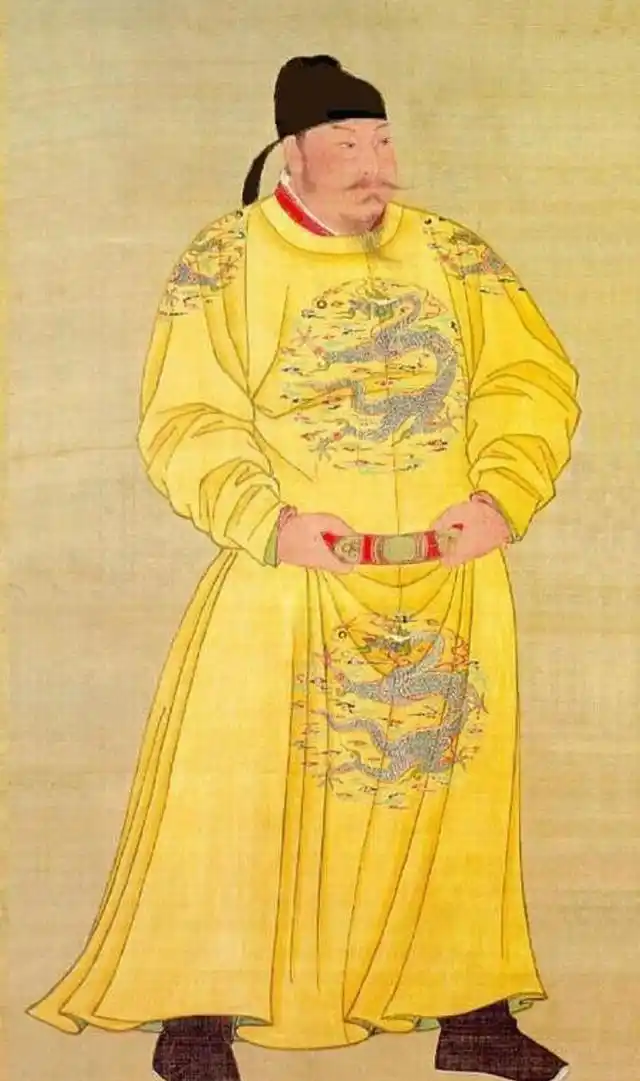
The emperor the Chinese tradition calls Taizong has been the standard illustration of good government for thirteen hundred years. Zhenguan zhi zhi, the orderly rule of the Zhenguan era, named after his reign title, became a unit of measurement rather than a description: eleventh-century reformers invoked it against their own emperors, Ming officials quoted it at the throne, twentieth-century statesmen used it as shorthand for what a government ought to be. The reputation rests on twenty-three years of deliberate work — a bureaucracy reassembled after the Sui collapse, a legal code revised downward rather than upward, a lighter tax burden, a frontier policy that broke the Eastern Turks and pushed Tang authority as far as the Tarim basin — and on something harder to institutionalise: a court culture in which the emperor expected to be told, in public and at length, that he was wrong.
The reputation has a fault line running through it. Li Shimin took the throne by killing his elder and his younger brother on one morning in July 626, and by having their ten sons killed. He then governed for twenty-three years knowing this would be the first thing said about him, and he did more than live with it. He asked to read the official record of his own reign, was refused by the official who kept the diary, and in 643 went around that man to the chancellor supervising the history bureau, who brought him the drafts. What he objected to was not invention but hedging. The account of how he came to the throne that survives in the Old Book of Tang, the New Book of Tang and the Comprehensive Mirror is the account he approved.
This is therefore also a story about the document that made him. Everything below on the founding of the dynasty and the succession of 626 must be read with that caveat attached; everything after 626 can be read more or less as it stands.
1. The Second Son
Li Shimin was born on 28 January 598 at Wugong, in what is now Shaanxi. The Old Book of Tang, compiled a century later, gives the following year instead, and the two dates have never been reconciled. The difference is small but it governs every age in this essay, so it is worth stating once: 598 makes him twenty-eight at the Xuanwu Gate and fifty-one at his death, and 599 makes him twenty-seven and fifty. Chinese sources also count age inclusively, which is why the same man can be described in good faith as fifty, fifty-one and fifty-two when he died. This essay follows 598 throughout.
His father, Li Yuan, was a Sui official of the mixed Chinese and Xianbei aristocracy of the north-west and a cousin of the reigning house: his mother was a sister of the founding Sui emperor's empress, which made the reigning Yang emperor his maternal cousin. Li Shimin was the second legitimate son of Li Yuan and Lady Dou, who came of a family that had married into the Northern Zhou imperial clan. The couple had four sons and one daughter — Li Jiancheng, the eldest; Princess Pingyang, who would one day raise an army in her father's cause; Li Shimin; Li Xuanba, who died young; and Li Yuanji, the youngest.
Li Yuan educated his sons in letters and in arms. In 613, when Li Shimin was fifteen, his mother died in the far north-east; a kinsman of hers named Gao Shilian, looking for a match for his niece, settled on the young man, and the girl he married — known to history as Empress Zhangsun — would be his closest political partner for the next twenty-three years. In 615, at seventeen, he is said to have advised a general sent to relieve the emperor Yang, then besieged by Turks at Yanmen, to fake overwhelming numbers with banners by day and war drums by night. When you are weaker, look stronger: the first recorded instance of an instinct that ran through his whole career.
That story comes from a history written under his own patronage, and it is the first lesson in how to read this life. The Account of the Rise of the Great Tang, composed in his father's reign by Wen Daya — secretary of Li Yuan's military headquarters, and an eyewitness of the founding — says the troops that broke that siege were brought by Li Yuan. Here is the pattern. The founding of the Tang was a family enterprise, and the official version is organised around one member of that family who happened not to be its head at the time. Wen Daya is not neutral either; he worked for Li Yuan and writes Li Yuan up. But his book is a contemporary record that escaped the later editing, and it is the control against which the official story can be measured.
The disagreement is sharpest about 617, when Li Yuan rose in rebellion at Taiyuan. In the official account the enterprise was Li Shimin's: he and a palace official named Pei Ji manoeuvred a reluctant, rather dissolute father into revolt, using the emperor's own women as bait — a story that reads like a moral fable. In Wen Daya's version Li Yuan is the protagonist from the start, weighing the omens, deciding, and deploying his sons as agents. There is no way to settle it, and it matters less than the fact that by 626 everyone had an interest in settling it one way. When Li Yuan rose in the fifth month of 617, Li Shimin was nineteen.
2. The Soldier Prince
The campaign that followed made the second son indispensable and then made him dangerous. Li Yuan marched south, took Chang'an and installed a Sui boy as figurehead; in 618, after the emperor Yang was killed, he took the throne himself and created Li Shimin Prince of Qin. For the next six years the new dynasty's grip on the north China plain was secured almost entirely by this prince in the field. In 618 he destroyed Xue Rengao in the Jing river valley; in 619 and 620 he recovered the north, driving out Liu Wuzhou and his general Song Jingang, who had taken Taiyuan while Li Shimin's youngest brother held it and lost it.
The decisive operation came in 621. Li Shimin had Wang Shichong shut up inside Luoyang and was settling into a siege when Dou Jiande marched down from Hebei with the largest army in the north to relieve him. The obvious move was to concentrate and give up the siege; he did the opposite, leaving a holding force before Luoyang and riding east with a flying column to meet Dou before the two enemies could join. For weeks he refused battle; then he attacked, drove into the middle of their formation, and took Dou prisoner. Wang Shichong surrendered without a fight, and the two strongest surviving states of the north were destroyed in a single campaign.
The rewards were correspondingly large. Li Shimin was made Generalissimo of the Heavenly Strategy, an office invented for him, with a staff and a headquarters of his own. Then the record starts to bend. It was the crown prince Li Jiancheng, marching east in 623 with an army of his own, who finished the last rebel of the east, Liu Heitai — not by slaughtering the rebels, as the local commanders had been doing and thereby generating the next rebellion, but by following the advice of an adviser named Wei Zheng and releasing the prisoners. It is a real achievement, and it is recorded in a paragraph. Li Jiancheng's other contribution to the dynasty's military record is the capture of Chang'an, where he commanded one wing while his younger brother commanded another, and which the official account credits chiefly to Li Shimin.
By the middle 620s the two men were the two poles of the state. Li Jiancheng was crown prince and stayed in the capital, which meant he ran the civil administration; Li Shimin had the army's loyalty, an independent staff, and a growing treasury of his own from the conquests. Li Yuan, whose position had been made by balancing factions, balanced this one too, which was reasonable in an emperor and fatal to a family. In 624 a rebellion traced back to the crown prince's household gave Li Yuan a moment in which he told Li Shimin he would make him heir; when the investigation collapsed he executed the accusers, restored the crown prince and let the moment pass.
The pretext recorded for what happened next is that the crown prince and Li Yuanji arranged to take the Qin prince's best officers from him on the eve of a campaign against the Turks, and to kill him at the farewell banquet. It may be true. It comes from the official history, and its function is to make the following morning an act of self-defence. What is not in doubt is the arithmetic: Li Shimin was the second of four sons, with an unbeaten army behind him, and every year that passed hardened his brother's position. He moved first.
3. The Morning at Xuanwu Gate
Shortly after dawn on 2 July 626, at the Xuanwu Gate on the northern wall of the palace city in Chang'an, Li Shimin and a small party of horsemen waited in ambush for the crown prince and the Prince of Qi to pass through on their way to an audience with their father. The party was small enough that the Old Book of Tang can list it: the empress's brother Zhangsun Wuji, the general Yuchi Jingde, the strategist Hou Junji, Zhang Gongjin, and five others, with their retainers. Li Jiancheng and Li Yuanji rode into the gate and found out too late. Li Shimin shot the crown prince dead with a bow; Yuchi Jingde, arriving with cavalry, shot Li Yuanji in the back as he ran for the palace where their father was.
The gate had been shut behind them. The Eastern Palace and the Prince of Qi's household turned out their troops and attacked it, and it held, because the man commanding it was Li Shimin's. When the attackers hesitated, the two severed heads were held up over the wall, and the fight went out of them. The one piece of evidence about the gate that does not come from the official histories is the epitaph of the officer who commanded it, Chang He — a former rebel of peasant origin who had served under Li Jiancheng in Hebei and was therefore trusted to hold the northern gate. The epitaph, composed in the next reign and preserved among the manuscripts found at Dunhuang, now in Paris, records that in 624 Chang He was summoned to the capital by order of the Prince of Qin, given a gold knife and thirty ingots of gold, and posted to the north gate with money to buy the loyalty of the officers under him. Read that way, Li Shimin bought the gate two years in advance — the conclusion Chen Yinke drew when he first worked the document into the history of the coup; other scholars have argued that Chang He stayed neutral and took no part on either side. It is not the last word, but it is the only surviving document about Xuanwu Gate not written by the court that benefited.
While the fighting at the gate went on, Yuchi Jingde, still in armour and carrying his spear, walked to the artificial lake inside the palace where the emperor was taking the air in a boat. His business was to inform Li Yuan that his sons were dead and to take charge of the imperial guard. Li Yuan asked the assembled ministers what should be done and was told that Li Shimin had behaved as the Duke of Zhou did when he executed his own brothers, and that the empire was now his. His recorded reply — that this had long been his wish — is either the most humiliating sentence in the history of the dynasty or an honest one; either way it was followed within hours by an edict in his own name ordering all troops in the capital to accept Li Shimin's orders. Three days later Li Shimin was made crown prince, and on 4 September his father retired.
Then the killings were completed. Li Jiancheng's five sons and Li Yuanji's five sons were put to death, ten boys, and their names struck out of the clan register. Li Shimin took his younger brother's wife, the Lady Yang, into his own household and had a son by her. He also, in later years, restored a kind of honour to the dead men: in 640 he assigned one of his own sons to be the heir of Li Jiancheng, and in 642 he raised his brothers' posthumous titles back to nearly their old rank, so that Li Jiancheng is remembered as the Yin, or Hidden, Crown Prince. That is the whole of the restitution. The crown prince's line was extinguished.
There is no version of these events that is not contested, and the honest position is narrower than either the traditional telling or the modern debunking. Certain: Li Shimin killed two brothers and ten nephews and any claim his elder brother had to the succession; he had prepared the ground a year or more in advance; and he was clever enough, that same day, to make his father issue the orders that legalised the whole thing. Not certain: whether he acted from necessity or ambition, what Li Jiancheng had actually done to him, and what either brother was like as a man. On that last point the sources are not merely thin but actively hostile, and the hostility was official.
4. Writing the Record Straight
Every Chinese court kept a qijuzhu, a register of activity and repose, in which designated officials recorded the emperor's words and acts for the benefit of posterity. It was sealed and not shown to the emperor; that was the point of it. In the tenth month of 635, five months after Li Yuan died, Li Shimin asked to see it and was refused. A few years later — the sources place the exchange in different years, from the eleventh to the sixteenth of the reign — he put the question directly to Chu Suiliang, the official then keeping the register. Chu Suiliang said that the register existed to write down what the emperor said and did, good and bad alike, and that no emperor had ever been permitted to see his own. Li Shimin pressed: if I do something wrong, do you write that down too? Chu Suiliang said it was his job to hold the brush, and that he would write it. The imperial attendant Liu Ji, standing by, added that even if Chu Suiliang did not write it down, everyone in the empire would.
He got the document anyway, by a different road. In 643 he went to Fang Xuanling, the chancellor who had been supervising the history bureau since 629 — a standing arrangement under which the histories were formally produced by the chancellery rather than by independent scholars, and which a hostile reading treats as the structural defect that let the emperor in. Fang Xuanling tried to refuse on the same grounds as Chu Suiliang and was overruled. In the seventh month of that year the historians presented two works of twenty chapters each, the Veritable Records of the Emperor Gaozu and the Veritable Records of the Present Emperor, and Li Shimin read them. What he objected to was not that they were false but that they were evasive: the entry for the fourth day of the sixth month, they had written, "with much delicate phrasing". He said that the Duke of Zhou had killed his brothers Guan and Cai to secure the Zhou, and that Ji You had poisoned his brother to save the state of Lu, and that what he had done was of the same kind, and that the historians need not be so careful. Then he gave the order: cut the ornamental words, write the thing straight.
The order sounds like candour and is generally read as the opposite. The historian's problem is not the adjectives. By the time the instruction was given, the frame had already been fixed: the emperor was the Duke of Zhou, and his brothers were the rebels Guan and Cai. The historians were told to write plainly within a verdict that had been handed to them, and the writing that followed was plain, confident and false. Zhang Taiyan, writing in the twentieth century, put the verdict bluntly — that from the moment he took the throne Li Shimin feared for his posthumous name, and that the reason the court records of the two reigns contain no trustworthy words is that from the beginning the chancellor supervised the writing of the history.
What makes the case unusually strong is that a control text survives. Wen Daya's Account of the Rise of the Great Tang, written in the founding reign by a man who kept the documents, was never revised, and where the later official histories and this contemporary record differ, they differ in a pattern with three strands: who initiated the rising of 617; how much of the capture of Chang'an was the crown prince's work; and the state of the old emperor's household — the implication being that Li Yuan was so entangled with the Sui emperor's concubines that he had to rebel. All three run directly into the justification of the coup of 626. Outside those three questions, the early Tang materials, including unofficial ones that were never near the history bureau, agree with one another to a degree that is itself evidence: the rewriting was not general but a surgical operation on one morning and its antecedents.
Two cautions belong here. The surviving portrait of Li Jiancheng is of a mediocrity with a taste for wine and women, a plotter who tried to poison his brother at a banquet and, in the Old Book of Tang, left him vomiting several pints of blood — a formula rather than a medical report, since the same phrase is used of half a dozen faithful sons and honest officials across earlier dynastic histories. And almost every memorable thing Li Shimin is supposed to have said about himself was collected, selected and arranged in the eighth century by an official named Wu Jing into the Essentials of Government of the Zhenguan Era, a handbook of good rule drawn from the emperor's conversations with his ministers. It is a superb book and it is not a transcript. When it has Li Shimin say that a ruler needs a mirror, it quotes an emperor through the filter of an editor with a lesson to teach.
5. The Oath by the Wei River
The new reign began with a humiliation, and everything Li Shimin did about the northern frontier for the next four years followed from it. In the third week of September 626, within three weeks of his father's abdication, the Eastern Turkic qaghan Illig brought his army south. He had watched the Sui collapse, taken the submission of every warlord on the northern plain including Li Yuan, and had a legitimate expectation that the men fighting over Chang'an were his clients. The main body reached the Wei River, some forty li from the walls of Chang'an, and the capital was put under curfew. Most of the Tang field army was far away.
He did not defend the walls. He rode out with six riders, among them the chancellor Fang Xuanling and his own uncle Gao Shilian, to the bank of the Wei, and asked to speak to the qaghan across the water. The Turkish envoy who had come to court to announce the incursion had been arrested and was being held in the chancellery — a breach of diplomatic practice meant to be understood as one. According to the Comprehensive Mirror, Li Shimin had reasoned it out in advance: the qaghan had come because a new emperor was on the throne and the country had just torn itself apart, and if the Tang shut its gates and looked weak the Turks would plunder the countryside beyond controlling; so he would look strong instead, ride out lightly in person, and let the Tang armies arrive behind him and spread their banners along the far bank. The Turks, the sources say, got down from their horses and bowed. Six days later, on 25 September, Li Shimin had a white horse killed and swore an oath with Illig on the Bian Bridge. The Turks went home.
It was a payment, whatever the ritual language, and he defended it afterwards to his own generals: he had been on the throne for weeks, the country was unsettled and the people not yet rich, and a battle would cost him dearly even if he won, whereas gold and silk would make the Turks contemptuous of preparing for war. "The way to take," he said, quoting the Laozi, "is first to give." The next month Illig sent three thousand horses and ten thousand sheep as a gesture; the emperor refused the animals and asked instead for the return of the Chinese families the Turks had carried off, and for the release of the Tang envoy Wen Yanbo, whom they had been holding.
The answer came in the winter of 629, when the confederation had been weakened by the loss of the Tiele tribes to a new khanate, by Illig's quarrels with his own relatives, and by hard winters in which the herds died. In the eleventh month the emperor sent four columns north, about a hundred thousand men under Li Jing, Li Shiji, Xue Wanche and Chai Shao. Li Jing's approach is the one the histories savour: three thousand picked cavalry on a night ride over the Yin Mountains, through fog and snow, coming down on the qaghan's camp before it had any notion a Tang army was within a hundred miles. Illig was taken alive and brought to Chang'an in the spring of 630, where he was not executed but given a title, a house and a place at court — which told every Turkish nobleman watching that surrender was survivable and even profitable.
That spring produced the title the reign is usually remembered by. The chiefs of the Tiele tribes and the kings of the Western Regions came to court and asked the Tang emperor to accept the name of Heavenly Qaghan — a steppe title, offered in the political idiom of the nomads rather than the language of the Son of Heaven. Li Shimin's recorded reply is a protest: by what right should a Son of Heaven of the Tang also be a qaghan? He accepted anyway, and from then on his letters to the rulers of the north and west went out under the style of "the Emperor, the Heavenly Qaghan". No Chinese ruler before him had written to the steppe under both titles at once.
What to do with the hundred thousand or so Turks now inside the frontier was a real argument. Wei Zheng said to put them back beyond the passes, on the ground that a settled population and a nomadic one cannot be taught to live together. Wen Yanbo, the man the Turks had just released, said to keep them: the empire could teach them agriculture and give their chiefs rank, and the tribes, dispersed among the frontier commanderies, would each be too weak to be dangerous. Wen Yanbo won. Four frontier commanderies were set up, nearly ten thousand Turkish households were moved into Chang'an itself, and over a hundred Turkish chiefs were given commissions in the guards at the fifth rank or above — about half as many as the civil officials of that rank already at court. It was reversed within nine years. In 639 a Turkish officer of the palace guards named Jieshelü, resenting a promotion he had not received, attacked the emperor's summer lodge at night with a few dozen tribesmen and killed several dozen guardsmen before he was beaten off; the emperor stopped using Turkish guards and sent the Turks back across the Yellow River under a prince of the old royal house whom the Tang had renamed Li Simo. It did not work. The new khanate could not survive the attacks of the Xueyantuo, its people were across the river by 641 and back south of it by 644. The Tang would govern the steppe with garrisons and titles, not with a client khagan.
6. The Instruments of Good Government
The administrative achievement is the part of the reign hardest to dramatise and the reason it is used as a standard. At the centre stood three departments: the Zhongshu, which drafted policy; the Menxia, which had the right to send it back; and the Shangshu, which executed it through six functional ministries. The machinery worked because of a fourth thing that had no formal place in the design and mattered more than any of the three: the council of state, where the heads of the departments and a rotating group of senior officials argued a policy through before it became an edict. That a policy could be argued at all required an emperor willing to sit in the room while it happened, and to appoint to that room men with no claim on him but their ability. He did, for a decade. Fang Xuanling could hold a dozen possible courses of action in his head and cost out each one, and Du Ruhui could look at the dozen and know which would work — a complementarity that became the proverb "Fang plans, Du decides".
Wei Zheng is the emblem of the reign, and the emblem needs care because his memorials survive as a collection. He had been an adviser to the crown prince Li Jiancheng and had urged him to strike first in 626; when he was brought in afterwards, Li Shimin asked him why he had set one brother against another, and Wei Zheng replied that if the crown prince had taken his advice, the present emperor would not be sitting where he was. Li Shimin employed him, and made criticism a functioning part of the job rather than an act of heroism. The Essentials of Government of the Zhenguan Era counts fifty occasions on which he contradicted the emperor to his face and eleven written remonstrances. In 637 he submitted the memorial on the ten things an emperor should think about; in 639 a second, the Ten Failures to Finish Well, cataloguing ten specific ways in which the emperor of 639 was worse than the emperor of 627 — building more, listening less, hunting more, treating his officials with less consideration. The emperor had it written on a screen in his private quarters and said he would read it morning and evening. On the evidence of the following decade he did not change much of what it complained about.
In law the achievement is more measurable. The Tang inherited the Sui code and spent eleven years revising it before promulgating the code of 637. The revisions ran in one direction: fifty-two trivial articles deleted, ninety-two articles prescribing death removed, seventy-one commuting exile adjusted. A new middle penalty, exile with labour, was created to give judges something between exile and death. The procedural change was more interesting. In 631 the emperor in a rage ordered the execution of a judicial official named Zhang Yungu, who had reported that a man accused of sedition was mentally ill and could not be prosecuted; he was beheaded, and it turned out the emperor had killed an innocent man. He then built a mechanism that made his own officers' silence impossible: every capital sentence had to be reported back to him three times before it could be carried out, and in the capital five times, on the day before, the day of, and three separate submissions on the day itself.
The figure later ages fastened on comes from before that reform: twenty-nine people executed for capital crimes in the whole empire in 630 — a number recorded by men with a point to make, in a system whose statistics were not audited. The same caution applies to the most famous story of the reign's justice: that in 632 the emperor released three hundred and ninety condemned men to go home to their families on their word that they would come back, and that all three hundred and ninety came back. Ouyang Xiu, writing three centuries later, denounced the performance as a stunt designed to manufacture a reputation for virtue.
The rest of the domestic programme is a list, and the list is why the reign is a benchmark. In 627 the empire was divided into ten circuits for inspection, a device for reaching past the provinces into the districts, and in 635 the population was registered in nine grades for taxation. In 638 the state produced a new ranking of the great families, the Register of Clans, which put the imperial house first and the old aristocratic houses of the east below it — an attack on inherited prestige by a dynasty that had acquired its own prestige recently. The history bureau, which had produced the official histories of the five dynasties between the Han and the Tang by 636, was set to work again in 646 on a history of the Jin, finished in 648, and in the Book of Jin the emperor wrote four of the appraisals himself. There is a comedy here the reign never quite confronts: the emperor who insisted on reading his own diary was also the patron who ordered the standard histories of six earlier dynasties.
7. The Empress, the Mirror, and the Heir
The most stable relationship of his life ended in 636. Empress Zhangsun had married him at thirteen and been his partner for twenty-three years; she argued with him in private, spoke up for clemency when his temper got the better of him, opposed the promotion of her own relatives, and wrote a book of models for women that the court historians counted among her achievements. Dying at thirty-five, she extracted three undertakings from him, none of them for herself: that she not be buried expensively and that her tomb be cut into a hill rather than raised into a mound; that her family not be given power, since a consort's kin were the standard route by which dynasties were ruined; and that Fang Xuanling, whom the emperor had sent away in a temper, be kept on. To be near her he later built a viewing terrace inside the palace, from which he could look toward the mountain where she was buried, and took to going up it — until Wei Zheng remarked that he had understood the emperor was looking toward the tomb of his father, and that in the case of his wife's tomb he would of course have been able to see it too. Li Shimin wept and had the terrace pulled down.
Seven years later, in the first month of 643, Wei Zheng died. The emperor's response is the most quoted of his reign: that a man needs a bronze mirror to arrange his clothes, history to understand why states rise and fall, and an honest colleague to show him his own mistakes, and that he had just lost the third. Within weeks he had portraits of twenty-four of the men who had built the dynasty hung in the Lingyan Pavilion, with Wei Zheng fourth. The rest of the year destroyed his credit as a judge and a father. The crown prince Li Chengqian, heir since his father's accession, had been undermined less by his own mistakes than by the visible campaign of his brilliant younger brother Li Tai, and was found to have been plotting with the conqueror of Gaochang and a half-brother of the emperor to murder Li Tai and force the emperor to hand over power. He was deposed and sent into exile, where he died two years later at twenty-six. Li Tai's campaign then destroyed itself: he told his father that he would kill his own son when the time came in order to hand the throne to his younger brother, and Chu Suiliang asked whether anyone would believe that a man prepared to murder his son would keep his word about his brother. Li Shimin took out a knife and tried to cut himself, was held back by Zhangsun Wuji, and was persuaded to name Li Zhi, his ninth son, then a boy, as crown prince.
Wei Zheng was destroyed in the same wreckage. Two of the men caught in the plot, Hou Junji and an official named Du Zhenglun, had been recommended for high office by Wei Zheng, which looked like a faction. And the emperor learned that Wei Zheng had been in the habit of showing his remonstrances to Chu Suiliang, the historian keeping the court diary — not concealing them, but ensuring they would be recorded. To an emperor who had spent four years constructing his own record, that was the one thing that could not be forgiven: Wei Zheng wanted to be the honest mirror in the story, and the story would then be as much about him as about the emperor he had corrected. Li Shimin cancelled the marriage he had arranged between his own daughter and Wei Zheng's son, and had the stone stele he had written himself, in his own hand, over Wei Zheng's grave pulled down and its inscription effaced. Two years later, retreating from Korea, he thought of Wei Zheng, said that if the man had been alive he would never have been allowed to go, sent offerings to the grave, brought the family back into favour and is said to have had the stele re-erected. The restoration was partial: Wei Zheng was not among the ministers granted the honour of sharing the imperial sacrifices when the list was drawn up three months after Li Shimin's death, and was included only in 706, under a different dynasty.
One more person entered the household in the middle of this, and she is the one figure here who outlasted everyone. In the eleventh month of 637 a girl of fourteen was brought into the palace as a fifth-rank concubine because the emperor had heard she was beautiful, and was given the name Wu Mei. She was not favoured; she remained of that rank for twelve years; and when the emperor died in 649 she was sent with the rest of the childless concubines to a nunnery outside the city. She would be brought back by Li Zhi, the boy who had just been made crown prince, become his empress in 655, and eventually rule China in her own name as the only woman in its history to do so.
8. The Heavenly Qaghan
The title of 630 was a claim on the whole of the north and west, and the reign spent nineteen years making it true, more by diplomacy and the threat of force than by conquest. The Tuyuhun, a nomadic people of the salt-lake country on the road to Tibet, were destroyed as a state by Li Jing in 635, and in 639 the Tang married the new khan to a princess of the imperial clan. Tibet itself had become a state: its young ruler, made paramount chief in 629, sent an embassy in 634 and asked for a Chinese princess in 636, and was refused; he attacked the frontier in 638 and was driven back with difficulty. The Tang then granted the marriage it had rejected, and in 641 the Princess Wencheng travelled to Tibet. Later tradition credits her with carrying silk, grain-milling, medicine and the Buddhist faith into Tibet, though Buddhism was known there already; what is certain is that a Chinese princess sent to Lhasa was cheaper than an army sent to the plateau.
In the oasis country the pattern was harder. Gaochang, a city-state on the northern silk road under a ruling house of Chinese origin, had been a Tang client and had gone over to the Western Turks, closing the road east. In 640 an army under Hou Junji crossed the desert and arrived before the capital; the king, who had calculated that the desert would stop them, is said to have died of the shock, and his son surrendered. The territory was made a Tang prefecture, and in the ninth month the Anxi Protectorate was set up at Jiaohe to hold the region. Karasahr was brought to heel in 644; Kucha, the greatest of the northern oasis cities, was taken in 648 by a Tang army with Turkic and Tiele cavalry in it, in a campaign that cost the life of the governor of the protectorate; and by the end of the decade the four garrison towns — Kucha, Karasahr, Khotan and Kashgar — had taken shape as the system by which the Tang held the Tarim basin. This was never cheap or stable, and it depended absolutely on the Tang's ability to raise armies of nomad cavalry for its own use, which is the real long-term consequence of the settlement of 630.
On the steppe the great manoeuvre was the destruction of the Xueyantuo, the confederation that had replaced the Eastern Turks and had become, by the 640s, the power the Tang worried about. It came apart from within as the Tiele tribes under it revolted; in 646 a Tang army went north to finish the business, and the khanate was gone. In 647 the Tang divided the steppe into six commands and seven prefectures under their own chieftains and set up a protectorate at Yanran to supervise them — an administrative act on ground no Chinese army garrisoned, as much a claim as a governance. In the first month of that year the assembled chiefs asked for something more concrete: a road across the desert to the emperor, with sixty-eight post stations, each supplied with horses and with food and drink for travellers, and a yearly tribute of sable pelts in place of tax.
The cultural consequence of holding the road is the best-documented thing about the reign. Chang'an filled with Sogdian merchants who ran the caravan trade between Samarkand and the Chinese capital; in 635 a missionary from Persia named Alopen was received and given permission to preach, and the community he founded would put up a stone in 781, six generations later, describing the arrival. In 629 a monk named Xuanzang left Chang'an without authorisation and went to India to find texts, which was illegal; he came back in January 645 to a hero's reception, was received by the emperor at Luoyang while the Korean campaign was being prepared, refused an official post, and was instead asked to write down what he had seen. The Great Tang Records on the Western Regions, compiled the following year, remains one of the central sources for the geography and history of medieval Central Asia, and it exists because the emperor was curious about what lay beyond his frontier.
Then there is the story that best suggests the scale and the accident of Tang power in this period. In 647 an official named Wang Xuance was sent as envoy to India with thirty horsemen; in his absence a usurper, Arunasva, seized the throne of the greatest of the Indian states and attacked the embassy. Wang Xuance escaped into the mountains on the Tibetan frontier and, instead of going home to report a failure, requisitioned an army — 1,200 picked troops from Tibet and 7,000 cavalry from Nepal — marched back, fought for three days, stormed the capital, and returned in 648 with the usurper as a prisoner, twelve thousand captives and the method of refining sugar from cane.
9. The Korean War and the Narrowing of Counsel
The one war the reign chose and lost was in the north-east. In 642 the military dictator of Goguryeo, the kingdom covering the north of the Korean peninsula and the east of Manchuria, murdered his own king and installed a puppet, then allied with the kingdom of Baekje against Silla, the Tang's client on the peninsula's south-east coast. In 644, over the objection of senior advisers including Chu Suiliang, the emperor decided to go himself. The scale was serious: sixty thousand soldiers under Li Shiji marching overland, and a fleet of five hundred ships with forty thousand men from the Yangzi provinces plus three thousand volunteers, sailing from the Shandong coast for the enemy capital under the admiral Zhang Liang.
The campaign went well in the field. The Tang took a string of fortified towns in the Liaodong peninsula, and the emperor personally directed cavalry in the largest battle of the war, on a hill south-east of the fortress of Anshi, where his army broke a relieving force the Tang estimated at a hundred and fifty thousand. That battle produced the reign's favourite military anecdote: a commoner soldier in the ranks, dressed in white, who shouted, charged and broke into the enemy line, and whom the emperor noticed from his command post, summoned afterwards and gave a rank and a horse. His name was Xue Rengui and he became one of the great commanders of the next generation. Then the campaign stopped. The army invested Anshi Fortress, which guarded the road north, and the fortress did not fall. The defence was made harder by the Tang's own threats: Li Shiji had announced that when the place was taken its men would be buried alive for the trouble they had caused, and the garrison, knowing what surrender meant, fought harder. The emperor offered the commander a title and a gift of silk, and was refused. The siege lasted from the sixth month into the ninth; the weather turned; and in the ninth month Li Shimin withdrew rather than keep the fleet and the army in the field through a Manchurian winter.
The tally given by the Comprehensive Mirror is the most honest summary of the enterprise: ten cities taken; seventy thousand people deported from the three conquered prefectures into China; forty thousand enemy dead in the three great battles; about two thousand Tang soldiers killed; and seven or eight horses in ten dead. That is not a catastrophe on the scale of the Sui's campaigns. It is not a victory either, and it was presented at court as one and understood by everyone present as something else. Two smaller expeditions followed in 647 and 648, and a decision to attempt the conquest again in 649, which the emperor's death cancelled. Goguryeo was finally destroyed in 668, nineteen years later, by the son who had been given the throne in 643 and the concubine who had been taken into the palace in 637.
The Korean war had a domestic effect that matters more than its military result. It came at the point when the men who had kept the emperor honest were dying or out of favour. Wei Zheng had died in 643. Fang Xuanling was in his last years and died in 648. Liu Ji, one of the sharpest critics of the first decade — it was he who had told the emperor that even if the court diarist did not write down his faults, everyone in the empire would — was made to take his own life at the end of 645 on a charge, reported by the historian Chu Suiliang, that he had spoken of acting as a regent while the emperor lay ill. The mechanism of remonstrance had not been abolished; it had lost the men who ran it, and the emperor had stopped being afraid of it. In 648 he wrote a short manual of instruction for the boy he had made heir, the Model for an Emperor, in twelve chapters — and the odd thing about it is its candour: it tells the crown prince to take the ancient sage kings as his pattern, and specifically not to take his own father, who had done many necessary things that no one should wish to repeat.
10. Death, the Tomb, and the Verdict
In 648, along with Wang Xuance's prisoners, there arrived at Chang'an a Brahmin from Magadha who claimed to be two hundred years old and to know the secret of long life. The emperor — who had been taking Chinese elixirs and mineral drugs for years, to the point that his chancellor had once begged him not to attend a funeral while under medication — received him with honour and installed him in a gate of the palace. The sources, hostile to the whole business, are also honest about what happened: the Comprehensive Mirror's own summary is that the man's claims were empty, that the drug was never produced, and that he was eventually sent home. The belief that Li Shimin died of the Brahmin's medicine is a later claim, made by officials of later reigns with an argument to win — one, under his son, said in open court that the physicians had not known what to do; another, a century and a half later, said flatly that Taizong had died of a monk's longevity drug. It may be true; it cannot be sourced to the reign. What the record shows is a long illness, the removal of the court to the Cuiwei Palace in the Zhongnan Mountains in the fourth month of 649, and death there on 10 July, in the twenty-third year of the reign.
The age at death depends on the birth date: born in January 598 he was fifty-one, on the Old Book of Tang's reckoning fifty, and by the inclusive Chinese count the fifty-two that most sources report. His son Li Zhi, twenty-one, took the throne the following month. The burial followed the economy his wife had demanded thirteen years earlier: he was put into a chamber cut into a mountain in the Jiuzong range north-west of Chang'an, without a raised mound. In front of it stood six stone reliefs of the horses he had ridden in the six campaigns that made him, carved — by tradition, from drawings by Yan Liben — in the year the empress died. The finest is the grey that took arrows at Luoyang while a general named Qiu Xinggong gave the emperor his own horse and led the wounded animal out of the fighting: the only panel with a man in it, because Li Shimin wanted the rescue remembered. Two of the six were broken out of their sockets in 1914 and shipped abroad, and are in the museum of the University of Pennsylvania in Philadelphia; the other four are in the Beilin Museum in Xi'an. Fourteen stone figures of foreign kings stood before the same tomb.
The most famous thing said to be in the tomb is not a horse. The emperor spent his last years collecting the calligraphy of Wang Xizhi, and above all the Orchid Pavilion Preface, written in 353 and regarded ever since as the finest piece of writing with a brush in the tradition. He obtained it by sending a censor to an elderly monk's monastery disguised as a wandering scholar, and had copies made by four court calligraphers, which is why it survives as Tang copies rather than as an original. By the account of an eighth-century writer he then asked for the manuscript to be placed under his head in the tomb. What can be said is that in the tenth century a warlord dug into the Zhaoling and a historian of the Five Dynasties recorded that he came out with the calligraphy of the two great masters of the tradition, and that the list of what he took does not mention the Orchid Pavilion. Rival explanations exist — that it went into the tomb of the son instead, that the emperor's sisters substituted a copy at the funeral — because its disappearance is intolerable to everyone who cares about it. The honest position is that it is in one of two imperial tombs, or in neither.
The verdict has to hold several things at once, and the case against is easier to state than the case for. Li Shimin seized power by killing his brother, his brother's children and his own claim to honesty, and then had the official account of it rewritten to a specification he dictated. He lost one heir to a conspiracy and the next to his own favouritism, and destroyed the reputation of the most honest minister he ever had in a fit of vanity. He bought a peace from the Turks and spent four years preparing to avenge it. He annexed the oases and the steppe and paid for them out of the households of the Chinese interior, which is the standing cost of every Chinese empire at its widest. He invaded Korea and came home with ten cities, seventy thousand deportees and seven horses in ten dead, and told the court it was a victory. And yet the praise is not invented: he built an administrative machine that ran the empire through the incompetence of his son and the rule of the woman his son made empress; a legal code that China's neighbours copied; and institutions — inspection, collegiate decision, written objection — that outlived everyone who wrote them. Above all he made the act of being contradicted part of the definition of the office. That is a smaller thing than the legend claims and a much rarer thing than it sounds. The tradition that calls him the model emperor is quoting a book of his own good advice, edited by a man with a lesson to teach — but the advice is real, and so is the fact that it was answered rather than punished. What the record shows is not a man who was right, but a man who had learned in the hardest possible way that he could be wrong, and who spent twenty-three years building a state whose purpose was to keep telling him so.