Home / Historical Figures / Tang Dynasty
Li Bai
李白
Li Bai, 701 – 762 · Tang dynasty poet
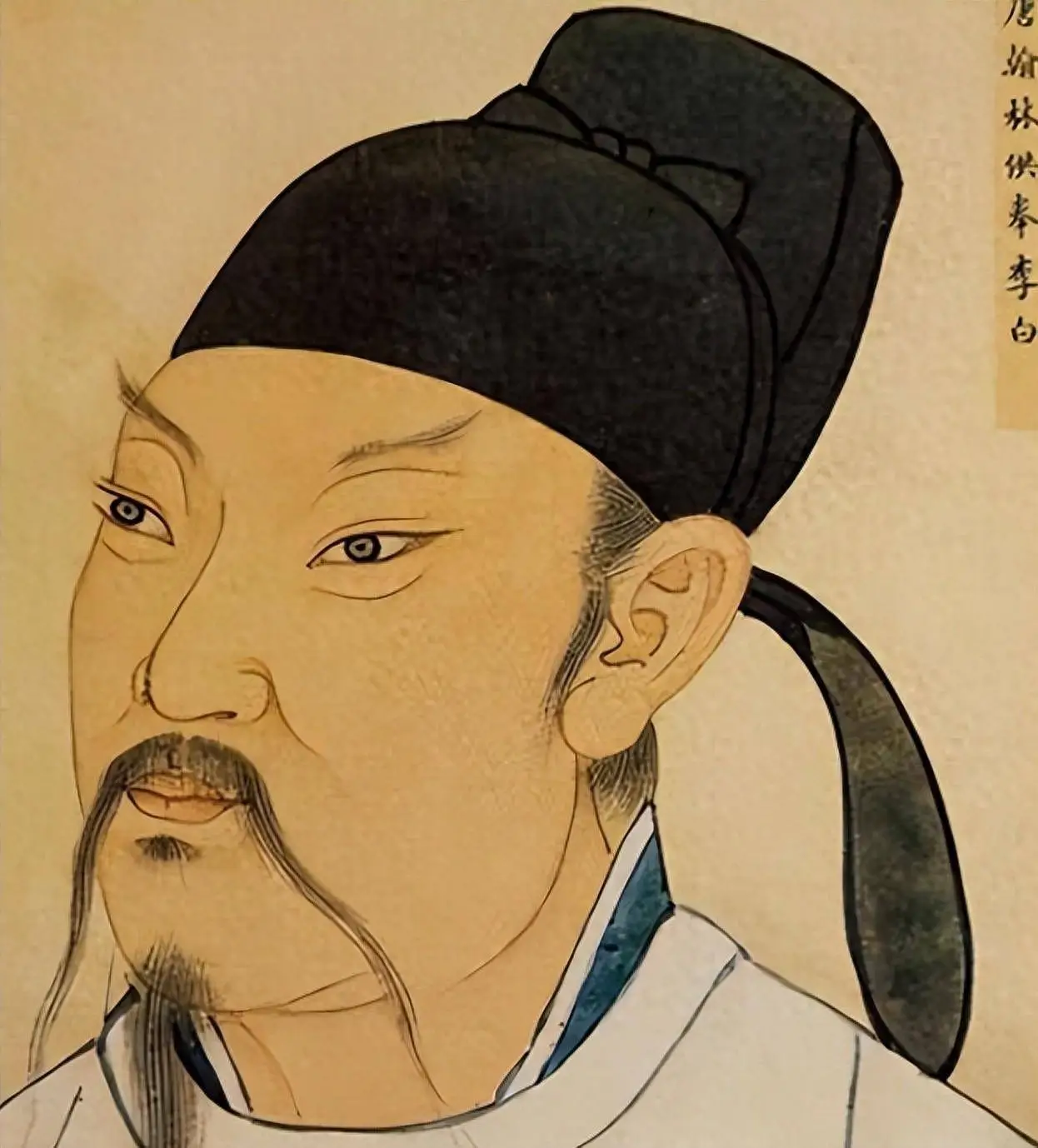
No poet in the Chinese tradition is so completely identified with a single image. Li Bai is the man with the wine cup and the moon, the genius who refused to be housebroken, who made the emperor's favourite eunuch pull off his boots and slept it off in a wineshop in Chang'an. About a thousand poems survive, and they are so consistent in voice that the voice has swallowed the man. He is remembered as a temperament rather than a career.
The record is stranger than the image, and sadder. He was born into a family that had been exiled to the western frontier for a crime nobody can now name and had come back to Sichuan under a false name. He was formidably educated and could not sit the examinations. He spent his twenties and thirties writing flattering letters to provincial officials — one of them is now among the most admired prose in the language — and most of them failed. At forty-two he was summoned to the court of Emperor Xuanzong, and in less than two years he was paid off and sent away. When the An Lushan rebellion broke the empire in half he joined the wrong prince, was imprisoned, was sentenced to exile on the far southwestern frontier, was saved by a drought, and died at sixty-two in a rented room in a river town with his manuscripts in a bundle beside him.
The poems are the point, but the life is the explanation. What follows keeps the two together: the man as the documents give him — disputed birthplace and all — and the poems as the thing he did with the failure.
1. The Family at the Edge of the Map
Nobody knows where Li Bai was born. On one side are the men who knew him. Wei Hao, who found him in 754 and travelled with him, wrote that "his body was born in Shu" — in Sichuan. Li Yangbing, the kinsman at whose house he died, wrote that the family had been exiled to the far west for a crime, had "fled home to Shu" in the Shenlong era — 705 — and that the child was named only after that return. On the other side stand later documents that place the family's exile at Suyab, a garrison town in what is now Kyrgyzstan, and a modern argument, made most influentially by Guo Moruo in a book of 1971, that Li Bai was born out there on the steppe rather than in China at all. It has arithmetic behind it: he was born in 701, the family came back in 705, and a boy of four or five is not an infant. It has no contemporary testimony behind it.
What the sources agree on is that the family was away, and had good reason not to be found. An ancestor had been deported westward for an offence at the end of the Sui; Li Yangbing puts the place of exile at Tiaozhi, Fan Chuanzheng at Suyab, the New Tang History only at "the Western Regions" — by the eleventh century nobody was sure either. The family changed its surname to hide. They came back in 705, when a general amnesty made it safe, and settled at Changming in Mianzhou, north of Chengdu. His father's name in the sources is Li Ke, and Fan Chuanzheng adds that this was not a name but a label: he had absconded from his district and "took 'guest' as his name." The household traded. That single fact explains more about Li Bai's career than any anecdote of his genius: the Tang state, in principle, did not admit the sons of registered merchants to office, and the door that ambitious men of his century walked through was closed to him before he was old enough to knock on it.
And so he claimed a different door. He was, he said, a descendant of Li Gao, the king of Western Liang, and so, at nine generations' remove, a collateral of the imperial house; the New Tang History calls him the ninth-generation descendant of Emperor Xingsheng, Li Gao's posthumous imperial title, as though the relationship had been certified rather than asserted. He could not document it and did not need to. It gave him a lifelong conviction that he belonged among the great, and explains the tone he took with princes and ministers: not a client, but a poor relation unjustly forgotten.
He was educated like an heir. He said of himself that at five he was reciting the primers and at ten had read the hundred schools, and that by fifteen he had a reputation among the great men of the region. In 720, when he was twenty, he met Su Ting, then chief administrator of Yizhou and the greatest official in the southwest, on the road and presented his work. Su Ting's verdict, as the New Tang History gives it, was that this boy was of extraordinary talent and that with more study he would equal Sima Xiangru, the Han poet and a man of Shu. Li Bai took the model and never let it go: the man of Shu who talks his way into the emperor's favour, is kept as a curiosity, is paid off, and writes out of the humiliation. He had been given the plot of his own life at twenty.
He also learned to use a sword, and studied with Zhao Rui, an expert in the lost arts of the Warring States persuaders — the discipline of talking a ruler into a career. He practised Daoist meditation and mountain retreats, and did not sit an examination, since he could not. Shu gave him his landscapes and his legends; he left it in his middle twenties and never came back, and the measure of what it meant to him is that in old age, hearing a cuckoo, he wrote the line any exile would recognize: he had heard that bird in Shu, and now he heard it in Xuancheng.
2. The Road Out
He left in the spring of 725, going down the Yangtze through the Three Gorges with a sword and, as he put it himself, taking leave of his family to wander far. He was twenty-five, and he had a plan: to meet the great, to be talked about, to be recommended, and to end up beside the throne. The first stage of the journey was spent with a friend, Wu Zhinan, drifting through the Xiang country and Dongting Lake; Wu fell ill and died on the road. Li Bai mourned him, sat with the body through the summer heat as it began to decompose, held his ground when a tiger came, buried him provisionally beside the lake, and years later came back, cleaned the bones himself and carried them home. It is the first sign of what makes him readable: he was not squeamish about the world.
He went east then, to the delta country, and spent less than a year in Jinling and Yangzhou being generous; by his own later accounting he gave away more than three hundred thousand cash to men down on their luck before falling ill there himself with nothing to show for it. In 727 he married into the Xu family at Anlu, in Hubei — a granddaughter of Xu Yushi, a chancellor under Emperor Gaozong. His own phrase for it, "the Xu household invited me and gave me a granddaughter in marriage," makes plain that he moved into her house rather than the other way round. It did not buy what he wanted. It placed him at the edge of a great family's connections, and the family was a generation past its power, and for thirteen years the Anlu period produced no office and not much else — though it did produce a home, a patient wife, and two children, a daughter named Pingyang and a son named Boqin.
What it produced in poetry was the letters. For a decade his method of looking for work was the formal petition, and he wrote a great many, to governors and censors and great families, each one praising his own talent and asking to be received. The most famous is the letter to Han Chaozong, governor of Jingzhou, written around 734 and still a set piece in Chinese prose anthologies; its opening is as naked a piece of self-advertisement as survives from the period: "I have heard that the way to be happy in this world is not to be made a marquis of ten thousand households, but only to know Han of Jingzhou." He follows it with his credentials in three strokes — "at fifteen I was good with a sword and went round the princes; at thirty I had made my writing and went up to the ministers" — and with an offer of service phrased as though the governor would get the better of the bargain. They are better read as a professional instrument, wielded by a man who had no other.
His first attempt on the capital came in 730. He spent a summer and autumn in Chang'an looking for an introduction and got as far as a villa of the emperor's sister, Princess Yuzhen, on Mount Zhongnan, where he waited, wrote poems about the rain, the crickets, the rusty knife in the kitchen and the absence of anyone who would speak to him, and was not received. He stayed another season, drank, gambled, kept the company of young men with fighting cocks and no prospects, and went home. This first journey was not in the old biographies at all: it was argued back into the record in the twentieth century out of his own poems, and is a reasonable reconstruction rather than a documented event. The pattern it established is certain, because he repeated it.
In 735 he travelled north to Taiyuan, and there, the New Tang History says, he saw a young officer named Guo Ziyi in the ranks, thought him remarkable, and got him excused from a punishment. Twenty-two years later, when Guo Ziyi was the most powerful general in China and Li Bai was under sentence of death for his part in the prince of Yong's rising, the general is said to have offered to give up his own office to buy the poet's life. The story is in the New Tang History and nowhere earlier. His wife died around 740; the marriage had lasted about thirteen years, much of it spent with him somewhere else. He left Anlu, took the two children, and moved east to Rencheng in Shandong, where he had relatives, friends, and the country of Lu to be a poet in.
3. An Immortal in the Palace
In the autumn of 742 the summons came. He was forty-two, and two routes are given for it. The New Tang History has him in the southeast with the Daoist master Wu Yun; when Wu Yun was called to court, Li Bai went with him and met He Zhizhang, the old poet who was then imperial librarian, who read his work and said the words that fixed him for the rest of history: "You are an immortal banished from heaven." The other route, commoner in modern accounts, is that the emperor's sister, Princess Yuzhen, had been recommending him for years. The two are not exclusive. What is not in doubt is the state of mind. He wrote a poem on leaving his children in the south, and it ends with the loudest line of self-congratulation in Chinese poetry: "Laughing aloud, I walk out of the gate; how could a man like me be one of the common herd?"
What happened in Chang'an was, by his own account and everybody else's, extraordinary. The emperor received him in the Jinluan Hall, questioned him about the affairs of the day, and then — the detail is in the New Tang History and repeated with relish by every later writer — gave him food from his own table and mixed the soup for him with his own hand. He was made a Hanlin attendant, and it is important not to inflate this: the post carried no rank. It was attendance on the person of the emperor, a literary companion who could be asked to write on command — a court poet with a salary and no portfolio.
The work he did there was exactly what the post was for. The three Qingping Melodies were written at the Aloeswood Pavilion, on an imperial outing to see the peonies in bloom, to be set to music on the spot and sung in praise of the woman beside the emperor; they compare Yang Guifei to the peonies, to clouds, and close by comparing her to the most beautiful woman in the Han palace, Zhao Feiyan. The Palace Pleasures were written the same way; the sources have the emperor, finding him drunk, ordering his face washed so that he could be handed a brush, after which he wrote without a pause — a very great poet doing an occasional job to the utmost of his ability.
The anecdotes began to accumulate almost at once. The best known is the boot. He was drunk in attendance on the emperor and called on Gao Lishi, the most feared man in the government, to pull off his boots for him. Gao Lishi, who had risen from nothing to a position even princes deferred to, took it as the insult it was and waited. The opportunity came with the peony poems: the New Tang History has him point out that the line about "Flying Swallow leaning on her new paint" made the emperor's living favourite into a dead usurper's consort, after which Yang Guifei, who had been delighted with the poem, blocked every promotion. The Old Tang History has the boot and the dismissal but not the plot: the poet, drunk in the audience hall, put out his foot for the eunuch, and was sent away for it. What the record will bear is narrower than the legend: he was disliked by the men nearest the throne and the woman nearest it, and made no attempt to be liked by them.
He also drank, continuously, in the plain and unliterary sense. Du Fu, in a poem listing the great drinkers of the age, gives him four lines that have outlived everything else about the court years: "A hundred poems to a single jug of wine, he sleeps it off in the market of Chang'an; the son of heaven calls him and he will not come aboard the boat — he calls himself a wine immortal." By the autumn of 743 the favour was cooling. In the spring of 744 he left, and the two histories disagree about how. The Old Tang History has him expelled; the New Tang History has him asking to go back to the mountains, the emperor granting it with a gift of gold — "granted gold and sent back to the hills," the phrase every later writer used. Wei Hao, closest in time, says flatly that he was driven out by Zhang Ji's slander, and that a post as imperial secretary, promised him, was never given. What is certain is the shape of the thing: he had been handed, at forty-two, the only opening of his life, and by forty-four it was shut.
4. The Long Decade
The year he left the capital, 744, was also the year he was ordained. At a Daoist temple in Qi he received the register of rites from the priest Gao Rugui — the full ceremony, which made a man a priest in his own right — and Wei Hao, seeing him a decade later, noted that he still kept the green silk cap and cape of the ordination. This was not a hobby: it gave him a second identity no court could take away and a language for the part of his mind that wanted out of the world altogether. Whenever the political career collapsed, the mountain was always there.
That autumn he met Du Fu, eleven years younger and not yet the author of anything anybody had noticed; the meeting is the most famous encounter between two poets in the language, and the account of it is one-sided. They travelled that autumn in the Liang and Song country with Gao Shi, the poet who was also a soldier, and met again the following year in the east of Lu. Du Fu wrote about it for the rest of his life: about the two of them sleeping under one quilt and going out hand in hand; about Li Bai in prison and exile, when the rumour went round that he had drowned; about the world wanting to kill him and only Du Fu pitying his talent. About fifteen of Du Fu's poems mention him. Li Bai's surviving poems to Du Fu are two or three, and one of them is a drinking song. The likeliest explanation is the least dramatic: Li Bai was the older and the famous one, and the manuscript tradition that preserved Du Fu's work was much better at preserving Du Fu's.
The company he kept was large, loose and mixed: officials, monks, Daoist masters, other poets, and a group of six in Shandong who called themselves the Six Idlers of the Bamboo Stream and met on Mount Culai to drink. Du Fu put him in the gallery of the Eight Immortal Drinkers, and the New Tang History gives those eight names too. He was in demand as a presence, and it paid: a poet of his fame could expect to be fed, housed and seen off with gifts by every great household along his route, and his poems were the fee — a career with no pension.
His domestic arrangements in that decade are known only in outline. After the death of his first wife he lived with a woman surnamed Liu, who left him, and then with a woman of Lu, who bore him a second son, Poli; neither was a formal marriage. In the early 750s he married Zong, a granddaughter of the chancellor Zong Chuke, executed as a partisan of Empress Wei in 710 — a great name in a ruined house, which is the position Li Bai had spent his life occupying from the other side. The story that she first met him by paying a thousand gold pieces for a tavern wall he had written a poem on is later anecdote, not contemporary record; what is on record is that she was with him in the crisis of 757 and lobbied for him while he was in prison. The poems he wrote to his children are among the few places where his voice loses its confidence. One of them imagines the two of them in Shandong by a peach tree he had planted himself and asks whether they still remember him. He had been away for three years. He very rarely went back.
The decade's geography is enormous. He went south into the Wu and Yue country, to the mountains of Zhejiang and the temples of the southeast, and he went up famous mountains and wrote the poems that made them famous. One acquaintance of those years, Wang Lun, is supposed to have lured him to a place in Anhui with a joking invitation and been given, in farewell, the line that the water is a thousand feet deep and still not as deep as the feeling.
And in 751 he went north. He left the Kaifeng country in the autumn, travelled the better part of a year through the Hebei plain, and in 752 reached Youzhou, the modern Beijing region, base of the three frontier commands — Fanyang, Pinglu and Hedong — held by An Lushan, then the most powerful soldier in the empire. His own line about arriving is "in the tenth month I came to Youzhou, spears and halberds like scattered stars," and the poems he wrote there, about frontier cavalry in tiger-skin caps and the hunting, are admiring: the frontier is a place where a man like him might still matter. It has become a settled modern claim that he went north to spy on An Lushan and came back knowing a rebellion was coming. The evidence is a passage in a very long autobiographical poem written in 759, after the rebellion had destroyed half the empire, in which he says he knew what could not be said and dared not draw his bow — which is what a man says afterwards. At the time, what the poems show is a poet of fifty-two looking for a patron on the frontier, watching a great army drill, and going home without one. Three years later the rebellion started.
5. The Prince of Yong
In the eleventh month of 755 An Lushan rose at Fanyang with the three frontier armies behind him, and the Tang order broke. The rebels were in Luoyang by the first month of the new year. In the sixth month of 756 they took the Tong Pass, the fortress that covered Chang'an, and the emperor fled west to Sichuan. Xuanzong's son declared himself emperor at Lingwu in the northwest; his father, in Chengdu, became the retired emperor. Two courts existed at once, and neither could quite say what the other was.
Li Bai was in the south when it began. He took his wife out of the fighting and drifted, and finally went up the Yangtze to Mount Lu and into retreat on a ledge of rock above the river. He had been a Daoist priest for twelve years by then, and he was fifty-six, and he had spent his whole adult life saying he was waiting for a chance to be useful. The chance came from a prince. The fleeing Xuanzong, before he had conceded the throne, had divided the empire among his sons; the sixteenth, Li Lin, the prince of Yong, was made military governor of the four southern circuits with his seat at Jiangling, and he raised troops and a river fleet. The new emperor in the north, unwilling to let his brother keep an army in the richest part of the country, ordered him to hand it over and come west alone. The prince did not. In the twelfth month of 756 his flotilla moved down the Yangtze toward Guangling, and he sent three successive invitations up the mountain to the most famous poet in China.
Li Bai came down and joined his staff, and the poems he wrote on the way down are the evidence of what he thought he was doing. In the Songs of the Prince of Yong's Eastern Progress he imagines the fleet sweeping the rebels out of the north and the emperor entering Chang'an in triumph, and he puts himself in the middle of it as the strategist who does the work without moving: "Only use me as Xie An of the Eastern Mountain, and I will settle the dust of the barbarians for you, laughing over a game of chess." It is the oldest fantasy in his repertoire — the great man in retirement who is finally called for — and he wrote eleven poems of it, which is what makes the episode painful rather than merely unlucky. The modern argument that he was a dupe rests on the politics: the division of the regions among the sons was a real edict, and the case against the prince was made by a brother who wanted his army. In 762, a month after coming to the throne, Emperor Daizong issued a general amnesty in which the prince of Yong and everyone entangled in the charges against him were cleared together. But whatever the law was, the poems show a man who believed he had been handed the great moment of his life.
The campaign lasted a few months and ended in something close to farce. The prince's own commanders began deserting — one of them took six thousand men and rode away — and the government force facing him then lit two torches for every man along the north bank one night, so that the reflections doubled its apparent size in the water and the prince believed the imperial army had crossed. He took his household and fled south. He got as far as the pass at Dayu in the far south before the Jiangxi commissioner caught him in the second month of 757 and killed him, under circumstances the emperor made a show of deploring. Li Bai fled south with the wreckage. He was taken at Pengze and imprisoned at Xunyang. His own account, written two years later, is that he was not a volunteer at all: "At midnight the river fleet came; Xunyang was full of banners. A hollow name was my undoing; they pressed me aboard the tower ship. They merely gave me five hundred in gold, and I threw it away like smoke." Whether that is the truth or a lawyer's drafting is impossible to determine.
He was in the Xunyang jail through 757 while the government decided what to do with a famous man who had joined a failed prince. His wife lobbied; the commissioner for the region, Cui Huan, and the censor Song Ruosi worked on his behalf; Song, on his way west with three thousand troops from the Wu country, stopped at Xunyang, took the prisoner out of jail and made him his military secretary. He went with Song to Wuchang and fell ill at Susong. Neither the rescue nor the petitions changed the verdict. He was sentenced to long exile at Yelang, in the far southwest — technically a survival, in practice a sentence to die on the road. The New Tang History adds that the first finding was death, and that Guo Ziyi, whose life he had saved in Taiyuan twenty-two years earlier, offered to surrender his own office to redeem him, whereupon the sentence was commuted. It is a good story and only one source has it. What is not in doubt is the arithmetic: a man of fifty-seven when the sentence was passed, in poor health, sent a thousand miles beyond the last garrison town with no date of return.
6. Yelang
He left Xunyang for Yelang in the spring of 758. His wife's brother escorted him part of the way; his wife did not come. The route ran down the Yangtze to Jiangxia, then upriver through Jiangling and into the Three Gorges as winter closed on the river — the gorges he had gone down as a young man with a sword, now going the other way. Yelang lay in what is now northern Guizhou, beyond the last garrisons, a country of mountains no administration of the empire ever really governed. The poems of the journey are the bleakest he wrote: water without end, the songs of the boatmen, hair going white in a place where nobody would find it.
In the third month of 759 the government, facing a drought, proclaimed a general amnesty, releasing everyone whose sentence was below death. The order reached Li Bai on the upper river, before he had arrived anywhere; he turned around and went back down. The poem he wrote on the return, Early Departure from Baidi City, is twenty-eight characters long and the most famous quatrain in the language: he leaves in the morning amid the coloured clouds, the river is a thousand miles and the journey home takes a day, the gibbons on both banks are still calling when the light boat has already passed ten thousand mountains. Everything in it is speed: two years of disaster, prison and exile compressed into four lines of pure motion, with nothing in the poem that acknowledges them. It is not gratitude, not relief, not reflection, but the sensation of a man moving faster than his own history.
The years after the amnesty he spent drifting down the middle and lower Yangtze, and they produced some of the strongest poems he wrote. He stayed with Wei Liangzai, the governor at Jiangxia, and wrote him the longest poem he left, an autobiography in eight hundred and thirty characters, which contains the "clear water and lotus" line that became the standard description of his style. He went back to Xuancheng and Jinling and lived on the hospitality of men who remembered him. He was nearly sixty, with no money, no office and two children he rarely saw, and he was still, in the same letters and petitions, asking for a post. The begging did not stop — the part of him the tradition tends to edit out, and the part that explains the rest: the enormous poems about immortality and wine are the work of a man who spent forty years trying to get a job in the government.
Late in 761 he heard that Li Guangbi was taking a great army east against the remaining rebels, and he set out for the front. He was sixty-one. He got as far as Jinling before he turned back, ill, and the poem he wrote about it is a complaint that a man who still knows which end of a sword to hold has been left out of the last campaign of the war. He was not a soldier and never had been, but at the very end, sick and penniless and past any chance of a career, he tried to go to the war. He turned back anyway, and went instead to Dangtu, a river town down the Yangtze, where a kinsman of his, Li Yangbing, was the magistrate.
He reached Dangtu at the end of 761 and was ill there for a year. The poems he wrote that winter are those of a man settling accounts: the mountain climb on the Double Ninth with the whole wasted life in front of him; a small poem about a flower, written the day after and titled with the date, as though he needed to prove he was still alive. Then he worsened. Li Yangbing, writing his preface in the eleventh month of 762, says he himself was on the point of giving up his post, "and the duke was taken gravely ill; his manuscripts were in ten thousand rolls and his own collection had not been made. He handed me the slips from his pillow and told me to write the preface." A day or two before or after, he wrote a last song about a great bird that flies up and shakes the eight quarters and is struck down at mid-heaven with its strength gone. He died at Dangtu in 762.
The cause of death is not settled and never will be. The Old Tang History says he drank too much and died of it at Xuancheng; Li Yangbing's word is simply that he was gravely ill; the late-Tang poet Pi Rixiu gives the disease the name by which it is usually known, "the rotting flank," which modern medical historians read as chronic empyema. Then there is the version everybody remembers: that he was out on the river in a brocade robe one night, drunk, saw the moon's reflection, reached for it, and went over the side. It appears in a tenth-century collection of anecdotes and was fixed in verse in the eleventh — not a false account but a true one of a different kind: the story a country tells about a poet when it has decided what he was. The two histories' disagreement about where he died dissolves. Dangtu was a county inside Xuan-cheng prefecture, so "died at Xuancheng" and "died at Dangtu" are the same sentence at two scales.
In the fourth month of 762, while Li Bai was dying in the river town, Emperor Suzong died and his son Daizong came to the throne; in the fifth month the new emperor declared a general amnesty, and among its acts were the rehabilitation of the prince of Yong and of everyone caught up in the charges against him. The New Tang History adds the sentence that closes the story: the throne summoned Li Bai to be a remonstrance official, and he was already dead. Posterity has sometimes called him Li the Remonstrator for an office he never held. He was buried that year east of a hill at Dangtu; fifty-five years later a regional commissioner, who had gone looking for his descendants and found two granddaughters married to farmers, moved the grave to the sunny side of the green hill, where they said their grandfather had wanted it.
7. The Wine and the Moon
About a thousand of his poems survive, and they are not the poems of a career. The forms he worked in were the old ones: the yuefu ballads, the long "song" style used for narrative and lament since the Han, and the short regulated quatrain. He was not an inventor of forms; what he had was an ear for the long line's momentum and an absolute command of the quatrain's last line. In the four-line form he is generally allowed to be the equal of anybody who wrote in Chinese: the third line turns, the fourth opens, and the whole thing lands somewhere the reader was not.
The subject matter runs narrower than his reputation suggests. He wrote about mountains and rivers, about parting from friends, about wine, about the moon, about the desire to be used by the state and the equal and opposite desire to walk away, about immortals and the absurdity of dying. What he wrote very little about is the ordinary suffering of his age. The rebellion killed millions and destroyed the north; Li Bai's poems about it are fewer and thinner than one would expect from a man who lived through the whole of it. Du Fu's poems from the same years are an inventory of what the war did to particular people; Li Bai's are mostly the record of what the war did to him. The charge is true, but it is not the whole account of what poetry is for.
The technique that carries it is scale. Li Bai's poems move distances other poets do not attempt: a mountain road harder to climb than the sky, a waterfall falling from the Milky Way, a wine cup that will make a hundred generations of sorrow go away. Hard Roads in Shu — the poem about the road to Sichuan, which begins with an exclamation, calls up the legendary kings who cut the mountains open, describes a ladder of planks across a cliff, and ends by warning a traveller to turn back — has no moral and no resolution, and it was written by a man who had left Shu and refused to go back. The exaggeration is not decoration. It is the only scale on which the feelings inside the poem are the right size.
Wine in his poetry is not a prop and not an anecdote. It is a method of accounting. Bring in the Wine is built on the proposition that the only rational response to the brevity of a human life is to spend everything immediately: the Yellow River flows into the sea and does not come back, a man's white hair turns black at dawn and white again by evening, and therefore the thing to do with a thousand pieces of gold is to scatter it, because it will come back. The famous couplet — "Heaven gave me my talents, they must be of use; a thousand pieces of gold scattered, they come back again" — is usually quoted as bravado, and in the poem it is closer to an argument: that the world's economy of reward and punishment, in which he had failed for twenty years, is simply the wrong economy. And the poems do not pretend the wager is safe: they know the account is not settled, and that not counting is a decision made over and over against evidence.
The other great subject is solitude, and the figure for it is the moon. In the most famous of his drinking poems he sits alone with a jug and, finding no one to drink with, invites the moon and his own shadow — which makes three, though the moon cannot drink and the shadow only imitates him — and makes a date with both of them to meet again beyond the sky. It is a poem about company that is not there, comic before it is sad and neither by the end. He talks to the moon as to a friend who has been with him everywhere; it is the one thing in his poems that is always the same, and his life was a record of enormous distances, so the moon is the connecting thread. The legend that he died reaching for it is not a stupid legend. It is the audience's summary of what his poems are like.
And running under all of it is the "I." Li Bai's speaker is the most conspicuous figure in Chinese poetry — not a modest observer but a man announcing his own size in a landscape, comparing himself to Xie An, to a great bird, to the magicians of the mountains. He asks the reader to believe that his brush "shakes the five sacred mountains." This is why he is the most quotable and most misquotable poet in the tradition, and why a modern reader is likely to find him off-putting at first and, after a hundred poems, to accept it as the deliberate construction of a self rather than vanity. The poems are full of the awareness that the magnificent figure in them is a performance, which is why the honest poems about failure hit as hard as the loud ones.
8. What He Was Made Into
He very nearly did not survive as a poet at all. Li Yangbing says in his preface that in the eight years he had been a refugee from the troubles in the Central Plain, nine parts in ten of what Li Bai had written had been lost, and that most of what he had came from other people; Wei Hao had made a collection the year before, from material the poet gave him directly. Those two collections are the whole foundation. In 998 Yue Shi joined Li Yangbing's ten rolls to ten more he found, making a collection of 776 poems; two generations later Song Minqiu gathered more — a minister's family collection, a copy of Wei Hao's, poems preserved in anthologies and on stone — and brought the count to 1,001 poems and sixty-five pieces of prose in thirty rolls, which Zeng Gong then put in order. The manuscript a dying man handed over on a pillow in a rented room is the reason there is a Li Bai — and it explains the thing that puzzles readers, that his last years produced some of his strongest poems.
What the dynasty did with him afterwards is another matter. About seventy years after his death, in the reign of Emperor Wenzong, the court issued a decree naming the three perfections of the Tang: Li Bai's poems, the sword dance of Pei Min, and the cursive script of Zhang Xu. He was officially filed beside a swordsman and a calligrapher as an example of a great art — a fair summary of what he had been to the palace. The name He Zhizhang had given him in 742 — the banished immortal — turned into a whole personality: the Poet Immortal, the Wine Sage, the man who could not be employed. The boots, the moon, the brocade robe on the river, the emperor mixing his soup, the hundred poems to a jug of wine, all hardened into a character type that Chinese culture has used ever since for the artist who belongs to no institution. The personality is not a lie. It is a selection, and it selected almost entirely the poems in which he was magnificent and very little of the record of a man who spent four decades asking for work.
There has always been a counter-tradition, and it deserves its hearing. From the Song onward, critics who preferred Du Fu — who was made into the Poet Sage and whose reputation rose steadily until it passed Li Bai's — argued that Li Bai was brilliant and irresponsible: that he wrote about immortals and drinking while the country was being destroyed, that he took no interest in the poor, that his politics were a young man's fantasy of being summoned. One thirteenth-century critic, Luo Dajing, wrote the sentence later ages kept quoting back at him: that he was all gallantry and bravado, drunk among the flowers and the moon, and that "the altars of the state and the common people never entered his heart." As a description of the poems it is partly true; as a description of the man it is false: he joined the only government-in-waiting available to him in 756 because he wanted to fight the rebels, and tried to join the army again at sixty-one, and both attempts ruined him.
His influence was enormous and, in an important sense, unusable. Su Shi, three centuries later, held both ends of it at once: he could say that Li Bai and Du Fu between them had "bestridden a hundred generations, so that the poets of all ages were done away with," and also call Li Bai "a madman" who had "forfeited his integrity with the prince of Yong," though he held the prince affair to have been forced on him. But he would not allow the sneer: to make the most feared man at court pull off your boots in the audience hall was, he wrote, proof of a spirit that "covered the empire". What could be borrowed from Li Bai was not the technique but the ambition, the willingness to make a poem out of the largest feeling available and trust the reader to follow.
The honest verdict is that he was not a statesman, not a philosopher, not a moralist and not a sage, and that the attempt to make him one is what has made him boring to some readers. He was a man of very great literary talent, a compulsive and self-dramatizing user of other people's hospitality, a bad husband by any measure and an affectionate father by his own account, a competent swordsman, a genuinely ordained Daoist priest, and a failure at the only career he ever wanted. The failure is not incidental to the poems. It is the engine of them. The poet who wrote that heaven had made his talents useful had spent twenty years being told they were not, and the poems that say so are the ones that have kept him alive in the language.
He asked the question himself in the last poem, the song about the great bird struck down in the middle of the sky. Its closing line is an admission that he did not know whether anyone would be left to receive what he had made: "Later men will get it and pass it on — but Confucius is dead, so who will weep for me?" He was sixty-two, in a rented room at Dangtu, with his manuscripts in a bundle on the bed, and his grandchildren would be farmers' wives whom a commissioner would have to go looking for fifty-five years later. The answer took twelve centuries, and it is the one thing in this life that came out the way he wanted. He was wrong about the careers, wrong about the princes, wrong about the frontier, and wrong about almost everything he believed concerning what he was for. The poems survive. That is all any of it was for, and it is the largest thing any of the men around him produced.