Home / Emperors / Qin Dynasty
Qin Shi Huang
秦始皇
Ying Zheng, 259 – 210 BC · First Emperor
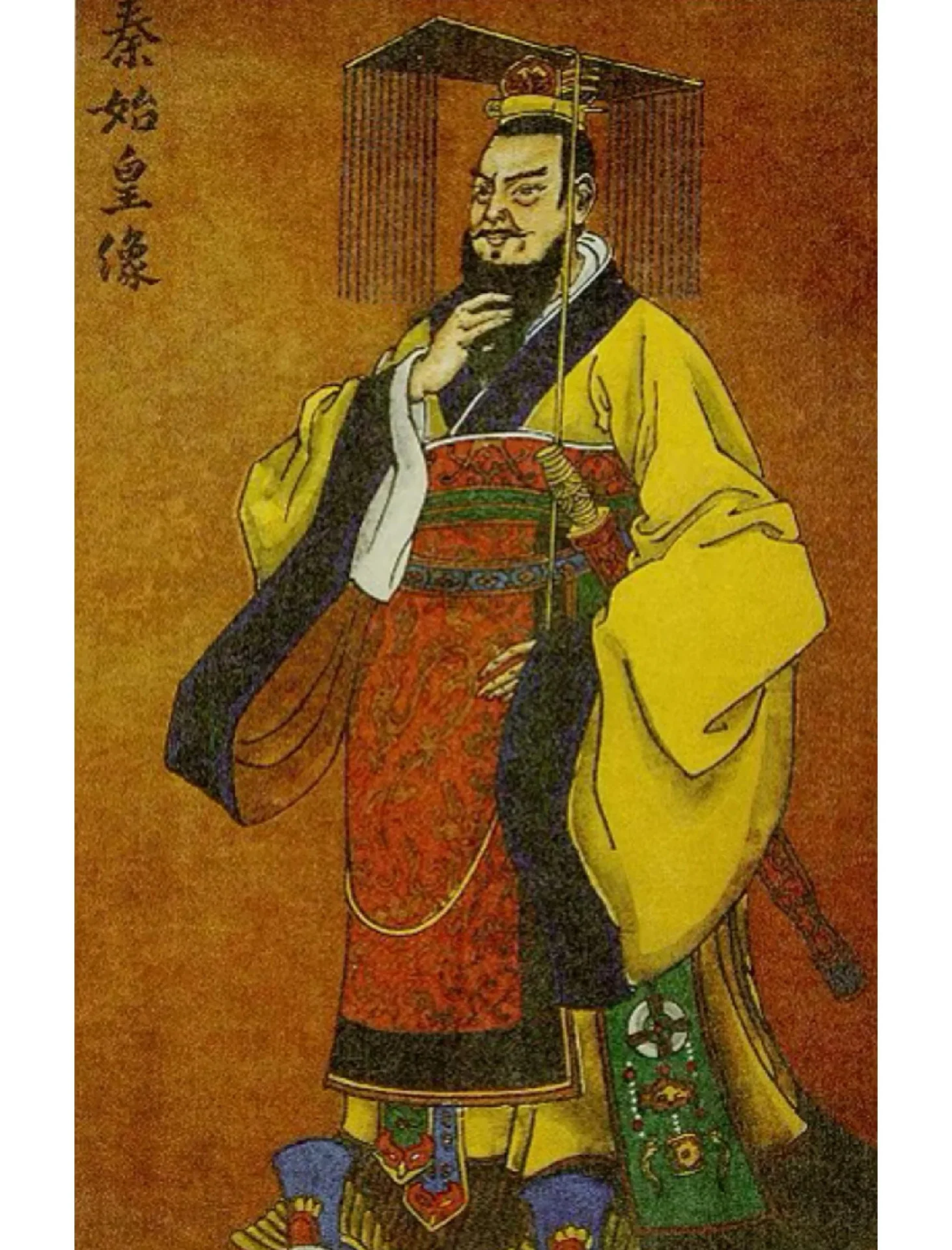
In 221 BC a king of the western state of Qin finished a war that five centuries of fighting among the Chinese states had failed to settle. One by one the rival kingdoms that had divided the Zhou world since its collapse were extinguished, and for the first time a single ruler claimed authority over the whole settled heartland. He did not take the title of king. He invented a new one, by taking one word from the phrase his ministers had proposed, another from the titles of high antiquity, and joining them.
The word was huangdi, and the arithmetic of it mattered. Huang, the august, belonged to the Three Sovereigns of legend; di, the divine ruler, to the Five Emperors of high antiquity. Joined and prefixed with shi, first, it announced a sovereign greater than the sage-kings of the past — later ages called him Qin Shi Huang, the First Emperor of Qin.
He reigned over a united China for eleven years, and those eleven years rearranged the country more thoroughly than any comparable span in its history: the script in which these words are written, the administrative map of China, and the assumption that a shared cultural world should also be a single state under one law all descend from them. The same years produced a record of forced labour, censorship and mass execution, assembled almost entirely by the dynasty that overthrew him. He is at once the founder of the Chinese state and its most notorious tyrant, and the two descriptions come from the same facts.
1. A Hostage's Son, a Regent, and a Coup (259 – 235 BC)
The child who became the First Emperor was born in Handan, the capital of the state of Zhao, in 259 BC; some sources give 260, and the year has never been settled. That he was born in Zhao rather than Qin was a product of the diplomatic customs of the Warring States: princes were kept at foreign courts as pledges of good behaviour, and his father, a Qin prince named Yiren, was such a hostage when the boy was born. The position became dangerous before the birth. In 260 BC Qin destroyed the army of Zhao at Changping and, by the Records of the Grand Historian's traditional figure, buried four hundred thousand of its soldiers alive.
The family escaped through a wealthy merchant named Lü Buwei, who had attached himself to the obscure prince and was betting his fortune on him. Sima Qian tells the story as commercial calculation: Lü Buwei called the prince a strange commodity worth hoarding. He also records a second story, one that followed Zheng for two thousand years — that Zheng's mother, known as Zhao Ji, had been Lü Buwei's own concubine and was already pregnant by him when he presented her to Yiren, so that the child born at Handan was the merchant's son and the First Emperor the biological son of a tradesman.
Modern historians almost universally treat that as hostile invention. It is delivered inside the Records itself as hearsay, and it does the work a slur needed to do in an age when merchants ranked near the bottom of the social order. What happened to Zheng is not in doubt. His father became king of Qin in 250 BC, with 249 BC counted as the first year of his reign, and died in 247 BC after a reign of three years. Zheng succeeded him at the age of thirteen, with 246 BC counted as the first year of his own reign — the same convention, and the reason the same accession is dated to two different years in different accounts. Government passed to Lü Buwei, made chief minister and given the title second father. For the eight years that followed, the boy was a figurehead, and the men who governed in his name were the men he would have to destroy.
Lü Buwei governed well and conspicuously. His most durable act was a book: he assembled a household of scholars and commissioned the Spring and Autumn Annals of Mr Lü, and in 239 BC had it displayed at the capital's market gate with a thousand pieces of gold hung above it for anyone who could add or remove a single word. The trouble came from the palace, and out of his own arrangements. Zheng's mother, the queen dowager Zhao Ji, had taken a lover named Lao Ai, whom Lü Buwei had introduced to her and passed off as a eunuch. The affair was not merely scandalous but dynastic: she bore him two sons and hid them. Lao Ai was made marquis of Changxin with lands in Shanyang and Taiyuan, kept retainers in the thousands, and the Records says that affairs great and small in the palace were decided by him.
In 238 BC Zheng went to Yong, the old capital, to be capped and to take up the sword — the ceremony that made him a man and, in principle, a ruler. Lao Ai seized the king's seal and the queen dowager's, used them to call out the garrison troops, the palace guards and his own retainers, and marched on the Qinian Palace. The plot failed within days. Zheng ordered the troops of Xianyang, under the chancellors Lord Changping and Lord Changwen, against him; the fighting was in the streets of the capital and a few hundred men were killed. Lao Ai was taken and torn apart between chariots, and his clan was exterminated. Twenty senior officials were beheaded, the queen dowager's two sons were killed, and more than four thousand households of Lao Ai's retainers were stripped of rank and deported to Shu.
Then came the settlement of the household. The queen dowager was sent away to Yong, and the following year a man from Qi named Mao Jiao pointed out that a king who advertised himself as the man who would settle the world could not afford a reputation for having banished his mother, so Zheng brought her back to Xianyang. The chief minister did not fare as well. Lü Buwei was implicated in the affair he had arranged and dismissed in 237 BC; two years later, after Zheng sent him a letter that the Records preserves — pointed questions about his services and his rewards that amount to an instruction — he drank poison and died. Zheng was in his early twenties, and had in three years destroyed a lover, a faction, a chief minister, and the only man alive who could plausibly claim credit for his throne.
2. The Destruction of the Six States (236 – 221 BC)
Zheng inherited the strongest state in China, and its strength was a century and a half old. The reforms of Shang Yang, who had reorganised Qin's land, its army and its law in the middle of the fourth century BC, had turned the state into a machine for producing soldiers and grain: land registered to individuals and taxed directly, ranks of nobility awarded for enemies killed, laws published and applied to noble and commoner alike. The plan that destroyed the other six is credited to Li Si and to a strategist from Daliang named Wei Liao, who advised the king not to grudge money: buy the ministers of the rival courts, he said, and for three hundred thousand in gold the other kings could be had.
The sequence began in 230 BC with Han, the smallest and most exposed of the six; its territory became Yingchuan commandery. Zhao was the harder problem, and it was solved by purchase rather than battle: its general Li Mu had beaten Qin's armies repeatedly, so Qin's agents paid a favourite of the Zhao king to persuade him that Li Mu meant to sell the kingdom, and the general was killed. In 228 BC the Qin army under Wang Jian took the Zhao capital at Handan and captured the king. What followed was an act of resistance that Chinese memory never let go. In 227 BC an envoy from Yan named Jing Ke came to the Qin court with the map of the territory his king was prepared to cede and with the head of a Qin traitor who had taken refuge there; rolled inside the map was a dagger. He got close enough to seize the king's sleeve and strike, and the king escaped only because a Qin statute allowed the attendants in his hall to carry no blade of any size. Yan's capital fell the following year, and its king fled northeast, offering up the head of his own son, who had planned the attempt.
The end came quickly. In 225 BC Wang Ben, the son of Wang Jian, took Wei by turning the waters of the Yellow River into the moat of its capital at Daliang; after three months the walls gave way and the king of Wei surrendered. Chu, the largest state in the south, went wrong first. Zheng asked the veteran Wang Jian how many men he would need and was told six hundred thousand by the Records' count, then asked a younger general named Li Xin, who said two hundred thousand would do. He gave the command to Li Xin, whose army was broken by the Chu general Xiang Yan. Zheng travelled to the old general's estate in person to ask him to take the field again, and gave him the six hundred thousand he had asked for. Wang Jian refused to fight for a year, drilling his men while the Chu army wore itself out waiting, and then destroyed it. By 223 BC the Chu capital had fallen, its king was a prisoner and Xiang Yan was dead. In 222 BC Wang Ben finished what was left of Yan and destroyed the rump state of Dai; in 221 BC he took Qi, the last of the six, whose king surrendered almost without a battle. Nine years, six states, and the Warring States period was over.
3. The Word Huangdi (221 BC)
The first act of the new reign was an argument about a word, and the emperor decided it himself. His ministers reported that the kings of antiquity had used no title higher than di, that the most exalted of the legendary rulers had been the Grand August, and that he should therefore be styled Grand August. Zheng struck out the first character. He kept huang, kept di, and joined them: emperor. The formula he decreed was Shi Huangdi, the First Emperor, with his successors numbered Second and Third in a line that would run, in the words the Records preserves, to ten thousand generations. The same edict abolished the posthumous name: to let a son judge a father and a subject judge a lord was, he said, pointless. The titles of Chinese emperors are normally the invention of their successors. His is his own.
The second argument was more consequential, and the emperor decided it against his chief minister. The chancellor Wang Wan proposed that Zheng follow the Zhou and enfeoff his sons as lords over the conquered east, on the ground that a distant frontier could not be held without kinsmen in it. Li Si, then commandant of justice, opposed him: the Zhou had enfeoffed their kin, and within a few generations those kin had grown so distant that they fought like enemies, so that the Zhou's own vassals destroyed the Zhou. Zheng agreed, and the empire was cut into commanderies and counties, each administered by officials appointed by and answerable to the emperor, and moved on from their posts. The Records says thirty-six commanderies were established, and the figure is probably a round number: the Book of Han repeats thirty-six, and Qing and later scholars have argued for figures as high as forty-eight. Excavated documents have shown the received list to be incomplete. Bamboo slips recovered in 2002 from a well at Liye, in Hunan, mention a commandery no received text records — Dongting — and seals and slips have since produced others. The real total was somewhere near fifty.
With the structure came a set of claims about what the dynasty was. Qin's theorists held that dynasties ruled under the sign of one of the five powers of the natural world, and that Qin's was water: the colour was black, the number was six, and the court adjusted its dress, its flags, its standards, its carriages, its teams of six horses and its calendar accordingly. The weapons of the defeated states were gathered in the capital and melted down, and the metal was cast into twelve colossal human figures set up in the palace courtyards. One hundred and twenty thousand of the wealthiest families in the empire were moved to the capital region, where they could be watched and where their local power would starve for lack of them.
4. The Machine of Uniformity (221 – 212 BC)
The programme's own name for itself was tong, making things the same, and it began with measurement, where the evidence is unusually good because the instruments survive. In 344 BC, in the administration of Shang Yang, a bronze vessel had been cast and inscribed to fix the size of a sheng: sixteen and one fifth cubic cun. Because the vessel's internal dimensions were cut to that definition, measuring it recovers the length of the Qin foot — about twenty-three centimetres — which is otherwise unknown, since no Qin ruler has ever been excavated. In 221 BC a second inscription was cut into the vessel, a forty-character edict announcing that the emperor had united the world and ordering the two chancellors, Kui Zhuang and Wang Wan, to make uniform all weights and measures wherever any discrepancy was suspected. The unification was therefore less a reform than an export: Qin had had this system for a hundred and twenty-three years and now imposed it on everybody else.
The instruments were mass-produced and distributed. Bronze weights bearing the same forty-character edict have been recovered from sites across the former empire, along with standard measuring plates and imperial standard vessels cast to the same specification. That the state expected its own officials to keep the kit honest is in the law: the Qin statutes recovered in 1975 at Shuihudi, in Hubei, include a section on checking that specifies the permitted error on service weights and measures, with penalties for officials who let an instrument drift out of tolerance. The same logic was applied to money: the competing currencies of the Warring States gave way to a single coin, round with a square hole in the middle and inscribed with its nominal weight of half a liang, and coinage was in principle reserved to the state.
If weights could be standardised, so could writing, and here the record is fuller and the reality more complicated. The empire adopted the script of Qin — the form later called small seal — as its official hand, and the primers for it were written by the highest officials in the government, Li Si among them. The empire made the claim for itself on its monuments: the inscription cut into the rock at Langya, on the Shandong coast, in 219 BC, boasts that the empire is one in which weapons and instruments have a single measure and writing a single script. The archaeology complicates the boast. The Qin documents that survive on bamboo and wood, everyday records rather than monuments, are written overwhelmingly in the fast, semi-cursive hand we call clerical script, not in the elegant seal form of the steles. The standardisation of writing was a direction rather than an event, and much of what is meant by it was carried through by the dynasty that followed.
The roads carried the standards and the armies. The sources describe a network radiating from Xianyang: the chi dao, or speedways, running east and south; a five-foot way cut into the mountains of the southwest; and, most remarkable, the zhi dao, the straight road, begun in 212 BC and driven north from the capital region to the frontier at Jiuyuan, near modern Baotou. Its line has been traced for 498 kilometres inside Shaanxi alone. Where it crossed the Fuxian district it ran thirty to forty metres wide and in places fifty-eight, built by cutting away one side of a ridge and levelling the cut — what the Records calls cutting the mountains and filling the valleys — and a 2009 excavation at a river crossing there exposed the road surface, more than twenty cart ruts, and twenty-one human footprints, those of an adult man, of women and of a child. It stayed in use into the Han and beyond. What is more often asserted than demonstrated is the standardisation of vehicles. The sources say the empire's carriage wheels were six feet apart and that the roads were made so that carts should have the same track; the ruts at Fuxian, measured against each other, come in three different gauges, 110, 130 and 140 centimetres, which is not what a single standard looks like. Unlike the weights, the coins and the road beds, the story of the wheel gauge has no artefact to confirm it and one set of road evidence against it.
5. The Wall, the River Bend, and the South (215 – 213 BC)
Zheng's frontier problem was the steppe, and in 215 BC he moved on it. The Xiongnu, a confederation of pastoral nomads to the north, had been pushing their herds into the fertile loop of the Yellow River that the Chinese called the Ordos — land that Qin and Zhao had each claimed and each lost. The emperor sent a general named Meng Tian north with, by the Records' count, three hundred thousand men, and Meng Tian drove the Xiongnu out of the river bend and across the desert. The line he established was held by walls. Qin did not invent them: Qin, Zhao and Yan had each raised long rammed-earth ramparts along their own northern borders decades earlier, and what Meng Tian's men did was connect and extend them into one system, running, in Sima Qian's phrase, more than ten thousand li from Lintao in the west to Liaodong in the east. Field survey has confirmed the shape of the thing: an earthen rampart rather than a brick one, running north of the line the Ming would later build. The stone wall that visitors walk today is largely Ming work, fifteen hundred years later, and the impression that the First Emperor built the Great Wall owes more to those walls than to anything Qin constructed.
The Records gives no casualty figure for the work; it gives Meng Tian's army at three hundred thousand and says nothing about how many of them died in it, which is itself telling, since the rampart was raised by soldiers, convicts and conscripts working in frontier winters at the end of a supply line. What China did with the memory was to attach a story to the wall. The tale of Meng Jiangnu, the woman whose tears brought down a section of it as she searched for her husband's bones, is not a Qin story at all: its original form is a Spring and Autumn anecdote about a woman whose husband had died in a distant war, in a state far to the east, with no wall in it. Over the centuries the tale migrated onto Qin's wall, because it supplied what the record did not. The grieving wife is not evidence of harsh labour; she is evidence of what later ages assumed it must have been like.
The south was a different problem: not a line to hold but a country to take, and it went badly at first. In 214 BC Qin's armies crossed into the land of the Yue, in what is now Guangdong, Guangxi and northern Vietnam, and a Han account of the campaign says that the commander, a man named Tu Sui, was killed and that the terrain and the diseases of the region did his army more damage than the enemy did. Qin held the ground by settling it — garrisons, colonists, and a canal to move grain — and set up three new commanderies, Nanhai, Guilin and Xiang, along the coast and the rivers of the far south. One of the officers who stayed behind was a man named Zhao Tuo, who would be heard from again: when the empire fell he made himself king of the south, and the Han would spend half a century dealing with him. The pattern repeated what Qin had done everywhere: roads and canals first, then walled county seats, then officials, registers, taxes and conscription. The price was paid by the men sent there: of all the categories of Qin service, the posting to the far south was the one most people did not come back from.
6. The Slips in the Well: What Qin Law Actually Was
In December 1975 a work crew digging an irrigation channel at Shuihudi, near Yunmeng in Hubei, cut into a patch of grey soil that did not match the ground around it, and the archaeologists who came found twelve small Qin tombs. One of them, number eleven, held the body of a man buried with hundreds of bamboo slips stacked at his head, at his right side, across his abdomen and at his feet. Inscribed on them was the largest body of Qin law ever recovered: a set of statutes in eighteen sections, another on the inspection of stores, a miscellany of further statutes, an official commentary in question-and-answer form on how particular cases were to be decided, and a manual for the investigation of crime. His name was Xi. He was a clerk in the Qin administration, the kind of official who had to know the statutes because he had to apply them, and he had taken his professional library into the ground with him.
The statutes are astonishingly concrete. The Statutes on Fields forbid felling timber in the second month of spring. The Statutes on Cloth and Coin treat bolts of cloth as currency, fix the standard length and breadth of a bolt, require goods in the market to be plainly priced, and bar officials and traders from picking the better coins out of a transaction. The Statutes on Rations for Travel set a courier's meal allowance by rank and fix the driver's portion at a third of it in coarse rice. The Statutes on Checking specify how large an error is permitted in a set of service weights before an official is punished for it. The penalties run from fines counted in suits of armour and shields, through labour sentences whose names sound like poetry and were not, up to mutilation and death. And the manual of case models tells an official how to examine a corpse and record its wounds, how to question a woman who has borne a child out of wedlock, how to take the measure of footprints. The slips describe a state that was harsh and procedural at once, in which cruelty was administered through forms.
The second of the great finds came out of a well. In 2002, building work in western Hunan required the excavation of a Warring States town at Liye, and in the town's central well, under layers of silt, archaeologists found more than thirty-eight thousand slips of bamboo and wood — over two hundred thousand characters, ten times the total of all Qin slips previously known, and the archive of a single county government. The county was Qianling, in Dongting commandery, in the far south of the empire, and the slips record its business continuously from 222 BC to 208 BC, dated to the month and the day. Census registers. Grain in and grain out. Prisoners, and what they were fed. Post stations, and which courier carried which letter. And on one slip, from an office at the edge of the world, the routine observation of an administrator who did not want to pull men off the harvest: an urgent matter is not to be left waiting, and only then may labour be levied; it is the farming season, and the black-headed people are not to be disturbed.
The effect of this material has been considerable, and it cuts two ways. It destroys the picture of a state run by caprice: the Qin that emerges is a government that ran on documents, in which officials could be punished for taking money or meat from the people they governed, for seizing a farmer's irrigation water, for requisitioning labour in the growing season, or for arrogance toward the black-headed. But the same material shows a state that watched its own officials far more closely than it watched anyone else, on the principle that a wise ruler governs his officials and not his people. The pressure on the men who administered the empire was therefore intense, and the local clerk with a backlog of quotas was the most obvious person to pass it down to the nearest farmer. That is one plausible road from a government of forms to the phrases the Records uses at the end of the dynasty: that the elders of the empire had long suffered from Qin's harsh laws, and that the young men of the eastern counties had suffered from Qin's officials. One further complication: when the legal codes of the early and middle Han are recovered and compared, they turn out to be, in some respects, more detailed and more severe than those of Qin.
7. The Books and the Scholars (213 – 212 BC)
In 213 BC the emperor gave a banquet at Xianyang, and seventy scholars were brought in to offer him their good wishes. One of them praised him for abolishing the hereditary lords and creating commanderies. Then a scholar from Qi named Chunyu Yue rose and said that the Zhou had lasted a thousand years because they had enfeoffed their sons and brothers as supports, that the emperor had not done so, and that a thing which does not follow the ancients and yet endures was something he had never heard of. The chancellor Li Si answered him, and his answer was not about the merits of enfeoffment. It was about books. Men who read the old texts, he said, use them not to instruct but to slander: each school has its own version of the past and criticises the government of the present by an appeal to antiquity. The emperor agreed to what Li Si proposed, and the decree survives in the Records. The official histories of every state but Qin were to be burned. Anyone who privately kept a copy of the Book of Songs, the Book of Documents, or the writings of the hundred schools was to hand it in for burning. Thirty days after the order, a man who had not surrendered his books was to be tattooed and put to hard labour. Anyone found discussing the Songs or the Documents in company was to be executed in the market; anyone who used antiquity to criticise the present was to have his family exterminated; and an official who knew of such conduct and failed to report it was to be punished as an accomplice.
The decree was not total, and the exemptions are what make it a policy rather than a bonfire. Qin's own records were kept, and so were the books held by the imperial scholars in their official capacity; the target was private libraries, not the state's. Works on medicine, divination and agriculture were expressly spared. And the object of the exercise was not the destruction of knowledge but the end of arguing about government out of the past: the decree closes by saying that anyone who wants to study the law should take an official as his teacher. What followed was less a single fire than a regime. The ban on privately holding the proscribed texts stayed on the statute book through the whole of the early Han, and was repealed only in 191 BC, fifteen years after the dynasty that made it ceased to exist. The damage was not that every old book disappeared — the Records, written under the Han, quotes them freely. The damage was that for a generation the only convenient copies of the classics were the ones the state approved of, and the versions that survived had to be reassembled afterwards from memory and from hidden copies.
The episode paired with the book-burning is a different kind of story. Two masters of the arts employed to find the drugs of deathlessness — Hou Sheng and Lu Sheng — had failed, and they were afraid of being called to account. Before they disappeared they put about an account of the emperor's character: that he was arrogant and self-satisfied, that he trusted only the officials of the law courts, that the seventy scholars on his payroll were decorative, that he liked to overawe people with executions. The Records gives his reaction in his own words: he had gathered a great many men of letters and practitioners of the arts, he had honoured Lu Sheng richly, and this was how he was repaid. He ordered the imperial secretaries to interrogate everyone involved, and under interrogation the men implicated one another, until more than four hundred and sixty were named as offenders and executed by burial at Xianyang. The emperor's eldest son, Fusu, objected: the empire was newly settled, the people of the distant regions had not yet been gathered in, and these were men who recited and followed Confucius, so that binding them all with severe law would unsettle the world. His father's answer was to send Fusu north to serve as an observer in Meng Tian's army — a demotion, and one that removed the eldest son from the capital at precisely the moment when being there would have decided everything.
The two events are remembered as one, under four characters: fenshu kengru, burning the books and burying the scholars. The phrase is later than the events. It does not occur in the Records, where the decree of 213 BC is a decree about books and the victims of 212 BC are called zhusheng — a general word for learned men. Its earliest use is in a preface attributed to a Han scholar of the second century BC. Even inside the Records the vocabulary shifts: the chapter on the Confucians says that in the Qin's last age the Songs and Documents were burned and the practitioners of the arts — diviners and drug-makers — were buried, while the Book of Han elsewhere says plainly that books were burned and scholars buried. Who exactly died in 212 BC has been argued ever since. Some hold that the victims were the alchemists and diviners who had defrauded the emperor, and that Confucians and practitioners of the arts were not the distinct groups we now take them for; one Western scholar has argued that no such mass execution took place at all, an argument the Cambridge History of China thought worth adopting. Against that, the account sits in the standard annals, and Fusu's protest makes most sense if the men concerned were readers of the classics. The two halves of the phrase, then, are not equally established. The burning is a documented decree with a text, an exemption list and an enforcement clause; the burial is one passage in one source, its victims are unidentified, and its figure of four hundred and sixty is a round number rather than a count.
8. The Emperor Who Would Not Die (219 – 210 BC)
Between 220 and 210 BC the emperor travelled. Five times he left the capital region on tours of inspection that took him to the northwestern frontier, to the eastern sea, to the northern passes and, at the last, to the south. At each significant point on the route his ministers raised a stone and cut into it an inscription in the emperor's praise, and the texts of several are preserved entire in the Records — which makes them one of the few places where the empire speaks in its own voice rather than through a hostile historian's summary. The inscription at Mount Tai, cut in 219 BC, runs to a hundred and forty-four characters. The one at Langya on the coast is the fullest statement of what he wanted said about him: that the law is level and the measures uniform; that agriculture has been promoted and the merchants suppressed, so that the common people are rich; that weapons and instruments have one measure and writing one script; and that the empire's territory runs from the deserts of the west to the northern forests, so that wherever human footprints reach there is no one who is not a subject. The same stone names the ministers who stood with him on the shore to agree to it.
In the same years the emperor began to look for a way out of dying. The search was not eccentric by the standards of the century: substances that would preserve the body were argued for in the same language as medicine and cosmology, and the practitioners of the arts were licensed members of his court. What was unusual was the scale of the funding. In 219 BC a man from Qi named Xu Fu told him that in the sea there were three mountains inhabited by immortals, and asked to be sent to find them; the emperor gave him a fleet and several thousand boys and girls. Nine years later Xu Fu was still at large, having spent a great deal of money and found nothing, and had a new excuse: the islands could be reached, he said, but a great fish kept blocking the way, and he would need archers with repeating crossbows. Meanwhile the emperor's advisers had told him something with larger consequences for how he governed. The drugs would not work, one of them explained, unless the emperor kept himself hidden. He took the advice literally. He stopped calling himself by the ordinary first-person pronoun of a sovereign and began to call himself the true man; he had covered walkways built between his palaces so that no one could trace his route; and he made it a capital offence to say where he had gone. The officials whose business it was to know were the ones kept in the dark, and among them was a palace official named Zhao Gao, who ran the emperor's seals and his carriages.
The building grew with the obsession. Above the river at Xianyang the emperor had already reproduced the palaces of the states he had conquered; now he began a new audience hall on the south bank, in the imperial park, whose principal building was called Epang — a provisional name, because the Records says plainly that the palace was unfinished and would be given its real name when it was. It never was, and the platform that survives shows how large it was meant to be. A joint team from the Chinese Academy of Social Sciences and the Xi'an archaeological authority worked on the site from 2002 to 2008 and established that the front hall's rammed-earth base measures twelve hundred and seventy metres east to west and four hundred and twenty-six north to south, standing twelve metres above the Qin ground level — some fifty-four hectares, about four-fifths of the area of the Forbidden City. On it there are no roof tiles, no pillar bases and no palace walls, except for three sides of an outer rampart; the fourth wall was never begun. There are also no traces of burning — no reddened earth, no ash. Which means that the most famous fire in Chinese literature never happened. The torch of the man of Chu that reduced Epang to scorched earth comes from a poem written a thousand years later, by Du Mu in the ninth century, as a warning to his own emperor about extravagance. What the Records says Xiang Yu burned is the palace complex at Xianyang, and there the archaeologists have found the ash, the burnt earth and the charred timbers to prove it.
9. The Tomb and the Army Beneath (247 BC – the present)
The tomb was the largest thing the emperor ever built, and no one has seen inside it. The Records describes the burial chamber in terms that read like cosmology: three springs dug through, bronze poured to line the outer coffin, a chamber filled with models of palaces and towers and of officials and rare objects; rivers and seas of quicksilver made to flow by mechanism; a ceiling set with the heavenly bodies and a floor laid out as the geography of the earth; and crossbows rigged to fire on anyone who broke in. It also says that after the coffin was placed the doors were shut and the artisans who had built the chamber were sealed in with it, a detail never confirmed. What has been confirmed is the mercury: soil samples taken above the burial chamber show concentrations far higher than in the surrounding ground, which is what Sima Qian's account would predict and which is not, in itself, proof that there is a chamber of liquid metal beneath the mound. The mound is a truncated pyramid, measured at about fifty-one metres at its northern edge today. The Han commentators give its finished height as fifty zhang, more than a hundred metres, and that figure is a boast that no survey supports.
The fullest picture of what surrounds the tomb comes from a decade of survey begun in 1998 by the archaeologist Duan Qingbo, whose team mapped three square kilometres of the site. Instruments found, inside the mound itself, a ring of finely rammed-earth wall around the burial chamber, rising some thirty metres from the Qin ground level and reaching to within a metre of the mound's surface, with nine steps cut down its outer face; broken tile on those steps suggests a covered gallery once ran round the wall. The burial chamber, still unopened, has been mapped by remote sensing: the pit cut for it is put by the geophysical surveys at about a hundred and seventy metres east to west and a hundred and forty-five north to south — the figures vary with the survey — with the chamber itself some thirty-five metres down. The survey also located the drain that keeps the groundwater off it, a wall of rammed clay about 1.3 kilometres long, and the walled palace compound inside the inner enclosure. Across the whole protected area of some fifty-six square kilometres, survey has recorded more than four hundred subsidiary pits and tombs. The pits are the point of it. They are not a treasury; they are a government. One holds stone armour and helmets; one figures of acrobats; one the figures of civil officials, interpreted as the underground replica of the office of the chief justice; another bronze waterfowl set out along a modelled watercourse; another a chariot team belonging to the imperial stables. The emperor was buried inside a working model of the state he had made, staffed by its ministries.
East of the mound lies the thing that made the tomb famous. In 1974 a farmer named Yang Zhifa, digging a well with neighbours on dry land about a kilometre and a half from the mound, struck something his shovel took for a Buddhist statue. It was a terracotta figure the size of a man. What the provincial archaeologists eventually uncovered was a buried army in three pits, drawn up in battle order and facing east, towards the states that had been conquered. The largest pit is two hundred and thirty metres long and sixty-two wide, divided by rammed-earth partitions into eleven corridors, and held something like six thousand figures. A second, found in 1976, is smaller and mixed — cavalry, archers, chariots. The third is a command post with sixty-eight officers and a chariot. A fourth pit was found empty, which the excavators read as work interrupted by the emperor's death. The whole force has been estimated at about eight thousand. They were made in a way that explains why no two faces are alike: heads, arms and hands were pressed from moulds, and clay was then added to each by hand so that the face, the hair and the moustache could be finished individually. More than eighty names of workshops and craftsmen are stamped or scratched on the figures.
The instructive fact about the terracotta army is that the Records never mentions it. Sima Qian, who describes the chambers of the tomb and the mercury and the crossbows, who gives the workforce for the tomb and the palace together at seven hundred thousand, and who wrote a little more than a century after the burial, says nothing about eight thousand statues of men. That is the clearest case in Chinese history of the written record and the material record each having seen only part of the same thing. The pits themselves carry the marks of what came afterwards. Many of the figures were smashed, the weapons that armed them were taken, and there are traces of fire. The usual attribution is to Xiang Yu, who destroyed the capital a few years after the emperor died. It is the obvious guess and it remains a guess; no text says he went to the tomb. What the modern work did not find is any mass grave of the artisans said to have been sealed in with the coffin. What it did find created a new problem. The figures were painted. The lacquer under the paint curls within seconds of meeting the dry air of Shaanxi and flakes away within minutes, and the warriors lifted from the ground in the 1970s are now the colour of the clay they are made of — the one colour they were never meant to be. That is why the chamber under the mound is still closed: not a technical inability but a deliberate refusal, on the ground that the first generation to excavate this site destroyed in a few minutes the finest thing about it.
10. Death, the Forged Will, and the Verdict of the Next Dynasty (210 – 206 BC)
In 210 BC, on the fifth of his tours, the emperor fell ill at a place called Pingyuan Ford, on the road in what is now Shandong, and was carried on. He died in the seventh month at the Shaqiu platform, in the south of modern Hebei, aged forty-nine. The son he had left in the capital was not the one he wanted. He had written a letter to his eldest son Fusu, who was in the north with Meng Tian's army, telling him to hand over the army and come to Xianyang for the funeral — which was as much as the Qin ever did to name an heir. The letter was sealed and given to the office that handled the emperor's seals, and the man in charge of that office was Zhao Gao. Zhao Gao did not send it. For the next weeks the death was concealed. The carriage with the body in it travelled back towards the capital, and the court went on bringing meals to it and delivering petitions to it as though the emperor were alive, with a cartload of salted fish travelling alongside to cover the smell.
At Shaqiu, Zhao Gao put a proposition to the emperor's son, Huhai, and then to the chancellor Li Si. The succession had not been formally settled; the letter naming Fusu had not gone out; the three of them could settle it as they chose. Li Si, who had spent nearly forty years building this state and knew exactly what a Fusu accession would mean for a man like himself, agreed. They forged an order in the dead emperor's name: Huhai was to be heir, and Fusu and Meng Tian were condemned. Fusu, sent to the frontier for his one act of dissent two years earlier, received the order and killed himself rather than dispute it. Meng Tian refused, was arrested, and was ordered to take his own life. Huhai took the throne as the Second Emperor. He killed his brothers and his sisters — the Records gives twelve princes executed in the market place and ten princesses killed at Du — and he gave his confidence to the man who had put him there. The tomb was finished, and its workforce was moved, briefly, onto the unfinished palace at Epang.
The end came faster than anyone in the capital thought possible. In the seventh month of 209 BC, at a place called Daze, a party of conscripts from the east who had been delayed by rain on their way to garrison duty concluded that lateness would mean death anyway, and killed their officers. The rising they began should have been a local affair. Instead, as the Records puts it, the young men of the eastern commanderies, who had suffered for years at the hands of Qin's own officials, killed their governors and commandants and joined it, and within months the rebellion had a dozen centres and an army in the hundreds of thousands. The Qin armies that had beaten the six kingdoms could not beat their own countryside. Zhao Gao, having destroyed Li Si on a charge of treason, forced the Second Emperor to kill himself in 207 BC and put a kinsman of the First Emperor named Ziying on the throne — the sources disagree on the exact relationship — as a king, not an emperor, because the empire had shrunk to a corner of itself. Ziying had been king for forty-six days when the rebel leader Liu Bang reached Xianyang, and he came out to the road in a white carriage with his neck bound, and surrendered. Two months later Xiang Yu entered the city and destroyed it, and the dynasty had reigned fifteen years. The First Emperor had intended ten thousand generations.
The verdict on him was written almost immediately and has dominated the record ever since. Within a generation of the fall, a young Han official named Jia Yi wrote an essay on the faults of Qin, and its argument is the one the whole tradition would follow. The Qin had succeeded by force and failed because they tried to govern by force; they had understood how to take the empire and not how to keep it; and so a man with a plough-handle and no weapons had destroyed a dynasty that had held the world. Sima Qian found the argument so persuasive that he printed it in full at the end of his annals of the First Emperor, which is how a tract written to explain the Han's right to rule became, in effect, the official obituary of the man they had replaced. The Han needed the Qin to have failed, and needed the failure to be a matter of character; and the historian who is our only continuous source for the whole period wrote inside that need.
Modern accounts have been less certain. Historians working from the archaeology — from the slips, the roads, the weight-stones and the steles — have tended to describe the Qin as the founder of the imperial system rather than as a moral catastrophe, and to read the standardisation and the central bureaucracy as the template the Han took over almost intact. The picture that has emerged is not exculpatory: it is of a state that did something nobody had done before and had no idea how much of it its people could bear. It standardised a continent quickly, mobilised its population continuously, and built no mechanism for hearing complaint about either. The measure of the man is not whether he was a tyrant — the coercion is not really disputed, only its scale and its novelty. The measure is that everything he built and everything he burned came out of one decision to make the world uniform. What survives of him is not the dynasty, which lasted fifteen years, or the tomb, which no one has opened, or the books he tried to take out of circulation, which were restored by the house that condemned him. What survives is the shape of the state: the commanderies and counties, the script, the weights, the coin, and the proposition that a shared cultural world ought also be a single country under one law. He lies under a hill outside Xi'an, in a chamber nobody has entered, above a river of mercury that only the instruments have seen; and a kilometre and a half to the east the soldiers he had made stand in their ranks, facing the states he conquered, in the one part of his empire that has never fallen.