Home / Emperors / Qin Dynasty
Qin Er Shi
秦二世
Huhai, c. 230 – 207 BC · Second Emperor of the Qin dynasty
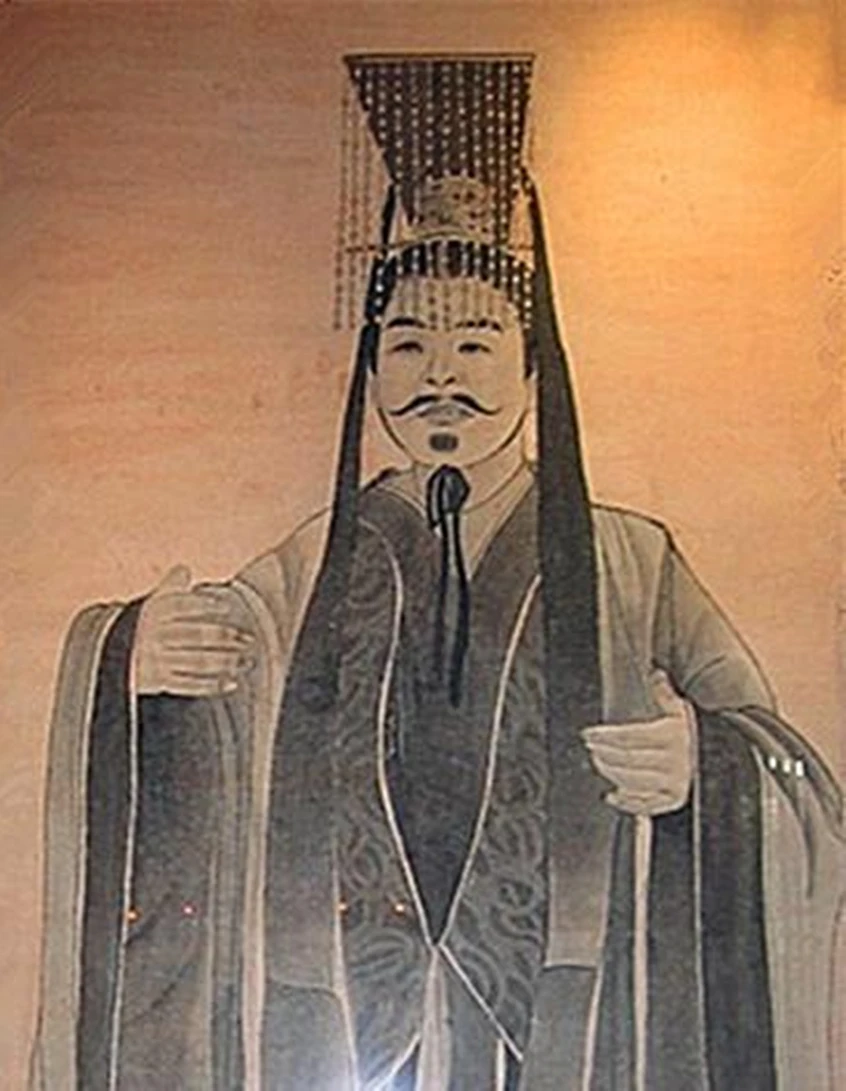
Of the two emperors the Qin dynasty produced, the second is remembered chiefly for what he did with a position he had not been raised to expect. Three years of killing inside the palace, three years of refusing to be told what was happening outside it, and at the end his own death at the hands of the man who had put him on the throne. He was a young man, and in the accounts that survive he appears less as a ruler than as an instrument: educated for nothing in particular, pushed forward by a courtier who wanted a pliable emperor, and used by him until he was no longer useful.
His name was Huhai. The title he carried — Er Shi, "Second Generation" — was not a name but a promise, part of his father's design that the dynasty should pass from the First Emperor to the Second, the Third, and so on through ten thousand generations. It failed at the second step. What makes him difficult to judge is that almost everything known about him was written under the dynasty that replaced his, by men with an interest in the proposition that the Qin had fallen because they deserved to. The basic story is dense with incident and firmly attested. The character at its centre is not.
1. The Eighteenth Son (c. 230 – 210 BC)
Huhai was a son of Qin Shi Huang, and by the count preserved in the commentaries he was the eighteenth of them. Even his age is given two ways: the Records makes him twenty-one when his reign began, which would put his birth in 230 BC, while a lost Qin court record quoted in later commentary makes him twelve, which would put it a decade later. Most historians follow the Records. Later tradition usually calls him the youngest, and this is worth pausing over, because the phrase appears to come from a speech by the rebel Chen Sheng — "I have heard that the Second Emperor was a younger son, and should never have been raised" — which makes it a piece of rebel rhetoric rather than a record. Some historians have noted that Shi Huang was around thirty when Huhai was born, and have doubted that a man in his prime simply stopped fathering children. The figure eighteen, the claim to youth, the name of his mother, which is not recorded in the early sources at all, are all softer ground than they look.
What is firmly recorded is his education. Shi Huang assigned him to Zhao Gao, the official in charge of the imperial carriage, to learn law and the deciding of cases, and the Records adds a detail that became the hinge of the whole reign: Huhai privately liked him. The arrangement tells us as much about the father's state as about the son's. Shi Huang had abolished the hereditary principalities that had divided the old kingdoms, and with them the whole apparatus by which a prince had once been given a territory and an army to practise on. His sons held no fiefs, commanded nothing, and had no share in government. What they could be given instead was an education and a position near the throne, and Huhai got both — in the form of a tutor who had risen from the lowest branch of the state's service and who taught the law as a body of rules to be applied without sentiment.
In 210 BC, on what became his father's fifth and last tour, Huhai asked to come along and was allowed. He had never held an office, commanded anything or been given any responsibility, and there is no record of his having done anything at all before his father died.
A story in a later Han collection gives a hint of how he was regarded in the family. At a banquet where officials left their shoes at the foot of the steps, the young Huhai came down and trampled the finer pairs as he went, and his brothers, hearing of it, sighed. The anecdote is the kind of thing that attaches itself to men remembered badly, and should be read that way — but it captures the shape of the problem: a prince given no part in anything, with a tutor who had his confidence.
2. The Death at Shaqiu, and the Question of the Edict (210 BC)
Qin Shi Huang fell ill on the road at Pingyuan Ford and grew worse. He had a horror of the word death, and none of his ministers dared raise the subject with him. As he weakened he wrote a sealed letter to his eldest son Fusu, then on the northern frontier: come to the funeral at Xianyang and be buried there. The letter was sealed with the imperial seal and left in the office of the man who kept the seals — Zhao Gao. It was never given to a courier.
The emperor died at Shaqiu, in what is now Hebei, in the summer of 210 BC. The Records gives a day as well as a month, but the day cannot be right: a calendar of that year recovered from another Qin tomb shows the month contained no such day. Even the precise-looking parts of this story have been copied, and miscopied, for a very long time.
Li Si, the chancellor, kept the death secret, and his recorded reason is the important one: there was no true heir apparent. The biography of the general Meng Tian has Meng Tian saying the same thing outright — the emperor, being away, had not established an heir. Later historians have noted that princely heirs were not normally given armies, so that Fusu's frontier posting, after he remonstrated with his father, was itself a sign of being passed over. There was no legitimate heir to deprive of anything, only a vacancy.
The body was carried back in a curtained carriage. Meals were brought in and petitions were answered from inside it as though nothing had happened, and only Huhai, Zhao Gao and five or six eunuchs knew the truth. It was summer, and the corpse began to smell; a cartload of salted fish was carried along with the convoy to confuse the odour. The deception held until the party reached Xianyang. It is one of the great set pieces of Chinese history, and it rests almost entirely on inferences about what a concealment would have required.
Zhao Gao, who held the seals and had taught the young man law, spoke to Huhai first and then to Li Si, and between them they produced a version of events in which Shi Huang had named Huhai his heir and had condemned Fusu and Meng Tian to die. Fusu, on the frontier, killed himself. Meng Tian, who argued that such a sentence ought to be verified before it was obeyed, was arrested and imprisoned.
The argument that Zhao Gao made to Li Si is preserved in the form of a conversation, and it is the least trustworthy passage in the story and the most revealing. Zhao Gao is made to say that the seal and the edict are in Huhai's hands, that the empire's fate hangs on the two of them, and that a chancellor who loses his office has lost everything. Li Si is made to answer with the language of loyalty, and then, a paragraph later, he agrees. Whether or not the words are Sima Qian's invention, the calculation they describe is legible. Li Si had risen from a provincial clerkship to be the architect of the conquest and the designer of the empire's administration; everything he had was attached to the office, and the office to the throne. The chancellor who had argued at the founding of the dynasty that no territory should be given to princes, precisely so that no rival centre of power could form, now discovered what that argument meant when applied to a chancellor.
That is what Sima Qian says, and for two thousand years it has been the accepted account: an emperor's testament destroyed, a forged edict, a helpless elder brother dead on the frontier. Two documents recovered from the ground complicate it.
The first is a manuscript on bamboo slips now held at Peking University, a book of the early Han called Zhao Zheng Shu, after the personal name of Shi Huang. In its account the dying king weeps and tells his ministers to decide the succession; the chancellor Li Si and a senior minister, Feng Qubing, propose that Huhai be established, since the road was long, the summons urgent, and it would be dangerous to leave the court undecided; and the king says yes. No forgery, no intercepted letter — Shi Huang personally approved his son.
The second is a wooden tablet found in 2013 in a well at a site in Yiyang, Hunan: an edict issued in the first year of the Second Emperor's reign, which opens by announcing that the world has lost the First Emperor and that "I received the testamentary edict." An emperor with an uncontested right to his throne does not usually need to say so in an official proclamation.
Neither document settles the question, and historians disagree sharply about how much weight to give them. The Zhao Zheng Shu was copied close to Sima Qian's own lifetime, but its genre is disputed and some scholars place it with anecdote rather than history. The edict can be read two opposite ways: as proof the succession was lawful, or as proof it was doubted — one study argues the second, on the principle that the thing a closed regime insists on in public is what it is least secure about. What is clear is that the forgery was not the only version circulating in the early Han, and that both agree on the part that matters: whatever the paperwork said, Huhai benefited, and Zhao Gao and Li Si arranged it.
There is one further thing to be said about the forgery, and it concerns the shape of the story rather than its truth. A forged edict that destroys a legitimate heir is a story about an unjust accession. A dying emperor who names a young son because there is no time to decide otherwise is a story about a vacancy. The second fits the record better. Shi Huang had never named an heir, and when he fell ill he was on the road with the one son who had asked to come along. If there was a forgery it was a forgery of opportunity — and there may have been nothing to forge except a form of words everyone present was willing to accept.
3. The Killing of His Own House (210 – 209 BC)
Shi Huang was buried at Lishan in the ninth month of 210 BC. Huhai ordered that his father's concubines who had borne no children should be buried with him, and the Records notes only that the number of those who died was very large. When the burial was finished, the artisans who had built the tomb's mechanisms were shut inside it, so that its secrets would not be known.
Then he turned on his own family. Sima Qian tells the killings twice, in two different chapters, with two different tallies: in the Li Si biography, twelve of the princes were executed in the market at Xianyang and ten of the princesses were put to death at Du; in the annals, six of the princes were killed at Du. Later retellings usually merge the two into a single round figure of more than twenty. The numbers should be left as the sources left them, which is to say inconsistent — but the direction of the thing is not in doubt.
The annals give the programme that produced these deaths, and it is more deliberate than the word "tyrant" suggests. Huhai asked Zhao Gao what to do about the ministers who were dissatisfied, the officials who were still strong, and the princes who were certain to contest the throne with him. The answer is a plan with two halves. The first is murder: go out on progress, find crimes among the commandery governors and commandants, and execute them — both to terrify the empire and to remove the men the emperor had never liked. The second is promotion: raise up the humble, make the low-born noble and the poor rich, and the state will be settled. Huhai's reply was one word: excellent.
The second half of that advice is the part usually forgotten, and it explains why the killings worked. It is not only that the great families were destroyed; it is that everyone who might have replaced them owed his position to the man doing the destroying. The old officeholders, whose fathers had served the Qin for generations, gave way to men who existed only because Zhao Gao had chosen them. That is a machine for producing silence, and it worked as designed.
Three brothers named Jianglü were brought before an envoy with nothing to accuse them of. They protested that in matters of court ritual, in the statutes of the realm, and in obedience to orders they had done nothing wrong, and asked on what grounds they were to die. The envoy said only that he did not know, and was carrying out his instructions. The three wept, drew their swords and killed themselves. Another prince, Gao, watching his brothers go one by one, decided that flight would endanger his family and asked permission to be buried with his father at Lishan; Huhai was delighted and gave him a hundred thousand cash.
The Meng brothers followed. Meng Yi, whose offence was to have once sentenced Zhao Gao to death and been overruled by Shi Huang, was imprisoned and ordered to kill himself; Meng Tian, still in his cell at Yangzhou, was then told of his brother's crime and took poison. That old case explains the direction the killings took. Zhao Gao had committed a serious offence, Shi Huang had handed him to Meng Yi for judgment, and Meng Yi had judged him according to the law — which meant death, and the removal of his name from the register of those permitted to attend the court. The emperor, admiring his usefulness, had set the sentence aside. Zhao Gao therefore owed his life to a pardon, and the need for one to the man who had sentenced him. Years later he was in a position to collect both debts.
The pattern is worth naming, because it explains what happened next: within a year of taking the throne Huhai had killed the relatives whose interest lay in his survival, and the ministers who had run the state were being removed one by one. Empires normally survive such a purge because the men destroyed have clients, kinsmen and colleagues who inherit their offices and their resentment. The Qin had spent a generation dismantling exactly those structures. Its princes had been given no fiefs and no armies, its noble houses had been uprooted to the capital, and its administration was a bureaucracy of appointed men who could be replaced by a stroke of the brush. What was left was Zhao Gao.
4. A Renewal Announced, and a Tour Undertaken (210 – 209 BC)
The reign did not begin as a terror. Within weeks of the burial, Huhai proclaimed a general amnesty, and the tablet from the Yiyang well preserves the tone of his first official act. Its text opens by announcing the death of the First Emperor and the emperor's own accession, states that "I received the testamentary edict", and then proceeds to a programme: a renewal with the common people, the release of men condemned to exile, lighter levies, and an instruction to officials not to pursue county magistrates for small faults. Read without knowing what came after, it is the language of a government promising relief. The document is also the most valuable object connected with the reign, because it is the only surviving statement of policy that can be attributed to Huhai himself rather than reported about him. The phrase it turns on is renewal — a fresh reckoning with the black-haired commoners. Whether it was meant, and whether it was abandoned, cannot be recovered. What can be said is that the same government which proclaimed a lighter levy in the winter was ordering the resumption of the largest building project in the empire by the fourth month.
In the spring of 209 BC he travelled east. The Records preserves his reasoning, put in the form of a conversation with Zhao Gao: I am young, newly on the throne, and the common people have not yet attached themselves to me. My father toured the provinces to display his strength and overawe the world. If I sit still and do not tour, I will be seen as weak, and will have no means of holding the empire as a herdsman holds his beasts. It is a sentence from a man who has understood a very specific lesson from his father's reign: that in the absence of any hereditary claim on the affections of the governed, authority has to be performed.
The tour itself was long, and followed the ground his father had covered: east to the coast, along the sea, south to Kuaiji in the far southeast, and then north again to the Liaodong frontier before turning back. He was accompanied by Li Si. And at every one of the great steles his father had left standing — on Mount Tai, at Langya, at Jieshi, at Kuaiji — he had a decree cut into the stone beside the original text, together with the names of the ministers who had come with him.
The decree is short, and its 78 characters are the most important words the reign has left on any permanent surface. The emperor says: the stone inscriptions are all the work of the First Emperor. Now that I have inherited the title, if the inscriptions do not identify the First Emperor, then in distant ages they will be taken for the work of a later descendant, and will not match his achievements and great virtue. The chancellor Li Si, the right chancellor Feng Qubing and the censor-in-chief De venture to submit that the decree be inscribed on the stones in full; and the emperor says: approved.
Read one way this is filial piety of an unusually careful kind — a son protecting his father's name from the erosion of time. Read another way it is a man standing at a monument he did not build and arranging for the record to be unambiguous about who did. The decree's wording supports the second reading as much as the first: what it is anxious about is not that the First Emperor be forgotten but that the inscriptions might be attributed to someone else. Any later generation reading a stone that said only "the emperor" would have no way of knowing which one it meant — and the whole point of his father's design had been that the sequence would run through ten thousand of them.
The fate of these stones is a small emblem of the fate of the reign. The First Emperor's inscriptions survive as texts in the Records and in Song dynasty rubbings; of the stone itself, on Mount Tai, about ten legible characters remain, conventionally called the Ten Characters of Mount Tai, and they are from the Second Emperor's decree. The fragment of the Langya stele held by the National Museum of China is thirteen lines and 87 characters — the Second Emperor's decree and the names of his ministers, cut in 209 BC. The largest body of surviving Qin imperial stone epigraphy is his. He is remembered for having destroyed his father's work, and the reason any of that work can still be read on stone is that he had his own decree carved beside it.
The tour lasted into the fourth month of the year, when he was back at Xianyang. It had taken him some months and covered several thousand miles, and by the standards of the reign it had been a success: the provinces had been shown an emperor, the steles had been corrected, and the government had continued to function. Nothing in the record suggests that anyone, at that point, expected the dynasty to last less than two more years.
5. Palaces in Stone (209 BC)
In the fourth month of 209 BC, having returned to the capital, he gave the order that fixed his reputation. The vast palace complex at Epang, begun by his father in 212 BC and abandoned when the workers were pulled off it to finish the mausoleum, was to be resumed. His recorded reasoning is not the reasoning of a voluptuary. His father, he said, had found the court at Xianyang too small and had begun the Epang palace to provide halls and chambers for it; the work had been stopped by his death, and the labour had been diverted to the tomb at Lishan. Now that the tomb was finished, to leave the palace unbuilt would be to advertise that the First Emperor had been wrong to begin it. So the work restarted, and the frontier was garrisoned on the old plan.
It is the argument of a young man with no achievements of his own who has decided to finish the one his father left him. He could not outdo Shi Huang by conquest or by legislation; both were complete. The only way to show himself his father's equal was to finish what his father had begun — and a man taught law learns to think in terms of consistency, which makes a statute apply to everyone and a monument, once begun, impossible to abandon without admitting an error.
The archaeology of that decision is more eloquent than any account of it. Excavation at the Epang site since 2002 has found no burnt earth and no trace of use — no walls, floors, pillars or drains of a finished building, only an enormous rammed-earth platform 1,270 metres long and 426 wide, with the foundations of three of its four enclosing walls. It was never completed and never burned; the fire that later ages placed here burned the palaces north of the river. Nor did the work simply stop: the histories already say so, in a line that reads like an epitaph — he restarted Epang, and it was unfinished when the dynasty perished. Drilling has since found the platform was laid on half a metre of lake silt, which had to be drained and levelled before the ramming could begin. Huhai's order committed the empire to the largest single earthwork in the ancient world, on a marsh, for a building he would never see.
What it cost is recorded in the same paragraph as the decision. Fifty thousand men were conscripted as a garrison for Xianyang and set to training with dogs, horses and birds for the hunt, and because so many had to be fed, the commanderies were ordered to send in grain and fodder — with the further instruction that the men carrying it were to bring their own food, and that within three hundred li of the capital no one was to eat any of the grain they carried. It is not the language of a government that has lost control of its finances; it is the language of one that has decided the capital's needs come before the countryside's, and is willing to say so. The Records closes the passage with four characters: the laws were applied with increasing severity.
Meanwhile Zhao Gao, now chief of palace attendants, was completing the arrangement he had begun. His further advice was that a young sovereign ought not to sit in council exposing his inexperience to experienced men; better to remain in the inner palace and let his trusted servants report to him. Huhai agreed. From that point the emperor is no longer in the room where decisions are made, and the record of the reign becomes, to a striking degree, a record of what other people told him.
But the famous quotations in which he justifies this are the ones scholars trust least. In the Records he is made to cite the philosopher Han Fei on how the sage kings lived in huts and wore themselves out with labour, in order to argue that the point of ruling is to have the world serve one's own pleasure. Han Fei said nothing of the kind; he warned that a ruler who gave himself to drink and women and palaces was inviting the destruction of his state. The speech, and the harsh treatise on supervision and punishment that Li Si is said to have written in reply, read like later constructions designed to put the two most hated men of the Qin at the centre of its collapse. That they may be inventions does not make Huhai a good ruler; it does mean that the image of the pleasure-seeker quoting philosophy at his ministers was drawn by his enemies. It is precisely in those manufactured speeches that the accusations of luxury, idleness and contempt for advice are lodged. Remove them and what remains is a young man who did not sit in council and who spent the empire's labour on a building his father had begun.
6. A Rebellion, and the Report He Preferred (209 – 208 BC)
In the seventh month of 209 BC — three months after the order to resume the palace — a party of nine hundred conscripts marching north to garrison duty at Yuyang was stopped by rain at a place called Dazexiang. They could not arrive on time. Under the law, said their two headmen, Chen Sheng and Wu Guang, arriving late meant death, and so they killed their officers, raised a revolt, and gave it a slogan that outlived them: are kings and nobles born to their stations? They took the district city of Chen and proclaimed a state of their own, calling it Zhang Chu — "the enlarged Chu" — and Chen Sheng made himself its king.
The law they cited has been the subject of a long argument. In 1975 a tomb in Hubei yielded a cache of Qin statutes which say something different. On forced labour, the code provides fines: late by three to five days, a reprimand; by six to ten, a fine of one shield; by more than ten, a fine of one suit of armour — and if it rains, the levy is simply cancelled. Legal historians have pushed back, pointing out that these are the rules for labour service, that frontier garrison duty had its own statute which does not survive, and that late arrival in the military was a capital matter under the Han as well. Others answer that Chen Sheng had every reason to exaggerate: he argued both sides in the same speech, telling his men that even if they escaped execution six or seven in ten would die on the frontier anyway. Whatever the statute said, the men believed the harsher version.
What happened next was not a peasant rising in the sense that phrase suggests. Within weeks the whole of the east was in revolt, and the Records is explicit about who was doing the revolting: the young men of the commanderies and counties, worn down by the officials, killed their governors, commandants, magistrates and assistant magistrates, and answered Chen Sheng; they set one another up as kings and lords and marched west under the name of punishing Qin. These were not men with nothing to lose. They were the local elite of the conquered kingdoms, who had spent twelve years watching their states converted into administrative units, and who now discovered that the empire's writ no longer ran.
What Huhai did about it is the clearest thing we know about him as a ruler. Envoys who reported the truth were prosecuted. The Records has the sequence in three sentences. An envoy came back from the east and reported that the rebels had risen; the emperor was furious and had him handed over to the law. A later envoy was asked the same question and answered that they were only bandits, that the commandery governors and commandants were already hunting them down, that they had all been taken, and that there was nothing to worry about; the emperor was pleased. Thereafter, envoys who came back from the east said the same thing and survived. The man who got this right, and was rewarded for it, was a scholar named Shusun Tong — who went on, after the Qin fell, to design the court ceremonial of the Han.
The mechanism did not require the emperor to be stupid. It required only that he punish bad news and reward good, which he did, twice; after that the court supplied exactly the information its ruler wanted, and every man in it had a personal interest in supplying it. The rebellion was not invisible. It was filtered.
The picture is not of a tyrant, exactly. It is of a man who had spent his life behind walls, had learned law as a school subject, and had no way of telling a bad report from a false one, so he chose the version he could bear.
Far away from that court, in a county in the far south, a small proof of the opposite was being filed away. The thirty-eight thousand bamboo and wooden documents recovered from a well at Liye, in western Hunan, are the archive of the county administration of Qianling, in Dongting commandery, and their dates run without a break from the twenty-fifth year of Shi Huang to the second year of the Second Emperor. They record household registers and land, taxes and corvée, granaries and military stores, post-station distances, the sale of slaves, the labour of convicts and the assessment of officials' performance. One slip records the working days of a man in government service: 211 days, two of them excused for illness. Another is a letter about a man named Lang, who had borrowed a government boat three zhang and three chi long to look for roofing tiles in the ruins of the old Chu territory and had not brought it back; the county wrote to his superior to have it returned, and the answer came back that Lang was involved in a case under review and that the boat's whereabouts would be established when he was questioned. This is the everyday noise of administration, and it continued. The machine did not fail; the men at the top of it did.
7. The Chancellor's Fall (208 BC)
It also killed his chancellor. Li Si, the architect of the conquest and one of the men who had placed Huhai on the throne, petitioned with the right chancellor Feng Qubing and the general Feng Jie to halt the palace and cut the taxes. The answer he got is one of the few recorded statements of policy from the reign, and it is a refusal on principle. The emperor said that his father had found the court at Xianyang too small and had built the Epang palace for it; that the work had been halted by his death, and the labour diverted to the tomb; and that now, the tomb being finished, to abandon the palace would be to declare the First Emperor's undertaking a mistake. He then turned to the accusation: the two Feng and the chancellor were unable to repay their offices, and would be judged.
All three were handed over to the law. The two Feng killed themselves rather than be tried. Li Si allowed himself to be imprisoned and argued his case, which was the mistake that killed him. He had behind him a career of forty years and a genuine record of service; he believed, or said he believed, that he could explain himself to the men who now ran the government, and that explanation still meant something.
Zhao Gao had been careful to prepare the ground. The charge against Li Si was built out of his family: his son Li You was governor of the commandery of Sanchuan, through which the rebels had marched west, and the accusation was that he had failed to fight them. There was a further charge, and it is the more interesting one — that as chancellor he held authority outside the capital while his son held a commandery, so that between them they controlled as much as the throne did. That accusation had a certain force. It is the argument the First Emperor himself had used against the principalities at the founding of the dynasty, and it applied to the office Li Si had designed as much as it had applied to the kings.
What Li Si did in prison is the part of his story hardest to reconcile with the rest. He wrote a memorial urging the emperor to practise supervision and punishment without restraint — that a ruler should follow his own desires, that severity in taxation marked a capable official and many executions a loyal one, and that a throne which made itself feared had nothing to fear. He was not defending the empire; he was defending himself, by telling his captor's master exactly what his captor wanted to hear. It did not work. Zhao Gao set the memorial aside, and when Li Si tried from his cell to send a further appeal, he was told that a prisoner had no business submitting memorials. Tortured until the confession satisfied his accusers, he was executed in the market at Xianyang in the seventh month of 208 BC under the five punishments — tattooed, his nose and feet cut off, and finally cut in two at the waist. His kin were exterminated with him. As he was led out he turned to one of his sons and said he wished he could again take the yellow dog hunting through the east gate of Shangcai, as they used to; father and son wept.
Three things had now happened to the Qin administration. Its founding theorist had been destroyed along with his family. Its senior military men, the Meng brothers, were dead. And the chancellery had been made into something new: Zhao Gao, who took the unprecedented title of chancellor of the inner palace, decided everything, and the emperor sat behind him and was told what he had decided. The title is the tell. There had never been a chancellor of the inner palace, because the whole point of the chancellery was that it stood between the throne and the outer world. Zhao Gao's described a government conducted in a private room, and that is what the empire now had.
8. The War the Court Did Not Fight (209 – 207 BC)
While the court ate itself, the war went on without it. Chen Sheng sent a general named Zhou Wen west with an army that the Records counts in the hundreds of thousands, and it reached the place called Xi, within a day's march of the capital, before there was anything to stop it. There was nothing to stop it because there were no troops in the capital region: the empire's armies were on the northern frontier and in the south, and the garrisons of the interior had been reduced to the functions of police. What stopped it was a suggestion from the privy treasurer, Zhang Han: arm the convicts labouring at Lishan. An amnesty was proclaimed, the workforce became an army, and Zhou Wen's force disintegrated.
The rebel coalition then began to come apart in the ordinary way of coalitions. Wu Guang was killed by one of his own officers in 208 BC; Chen Sheng, whose state of Zhang Chu had lasted six months, was killed shortly afterwards by his own charioteer, and the two deaths are worth keeping in that order, since both were murders by subordinates rather than defeats. The kingdoms that replaced them were led by men of better family: the nobles of the old states, who had the authority the first rebels lacked. The Qin then began to win battles and lose the war. Zhang Han destroyed the rebel commander Xiang Liang at Dingtao in the ninth month of 208 BC, then moved north, where Wang Li's army was besieging Julu, the capital of the revived kingdom of Zhao.
Xiang Liang's nephew Xiang Yu came north to relieve it. He ferried his army over the river, sank the boats, smashed the cooking pots, and told his men they would eat when they had won or not at all. The relief of Julu broke Wang Li's army. Zhang Han, who had been supporting the siege and who had failed to destroy the relief force before it reached the city, now had reason to fear what the court would do to him — he had already sent an officer back to Xianyang to ask for instructions and had been kept waiting by Zhao Gao, who would not see him — and in the seventh month of 207 BC he surrendered with his troops. What followed was one of the great atrocities of the period: by the Records' count, more than two hundred thousand surrendered Qin soldiers were buried alive at Xin'an, to prevent them from turning again.
The empire's armies had now passed, one after another, into the hands of men who were fighting for themselves. The northern army was gone at Julu, the largest remaining force had changed sides with its commander, and Liu Bang, a former village official turned rebel, had taken the Wu pass, the southern gate into the capital region, leaving the road to Xianyang open. The military record disposes of a common way of explaining the collapse. The Qin did not lose because its soldiers would not fight or its generals were incompetent; its best commanders won battle after battle. What had been destroyed was the connection between fighting and being rewarded. A commander could no longer be sure that a victory would be reported, or that a report would be believed, or that a reward would follow, and he had watched an imperial family and its senior ministers killed for reasons no one could identify. So they began to negotiate with their enemies. Huhai's court lost the war the way it had lost the truth: by making the honest option dangerous.
9. Wangyi Palace (207 BC)
Zhao Gao's response to the situation was to stage a test. He brought a deer into the court and announced to the emperor that it was a horse. Huhai laughed and told him he was mistaken — it was plainly a deer. He asked the assembled ministers. Most, who understood what was being asked of them, said it was a horse; some said deer; some said nothing. The ones who said deer were later destroyed. The episode is remembered as a demonstration of Zhao Gao's power, which it was, but it is also the last occasion on which anything like a court existed: what was being measured was not the emperor's judgment but the ministers', and the answer was that two of three possible responses were unsafe and the third was silence.
Huhai, according to the Records, was less frightened of the answer than of himself: he thought he must be suffering from some delusion. He consulted a diviner, was told his ritual fasting had been faulty, went to a park to fast, shot a man who strayed into it, and was persuaded to move to another palace, where he could fast properly. The dream that prompted this was recorded as a white tiger biting his left trace-horse, and the interpretation offered was that the river Jing was owed a sacrifice. He went to Wangyi Palace, by the Jing, to perform it.
An envoy he sent to press Zhao Gao about the rebels in the east was the trigger. Zhao Gao had been telling the emperor for two years that the rising was a matter of bandits, and he understood what an honest accounting would now cost him. He conspired with his brother Zhao Cheng and with his son-in-law, the magistrate of Xianyang, Yan Le. Yan Le marched more than a thousand armed men to the palace at Wangyi under the pretence of chasing bandits; the officer who challenged them at the gate was bound, accused of being in league with the rebels, and killed. The attackers got inside and shot arrows into the emperor's quarters. The guards around him ran.
Huhai fled into an inner room. One eunuch stayed with him, and Huhai asked him why he had never warned him, that it had come to this. The answer in the Records is the sharpest line in the whole story: because I did not dare speak, I am alive; if I had spoken, I would have been executed long ago, and would not be here now. It is the same mechanism that had been operating for three years, described by the one man in the palace who had survived it by saying nothing at all — and it was said, at last, to the man who had built it, in the last hour of his life.
The commander of the attackers gave him a short speech — that he was arrogant and violent, that he had killed without reason, that the world had turned against him, and that he should consider what to do. Huhai asked to see the chancellor, and was refused. He asked to be given one commandery and made its king. Refused. He asked to be made a marquis of ten thousand households. Refused. He asked, finally, to be allowed to live with his wife and children as an ordinary commoner, the same as anyone else. The officer told him that he had his orders from the chancellor to put him to death on the world's behalf, and that whatever the emperor said, it would not be reported. Then Huhai killed himself.
He was twenty-three or twenty-four, if the Records' figure for his age at accession is followed; the alternative tradition would make him a boy at his death. He had reigned three years, and the last of the three requests is the one that stays in the memory: the emperor who had been given the title of the Second Generation, to be followed by the Third and the Fourth through ten thousand generations, asking last of all to be made one of the black-haired commoners his father's state had been built to administer.
10. A Commoner's Grave, and a Verdict with a History (207 BC –)
Zhao Gao installed a man named Ziying, who took the title of king rather than emperor, since there was no longer an empire to be emperor of. The Records calls him a son of Huhai's elder brother, a grandson of the First Emperor, while other sources put him a generation higher, as Shi Huang's brother; the question has never been settled. He was given a ritual fast of five days before his accession, and he used it. When Zhao Gao came in person to urge him on, an attendant killed the chancellor on the spot, and Zhao Gao's family was exterminated with him — the same fate he had arranged for Li Si, by the same method, about a month after arranging it for his own emperor.
Ziying reigned forty-six days. Liu Bang reached Bashang, outside Xianyang, and the last king of Qin came out with a white rope around his neck, in a plain carriage drawn by a white horse, and handed over the seals. Liu Bang did not kill him; Xiang Yu, arriving some two months later, did, along with the surviving princes of the Qin house, before burning the palaces. The surrender fell in the tenth month of 207 BC, but that month opened the year the Han counted as the first of their dynasty, which is why the end of the Qin is dated both to 207 and to 206 BC — the dynasty that fell had begun its years in the tenth month, and the dynasty that replaced it kept the custom, so that the last three months of the Qin and the first three of the Han are the same months under different names.
He was buried with the rites of a commoner south of Du, in what is now the Qujiang district of Xi'an. The mound is still there: an earthen circle twenty-five metres across and about five high, ringed by a low brick wall, with no stone figures and no stone beasts, in a free public park among the apartment towers. A stele in front of it was put up in 1776 by Bi Yuan, the governor of Shaanxi, and reads "the tomb of Qin Er Shi, emperor of Qin". A survey in 1982 recorded what remains inside — a few grey pottery jar fragments and a piece of a bronze sword, which is what one would expect of a burial conducted without ceremony. His father's tomb is a mountain with an army buried beside it; his is a heap in a field with a Qing administrator's inscription, and the most visited thing in the park that contains it is a sculpture group of the deer that was called a horse. He had asked to be a commoner. That part of the request was granted.
That is the story, and it is worth noticing where Sima Qian chose to put it. Huhai has no annals of his own. There is a chapter for the First Emperor, and the whole of the Second Emperor's reign — the killings, the palace, the rebellion, the deer, the three requests — is told at the end of his father's, together with the dynasty's official elegy: the essay by the Han statesman Jia Yi on the faults of Qin, which argues that the Qin took the empire by force and then tried to keep it by force, and that its severity turned the people whose labour sustained it into its enemies. Jia Yi wrote within a generation of the events, and his essay became the standard verdict.
It is a verdict with a history of its own, since the men who compiled the evidence for it lived under the dynasty that benefited. The Qin had to have fallen through misrule, and the misrule had to have a face — which is why the passages about Huhai that modern scholarship most suspects of being manufactured are precisely the most quotable. Set them aside and the portrait is thinner but clearer: a young man with no experience, an empire's worth of unfinished construction, and a court from which the truth had been systematically removed.
The clearest case of that rewriting is not Huhai but the man who ruined him. Zhao Gao is a eunuch in every popular telling, and the sources do not say so. The phrase they use is that he and his brothers were born in the hidden palace — which later commentary turned into a place of castration, and which scholars working from excavated Qin and Han statutes now read as the hidden office, the state workshops where people mutilated under the penal code worked after release. The anecdotes also hold together badly: Zhao Gao had a daughter, married to the magistrate of Xianyang, and a man who had been castrated does not have a son-in-law. The twentieth-century historian who taught that the ancient past is built up layer by layer, each age adding what it needs, could have asked for no better example. What the record shows is a man trained in the law, risen from the lowest rank of the penal administration, once condemned to death by a minister and pardoned, who spent the next decade making sure that no minister would ever be able to condemn him again. That is a more frightening figure than a eunuch, and it fits the evidence.
There is a last piece of evidence, and it is an absence. The archive at Liye runs to the second year of the Second Emperor and stops. Its last dated documents belong to the second year of the reign, the year Li Si was executed; the war itself had begun the year before. After that there is nothing, because the county that kept the file lay in the path of the fighting and the government that required it had ceased to require anything. Everything else that survives was written by people who had reason to explain the collapse, and most of it by people who benefited from the explanation. The Qin lasted fifteen years, two emperors and a king, and it left an archive of its ordinary business in a well, an amnesty on a wooden tablet, and a decree cut into its enemy's most useful monument. The phrase for a state that collapses almost at once — that it perished in the second generation — comes from it. Every ruler after Huhai knew the story and used it. The lesson was drawn so successfully that Huhai himself largely disappeared behind it: he is remembered not as a person but as the demonstration, the short second act between the founder and the fall.