Home / Emperors / Han Dynasty
Emperor Gaozu of Han
汉高祖
Liu Bang, 256 – 195 BC· founding emperor of the Han dynasty from 202 BC
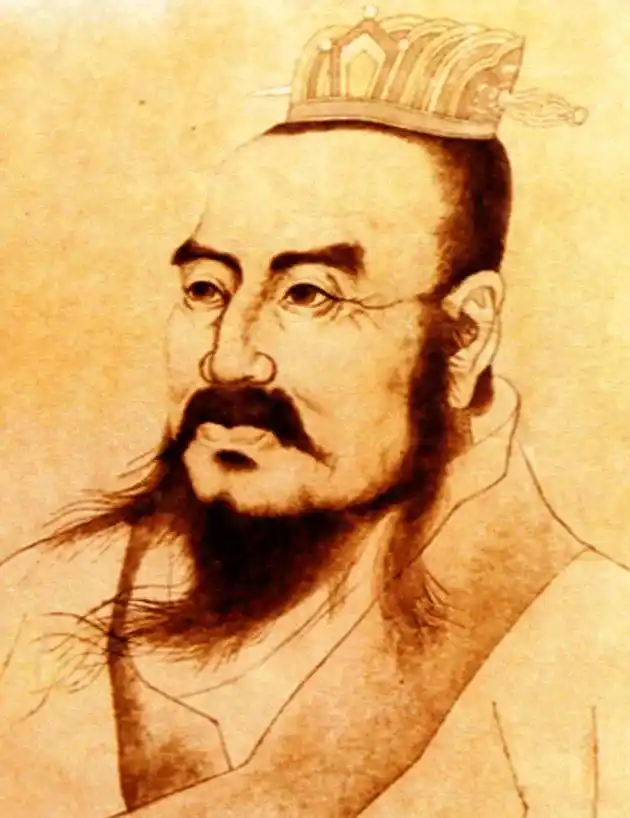
Liu Bang was in his forties when he became a rebel and past fifty when he became an emperor, and in the seven years between he fought a civil war against the finest soldier of his age and lost almost every battle he personally commanded. He was broken at Pengcheng so completely that his father and his wife fell into enemy hands; he escaped a siege at Xingyang only because a subordinate dressed in his robes and let himself be burned alive in his place; he took a stray arrow during his last campaign that troubled him until it killed him. Xiang Yu won the battles. Liu Bang won the war.
He did it with a talent that has nothing to do with generalship. Explaining his own success to his court, he named three men — a strategist, an administrator, a commander — said he was inferior to each of them at his own work, and observed that his single gift was the ability to use them. He was also, by the standards of the emperors around him, an odd man: born in a village, employed at the bottom of the Qin bureaucracy, uneducated, fond of drink, given to insulting his ministers to their faces. The Qin had ruled through law and fear and lasted fifteen years. The Han kept the Qin's bureaucracy and lasted four centuries. Most of what he did as emperor was done in the seven years he had, and most of it was unglamorous: he moved his capital west, dressed his court in ritual, cut the taxes, freed the people who had sold themselves during the famine, and then — one after another, by war, by fraud and at last by the hands of his own empress — destroyed the kings he had created in order to win the throne.
1. A Commoner in a Broken Empire (256 – 209 BC)
He was born in the village of Zhongyang in Feng, a district of Pei, in what is now northern Jiangsu, and the year is the first thing about him that cannot be settled. Huangfu Mi, a third-century scholar, put the birth in 256 BC; a later commentator, reckoning from a line in the History of the Han that the emperor took the throne at forty-two and died at fifty-three, put it nine years later, in 247 BC, and modern scholars have argued for both. The sources nearest him — the Records of the Grand Historian, the History of the Han, the Comprehensive Mirror — give no year at all. The conventional choice, 256 BC, has the advantage of being the year the last Zhou king died and the Qin took the nine ritual cauldrons. What is certain is smaller and more useful: he was born a subject of the Qin in country that had belonged to Chu.
His family was not noble, and the evidence for that is a silence: the Records call his father Old Man Liu and his mother Old Woman Liu, which is not a record of names but the absence of one. The dominant modern view is that his people were hereditary minor clerks, the class that produced the village headmen, scribes and jailers without whom no empire of that size could function; a minority holds that they were Wei gentry moved east when Qin destroyed the Wei capital, a fallen aristocracy trying to look ordinary. Either way he was neither a peasant in the fields nor a lord: a functionary at the edge of the map, the kind of man a great empire needs in enormous numbers and never remembers.
His post was headman of Sishui, with duties covering the post station, local order and the escorting of convicts, and he did not take it seriously. The Records has him drinking on credit at the wineshops and never settling the bill, mocking the clerks in his own office, and wholly uninterested in the family farm; the same source says he was generous with money, open in manner, and had a way with people. A wealthy man named Lü, newly arrived in Pei as a refugee from a feud, held a banquet and announced that no one giving less than a thousand coins could sit at the head table. Liu Bang arrived, gave nothing, announced ten thousand, and was seated at the top by his host, who read faces for a living and decided on the spot to marry his daughter to him. The daughter, Lü Zhi, outlived him to rule the empire herself. Two sentences from these years later became shorthand for the difference between the two men who would decide the fate of the Qin. Watching the First Emperor's procession pass, Liu Bang said that a real man ought to be like that; Xiang Yu, watching a similar procession elsewhere, is said to have remarked that the man could be replaced. Neither sentence is a plan. Around 209 BC, escorting prisoners to forced labour at the emperor's mausoleum, Liu Bang found men escaping along the way, released all of them rather than arrive short and be punished for it, and went into the marshes of Mount Mang with a dozen volunteers as an outlaw. It was the first decision of his life that was unmistakably his own. The Records opens his biography before any of this with a story about a dragon, which is what a founding myth looks like and should be read as one.
2. The Uprising, and the Other Man (209 – 208 BC)
The collapse came fast. In 209 BC two conscript officers named Chen Sheng and Wu Guang, delayed by rain and expecting execution for being late, mutinied in the marshes of Daze and told their men that kings and nobles were not born to their rank. Their rising was crushed within months — Chen Sheng was killed by his own driver — but it lit a dozen others, and one of them started in Pei. When the magistrate of Pei tried to close the town against the rebels he was killed by the townsmen, and the leading men of the district met to choose a leader. They wanted the two famous clerks, Xiao He and Cao Shen, and the two clerks refused, for a reason the Records gives plainly: they were literate officials who cared for their skins, and if the revolt failed the Qin would punish a rebel's whole clan, whereas a man with no office and no family reputation had less to lose by saying yes. They sent for Liu Bang in the marshes and made him Duke of Pei — a title chosen according to Chu custom rather than Qin law, which tells us where these men thought they belonged.
In the southeast a different kind of rebel was at work. Xiang Yu was the nephew and the pupil of Xiang Liang, a nobleman of Chu whose family had been waiting for revenge since before Xiang Yu was born; when he was a boy his uncle offered him a sword to study and then a book, and he was uninterested in both, asking instead to learn how to fight ten thousand men. In 209 BC Xiang Liang killed the commandant of Kuaiji with his nephew's help and raised eight thousand men from the lower Yangzi, the same eight thousand that Xiang Yu would later say he had led west and could not bring home. Chen Sheng's rising had been a peasant revolt against dying on schedule; this was the restoration of a defeated kingdom, conducted by men who knew exactly who they were.
For about a year Liu Bang and Xiang Yu were on the same side and under the same orders. They campaigned together against the Qin general Zhang Han, took the town of Chengyang in a joint assault, pursued the enemy to Puyang and to Yongqiu, and together killed Li You, the son of the chancellor Li Si, in a battle that Liu Bang's own annals and Xiang Yu's annals describe in the same words. In 208 BC Xiang Liang, who had by then found a grandson of the old kings of Chu herding sheep in the countryside and enthroned him as King Huai, was destroyed at Dingtao by Zhang Han in a night attack while the other columns stood aside too far away to help. King Huai, who had been a shepherd and then a puppet and had no intention of remaining either, pulled the surviving troops back to Pengcheng, took the best of them under his own command, and divided the war into two columns. The northern one, whose business was to relieve the siege of Julu, went to a general named Song Yi, with Xiang Yu — whose personal ferocity was already the most feared thing on the rebel side — as his second in command and the old strategist Fan Zeng beneath them. The western one, whose business was to march on the Qin heartland, went to Liu Bang, whose soldiers were his own and who was made Marquis of Wu'an. Xiang Yu had been put under a man he despised; Liu Bang had been given an independent command.
3. Two Columns, One Promise (208 – 206 BC)
The arrangement at Pengcheng came with a promise attached, and the promise decided the next three years: whoever first entered and pacified the region inside the passes would be made king of it. The two columns were not equally difficult and the council knew it. Xiang Yu, the old commanders of Chu said, was a violent and treacherous man — he had attacked the town of Xiangcheng and left no one alive in it, and everywhere he had gone he had destroyed what he passed. The Qin population had suffered under its own government for a long time, and if a man of good faith were sent west with instructions to treat them decently, they would come over; send Xiang Yu and they would fight to the last man. Only Liu Bang, a kuanda zhangzhe, a generous elder, could be sent. He was not chosen as the better soldier. He was chosen as the better occupier, and he spent the next year proving it by moving slowly, negotiating surrenders rather than storming walls, and absorbing local troops and local advice as he went.
Xiang Yu, in the north, was proving the other half of the argument. Song Yi marched to Anyang and then sat there for forty-six days without advancing, on the theory that the Qin and the rebels should exhaust each other first; Xiang Yu went into his tent one morning, cut off his head, and took command. At Julu he ferried his men across the river, sank the boats, smashed the cooking pots, burned the huts and gave out three days' rations, so that there was nothing to do but win or die. His army met the Qin's best in nine successive engagements and broke it, while the other rebel commanders watched from the walls of their own camps and did not come out; when it was over they came to his tent on their knees and did not dare look up at him. In the seventh month of 207 BC the last great Qin army, under Zhang Han, surrendered to him, and he took it and its men west. At a place called Xin'an, on the road, some of those surrendered soldiers began to grumble about being dragged into a war against their own countrymen; Xiang Yu had the whole body of them, by the histories' figure more than two hundred thousand men, killed in a pit in one night. Guanzhong learned about Xin'an long before it learned anything about Xiang Yu.
The other column had gone the long way round and never destroyed anything. When the army reached Wan, Liu Bang wanted to leave the city behind and hurry on towards the passes, and Zhang Liang, who had joined him earlier and whom he had begun to consult in a way that alarmed the men around him, told him that a hostile city at his back was worth more than the days he would lose. He besieged it, accepted the governor's surrender, and made him a marquis, so that every other city on the road afterwards knew what surrender was worth. At the pass at Yao, the last gate before the capital, Zhang Liang had the defending general bribed with treasure and took the army through him while he was off his guard. In the tenth month of 207 BC, in the winter that the Han calendar counted as the beginning of a new year, Liu Bang's advance guard reached Bashang, a short ride from the Qin capital at Xianyang, with a hundred thousand men.
The last Qin ruler, a young man named Ziying, came out to the roadside with the imperial seals and tally cords around his neck, riding a plain cart drawn by white horses, and rendered his kingdom to a man who had been a village headman a decade or so before. The boy was spared, on the ground that it was unlucky to kill a man who had already submitted, and handed over to the law officers. Liu Bang then entered Xianyang and had to choose. He had the palaces, the treasuries, the horses and the women of the Qin in front of him, all of it now his by right of conquest, and he took the treasury out of circulation instead, sealed the palace stores, set guards on them, and went back to camp at Bashang. Then he did the thing that made his name in Guanzhong: he assembled the elders and told them that the Qin statutes were abolished, that for now there would be three rules — murder punished by death, injury and theft punished according to their kind — and that he had come to restore order rather than to plunder. The elders expected him to be made king of the region under the promise made at Pengcheng, and began to fear that the man who had won the battle would arrive and change the arrangement.
He arrived. The column that had done the real fighting came west in the same winter, found the way through the mountain passes closed against it, and broke through. Liu Bang had posted those guards himself, an attempt to hold what the coalition had promised him, and in one stroke he had given the most dangerous man in China a personal grievance. Xiang Yu came on with his own army and the armies of the other rebel kings behind him — the Records gives him four hundred thousand men against Liu Bang's hundred thousand, and every great number in this war is that kind of figure — and halted at Hongmen, a few miles from Bashang. Xiang Yu's uncle Xiang Bo had once been saved from execution by Zhang Liang, and when he learned that his nephew intended to attack in the morning he rode through the night to warn him. Liu Bang, advised that his only chance was to appear before Xiang Yu in person and submit, went the next morning with a hundred horsemen.
4. Hongmen, and the Map of 206 BC
What happened next is the most famous dinner in Chinese history, and it survives because Sima Qian wrote it out as scene rather than as chronicle. Liu Bang came into the camp, explained that he and Xiang Yu had both been working for the same king against the same enemy, and asked who had been poisoning the general against him. Xiang Yu, who had been ready to destroy him that morning, told him: it was your own left marshal, Cao Wushang. The gesture is characteristic and costly, because a man who gives up an informant in the first minute of a negotiation has no further use for informants. The drinking began. Fan Zeng, the old strategist who had brought Xiang Liang the idea of restoring Chu, raised his jade disc three times as a signal to strike, and Xiang Yu looked away each time. Fan Zeng left the tent, fetched Xiang Yu's cousin Xiang Zhuang and told him to go in and dance with a sword. Xiang Zhuang danced; Xiang Bo, who owed Zhang Liang his life, rose and danced too, and put his body between the blade and Liu Bang. Zhang Liang went out to the gate and found Fan Kuai, a dog butcher from Pei who rode as Liu Bang's chariot companion. Fan Kuai went in with his sword and shield, knocked the guards down with the edge of the shield, came through the curtain, and stood facing Xiang Yu with his hair standing up and his eyes starting out of his head.
Xiang Yu, whose own reputation was built on killing men in front of witnesses, was pleased rather than offended. He called Fan Kuai a strong man and offered him a cup of wine; Fan Kuai bowed and drank it off. He offered him a shoulder of pork; Fan Kuai put the shield face up on the ground, laid the meat on it, and cut it with his sword and ate it raw. Xiang Yu asked whether he could drink another, and Fan Kuai gave him the only speech that mattered in that tent. He would not refuse the cup, he said, because he did not refuse death either; the king of Chu had promised that whoever entered the passes first would be king of that country, and Liu Bang had entered first, taken nothing, and camped in the open at Bashang, waiting. The man who had done that deserved a reward, not an execution, and killing him would be the same mistake the Qin had made. Xiang Yu told him to sit down. Liu Bang got up on the pretence of going to the privy and did not come back; Fan Kuai gave him the sentence the episode is remembered for, that great actions do not require small precautions and that the men who hold the knife and the chopping block do not wait for the fish and the meat to take their leave. He rode out with four men on foot behind him by back roads to Bashang, leaving Zhang Liang to present two jade discs and a pair of jade cups with apologies for his master's inability to hold his drink. Xiang Yu accepted the discs. Fan Zeng took his cups, threw them on the floor, smashed them with his sword and said out loud that the boys around him were not worth planning with, that the man who would take the empire was the one who had just ridden away, and that they would all of them end as his prisoners. Liu Bang, back in his own camp, had Cao Wushang executed before anything else.
Posterity has generally held that Xiang Yu's hesitation cost him the empire, which is too simple. He had wanted Liu Bang on his knees and had received it, in front of the whole coalition, which was the only currency that mattered among kings who had to be kept in line. What the scene reveals is narrower and more durable than the moral usually drawn from it: Xiang Yu preferred the satisfaction of a rival abased to the removal of the rival, and Liu Bang preferred to be abased and alive, and had the presence of mind to leave the table while it was still possible. Xiang Yu then did exactly what the elders of Chu had been afraid of. He entered Xianyang, killed Ziying, looted the palaces, and burned them; the Records says the fires lasted three months. One of his advisers told him that the region inside the passes was protected by mountains and rivers on four sides and that a man who wanted to be hegemon ought to rule from there; Xiang Yu answered that a man who had become rich and famous and went home in the dark was a man in embroidered clothes walking at night, and that nobody would know. The adviser said in private that the people were right to say Chu men were monkeys in hats, and was boiled alive for it. Xiang Yu had already sent the last king of Chu — the man he had made, and who had begun to give orders of his own — south into exile, and had had him killed on the river on the way.
His settlement was to carve the empire into eighteen kingdoms. Xiang Yu took the nine richest commanderies of the old states of Liang and Chu for himself, called himself Hegemon King of Western Chu, and made his capital at Pengcheng in the east. He gave the old kings and his own generals territory in a pattern designed to reward his friends and keep everyone else weak: the men who had followed him got the good land, the legitimate kings were moved to the edges of their former countries, the surrendered Qin generals were put in charge of the region inside the passes, and two men who had the best claims of anyone were deliberately slighted. Tian Rong, who had actually taken the whole of Qi in the fighting, got nothing; Chen Yu, who had raised the army that made Zhang Er possible, was given three counties. The Records records both slights without comment and records the result in the next chapter: within months, both men were at war with him.
Liu Bang was given the worst of the eighteen shares and the one with the most deliberate insult in it. He was made King of Han over the commanderies of Ba, Shu and Hanzhong — the far south-west, beyond mountains hard to cross in either direction, the region Qin had used for exiles — and he was given it with the excuse that Ba and Shu were also part of the region inside the passes, which was a lawyer's answer to a promise. To make the mountains work as a wall, Xiang Yu put the region inside the passes under the three Qin generals who had surrendered at Julu and whom the population of Guanzhong loathed for having led their sons to Xin'an and come back without them. Their lands became known as the Three Qin. The intent was a buffer; it became a door. Liu Bang was furious and wanted to attack Xiang Yu immediately, and it was the administrator Xiao He who talked him out of it by pointing out that being king of a bad country was better than being a dead claimant, and that Hanzhong was a place to raise soldiers, feed them, collect men of ability, and then take back the passes. Liu Bang went south with the thirty thousand men Xiang Yu allotted him and tens of thousands more who followed him on their own, and burned the plank road through the mountains behind him as he went — an order that served two purposes at once, since a broken road stops pursuers and tells a suspicious neighbour that you never intend to come back.
5. Learning to Lose: The Chu–Han War (206 – 202 BC)
The man who made the next four years possible had arrived in Hanzhong in the ranks, without a command or a patron. Han Xin was the son of a poor family from Chu, and the two stories the Records tells about him before the war are both about humiliation: he lived for a while on the charity of a woman who washed silk, and when a young man in the market told him that if he was brave he should draw his sword and if he was afraid he should crawl between his legs, Han Xin looked at him, got down on the ground and crawled. In Hanzhong he was nearly executed in a batch of offenders and saved at the last moment by Xiahou Ying, who heard what he said and gave him a post in charge of grain. Still nobody had listened to him, so he left; Xiao He, the chancellor, rode after him through the night without stopping to tell anyone, and came back with an argument he put in the plainest terms available: if the king intended to stay in Hanzhong then Han Xin was of no use to him, and if the king intended to contest the empire, no one else in the camp could win it for him. Liu Bang, who had given out titles freely and often, then did something he had never done, which was to spend on a ceremony rather than a promise. He fasted, built an altar, and made Han Xin general of the whole army in public, in front of men who had outranked him for years.
Han Xin's first act as general was a lecture, and it is the best surviving analysis of Xiang Yu by a man who had served in his guard. Xiang Yu could roar well enough to frighten a thousand men, but he could not find a use for a capable subordinate, which made his courage a private matter; he wept with the sick over their wounds, but when a man earned a fief the seal wore smooth in his hand because he could not bring himself to let it go. He had broken the promise about the passes and put his own followers in the best land, so that every king in the empire had a grievance, and everywhere his army had gone it had left the towns destroyed. What Han Xin proposed was the mirror image of the policy Liu Bang had followed on the road to Xianyang: go back through the mountains, take the passes, and keep every promise about land, titles and plunder, because an army that is seen to keep its promises can move through a country without storming it. What the Records records of the operation is small — that Han Xin came back by the old road, that the whole region was taken in a single campaign that autumn, and that Zhang Han, the one competent general among the three, was besieged in his capital and destroyed while the other two submitted. The phrase usually attached to it, openly repair the plank road and secretly cross at Chencang, is a later proverb. The Han now held the richest agricultural basin in China.
What followed was four years in which Liu Bang lost, and the pattern was set in the fourth month of 205 BC. Xiang Yu had gone east to crush a rebellion in Qi and had got himself stuck in it. Liu Bang assembled the other dissatisfied kings and marched on Pengcheng, Xiang Yu's capital, with an army the Records puts at five hundred and sixty thousand men. He took the city, lost control of his own coalition, which looted it, and was still there when Xiang Yu came back: Xiang Yu left his main army in Qi and rode south with thirty thousand picked cavalry, took the Han forces at dawn from the west, drove them back into the Gu and Si rivers and then into the Sui, and destroyed them. The Records says that so many men were drowned at the Sui that the river stopped flowing, which is the figure the ancient historians reach for when a disaster is beyond counting. Liu Bang escaped with a few dozen horsemen. His father and his wife were taken by the Chu and spent the rest of the war as hostages, and his son and his daughter were somewhere in the rout. This is where the sources contradict each other, and it is worth setting the contradiction out rather than choosing. The annals of the founder say that after the defeat he sent men to find his family and recovered only his son. A different chapter, the table of the meritorious marquises, says his general Wang Ling brought both children out through the fighting at the Sui. A third version, in the annals of Xiang Yu and in the biography of Fan Kuai and his fellows, has Liu Bang meet the children on the road and — with enemy cavalry closing — push them out of his carriage three times, until his driver Xiahou Ying stopped the horses, picked them up and put them back. The three accounts cannot be reconciled, and the one most often repeated is the least flattering.
Pengcheng decided the character of the war. Liu Bang could not beat Xiang Yu in the field and after that first attempt he largely stopped trying. He fell back to a line through Xingyang and Chenggao, on the road from the passes to the eastern plain, anchored his supply on the great granary at Ao and on the canal route from Guanzhong, and stayed there for more than two years while the war was decided elsewhere. He lost that position twice and got it back twice. In 204 BC, with the Chu besieging Xingyang and the garrison starving, a subordinate named Ji Xin dressed in the king's robes and came out of the east gate announcing that the Han king surrendered — Liu Bang had two thousand women put on armour and sent out of the same gate in the night ahead of him to make the Chu army gather and look. While the Chu came forward, Liu Bang rode out of the west gate with a few men. Ji Xin was burned alive. On another occasion he got away by night, crossed the river, and walked into Han Xin's camp at Xiuwu without warning, where he took the general's army out from under him and sent him off to raise another one. The strategy that won the war was being executed by other people in other places. While Xiang Yu hammered at the centre, Han Xin took the eastern theatre province by province: Wei in 205, with a feint at one river crossing and the army going over on floats made of jars somewhere else; Dai in the same year; Zhao in 204, at the Jingxing pass, where he put his own army with its back to a river and told his officers that they would win because they had nowhere to run; and Qi in 203, after which he broke the relief army under Long Ju at the Wei river in Shandong by damming the current with sandbags, letting the enemy half cross, and opening the water on them. Peng Yue, operating behind Xiang Yu's lines in the old territory of Liang, cut his supply routes. Ying Bu, the king of Jiujiang and one of Xiang Yu's best commanders, was talked into defecting by an envoy named Sui He, who forced the issue by having him kill the Chu envoy in his own hall; the Chu then destroyed his family. Xiang Yu won every battle he personally commanded and lost the war he needed the battles to support.
There was a moment when his own general tested him. In 203 BC Han Xin, having taken Qi, sent a messenger asking to be made a proxy king of the territory, on the ground that the country was unstable and needed a ruler. Liu Bang was being besieged and losing at the time, and his first response, according to the Records, was to curse the messenger to his face. Zhang Liang and Chen Ping each put a foot on his, and he understood, and changed the sentence in the middle of it: a man who has conquered a kingdom, he said, should be a real king, and what was this talk of a proxy. He gave Han Xin the title outright, and then had to make the same concession to Peng Yue to bring him to the last battle. It is the instinct that saved him at Hongmen applied to the people who worked for him: work out exactly what a person's continued loyalty is worth at this moment, and pay it. In the ninth month of 203 BC the two exhausted sides agreed to divide the empire along the Hong Canal, west to Han and east to Chu, and to return each other's hostages. Liu Bang's father and wife came back. Xiang Yu began marching east. Liu Bang, advised by Zhang Liang and Chen Ping that this was the moment to finish the war rather than the moment to be a man of his word, turned around and followed him — and lost again at Guling, because Han Xin and Peng Yue had not brought their armies. Zhang Liang told him the price: divide the empire, give Han Xin everything east of Chen to the sea and Peng Yue everything north of Suiyang to Gucheng, and they will come.
They came. In the winter that turned the year, at Gaixia, the combined Han armies surrounded what was left of the Chu force. Xiang Yu, says the Records, heard the songs of Chu being sung from the Han camps in the night and concluded that Chu must already have fallen, since there were so many of its people on the other side. He came out of the ring with eight hundred horsemen, broke through in the small hours, and rode south. He was down to twenty-eight men when he reached the Wu river, and a boatman of Jiangdong offered to take him across: the region still had hundreds of thousands of people, and he could raise another army. He refused, saying that he had taken eight thousand sons of Jiangdong across that river and not one of them was going back with him, and that he had no face to meet the men who had lost their sons. He gave his horse to the boatman, fought on foot, and cut his own throat. He was about thirty. Within weeks of Gaixia, Liu Bang entered the camp of Han Xin, who was now the most powerful man in China, took his army away from him, and moved him out of the rich kingdom of Qi into the kingdom of Chu, which was his home country and had no fortifications worth the name. At the beginning of 202 BC, at Dingtao, the assembled kings and ministers asked him to take the imperial title, and he refused it three times before accepting. The title had been a Qin invention and had died with the Qin four years earlier; the settlement Xiang Yu built had assumed a world of kings with one of them first, and no one had expected the word emperor to come back.
Then, that summer, installed for the moment at Luoyang, he held a banquet and asked his ministers why he had won. Two of them answered that he was rude and contemptuous to people while Xiang Yu was decent to his followers, and that he had won because he shared out the spoils while Xiang Yu begrudged honours and could not part with a fief after the seal had worn smooth in his hand. Liu Bang said they had grasped one reason and not the main one, and named his three: Zhang Liang, whom he could not match at strategy; Xiao He, whom he could not match at keeping an army fed; Han Xin, whom he could not match at command of troops. Each of them better than him at his own work, and all three used by him. The phrase he used for the skill — jiang jiang, to lead the leaders — was one Han Xin had used about him first, and the sentence is not modesty. It is a job description, and the kings he had made to buy the war were now standing in a country that had no enemies left.
6. The Kings He Had Made (202 – 195 BC)
The empire he ruled was not one state. It was a coalition that had won, and at the moment of victory seven men held kingdoms that were theirs by the same kind of title he held his own: Han Xin had Qi and then Chu, Peng Yue had Liang, Ying Bu had Huainan, Zhang Er had Zhao and after his death in 202 his son Zhang Ao held it as Liu Bang's son-in-law, Zang Tu held Yan, a second Han Xin held the northern kingdom of Han, and Wu Rui held Changsha in the far south. None of them had been appointed by a government. They were sovereigns with their own armies, revenues and officials, created precisely because they had been too strong to command and too useful to refuse, and between 202 and 195 BC every one of them was removed except the last. The sequence follows the line of least resistance at each moment, and it ends by destroying the last two with a machine that had begun to run on its own.
The first was Zang Tu, the king of Yan, in 202 BC, in the same season as the imperial proclamation. He was the cheapest possible target: he had been Xiang Yu's nominee rather than Liu Bang's ally, he ruled the far north-east beyond the reach of any other Han force, and no other king had a reason to rescue him. Liu Bang took the field himself and captured him, and gave Yan to Lu Wan, a man from his own village who had been born in the same lane on the same day as him. It was the first of a series of substitutions that would end with every frontier kingdom held by a Liu, and the first proof that the emperor would move against a king without needing a reason that would survive the telling.
The one that mattered was Han Xin. His crime was that he was the best general of the age and knew it, and that his kingdom of Chu sat astride the richest country in the east with the loyalty of the army he had built. In 201 BC a man reported him for treason. Liu Bang asked his generals what to do and they told him to march; Chen Ping asked him whether his own armies could beat Han Xin's in the field, and Liu Bang admitted they could not. Chen Ping's plan was to announce a tour of inspection to Yunmeng, a hunting ground in the south, and require the kings to attend at Chen on the way. Han Xin came, and was arrested. There was no trial and no execution: he was taken to Luoyang, stripped of his kingdom and given the rank of marquis — the title, by then meaningless, of Huaiyin — and kept in the capital where he could be watched. He lived there for five years. In 196 BC, while Liu Bang was in the north campaigning against Chen Xi, Han Xin was accused of plotting with the rebel. The empress Lü Zhi summoned him to the palace on the pretext of congratulating her on the news of a victory, and Xiao He, the chancellor who had ridden through the night to bring him back to Hanzhong ten years earlier, went to fetch him; he was killed in the bell chamber of the Changle Palace. Xiao He's part in it gave Chinese a proverb. When Liu Bang came back he asked what Han Xin had said before he died, and was told that he had regretted not following the advice of Kuai Tong and rising when he had three kingdoms in his hand. The Records says the emperor was pleased and sorry at the same time, which is as much as it ever allows him.
Zhang Ao was next, and his case is the one that shows what was really being removed. Zhang Ao was the son of Zhang Er, one of the founding allies, and he had married Liu Bang's only daughter; he had done nothing and intended nothing. In 200 BC, on his way home from the disaster at Pingsheng, Liu Bang passed through Zhao and treated his son-in-law as something between a servant and a nuisance — sitting with his legs sprawled, cursing him in front of his own ministers. The ministers were outraged on their king's behalf, and the chief minister of Zhao, Guan Gao, formed the idea of killing the emperor. The plot came to nothing: the assassins hid in a wall at a post station where Liu Bang was to sleep, and he changed his itinerary at the last moment because the place had an unlucky name. Guan Gao was arrested in 198 BC, tortured, and refused to implicate his king; when the evidence was laid out, Liu Bang admired the man, released him, and was told that Guan Gao had cut his own throat rather than live having failed his lord. Zhang Ao was deprived of Zhao anyway and made a marquis, and the kingdom was given to Liu Bang's son Liu Ruyi, whose mother was the woman the emperor preferred. In the north in the same years the second Han Xin, whose kingdom bordered the Xiongnu, was pushed into defection by a letter from the emperor accusing him of double-dealing, went over to the steppe in 201, and was killed by a Han army in 196.
The last three fell together, and each of them fell because of the one before. Chen Xi, who commanded the frontier garrison of Zhao and Dai, revolted in the ninth month of 197 BC and took the title king of Dai; Liu Bang campaigned against him in person, and Chen Xi was killed in the winter of 195 by a force under Zhou Bo. While Liu Bang was away, Lü Zhi twice acted without him. She had Han Xin killed. She also dealt with Peng Yue, the king of Liang, who had been summoned to join the campaign, pleaded illness, and sent a subordinate instead; when his own grand equerry fled to Chang'an with a report of a conversation between the king and a general who had urged him to revolt, Liu Bang had him arrested, and — having decided against execution — stripped him of his rank and sentenced him to exile in the south-west. Peng Yue met the empress on the road to Shu, asked her to plead for him, and was brought back to Luoyang, where she had a man lay a fresh accusation and arranged for the sentence to be extended. He was executed and his body was made into a meat paste and sent as a warning to the remaining kings. It reached Ying Bu in Huainan, who understood the message exactly: he revolted in the seventh month of 196 BC, took the field against his neighbours, and was beaten by Liu Bang at Qixi in 195 — the battle in which the emperor took the stray arrow — after which he fled south and was killed at Poyang by an envoy of the king of Changsha. Lu Wan, the friend from the same lane, was the last. Accused of negotiating with Chen Xi's people, he was summoned to the capital, came part of the way, and waited below the Great Wall hoping that the emperor would recover so that he could come in and explain himself; when Liu Bang died instead, he went over to the Xiongnu with a few thousand of his own men.
Wu Rui's kingdom of Changsha survived, and it survived for the reasons the others did not: it was small, it was far from the capital, it was poor compared with Qi or Chu, and it stood between the Han and the kingdom of Nanyue in the south, which made it worth more as a buffer than as a fief. That is the whole of the internal logic of these seven years. Each king was removed at the moment when he was the most isolated; the ones who were loved were removed with the most elaborate pretexts, because a pretext was needed; and the men who did the work were the men the emperor had left behind when he marched north — which is to say that by 195 BC the empress, the chancellor and the palace apparatus had already learned how such things were done, and had done them twice without him.
7. Two Systems in One Empire (202 – 195 BC)
He began by placing his capital badly. The natural choice was Luoyang, in the old central plain, and it was where he first installed himself, in the palaces of the Zhou kings. The man who changed his mind was a conscript from Qi on his way to the frontier garrison, named Lou Jing, who got himself an audience and argued that the question was not where the centre of the world was but where a man with an army could be attacked from. The Zhou had held Luoyang because their authority came from a long accumulation of virtue, and a place open on every side was exactly what a ruler with that kind of credit wanted. Liu Bang had not accumulated anything; he had fought for seven years and made enemies on the way, and what he needed was the old Qin heartland, walled on three sides by mountains and rivers, with one door to the east. Zhang Liang, asked for his opinion, added the details that mattered: the land inside the passes was fertile, it had the resources of Shu behind it and pasture in the north, and if a revolt ever broke out in the east the grain of the whole empire could be floated down the rivers into the capital. Liu Bang moved west that same year, and gave Lou Jing the surname Liu for his trouble, which was how the Han absorbed useful strangers into the imperial clan.
The second half of the settlement was not a province but a ceremony. The men who surrounded the emperor were soldiers and clerks who had spent their lives in camps and county offices and treated the imperial household as an extension of a war council: at the banquets that followed the victory they shouted, argued, got drunk, drew weapons and cut up the furniture. The scholar Shusun Tong, a Qin official who had made a career of knowing which way the wind was blowing, was asked to design a proper court ceremony. He recruited thirty scholars from Lu, rehearsed the whole thing for a month with willow poles in a field outside the city, and staged it in 200 BC in the new Changle Palace. The officials came in by rank, waited in ranks, and performed their prostrations while the emperor sat above them and not one of them lifted his head. The Records says Liu Bang observed that he now understood what it meant to be emperor, which is usually read as comedy about a man acquiring a taste for grandeur. It is better read as a description of a problem solved: an empire assembled out of a coalition of warlords could not be run as one, and ritual was the cheapest available technology for turning followers into officials.
The third part of the settlement was the map, and it was a compromise that no one had designed. In the east and the north the empire was a federation of kingdoms; in the west, from the passes out to the frontier of Shu and north to the Ordos, it was a Qin-style state of commanderies and counties administered by officials appointed and removable from the capital. The kingdoms formed a ring around the whole landward edge of the empire, each of them bordering the Xiongnu or the Yue: Yan and Dai in the north, Qi and Zhao in the east, Liang, Chu, Huainan and Changsha along the south. The largest of them held five or six commanderies, dozens of walled towns, and a full establishment of palaces and officials that aped the imperial court. Inside that ring the court kept fifteen commanderies for itself — a list that amounts to the whole of the west, from the three rivers and Yingchuan and Nanyang across to Shu, and north from Yunzhong to Longxi. The kingdoms had two powers that made them states rather than provinces: they appointed their own officials, and they collected their own taxes.
What replaced the seven kings of the war was nine kings of the imperial family, plus the kingdom of Changsha, left to the Wu family because it was small, poor and useful as a buffer. In his last year, with the file of dead kings behind him, Liu Bang had a white horse killed and made his ministers swear an oath over the blood: that only members of the Liu clan could be made kings, and that anyone who broke this would be attacked by all the rest. The oath is reported in two slightly different forms in the Records, and some historians doubt the ceremony happened as described; whether it did or not, the principle governed Han politics for two centuries. It was also an admission, because a dynasty that has to make its own family the constitution has already concluded that it cannot trust anyone else. The arrangement contained its own contradiction: the kings of the east held real powers, the court held a quarter of the country, and the only thing keeping them in line was kinship, which weakens by one degree in every generation. It was the emperor Jing who tried to cut the kingdoms down in 154 BC, and the revolt known as the War of the Seven Kingdoms nearly succeeded before it was put down; it was the emperor Wu who finally solved it, not by war but by requiring each kingdom to be divided among all a king's sons, so that every generation broke the realm into smaller pieces. The founder had made a compromise with feudal power to win a war, and his descendants spent a century undoing it.
8. Governing a Ruined Land (202 – 195 BC)
The empire he took in 202 BC was not merely poor. It had been fought over for seven years by armies living off the land, and the History of the Han records the results in terms that read like a description of famine: grain worth ten thousand coins a measure, a horse a hundred pieces of gold, and the emperor himself unable to find four horses of the same colour to pull his carriage, so that the highest officials of the state rode oxcarts. The first problem was therefore not policy but demography, and the measures of 202 BC were aimed at getting men back onto land and keeping them there. Soldiers were demobilised and sent home; those who had come from the east and chose to stay in Guanzhong were exempted from labour service for twelve years, and those who went back for six. Officers and soldiers below a certain rank were promoted to the lowest noble rank and, above it, raised one grade, which carried exemption from labour service and tax for the man and his household; the same ranks carried the right to land and a house. Men who had taken their families into the hills and marshes during the fighting were told to come back to their counties and would have their old rank and their old fields restored. Anyone who had sold himself or a child into slavery during the famine was made a free commoner again — a measure that reads as mercy and was also arithmetic, since a slave paid no tax and a free farmer did.
The tax rate was cut to one part in fifteen of the harvest, which makes no sense as a revenue measure and perfect sense as a recovery measure. Merchants were treated with contempt — forbidden silk clothing, weapons, riding horses and office, and charged a doubled poll tax — because a government with a currency it could not yet control and a countryside it needed to repopulate wanted men in the fields rather than moving goods between them. The legal code was rebuilt along Qin lines and softened: Xiao He took the Qin statutes, pruned them, added provisions on households, conscription and stables, and produced the nine-chapter Code, which replaced the improvised three rules of the first year in Guanzhong with something an empire could actually administer. Han Xin, of all people, was set to revise the military law, and a former Qin scholar named Zhang Cang to standardise weights, measures and the calendar.
The intellectual frame came from a man Liu Bang had initially refused to meet. Lu Jia arrived at court talking about the Book of Songs and the Book of Documents, and the emperor told him bluntly that he had taken the empire on horseback and had no use for poetry. Lu Jia is said to have answered that it could be taken on horseback but could not be governed from one, and that the Qin's single-minded reliance on severity was precisely why it had lost. Liu Bang, who had just watched a dynasty organise its own destruction that way, told him to write it down; the result was a book of twelve essays arguing that a ruler should do less, tax lightly and leave the population alone, and the Records says that he presented them one at a time and that the emperor approved every one. The philosophy that governed the first sixty years of the Han was generally called the learning of the Yellow Emperor and Laozi — non-interference, whose real content was fiscal restraint, low labour demands and an absence of grand projects. Its appeal is shown by how it survived its author. Xiao He died in 193 BC and was succeeded as chancellor by Cao Shen, who had served with him in Pei and made a point of changing nothing at all; when the emperor Hui complained that he seemed to be doing nothing, Cao Shen asked whether the young man thought himself a better administrator than his father had been, and when he admitted he was not, observed that there was therefore no reason not to follow the existing arrangements exactly.
9. The North: Pingsheng and the Marriage Alliance (201 – 198 BC)
The one place where restraint failed was the north. The Qin had cleared the Xiongnu from the Ordos loop of the Yellow River and built walls to keep them out; after the Qin's collapse and seven years of civil war the steppe confederation had reorganised under a chanyu named Modu, whose career is one of the most cold-blooded in the ancient record. Modu's father wanted a younger son to succeed him and had sent the elder as a hostage to a neighbouring tribe and then attacked it, expecting him to be killed. Modu escaped, and trained a body of picked archers in a single discipline: he shot a whistling arrow at a target and every man was required to shoot wherever it went, and he executed anyone who hesitated. He tested them on his best horse, on his favourite wife, and finally on his father's horse; when nobody flinched, he shot his father on a hunt and took the throne. The eastern tribe next door then demanded his horses, and he gave them; demanded one of his wives, and he gave her; and demanded a strip of grazing land, at which point he said that land was the foundation of a state and could not be given away, and destroyed them. By 200 BC he had driven the Chinese out of the Ordos and made himself master of the steppe from Manchuria in the east to the Ordos in the west. In the autumn of 201 BC he surrounded the king of the frontier kingdom of Han at Mayi, and the king surrendered to him and opened the way south.
Liu Bang went north himself in the winter of 200 BC, and won the opening engagements easily enough — his generals broke the king of Han's army at Tongdi and beat the combined force below Jinyang — to conclude that the enemy was weak. He sent out scouts, and the envoys came back one after another with the report that the Xiongnu were there to be taken, because Modu had hidden his cavalry and shown them nothing but old men and thin animals. The last man he sent, Lou Jing, the same conscript who had moved the capital, came back with the opposite answer: two armies about to fight put their best forward, and what he had seen was the opposite of that, which meant there was a trap. Liu Bang had him put in irons at Guangwu for discouraging the troops. He then took his cavalry on ahead of the infantry, in the middle of a winter campaign in which as many as two or three men in ten lost fingers to the cold. He reached Pingsheng, on the plain outside the frontier town of Pingcheng, before the main body had caught up. Modu closed the ring with his cavalry around the hill called Baideng, and for seven days nothing could get in or out: the Records says the Chinese inside and outside could not relieve or feed each other, and adds that the Xiongnu horses were sorted by colour — white to the west, blue-black to the east, black to the north and red to the south — so that the ring itself was a display.
The emperor's escape is the least documented episode of his life. His strategist Chen Ping sent a large gift to Modu's consort and she persuaded her husband that two rulers should not push each other to the wall, that he could not occupy Chinese land if he took it, and that the Chinese king had something uncanny about him; the Records declines to say what the rest of Chen Ping's stratagem was, noting only that it was kept secret and never became known. Modu, who had expected two of the surrendered Han generals to arrive with their forces and had begun to suspect they had made a deal with the emperor, opened one corner of the ring. Liu Bang had his men hold their crossbows at full draw and face outward, and walked out through the gap to his army. Lou Jing was released at Guangwu and made a marquis, and on the way home Liu Bang had the ten envoys who had told him the Xiongnu could be attacked executed. The consequence was the abandonment of any attempt to settle the northern frontier by force, which was never reversed in his lifetime. From 198 BC, Han policy toward the Xiongnu was marriage alliance and the formal exchange of goods: a woman of the imperial clan presented as a princess and sent to the steppe each time the agreement was renewed, accompanied by fixed quantities of silk, grain and wine, with the two rulers addressing each other as brothers, and matched on the Chinese side by the opening of border markets. Chinese writers were uneasy about it from the beginning, and later generations attacked it as a humiliation; the more useful observation is that it was clear-eyed arithmetic. The Qin had spent enormous resources fighting the steppe and had not won, and the empire Liu Bang now commanded had an empty treasury and a countryside full of unburied dead. The gifts were cheaper than the war, and the policy held, imperfectly, for sixty years.
10. The Great Wind, and the Last Arrangements (196 – 195 BC)
The succession nearly broke the dynasty before it had properly begun. His empress, Lü Zhi, had borne him the crown prince, Liu Ying; his favourite, Lady Qi, had borne him a son named Liu Ruyi, whom he thought more like himself and several times tried to put in the crown prince's place. He was not persuaded out of it by argument about order. His censor-in-chief, Zhou Chang, was a man who had once been ridden like a horse around the throne room for telling the emperor to his face that he was a tyrant, and he was a stammerer, and when the proposal was put to the ministers he said that he could not put the case into words but that he knew in his heart it could not be done, twice over, and that he would not accept the order even if it cost him his head. After the audience the empress, who had been listening from behind a screen, knelt to him and told him that without him the crown prince would have been lost. Shusun Tong, the master of ceremony who had settled the court's manners and was by then tutor to the crown prince, argued from precedent — that a ruler who displaced a legitimate heir on account of a favourite had put his state into decades of war — and offered to die on the spot if his advice was refused. Liu Bang laughed and told him to stop, and did not abandon the idea.
What finally settled it was a piece of theatre and the one thing that consistently moved him, which was the opinion of men who had refused to serve him. Four aged scholars known as the Whiteheads of Mount Shang had spent years declining his invitations, on the stated ground that he insulted his guests. Lü Zhi forced Zhang Liang to advise her, and Zhang Liang told her that argument was useless and that the only thing that would move her husband was the sight of men he had never managed to attract; the four were summoned by the crown prince with gifts and a humble letter, and they came. At a banquet in 195 BC Liu Bang saw four white-haired old men standing behind his son and asked who they were. Told, he was astonished: he had sought them for years and they had hidden from him. They answered that the crown prince was kind and respectful to scholars and that men would die for him. When they had gone, Liu Bang called Lady Qi over, pointed after them, and told her that he had wanted to replace the boy but that these four were with him, that his wings were full, and that Empress Lü would be her master now. Lady Qi wept. He asked her to dance a Chu dance while he sang, and the song he sang was about a great bird that had crossed the four seas and taken the measure of the sky, and about what good archers and fine cords were for, when the quarry had already flown.
Before that he had made his last journey home. Returning from the campaign against Ying Bu with the arrow wound in him, he stopped at Pei, the district where he had been born and had worked as headman, and held a banquet for the men and women he had grown up among. He called a hundred and twenty children from the town and taught them a song he had written in the dialect of Chu: A great wind rises, the clouds fly and scatter. Across the four seas the power is mine, and I have come home. Where do I find brave men to guard the four borders? The Records says he sang it himself with the children in chorus, and then got up and danced, and then wept, telling the men of Pei that a man who has gone out into the world and won it still longs for home. He exempted the people of Pei from taxes and labour for ever. Pei's elders asked for the same for Feng, the village of his birth, and he refused at first, because the men of Feng had gone over to the enemy at the beginning of the war and one of them, Yong Chi, had been the reason he had failed to hold the district; they pressed him, and he gave way. He was ill for months and would not be treated. When the empress brought him a famous physician who said the illness could be cured, he cursed the man and sent him away with fifty catties of gold, saying that he had taken the empire from a village with nothing but a sword, that this was heaven's business and not a doctor's, and that if his time had come then no physician could help him.
Some time before the end the empress asked him how the government should be arranged after him. Xiao He was dying; who should replace him? Cao Shen, he said. And after Cao Shen? Wang Ling, who was a little too honest, with Chen Ping to help him — Chen Ping had intelligence to spare but could not be given sole charge. And then the sentence that turned out to be the most reliable prophecy in Chinese political history: Zhou Bo, he said, was a plain man who did not care for books, but it was Zhou Bo who would keep the Liu family safe, and he should be made grand commandant. He died in the fourth month of 195 BC, in the Changle Palace, and the empress concealed the death for four days while she considered whether the generals would accept her son and weighed the possibility of killing them all. It was a courtier who talked her out of it, and the news was released only when she had decided.
The verdicts on him diverged almost immediately and have not converged. Sima Qian, writing a century later, asked how a man with no territory to his name could have made himself emperor, and whether this was not what the tradition meant by a great sage, and then answered himself twice with the same exclamation about heaven. Ban Gu, writing the dynasty's own history, described a ruler with no literary accomplishment at all whose virtue was that he was clear-minded, could think, and would listen to anyone from a gatekeeper to a conscript. Against that, Han Xin, who had reason to hate him, said he could not command troops but could command the men who did; Wei Bao, a king who deserted him, said he was rude, vulgar, and humiliated his own ministers in the way a man curses a servant. Both assessments are in the record and both are accurate, and they are not in conflict: the man who could not stop insulting the people who ran his empire also could not stop listening to them, and the empire lasted. The unfavourable version of him began later and grew. A third-century poet looked over an old battlefield and complained that in an age without heroes even a small man could make a name; a Yuan dynasty dramatist wrote a ballad about the emperor returning to his home village and filled it with petty thefts, unpaid debts and fraud. By the twentieth century Liu Bang had become the archetype of the vulgar emperor, the illiterate peasant who lied and cheated his way to power and then murdered his friends, and this is the version most people meet. It is not the version Sima Qian wrote.
What survived him was not his personality, which remains genuinely unattractive in the ancient sources, but the arrangements he accepted as necessary and did not have the strength to refuse. The Qin had tried to govern through uniform law and the destruction of everything that stood between the throne and the person, and had lasted fifteen years. The Han kept the Qin bureaucracy and, in the east, gave away half the empire to kings to buy peace. The men he had made to win the war were dead, and the men he had made to replace them were his own sons and brothers, and into that family the empress dowager moved for fifteen years after his death, killing kings and putting her own relatives into the kingdoms he had reserved for the Liu. When she died in 180 BC it was the grand commandant Zhou Bo — the plain man who did not care for books — who walked into the palace army's camp with a tally and turned it, and the Lü family was destroyed and a son of the founder who had been sent to the cold northern frontier was brought to the throne instead. The oath over the white horse, whether or not it was sworn as the histories say, had been kept fifteen years after his death, and by exactly the man he had named. The names by which the Chinese majority still describes itself, the script, the language, and the sense of a continuous civilisation, are all derived from the dynasty he founded. The man who did that was a village official who spent the first half of his life in obscurity, lost most of the battles of the second half, and understood, better than anyone else in the story, that the way to win a war of that kind was to be the last person still willing to give something away.