Home / Emperors / Xin Dynasty
Wang Mang
王莽
Wang Mang, 45 BC – AD 23 · An empress's nephew who was handed the throne of the Han without a battle, ruled for fifteen years
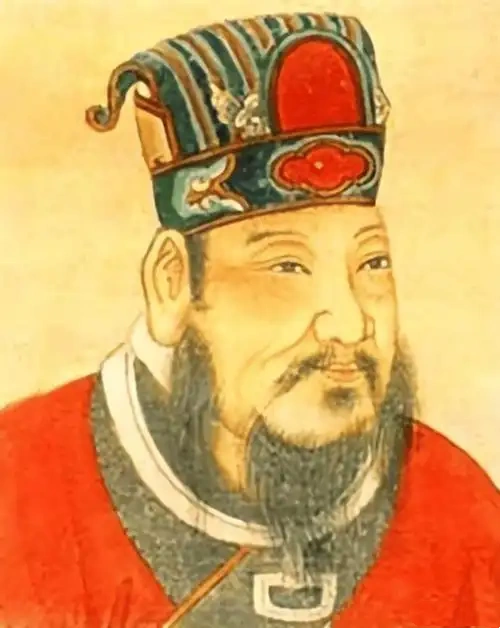
In the first weeks of the year the Western calendar calls AD 9, a man of fifty-three took the throne of the Han without a battle. He had raised no army and won no province. The throne was handed to him by an edict issued in the name of a child of four, on the strength of a casket that a forger had carried into the ancestral temple, and the officials who praised the transaction were not inventing reasons. They knew the model and believed they had found it. Twenty years earlier a memorial at the court had already compared him to the Duke of Zhou.
His name was Wang Mang, and he was the nephew of the empress who had stood behind the throne for three decades. In a family that rode horses and gambled and matched one another in carriages and singers, he had worn the plain cloth of a scholar, given away his salary, refused the estates offered to him, kept a single wife, and spent whole months nursing a dying uncle. That was the reputation he was admitted to the court on, and it was the reputation that carried him onto the throne.
He held it for fifteen years, and what he did with it was less a government than the execution of a text. He took the Rites of Zhou, a ritual canon older than the empire, and the reports of omens, and a theory of names, and he rebuilt the land, the money, the offices, the place-names and the frontiers to match. Almost none of it held. His land law took fields from men who could defend them and assigned them, on paper, to men who could not. His coinage made the market of a country of millions turn on a table of metals and shells that no one could read. His diplomacy converted four peaceful frontiers into four wars in nine years. In the third year of his reign a river that his government had declined to repair drowned a province, and in his last an army of four hundred and twenty thousand men was destroyed by three thousand. He was killed by a merchant, his body was cut to pieces by his own soldiers, his tongue was eaten in the market of a rebel capital, and his head was kept as a trophy in a government arsenal for two hundred and seventy-two years, until it burned.
Four sons were born to him. He killed or drove to death three of them, each time for the sake of the same thing.
1. The Orphan of the Wang Family
He was born in 45 BC, in Yuancheng in Wei commandery, in what is now the south of Hebei. His grandfather Wang Jin had been a minor official of the law courts and had done better through his daughters than through his career: one of them, Wang Zhengjun, entered the palace of the heir apparent in the 50s BC and bore him a son. When that heir became Emperor Yuan, Wang Zhengjun became his empress; when her son took the throne in 33 BC as Emperor Cheng, she became the dowager empress, and the family she had come from became the government.
The mechanism was fast and open. On her son's accession the empress dowager's eldest brother Wang Feng was made grand marshal and general-in-chief and given the conduct of the administration, and the rest of the brothers followed him into the peerage. Under Emperor Cheng the family held the grand marshalship in an unbroken succession — one family in the highest office for the whole of a reign. The History of Han records it without surprise as a fact of the period, in the way it records a run of good harvests.
Wang Mang's own father was Wang Man, one of the empress dowager's brothers who did not live to share in the family's rise, and Wang Mang grew up in a house that had nothing to show for its connection but the connection itself. In the division of the family's fortunes this was the decisive fact. His cousins, by the time they were grown, had mansions and stables and followings and places in the guard; he had a widowed mother, a widowed sister-in-law, a nephew, and no rank. The History of Han gives the situation in six characters that have been quoted ever since: he was alone, poor, and therefore bent himself to be respectful and frugal. The biographer means it as the first stroke of the portrait, but it also happens to be the plain sociology of the case. The men of his generation had capital, and he had none; the one resource left to a poor relation inside a great clan was reputation, because reputation is the only form of wealth that can be accumulated without money.
He went about it with a concentration that no one in the family matched. He studied the Rites under a teacher named Chen Can, wore the dress of a student, and made himself known among scholars rather than among the sons of marquises. Within the house he took the part of the dutiful junior; outside it he kept the company of men of letters. The family's own style was the opposite, and his refusal of it was read by everyone who saw it, his relatives included, as virtue rather than reproach.
The three accounts of his early life that survive — the memoir of the empress dowager, the biography of Wang Mang himself, and the family memoir of the Bans — all agree on the same facts and all draw the same conclusion from them. He was the one member of the clan who could be described without mentioning money. That was his whole position in the world, and he spent the next forty years widening it.
2. The Nursing of a Sick Man
The event that launched him was an illness in his uncle's house. The grand marshal and the head of the family was dying, and the nephew with nothing to inherit was the one who attended him to the end. Every account of Wang Mang opens with that sickroom, and the scene does not need to be retold here. What the dying man left him was not an estate but a recommendation, and it carried him into the palace.
What followed was slower and more important. Great men of the court began to speak for him; one of his uncles offered part of his own fief to fund a title. In 16 BC the emperor gave him the fief of Xindu, in Nanyang, and with it the first of his offices. He was thirty. He had entered the government without a father, without an inheritance, and without ever having held a command, and he had done it on the strength of a sickbed and a reputation.
It is worth being exact about what he had learned, because he used it for the rest of his life. He had found a method: a visible, extreme, self-denying act, performed where it would be seen, converted into advancement. And he had discovered the asymmetry that made the method work. In a court where everyone was taking, the man who visibly refused to take could not be outbid. Every office he declined and every gift he passed on increased the price of him.
He practised it on a larger scale after 16 BC. He gave his salary and his revenues away to his clients and to scholars, kept his horses and his carriage in poor condition, and lived more plainly as he rose. The History of Han preserves one scene of it. When the wives of the ministers came to inquire after his mother's illness, the woman who came out to receive them was dressed so shabbily that they took her for a servant, and were told, and were astonished, that she was the marquis's wife. The anecdote has a double edge that the men who repeated it seem to have felt: it is the proof of a great man's simplicity and the record of a piece of theatre.
By the middle of the reign he was the most widely spoken-of man in the official world, and his name was worth more than the names of his uncles. In 8 BC the highest office came open, and the man in front of him was a cousin on the empress dowager's side, Chunyu Chang, who had risen faster than Wang Mang and had left himself open. Wang Mang gathered the facts of the case, and the case did the rest. His rival died in prison, and the office was Wang Mang's. It was the first time he had paid for a promotion with another man's destruction. It would not be the last.
He entered the office in the manner of someone who had rehearsed it. He took the largest share of the salary and gave it to his retainers; he is said to have been poorer in his own establishment than before he took the post. He asked for the opinions of men of learning, and was solicitous of the officials who served under him. The History of Han notes it in four words and no more: he restrained himself without tiring.
3. The Grand Marshal
He held the office for one year. In the third month of 7 BC Emperor Cheng died suddenly in the Weiyang Palace, without an heir, at forty-five; the man who had risen by serving a sick uncle had now to conduct the funeral and manage the succession of an emperor he had served for twenty years. The throne passed sideways, to the son of the emperor's brother, who reigned as Emperor Ai. With him came his own kin — his grandmother the dowager of Dingtao and his mother the Lady Ding — and with them came the end of the Wangs' monopoly.
The break came over a question of precedence, and it is enough to say that Wang Mang refused the new emperor's grandmother a place beside the grand empress dowager, that she never forgave him for it, and that he knew at once what he had done and asked to be relieved on the plea of illness. The emperor, needing the support of the wider court, let him go. He surrendered the seals and withdrew to his own house.
He stayed there for two years. In 5 BC the new chancellor, seeking to make his own position by attacking the fallen family, memorialized that Wang Mang had dishonoured the emperor's own kin and ought to be reduced to a commoner. The emperor refused to strip his rank and sent him south to his marquisate. And there, in the flat country of Nanyang, he committed for the first time the act that would define him. His second son, Wang Huo, killed a slave. A slave was property, and the killing of one by the son of a marquis was the kind of thing that was settled quietly with money; instead Wang Mang made the boy die for it. There is no record that he hesitated, and no sign that he was performing. The man who had spent his life building a name out of self-denial had just paid for his name with his son, and what the official world took from the transaction was the size of his conscience.
It worked. Through the three years he spent in the south the memorials asking for his return came up from the provinces by the hundred. In 2 BC the court invited plain criticism, in the manner of an age that read omens as reproaches, and the plain speech it produced was in his favour: the man who had upheld the dignity of the throne against the Dingtao women had been driven out for it. The emperor recalled him to the capital to attend on the grand empress dowager. He was not given back his office, but he was in the capital, with the old empress's ear, when in the sixth month of 1 BC Emperor Ai died at twenty-five without a son.
What followed took three days. The grand empress dowager went that same day to the Weiyang Palace and took back the seals of state, and sent for Wang Mang; within the week the office was his. When the empress dowager asked the ministers to nominate, two of them voted against him, the generals He Wu and Gongsun Lu, and by nominating one another instead they made their objection stand on the record, which is how the record preserves the fact that the appointment was not unanimous. Wang Mang took the office, took charge of the palace guards, and took up the question of the succession.
4. The Regency
The heir he chose was the son of the king of Zhongshan, a boy of nine whose father had been a son of Emperor Yuan, and whose grandmother had died in a witchcraft case in the previous reign. The choice of a child needs no explanation beyond itself: a grown man from another branch of the imperial house would have governed. The boy was enthroned, and the government was put into Wang Mang's hands under the title of regent, in an era named Yuanshi.
For eight years he governed the empire in the name of a child, and the eight years are the hinge on which his reputation turned. As regent he could not yet alter the dynasty; what he could do was alter everything inside it, and he did. He had the descendants of the ancient royal houses and the heirs of the founders' ministers sought out and enfeoffed. He increased the offerings and the music in the ancestral temples, extended relief to the widowed, the orphaned and the childless, and had the old and the poor given cloth and grain. He reduced taxes in the districts that suffered from drought and locusts and had the imperial parks opened and turned into settlements for refugees.
His contemporaries wrote down what they thought they saw, and one document of these years is worth keeping because it is a list. In AD 2 the assistant to the grand minister, Chen Chong, presented a memorial in praise of him, item by item: that he bent himself to benevolence and governed his heart by the rites, turned his back on the customs of the age and stood alone; that he ate coarse food and wore poor cloth, kept a shabby carriage and a worn-out horse, and had but one consort, so that within his own gates the virtue of a son and a brother was known to everyone; that he was quiet and took his joy in the Way, mild and courteous to men of worth, and generous to old friends. Chen Chong set the list beside a row of precedents drawn from antiquity and concluded that the duke could be ranked with the sages. Every item on the list was true, and every item was the thing he had chosen. What is worth marking is where most of them would be spent. Within twenty years the man who ate coarse food and drove a shabby carriage would be raising nine ancestral halls at a cost beyond reckoning and at the price of tens of thousands of lives; and the man praised as mild and courteous to men of worth would be governing by edicts that no clerk could keep up with, and would die with the whole of the empire in arms against him. The list was not a lie about the man who had earned it. It was an inventory of the capital he had accumulated, and he would spend all of it.
He also began, in these years, to change the map. In AD 4 he had the chiefs of the Qiang beyond the western frontier persuaded, with gifts, to hand over the country around the salt lake of the far west, and he made it a commandery and called it Xihai, the Western Sea. The name was the point. The empire already had a Eastern Sea commandery, a Southern Sea and a Northern Sea; with a Western Sea added to them, the realm could be described, in the official geography, as bounded by four seas in four directions, which was how the classics described the kingdom of the Zhou. The land itself was a pasture with a few thousand households on it. To make it look like a commandery, and to populate it, the government needed settlers and convicts, and to produce the convicts it added fifty articles to the penal code. Men were transported from the interior to a grassland on the far side of the known world so that a place on the map could be made to agree with a sentence in a book. It is the first of his projects in which the whole machinery of the episode can be seen at once, and it cost the government the goodwill of the western frontier years before it had anything to show for it.
In the same years, the child emperor grew older, and the arrangement by which the regent held the government was one that everyone had been promised would end. In the twelfth month of AD ## 5 the boy died, at fourteen, and if Wang Mang had been a poisoner — the charge was his enemies', repeated for two thousand years, and no court history of the reign entered it — his motive is exactly the one the arrangement had created, since the boy's coming of age would have ended the regency. The regency did not end. The grand empress dowager's edict, at the end of that winter, made Wang Mang acting emperor for another child, with the powers of a sovereign. He held that position for two years and nine months, wearing the dress and the name of the Son of Heaven; and at the end of that time an official presented a stone inscribed with an order from heaven and a box inscribed with the ministers of a new dynasty, and Wang Mang laid down the regency, took the throne, and named his house the Xin — the New.
5. The New Dynasty
The change was made in the twelfth month of the Han year, which the Western calendar counts as the first half of January in AD 9. On the first day of that month Wang Mang, at the head of the nobles and the officials, carried the seals of the Han up to the grand empress dowager, went with the talisman decree, and removed the Han name. He was fifty-three. The dynasty he founded was named for his own first fief: he had been marquis of Xindu, in Nanyang, and he took the character for newness out of that title and made it the name of an empire. The capital was left where it stood and given a new name: the Long Peace became the Constant Peace. It was the same city with a different word at the head of its name, and that was the point.
The court was filled in the manner of the Rites of Zhou: four supports and three dukes. The four supports were the grand preceptor, the grand tutor, the preceptor of state, and the general of state; the three dukes were the grand marshal, the grand minister of education and the grand minister of works. The men chosen were the ones who had built the regency. Wang Shun, the emperor's cousin, took the grand preceptorship and the fief of Anxin. Ping Yan, who had managed the confidential business of the government, took the grand tutorship. Liu Xin, the scholar who had been the regime's chief interpreter of the classics and of portents, took the preceptorship of state. And the fourth place was given to Ai Zhang.
Ai Zhang was the maker of the casket — a man of Zitong with no office and no family, who had written out, at the turn of the year, the text that named Wang Mang as the true Son of Heaven and listed the ministers of the government he was to form. The list had been his own composition. It had included his own name, and he was now one of the four supports of the state, with the fief of Meixin and a seat above the three dukes. Two other names on the list had belonged to nobody, and the government went and found men to fill them. A regime founded on a text will be run by whoever writes texts. The first man to understand what Wang Mang had received was a forger, and the price of the forgery was the fourth seat in the government.
In the same year the emperor set about his ancestry. He traced his house to the Yellow Emperor as its first ancestor and to the sage emperor Shun as its founder, through the ancient state of Chen and the kings of Qi, from whom the Wangs of Wei commandery claimed descent, and he had the altars and the sacrifices of those houses restored at the capital. It was the same operation as the casket and the same as the four seas: a claim about the past, made in the present, in the form of a named and dated institution. The Han had held the throne by conquest and by inheritance; Wang Mang meant to hold it by genealogy and by book.
In the first year he also did to the Xiongnu what he had already done to the titles of his own officials. The chief of the Xiongnu had for generations held a seal granted by the Han whose inscription gave him the title chanyu of the Xiongnu, and its form was that of a sovereign addressing a sovereign. Wang Mang sent an envoy to exchange it, and what the envoy brought was a seal whose inscription ended not in xi, the character for a ruler's seal, but in zhang, the character used for the seals of subordinate officers and marquises. The chanyu objected to the character and asked for the old seal back; the envoy, who had been instructed, said the old seal had been destroyed. It was the first act of the new reign abroad, and it set the pattern for all the others. The relationship between the Han and the steppe had been fixed, over two centuries of war and marriage and tribute, into a working arrangement that both sides understood. Wang Mang looked at the document that expressed it and found a word in it that was wrong.
At the end of the first year he issued a standard measure of capacity, worked in bronze, with the dimensions and the proportions of the ancient vessel described in the classics, and sent copies out to the commanderies as the fixed standard of the realm. It is a handsome object and a meticulous piece of work; it is also the only thing he made in those first months that did what it was supposed to do. For the rest, the first year of the Xin was given over to four great decisions, and he took all four of them at once, before the empire had any chance to answer the first. He changed the fields. He changed the slaves. He changed the money. And he changed the names of everything.
6. The Fields and the Slaves
The first of the four was the most serious and the most defensible. In the first year of the reign he issued an edict on the land, and its reasoning is worth setting out because it is a good argument. In the highest antiquity, he wrote, the land was divided into wells — units of nine squares, eight families to a well — and each household of a man and a woman held a hundred mu and paid a tenth of its produce in tax, and the kingdom was provided for and the people were rich and the songs of praise were sung. This was the way of Yao and Shun and the three dynasties. The Qin had destroyed it. They had raised heavy taxes to serve themselves, exhausted the people's strength for their own pleasure, abolished the sacred institution and abolished the well fields, and so engrossment began and greed was born: the strong measured their fields in thousands, the weak had not the ground to stand a needle on. Worse, they had set up markets in slaves and penned men with cattle and horses and given masters the power to end a life at will, so that the vicious traded men and sold other men's wives and children, against the heart of heaven and against human order. The Han had lightened the land tax to one part in thirty, and the powerful had turned even that into an instrument: the rate was written as one in thirty and collected as five in ten. So, the edict concluded, let the fields of the empire be renamed the king's fields, and let slaves be renamed private dependants, and let neither be bought or sold; let any household of fewer than eight persons holding more than a well's nine hundred mu divide the surplus among its kinsmen and its neighbours; and let those who have no land receive it under the same rule. And any man who denies the sacred institution of the well fields and makes confusion among the people is to be cast out to the four frontiers, to feed the demons of the waste.
The edict is a document of its author's mind. It is a diagnosis of a real disease by a man who had watched the disease work, written in the vocabulary of a book, with a remedy taken whole from the same book. Land engrossment and the slave trade were the two great facts of late Han society; the reformer who proposed to abolish both was not a fool and not a hypocrite. And the last clause of the edict tells the reader what he was, which was a man who had decided that the way to abolish an institution was to abolish its name. Rename the fields the king's fields and no one will own them; rename slaves dependants and slavery will end.
In AD 12 the History of Han records that persons condemned for buying and selling fields, houses, slaves and coinage, from the marquises and the ministers down to the common people, were too many to count. In that year an official named Qu Bo put the objection to him in the plainest terms available. The well fields were the law of the sage kings, he said, but they had been abolished a long time since; when the Zhou declined the people would not follow them; the Qin perceived that the people's hearts could be won and great profit gained by abolishing the well fields and laying out the long fields and the cross paths, and so became kings of the whole land; and to this day the empire has not tired of the change. To go against the people's hearts now, in pursuit of a system extinct for a thousand years, would fail even if Yao and Shun rose again — there was no hundred years of preparation for it. The empire had just been settled; the people had just attached themselves to a new house. It could not be done. Wang Mang heard him, and conceded the point in the only way he ever conceded anything: he issued a rescript saying that lands held under the name of king's fields might be sold, and that the law against buying and selling human beings would for the time being not be enforced.
There was a further reason, which no edict could reach. The law assumed a machinery that did not exist. To take the surplus of the great holdings and hand it to the landless, a government must know, household by household, who holds what and who holds nothing; the Han had no such register, and the men who kept the local records were the local magnates whose fields were in question. The law required the very officials who profited from engrossment to report it and undo it. What the administration could actually do was process accusations. A measure written to open the land to the poor worked, in practice, as a machine for generating cases against men who had bought and sold under the old rule. The strong could pay the fine or put the title in a kinsman's name; the weak had no title to be confirmed and no money to pursue one. A reform that needs a survey of the realm to succeed, and arrives in the realm as a schedule of penalties, takes the land away from nobody. The reform was not repealed. It was left standing in the statute book and quietly not carried out, and the land that had been taken from the strong did not go to the weak. In AD 22, with the risings already general, an edict was drafted to abolish the fields and the slaves and the state monopolies together, and the fighting reached the capital before it was issued.
The measure that was supposed to abolish slavery had one consequence that no one in the government seems to have foreseen. The edicts against the private coinage filled the prisons and the registers with offenders, and the penalty for a convicted coiner was to be made an official slave. The History of Han gives the scale of it in a passage written while the policy was still running: offenders were punished in groups of five, one man's crime reaching his neighbours, and those so condemned were registered as bondservants of the state, the men carried in caged carts and the women and children made to walk beside them with iron collars locked about their necks, sent in this condition to the mint works, in numbers counted in the hundreds of thousands. A government that had made the sale of a man a crime punishable by exile had created, in five years, the largest single body of unfree labour in the history of the Han.
7. The Coinage and the Markets
The money was changed four times in eight years, and each change taught the market to trust the government less than the one before. In AD 7, before the dynasty had been founded, he had issued three new coins to run beside the five-zhu piece that had been the money of the Han for a century: a large coin worth fifty, a knife-shaped coin worth five hundred, and a second knife with its inscription in inlaid gold worth five thousand. The last of these — a piece of bronze the length of a hand, marked as worth five thousand of the money in every purse in the empire — was not a coinage. It was a levy, collected from everyone who was paid in it. With the founding of the dynasty, in AD 9, the knives and the five-zhu were abolished altogether and two coins were issued in their place: a small one worth one and a large one worth fifty. In AD 10 the small and the large were superseded by the most elaborate money ever devised for an empire: the system of precious commodities, in which gold, silver, copper, tortoise shell and cowrie shell were struck or cut into six classes and twenty-eight denominations, with values fixed by the government in a table and the table fixed in law.
It could not have worked, and it did not. The five-zhu piece had been in circulation for a hundred and twenty years and its weight was known to every market in the country; the new money was light, was valued by decree, and changed its value with each edict. The people went on using the old coin. The government replied by making the old coin a crime. A decree of the period provided that anyone found carrying the five-zhu money, or heard to say that the large coin should be abolished, was to be treated as an enemy of the sacred institution of the well fields and cast out to the four frontiers. What the History of Han records of the result is a market that stopped: the farmers and the traders lost their living, goods and money both failed, and the people were seen weeping in the streets of the markets. In AD 14 the commodities system was abandoned and two new coins — the huobu and the huoquan — were issued in its place; the History of Han records the general effect of these years in a line that no later writer has bettered: each time the money was changed, the people were ruined in their trades and sank deeper into the penalties of the law.
Beside the money stood the monopoly and price system, laid down in the same year as the commodities: the six controls, by which salt, wine, iron, the wealth of the mountains and marshes, the minting of coin, and the lending of money were all taken into the hands of the state. It is the part of the programme that most closely resembles a modern policy, and it was designed with the same care. The state would buy grain and cloth and silk when they were cheap and plentiful, hold them, and sell them when the price rose above the assessed level for the season, so that the price of grain could not be worked by hoarders. It would lend money to a household that had to bury a parent or perform a sacrifice, at no interest, and to a man who wanted capital to set up in trade, at a rate not exceeding one tenth a year. It would tax the fisherman, the trapper, the weaver, the physician and the diviner on their takings, at one part in eleven, on the principle that a man who drew wealth out of the empire's resources should give something back to the empire. The aims are written into the edict, and they are not the aims of a fool: to level the many and press down the strong, to keep the rich from strangling the poor, and to make the state, and not the merchant, the party that holds the money.
The way the programme was argued deserves one example, because it shows the method exactly. Wine was the last of the six to be taken into the state's hands, and the minister who proposed it, Lu Kuang, put the case to the emperor as a pair of quotations that appear to contradict each other. The Odes say, Come, I will buy you wine; the Analects say that wine bought in the market is not fit to drink. Lu Kuang's solution was that the two sages were speaking of two different worlds. The Odes describe an age of peace, when wine was made by the government, was sweet and honest, and could be offered to anyone; Confucius lived after the Zhou had declined and wine was made by private traders, thin and untrustworthy, and so he would not touch it. To restore the ancient practice, therefore, the state should make the wine. It is a perfect specimen of the political reasoning of the age: an institution is created by reading two lines of the classics against one another and choosing the earlier world, and the earlier world happens to be the one that hands the treasury a monopoly.
The execution destroyed it. The men appointed to administer the five markets and the six controls were chosen, in the words of the History of Han, from among the great merchants, and the great merchants of Luoyang, of Linzi and of the capital took the offices, rode the government post-horses, and moved about the country in pursuit of profit. Every one of them understood how a price fixed by law is a price that can be beaten by a man who knows the law. They falsified the accounts, the provincial treasuries went bare, and the people were worse off than before. When an officer of state at last stood up in a council and asked the emperor to execute the men who had made the reforms — the designer of the well fields and the author of the six controls among them — the emperor had him put out of the hall by the guards, and then quietly demoted one of them to a frontier post, because the people's hatred had to be answered with something. What the episode shows is not that the policy was wrong but that it had been handed, in the first year, to the only class in the empire that had both the skill to run it and the interest to wreck it.
8. The Names of Things
It is in the names that the shape of the whole enterprise becomes visible. In the first year of the reign the offices of the empire were renamed wholesale, out of the vocabulary of the Rites of Zhou. The grand minister of agriculture became the Xihe, and then the Nayan, the receiver of words; the minister of justice became the Shi, the worker; the minister of rites became the Zhizong, the master of the ancestral hall; the chamberlain for the dependencies became the Yue, the master of music; the privy treasurer became the Gonggong, the worker of works; the commander of the waters became the Yuyu, the forester. The governor of a commandery, who had been the taishou, became the dayin, the great governor; the commandant of a commandery became a grand commandant; the magistrate of a county became the zai, the steward. The salaried grades of the bureaucracy were renamed too: the twelve hundred bushel officials became masters of the four seasons, and the lesser grades took the names of the subordinates of the ancient kings.
The places followed. Commandery names were altered in a sweep, and then altered again. The History of Han records the practice with a sentence that is almost a formula: a single commandery might be renamed five times and then renamed back to what it had been, so that the clerks and the people could not keep track; and thereafter every edict that went out from the capital had to carry the old names after the new ones so that the officials receiving it could tell which places it was talking about. A government that had to translate its own decrees back into the language of the people it was governing had made a statement about itself more damaging than any accusation.
The renaming was not, in Wang Mang's mind, a decoration. He held a theory of it. The classics say that the ruler's first duty is the rectification of names — that when the name is correct, the thing follows; that the way to reform an institution is to give it the name it ought to have; and that a state and a man are one with the words used for them. He was not the first or the last ruler to believe that a reform had been accomplished when its vocabulary had been settled, but he was one of the very few who had the whole machinery of an empire with which to test it. He had renamed the land as the king's land and the slave as the dependant; he had renamed the chanyu of the Xiongnu as a subject and his seal as a seal of office; he had renamed the officials of the Han as the officials of the Zhou. In each case the word was changed at the capital and the thing was expected to change in the country. The edicts on the land were already three years old when the History of Han recorded that men were being condemned in numbers too great to count for trading under the old names.
The History of Han gives his working life in a few sentences, and together they describe a man who had confused the making of rules with the making of a country. He believed that once the institutions were settled the empire would settle itself; and so he gave his mind to the geography, the ritual and the music, brought the six classics into agreement with one another, and let the business of the day wait. The ministers came in at dawn and went out at dusk, and the discussions ran for years without reaching a decision. He would have the lamps lit and sit over the documents until daylight, and even then he could not get through them. It is the portrait of a government of one man, working as hard as a man can work, on the wrong material. What he was trying to finish was a body of orders; what he had to govern was a country; and the two had stopped being the same thing somewhere in the first year, when the clerks in the provinces began writing back to ask which of the two names of their commandery they were to use.
The largest of the name-works was the temples. In AD 20, in the first year of the era Dihuang, with the risings already well begun, he gave orders for the construction of nine ancestral halls at the capital for the line of ancestors he had claimed — the Yellow Emperor, the emperor Shun, and the kings of the ancient houses through whom he traced his descent, down to his own father and grandfather. The work was done in a period of famine and war. The History of Han records the cost in a phrase: the labour and the expense ran beyond reckoning, and the conscripted workers and convicts died in tens of thousands. It is the last of the great operations of the reign, and the one that shows most plainly what the earlier ones had meant: an emperor who had changed the field and the coin and the office was building, in the worst year of his reign, an architecture for a genealogy that no one but his own clerks believed in.
9. The Frontiers
Abroad, the same theory did the same work. The Han had held its borders by a mixture of war, marriage and subsidy, and the arrangement had come to rest, over the century before the Xin, on a set of distinctions that both sides understood: who sent a princess and who received one, which seal was carried by which ruler, what a document called the man who signed it. Wang Mang, who had spent his life on the correct use of words, looked at these arrangements and read them as a series of errors.
The first of the corrections was the seal, in the first year. The chanyu of the Xiongnu sent an envoy to ask for the old seal, and the envoy of the Xin said it had been broken. The chanyu, who was a capable man and had a claim on the Han that went back to his father's time, took the loss as an insult and began to raid the frontier. In the second year the emperor went further and changed the chanyu's title itself, from the sovereign name chanyu to a new compound: Xiongnu submissive servant. No document in the steppe would accept such a name, and none did. What the emperor had gained was a form of words in his own chancery; what he had lost was the frontier.
In the third year, AD 11, he made the decision from which the dynasty never recovered. He ordered twelve columns of generals, and resolved on a levy of three hundred thousand men, with three hundred days' rations for each, to march out in ten directions and hunt the chanyu to destruction. The host was never assembled in the field, because the logistics of it were impossible: the grain and the fodder and the carts had to be brought up through the northern commanderies, and the men and the animals ate the road bare as they came. The generals who did reach the frontier were ordered to wait on the edge of the steppe for the columns that had not arrived, and the winter came, and the campaign dissolved into a standoff that lasted years. The levy was never disbanded. The men raised for the north stayed on the northern frontier, or in the camps and depots behind it, and the provinces through which their supplies passed were drained of what the farming year needed. It is the decision that turns the rest of the reign into a countdown. After it, the government is always short of men, always short of grain, always governing a country whose young labour is somewhere else.
One of his generals tried to stop him with history, and the exchange is worth setting beside the edicts. Yan You, who commanded in the north, memorialized against the campaign in the plainest terms available, by way of the record of what the dynasties had done to the Xiongnu before. The Zhou, he said, had treated them as one drives off a fly: when they came in, the army went out and turned them back, and no more was attempted, and the world called it good government, and that was the middle policy. The Han had chosen generals and drilled troops, marched them deep into the steppe on short rations, and won victories that were always repaid: thirty years of fighting and no settlement, with the empire exhausted and the Xiongnu wounded, and the world called it martial, and that was the lower policy. The Qin had refused to bear a small insult and spent the people's strength on a wall ten thousand li long, and the empire was drained to finish its frontier, and it lost the throne, and that was no policy at all. The memorial is a piece of good sense, and it was filed. What the emperor wanted from the north was not a settlement but an acknowledgment, and an acknowledgment was the one thing the steppe would not give.
The other frontiers were treated according to the same sense of what a name was worth. In the far south-west the king of Juting, a chief whose house had held its title from the Han for two generations, was deposed and reduced to a marquis, and when he objected he was killed, and his brother raised the south-west in revolt. In the north-east the kingdom of Goguryeo, which the Han had kept in a loose dependence for a century, was redesignated and its ruler renamed: the king became a marquis, and the high in the kingdom's name was changed to low — a demotion carried out on paper and delivered by an officer who took the king's head as well, at a meeting called to settle the terms. In the far west, in AD 13, the men of Yanqi killed the protector-general of the Western Regions, and the whole of the Tarim basin, which the Han had spent a century and several armies bringing into its system, went out of it. The pattern repeats in each case and is worth naming: the emperor inherits an arrangement built by others over decades, finds in its documents a word that offends a rule he holds, changes the word, and thereby converts a peace into a war that the empire cannot afford.
There is one frontier where the whole thing had been done before the dynasty began. The commandery of the Western Sea, established in AD 4 to complete the four seas, had been a name with a garrison attached; the Qiang who had been persuaded to hand over their pasture later regretted it, and the frontier the government had bought with gifts had to be held with troops. Its author had learned, five years before he took the throne, that a place renamed does not become the place in the book. He did not apply the lesson anywhere else.
10. The River and the Rebels
In the third year of the reign, the same year as the northern levy, the Yellow River broke its banks at Wei commandery and went where it had not gone for centuries, spreading over the commanderies of Qinghe and away to the east. It was the largest change of course the river had made in the Han period, and it drowned the richest grain country in the north. The government did not repair it, and the reason the History of Han gives is one of the coldest sentences about him in the whole record. Wang Mang's ancestral graves were at Yuancheng, in the path of the old river. When the river turned east, Yuancheng was no longer threatened, and so the breach was never closed.
For twenty years the floods and the drought and the locusts followed one another across the north China plain, and the government's answer to each was an edict or a sacrifice or the arrest of an official. By AD 17 the country had begun to produce men who had nothing to lose and somewhere to go. In the far south, in the hills between the Han river and the Yangtze, famine in the Jing province drove a crowd of starving men to gather for food; two leaders emerged, Wang Kuang and Wang Feng, and their band took its name from the place they based themselves in — the Green Wood. (The name Wang Feng belonged to Wang Mang's own uncle, the grand marshal who had died forty years before, and the coincidence of the two men has confused careless readers ever since; the leader on the Green Wood was a different man from a different class.) In the following year, AD 18, in the far east, a band under Fan Chong tied red cloth about their eyebrows to tell themselves apart in battle and became the Red Eyebrows. Both were risings of the destitute, and both grew because the government could not reach them: the commanderies where they rose had already been stripped of their garrisons to feed the northern front, and the men who might have put them down were standing in camps on the steppe.
In AD 21, in the second year of the era Dihuang, the trouble came closer. A rising in the south was raised by Qin Feng, and one in the east by a woman named Chi Zhaoping, whose band was said to be several thousand strong and who is the only woman among the leaders of the period. In AD 22 the famine in the east became general; the History of Han records that in some districts the people were eating one another. In that year the government at last proposed to abolish the land law and the monopolies and the restrictions on the mountains and marshes, and a decree was drafted promising to undo everything the reign had done, and it was never issued — the fighting reached the capital first. An officer named Tian Kuang, who had raised a militia on his own authority in the east to fight the rebels, was reprimanded by the emperor for doing it without orders, then confirmed in his command, then relieved of it, in the course of a season; the episode is a fair sample of a government that had lost the power to decide anything in the time available.
In the second month of AD 23 the risings were given a dynasty. The bands of the south — the Green Wood men and their offshoots, the New Market and the Flat Grove troops — took a member of the imperial house, Liu Xuan, and made him emperor under the name Gengshi, the Renewed Beginning; and from that moment the war for the empire had a Han to fight for. The government's answer was the campaign that ended it. In the sixth month of AD 23 the emperor sent his cousin Wang Yi and the minister Wang Xun against the rebel position at Kunyang, with what the sources call the greatest host ever put into the field by a Chinese government: four hundred and twenty thousand men gathered at Luoyang from the commanderies, with the rest still on the road, and the whole of it given out as a million. The town of Kunyang held a garrison of eight or nine thousand. A young cavalry officer of the Liu family, an undistinguished and at that point untested man named Liu Xiu, went out through the lines by night to bring up help, and came back with a few thousand horsemen, and on the day of the battle led three thousand of them straight at the centre of the government's line.
What happened then is recorded in two places, and both of them strain to find words for it. The sky turned against the camp: a meteor fell into it by night, and by day a cloud like a collapsing hill came down on it. A storm of rain and wind broke the lines, the river came up, and the host that had been gathered as a million broke without ever being brought to battle as a body — the men trampled and drowned one another, and the field was said to be covered for a hundred li, and the water the dead lay in stopped running. Wang Xun was killed in the rout; Wang Yi escaped with a few riders. Four hundred and twenty thousand of the empire's trained soldiers were destroyed by three thousand men in a morning, and the government never again had an army.
11. The Terrace on the Water
The end came in the tenth month of AD 23. The forces of the Gengshi emperor had come west from Nanyang, and on the first day of the month they entered the capital through the gate of Proclaimed Peace. For most of the city the change of government was an opportunity: the young men of the wards, fearing what a sack would do to them and seeing a chance to be on the winning side, set fire to the great workshop gate, and the fire reached the private apartments of the Weiyang Palace. The fighting was still going on in the streets and the courtyards of the palace when the emperor of the Xin, dressed in the dark ceremonial robes of a sovereign with the seals of state at his belt and the dagger of the sage emperor Shun in his hand, moved with his attendants from one hall of the palace to another, and the fire moved with them.
He had spent the last months of the reign doing what he had always done, which was to answer a political fact with a ritual one. In the spring, told that the omens of his house were failing, he had gone out to the southern suburb and had a device cast in five metals, shaped like the constellation of the Plough, two and a half feet long, and had called it the Authority of the Dipper; it was to be carried before him when he went out and kept at his side when he sat, and it would, he believed, suppress the armies coming against him. Now, in the hall, with the fire outside, a clerk of the calendar held the astrological board before him and called the hours as the days were counted, and the emperor, turning his mat to follow the handle of the Dipper as it pointed towards the danger, delivered the last recorded sentence of his reign, which is a sentence from the Analects that Confucius says in a moment of danger, with the armies of the Han substituted for the man who threatened him: August Heaven begot in me the virtue that is in me; what can the armies of the Han do to me?
Then he left the hall and went to the terrace that stood out on the water of the palace lake, where a man might still hold out, and where the water would be between him and the fire. He took with him the two things he had made: the box of the Mandate and the Authority of the Dipper. His household guards and the ministers who were still with him stood on the stair, and they fought there for the rest of the day and part of the night, and the emperor of the Xin was killed on his own terrace, in the middle of his own capital, by the men who had come for the seals. The first of them was a merchant of the city, Du Wu, who took the seal-belt from his body. The second was an officer of the guards, Gongbin Jiu of Donghai, who cut off his head. What followed was less a killing than a division. The soldiers who had been fighting on the terrace, finding that their sovereign's body was worth more in pieces than the man had been whole, cut it apart where it lay, and fought one another for the parts, so that several dozen of them were killed by their own comrades in the middle of the city they had taken.
The head was carried down the country to the new court at Wan, where the Gengshi emperor had it hung up in the marketplace. The people of the market struck at it with their hands. And in a scene that the History of Han records in a few words and that has fixed the judgement of him ever since, some of them cut out the tongue with a knife, and ate it. Later writers have read it as an execution performed on a man's words — by people who had learned in fifteen years that the words of the government were the instrument that had been used against them, the tongue that had renamed their fields and their money and their counties, and talked them four times into a new currency and three times out of their land.
His head was not thrown away. It was taken into the collection of the Later Han and then of Wei and then of Jin, and kept in the arsenal at Luoyang among the treasures of the dynasties, where it stood as an object of state alongside the shoes of Confucius and the sword with which Liu Bang was said to have killed the white serpent on the road to the capital. It stayed there for two hundred and seventy-two years. In AD 295, in the reign of the Jin emperor Hui, the arsenal caught fire; the officer commanding the city, fearing that the fire was the signal for a revolt, ordered the gates closed and the fire kept from spreading before he would allow water on it, and by the time he allowed it the accumulated treasures of several dynasties, and the arms of two million men, and the head of the man who had ruled China for fifteen years, were burned together, and the sword of the Han was said to have flown out of the roof and away, and was never found.
The judgement of the historians was formed early and has not shifted much. Ban Gu, writing the History of Han a generation after the event, for a family his own grandfather had suffered under the Wang regime, gave Wang Mang three full scrolls — among the longest chapters in the book — and closed them with a verdict that has been the standard reading ever since. Wang Mang, he wrote, was without benevolence and yet had the talents of a flatterer and a schemer; he came to power upon the accumulated weight of four generations of his family's influence, at a time when the Han was weakening, and the old dowager's long life gave the family a patron; and so he was able to work his wickedness and bring about the theft of the throne. The house of Han lost its taste for life, the empire turned against him, cities were not defended, and the realm became a waste: of all the rebels and lawless men and men without the Way whom the histories and the traditions record, Ban Gu wrote, there has never been one whose ruin was as complete as his. And then he added a sentence that has lasted two thousand years longer than any of the reforms: in former days the Qin burned the Odes and the Documents in order to establish their own doctrine; Wang Mang recited the Six Classics in order to dress up wicked words.
The same chapter leaves a face, and the face is worth keeping in view, because it is the one thing about him that was not chosen. He had a wide mouth and a short jaw, eyes that stood out with red in the whites, and a voice that was loud and hoarse. He would commit himself to violent courses and feel no shame about them afterwards. A man who had decided early that his body and his household were materials for a reputation did not need to be handsome, and he was not. What the portrait settles is the point every account of him agrees on: he was not playing to an audience he thought could see through him. He meant it. When he turned his mat to follow the handle of the Dipper, in a burning palace, with the soldiers already on the stair, he was doing what he had done for twenty years.
That is the charge, and it is a charge about the man rather than the measures. It has been contested since. A thousand years later, in the ninth century, Bai Juyi wrote a poem that turns on him and is still quoted whenever a public man is found out, and it makes the opposite point in four lines: the Duke of Zhou feared the days of slander; Wang Mang was humble before he seized the throne; if he had died in the middle of his life, who would ever know the true from the false? The argument of the poem is that Wang Mang's virtue and his crime cannot be separated, because the virtue was what made the crime possible. And in the twentieth century, when the vocabulary of reform and revolution had changed, he was taken up by writers who thought the reforms had been right and the verdict wrong. Hu Shi, who had been reading the biography and the economic chapters together, published in 1922 an essay whose title said what he wanted: Wang Mang, a Socialist of Nineteen Centuries Ago. Wang Mang, he wrote, had borne the injustice of nineteen hundred years and had still not been fairly judged; he had been a great statesman whose nerve and skill were beyond those of Wang Anshi; and what he had tried — the state holding the land, the state controlling the market, the state lending to the poor — was a programme that deserved a fair hearing in an age that had one of its own. His reason for the failure was characteristic of his moment and not of his subject: the state in Wang Mang's time had not yet been organised well enough for so large an intervention, and so it could not have taken effect at once.
The judgement that holds the ground now is less decisive than either. The reforms were aimed at real injuries and were drawn from the best learning of the age; they were imposed from a single centre upon a society of some sixty million people across a territory as large as Europe, in edicts that were required to be obeyed at once and were changed, in several cases, within two years; and the men who had to carry them out were the men they were aimed at. As for the virtues that carried him to the throne, they were real enough to be repeated through the whole of his life and not in the least incompatible with what he did when he had it. The man who refused a fief and the man who killed his sons and the man who renamed the counties of an empire and the man who died on the terrace with the box of the Mandate in his arms were the same man, and each of the four is unaccountable without the other three. He had set out to make the empire match a book, and he had been willing to give up his sons, his name and his throne to do it, and the book turned out not to describe the country. What remained of him at the end was a divided body in the middle of his own capital, a tongue eaten in a rebel market, and a head kept in a state museum until it burned; and, for the two thousand years after, every schoolchild who learned the poem about him learned the same lesson, which is that the two halves of a man's life must be weighed together, and that a virtue that has been performed long enough can be harder to tell from the real thing than any crime.
He had four sons. He made the second kill himself over a slave, in his fief, in 5 BC. In AD 3 he destroyed the eldest over a plot against himself, and made the killing a lesson. In AD 21 he drove the fourth and last to his death over an intrigue in the palace, when the empire was already coming apart. Only the third, who was simple-minded and took no part in anything, was never touched.