Home / Emperors / Sixteen Kingdoms
Liu Yao of Han Zhao
汉赵刘曜
Liu Yao, ? – 329 · last ruler of Han Zhao
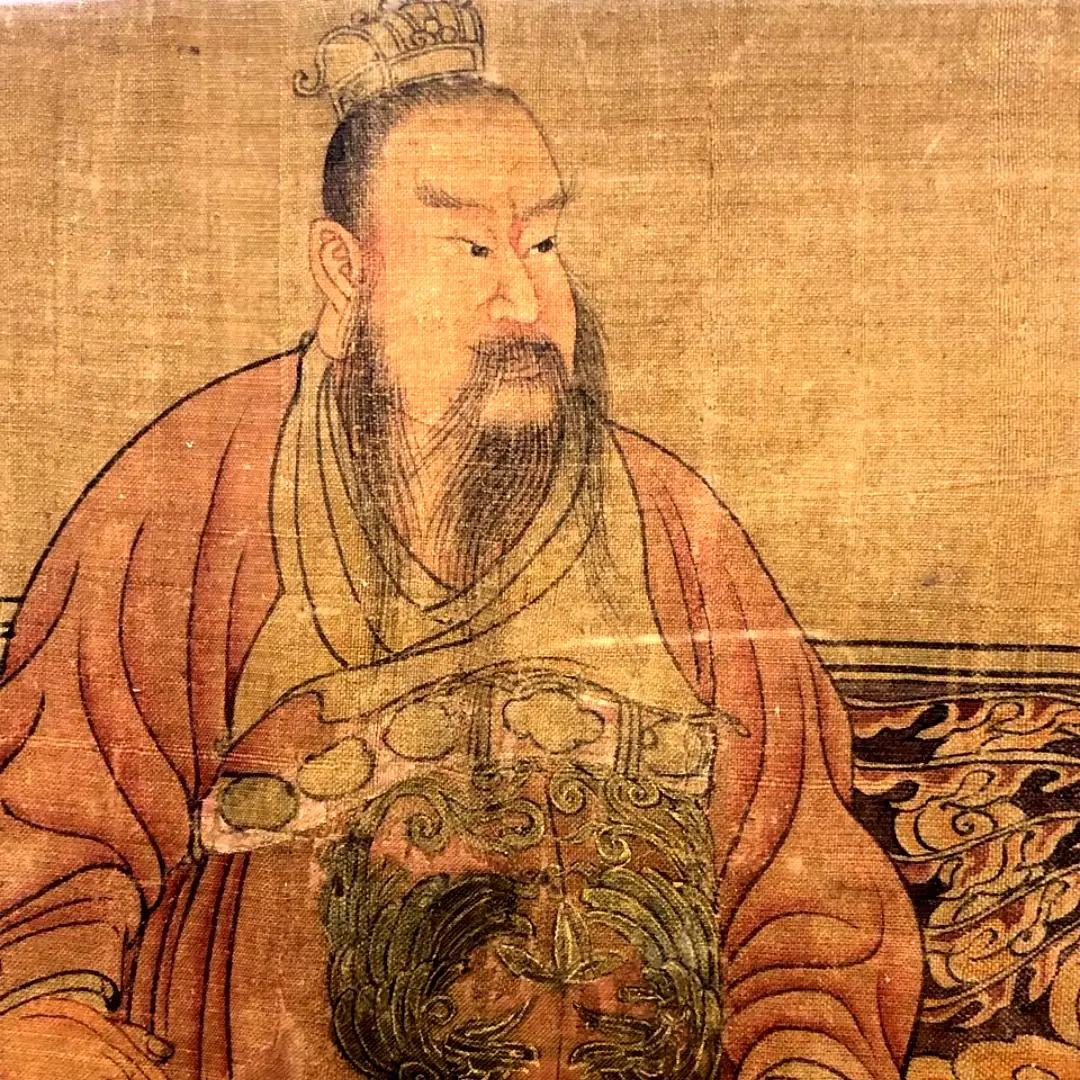
In the twelfth month of Guangchu 11, which fell in January 329, an army from Chang'an lay west of Luoyang, and its emperor rode out to form a line at the Xiyang gate. He had been drinking since the siege began. His red horse had stumbled for no reason that morning, so he had taken a smaller one, and he had drunk again on the way to the field. The line was still forming when the cavalry of Shi Le came through it. He fled, the horse went down in a stone-lined channel, and he came off it onto the ice. He had more than ten wounds, three of them through the body. A junior commander of Shi Le's army pulled him out and took him prisoner. He had held the throne since 318, over a state that had begun as Han and had been called Zhao since 319. The state did not survive him.
The man on the ice is usually placed at the end of a list: the last of the Han Zhao rulers, the one who lost the north to Shi Le. The list is correct and the emphasis is wrong. Liu Yao did not inherit a state and lose it. He inherited a coalition and renamed it. The coalition was made of Xiongnu households, Di and Qiang settlements in the Guanzhong, Chinese clerks, a Chinese academy, and commanders who had their own armies. The change of the state name in 319 was an attempt to turn that coalition into a dynasty with a claim on the north. It gave the state a ritual, a colour, a predecessor, and an ancestor. It did not give it a command structure. The strongest commander was Shi Le, whom Liu Yao had made Duke of Zhao in 318 and had tried to make King of Zhao in 319, and who took the same name for himself when the gifts stopped. The war that ended at Luoyang was a civil war inside the old Han army. The label Sixteen Kingdoms is later still; no one at Luoyang in 329 counted sixteen of anything. The main narrative is the third record in the Book of Jin, a Tang compilation of 648 that drew on the state histories of the northern courts. The genre is record rather than annals, and the voice is that of the victors.
1. The Orphan of the Liu House
The record begins with a boy in a thunderstorm. Liu Yao was eight, in the western hills with Liu Yuan, when the rain came and the party sheltered under a tree. Lightning struck the tree. Everyone else was thrown down; the boy did not move. Liu Yuan looked at him and said that this was the thousand-li steed of the family, and that his kinsman's line would not die out after all. The scene is the adoption. Liu Yao was a clansman's son, orphaned young and raised in Liu Yuan's household, and the record makes the raising into a prophecy. He was a son of the house without being a son of the body. The distinction matters for everything that follows. He had a claim on the throne, but never the closest claim, and he spent his life winning by other means what birth had not given him. The record gives no birth year and no age at death. The only age it gives him is eight, at the hunt.
The body in the record is the second argument for the same case. He was nine chi three cun tall, with hands that hung below his knees, white eyebrows from birth, a red light in his eyes, and a beard of no more than a hundred hairs, each of them five feet long. These are the record's measurements, and they are not measurements. Nine chi three cun is taller than any man in the source. Hands below the knees are the old physiognomic mark of a sage king, applied to Liu Bei before him and to founders after. White eyebrows and a red gleam belong to the same register. The body is a statement about the mandate, and it should be read as one.
The education was real, and so was the vanity. He read widely but did not refine the chapters and sentences, which is the record's polite way of saying that he was interested in the sweep of a book rather than its detail. He wrote good prose and was skilled in cursive and clerk script. He liked military books and could recite them from memory. He shot an arrow through an inch of iron and was called a divine archer. He compared himself to Yue Yi, Xiao He, and Cao Can, three men who had made a kingdom and a dynasty, and his contemporaries did not accept the comparison. Only Liu Cong said he was the equal of Guangwu and Cao Cao. The self-portrait is of a man who could do everything. The record notes, quietly, that no one else agreed.
Before any of this he had been a fugitive. As a young man he went to Luoyang, committed an offence that carried the death penalty, and fled to Korea, to the old Lelang country in the northeast. An amnesty brought him home. He then hid at Guancen Mountain in Shanxi with his qin and his books, apparently because he thought his unusual appearance would make the world reject him. The future emperor of the Central Plain begins as a man on the run in the Korean marches and a hermit in the mountains of Shanxi.
The sword came at Guancen. Two boys appeared at night, said that the King of Guancen had sent them to address him as Emperor of Zhao, and gave him a two-foot sword with a red jade hilt and an inscription on the back. The sword changed colour with the seasons. The episode is retrospective machinery. The title he would take in 319 is spoken to him in the mountains before he has a state, by a spirit who seems to have read the biography. The biographer is arranging the life around the name.
Under Liu Yuan he rose through the ordinary high offices; by 318 he was chancellor and commander-in-chief of the central and external armies, stationed at Chang'an. In 311 he was one of the three commanders who took Luoyang, with Wang Mi and Shi Le; the siege, the sack, and the capture of Emperor Huai belong to the Western Jin article. In 316 he took Chang'an and brought Emperor Min to Pingyang; that surrender belongs to the same article. What matters here is the result. After 316 he was grand steward, grand commander of the armies west of Shan, and Prince of Qin, and he stayed in the west. The palace army had been broken at Luoyang. Wang Mi's men had gone into Shi Le's army, and Shi Le's army was turning into a state in the east. By 318 Liu Yao was the only commander of the Liu house with an army that answered to him.
2. The Western Command
Chang'an in 316 was a capital twice over and a ruin twice over. It had been the capital of the Han and of the Western Jin, and it had been taken and retaken in the wars of the last decade. Its walls stood. Its palaces were damaged. Its hinterland had been drained by fighting, famine, and flight. Liu Yao's government was a military command in an imperial shell. The passes held the shape of the state: Tongguan to the east, Wuguan to the southeast, Chencang and the long road to the west. Inside the passes was the Wei valley, which could feed an army and not a court. Outside was the north China plain, which could feed an empire and belonged to someone else.
His army was a coalition in miniature. There were Xiongnu cavalry from the old divisions, Di and Qiang levies from the hills, Chinese infantry, and a staff of Chinese clerks who kept the registers and wrote the orders. His commanders were men like Liu Yue, Huyan Yan, and You Ziyuan. His son Liu Yin would become the commander of the tribal office. None of these men was a salaried officer in a bureaucracy. They were chiefs, clients, and companions, and their loyalty ran to Liu Yao before it ran to the state. The army was the only thing that made him emperor, and the army was a set of households.
With Pingyang he had a formal relationship and no real one. He was the emperor's clansman and the western commander, not the heir; Liu Can was the heir. The court's orders came west and were obeyed when they were convenient. Liu Yao did not intrigue for the throne in these years. He waited in the west, which was the safest place to wait. The capital of the state was in the Fen valley, and the Fen valley was where the Liu family had built its palace and its tomb. The west was where its best army was.
In the seventh month of 318 Liu Cong died. His son Liu Can took the throne. In the eighth month Jin Zhun, the father of two empresses and the director of the capital province, killed Liu Can and the Liu clan in Pingyang. The details belong to the article on Liu Cong and to the joint article on the two short reigns. For this life, three facts are enough. The clan that had made Liu Yao was destroyed. His mother, Lady Hu, and his elder brother were among the dead. And the only army left outside the walls of Pingyang was his.
He marched from Chang'an in the tenth month. At Chibi, a camp on the Yellow River in Hedong and not the Red Cliff of 208, the survivors of Pingyang came into his lines: Huyan Yan, Zhu Ji, Fan Long, and others who had escaped the massacre. They urged him to take the throne. He did, changed the era to Guangchu, and declared a general amnesty with one exception, the household of Jin Zhun. The accession was not a coup. It was the legal form given to a survival. The state had lost its capital, its court, and most of its royal house; the man with the remaining army became the state.
His first political act was an offer to the man who had killed his mother. Jin Zhun sent the envoy Bu Tai to Shi Le, who imprisoned him and forwarded him to Liu Yao. Liu Yao received him and sent him back with a message: let Jin Zhun's house hold the government, and he would keep the sacrifices. The formula is the classic one of a claimant who will settle for ritual supremacy. He was offering to let his mother's murderer govern, if he could be the emperor who did not govern. Jin Zhun hesitated, because he knew what he had done to Liu Yao's family.
In the twelfth month Jin Zhun was killed by his own kinsmen and officers, who put Jin Ming in his place and sent the six imperial seals to Liu Yao. The record has Liu Yao say to Bu Tai that he was the man who had let him obtain the seal and become emperor. Shi Le, who had also marched on Pingyang, attacked Jin Ming, and Jin Ming fled to Liu Yao with fifteen thousand people. Liu Yao had him killed, and then had the whole Jin clan killed, men and women, old and young. He did to Jin Zhun's clan what Jin Zhun had done to the Liu. The record lets the symmetry stand without comment. He retrieved his mother's body from Pingyang and buried her at Suyi, in a tomb called Yangling, with the posthumous title Xuanming Empress Dowager. He posthumously honoured four generations of his own line. Before he had a new name for the state, he had a tomb, a genealogy, and a court.
In the fourth month of 319 he returned west and made Chang'an his capital. He built the Guangshi hall in front and the Ziguang hall behind, made Yang Xianrong, the former empress of Emperor Hui of Jin, his empress, made his son Liu Xi crown prince, and enfeoffed six other sons. The clan princes were raised to commandery kings, and the ancestral temple, the altars of soil and grain, and the suburban altars were built or repaired. A state that had lost its old capital had equipped itself with the ceremonial kit of a dynasty. The kit was Chinese. The army was not. The treasury was thin. The east was gone.
The east had a name. In the tenth month of 318, while he was still settling the ruins of Pingyang, Liu Yao had made Shi Le grand marshal, grand general, added the nine bestowals, added ten commanderies, and enfeoffed him Duke of Zhao. The title was a fief in the old Zhao country, which was the plain Shi Le already governed. It was the only currency the court had left. In the second month of 319 he raised the offer: grand steward, King of Zhao, and the ceremonial honours that Cao Cao had received from the Han. The first Zhao in the story was a title Liu Yao gave away.
3. The Broken Capital
The new court had two dead capitals and one living one. Pingyang, in the Fen valley, had been the seat of the Liu house since Liu Yuan. Shi Le burned its palaces when he took it, carried off its instruments and its bronze armillary, and left a garrison. The ancestral temple had been opened; the tombs of Liu Yuan and Liu Cong had been broken into by Jin Zhun. Chang'an, in the Wei valley, was the old Han capital and the Western Jin's second capital. It had the prestige and the ruins. By making it his seat, Liu Yao moved the center of the state from the Shanxi highlands to the Guanzhong.
The Fen valley had been the base of the Liu clan for a generation; its loss took away the ancestral tombs, the old retainers, and the manpower of the Pingyang registers. The Guanzhong had been conquered in 316 and had never been settled. Its villages were empty, its irrigation works were damaged, and its people had fled west and south. The court that moved into Chang'an was a government of soldiers in a city of empty wards. The emperor built two halls and a temple; the markets did not fill.
The ceremonial settlement of 319 was nonetheless careful. Yang Xianrong was not a random bride. She had been the empress of the Western Jin, the wife of the emperor whose capital the Liu house had taken, and her presence at Chang'an gave the new court a living link to the dynasty it had destroyed. The histories have him ask her how he compared with the Sima men, and have her answer that her first husband was a fool who could not protect his wife and son, and that she had not known what a man was until she served him. The speech is court flattery, and it is also a political fact. The marriage made the Xiongnu emperor the heir of the Jin household in the most literal way available. She was made empress in 319 and died in 322. The record says she interfered in the affairs of state. The political fact is that the court at Chang'an had a Chinese face.
The heir was Liu Xi. The other son, Liu Yin, was the son of the first wife, Lady Bu, and had been lost among the Heini Yuju for years before he returned. He was the capable one. He would hold the Chanyu office and the tribal army. Liu Xi had the legitimacy and the empress behind him. The settlement of 319 fixed that arrangement without resolving it. A state with a Chinese heir and a tribal commander is a state with two futures.
The name of the state was still Han. It had been Han since 304, the year Liu Yuan took the royal title at Zuoguocheng, and the empire of Han since 308. The name had done great work. It had given a Xiongnu rebellion the language of a restoration, recruited Chinese officials who would not have served a Xiongnu king as such, and turned the conquest of Luoyang and Chang'an into the avenging of the Han imperial house. It had also exhausted its work. The Han dynasty had been dead for a century; the Jin was the dynasty that had actually ruled, and the Jin was still alive at Jiankang. By 319 the two Jin emperors were dead, the Han capital was destroyed, and the Liu clan was a remnant in the west. The name Han now described a restoration that had failed, in a capital that was no longer theirs, over a people who were mostly not Han.
And the east had a name. Shi Le's fief was Zhao. The old Zhao was the northern state of the Warring States, with its heartland in the Hebei plain. It was a name with a northern prestige and no claim on the Han. It was also, and this is the part that mattered, the name of the country Liu Yao did not hold. In 319, with the court installed and the tombs provided for, he changed the name of the state to Zhao. The question is why.
4. Zhao
The answer begins with Liu Yuan's design. When Liu Yuan took the royal title in 304, he was not inventing a name. He was claiming a descent. The Xiongnu chanyu's house had taken the surname Liu through the marriage alliances of the Han, and Liu Yuan could present himself as a kinsman of the Han imperial house and therefore as the rightful avenger of the Han against the Jin. The claim was genealogical, and it was useful precisely because it was genealogical. It made a Xiongnu army into a Chinese restoration. It gave the conquest of the two capitals a language that Chinese officials could accept. For fifteen years the name Han was the most valuable asset the Liu house owned.
By 319 the asset was spent. The restoration had taken the two capitals and lost them. The Han court had been destroyed by its own regent. The Liu clan had been killed in the palace it had built. The surviving emperor was in Chang'an, a city the Han had founded but had not ruled for three centuries. The name Han now reminded people of a failure, and of Jin Zhun, who had usurped the state in its name and had sought Jin titles. A name used by the usurper could not be the name of the restoration.
The name Zhao did several things at once. The record states the ritual facts without stating the reasoning: the new state took the element water, succeeding the metal of Jin; its sacrificial victims were black; its banners were black; Modu was paired with Heaven and Liu Yuan with God. The Five Phases line is the first part. Jin was metal. Water succeeds metal. The new Zhao was therefore the natural successor of the Jin, not its conqueror and not its restorer. The Han name had claimed descent from a dynasty a century dead. The Zhao name claimed succession to the dynasty that had just fallen. It was a move from blood to office, from restoration to dynasty.
The second part is the pairing. In the Chinese imperial cult, to pair an ancestor with Heaven is the highest honour the state can give, and it is normally reserved for the dynastic founder. Liu Yao paired Modu, the Xiongnu chanyu who had humbled the Han, with Heaven, and paired Liu Yuan, the dynastic founder, with God. The order is revealing. The steppe ancestor is at the top; the dynastic founder is second. The liturgy is Chinese; the content is Xiongnu. A state that had begun as a Chinese restoration had become a Xiongnu empire with a Chinese ceremonial. The Tang historian would later read the whole dynasty, this ritual included, as a barbarian usurpation. For Liu Yao it was proof of the opposite: that the Xiongnu could occupy the Chinese mandate without pretending to be Chinese.
The third part is geography. The old Zhao was a northern state, and its name pointed north. But the north was Shi Le's. The Zhao heartland was the Hebei plain, and Shi Le's capital at Xiangguo was in it. Liu Yao's power was the Wei valley, which had been the Qin, not the Zhao. He took the name of a country he did not own. A dynastic name is a program, not a description, and a claimant may name the country he intends to take. But it is a program that tells the enemy where the war will be fought. The name Zhao was a map with Shi Le's capital on it.
The record does not preserve a council. It gives the ritual and the result, and the reasoning has to be inferred from the sequence. In the tenth month of 318 Liu Yao made Shi Le Duke of Zhao. In the second month of 319 he offered him the title King of Zhao, with the honours of Cao Cao. Later in 319 he renamed his own state Zhao. In the eleventh month of 319 Shi Le took the title King of Zhao for himself and founded the Later Zhao. Within fourteen months the word Zhao had been a fief, a dynasty, and a rival dynasty.
The break between the second and third of those moments is the subject of the next section. What matters here is the logic. Liu Yao had used the name Zhao to pay a subordinate. The payment was a recognition that the subordinate already ruled the country that the name described. When he then took the name for himself, he was claiming the whole of the subordinate's country. The claim was not absurd; it was the whole point of the name. A state that called itself Han could accept a Duke of Zhao in the east. A state that called itself Zhao could not accept a King of Zhao in the east, because there could only be one Zhao. The name turned a vassal into a rival by definition.
Shi Le understood this immediately. When he heard that Liu Yao had killed his envoy, he said that he had served the Liu house beyond the duty of a subject, that their foundation was all his work, and that if they now plotted against him he would make himself King of Zhao or Emperor of Zhao without their leave. The record has him say it. The sentence is not only anger. It is the correct reading of the name. If Liu Yao was Zhao, then Shi Le could not be King of Zhao under him; he could only be King of Zhao against him. The two titles could not coexist in one hierarchy. They could only coexist as two states.
Later historians distinguish the two as the Former Zhao and the Later Zhao. The prefixes are conveniences of a later age, not names the two courts used. They were invented to tell two states with one name apart, and they imply a sequence that the two states did not have. This series uses Han Zhao for the whole polity, from Liu Yuan's altar in 304 to the fall of Shanggui in 329. The compound keeps both names in one word, which is what the polity was: Han for fifteen years, Zhao for ten. It also avoids the confusion with the Later Zhao, which was a different state, founded by a different man, with a different army. The men who fought at Luoyang knew only one word, Zhao, and they killed each other over which of them had the right to it.
The change of 319 was therefore a real political act, not a scribal error and not a whim. It gave the state a coherent ritual, a post-Jin claim, and a northern name. It also conceded three things that Liu Yao would not have put in an edict: that the Han restoration was over, that the north was now a group of kingdoms rather than a single empire, and that the strongest of those kingdoms was the one that already held the name he had chosen. It was an admission dressed as a founding.
5. The Break
The envoy was the first casualty. In the second month of 319 Shi Le sent his left chief secretary Wang Xiu to the Han court with the report of his victory at Pingyang. Liu Yao received him, and gave Shi Le the office of grand preceptor, the title King of Zhao, and the ceremonial of a Cao Cao assisting the Han. Wang Xiu and his deputy Liu Mao were made generals and marquises. The court could not command the east, so it decorated the man who held it. The honours were the prelude to an abdication; giving them to Shi Le said that the court knew who the real power was.
Cao Pingle, Wang Xiu's household officer, stayed behind to serve Liu Yao, and told him that Wang Xiu had come to reconnoitre, that he would report the weakness of the Han army, and that Shi Le would attack. Liu Yao's army was in fact exhausted. The campaign of 318 had left it thin, the treasury was empty, and the western frontier was unsettled. He believed the informer because the informer told him what he already feared. He recalled the investiture officer Guo Si, who had gone to complete the ceremony, and had Wang Xiu killed in the market.
The murder of an envoy was not a policy. In the political culture of the fourth century, an envoy was the one person who could cross a frontier and come back. Killing one was a declaration that there would be no more talk. It was also, in this case, a declaration of fear. Liu Yao had given Shi Le the nine bestowals the year before because he could not fight him; he had killed the envoy because he was afraid of what the envoy had seen. He had tried to buy the east with a title and lost it with a knife.
Liu Mao escaped and brought the story to Xiangguo. The record has Shi Le say that he had served the Liu house beyond the duty of a subject, that their foundation was all his work, and that now that they had succeeded they wanted to plot against him. King of Zhao, Emperor of Zhao, he said, I will make myself; what need have I of them. He killed Cao Pingle's three clans. The break was complete: there were two Zhaos.
The war that followed was fought along the line where the plain meets the mountains, from Hedong through Hongnong to Henan, and it was a war of raids, passes, and captured households. The raids went both ways. In 324 Shi Sheng, who commanded Shi Le's western front, crossed at Xin'an and took five thousand households back with him. The next year Shi Hu broke Liu Yue's army and buried nine thousand men. Wang Teng, Li Ju, and Guo Mo, the commanders who had held the ground between the two states, were destroyed or driven south. By the end of 325 the four eastern provinces of Si, Yu, Xu, and Yan were Shi Le's, and the west was Liu Yao's. The Yellow River had become the frontier.
The asymmetry was structural. Shi Le had one army, one base, and one command. His base was the north China plain, which produced grain, horses, and men. His staff included Chinese scholars who could run a government. Liu Yao had a coalition, a valley, and a set of passes. His base was the Guanzhong, which produced soldiers and not enough grain. His commanders were chiefs and clients. To attack the east he had to go through Luoyang, a salient with a long supply line and no secure rear. To defend the west he had to hold Hedong and Hongnong, which were mountains and river crossings. He could not be strong in both directions at once.
He also had a western war. Liang, Qinzhou, and the Di and Qiang of the upper Wei were a second front, and it was the front where he could win. The result was a pattern that repeated until the end: he won in the west and lost in the east. In 320 the Guanzhong revolt absorbed the whole year. In 323 he was in Longxi, killing Chen An. In the same year he was on the Yellow River, overawing Zhang Mao. In 325 he lost Liu Yue and nine thousand men in the east. The east was not lost in a single battle. It was lost while he was winning somewhere else.
6. The Guanzhong Settlement
The state Liu Yao built in the west was a court, an army, and a set of settlements. The court was in Chang'an, in the old imperial palaces, with the two new halls, the ancestral temple, the suburban altars, and the academy. The army was in the camps around the city and on the frontiers. The settlements were the Di, Qiang, Ba, and Jie communities that had been moved into the Guanzhong after each revolt. The three parts did not share a single administration. The court governed the Chinese registers; the Chanyu office governed the tribes; the army governed whatever it could reach.
The Chanyu office was at Weicheng, west of the capital. In 325 Liu Yao made his son Liu Yin Grand Chanyu, with left and right worthy kings below him, and filled the offices with the chiefs of the Hu, Jie, Xianbei, Di, and Qiang. The arrangement repeated Liu Cong's dual system, with one difference. Liu Cong had given the Chanyu title to his heir. Liu Yao gave it to the son who was not his heir. The Chinese court was in Chang'an under Liu Xi; the tribal command was at Weicheng under Liu Yin. The state had two centers and two possible successors, and the one with the army was not the one with the title.
The settlement had been shaped by the revolt of 320. In that year the long-simmering tension between the court and the tribal chiefs broke open. The trigger was a plot involving the colonel Yin Che and the Ba chief Xu Kupeng. Liu Yao executed the plotters and then had Xu Kupeng and fifty other chiefs killed, exposed their corpses in the streets for ten days, and threw them into the river. The Ba rose as one, acclaimed a leader named Juquzhi as king, and were joined by Qiang, Di, Ba, and Jie from the hills. The record claims three hundred thousand men. The gates of Chang'an were shut by day.
You Ziyuan, a senior official who had remonstrated against the executions, was in prison. He sent a memorial from his cell. The rebels, he wrote, had no grand design; they had risen because the law had fallen on them too heavily. The dead could not be brought back. The living could be released: the women, children, and aged who had been condemned to the palace workshops should be freed, the families should be allowed to care for one another, and the rebels should be allowed to return to their farms under a general amnesty. Give them a road back to life, he said, and they will come down without a fight. If Juquzhi himself holds out, give me five thousand weak soldiers and I will bring you his head.
Liu Yao was furious. He called You Ziyuan a slave and threatened to kill him. The other ministers remonstrated, saying that a man who advised from prison was a loyal man, and that if he were killed they would all die with him. Liu Yao relented. He made You Ziyuan commander, declared the amnesty, and the surrender began. The record says a hundred thousand came down at Yongcheng. Juquzhi's clan held Yinmi with five thousand families and was destroyed. In Shangjun, a Di chief named Xuchu Quanqu held the hills with a hundred thousand falls and called himself King of Qin. You Ziyuan defeated him in five battles, captured his son, and took his surrender. Two hundred thousand mouths, by the record's count, were moved into the Chang'an region.
The settlement was a success of the army and a failure of the state. It gave Liu Yao soldiers and labor, and it gave the Guanzhong a population that owed its land to him and its loyalty to its own chiefs. The chiefs became officers of the Chanyu office. The people became tenants, soldiers, and taxpayers of a government that counted them in mouths rather than households. It also made the capital's hinterland a military reservation, and a reservation is not a tax base.
The Chinese face of the state was the academy. Liu Yao founded an imperial academy east of Changle Palace and a primary school west of Weiyang, and enrolled fifteen hundred boys from commoner families, aged thirteen to twenty-five, chosen for aptitude. He appointed Liu Jun to head the directorate of education, created a new office of libationer for exalted letters, and gave it to Dong Jingdao, a scholar known for his mastery of the classics. He visited the academy, tested the best students, and appointed them as palace gentlemen. The academy was small, and it was still a statement. A Xiongnu emperor was funding a Confucian school in the ruins of the Han capital. It was the same program as the name change: the Chinese form, the northern content.
Yang Xianrong had been the wife of the Western Jin emperor. Her marriage to Liu Yao made the new dynasty the heir of the old one in the most visible way, and her household became a center of Chinese ceremony in a court of soldiers. The record says she interfered in state affairs. What is clear is that she stood behind Liu Xi, the heir, and that her death in 322 removed the strongest defender of the succession as it stood.
The succession was the fault line. Liu Yin, the son of Lady Bu, had been lost among the Heini Yuju for years and had returned as a grown man and a capable commander. Liu Yao considered replacing Liu Xi with him. The record says he did not, because the empress stood behind Liu Xi. He compromised instead. Liu Yin became grand marshal, Prince of Nanyang, with thirteen commanderies, director of the secretariat, and tutor to the crown prince, and he was called the imperial son. The title blurred the difference between the heir and the commander. It did not abolish it. When the emperor fell, the court would have to choose between the son with the title and the son with the army, and it would choose too late.
The fiscal base was the weakest part. The Guanzhong had been drained by a decade of war. The registers were thin, the irrigation works were damaged, and the court, the academy, the temples, and the army all drew on the same valley. The record's figures for the armies are claims, but the direction is clear: the state lived on the army, the army lived on the valley, and the valley was not enough. The loss of Henan in 325 made it worse. The plain had been the grain and the taxes; the valley had the soldiers. After 325 Liu Yao had the soldiers and not the grain.
7. The Western War
The west was the theater where Liu Yao was still a great captain. It was a country of walled towns and warlords, and it rewarded a commander who fought in person. In 323 he fought two campaigns there in one year, and both of them are among the best scenes in the record.
The first was against Chen An. Chen An had begun under the Jin prince Sima Bao, had submitted to Liu Yao when Sima Bao's cause collapsed, and had then rebelled when Liu Yao refused him a court audience because of illness. He captured Huyan Shi, killed Lu Ping, and took the title King of Liang, with a hundred thousand troops. Lu Ping, before he died, asked to have his head hung on the high road of Qinzhou so that he could watch Zhao execute Chen An. The record gives him the line, and the line is a prophecy.
Liu Yao came in person and besieged Longcheng. Chen An held out until the city was starving, then broke through with a few hundred riders. The record gives him a seven-foot saber in his left hand and an eighteen-foot serpent spear in his right; at close range he used both, at a distance he shot from the saddle as he wheeled away. He fought three engagements with the pursuers, lost the spear, abandoned his horse, and hid in a ravine with five or six men. The rain stopped, a tracker found the trail, and Huyan Qing killed him in the bend of a stream. The record says Liu Yao admired the fight and had the music bureau sing the Long-shang song, which had been made about Chen An by the people of the plateau. It is one of the few moments in the record where the emperor is shown listening rather than commanding.
The second campaign was against Zhang Mao of Liang. Liu Yao sent Liu Xian against Han Pu at Jicheng and a second column against Yin Jian at Sangbi, and came down from the Long road with two hundred eighty-five thousand men, by the record's count, camping along the Yellow River for a hundred li. The drums, the record says, shook the water. Zhang Mao's frontier posts abandoned their positions. His officers wanted to cross at once. Liu Yao refused. Two in three of his men, he said, had come from fear rather than loyalty; the guard was tired; the show was enough. He predicted that Zhang Mao would submit within a fortnight, and he did. The gifts were fifteen hundred horses, three thousand oxen, a hundred thousand sheep, three hundred eighty jin of gold, seven hundred jin of silver, twenty female musicians, and treasure. Liu Yao made him King of Liang, governor of Liangzhou, with a long string of commands that included the western regions.
He did not cross the river. That is the whole of the western war in one sentence. The submission was a face-saving arrangement: Zhang Mao kept his state and his army, and Liu Yao got a vassal on paper, a title that cost nothing, and a frontier that would not trouble him for a few years. The titles were real to the court that granted them and provisional to the man who received them. When Zhang Mao died in 324 and Zhang Jun succeeded, the arrangement lasted as long as Liu Yao's reputation. After the frontier defeats, Zhang Jun dropped the Zhao titles, called himself a Jin general again, and attacked Qinzhou. Liu Yin met him at the Tao River, held him for seventy days, cut his supply line, broke him, and pursued him to Lingju, where the record counts twenty thousand heads. The west was not conquered. It was held at the river.
The western war mattered because it was the war Liu Yao could win, and because it kept him from the war he could not. Every year he spent in Longxi or on the Yellow River was a year Shi Le spent consolidating the plain. The record presents the western campaigns as triumphs, and in a narrow sense they were. In the wider sense they were a substitution. He was a first-rate general of the second front and a second-rate strategist of the first.
8. Luoyang
In 328 Shi Hu came west through the Zhiguan pass with forty thousand men. More than fifty counties in Hedong rose for him as he advanced on Puban. Liu Yao feared a second attack from Zhang Jun in the west and the Yang in the south, and sent Liu Shu with Di and Qiang troops to Qinzhou. Then he took the central and external elite, moved by water and land, and crossed north at Weiguan. Shi Hu, who had not expected him so soon, retreated. Liu Yao pursued, caught him at Gaohou, broke his army, killed his general Shi Zhan, and left the dead for two hundred li. Shi Hu fled to Zhaoge. It was the last great victory of the Han Zhao, and it was won by the emperor in person.
Liu Yao did not march on Xiangguo. He crossed at Dayang and turned against Luoyang, where Shi Sheng held the fortress of Jinyong. The fortress was the forward gate of the plain; if it fell, the road east was open. He breached the Qianjin dam and let the water into the ditches, and then he waited for the garrison to starve. He did not assault. The siege became a winter camp.
The camp was the beginning of the end. The record says he had been a heavy drinker since youth and that in his last years it was worse. At Luoyang he drank and gambled with his favorites and neglected the troops. Officers who remonstrated were called bearers of ill omens and executed. The army sat in the cold, in front of a fortress it could not take, with a long supply line behind it and no clear plan for the next month. The siege had been intended to open the road east. It had become a place to wait.
A captured Jie told him that Shi Le was coming himself and that the army could not be withstood. The record says his colour changed. He lifted the siege and drew his army up west of the Luo, north to south for more than ten li. He had decided to fight outside the city, with the city at his back and the river on his flank, on ground that was narrow and dominated by the gate.
At Xiangguo, Shi Le's advisers mostly opposed a personal campaign. A king, they said, should not stake himself on a battle far from home; the frontier generals could hold the line. Xu Guang, the scholar who had become his closest civilian adviser, disagreed. Liu Yao had wasted a hundred days in front of one fortress, he said; his men were worn out, and a fresh army could break them in one engagement. Luoyang was the gate to Hebei. Shi Le agreed, put the court under martial law, and marched. The Comprehensive Mirror gives him sixty thousand infantry and twenty-seven thousand cavalry, concentrated at Chenggao. He crossed the river by night and entered Luoyang with forty thousand men.
The choice, as Shi Le's staff described it afterward, was between holding the pass at Chenggao, contesting the river crossing, and waiting inside the city. The first two might have saved him. The third could only end one way. Liu Yao stayed at Luoyang. The passes were empty. The record does not say whether he knew it.
The battle was fought at the Xiyang gate. Liu Yao had drunk several dou before mounting. His red horse stumbled for no reason, and he switched to a small horse. He drank again on the way to the field. At the gate, as he tried to form the line on the flat ground, Shi Kan's cavalry came through it. The line broke. He fled drunk, the horse went down in a stone channel, and he fell onto the ice. He had more than ten wounds, three of them through the body. Shi Kan took him. The record counts more than fifty thousand dead.
The drink is the story that everyone remembers, and it is true. It is also the smaller half of the truth. A sober Liu Yao might have formed his line at the gate. He would still have been at the end of a long road, in winter, with a coalition army that had been sitting in front of one fortress for a hundred days, facing a single command that had crossed a river in the night and knew exactly where it was going. The drink decided the afternoon. The structure decided the war.
9. The Captive
He was taken first to the office of the Henan commandant, where a physician named Li Yong treated his wounds. Then he was sent to Xiangguo. The record treats him as a king who had lost, not as a rebel who had been caught. He was given a place to recover.
At Xiangguo, an elder of the North Garden market named Sun Ji came to offer him wine. The old man sang a verse. It called him the King of Pugu, the title the verse gives him, and said that he had called himself emperor west of the passes; that he should have held his ground and kept his borders; that he had used his soldiers lightly and lost Luoyang; that his mandate was exhausted and heaven had destroyed him; and that the end was plain, so he should take the cup. The record has Liu Yao answer, how sturdy you are, I will drink for you. When Shi Le heard the story, his face changed, and he said that a man who had lost his state could be reckoned by an old man.
The verse is the public verdict, and it is accurate. He had used his soldiers lightly and lost Luoyang. The old man was not a historian and did not need to be. The record's own judgment, written three centuries later, says the same thing in a longer and more hostile language.
He was brought before his old generals Liu Yue and Liu Zhen, who were now in Shi Le's service. The record has him say that he had given them up for dead, that King Shi's mercy had kept them alive, and that he himself had killed Shi Ta and broken the oath, so that today's disaster was his due. It is the first time in the record that he admits the breach. The oath had been sworn at Chongmen, in the days when he and Shi Le were both generals of Han. At Luoyang he had asked Shi Le whether he remembered it. Shi Le sent Xu Guang to answer that what had happened was heaven's doing and there was nothing more to say. The answer was a refusal of the question, and the question was the only defence Liu Yao had left.
Shi Le asked him to write to Liu Xi and order the surrender of Chang'an. He wrote instead that the son should hold the state with the ministers and not change his purpose on his father's account. It was the only order he gave in captivity, and it was an order to lose. Shi Le read it and had him killed. The record does not give him a last speech. It gives him that sentence in a letter, and it is enough.
He died in 329, at Xiangguo. No tomb is recorded. No posthumous name came from his own state, because the state that would have given him one did not outlive him. Liu Xi and Liu Yin fled to Shanggui, and Shi Hu took the city, killed three thousand princes, ministers, and officers, moved nine thousand people to Xiangguo, and buried five thousand Tu Ge at Luoyang. The state that had begun at Zuoguocheng in 304 ended in a walled town on the upper Wei.
10. The Verdict of the Records
The Book of Jin was finished for the Tang court in 648. The chapters it devotes to the northern states are not annals but records, the form used for regimes that took the mandate without holding it. The wording is hostile from the first line: what the Liu house did is usurpation, what it ruled is a false state, and its officers are rebels. The chapter on Liu Yao ends with a judgment that is one of the most severe in the book.
The judgment starts with what he could do. It calls him fierce by nature, a soldier in an evil age, in war a match for Wang Jian, in killing second only to Dong Zhuo. It gives him his merits: he listened to You Ziyuan and the banners were briefly stilled; he listened to He Bao and the tower was stopped. Then it turns. Where armies pass, it says, thorns grow. He cut off a strong vassal and made a deadly enemy. He drained the cup and did not wake. He fell as if another hand had struck him, as easily as picking up mustard seed. The last line asks whether it was the rise of the Shi or his own utter collapse.
The frame is ethnic as well as moral. The judgment opens by calling the northern peoples men with human faces and beast hearts, who forsake sovereign and family for gain. The pairing of Modu with Heaven, which the record describes, is for the Tang historian part of the same indictment. The dynasty was a usurpation of the Central Plain by the steppe, and the ritual of 319 was not a liturgy but a confession. The historian is not lying; he writes from the side of the empire that reunified the realm and cannot accept the premise of the Xiongnu claim. The same ritual that legitimized Liu Yao is part of the evidence he uses against him.
The formula later writers use, that Liu Yao loved books but did not understand the turns of affairs, is a condensation, not a quotation. The record's own words are narrower. It says that he read for breadth and did not refine the chapters and sentences. The judgment says that he was brave, cruel, and politically isolated. The formula turns a political failure into a literary one. It is fair as a description of the gap between his self-image, in which he was a second Yue Yi or Xiao He, and his record, in which he lost the east to a title and the west to a letter. It is unfair as a diagnosis. He did not lose because he read too widely. He lost because he killed an envoy, besieged a city he could not take, and left his command divided between a son with the title and a son with the army.
The Comprehensive Mirror, compiled in 1084, gives a leaner chronology. It is a secondary work, and its dates are only as reliable as the sources behind them, but it is the best guide to the order of 319 and the numbers at Luoyang. The Springs and Autumns of the Sixteen Kingdoms is a different case. Cui Hong wrote it in the sixth century; the Northern Song lost the original. The hundred-chapter text now in circulation was assembled in the late Ming by Tu Qiaosun and Xiang Linzhi from the Book of Jin, the Book of Wei, and the Comprehensive Mirror. It cannot be cited as an independent witness. No fact in this article depends on it alone.
The name change has been explained in three ways. Some read it as the end of the Han restoration: a state that had claimed descent from the Han gave up the claim because the claim had failed. Some read it as a concession to the army: the state was now a northern coalition, and the Zhao name carried a military prestige that the Han name, tied to a fallen civil dynasty, did not. Some read it as a claim on Shi Le's territory: the name Zhao described the plain, and the plain was the prize. The sources do not record a council, and none of the three can be proved. The most defensible reading is that all three were present. The Han name had done its work and could not do more. The Jin succession was available, and the water-metal ritual took it. The north was the prize, and the name was a map of it. The map was accurate about the prize and wrong about the owner.
The structural verdict is simpler. Liu Yao inherited a coalition, not a state. The coalition had an army, a court, a set of tribal settlements, and a Chinese academy, and none of these parts shared a single command. He renamed the coalition and gave it a ritual, a colour, and an ancestor. He did not give it a fiscal base, a unified army, or a settled succession. The strongest commander became a rival, the capital could not feed the army, the able son was not the heir, and the western wars were a substitute for the eastern one. He changed the name and lost the structure. The formula is not a moral judgment. It is a description of what a name can and cannot do.
From the altar at Zuoguocheng in 304 to the fall of Shanggui in 329, the state had twenty-five years. His reign was the last eleven. The name he chose was the one his enemy kept. Han Zhao is the compound that this series uses, because the polity had two names and because the men who fought over the second one knew only Zhao. The old man at the North Garden market had the last word that the record preserves, and it was not about the name. He used his soldiers lightly and lost Luoyang. The historian adds the rest.