Home / Emperors / Jin Dynasty
Emperor Yuan of Jin
晋元帝
Sima Rui, 276-323 · the prince who carried the name of Jin across the river
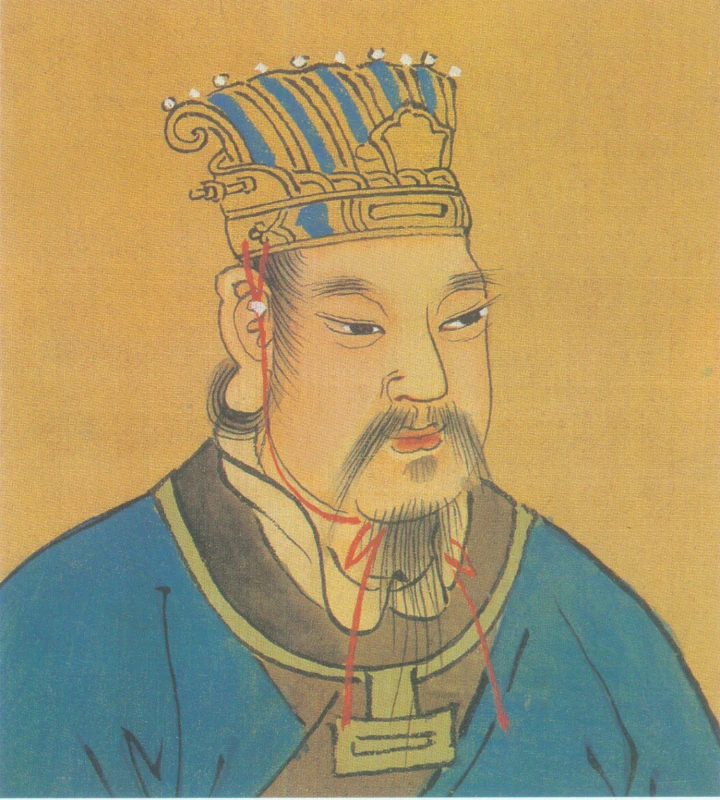
In the ninth month of 307, a barge came down the Yangzi and tied up at the wharf below Jianye. The man on board was a prince of the imperial house, thirty-one years old, with a commission as general and a mandate to hold the southeast for a court that was already losing the north. The city he entered had been the capital of the Wu dynasty until 280, when Jin armies had taken it and broken its palaces. It was now a provincial town of brick walls, river markets and ruined terraces, and the families who owned the surrounding country did not come to meet him. For six months nobody of consequence came. The prince had a title, a few thousand soldiers, and the name of a dynasty that seemed to be ending.
His name was Sima Rui. He was a great-grandson of Sima Yi, the dynasty's posthumous founder, but the imperial line had passed to another branch, and nothing in his first thirty years suggested that he would be the man to keep the dynasty alive. He had no great victory to his name, no province of his own, no party at court. What he had was a cousin by friendship, Wang Dao, and a seat at the edge of the world when the center collapsed. In 317 he would be proclaimed King of Jin, and in 318 emperor. The state he founded would last a hundred and three years, longer than the Western Jin that preceded it, and it would be governed by a compromise he did not design and could not escape.
That compromise is the subject of this article. The histories call it "the Wang and the Ma sharing the world," and they usually mean it as a proverb about the power of great families. It was more concrete than a proverb. It was an arrangement between a clan that supplied soldiers and administrators and a prince who supplied legitimacy, and it was struck in the first years after 307, when the prince discovered that the south would not be governed without the men who already owned it. For most of his reign he lived inside the arrangement and made it work. His most emperor-like moment came when he tried to step outside it, and failed. The failure cost him his best ministers, his health, and in some measure his reputation, but it did not cost him the throne. It cost the throne its power.
1. The Prince of Langye
Sima Rui was born in Luoyang in 276, the son of Sima Jin, Prince Gong of Langye, and his wife of the Xiahou clan. The Langye principality lay in the northeast, in the hill country behind the Shandong coast, a fertile and well-watered domain that had belonged to the house since the first Jin emperor had enfeoffed his kinsmen. Rui's grandfather, Sima Zhou, was one of Sima Yi's sons; his branch of the family was princely but distant from the throne. When his father died in March 290, Rui succeeded to the title at fifteen by the reckoning of his time. In the same year the founding emperor, Sima Yan, died, and the court passed to an heir who could not govern and to a succession of regents who governed too much.
The boy grew up in a principality that was wealthy enough to support a court and remote enough to be unimportant. The official biography describes him as deep and deliberate, with a generous manner and a talent for keeping his counsel. It does not claim that he was brilliant, and the omission is probably honest. He was a good horseman, a competent administrator of his own household, and a man who understood that in a family of ambitious princes the safest posture was stillness. His fief lay next to the home country of the Wang clan of Langye, one of the greatest gentry families of the north. The Wangs had produced ministers and generals for three generations; their estates and clients were part of the same landscape of limestone hills, salt marshes and coastal trade that supported the prince's court. Rui had known Wang Dao, a cousin of that clan, since they were young men in Luoyang. The friendship was not yet a political program. It was a habit of trust between two men who had grown up in the same corner of the world.
In 304 the war among the princes reached its crisis. Rui was a general of the left in the army of Sima Yue, Prince of Donghai, which marched north to destroy the power of Sima Ying, Prince of Chengdu, at Ye. The campaign ended at Dangyin, where the imperial army broke and the emperor himself was carried off to Ye. Rui was taken with him. In Ye he learned that his uncle, the Prince of Dong'an, had been killed on Sima Ying's order, and he understood that his own name was on no list of protected persons. He fled the city by night, reached Luoyang, gathered his mother and household, and took them back to Langye. The details of the escape are thin, and the official account gives him none of the drama it gives to other men. What matters is the lesson. He had seen an emperor led away as a captive, an army of the empire dissolve in an afternoon, and a prince of his own blood killed for being inconvenient. He had also learned that he could survive.
For a year he stayed in Langye. Then Sima Yue, who was rebuilding his power on the eastern plain, needed a man to hold his rear while he marched west to recover the emperor. In 305 he made Rui general who pacifies the east, supervisor of the military affairs of Xu province, and sent him to Xiapi, a walled town on the road between the Huai and the Yi. It was a rear-area command, not a kingdom: a few thousand men, a supply line, and the duty of keeping the roads open. Rui asked Wang Dao to join him as his chief of staff. Wang Dao was the same age, a man of the clan's more studious branch, and he had a quality rare among the Wangs: patience. He also had a clear view of what the north was becoming. In Xiapi, away from the noise of the court, the two men began to talk about a future that did not include Luoyang.
The opportunity came in 307. Sima Yue, now the dominant power in the north, wanted the southeast secured against a northern invader and against the local warlords who had already tasted independence. In the seventh month the court appointed Rui general who brings peace to the east, gave him the staff of authority, and made him commander of the military affairs of Yang province south of the Yangzi. The wording mattered. He was not made governor of Yang province; he was given military command over its southern half. He was not given the revenues of the province or the right to appoint its civil officials. He was given an army and a title, and sent to a city where the real owners of the land had never heard of him.
2. The Appointment
The appointment was a promotion and a sentence. A promotion, because it moved him from a rear garrison to the greatest city in the south, with a commission that outranked every local commander. A sentence, because it gave him a problem that no title could solve. Jianye was not an empty stage. The Wu region had been conquered by Jin in 280, but conquest had not transferred the land. It had transferred the tax registers, and even those were incomplete. The great families of Wu, the Gu, Lu, Zhu and Zhang of the lower Yangzi, the Zhou of Yixing, the He and Yu of Kuaiji, the Ji of Danyang, held their estates and their private retainers as they had under the Wu emperors. They knew the rivers, the rice fields, the salt works and the passes. They had fought for Jin against local rebels and had been rewarded with titles, but they had no reason to love a northern prince who arrived with a northern army and a northern appetite for offices.
Rui crossed the river in the ninth month with Wang Dao and a staff of northern gentlemen. The city received him because it had to. The walls were repaired, the yamen was opened, the garrison was quartered, and the prince began to issue orders that were obeyed within the radius of his soldiers. Beyond that radius, nothing. The Wu families sent no delegations, offered no grain, and proposed no marriages. For more than half a year the new commander of Yang province south of the Yangzi sat in his hall and waited for the south to notice him. It did not.
Wang Dao understood why. The Wu families were not rejecting the prince personally; they were waiting to see whether he would last. A northern officer with a commission from a collapsing court was a bad investment. What they needed was a demonstration that the prince commanded not only troops but the respect of the northern elite, and that the northern elite was worth joining. In the spring that followed, Wang Dao arranged one. On the third day of the third month, the festival of purification, the prince would go out to the river in a sedan chair, with a military escort and a procession of the most distinguished northern gentlemen on horseback. The Wu elders would come to watch, as they always came to watch the festival. They would see the prince, and they would see who rode with him.
The procession was theater, and everyone in it knew the script. Rui sat in the chair under a canopy, grave and silent. Wang Dao and the northern gentlemen rode behind him in a loose column, their horses brushed, their robes new, their reputations enormous. The Wu families lined the road. Gu Rong, the head of the greatest house of Wu, and He Xun, the scholar of Kuaiji, were among them. When the chair passed, they bowed. The bow was to the prince, but it was also to the company he kept. The northern gentlemen were the men whose names the Wu families knew from the capital; if they were willing to ride behind this prince, then the prince was worth a second look.
Wang Dao had already prepared the second move. He told Rui that Gu Rong and He Xun were the hope of the land, and that if the prince could attach them, the rest would follow. Rui sent Wang Dao to their houses with an invitation. Both men accepted posts. Ji Zhan of Danyang and Zhou Qi of Yixing came in as well, the one a soldier and administrator, the other the man who had already saved the province twice. The bargain was struck in a series of visits and banquets, not in a single document. The prince would protect the province from northern invasion, from upriver warlords and from imperial tax collectors. The families would staff his administration, supply his granaries when they chose, and lend him their prestige. The northern emigres would hold the highest military offices and the places at court. The Wu families would hold their land and their local offices. Neither side would ask the other to become something it was not.
The bargain was reasonable, and it was fragile, because it rested on a fiction. The fiction was that the prince governed the south. In fact the south governed itself through him, and he governed the north through the refugees who had followed him across the river. The Wu families could withdraw at any time by simply going home to their estates. The northern gentlemen could withdraw by finding another patron. The only thing that held the arrangement together was the fear of what would happen if it broke: another Chen Min, another rebellion, another army from the north coming down the river. Rui understood the fear, and for a while he used it well. He was generous with titles, sparing with prosecutions, and careful never to ask the Wu families for more than they were willing to give.
A century later, a collector of anecdotes recorded a scene from those first years. The emigre gentlemen, on a holiday, went out to the New Pavilion above the river and sat drinking. One of them, Zhou Yi, looked at the water and said that the landscape was no different from the north, but the mountains and rivers belonged to another house. The company wept. Wang Dao, who was among them, turned angry and told them that they should be working to recover the Central Plain, not sitting like prisoners of Chu weeping at each other. The story comes from a fifth-century collection, not from the official history, and its date is uncertain. It is nevertheless the best picture that survives of the emotional weather of the emigre court: men who had lost a country, drinking beside a river that looked like home, and a politician telling them to stop crying and start building.
3. The Three Pacifications
The south did not need the prince to save it. It had already saved itself. In 303 a rebel army from the middle Yangzi, led by Zhang Chang and his general Shi Bing, crossed into Yang province and took the provincial seat. The Wu families raised their retainers and their tenants, put Zhou Qi at their head, and destroyed the invaders. In 305 an officer named Chen Min, who had risen through the grain administration, decided that the empire was finished and that he could make himself master of the south. He took the provincial capital, appointed his own officials, and began to negotiate with the northern warlords. The Wu families destroyed him too, again under Zhou Qi, with the help of Gu Rong and Ji Zhan. In 310 or 311 a Wu general named Qian Gui, ordered north to relieve the collapsing capital, turned his army around and marched on the province. Zhou Qi destroyed him a third time.
Three times the region was saved by its own gentry, and three times the victor handed the province back to a Jin governor. This was not modesty. It was a political choice. The Wu families had no candidate for emperor and no desire to fight the north alone. They wanted a legitimate authority that would leave them alone, and the Jin name was the cheapest legitimate authority available. Zhou Qi was rewarded with titles, with the commandery of Yixing carved out of his home counties in 304, and with the reputation of the man who had kept the south for the dynasty. The new commandery was named Yixing, "righteous rising," for the uprising that had earned it. The name was a compliment and a cage. It fixed him as the dynasty's loyal servant, not as the south's own prince.
The three wars also changed the balance within the south. The families that had raised troops had tasted command; their retainers were now veterans; their sons expected offices. A regional army had come into existence, and it was not the prince's army. It was the army of the great houses, loaned to the dynasty when the dynasty's enemies threatened them. Rui could call on it in a crisis, but he could not command it in ordinary times. The three pacifications had saved the province and had also made it harder to govern.
Zhou Qi was not satisfied. He had saved the province three times, and the great offices went to northern emigres who had never fought for it. He was given a general's title and a local base, but not the provincial governorship he thought he had earned. He watched the prince's court fill with men from Langye and the north, and he understood that the bargain was not a partnership of equals. The Wu families supplied the land and the labor; the northerners supplied the army and took the offices. In 313 Zhou Qi fell ill. Before he died, he spoke to his son Zhou Xie. The northerners were killing him, he said, and if his son could avenge him, the son would be worthy of him. The word he used for the northerners was "cang," a southern slur that meant something between bumpkin and barbarian. It was the voice of the bargain's underside, and it was not meant for the histories.
Zhou Qi died in 313. His son waited a year, then raised troops in Wuxing in the eleventh month of 314 and sent word through the county towns that he was marching to punish Wang Dao and Diao Xie, the two men who stood for the northern court. The slogan was precise. It did not attack the prince; it attacked the prince's advisers. It presented the rising as a service to the dynasty, a correction of bad ministers, which was the traditional language of rebellion. The Wu gentry did not join. Gu Rong was dead, He Xun was cautious, and the other houses had too much to lose. The rising collapsed in a few weeks. The court pardoned Zhou Xie.
The pardon was the most revealing act of Rui's early government. A rising against two of the most visible ministers of the northern court was met with a pardon, because punishing the son of Zhou Qi would have turned a family quarrel into a regional war. The prince's law stopped at the gate of a great Wu house. Rui had learned the first rule of the south: the great families could be taxed, flattered, employed and occasionally frightened, but they could not be treated as ordinary subjects. The same rule would apply to the Wang clan, and it would destroy him.
4. A City Renamed
In 313 the city changed its name. The emperor in Chang'an was Sima Ye, and the character ye in his personal name could not be spoken or written in the empire. Jianye became Jiankang. The change was a technicality of the taboo system, but it marked a real shift. A city named for the founding of a kingdom became a city named for peace, and the peace it named was the peace of a court that had decided to stay. The emperor in Chang'an was still the sovereign; the prince in Jiankang was still his general. But the edicts from the northwest were becoming rarer, and the ceremonies of the southern court were becoming grander. The rename was the first sign that the south was no longer a refuge and was becoming a capital.
The city itself was layered. The old Wu palace had been burned and rebuilt; the tombs of Wu emperors lay in the hills; the canals that fed the markets still followed the lines the Wu engineers had laid. The Jin administration occupied the same offices and used the same clerks as the Wu administration, because there was no other administration to use. A northern prince who wanted to rule the south had to govern through the machinery of the state he had conquered, and the machinery remembered its old masters.
The second sign came in 315, with the pardon of Zhou Xie. The third was the rise of Wang Dun. Wang Dun was Wang Dao's cousin, a man of the same clan but a different temperament: harsh, impatient of restraint, and utterly unsentimental about power. He had married a princess of the imperial house and had served in the north before the collapse. By 313 he was directing the southern court's war against the rebels in the west. In 315 the court made him commander of the military affairs of six provinces, of Jiang, Yang, Jing, Xiang, Jiao and Guang, and governor of Jiang province, with his headquarters at Wuchang. The appointment recognized a fact: the army that had defeated the rebels in the west was Wang Dun's army, and it would not be commanded from Jiankang.
Wuchang sits on the south bank of the Yangzi, where the Han River joins the great river and the current turns east. An army based there can move downstream to Jiankang in a few days, and it can move upstream into the rich middle basin whenever it chooses. The geography made Wuchang a permanent threat to any government at Jiankang, and the court knew it. The answer was to balance the upper river with a loyal commander, or to keep the upper river weak. Rui did neither. He gave the upper river to Wang Dun and kept Wang Dao at court. The Wang clan now held the two ends of the Yangzi. The prince held the middle.
The same year, the court removed Tao Kan from Jing province. Tao Kan was the ablest general in the south, a man who had risen from a minor clerk to command armies, and he had done more than anyone to defeat the western rebels. He was also independent, blunt, and not a Wang. Wang Dun arranged for him to be promoted to the governorship of Guangzhou, a distant province on the southern coast, and the court accepted. The promotion was an exile. Tao Kan went south, governed well, and waited. The pattern of the reign was already visible: the best soldiers were moved away from the river, and the river was left to the Wang clan.
By 315 the architecture was complete. Wang Dao managed the court and the northern gentry. Wang Dun commanded the western army. Rui sat between them, a prince with a legitimate title, a small guard, and a growing sense that the title was not the same thing as a government. He had survived the collapse of the north, the suspicion of the Wu families, and the first rebellion against his ministers. He had not yet faced the question that would define his reign: whether a prince who owed his throne to a clan could ever rule without it.
5. The Oar
In 313 a man named Zu Ti asked the prince for permission to go north. He was forty-seven years old, a native of Fanyang in the northern frontier country, from a family of provincial officials. As a young man he had shared a room with Liu Kun, the poet and soldier who would later die in the north, and the two of them had trained at cockcrow, swords in hand, while the city slept. The story of the cockcrow drill became one of the most famous anecdotes of the dynasty, which is a little unfair to Zu Ti, because it makes him sound like a man preparing for a race rather than a man preparing for a war. By 311 he had brought several hundred households of his clan south through the chaos, and he had offered his service to the prince. He was given a place in the southern army and no command of consequence.
What he proposed in 313 was not a raid or a border patrol. It was a reconquest. The north, he argued, had not been lost because the people had abandoned the dynasty. It had been lost because the princes had fought each other and invited the barbarians in. The survivors in the north were waiting for a leader. If the prince would give him a commission and a few thousand men, the counties and the fortified villages would rise for him. It was the kind of argument that a cautious government hears as a request for money and a reckless government hears as a mandate.
Rui heard it as a problem. He did not want a northern war. A northern war would require taxes, troops and a concentration of power that the south would not tolerate. It would also create a victorious general who might become as dangerous as Wang Dun. But refusing outright would look like cowardice, and the court was already sensitive to the charge that it had abandoned the north. So Rui gave Zu Ti a title, a commission as governor of Yu province, one thousand men's rations, three thousand bolts of cloth, and no armour. The history adds the crucial phrase: no weapons. He was told to recruit his own army.
The grant was a permission, not an investment. A thousand men's rations were the supplies of a single garrison, not an army. Three thousand bolts of cloth would buy equipment for a few hundred. The new governor of Yu province was being sent into the most contested country in China with the supplies of a county magistrate and the authority of a name. If he succeeded, the court would share the credit. If he failed, the court had lost nothing but cloth. It was a policy that could be disowned, and it was the cheapest way to answer the demand for a northern expedition.
Zu Ti crossed the river with several hundred households of his own retainers. At midstream he struck the oar against the water and swore an oath that the histories preserved: if he did not clear the Central Plain and cross back, may the great river witness it. The gesture was theatrical, and it was also a contract. He was putting the river between himself and the possibility of return. He landed on the north bank, went to Huaiyin, built a forge, cast weapons, and recruited. Within a few months he had two thousand men. They were not the imperial army. They were refugees, villagers, deserters, and local strongmen, held together by pay, rations, and the reputation of a man who had sworn not to come back until the north was recovered.
For the next eight years he fought a war that the court never fully authorized. He took Qiao and held it against local warlords. He negotiated with the fortified villages that had submitted to Shi Le and pretended to raid them so that their hostages would not be punished. He accepted the surrender of bandit leaders and gave them commissions. He checked Shi Hu, Shi Le's nephew, when Shi Hu came south with a large army, and the figure of fifty thousand in the histories is a measure of how the clash was remembered. He took Yongqiu and made it his seat. He pushed the frontier to the Yellow River.
The most famous episode of the campaign was a trick with rice. Zu Ti's general Han Qian held the eastern platform of Pengpi, and the Zhao general Tao Bao held the western one. The two armies faced each other across a ditch for forty days, and both ran short of grain. Zu Ti filled sacks with sand and sent a thousand men carrying them up the road in full view of the enemy, as if they were rice. Then he sent a few bearers carrying real rice, who stopped by the roadside and rested. The Zhao soldiers, hungry and watching, seized the rice. They opened the sacks, saw the grain, and concluded that the Jin army was so well supplied that it could afford to leave food on the road. Their morale broke. Shi Le sent a thousand donkeys loaded with grain to relieve him, and Zu Ti ambushed the convoy at the Bian River and took it all. That night Tao Bao withdrew.
The war became a frontier with rules. Shi Le, who had never met Zu Ti, ordered the county of Chenggao to repair the tomb of Zu Ti's mother. He wrote to propose trade. Zu Ti did not answer the letter, but he allowed the markets, and the trade between the two sides made his army rich. When one of Zu Ti's officers defected to Zhao, Shi Le had the man killed and sent his head back. The two enemies had arrived at the arrangement that the Jiankang court could not imagine: a stable border, a profitable market, and a mutual recognition that did not require a treaty. Zu Ti was doing what a provincial governor does when the center is weak. He was becoming a state.
In 321 the court sent Dai Yuan to supervise him. Dai Yuan was a man of fine reputation, a gentleman of Guangling, a calligrapher and a favorite of the emperor. He was made general who conquers the west, commander of the military affairs of six provinces, and governor of Si province, with his seat at Hefei. The appointment was presented as a reinforcement of the northern front. It was in fact an inspection. Zu Ti, who had built an army out of nothing and had just been given a superior who had never built one, understood the message. He said that Dai Yuan was a man of Wu, with reputation but no far sight, and that he would not hold the north. He fell ill. In the same year he died at Yongqiu, at fifty-five by the Western count, fifty-six by the reckoning of his court. The history says he was grieved into sickness, which is the polite way of saying that the court killed him.
His brother Zu Yue took command of the army. The court gave him the title and the troops, but not the prestige. Within a year the Henan lands were lost, and Zu Yue retreated to Shouchun. The frontier that Zu Ti had built with sand, cloth and audacity dissolved. The court mourned him, gave him a posthumous title, and went back to its own affairs. It had never wanted a northern war, and now it did not have one.
The timing was exact. In 320 Zhou Fang, the governor of Liang province and the one western commander Wang Dun feared, had died. In 321 Zu Ti died. The two men who could have threatened Wang Dun from the north and the west were gone. The road down the Yangzi was open. The court had spent the last years of the emperor's reign dispersing its own army along the frontier and calling it defense. It had also removed the only general who might have made that defense real. When the crisis came, there was nobody left to meet it.
6. The King and the Emperor
In the eleventh month of 316 the city of Chang'an surrendered. The emperor, Sima Ye, was taken prisoner by Liu Yao and sent to Pingyang, where the ruler of Han Zhao kept him as a servant and later had him killed. The Western Jin, which had ruled the north for fifty-one years, was over. The news reached Jiankang in fragments, carried by refugees and couriers, and the southern court went into mourning for a dynasty it could no longer protect. There was no debate about a rescue. The armies that might have marched north had already been spent or dispersed, and the men who controlled them had other plans.
In the second month of 317 a general named Song Zhe arrived at Jiankang from Hongnong. He claimed to carry an edict from the captive emperor. The edict, as he reported it, gave the chancellor and Prince of Langye authority to take charge of all affairs of the realm, to hold the old capital when he could, and to repair the imperial tombs. Whether the document was genuine has been debated ever since. A captive emperor could still issue edicts, but a general who had fled the collapsing north had every reason to produce one. The court chose to believe it, because belief was the only form of action available. Rui put on mourning clothes, left his residence, and mourned for three days.
Then the officials urged him to take the imperial title. The Prince of Xiyang, an elder of the clan, led the delegation. Rui refused. They pressed. He wept and said that he was a criminal who had failed the empire, that he had no right to the throne, and that if they continued to press him he would go home to Langye. He called for his private carriage. The gesture was a ritual of reluctance, and it was also a threat. If he left, the south would have no legitimate head, and the men who had built their careers around him would be left with a court without a sovereign. The officials understood the threat. They offered a compromise: he would take the title King of Jin, following the precedent by which the founders of Wei and Jin had taken a royal title before the imperial one. He accepted.
On the xin-mao day of the third month he took the royal title, proclaimed an amnesty, and changed the era name to Jianwu, "establishing the martial." The amnesty excluded men guilty of killing their parents or grandparents, and it excluded Liu Cong and Shi Le, the emperor of Han-Zhao and his most dangerous general. The exceptions were a political map. The first showed that the new state claimed the ordinary jurisdiction of a Chinese dynasty over its own people. The second showed that it did not claim jurisdiction over the north. It claimed the north as territory to be recovered, not as population to be governed.
The new court appointed more than a hundred retainers, and the number became a nickname: the Hundred and Six. They were the nucleus of a government, with a chancery, a secretariat, ritual officers, guards and clerks. Most of them were northern emigres, men who had lost their land and had nothing but their offices. A few were Wu families, placed carefully in positions that honored them without giving them command. The court also built an ancestral temple and an altar of soil and grain, the two structures that made a capital into a capital. The rituals were borrowed from the old dynasty, and the borrowing was the point. The south was not a new country. It was the old country in a new place.
In the same year reports of auspicious omens began to arrive from the provinces: the usual inventory of strange birds, colored clouds and prodigious harvests. Rui refused them all. He said that he bore responsibility for the four seas and had not yet reflected on his faults, so what omens could there be. The answer was quoted for centuries, and it was probably sincere. It was also good politics. A man who had just taken a royal title could not afford to look as if heaven had endorsed him too easily.
In the sixth month a memorial arrived from the north with a hundred and eighty signatures. Liu Kun, the governor of Bing province and the last great loyalist of the north, had signed it. So had Duan Pidi, the Xianbei chieftain who held You province, and Murong Hui, the Xianbei ruler of Liaodong, and a long list of governors, generals and frontier commanders. They urged Rui to take the imperial title. The document was a roll call of the north's remaining loyalists, and it was also a list of men who could not help him. They controlled a few fortified cities, a few thousand horsemen, and the prestige of the old dynasty. They did not control the roads. The memorial proved that the north still looked to Jiankang. It did not prove that the north could save it.
Rui did not take the imperial title while Emperor Min was alive. To do so would have been usurpation, and the legitimacy he had built depended on the fiction that he was governing in trust. In the third month of 318 word reached Jiankang that the captive emperor had been killed at Pingyang. The court went into mourning. On the bing-chen day Rui took the imperial throne, changed the era name to Taixing, and made his eldest son, Sima Shao, crown prince. The two-step accession was not hesitation. It was a constitutional argument. The king had held the mandate in trust; the emperor held it in title. The interval between the two ceremonies was the space in which the dynasty was legally reborn.
The reborn dynasty was not a strong state. It had a capital, a court, a ritual calendar and a sovereign. It did not have a treasury, a reliable army, or a tax base that could be counted. Its soldiers were commanded by Wang Dun, its administration was managed by Wang Dao, and its revenue came from provinces whose great families regarded taxation as a negotiation. The emperor had one asset that did not depend on the Wang clan: his son. Sima Shao was young, intelligent and brave, and the court knew it. Wang Dun would later try to have him set aside. He failed, and the failure saved the dynasty. But that is a story for the next reign.
For now the emperor had a title and a problem. The title was the most legitimate in the south. The problem was that the men who had made him emperor had also made themselves indispensable. The next three years were the test of whether he could turn a title into a government. The answer would be written at Stone City.
7. The Two Houses
At a New Year audience, the emperor took Wang Dao by the hand and invited him to sit beside him on the imperial couch. The gesture was extraordinary. The couch was the seat of the sovereign, and no subject sat on it. Wang Dao refused. He said that if the sun descended to the level of all things, the people would have no light to look up to. The phrase was graceful, and it was also a definition of the constitution. The emperor was the sun. The minister was the atmosphere through which the light reached the earth. The light could not be seen without the atmosphere, and the atmosphere could not shine without the light.
The arrangement was not a secret. Contemporaries called it "the Wang and the Ma sharing the world." The Ma were the imperial house, the Sima, whose name meant "master of the horse." The Wang were the clan. The saying was recorded in the biography of Wang Dun, and it was not a boast by the Wangs. It was a description by their neighbors. The emperor supplied the dynasty's name, its ritual, and its claim on the loyalty of the north. The Wang supplied the army, the administration, and the network of kinsmen and clients that made the state work. Neither could govern without the other, and both knew it.
The division of labor was geographical as well as functional. Wang Dao was in Jiankang. He held the post of supervisor of the chancery, which gave him authority over the flow of documents, and the post of director of the imperial secretariat, which gave him control of the drafting of edicts. He was made a general of the flying cavalry and given the honors of a minister of state. In 321 he became minister of works. He was never chancellor during Rui's reign. The title was left vacant, and the absence of the title was itself a statement. The chancellorship was too close to the throne. A supervisor of the chancery could run the government without claiming to be its head.
Wang Dun was at Wuchang. His commission named six provinces, from the middle Yangzi to the far south, and his army was the largest and most experienced in the state. He had the power to move downriver, and everyone in Jiankang knew it. The court's answer was to keep him busy in the west and to keep his cousin at the center. Wang Dao's moderation was the guarantee that Wang Dun's army would not be used. Wang Dun's army was the guarantee that Wang Dao's moderation would be respected. The two cousins were not allies in affection. They were two poles of a single family enterprise, and the emperor was the space between them.
Wang Dao governed in a deliberately broad style. He did not like detailed prosecutions, strict audits, or the kind of administration that counted every household. The style had a name in the histories: "keeping the main outlines and not binding the small details." It was the style of a man who understood that the great families would tolerate a government that left them alone and would destroy a government that did not. Once he sent eight inspectors out to tour the commanderies of Yang province. They came back and reported on the successes and failures of the local officials. One of them, Gu He, said nothing. Wang Dao asked him why. Gu He answered that as the man who ran the government, Wang Dao should let the net be wide enough for a fish that could swallow a boat to escape, and that a man in his position should not listen to rumors or govern by petty scrutiny. Wang Dao sighed and praised him.
The anecdote is usually read as a portrait of Wang Dao's tolerance. It is also a portrait of the limits of the state. A government that lets the big fish escape cannot collect taxes from them, conscript their tenants, or punish their clients. It can only ask them to cooperate. For the first years of the reign, cooperation was enough. The north was lost, the south was rich, and the great families were willing to pay for peace. The emperor's court was poor, but it was stable. The stability was the achievement of the Wang clan, and the clan expected to be paid in offices.
The emperor paid, and he waited. He had been a prince for twenty-eight years and a client for eleven. He knew how to wait. But he was also the son of a dynasty that had once ruled the whole of China, and he had not forgotten what an emperor was supposed to do. In the years after 318 he began to build a party of his own. It was not a party of great families. It was a party of men who owed their careers to him and to the law: Diao Xie, the chief of the chancery, a northern emigre from a lesser clan; Liu Kui, the governor of the capital commandery, a hard, ambitious official with a talent for prosecution; Zhou Yi, the left director of the chancery, an aristocrat who tried to mediate between the factions; and Dai Yuan, the general and courtier who had been the emperor's companion since the years in the south.
These men were not the emperor's friends. They were his instruments. Diao Xie was rigid, learned and unpopular. Liu Kui was clever, aggressive and feared. Zhou Yi was generous and indecisive. Dai Yuan was elegant and militarily mediocre. None of them had a regional base. None of them could raise an army without the emperor's commission. That was the point. They were the only officials in the state whose power depended entirely on the throne.
The emperor's first target was the household registers. The great families of the south held their land through a maze of tenancies, clientage and tax exemption. Their estates were worked by tenants who were registered as clients of the family rather than as subjects of the state. Their private retainers were outside the army rolls. Their sons held office as a birthright and paid no tax. The state, which needed soldiers and grain, could see all of this and touch none of it. Diao Xie and Liu Kui began to touch it. They audited the registers, prosecuted the clients, and enforced the tax laws against families that had not been audited in decades. The histories call their program "carved and broken government," government by small cuts.
The cuts were real, and so was the resentment. Every prosecution was a lesson in what the state could do. Every audit was a bill sent to a house that had thought itself exempt. The reforms were not cruel by the standards of later dynasties. They were intrusive. A great house that had never been asked to prove the status of its tenants was now asked to produce a register. A general who had never paid a tax on his retainers was now asked to surrender them. The state was asserting a claim that had been theoretical since the conquest, and it was doing so in a province where the great houses had their own halls, their own retainers and their own armed tenants. The wonder is not that the reforms failed. The wonder is that they were attempted at all.
The great families began to compare the emperor's government with the government of Wang Dao, and the comparison was not favorable. Wang Dao had let them alone. The emperor's men were counting their tenants. The obvious conclusion was that the emperor had become the enemy of the families, and that the families needed a protector. The protector was upstream, at Wuchang.
8. The Narrow Government
The crisis began with a levy. In 321 the court ordered that the bondservants and clients of the great houses in Yang province, many of them northern commoners who had been reduced to dependence during the collapse, should be freed and enrolled for military service. The order was presented as a measure of humanity and a measure of defense. It gave the refugees a status and the state an army. It also took labor from the households that had sheltered them, and it did so at a moment when those households were already angry about taxes.
The levy was the most ambitious thing the emperor's government attempted. It created a new army loyal to the throne rather than to the clans, and it gave the emperor a force that could theoretically match Wang Dun's. But the new army was not concentrated at Jiankang. It was distributed among the frontier commands. Dai Yuan was sent to Hefei with the title of general who conquers the west and authority over six provinces. Liu Kui was sent to Huaiyin with the title of general who guards the north and authority over four. Sima Cheng, the Prince of Qiao, was sent to Xiangzhou, far up the river, to build a third base. Gan Zhuo, the governor of Liang province, was at Xiangyang. Tao Kan was still in Guangzhou, still in exile.
On a map, the deployments formed a ring around Wang Dun. On the ground, they formed a set of isolated garrisons, each too small to face the western army alone, separated by rivers and mountains, and dependent on the court for orders. The emperor had built an army and then scattered it. The dispersion was not entirely foolish. A single large army at the capital would have alarmed the Wang clan and the Wu families. A ring of small armies looked defensive. But a ring is only as strong as its communications, and the communications ran through the Yangzi, which Wang Dun controlled.
The emperor had three options. He could accept the Wang monopoly and reign as a ritual sovereign. He could build an army and a revenue base of his own, and fight. He could ally with the Wu families against the Wangs. He chose the second and half-chose the third. The levy was meant to give him soldiers. The audits were meant to give him revenue. The frontier commands were meant to give him allies. Each measure was rational. Together they were a declaration of war on the two groups whose cooperation he needed most: the emigre clans who supplied officers and the Wu families who supplied grain. A government that fights the sources of its own strength must win quickly, and the emperor did not win quickly.
Wang Dun watched the preparations and made his own. He wrote to Liu Kui, testing him with an offer of friendship and a hint of shared interest. Liu Kui answered with a lecture on loyalty. The answer was brave and impolitic. It told Wang Dun that the court would not compromise, and that the only way to remove Liu Kui was to remove the emperor's government. Wang Dun began to collect evidence for a memorial. The evidence was not difficult. The bondservant levy, the audits, the prosecutions, the promotions of favorites, the appointment of a northern general to command southern troops: every measure had made an enemy, and every enemy could be listed.
In the first month of 322 Wang Dun sent his memorial from Wuchang. It accused Liu Kui of ten crimes. The list was a coalition document. It spoke of the oppression of the people, the disruption of the provinces, the favoritism at court, the freeing of bondservants, the conscription of clients, and the humiliation of the great houses. It demanded the death of Liu Kui and promised that the army would withdraw as soon as his head was displayed. The memorial was addressed to the emperor, but it was written for the families. It told them that Wang Dun was their champion, and that the emperor's reforms would end with his fall.
The emperor's answer was an edict. He accused Wang Dun of relying on imperial favor to unleash treason, of comparing the emperor to the tyrant Tai Jia, and of intending to imprison him. The edict ended with a phrase from Confucius: if this could be endured, nothing was beyond endurance. The phrase turned a policy dispute into a question of usurpation. It also committed the emperor to a war he was not ready to fight. The court began to call back the frontier armies. The commanders marched, but they marched separately, and they arrived separately, and the capital's garrison was never large enough to hold the river.
The war began with a memorial and a quotation. It would end with a gate.
9. The Uprising at Wuchang
On the fourteenth day of the first month of 322, Wang Dun's army marched out of Wuchang. The columns moved east along the south bank, through the garrison towns that had been built to stop exactly this kind of march. Shen Chong, a Wuxing magnate and a client of the Wang clan, rose in the east with a second army. Wang Han, Wang Dun's elder brother and a court official, fled the capital in a light boat and joined the rebels. The empire's most powerful general was now in open revolt, and he had allies on both flanks of the capital.
In Jiankang, Wang Dao did what a clan leader does when a kinsman has committed a capital crime. He took his brothers, sons and cousins, more than twenty men in all, and went to the palace gate to await punishment. They stood there every morning and waited to be arrested. It was a performance of loyalty, and it was also a calculation. If the emperor killed the Wang clan, Wang Dun would have nothing to lose and everything to avenge. If the emperor spared it, Wang Dao could claim that the clan in the capital had never supported the rebellion. The vigil was a hedge against both outcomes.
Liu Kui urged the emperor to kill them. He argued that the clan in the capital was a danger inside the gates, that Wang Dao's moderation had always been a cover for his cousin's ambition, and that a clean purge would deprive the rebellion of its domestic base. The emperor refused. He needed Wang Dao to keep the government running, and he needed the Wang clan's clients to keep the provinces quiet. He also knew that a massacre of the Wangs would turn a dynastic quarrel into a blood feud. So he spared them, and he gave Wang Dao the command of the vanguard, a post that placed him formally on the emperor's side and practically in the middle of the war.
Zhou Yi saved Wang Dao without telling him. When Wang Dao was at the palace gate, he called out to Zhou Yi, using his courtesy name, and said that a hundred mouths depended on him. Zhou Yi walked past without answering. He went in to the emperor and argued, at length and with passion, that Wang Dao had no part in the rebellion and that killing him would be a mistake. The emperor agreed. Zhou Yi came out, and instead of telling Wang Dao what he had done, he joked to his companions that this year he would kill the rebels and hang a gold seal as large as a grain measure on his elbow. Wang Dao heard the joke and not the argument. He concluded that Zhou Yi had refused to help him, and he nursed the grievance in silence.
The misunderstanding was ordinary and fatal. Zhou Yi was a man who preferred to be generous without being seen, and Wang Dao was a man who had spent his life reading the intentions of others. Neither of them spoke plainly. The court was full of men who had learned to survive by indirection, and the habit of indirection was about to kill two of its best.
Wang Dun reached Wuhu and sent a second memorial, this one against Diao Xie. The emperor ordered Liu Kui and Dai Yuan to abandon their frontier posts and return to defend the capital. The orders were a confession that the ring had failed. The frontier armies were too far away to save the city, and the city did not have enough men to save itself. Liu Kui came back with his troops and made a show of confidence, reviewing the officials who came out to meet him and speaking grandly of the victory to come. He also repeated his demand for a purge of the Wang clan. The emperor refused again.
The defense of Jiankang depended on two forts. Liu Kui held Jincheng, a fort east of the capital. Zhou Zha, a member of the Zhou clan of Yixing and a general of the right, held Stone City, the old fortress on the hill above the river. Stone City was the key. It commanded the approach from the west and the water supply of the capital. If it held, Wang Dun would have to besiege it. If it fell, the capital was open.
Wang Dun's general Du Hong advised him to attack Stone City first. Liu Kui, he said, had too many devoted soldiers and would be hard to dislodge. Zhou Zha was a man without the affection of his troops, and his family had its own grievances against the court. The gate would not be held with the same conviction. Wang Dun accepted the advice. He moved against Stone City. Zhou Zha opened the gate.
The reasons were personal and political. The Zhou clan had produced the man who saved the south three times, and the court had rewarded him with a commandery and then watched him die while northerners took the great offices. Zhou Zha had served the dynasty, but he had also watched the dynasty's promises shrink. He may have believed that Wang Dun would win. He may have wanted to preserve his family's position in the new order. He may simply have decided that a gate opened is cheaper than a city stormed. The histories do not give him a speech, and the absence is telling. He did not need one. The gate was his argument.
The court's armies attacked Stone City and were beaten. Wang Dao commanded the vanguard, which meant that he commanded troops against his own cousin. The histories record the defeat and say nothing of his conduct in it. The emperor put on armor and rode out to encourage the troops, but the troops were already broken. Then he sent a message to Wang Dun. If the general had not forgotten the dynasty, the emperor said, he would yield the throne and go home to Langye. The man who had refused a throne in 317 was offering one in 322. The gesture was the mirror image of the accession, and it had the same purpose: to force the other side to choose between the forms of legitimacy and the reality of power.
Wang Dun did not answer the offer directly. He did not enter the palace. He stayed in Stone City with his army and let his soldiers loot the capital. The city that had been the capital of Wu, and then the refuge of Jin, was now a barracks for the army of the Wang clan. The emperor was still on the throne. The winner was still in the fortress. The war was over, and the settlement had not begun.
10. The Stone City
The settlement began with two names. Zhou Yi and Dai Yuan were the most respected men in the government, the one an aristocrat of the old north, the other a general and calligrapher who had been at the emperor's side since the first years in the south. They were also the two men Wang Dun feared most, because they could give the court a moral authority that his army could not match. He asked Wang Dao what should be done with them. The question was not a request for advice. It was a test of loyalty, and Wang Dao knew it.
Wang Dun asked whether the two men deserved the three highest offices of state. Wang Dao said nothing. Wang Dun asked whether they deserved the next rank, the head and deputy of the chancery. Wang Dao said nothing. Wang Dun asked whether they deserved death. Wang Dao said nothing. Three questions, three silences. The silence was not neutrality. In the grammar of the court, silence before a powerful man is consent. Wang Dun gave the order.
Zhou Yi was arrested and taken toward the execution ground. As he passed the imperial ancestral temple, he shouted to the spirits of heaven and earth and to the former emperors that the rebel Wang Dun had overturned the state and was killing loyal ministers, and he called on the spirits, if they had any power, to kill Wang Dun before he destroyed the dynasty. The guards struck him in the mouth with a halberd. The blood ran to his ankles, and he did not change expression. He was killed at Stone City. Dai Yuan was killed with him. Zhou Yi, who had saved Wang Dao from the purge, and Dai Yuan, who died with him, were killed because Wang Dao would not speak.
The news of Zhou Yi's death reached Wang Dao, and he did not yet know what he had done. Then he found the memorial. It was in the archives of the imperial secretariat, a document in Zhou Yi's hand, arguing with passion that Wang Dao was loyal and that the clan in the capital should not be punished. The memorial was the proof that Zhou Yi had saved him. Wang Dao held the paper and wept. He said: I did not kill Bo Ren, but Bo Ren died because of me. In the darkness, I have failed this good friend.
The line is one of the most quoted in the history of the dynasty, and it is a confession rather than an apology. Wang Dao did not say that he had been wrong. He said that the death was his, and that the debt was beyond repayment. The distinction matters. A man who says he was wrong can repent and change. A man who says the death is his carries it. Wang Dao carried it for the rest of his life, and the dynasty carried it with him. The most successful politician of the age had discovered that success could be a form of guilt.
Diao Xie did not wait for a trial. He fled the capital with a few followers, was abandoned by most of them on the road, and was killed at Jiangcheng, northeast of the capital. His head was sent to Wang Dun. Liu Kui fled north, crossed the line, and entered the service of Shi Le, who made him an attendant and a teacher to his heir. The two architects of the narrow government ended as a head in a box and a pensioner of the northern conqueror. The emperor's party was not defeated. It was erased.
The political settlement was quick. The court sent the officials to Stone City to pay their respects to Wang Dun, and the emperor offered him the chancellorship, the command of all military affairs, the supervision of the chancery, the governorship of Jiang province and the title Duke of Wuchang. Wang Dun declined the offices. He accepted the power. He made Wang Dao the head of the chancery, appointed his own kinsman Wang Yi governor of Jing province, and changed hundreds of officials and military commands. Some appointments lasted a morning and were reversed by evening. The government of the empire was being rewritten in a fortress by a man who would not enter the palace.
His refusal to take the final step had nothing to do with mercy. He had the army, the capital and the person of the emperor, and he could count. The Wang clan could dominate the court because the court was legitimate. If Wang Dun became emperor, he would be a usurper, and the northern gentry, the Wu families and the commanders of the frontier would have a cause to unite against him. Wang Dao's position would become impossible, because a cousin cannot serve as the loyal minister of a usurping cousin. The clan would split, and the south would divide. A puppet on the throne was worth more than a crown on his own head. The emperor lived because he was more useful alive.
The last resistance was crushed in the provinces. Sima Cheng, the Prince of Qiao, held Xiangzhou and refused to submit. Wang Dun sent an army upriver, took the city, and killed him. Gan Zhuo raised troops at Xiangyang, promised to march on Wuchang, hesitated, and was killed before he could decide. The men who had answered the emperor's call were destroyed one by one, and the provinces learned the lesson that the capital had already learned. The court could call, but the call was not a defense.
In the fourth month Wang Dun returned to Wuchang. The emperor remained in Jiankang. Wang Dao remained at the head of the government. The war was over, and the bargain was intact, but its terms were now written in blood. The emperor had tried to rule without the Wang clan, and the Wang clan had shown him what the price of trying would be. The throne had survived. The monarchy had not.
11. The Last Winter
The emperor lived for another eight months. They were not quiet months. The court was a shell of the one he had built. Zhou Yi, Dai Yuan and Diao Xie were dead. Liu Kui was in the north. The new army had been destroyed or dispersed. The officials who remained had learned to check with Wuchang before they acted, and the edicts that still bore the imperial seal were drafted by men who understood what Wang Dun would accept.
Wang Dao stayed. He was the head of the chancery, the emperor's oldest friend and the clan's most useful representative. He could not undo the killings, and he did not try. He governed in the old broad style, letting the great houses alone, keeping the documents moving, and preserving the forms of the dynasty. The forms were now the substance. A state that could not defend its ministers could still issue a calendar, perform a sacrifice, and appoint a governor. The rituals were the last part of sovereignty that no general could take away.
The emperor withdrew. The histories say that grief and anger made him ill, and the phrase is probably literal. He had been humiliated in his own capital, forced to offer his throne to a subject, and made to watch the men who had defended him die. He had also been forced to understand that the bargain he had lived inside for fifteen years was not a partnership. It was a cage with a gilded door. In the summer and autumn he was seen less and less. The court continued to function. The river continued to rise and fall.
The offer he had made in the spring had been a diplomatic move. By the winter it was a description of his position. Langye was lost, and the road north was closed, but the idea of going home had become the only freedom left to him. He did not go. He died in the inner hall of the palace in the intercalary eleventh month of 322, on the ji-chou day, which was 3 January 323 in the Western calendar.
He was forty-six by the Western count, in his forty-seventh year by the reckoning of his court. He had been prince for twenty-seven years, king for one, and emperor for five. The court buried him at Jianpingling, on the southern slope of Jiming Hill, gave him the temple name Zhongzong and the posthumous name Yuan. Zhongzong means the restorer of the line. Yuan means the beginning. The names were accurate in the way that ritual names are accurate: they described the office, not the man. He had restored the line and begun a state. He had not restored the power.
The funeral was a state occasion, and the state was poor. The tomb was cut into the hillside without a mound, and the rites were performed according to the old manuals; the amnesty that followed was the first act of the new reign. The ritual did what ritual does. It turned a death into a succession and a failure into a reign. The man who had been humiliated in his capital was buried as an emperor, and the government that had outlived him performed the rites.
Sima Shao succeeded him the next day as Emperor Ming. He was twenty-four or twenty-five, a young man with a soldier's instincts and a memory of the humiliation. Wang Dao was appointed to assist the government. The new emperor had been crown prince since 318 and royal heir since 317, and he had spent those years watching the Wang clan manage his father. Wang Dun had tried to have him declared unfit and set aside. The attempt had failed, and the failure was the one check on the clan that the old emperor had left behind.
The second rebellion, the one that would end with his death and the destruction of his clan, was still a year away. It belongs to the reign of Emperor Ming. What belongs to this reign is the settlement: the emperor dead, the clan in control, the capital intact, and the dynasty still alive.
The palace at Jiankang was small by northern standards, and the court had never had the money to make it larger. The emperor had entered the city as a stranger in 307 and died in a palace that was closer to a great house than to the palaces of Luoyang. The river outside the walls kept its name, and the city kept its new one. Jiankang, the city of peace, had survived a war fought inside its gates. Its founder had not.
12. The Settlement
The state that survived him was built out of the problems he could not solve. The first was the refugees. The collapse of the north had pushed tens of thousands of households across the river, and the court had to register them, feed them, tax them and defend them. It did not give them the land of the south. It gave them the names of the land they had lost. A Langye county was established for the Langye families, a Qingzhou for the men of the Shandong coast, a Xuzhou for the men of the Huai valley. In 320 the court created Huai-de county for the Langye refugees and a southern Langye commandery at Jiangcheng. The atlas of the north was reproduced in miniature around the capital, a map of homes that no longer existed.
The refugee administration became the most distinctive institution of the Eastern Jin. The newcomers were enrolled in white registers, the old households in yellow registers. The earliest explicit reference to the white registers belongs to 341, under the emperor's son, but the distinction they recorded was already being formed in his reign. The white registers were meant to be temporary. They were a promise that the exile would end and the refugees would go home. The promise became a privilege. The emigre families paid taxes on a different schedule, held a privileged place in the office rolls, and preserved the names of their northern commanderies for generations. The state that could not recover the north learned to preserve it on paper.
The second problem was the army. The military commands that Wang Dun, Dai Yuan and Tao Kan had held became the real provinces of the empire. A commander of three or six provinces controlled the taxes, the roads and the appointments within his zone, and the civil governor was often his subordinate. The court's authority was the authority to appoint and remove commanders, and the commanders knew it. The balance of the reign, with Wang Dun upstream and the court downstream, became the balance of the dynasty. Every later crisis was a variation on it. Yu Liang and Tao Kan in the 330s, Huan Wen in the 360s, Liu Yu in the 400s: a general upstream, a court downstream, a bargain between them. The pattern was set in 322, and it never changed.
The third problem was the clans. The Wang clan had shown what a great family could do with a monopoly of office and a private army. The later clans learned the lesson and improved on it. The Yu, the Huan, the Xie and the Wang of Taiyuan built their own networks of clients, estates and military commands. The emperor became the first among the clans, the keeper of the ritual and the arbiter of their disputes. The formula "the Wang and the Ma sharing the world" was not a temporary arrangement. It was the constitution of the Eastern Jin, and it outlasted the Wang clan that had invented it.
The fourth problem was the north. The dynasty never abandoned its claim to the Central Plain. It performed the sacrifices, kept the tombs in its ritual calendar, and gave titles to the warlords who still held the frontier. But the claim became a language rather than a policy. The northern expeditions of the next century were launched when a general needed prestige or a court needed a distraction. They were rarely supplied with the resources to succeed. Zu Ti's campaign was the model and the warning: a great enterprise, run on a pittance, abandoned when it became too successful. The south chose survival over restoration, and the choice was made in this reign.
The Tang historians who compiled the Book of Jin judged him by the standard of a conqueror. They said that his virtue of respect and frugality was sufficient, but his capacity for martial grandeur was not. Their encomium said that Zhongzong lost control of the strong minister and destroyed his own axe of authority. The phrases are elegant and a little cruel. They measure him against the founders of the Han and the Tang, men who began with armies and ended with empires. Rui began with a title and a cousin. He had no army of his own, no treasury, no loyal bureaucracy and no time. He held the south together for sixteen years and founded a state that lasted a hundred and three. The alternative was not a stronger Jin. It was another Chen Min, another warlord, another province lost.
A rumor survived him. The Book of Wei, the history compiled in the northern state that regarded the Eastern Jin as a usurpation, claimed that he was not the son of Sima Jin at all, but the biological son of a general named Niu Jin, with whom his mother had been involved. The Book of Jin records a prophecy that an ox would succeed the horse, and the two stories were joined by later writers. The claim is hostile, late and unverifiable. It is also revealing. Later ages could not quite believe that the house of Sima had produced such a founder, so they denied his father. The rumor is a measure of how much the dynasty needed to explain him away.
He was not a great man. He was patient, cautious, generous in small things and stubborn in the one thing that mattered. He understood the south better than any northern prince of his generation, and he understood that the south could not be ruled by force. He built a court, kept a calendar, and gave the dynasty a name that outlived him. He also tried to be more than a presiding figure, and the attempt killed his friends and broke his health. The failure was not a personal failure. It was the failure of a state that had never been given the means to be a state.
In 420 the last emperor of the Eastern Jin abdicated to Liu Yu, and the name Jin went out in the south. It had lasted a hundred and three years after the kingdom was proclaimed, longer than the Western Jin that had produced it. The prince who crossed the river in 307 had carried a name, a cousin and a promise. The name outlived him by a century. The promise was never kept.