Home / Emperors / Three Kingdoms
Emperor Wen of Wei
魏文帝
Cao Pi, 187 – 226 · founding emperor of Wei
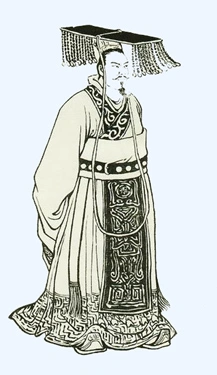
The throne he sat on had been made by someone else. For a quarter of a century his father had held the last Han emperor in one hand and the armies of the north in the other, and had died with the work half done, leaving behind a title that was not yet a dynasty, a court that answered to a dead man's name, and a northern China that had stopped asking whether the Han would come back. What was missing was the last step, and it was a step that only a son could take: the son could accept the abdication, because the father had been a subject and could not. Cao Pi took it in the tenth month of 220, and the act, which ought to have been the easiest part, turned out to be the thing that defined him. He was thirty-four, he had been named heir three years earlier, and he had five more years to live.
He used them to build a state where there had been a camp. He codified the law, he built the machinery by which officials would be graded and chosen for the next four hundred years, and he bound his own clan in a cage of restrictions so thorough that no Cao could raise an army to save the dynasty when the time came. He tried three times to take the south and failed three times. He wrote the first piece of literary criticism in the Chinese language and presided over the last gathering of the men who had made the literature of an age. His historians, writing for the house that replaced his, thought him a minor figure beside his father and a great one beside his sons, and they were right about both.
1. The Heir in the Marshal's House
He was born in 187, in the county of Qiao in Pei commandery, the second son of Cao Cao and of Lady Bian, who would later be empress dowager. There is nothing in the record of his childhood that a biographer could use; he appears first as a boy following an army. In 197 he rode south with the column against Zhang Xiu, and the campaign ended in a rout in which his elder brother was killed and his father escaped on a horse that brother gave up to him. He was not at his father's side by choice. The children of a man who was making himself a state travelled with the state.
His father had more sons than he knew what to do with, and the household was a palace with a hundred rooms and no rule of succession. Cao Pi was the eldest of the four sons of Lady Bian; below him came Cao Zhang, who could ride a horse through a line of spearmen, and Cao Zhi, who could write a poem at a banquet before the wine was cleared, and Cao Xiong, who died young and is barely in the record. There were other sons by other women, and there would be more. What made the family unusual was not the number of the sons but the fact that their father had not yet decided what sort of house he was building. While that question was open, the question of who would inherit it was open too, and every one of the brothers knew it.
Lady Bian was not of the kind of family that produced empresses. She came from a household of entertainers in the east, was taken into Cao Cao's house at Qiao while he was still a minor commander, and reached the headship of the family by accident: his first wife, Lady Ding, walked out after the death of Cao Ang, the son she had raised, and never came back, and the concubine who had borne him four sons took her place. Cao Pi was the eldest of the four. The circumstance governed most of what followed. In the households of the great the mother's rank fixed the son's, and a mother raised out of the musicians' quarters left her sons with nothing to inherit except the favour of a father who had chosen her himself.
The education that followed was not the education of a prince. It was the education of a staff officer. In 196 Cao Cao took the emperor from the ruins of Luoyang and set up his own capital at Xu, and from that point the court was a court only in the sense that it issued documents. The real work was done in the marshal's house, and Cao Pi grew up inside it, watching the men who came to be hired: Xun Yu arguing about the legitimacy of what they were doing, Guo Jia laughing at the difficulty of it, Jia Xu saying nothing at all and being right more often than the others.
He was trained in the things a son of that house was trained in, and in middle age he wrote them down with a precision that reads like nostalgia. He learned to shoot at six, was put on a horse soon after, and could shoot from the saddle by eight, and the account he gives of a day in the field, the quarry broken and the quiver emptied and the horse lathered, is the account of a man remembering the only part of his youth that carried no consequences. He was also, by his own testimony, a reader with a memory he trusted. The Dian Lun is the work of someone who had gone through the historians of the Han closely enough to argue with their conclusions from memory.
His education in letters was better than he liked to admit. The court he grew up in was the most literary in China, because his father had collected writers the way other men collected horses, and the youngest of the great stylists of the age were salaried members of the household. Cao Pi wrote to them, competed with his brother for their approval, and was in the room while they worked, and he was by temperament a critic: the habit of grading the men around him and setting the grades down on paper is visible in his letters decades before the Dian Lun was assembled. The habit made him the best judge of prose of his generation. It did not make him a judge of men, and the difference between those two things runs through the rest of his life.
In 211 he was given his first real office, as leader of the court gentlemen and deputy to the chancellor, which meant that when his father went out on campaign the papers came to him. The arrangement was practical and it was also a test, and he passed it. What the test was not, and this matters for everything after, was a designation. The heir to a house that had not yet become a dynasty was whatever his father said he was that year, and there were two brothers who wanted the same sentence.
The office came with a household of his own, and the household became the instrument of his success. The men appointed to it were chosen young: Sima Yi, who had been pressed into service and had come reluctantly; Chen Qun, whose father and grandfather had been ministers and who understood the machinery of recommendation better than anyone in the north; Wu Zhi and Zhu Shuo, who were not great men and were his friends. Later writers called four of them the friends of the heir, and the phrase is accurate in the sense that matters. What Cao Pi acquired in 211 was not a claim to the succession but a staff. When his father rode out and the memorials came in, they were answered from that office, and the men who answered them would be the men who governed Wei.
The elder of them was Cao Zhang, who was the better soldier and the worse politician, and the more dangerous was Cao Zhi, who was the better poet and the worse politician. Cao Zhi had the quicker mind, the finer style, and the circle of writers who had gathered around their father, and in the middle 210s the succession was genuinely open. Cao Pi had what Cao Zhi lacked, which was the ability to be dull at the right moment. He cultivated the men his father actually listened to, and he let his brother make enemies. In 217, when Cao Cao finally named him heir, the decision had the air of a man choosing the son who would not embarrass him.
What the household at Ye looked like from the inside can be read in his own letters, and what they describe is not a court. His father's establishment was a headquarters with a literary club attached. Officers gave dinners in the evenings, the writers were expected to attend and produce something, and the sons of the house competed in the same room as the professionals. In 211, when the north was settled and the last of the Yuan family's power had been broken, the club had its best years, and Cao Pi, at twenty-five, was its principal patron and one of its members. The letters he wrote to his friends in those years, the poems, and the songs he set for the women of the household to sing are the record of a young man who had found the one part of his inheritance he could enjoy before he had to administer it.
What settled it is recorded in a single exchange. Cao Cao, unable to make up his mind, put the question to Jia Xu, who said nothing for a long while and then remarked that he had been thinking of Yuan Shao and of Liu Biao, the two men whose sons had destroyed their fathers' work by quarrelling over it. The answer was not an argument for Cao Pi; it was an argument against the risk of Cao Zhi, and in the politics of succession that is enough. The anecdote collections add a second story, that Cao Pi had his friend carried into the palace in a hamper of silk so that he could consult him unobserved, and that when his brother reported it he repeated the journey openly the next day and made the report look like slander. That story belongs to the collections of talk rather than to the annals, and it belongs to the same layer as the poem of the seven paces.
There were men on both sides of the question, and their names are worth setting down, because most of them paid for it. Cao Zhi's party was led by the two Ding brothers, who had urged Cao Cao to marry a daughter into the family of the poet and who had told the chancellor to his face that the succession should not go to the eldest son; behind them stood Yang Xiu, the cleverest of the young officials, who understood his master's temper and died of it. In 219, with the succession settled and the war in the west going badly, Yang Xiu was executed on the charge of having leaked the court's business and of corresponding with the princes, which was a real offence and a convenient one. Cao Pi inherited the knives. Within months of the succession the Ding brothers were dead with their families, and what was said against them afterwards was their associations rather than their conduct.
2. The King at Ye
His father died on the first day of 220, at Luoyang, and the state he left was a thing without a name. Cao Pi succeeded him as king of Wei and chancellor, and the court at Ye and at Xu behaved for a few weeks as though nothing had happened, which was the point. The army was in the field, the provinces were held by men who had been appointed by a dead man, and the Han emperor was still an emperor in the sense that he still had a seal.
The first weeks were the dangerous ones, and what held the state together in them was procedure. The troops of the eastern provinces, who had been Cao Cao's own and had been paid by him in person, broke camp and marched away when the news reached them, and no one among their officers tried to use them. Cao Zhang, the son who commanded soldiers in the north, rode to Luoyang at speed and asked where the seal of the prince of Wei was kept, and Jia Kui, who was in charge of the funeral, asked him in return whether he had come to mourn or to dispute the succession, and the question ended the matter. It took a man of his seniority to ask it. Chen Jiao, who had thought to take charge of the funeral arrangements before anyone else considered the problem, put the crown on the heir's head within days of the death and informed the court that the mourning would have to wait. Neither of them was rewarded in proportion, and both were the reason there was a dynasty at all.
The provinces were a different problem from the palace, and he solved it in the same spirit. His father's state rested on a dozen men who commanded their own troops in their own districts: Zang Ba in the east, with the group of officers who had come down out of the hills of Taishan with him, and others like them in the north of Xu province and along the Huai. Within two years of the succession these men were called to the capital one at a time, given court offices and marquisates, and relieved of their commands. Zang Ba was brought to Luoyang and given the office of the golden mace, and the soldiers he had raised were absorbed into the army of the centre. Nothing was written about it and nothing was resisted. It is one of the earliest recorded cases of private armies being dissolved by promotion, and it was possible only because the men being promoted had spent thirty years being told that their general was the state.
The problem was not military. The problem was that everyone in the north knew what the next step was, and everyone knew that the man who had earned it was dead. A king could not take the throne, because a king was a subject. A subject who made himself emperor was a rebel, and his father had spent his life destroying rebels. The only clean path was the one the ancient books described: the reigning emperor, seeing that he had lost the mandate, offers the throne to the man who has it, and the man refuses three times and accepts. It was a fiction, it was a fiction everyone was going to maintain for the next sixteen centuries, and it required the reigning emperor's cooperation.
The case for the change was built in stages, and the stages have survived because they were meant to. First came the portents: an official named Li Fu produced an omen text, a court astrologer named Xu Zhi produced a treatise that appeared to promise the throne to a man of the surname Cao, and the memorials explaining what these meant were written by men with a taste for the genre. Then came the petitions of the officials, who asked the emperor to yield; then the emperor's edict of submission, drafted for him; then the heir's reply declining on the ground of his own unworthiness. The whole exchange was conducted in the language of the ancient documents, with the sage kings as the precedent, and no one in the room was under the impression that the precedent was history. It was the form, and the form was the point.
The alternative was never seriously in play, and the reason is worth stating plainly. In 220 there was no party in the north that wanted the Han restored. There was a court full of men whose careers had been made by Cao Cao, an army whose officers held his commissions, and a countryside that had been fought over for thirty years and wanted nothing so much as a season without armies. The people who spoke for the Han were a handful of officials who had inherited the sentiment and a palace that had not exercised power since 196. The abdication did not destroy the Han; the Han had been a form for twenty years. It gave the form to the man who already held the substance, and so removed the last anomaly from the government of the north.
That cooperation was arranged in the spring and summer of 220, and the arrangement was not gentle. The emperor was made to understand that the alternative existed. By the tenth month the officials had put their names to the customary memorials, the omens had been collected, and the emperor's edict of submission was ready. Cao Pi, who had read the same histories as his advisers, went through the refusals the form required and then accepted.
The formalities cost him nothing and settled nothing. What the tenth month gave him was a title, an era name, and the problem that had occupied his father for twenty years and now belonged to him alone: how to turn an administration that ran on the personal authority of one family into a government that ran on the authority of a state. His father had governed through a household staffed by men he had chosen at sight and paid out of his own revenues. A dynasty is governed through offices, and offices outlive the men who hold them, and Cao Pi had read enough history to know that this was both the strength and the danger of what he had just done.
3. The Abdication
The ceremony itself was held at an altar at Fanyang in the tenth month, and the Han annals set out its proceedings at length, which is the point of such a ceremony: it is long so that it can be quoted. For the record of how the throne changed hands the reader should go to them. What belongs to the Wei side is what he did with the result. The old emperor was given a fief, a title, and a residence, and he lived fourteen more years in it, treated with a courtesy that was itself part of the fiction.
What Cao Pi did in the weeks after was more important than the ceremony. He changed the era name to Huangchu, the first year of a new count, and he named his state Wei. He gave his father the posthumous title of emperor and the temple name of Taizu, so that the man who had never worn the crown would be honoured as the founder of the dynasty; his grandfather Cao Song was made emperor too, and his great grandfather Cao Teng above him. The family that had begun with a eunuch's adopted son now had three emperors behind it. He moved his capital to Luoyang, the old capital of the eastern Han, and kept the other four seats of government, at Xu, Ye, Qiao and Chang'an, in commission, so that the first city of the empire was no longer the one his father had ruled from.
The most awkward of the three posthumous titles was the third. Cao Teng had been a eunuch of the Han palace, a man without descendants by definition, who had taken an heir from his own family so that someone would make offerings at his grave; he had been dead for more than half a century when that line reached a throne, and the man who took it was his great-grandson. To make him an emperor was to make the founding ancestor of Wei a man who had been castrated, and the fastidious officials of the next generation found it difficult to say out loud. It was never repealed. The offering and the mockery both lasted, and neither changed the fact that the three titles together gave the new house the depth it had been missing. A state whose history begins in 220 is a regime; a state whose ancestors reach back into the palace of the Han is a dynasty.
There was an argument to be made about colours, and he made it. The Han had ruled under the sign of fire, and the theory by which every dynasty explained itself required that the house which replaced it rule under the element that fire produces. Earth follows fire; the colour of earth is yellow; and so the new era was called the Yellow Beginning, and the court's ceremonial colours, its banners and its robes and the beasts it sacrificed, were changed to yellow in the first year. The change cost almost nothing and settled a great deal. It said that Wei was not a usurpation but a phase, the next term in a sequence that had been running since the Zhou, and it made the transfer of power look like an act of nature rather than an act of one family. The learned men of the next three centuries took the argument seriously, which was the point of making it.
The choice of Luoyang was the choice of a man who intended to be a Chinese emperor and not the head of a regional regime. Ye had been his father's place, a military headquarters north of the Yellow River with no imperial tradition. Luoyang had been the capital of two dynasties and had the ruins to prove it, and its selection announced that the new state claimed the mandate and not merely the north. It also put the court far from the Yellow River plains where his father's men had their estates, which was a cost he accepted.
Two smaller arguments of those years are worth recording, because they show how he handled the ceremonial claims of a new house. The first was the discussion, in his middle years, of the ancient sacrifice on Mount Tai by which a ruler announces to heaven that the realm is well governed. The court produced the precedents and worked out the forms; the emperor did not go. The reason given in the surviving discussions is money. The second was the reform of the suburban offerings, whose scale he reduced and whose days he fixed, on the principle that a new dynasty should be seen to be economical. The rites were rearranged again in his son's reign. What matters is the pattern: he was willing to be the emperor of a new dynasty in writing, and unwilling to spend money proving it.
The city he moved into was a ruin being rebuilt. The eastern Han capital had been burned by Dong Zhuo in 190 and had stood nearly empty for a generation while the court sat at Xu, and his engineers laid out the palaces again on the old ground: the great hall, the gates, the ancestral temple, the walls. He did the work with the economy of a man who had watched his father build nothing, and the surviving comments of his ministers on the subject are complaints about slowness rather than about expense. The capital was also a statement about what sort of state Wei intended to be. A court at Ye would have been the household of a warlord with a title. A court at Luoyang was the government of China, and it came with an obligation attached, which was that the claim to the mandate would henceforward have to be argued in the language and the forms of the Han.
He spent his first winter on the question of what to do with the man who had given him the throne. The answer was that he did very much. The abdicated emperor was styled Duke of Shanyang, given the city and its revenues, and permitted to use the forms of a subject addressing a sovereign, which meant that the fiction was maintained in both directions. He was not killed. In a century when every other transfer of power had ended with the old ruler's death, this one did not, and the restraint was deliberate: it was the proof that the ceremony meant what it said.
The terms of it are set out in the record of the abdication itself and are worth more than the ceremony that produced them. The deposed emperor kept, inside his own small territory, the rites and the calendar of the house he had lost, and he was not required to behave towards the man who had taken his throne as a subject behaves towards a sovereign. He died in 234 and was buried as an emperor, by the dynasty that had taken his throne. For the next three hundred and fifty years, nearly every change of dynasty in China was made with the same machinery, and the restraint shown in 220 was cited each time as proof that the thing could be done without a massacre. The citation was accurate. It was also the last occasion on which it was true, and the men who repeated it left that part out.
4. The Offices of Men
The reign of Huangchu produced three pieces of work that outlasted the dynasty. The first was the code. The Han law had accumulated two centuries of precedent and commentary, and Cao Pi ordered a committee under Chen Qun to cut it back: eighteen chapters, with the case law regularised and the harsher Han penalties reduced. It was a working law for a working state, and it was the version that the Jin and the southern dynasties inherited.
The committee's work deserves the credit it has been given. The Han code had grown by accretion for two hundred years and had never been systematically reordered; the eighteen chapters Chen Qun's men produced were drafted with the decided cases beside them, and the commentary written to accompany them was preserved and used. The history of Chinese law has few clean periods and this is one of them. Cao Pi did not draft it and probably did not read it. He did the thing that mattered, which was to appoint a committee, leave it alone, and then issue the result as the law of the state rather than as one more body of opinion for magistrates to choose among.
The code had a sequel that says more about him than the code itself. Chen Qun's committee had reduced the mutilating penalties of the Han without abolishing them, and in the first years of the reign the argument was reopened. Zhong Yao, the oldest and most respected official in the state, memorialised for the restoration of the mutilating punishments in full, on the argument that a penal system without them could not deter; Wang Lang, who was nearly seventy, argued the other way at length and out of the history of the Han. The discussion ran for years and Cao Pi never gave a decision, and the debate outlived him. His own contribution to the subject was small and practical, an order attributed to these years that replaced the iron foot-shackles of the old penal system with wooden ones, and had the effect of keeping alive prisoners who would otherwise have died of their irons.
The second was the machinery of appointment. In 220, on Chen Qun's proposal, Cao Pi established the system of the nine ranks: in each commandery and province an official called the rectifier would grade the local men of promise into nine classes, and the central government would draw its officers from those grades. The intention was honest. The old Han practice of recommendation had broken down under a century of war, and the court had no reliable way of knowing who was competent. The rectifiers were meant to answer that.
The mechanics were more modest than the name suggests. The court appointed one rectifier for each commandery and a senior one for each province, drawn from men already serving in the capital, and these were to grade the local candidates into nine classes and send the lists up; there was to be a revision every three years, so that a bad grade could be corrected. The scale of the thing should be kept in view. By the count of the registers, the three states together held about as many households as the single old province of Jing had held under the Han, and the officials appointed through the system in any one year were numbered in dozens. What was being built was not a civil service but a channel through which a small governing class renewed itself.
What the system became is one of the long arguments of Chinese history. Within two generations the grading had passed into the hands of the great families, and the grade a man received was the grade his father had received, so that the pool from which officials were drawn contracted to a few hundred households. Cao Pi did not intend that and could not have prevented it, and the honest way to write about it is to record the intention and then record the outcome, without pretending the second followed from the first like a theorem.
The men who built it were not outsiders, and it is worth saying so plainly because the point is usually made as an accusation. Chen Qun came of a family that had produced ministers for three generations in Yingchuan; Sima Yi's father and grandfather had both been governors; the rectifiers were drawn from the same class as the men they graded. The Han had chosen its officials by recommendation, and recommendation had become the property of a handful of families two generations before Cao Pi was born. What the nine ranks did was give the inherited advantage a legal form and a periodic audit. Whether the legal form made the advantage worse or merely made it visible cannot be settled from the evidence, and the argument that it created the aristocracy of the following four centuries assumes that an institution can manufacture a class, which is the one thing institutions rarely manage.
The reformer and the man who broke his own law were the same person, and the record is not embarrassed about it. In the middle of the reign he had a censor named Bao Xun put to death. Bao Xun had been right about the southern campaign and had said so in public, and years earlier he had declined, on a legal point, to do a favour for a connexion of the empress, and the emperor had not forgotten either. The case went through the proper stages and produced the sentence he wanted; the senior judge whose business it was refused to sign the order, was summoned away from his office, and was replaced for the afternoon by an envoy carrying the imperial warrant, and the sentence was carried out. The second case was a matter of money. Cao Hong, a cousin of his father's and one of the great commanders of the old generation, was arrested over the misconduct of his retainers, and the court found against him and proposed death, and everyone in Luoyang knew the real reason, which was that Cao Hong had once refused to lend money to a young prince. The empress dowager intervened and told her son that but for Cao Hong the family would have no state to quarrel over, and Cao Hong was stripped of everything and allowed to live. The law of Wei was a good law. Its first subject was its first exception.
5. The Palace and the Clans
Two laws did more than any others to mark the reign, and they were aimed at the two institutions that had destroyed the Han. The first was the palace. In the first weeks of his rule as king, before the throne had changed hands, he abolished the offices of regular attendant in the palace and of the lesser yellow gates, the two posts through which the eunuchs of the later Han had governed the court, and replaced them with a body of cavalier attendants and cavalier gentlemen, four of each, recruited from the families of officials. He decreed that no eunuch should hold any office above the headship of a bureau or take part in the government, and he had the decree carved on tablets of metal and deposited in the stone chamber of the archives, which was the Han procedure for a law the state wished to be unable to forget. The eunuchs never regained the palace. It is the most successful single thing he did.
The second law concerned the families of consorts, and it went further than anything the Han had attempted. No woman was to take part in the government; no official was to submit business to the empress dowager; no member of an empress's family was to be appointed to a regency; and none of them was to receive fiefs by irregular grant. The Han had tried versions of this and had never held to them, and the reason is that such a ban is always written by an emperor who has a mother. Cao Pi wrote his into the same metal. In the same years he reorganised the secretariat, moving the drafting of edicts out of the office of the master of writing and into a new bureau of palace secretaries staffed with scholars, so that the paper which carried authority would be produced by men with no territorial base. Both changes were sound. Both were also, in the end, beside the point: the family that took the throne from his descendants in 265 did it from inside the army and the great offices of state, with no consort involved on either side. He had fortified the palace against the dangers he had seen, which are the only dangers any reformer fortifies against.
He legislated about the palace in the narrower sense as well. The Han had kept a harem of graded ranks and the disorders of the later Han had begun in it; Cao Pi set the ranks out in a table, gave each a name and a number and defined its allowances, so that the household of the emperor became an establishment with a register instead of a collection of favourites. A regulated harem is still a harem, and the regulation was real for all that, because an institution whose members can be counted is one the court can audit. It did not keep his own household in order. In 221 the Lady Zhen was ordered to die in Ye, and in the following year the Lady Guo was made empress; the working out of that arrangement belongs to the life of his son, who was the child of the first of those women and the ward of the second. The law against the families of empresses was written by the man who had just destroyed an empress.
6. The Law Against His Own House
The last of the three was the law he passed against his own family. The princes of the imperial house were forbidden to attend court, to hold office, and to receive guests; the collateral branches were settled in Ye under the eyes of inspectors appointed to watch them. It was the logical end of a century in which imperial uncles had destroyed dynasties, and it was the most successful of his three reforms in the short run: no Cao ever led a revolt against a Wei emperor. It was also the reason that when the regent's family finally moved against the throne, there was no prince anywhere in the empire with an army, a staff, or the right to speak to one.
The mechanism is worth describing, because it is the plainest surviving statement of what the early Wei court was afraid of. The prohibitions were enforced through an inspector appointed to each prince's household, whose duty was to watch his conduct and report it, and the reports were read at court; the fiefs were deliberately small and were changed often, so that no prince could take root among the families of his district. In 223 the princes were summoned to the capital for the first time since the founding, and the visit ended with one of them dead and another sent back to a new and smaller fief, and the summons was not repeated for years. The arrangement was not a punishment. It was a design, and it achieved exactly what it was designed to achieve: through the forty-five years of Wei no prince of the imperial house raised a rebellion, and when the dynasty was taken from them none of them was in a position to put one down.
He did other things. He lifted the ban on the imperial parks so that the poor could cut fuel and catch fish in them, he reduced the palace expenditure, he commuted penalties, and he stopped the building works his father had left unfinished. The picture his historians drew of him in these years is of a frugal, careful, slightly anxious ruler, and it is not contradicted by anything else in the record.
He founded schools. The commandery academies had collapsed with the Han, and in the middle of his reign the court ordered the establishment of an imperial academy at Luoyang, with lecturers appointed for the classics and a system by which students were examined at fixed intervals and promoted or dismissed by their results. It was the first attempt in a century to make the state the patron of learning rather than the patron of individual scholars, and it worked badly and it lasted. He was willing to be the emperor of a new dynasty in writing, and unwilling to pay for the ceremonies that would have said so.
7. The Three Roads South
The south was the problem he could not solve, and he went at it three times. The first occasion was 222, the year after Sun Quan had accepted from Wei the title of king of Wu. That acceptance had been a humiliation for Sun Quan and a convenience for Cao Pi, and both men knew it. When Sun Quan broke with Wei in the aftermath of Yiling and renewed his pact with Shu, Cao Pi sent three columns against him: Cao Ren against Ruxu, Cao Xiu against Dongkou, Cao Zhen against Jiangling. None of them achieved anything. The armies could not cross the river, the war became a matter of positions and supplies, and in the autumn they came home.
What actually happened in those months is instructive. Cao Ren attacked Ruxu with a force several times the size of the garrison and was broken, with a forward commander killed, and the expedition came back across the water. Cao Xiu's column at Dongkou was scattered by a storm, which wrecked part of the Wu fleet opposing it as well, so that neither side could use the result. Cao Zhen sat down before Jiangling and besieged it for six months without taking it, though the city was held by a garrison already thinned by disease. The pattern in all three was identical. A northern army could reach the river and could take ground beside it, and everything beyond the water belonged to whoever had the ships, and the ships were Sun Quan's.
The cost of the three campaigns is recorded in the biographies rather than in the annals. Zhang Liao, the best of the old commanders and the man who had broken Sun Quan in front of Hefei, went south with the eastern army in 222 and died at Jiangdu on the way, and the emperor, who had gone to his bedside while he was ill, wept for him after. Officers of the second rank were kept in the south for years at a time while their estates in the north were administered by agents. What the campaigns did not cost him was the goodwill of his own court, because the court had wanted the war. What they did cost was the position the throne had taken at the outset. By the end of the reign the papers of the court speak of Wu as a state and of Sun Quan as a power to be negotiated with, and the recognition appears first in the tone of the correspondence and only afterwards in the language of the historians.
He tried again in 223, with the same result. In 224 he went himself, taking the fleet down to Guangling on the northern bank, and stopped there: he could see the water and could not cross it. The obstacle was not the river but the fleet, and he did not have one, and the shipyards that could have built it were on the other side. The third attempt came the following year, with the columns arranged differently.
The eastern expedition is remembered for one incident, and it is remembered because it is both comic and exact. The defender of the far bank could not match the fleet and so built a wall along the shore out of reeds and cloth and the hulls of boats, and covered it with flags, and from the middle of the river it looked like a fortress of great extent. The officers sent to sound the crossing came back and reported a defence too strong to attack, and the emperor, who could see the shore and could not see behind the cloth, ordered the withdrawal. He is said to have remarked that a thousand squadrons of armoured horse would have been of no use to him there. The sentence is not about the wall. It is the best short statement of the military problem that neither he nor any of his successors ever solved.
What is worth recording about these campaigns is not the manoeuvring, which belongs to the annals of Wu, but the effect on his own court. He had taken the throne on the argument that his state was the legitimate successor of the Han and that the south was a rebellious province. Three failures made that argument harder to hold, and the strain showed in the language of his edicts, which became defensive about the cost. He also learned, expensively, that Sun Quan was not a subordinate who had erred but an equal who had changed sides, and the correspondence between them in these years has the tone of two men who have stopped pretending.
There is a question later historians have asked and the record does not answer: whether the three campaigns were meant to conquer Wu at all, or whether the court needed the appearance of a southern war for reasons of its own. The evidence points both ways. He never committed the numbers his father had committed when the fighting actually mattered, and each time he withdrew before the season could be used. But he also went himself, which a ruler does not do for a demonstration, and the edicts in which he explained the cost of the campaigns to his own officials read like the edicts of a man who expected to be believed. The likeliest reading is that he intended the conquest and discovered, in three attempts, that it required a navy he could not build out of provinces he did not hold.
The northern frontier was the part of his inheritance he managed best and the part least written about. His father had broken the Wuhuan at the White Wolf Mountain and had resettled their people in the frontier commanderies as auxiliaries; his son raised their chieftains to marquisates and used their horsemen in the southern campaigns, and a protector of the Wuhuan sat on the frontier to keep the accounts. The Xianbei beyond them were stronger and were split among rival chieftains, and the court did what the Han had done with steppe peoples for three centuries: it recognised all the rivals, kept the titles and the gifts flowing, and let the division do the work. In the northeast, where the Gongsun family had held Liaodong since the end of the Han, he sent an envoy to confirm the head of the house as general of chariots and cavalry and marquis of Pingguo. The arrangement was cheap and it held as long as he lived. It failed in the next reign, when the Gongsuns declared themselves a kingdom and the Xianbei found a leader; the failure belonged as much to the position as to the men who held it.
8. The Soldier and the Poet
The law he passed against the imperial house was applied to his own brothers with a thoroughness that has made later readers uncomfortable, and the discomfort is justified. Cao Zhang, the soldier, came to court in 223 and died in his lodgings, and no cause was ever published; Cao Pi did not mourn him with the rites due a prince. Cao Zhi, the poet, was reported in 221 by the inspector of the king's household for drunkenness and for intimidating the emperor's envoy, which was a serious charge and a thin one, and he was reduced to a marquis and moved from fief to fief for the rest of his life. He wrote his best poems on the roads between them.
Cao Zhi's case is documented more fully than the others because he was a writer and his letters survive. He was reduced in 221, moved from fief to fief across the eastern plains, watched by inspectors who reported his drinking and his temper, and permitted to hold no office of any kind. The poems of those years are the record of a man who had been told to live and who found that living meant occupying a house he was not allowed to leave. He wrote to the throne asking to be given work, and the requests survive, and the refusals survive in the form of silence. He was not the only one. Of the four sons of Lady Bian, only Cao Zhi outlived the decade, and he did it in small fiefs on the plains.
Cao Zhang's death has never been explained, and the explanation that circulated later is worse than no explanation. The anecdote collections have it that the emperor, uneasy about a brother who could fight, gave him poisoned dates at a family dinner, and that their mother, when she understood, could not get him water in time. The story is late and unverifiable and the plain record does not need it. Cao Zhang had come to the capital in 223 against the advice of everyone, had asked where the seal of the kingdom was kept in the confusion of the succession, and was a soldier with a following in a state that had just decided that no member of the family was to have a following. He died in his lodgings, and his brother gave him a funeral smaller than his rank required. The family that had spent twenty years competing was now forbidden to compete, and the prohibition was enforced on the one member of it who had a weapon.
There is a story that Cao Pi set his brother a poem to be composed within seven paces and that the poem saved his life. It is a good story and it is not in the histories; it belongs to the anecdote collections of the fifth century and after, and it should be labelled as what it is. The plain record is worse in some ways and better in others. Cao Zhi was not executed, which in a century of fratricidal successions was a decision, and he was not employed either, which was the same decision seen from the other side.
The story of the seven paces survived because it gave the age a sentence about power that anyone could carry away, and the sentence has been used ever since to mean something the historians of the period did not intend. In the anecdote the clever brother saves himself by being clever. In the record the clever brother was never executed and never employed, and spent the last ten years of his life moving between small fiefs, and died at forty-one in a house he had been forbidden to leave. The poem is the version of the story in which talent counts for something. The life is the version in which it does not.
9. The Princes in the Cage
The princes' own account of their condition is worth having, because the official record is written from the other side. Their establishments were small: a staff of clerks, a guard of a hundred or two men, and no right to appoint anyone to anything. Because the fiefs were moved so often the local officials never became their dependents, and because a prince's sons divided what he left, a family's holdings fragmented with every generation. The inspectors of the court lived in the households and sent in their reports, and the reports were read. The men who had grown up in the same house as the emperor now wrote letters asking to be allowed to travel, to visit a grave, to hold any office at all, and the letters were answered by the officials and not by the emperor. Of the sons of Cao Cao, the ones who survived the decade were the ones who had been harmless before it began.
The law did its work. It is worth noticing what it was for. Cao Pi had read the history of the Han as his father had read it, and the lesson both men drew was that the Liu imperial clan had been too strong for its own good: princes with armies and with the right to be consulted had torn the early Han apart twice, and the regent families of the late Han had begun as imperial in-laws. A dynasty that meant to last could not have a second centre of loyalty inside the ruling house. The system he built did exactly what it was designed to do for the whole life of the dynasty, and both facts belong to the same design.
Nothing shows how deliberate the design was more clearly than what the house that replaced his did with it. It reversed the policy, on the theory that a ruling house needed its relatives armed, and within a generation eight princes of that family were fighting the civil war that broke the western Jin and drove its court out of the north. Cao Pi's arrangement produced a dynasty that could not defend itself. The arrangement that replaced it produced a dynasty that destroyed itself. Both are recorded as mistakes, and the difference between them is the difference between being governed by a regent and being governed by an uncle.
As the law had provided, there was no prince to answer the summons that came in 249, and the events of that year belong to the reign of the prince of Qi. What belongs here is the family the arrangement left behind: a few dozen princes and marquises, all of them watched, none of them able to help, and none of them dangerous enough to be worth destroying. A house that had forbidden itself an army because an army inside the family had ruined the Han discovered that the same prohibition now protected the family that was taking its place.
10. The Writer at Luoyang
The one field in which he was not imitating anyone was literature, and it is the field in which his reputation has survived most easily. The writers who had gathered at Ye under his father were the best of an age, and Cao Pi had grown up among them, writing to them, competing with his brother for their approval. When his father died the circle dispersed, and Cao Pi, in a position to commission anything he wanted, wrote about what had happened to it.
The dispersal had begun years earlier and had not been gentle. Kong Rong, the most celebrated of them and the hardest to govern, had been executed with his family in 208 on the orders of Cao Cao. Ruan Yu died in 212. Then in 217 an epidemic went through the army and the capital and carried off four more within a few years: Wang Can, Chen Lin, Xu Gan and Ying Yang, with Liu Zhen following soon after. Seven men had made the literature of the age, and by the end of the decade six of them were dead of sickness and one of them by the axe. Cao Pi's own account of their funerals is among the strangest documents of the period. He recorded that at Wang Can's burial he remarked that the dead man had loved the braying of a donkey, and proposed that the mourners should bray for him once, and they did, and he wrote it down.
The other thing he did for letters in these years was to order a book. A commission of scholars under Wang Xiang was set to gather the written tradition into a single work arranged by subject, so that a ruler could find what the classics said about a rite or a river without reading the classics; the result, known as the Imperial Survey, ran to several hundred sections and is the first encyclopaedia in the Chinese tradition. It survives only in fragments and its importance is not in what it contained. It is the moment at which the state took the management of knowledge as one of its functions, and the assumption was never given up. Every great compilation of the next two thousand years descends from a book that Cao Pi ordered because he wanted to be able to look things up.
The piece is the essay on literature from the Dian Lun, and it contains the sentence that made him the first literary critic in the Chinese language: that writing is the great enterprise of the state and one of the things that does not perish with the body. Before that, literature had been ornament, or moral instruction, or the private accomplishment of a gentleman. To argue that a piece of prose could make a man immortal was a claim about the value of the art itself, and once it had been made it could not be unmade. He goes on to classify the writers he has known, to insist that each has his own temperament and cannot be judged by a single standard, and to complain, with the irritation of a man who has been outshone, that his contemporaries overrated reputation and underrated substance.
The essay is short, and its structure is close to a list, and the list is the innovation. He takes the four great classes of writing and assigns to each the quality it demands: memorials should be dignified, letters and arguments should be orderly, inscriptions and eulogies should be truthful, and poems and rhapsodies should be beautiful. It sounds like a truism and it was not one, because no one before him had written that different kinds of writing are measured by different standards, or that a man may be excellent in one and worthless in another. He goes on to say that this is why writers misunderstand one another, and the sentence with which he opens the essay is the most quoted line in Chinese criticism: that men of letters despise one another. He had reason to know. He had spent his youth competing first for his father's approval and then for the empire's, and he set the observation down as a general truth about literature.
The essay is a fragment of a larger book, and the book is the part of his output that historians of literature find most revealing. The Dian Lun had twenty sections, and besides literature it took up the theory of government, the failings of the officials of his father's court, the question of what makes a ruler worth the name, and an account of his own life that is the source for most of what is known about his youth. He wrote it as a prince and circulated it in copies, and that is the significant fact: the first work of literary criticism in the language was also a ruler's public statement of the terms on which he expected to be judged. He had grown up in a house where the way to be noticed was to write; he came to power and went on using the method; and the book is the first case in Chinese history of a sovereign setting the standard for himself in advance.
He also wrote poetry, and letters to his friends, and the letters are the liveliest documents of the age. The one to Wu Zhi, written in the winter after his father's death, remembers the riding and the drinking and the women singing, and ends by admitting that the pleasure is gone and that he knows it. It is the voice of a man who has got everything he spent his life wanting and finds that the wanting was the better part.
There was one more thing in the relation between the court and its writers, and it was not comfortable. When the household was at Ye the wives of the princes appeared at the evening gatherings and the writers were expected to look at the floor. Liu Zhen, the most unbending of the seven, raised his eyes to the Lady Zhen at one of these dinners; Cao Cao heard of it and had him condemned to death commuted to hard labour in the workshops, and he was pardoned afterwards and went on writing. The episode is worth keeping because of what it shows about the position of letters in the state: the men who made the literature of the age were retainers, and the price of a look was a term at forced labour. Cao Pi, who had been the host of the dinner, wrote the story down years later with the pleasure of a man recalling an evening he had enjoyed.
He wrote in verse as well, and one of his poems earns its place in any account of him for a technical reason. The Song of Yan is a song of parting in lines of seven characters, and it is the earliest complete poem in that form by an author whose name is known, which makes it the ancestor of a tradition that runs to the end of the Tang. It is also the work of a man who had never seen the frontier country he describes, and the description holds because the loneliness is real even where the geography is not. Whether a prince who wrote the first long poem in a new metre, compiled the first treatise on criticism in the language, and ruled the north for the last five years of his life should be remembered as the legislator or the man of letters is a question his own dynasty never troubled to ask. His historians, employed by the family that had taken his throne, answered it by giving him a chapter in the dynastic history and leaving his prose to be collected by other men.
11. The Last Year and the Trust
He fell ill in the spring of 226, at forty by the count of the time, and he knew enough about medicine and about his own habits to understand what it meant. He summoned four men and gave them the regency: Cao Zhen and Cao Xiu, who were of his own house and commanded the two great armies, Chen Qun, who had written his laws, and Sima Yi, who had served his father and who had a reputation both at court and in the field. The choice of the last has been second guessed ever since.
There is a detail of the last months that belongs with the regency. Cao Rui was not named heir until the first month of 226, six years into the reign and four months before his father died. He had been passed over before, and the story of how the choice came back to him is told in the account of his own reign. What matters here is the timing, and the timing was not indecision. The delay was not indecision. Cao Pi had himself been named heir three years before he succeeded and had watched what the naming did to a household, and a man who had seen his own family devour itself over a title was in no hurry to write his son's name down.
All four were chosen for reasons that can be reconstructed. Cao Zhen and Cao Xiu had both been raised in the household since childhood and were the two commanders of the first rank who belonged to the clan, and they were given the two great armies. Chen Qun had drafted the code and rebuilt the secretariat and knew the apparatus of the court, and he was given the civil administration. Sima Yi was forty-seven; he had served in the household of the heir before the succession, had been proved right about the campaign in the northeast, held one of the great commands, and had no faction of his own. He was the ablest man in the state and he was not connected, and the second fact was offered as the guarantee of the first. It was a reasonable calculation, and it missed the thing that mattered, which is that a regency is not held by a faction but by whoever is willing to move the troops.
The judgement is not quite fair. In 226 Sima Yi was forty-seven, he had been checked and promoted and checked again, and the office he was given was one of four. Cao Pi could not have known that the other three would die within eleven years, or that his own son would hand the whole regency to a single man. What he did know was that there was no one else in the empire who could hold the northwest, and he made the same calculation his father had made about every dangerous subordinate: that the man's usefulness exceeded his ambition. It was not an unreasonable calculation. It was just wrong.
There was one other thing in the testament, and it is the longest statement of his opinions that survives. He had ordered years earlier that his tomb be cut into the hillside east of Shouyang with no mound and no wall and no precious objects, and no human or animal victims; he forbade his successors to bury anything of value with him and forbade them to visit the grave with ceremony; and he observed that every expensive tomb dug in China since antiquity had been opened by robbers and every cheap one had not. The document is the work of a man who had read the histories and drawn from them a conclusion about vanity. It is also a fair summary of his mind: the instinct of an administrator, the method of an historian, and no belief whatever in the value of display.
The same testament had another clause, and it is the one a reader notices first. He ordered that the women of the palace below the rank of the chief consorts be sent back to their families and be free to marry, and the order was carried out within days of his death. It could be read as an economy or as a scruple, and the record does not say which, and probably it was both: the harem of a dead emperor was a standing expense and a standing scandal, and the man who had legislated about the families of empresses had spent his last years in the company of a large one. He had left orders about his own body, about the servants of the state, and about the women of his household, and the three orders have the same tone. He did not intend to be remembered for a funeral.
He died in the fifth month, in the palace at Luoyang, and he was buried at Shouyang, in the hills northeast of the capital. His son Cao Rui succeeded him at about twenty-three, and the first years of the new reign were conducted by the four men he had named, and then by two of them, and then by one of the house of Sima.
The new emperor had been raised outside the palace and governed at first through the men his father had named. Cao Zhen died in 231 and Chen Qun in 237. Sima Yi died in 251 and was succeeded by his sons, and the three regencies were gathered into a single family, and in 265 the transfer of power was carried out a second time, in the same city, with the same ceremony that Cao Pi had perfected, and the man handing over the seal was a member of his own house.
His own historian, writing two generations later for the house that had taken everything from Cao Pi's descendants, gave him a verdict that is almost generous. He said that Cao Pi had been given the talent of a writer and the memory of a scholar, that he had gifts his father lacked, and that if he had added to them a larger mind and a steadier sense of justice he would have stood with the rulers of antiquity. The sentence is a compliment and a dismissal at once, and it is a fair summary of the reign: a state built well, a dynasty left defective, and a man who did the necessary thing at the necessary moment and was never afterwards quite large enough for what he had done.
One last administrative detail has outlasted everything else, and it is the name. The posthumous title the court gave him was Wen, the Literary, which was the highest compliment the system had for a ruler and was also, in his case, a finding that the other candidates were worse. The temple name is another matter: the sources disagree, one line of transmission calling him the high ancestor and another the first ancestor, and the disagreement is more interesting than the name, because a founding temple name is a claim about what a dynasty is. Whether Wei began with the man who made it or with the man who took it was never settled, and the ambiguity is the most accurate monument he has.