Home / Emperors / Sixteen Kingdoms
Emperor Guangwen of Han Zhao
汉赵光文帝
Liu Yuan, ? – 310 · founder of Han Zhao
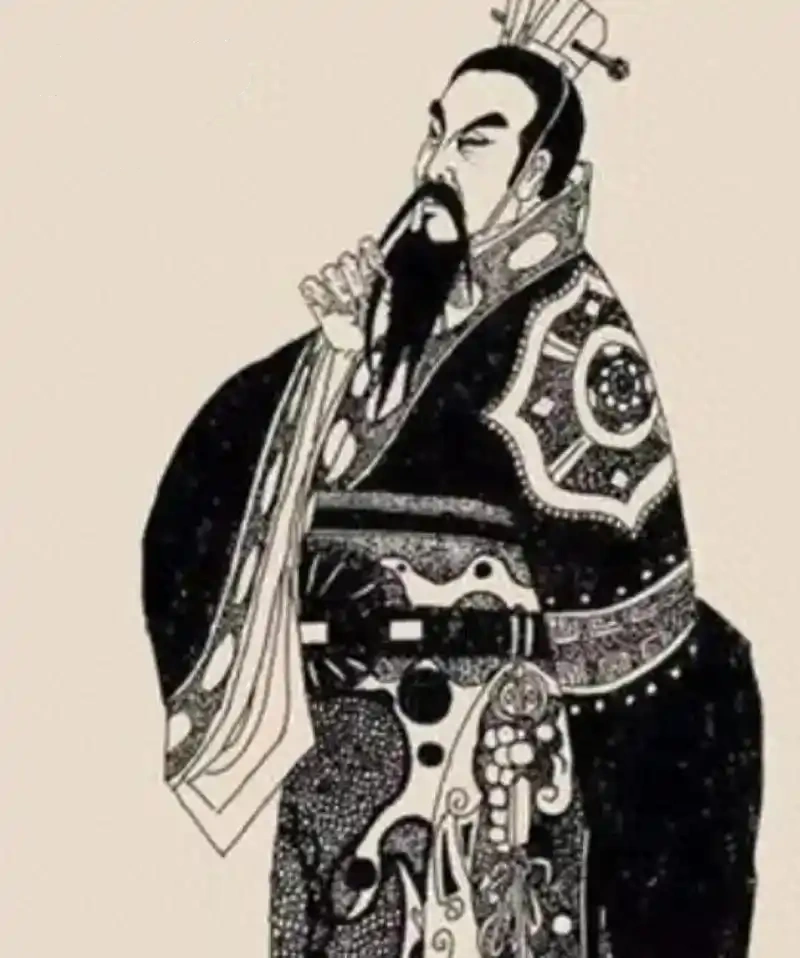
In the tenth month of 304, in the hill country of Lishi, west of the Jin provincial seat at Jinyang, a Xiongnu nobleman built an altar in the southern suburb of a fortress called Zuoguocheng, sacrificed to Heaven, and took the title King of Han. He was the son of the Left Division chief of the Southern Xiongnu and a former hostage of the Jin court, and he had spent his youth in Luoyang reading the classics of the empire he was about to attack. The title he took was not the title of a chanyu. It was the title of a Chinese king, and the state he proclaimed was called Han, the name of the dynasty that had fallen eighty-four years earlier. The state he founded is known to history as Han Zhao. He called it Han; in 319 his clan-nephew Liu Yao, by then emperor at Chang'an, renamed it Zhao. Shi Le, the commander who had served Liu Yuan and made himself master of the eastern plain, took the same name for his own state, and later historians, needing to tell the two apart, joined the two names of Liu Yuan's line into one: Han Zhao, the Han and the Zhao together, distinguished from Shi Le's Later Zhao by the order of the names. The label Sixteen Kingdoms is later still. No one in 304 counted sixteen of anything; the courts of the fourth century said Han, or Zhao, or the name of whatever state they served.
This article is about the name. Its argument is that the name was a political invention, and that the invention was the most important thing Liu Yuan did. He was not a member of the Han house. He was a Xiongnu aristocrat whose family had been settled inside the Jin frontier for generations, whose father held a Jin title with no land attached to it, and whose own career at the Jin court had been a long education in the gap between admiration and trust. The Han name was not a description of his blood. It was a claim on the mandate, made in the only political language that the Central Plain would recognize. It was not a mask in any simple sense. A mask is worn for an audience and removed at home. Liu Yuan built a court, sacrificed to the Han emperors, appointed a chancellor, and ruled through the forms he had borrowed. He also kept the Five Divisions, took the title of Grand Chanyu, and created an office for the tribes. The two systems were not a disguise and a reality. They were two constituencies, and he needed both. The principal narrative of his life is the first chapter of the records of the Book of Jin, compiled in 648 by a commission of the Tang court. It calls him Liu Yuanhai, using his courtesy name, because the character yuan in his personal name was the personal name of the Tang founder, and the taboo outlived the man by three centuries. That detail is a warning. The text that preserves him was written by the dynasty that ruled the same Central Plain three centuries later, in a genre reserved for states that had claimed the mandate falsely, and its vocabulary is hostile before its first sentence is read.
1. The Hostage
Xinxing commandery lay in the hill country north of the Taiyuan basin, where the roads from the northern pastures come down to the plain. It was there, in a Xiongnu settlement under Jin administration, that Liu Yuan was born. The year is not recorded. The biography supplies a chain of portents instead: a fish with two horns at a sacrifice, a dream of a man carrying a small sun, a pregnancy that lasted thirteen months, a character written on the infant's left palm. The same biography gives him a height of eight feet four inches, a beard three feet long, and three red hairs on his chest, each three feet six inches long. The last measurement is the give-away. This is not a description. It is a case for the mandate, assembled in the same style as the birth stories of the dynastic founders.
His father was Liu Bao, Left Worthy Prince and chief of the Left Division of the Southern Xiongnu. His mother was a daughter of the Huyan clan, one of the noble families that supplied the chanyu's wives and generals. At seven he lost his mother, and the record says that his mourning was so violent that the clan and the tribe admired him. The minister of works Wang Chang is said to have sent condolences. Wang Chang died in 259, and the chronology of the anecdote is one of the reasons no one has been able to fix the birth year. The article therefore gives none.
The education was that of a gentleman of the late third century. He studied the Mao Odes, the Jing school of the Changes, and the Ma school of the Documents under Cui You of Shangdang. He is said to have loved the Zuo Tradition and the military classics of Sun and Wu, and to have read the Records of the Grand Historian, the Han History, and the various masters. The biography then gives him a remark too neat to be a transcript. He told two fellow students that he despised Sui He and Lu Jia for having no martial skill and Zhou Bo and Guan Ying for having no letters. Therefore he took up arms, and became a remarkable archer.
The remark is a set-piece: the ideal of the complete man, civil and martial in one person, placed in the mouth of a founder. It tells us what the compilers of the fourth-century national history thought a founder should have read. It may also be true in substance, since a boy raised between the steppe and the capital would have had exactly this ambition. The education was real; the list of books is the portrait.
The decisive years were spent in Luoyang. In the Xianxi period, in 264 or 265, he was sent to the Jin court as a retained son, a boy held at the capital to guarantee his father's loyalty. The court called the arrangement by a euphemism; it was a hostage. Sima Zhao, the regent whose son would found the Jin dynasty a few months later, treated him well. Wang Hun of Jinyang, head of one of the greatest families of the province, befriended him and made his son Wang Ji bow to him. The connection was provincial as much as political. Liu Yuan later said that Wang Hun and Li Xi knew him "from the same corner of the country." The great families of Taiyuan had lived next to the Xiongnu divisions for generations. They received a Xiongnu aristocrat in a way the imperial court never did.
The court's admiration is recorded in an exchange. Emperor Wu summoned him and said that even You Yu and Jin Midi could not surpass his bearing and intelligence. Wang Ji went further: his civil and military talent was greater than theirs, and if he were given the southeast, Wu would be pacified. The proposal was serious. The conquest of Wu was the one great enterprise left to the dynasty, and Liu Yuan was a soldier with a scholar's education and a frontier nobleman's following. Then Kong Xun and Yang Yao spoke. If the emperor gave him a small command, he could not succeed; if he gave him real power, he might not come back after Wu was conquered. The record has them say that men not of their kind must have a different heart. The emperor said nothing.
The sentence is older than the Jin. It comes from the Zuo Tradition, where it is spoken about Chu, a state of a different clan, and its presence in the record is a lesson in how these texts were made. The ministers were quoting the canon against a man who had been taught the same canon. Liu Yuan knew where the sentence came from, and he knew that it was not an argument but a boundary. The court could praise him to his face and still refuse him a command because of a line from a book that both sides had read.
The refusal was repeated. When the Qin and Liang provinces collapsed in the 270s, Li Xi proposed giving Liu Yuan a general's title and the Five Divisions to recover the west. Kong Xun objected: if Liu Yuan pacified Liangzhou, the difficulty would simply move there; a dragon that gets cloud and rain is no longer a creature of the pond. The emperor declined. The phrase is a confession. The court did not think of the Five Divisions as its own army. It thought of them as a dragon in a pond, and it was afraid of the rain.
The most revealing scene from the Luoyang years is a farewell. Wang Mi, a magnate from Donglai who would later become one of Liu Yuan's commanders, was leaving the capital. Liu Yuan saw him off at Jiuqu, on the bend of the river below the city, and wept. The record has him say: "Wang Hun and Li Xi have praised me from the same corner of the country, and the slander has followed. I have no ambition for office. I only want you to understand me. I am afraid I will die in Luoyang and part from you forever." He drank and whistled, and the company wept with him. Sima You, Prince of Qi, heard the whistling, sent a man to look, and told the emperor that if Liu Yuan were not removed, Bingzhou would not be peaceful for long. Wang Hun vouched for him again. The emperor said that Wang Hun was right, and that killing a hostage on suspicion would not show the empire's virtue to the peoples beyond the frontier.
The emperor's scruple was a gentleman's scruple, and it cost the dynasty a province. But the scene is also a portrait of a man who expected to die in the capital that had educated him, and who had understood that his talents were a liability. He was too able to be employed and too well connected to be killed. The court kept him at the edge of its life, with a title and no command. The rest of his career was an answer to that arrangement.
2. The Five Divisions
The Xiongnu who lived inside the Jin frontier were not a steppe horde. They were the descendants of the southern chanyu's people, settled in the bend of the Yellow River and the valleys of Shanxi since the first century, and administered by the Jin state as a separate but registered population. In 216 Cao Cao had divided them into five divisions, each under a chief from the Liu clan. Liu Yuan's father held the Left. In the Taikang period the title of chief was changed to commandant, a small demotion in name and a real one in status. The five seats were Left at Zishi in Taiyuan, Right at Qi, South at Puzi, North at Xinxing, Central at Daling. The families of the ruling clan, the Book of Jin says, all lived on the banks of the Fen and Jian streams near Jinyang, inside the Jin provincial core.
This is the first fact any account of Liu Yuan has to establish, because it explains both his power and his grievance. The Five Divisions were a military reservoir inside the empire, supplying auxiliary cavalry, frontier scouts, and labour. They were also a status group that had once been a kingdom. Their chiefs bore the titles of the old chanyu's court, and the titles were empty. The Jin court gave them seals, ranks, and places at the provincial sacrifices, and it did not give them land, revenue, or command. Liu Xuan, the clan elder who would become Liu Yuan's chancellor, put the grievance in a sentence that the record preserves: since the Han fell, Wei and Jin had replaced one another, and the chanyu had an empty title with no foot of land; the princes had been reduced to registered households.
A registered household is a unit of taxation and conscription, and a unit of humiliation for a family that remembered being a dynasty. The Five Divisions were not poor. They were positioned at the crossroads of the northern frontier, where the Jin needed them and feared them. Kong Xun's objection had already stated the court's view: use them at the edges, never give them a leader. The policy worked for a generation. It failed in 304, when the Jin princes began to fight and one of them needed troops.
The war of the eight princes is the immediate context. Sima Ying, Prince of Chengdu, held Ye and the person of the emperor. Wang Jun of Youzhou and Sima Teng, Duke of Dongying and governor of Bingzhou, raised the Xianbei against him. Liu Yuan was at Ye as Ying's officer, with an acting general's title and supervision of the Five Divisions. Liu Yuan asked for leave to attend a family funeral, and Ying refused. Later, when Wang Jun's cavalry broke Ying's army, Liu Yuan persuaded him that the Five Divisions could save him; Ying agreed, made him Northern Chanyu, and sent him back to raise troops. It was a permission granted in desperation, and the most consequential permission of the century.
At Zuoguocheng the clan leaders made him Grand Chanyu. The record says that within twenty days he had fifty thousand men. The figure is the record's, and it measures an expectation rather than a muster. The important point is the speed. The Five Divisions had been waiting for a leader, and the Jin had supplied one by sending a prince's commission with a clan nobleman attached to it. Liu Yuan now held three titles: the Jin prince's Northern Chanyu, the clan's Grand Chanyu, and, within a few weeks, the title he would make for himself. Each title had a different audience. The first legitimized the return. The second legitimized the army. The third would legitimize the state.
The first test of the third title came immediately. Sima Ying, defeated, fled south with the emperor. Liu Yuan said that he had given his word to the prince and could not abandon him, and ordered a relief force of twenty thousand infantry and cavalry, according to the record. Liu Xuan and the clan leaders refused. Their argument was simple: the Jin had treated the Xiongnu as slaves; the Jin princes were destroying one another; this was heaven abandoning the Jin and handing the north to the Xiongnu. The moment had come to raise the clan and restore the work of Hu Hanxie, the chanyu who had submitted to the Han in the first century BC and whose descendants had been settled inside the frontier. The Xianbei and the Wuhuan were of the same kind and could be allies. Why rescue an enemy?
The argument is the program of an ethnic restoration. It is also a program that would have produced a smaller state: a chanyu's confederation on the northern frontier, allied with other frontier peoples, in the old pattern of the southern Xiongnu. Liu Yuan rejected it with a sentence that is the founding sentence of Han Zhao. A great man, he said, should aim at the work of Liu Bang or Cao Cao. What was Hu Hanxie worth? Emperors were not a fixed family. Yu had come from the Western Rong and King Wen from the Eastern Yi, and the mandate went by virtue.
This is the hinge of the article. The clan wanted a chanyu. Liu Yuan wanted an emperor. The Five Divisions could give him an army, but they could not give him a state, because a state in the Central Plain was not a tribe with a bigger following. It was a set of institutions, a ritual, a calendar, a bureaucracy, and a name. The name was the first thing he had to choose, and the choice was not obvious. He could have called himself a Xiongnu king, a chanyu of the five divisions, or a Jin rebel with a princely title. He chose Han.
3. The Name
The council at Zuoguocheng is recorded as a debate between Liu Xuan and Liu Yuan, and the record gives Liu Yuan a speech that is too long and too well composed to be a transcript. It is a formal composition, full of classical quotations and shaped like a Warring States argument. It should be read as the national history's account of what the founder said, not as a verbatim record. The speech has three parts, and each part is a move in a political argument.
The first move is the rejection of the chanyu's program. Liu Xuan had spoken of restoring the work of Hu Hanxie. Liu Yuan answered that the work of Hu Hanxie was the work of a client. Hu Hanxie had submitted to the Han, received a princess, and been settled inside the frontier with a title and a subsidy. His descendants had kept the title and lost the land. To restore that work was to restore a subordinate kingdom. Liu Yuan wanted the empire itself. The names he used, Liu Bang and Cao Cao, set the scale: the founder of the Han and the warlord who made the house of Wei.
The second move is the argument from virtue. The record has him say that emperors are not constant: Yu came from the Western Rong, and King Wen from the Eastern Yi, and the mandate was given according to virtue. The line is a commonplace of the Warring States canon; it echoes a Mencian argument, in which Shun was an Eastern Yi and King Wen a Western Yi, and the sage's virtue, not his birthplace, made him a sage. In Liu Yuan's mouth it does two things. It denies that the Jin monopoly of the mandate is natural, and it denies that the Xiongnu are disqualified by their origin. It is a claim of universal kingship, not a claim of ethnic superiority. This is the strongest evidence against reading him as a Xiongnu nationalist.
The third move is the Han claim. Here the record has him say: "The Han ruled the world for a long time, and their kindness was bound in men's hearts. That is why Liu Bei, in a single province, could hold out against the world. I am a nephew of the Han house, and we were sworn as brothers. The elder brother has died, and the younger succeeds him. Is that not proper? We may call the state Han and honor the Last Sovereign, to gather men's hopes."
The chain has three links, and they do not quite fit. The first is the marriage alliance: a Han princess had been given to Modu, and the chanyu's descendants were therefore the Han emperor's nephews. The second is the sworn brotherhood: Gaozu and Modu had sworn to be brothers, which makes the Xiongnu the Han's equals, not its juniors. The third is the succession: if the Han is the elder brother and the Xiongnu the younger, then the younger inherits when the elder dies. A nephew cannot also be a brother, and a brother cannot also be a nephew. The record does not notice the inconsistency, and the inconsistency is the point. The claim was assembled from whatever the tradition offered, because the tradition offered several ways of making the Xiongnu kin to the Han, and Liu Yuan needed all of them.
The claim was not new. The chanyu's clan had used the surname Liu for centuries, and the story of the Han princess was part of their own genealogy. What was new was the use of the name as a state name. The Han had been gone for eighty-four years and the Jin had ruled for less than forty when Liu Yuan took it. A restoration was not a live program; it was a memory. He made it live by attaching it to a state, an army, and a calendar.
The ritual acts of 304 were the constitution of the new state. He built an altar in the southern suburb, the correct place to receive the mandate. He took the title King of Han, not emperor, explaining that the realm was not yet settled and that he would follow the Founder, who had been King of Han before he was emperor. The title was a quotation of Liu Bang's own first title, and it placed Liu Yuan in the first year of a new Han, not the last year of an old one. He proclaimed an amnesty, changed the era to Yuanxi, and gave offices to his followers.
Then he made the dead speak. He posthumously honored Liu Shan, the last emperor of Shu Han and the Duke of Anle of the Jin, as Emperor Xiaohuai. He set up the tablets of the Three Ancestors and of the five Han emperors who had been given temple names ending in Zong. The Three Ancestors were the Founder Liu Bang, the Restorer Guangwu, and the First Emperor of Shu Han, Liu Bei. The Five Honours were the five honored emperors of the middle Han. The list is the argument. By placing Liu Bei among the three ancestors, he canonized Shu Han as the legitimate third Han. By honoring Liu Shan, he claimed to avenge the last sovereign. By sacrificing to the Han emperors at all, he claimed to be their successor.
The most precise detail is in the proclamation. It says that the sacrifices had been without blood for forty years. The Han had fallen in 220. Forty years before 304 is 264, which is the year after the fall of Shu Han. The arithmetic counts from 263, not from 220. This is not a slip. It is a date with a meaning: the Han did not end when Emperor Xian abdicated to Cao Pi. It ended when Liu Shan surrendered to Deng Ai. The Wei interregnum is void, and the legitimate line runs from Liu Bang through Guangwu to Liu Bei and Liu Shan, and then, by the logic of the younger brother's succession, to Liu Yuan.
The argument was aimed at the Jin gentry, not at the Five Divisions. The tribes needed land, pay, and a leader; the gentry needed a reason to believe that the new power was not simply a frontier army. The Han name gave them one. It said that the new state was the old state restored, that its offices were the offices of the classics, and that its ruler was the heir of the dynasty whose books the gentry had read. It also said something less comfortable: that the Jin, which had received the mandate from Wei, and Wei, which had received it from the Han by usurpation, were both illegitimate. The Han name turned the Jin's own foundation story into an accusation.
The limits of the claim were visible at once. The Jin had ruled for less than forty years, and most of the men who governed the provinces had made their careers under it. The genealogy was thin: a princess from four centuries earlier, a sworn brotherhood, and a succession rule no one had applied to a dynasty before. The great families of the Central Plain, by and large, did not come. The local elite of Bingzhou came in part: Fan Long and Zhu Ji took the great offices, and Chen Yuanda served him with frank advice. But Cui You, his own teacher, refused the office of censor. The refusal is a small fact with a large meaning. The man who had taught him the classics would not serve the state that claimed the classics.
Liu Yuan knew the limit. In the same speech in which he claimed the Han, he said that the men of Jin would not necessarily follow him. The sentence is the honest part of the program. The Han name could attract the frontier commanders, who wanted legitimacy, and the local gentry, who wanted order. It could not manufacture a bureaucracy, a tax base, or a consensus among the men who owned the land. It was a wager, and the wager was that the name would do more work than the army could.
4. The King at Zuoguocheng
The court that met at Zuoguocheng in the winter of 304 was small and deliberate. Liu Xuan became chancellor. Liu Hong became grand commandant. Fan Long became grand herald and Zhu Ji director of ceremonies. Cui You was offered the censorate and declined. The offices were not the offices of the Jin. They were the offices of the Han and of the classical tradition: chancellor, censor, grand commandant, grand herald, director of ceremonies. The choice was a statement. A Jin restoration would have used the Jin's own offices. A Han restoration used the Han's own names, and the names carried the prestige of the canon.
The new queen was Lady Huyan, the mother of his eldest son. The heir was Liu He. The court had a ritual, a calendar, and a genealogy. It did not have a treasury, a fixed territory, or a chain of command. Its territory was the hill country around Lishi and the roads into the Taiyuan basin. Its army was the Five Divisions plus whatever local strongmen joined. Its revenue was whatever the granaries of the moment could supply. In the first year it was enough.
The campaigns of 304 and 305 were designed to make the state viable. Jin forces under Nie Xuan attacked and were beaten at Daling. Sima Teng, the Jin governor of Bingzhou, was so frightened that he abandoned the province with more than twenty thousand households and fled east of the Taihang. The figure is the record's, and it measures how quickly the Jin position in the north had become a liability. Liu Yao took Taiyuan, Xuanshi, Tunliu, Changzi, and Zhongdu. For a few months it looked as if southern Shanxi would fall.
Then the material base asserted itself. A famine at Lishi forced the court to move to Liting, where a granary could feed it, leaving Liu Hong and Ma Jing to hold the old seat. Liu Jing was sent to intercept the new Jin governor, Liu Kun, at Banqiao, and was defeated; Liu Kun went on to hold Jinyang. The Jin still had an anchor in the north, and the anchor was a man who would not be dislodged for a decade. The famine, the retreat, and the defeat at Banqiao are the correct scale for the first year of a new state. The name had been proclaimed; the granary was still the problem.
In 308 the court moved again, to Puzi, on the advice of Liu Yin and Wang Yu. Their argument was strategic. The state had been sitting in a corner. It should strike Liu Kun, settle Hedong, take the imperial title, march south, take Chang'an, and then roll up Luoyang from the west. Liu Yuan said that this was exactly his own intention. He moved into Hedong, took Puban and Pingyang, and saw the walled villages of the two commanderies submit. Puzi became the capital. The move was a turn from the hill country toward the river and the plain.
The same years brought the commanders. Ji Sang rose in the Zhao and Wei country and was destroyed; the four Xianbei divisions of Shangjun under Lu Zhuyan; the Di chief Shan Zheng, who called himself Great Chanyu; Wang Mi of Donglai; and Shi Le submitted one after another. The dates in the two histories do not quite agree, and the Book of Jin lumps the group together; the Comprehensive Mirror places Shi Le's submission in 307. The important fact is not the date but the pattern. These were not officers. They were independent warlords with their own armies, their own territories, and their own plans. They submitted because Liu Yuan had a title that could make them legitimate, and because he was far enough away not to command them.
The court gave them titles. It made Wang Mi a general and a duke, Shi Le a general and a duke, and the frontier chiefs commanders with seals. The titles cost nothing and bought everything: the appearance of a state, the reality of a coalition. The Han name was the currency in which the purchases were made. A bandit leader who had been nobody in the Jin order could become a prince in the Han order, and the prince would fly the Han banner and call the Han court his sovereign. The arrangement was cheap, and it was fragile.
The King of Han was therefore a warlord among warlords, with a better title. He had the Five Divisions, the loyalty of his clan, and the prestige of the Han. He did not have the revenues of a province, the bureaucracy of a court, or the power to order a commander to give up his army. The state was a coalition of armed households, and for a few years the name was enough.
5. The Emperor at Pingyang
In the tenth month of 308, on the jiaxu day, Liu Yuan took the imperial title. He proclaimed an amnesty, changed the era to Yongfeng, and made the appointments that turned a royal court into an imperial one. Liu He became grand marshal and Prince of Liang. Liu Huanle became grand minister of education and Prince of Chenliu. Huyan Yi became grand minister of works and Duke of Yanmen. The clan was enfeoffed by degree of kinship, the non-clan by merit. The commandery titles are worth a pause. A Xiongnu nobleman was made Prince of Chenliu, a name from the old Han heartland, and another was made Duke of Yanmen, a frontier commandery. The titles were a map of the empire the court intended to govern.
In the first month of 309 he moved the capital to Pingyang. The move was advised by the astrologer Xuanyu Xiuzhi, who said that within three years Luoyang would fall, that Puzi was too cramped, and that Pingyang had the purple vapour and was the old seat of Yao. The last clause is the important one. Pingyang was, in the local tradition, the capital of the sage king Yao. A court that had claimed the Han mandate now claimed the seat of Yao. The two claims were not in competition. They were layers of the same argument: the new state stood in the line of the sage kings, and its capital was a proof.
The same year produced a seal. A jade seal was found in the Fen River, inscribed with four characters that read "the new preserves it." It was said to be a seal of Wang Mang, the usurper who had briefly ended the Han. The finder added three characters, "spring, sea, light," and Liu Yuan took the object as his own omen. He proclaimed an amnesty and changed the era to Herui, "river auspicious," to mark the find. The episode is a small masterpiece of political production: a seal from the usurper who had destroyed the Han, found in the river of the new capital, improved with three auspicious characters, and accepted as a sign that the Han had returned. No one asked why a Wang Mang seal was an omen for a Han restoration. The object was not a document but a stage prop, and the court needed a stage.
The institutions of the last year are the most interesting part of the reign. In the seventh month of 310, on his deathbed, Liu Yuan created the Chanyu Office west of Pingyang. He made Liu Cong, his fourth son, grand marshal, Grand Chanyu, and concurrently director of the secretariat. He appointed Liu Yao and Qiao Zhiming as the Left and Right Auxiliaries of the Chanyu. The office was a government for the tribes, parallel to the Chinese-style court, with its own chief and its own assistants. The geography was a diagram. The emperor sat in the Chinese hall; the Grand Chanyu sat in the office on the western side; the registered population and the tribes were governed through two chains of command.
The dual structure was not yet a constitution. It was a set of titles held by one man and then divided among his heirs. Liu Yuan had held the chanyu's title before he took the imperial one. At the end he separated the two, and the separation was fatal: the heir got the throne, and the general got the tribes. But the idea was there, and it would outlast him.
The material base remained thin. The court lived on the Fen valley, the granaries of Pingyang and Hedong, and the tribute of commanders who were supposed to be subordinates. It minted no reliable coin and collected no regular land tax from a whole province. Its greatest asset was its name. The name gave it the power to appoint, and the appointments gave it the power to bargain. A court that could make a bandit a prince could also make a prince a general, and the ceremony of appointment was the closest thing it had to a chain of command.
The court also performed the rituals of a dynasty. It sacrificed to the Han emperors, kept a calendar, buried its dead with imperial titles, and received envoys. These are not decorations. In the political language of the fourth century, a state that performed the sacrifices claimed the mandate, and a state that kept a calendar claimed the years. The Han Zhao could not tax the Central Plain, but it could date its documents by its own era. The calendar was a form of sovereignty no warlord could take away.
6. The War for Luoyang
Luoyang was the test. The Jin court still held the old capital, and the old capital was the symbol of the mandate. A state that claimed the Han and sat in Pingyang could not leave Luoyang to the Jin and call itself the empire. The Jin court, meanwhile, was paralyzed by the conflict between the emperor and the regent Sima Yue. The armies that might have defended the capital were being used against one another. The war for Luoyang was therefore a race between a state that needed the symbol and a dynasty that could not defend it.
The first campaign was in 309. Liu Cong and Wang Mi advanced on Luoyang, with Liu Yao and Zhao Gu in support. They beat the Jin forces under Cao Wu, Song Chou, and Peng Mo, reached Yiyang, and beat a second army under Chunyu Ding and Lu Yi from Chang'an. The victories made Liu Cong careless. The governor of Hongnong, Huan Yan, offered to surrender. He was received, and that night he attacked the camp. The Han army broke and fled back to Pingyang. Liu Yuan met the returning soldiers in white mourning dress, a public act of self-blame that was also a political gesture: the ruler took the defeat on himself and did not punish the general.
The second campaign was in the winter of the same year. The court levied a great force: Liu Cong, Wang Mi, Liu Yao, and Liu Jing with fifty thousand elite cavalry, and Huyan Yi with infantry behind them. The record's figure is the usual round number, a statement of scale rather than a muster roll. They beat the Jin at Henan and closed on the city. Liu Cong camped at the Ximing Gate, then at the Daxia Gate, then south of the Luo, then at the Xuanyang Gate. Liu Yao held the Shangdong Gate. Wang Mi held the Guangyang Gate. Liu Jing attacked the Daxia Gate. For a few days the Han army was at the walls of the capital.
Then the details turned. Jia Yin attacked at night and killed Huyan Hao. Liu Cong went to pray at Mount Song, leaving Liu Li and Huyan Lang in charge. According to the record, Sun Xun, a Jin officer, took three thousand picked troops out of the Xuanyang Gate and attacked the camp, killing Huyan Lang. Liu Li, fearing that Liu Cong would blame him, drowned himself in the Luo. Wang Mi advised withdrawal: the city was still strong, the army was short of grain, and a long siege would destroy it. Liu Cong, who had asked to stay, would not withdraw without an order. The astrologer Xuanyu Xiuzhi told Liu Yuan that the year xinwei, 311, would bring Luoyang, and that the Jin aura was still strong; Liu Yuan sent an officer to recall the army. Wang Mi withdrew through Huanyuan and was beaten by Bo Sheng at Xinji. The second campaign was over.
The failure was not one of courage. An army from the Fen valley had to cross the Taihang or the Yellow River, feed itself in the Henan plain, and besiege a walled capital while the Jin still held Jinyang and Chang'an. The Han state could raise a striking force, but it could not sustain a siege. Its commanders were independent, and their armies were their own property; a long campaign in a hostile plain was the one thing they could not afford. The name had brought them to the walls. It could not keep them there.
The same year produced the darkest episode of the reign. Liu Jing took Liyang and defeated the Jin general Wang Kan at Yanjin. He then drowned thirty thousand men and women in the Yellow River. The figure is the Comprehensive Mirror's, and it is the kind of number that ancient war histories produce when they want to make a point. The point here is Liu Yuan's reaction. The record has him say: "What face has Jing to see me again? And how can Heaven tolerate it? Those I want to destroy are the Sima. What crime have the common people committed?" He demoted Liu Jing.
The anecdote is a deliberate portrait. It shows a ruler who wanted a dynastic war, not a massacre, and who understood that the slaughter of commoners would destroy the claim to the mandate. It also shows the limit of his control. The massacre was committed by one of his own generals, in his name, during a campaign he had ordered. The rebuke came after the fact, and the demotion was a gesture. The Han name was supposed to make the war a restoration. The war was making it a conquest. The gap between the two was the space in which the state would fail.
In 310 the war was still unfinished. Liu Yuan fell ill in the seventh month. The Jin court was on the edge of its own collapse; Sima Yue had left the capital with the main army, and the emperor was isolated. Luoyang would fall a year later, to Liu Yao, Wang Mi, and Shi Le, the men Liu Yuan had titled and could not command. The founder had built the machine and chosen the name. The victory belonged to his successors.
7. The Three Commanders
The Han state was held together by three commanders and a clan. The commanders were Liu Yao, Shi Le, and Wang Mi. The clan was the Liu family, the Huyan, and the Shan. The relationship between the two was the central political problem of the reign, and it was never solved.
Liu Yao was the most intimate. He was a clan nephew, orphaned young, and Liu Yuan had raised him in his own household. The record gives him white eyebrows and a red light in his eyes, a bow that could pierce an inch of iron, and a taste for books. He compared himself to Yue Yi, Xiao He, and Cao Can; Liu Cong said he was of the caliber of Guangwu and Wei Wu. He was the sword of the house, and in 310 he was made the Left Auxiliary of the Chanyu. He was also the man who would rename the state Zhao in 319. His loyalty was the loyalty of a son, not of a subordinate.
Shi Le was the most dangerous. He was a Jie, a former slave and bandit, and he had made himself the master of the Hebei plain. He submitted in 307 and received titles, but he kept his own army, his own officers, and his own treasury. By 309 he had gathered the captured literati of Hebei into a "Gentlemen's Camp" and taken Zhang Bin as his adviser. The court at Pingyang could make him a general and a duke. It could not make him come to court, give up his army, or obey an order that did not suit him. He would found the Later Zhao in 319, and the name would collide with Liu Yao's Zhao.
Wang Mi was the most flamboyant. He was a magnate from Donglai, a bandit leader with a taste for display, and he joined the Han cause in 306 or 307. He fought in Henan and Shandong and wanted Qingzhou as his own base; Cao Yi, one of his officers, was sent to take the province, which shows that a Han commander could conduct his own territorial policy under the Han name. His rivalry with Shi Le was one of the reasons the coalition could not become an army.
The court's instruments were titles, seals, and honors. It could make a bandit a prince and a prince a general, and call a conquest an appointment. It could not give a commander a reason to obey when obedience was expensive. The Han name was the currency, and the currency was soft. Every commander took the title and kept the army. The state was a federation of war bands with a common flag.
The clan was the other half of the problem. Liu Yuan had five sons who mattered: Liu He, the eldest, by Empress Huyan; Liu Cong, the fourth, by Lady Zhang; Liu Yu, Prince of Qi, a son of Liu Yuan and not the Liu-Song founder of the same name; Liu Long, Prince of Lu; and Liu Yi, the youngest, by Empress Shan. The Huyan supplied the first empress, Huyan Yi, and Huyan You; the Shan supplied the second empress, a Di chief's daughter, and through her the youngest son. The succession was a contest of maternal clans as much as of princes.
The deathbed settlement tried to balance the two halves. Liu He, the heir, got the throne and the civil regents: Liu Huanle, Liu Yang, and Liu Yannian. Liu Cong, the general, got the army, the title of Grand Chanyu, and the direction of the secretariat. Liu Yi, the youngest, got the title of Prince of Beihai and the protection of his mother's clan. The settlement was a balance of throne and army, and it was a recipe for a coup. An heir with the throne and no troops, and a general with troops and a lesser title, is the oldest instability in dynastic politics.
The Han name did nothing to solve this. A dynastic name can legitimize a ruler, but it cannot create a ruling house. The Liu clan was a clan, not a bureaucracy; its members were generals, not administrators; its cohesion was kinship, not law. The state had a chancellor, but the chancellor was a clan elder; it had a censor, but the censor had refused the office; it had a court, but the court was a meeting of commanders. The name was a roof over the coalition. It was not a foundation under it.
8. Seven Days
In the seventh month of 310 Liu Yuan fell ill. On the gengwu day he took to his bed. On the xinwei day he made the last appointments: Liu Huanle grand steward, Liu Yang grand tutor, Liu Yannian grand guardian, Liu Cong grand marshal, Grand Chanyu, and director of the secretariat. He created the Chanyu Office west of Pingyang. On the dingchou day he summoned the regents into the palace and gave them the testament. On the jimao day he died. The Book of Jin gives the year; the Comprehensive Mirror, four centuries later, gives the days.
He was buried at Yongguang and given the posthumous name Guangwen, "glorious and cultured," and the temple name Gaozu. The Book of Jin calls these false titles, and the qualifier is the historian's, not the court's. The man who had claimed the Han mandate died with a Han-style posthumous name, in a capital he had built, surrounded by the institutions he had borrowed. The forms had held to the end.
Liu He succeeded. The record describes him as tall, handsome, and well read in the Odes and the Zuo Tradition, but suspicious and without generosity. He had been crown prince for less than a year, and had spent it watching his father divide the state between his brothers. Huyan You, his maternal uncle, and Liu Rui, Prince of Xichang, had been left out of the regency, and they wanted a purge. They told him that the princes had strong troops in the capital and that the Grand Chanyu had a hundred thousand men camped in the suburbs, a figure from the Comprehensive Mirror; the throne, they said, was a borrowed seat.
Liu Sheng, Prince of Anchang, objected. The late emperor was still in his coffin, the princes had not rebelled, and a family war would make the realm despise the new ruler. Huyan You and Liu Rui had him killed. The plot went forward: Liu Rui and Ma Jing to attack Liu Cong, Huyan You and Liu Anguo to attack Liu Yu, Liu Cheng and Liu Qin to attack Liu Long, and Tian Mi and a palace guard to attack Liu Yi. Tian Mi and the guard deserted to Liu Cong and warned him. Liu Cong armored his troops and waited. Liu Rui's attack failed, and the conspirators turned on Liu Yu and Liu Long and killed them. Liu Cong counterattacked, took the Ximing Gate, pursued into the Southern Palace, and killed Liu He in the west chamber of the Guangji Hall. Huyan You and Liu Rui were executed, and their heads were displayed in the streets. The new reign had lasted seven days.
Liu Cong offered the throne to Liu Yi, the son of Empress Shan, and then accepted it at the insistence of the ministers, promising to yield it to Liu Yi when he came of age. He made Liu Yi heir apparent as his younger brother, and Grand Chanyu. The promise was not kept. In 318 Liu Cong died and his son Liu Can succeeded; Liu Can was killed within a month. That belongs to the joint article on the two short reigns. What belongs here is the pattern: the founder's state survived him by seven days in the hands of his heir, and then passed to the son who had the army.
The war he had begun ended after his death. Luoyang fell in 311, and Chang'an in 316; those events belong to the reigns of his successors and to other articles. The founder did not see the fall of the capital he had claimed. His armies reached the walls of Luoyang twice, and both times they withdrew.
9. The Verdict of the Histories
The Book of Jin does not give Liu Yuan a chapter in the basic annals. It puts him in the "records," the section reserved for states that claimed the mandate without receiving it. The placement is a judgment before the first sentence is read. The text calls his accession "false," his state "pseudo," his campaigns "raids," and his officials "rebels." The vocabulary is not neutral, and it was not meant to be. The Tang court ruled the same Central Plain that the Jin had ruled, and it wrote the history of the fourth century from the standpoint of the empire that had reunified the realm.
The closing commentary on the Han Zhao records is one of the harshest passages in the history. It calls the Xiongnu "men with human faces and the hearts of beasts," who abandon their rulers when profit appears and forget righteousness when wealth is at hand. It admits that Liu Yuan was "a hero among men," that he "practiced the Chinese wind and had an elegant bearing," and that his talent was not that of an ordinary man. Then it turns. His state, it says, remained a realm of Yi and Di, where the positions of ruler and minister were never properly distinguished; his respect for Confucian learning and his open reception of the upright were "what the ancients called stealing benevolence and righteousness."
The passage is useful precisely because it is so extreme. It shows that the Tang historians could not accept the premise of the Han claim. For them, a Xiongnu who read the classics was not a Han; he was a man who had stolen the language of the Han. The judgment is ethnic and political: a state that had not descended from the legitimate line could not become legitimate by learning its rituals. The same logic that had refused Liu Yuan a command in Luoyang refused him a place in the annals three hundred years later.
The Comprehensive Mirror, compiled in 1084, uses a different language. It calls him "the ruler of Han" and does not add the word usurper. Sima Guang was writing a privately compiled history presented to the throne, not a state history for a dynasty, and he was willing to use the titles that the actors used. He was also writing in a period when the northern frontier had been lost again. The Comprehensive Mirror is still secondary, and its chronology is only as good as its sources, but its restraint is a useful corrective to the Book of Jin.
The Springs and Autumns of the Sixteen Kingdoms, attributed to Cui Hong, is the text that later ages treated as the other great source. Cui Hong wrote in the sixth century, and his work was lost by the Northern Song. The hundred-chapter text that circulates today is a late-Ming reconstruction by Tu Qiaosun and Xiang Linzhi, stitching the Book of Jin, the Book of Wei, and the Comprehensive Mirror together. It cannot be cited as an independent witness; where it differs from the Book of Jin, the difference is usually the reconstruction's.
The modern debate about the Han name has two poles. One reading treats it as a strategy: a genealogy invented for the occasion, a ritual borrowed for its audience, a title chosen because it sold. On this reading, Liu Yuan was a warlord who understood that the Jin gentry would not follow a chanyu, and who therefore dressed his state in the only costume that the gentry would recognize. The other reading treats the name as evidence of a real identification: a frontier aristocracy that had lived inside the Jin order for generations, had read its books, and regarded itself as the heir of the Han. On this reading, the name was not a mask but a self-description.
The evidence does not permit a clean choice. The genealogy was invented, and the education was real. The ritual was borrowed, and the congregations were sincere. The name was a wager, and a wager is not a lie. Liu Yuan did not know whether the Jin gentry would come; he knew that without the name they would not even consider coming. He made the claim, built the institutions that made it credible, and governed inside them for six years. Political founders do not discover an identity and then express it. They choose a name and then make it true.
The name did not last. In 319 Liu Yao renamed the state Zhao, and the Han phase of the dynasty ended nine years after Liu Yuan's death. The change was a recognition that the Han claim had done its work and could not do more. The state was no longer a restoration; it was a northern kingdom among others, and it took the name of the old state of Zhao, which had its own prestige in the north. The line lasted until 329, when Liu Yao was taken by Shi Le. Twenty-five years after the altar at Zuoguocheng, the state was gone.
The model lasted longer. A frontier dynasty with a Chinese dynastic name, a Chinese-style court, a Chanyu Office for the tribes, and a claim to the mandate by virtue rather than by blood: every later northern state did some version of this. Shi Le's Zhao, the Murong's Yan, the Fu's Qin, the Yao's Qin. The names changed, and the compromise did not. The Han Zhao was the first experiment, and its founder wrote the formula.
He was not a Chinese patriot, and he was not a Xiongnu nationalist. He was a man who had been taught to read the canon and then told that the canon was not for him. His answer was to claim the name of the dynasty that had written the canon, and to build a state that could perform its rituals. The claim was an instrument, and it was also the only intellectual home available to him. Both things are true, and neither cancels the other.
The altar at Zuoguocheng is gone. The sacrifices he established were discontinued when his successor renamed the state. What survived was the argument: that the mandate was not the property of a family or a frontier, that a man from the edge could inherit the center if he took its name and kept its forms. The argument was as old as the classics he had read; the use he made of it was not. He turned a name that had been dead for eighty-four years into a state that lasted twenty-five, and he made the Jin court answer a question it had refused to answer in Luoyang: who may inherit the Han?