Home / Emperors / Jin Dynasty
Emperor An of Jin
晋安帝
Sima Dezong, 382 – 419 · tenth emperor of the Eastern Jin
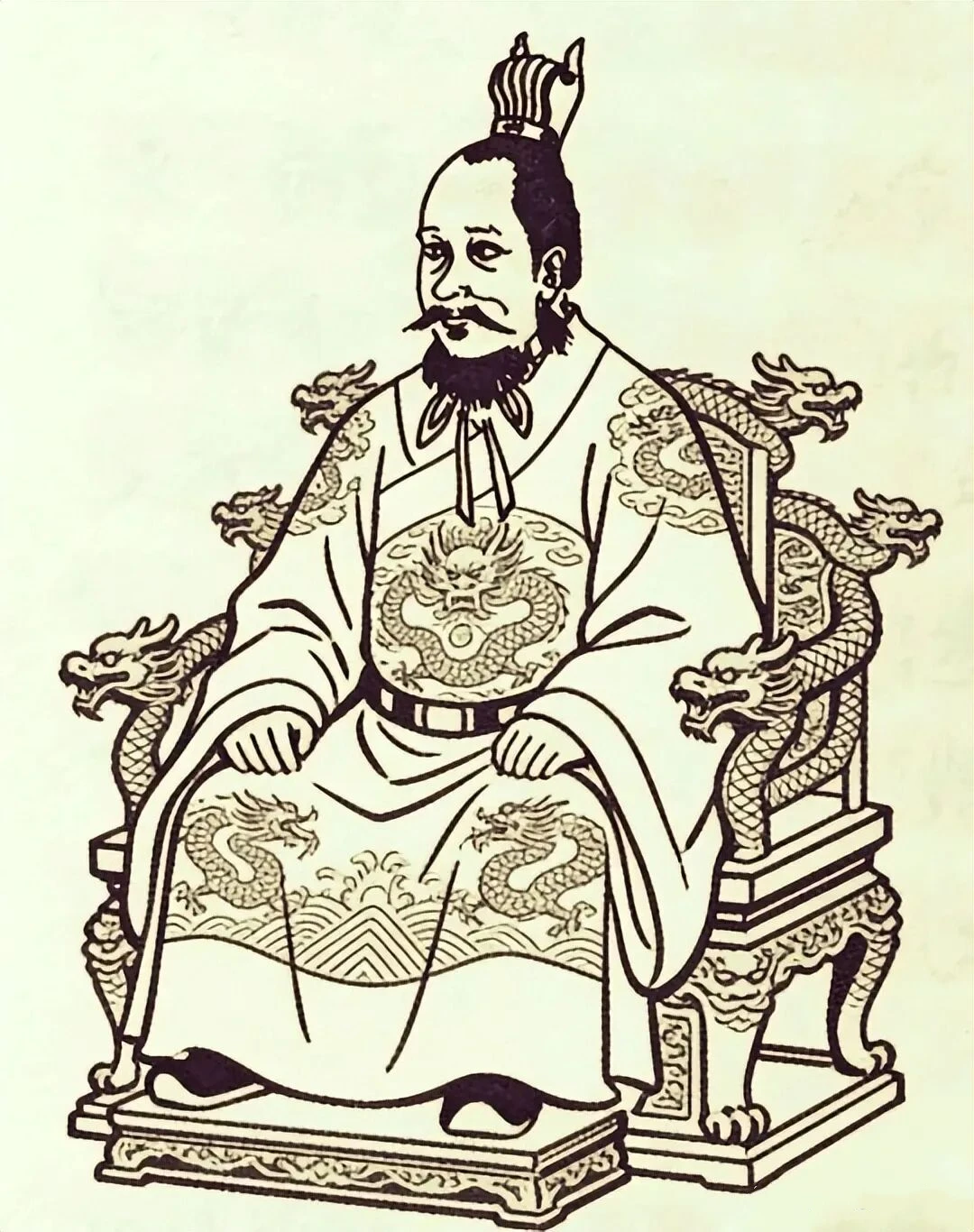
In the twelfth month of 403 an edict was read in the palace at Jiankang in the name of the emperor, transferring the throne to Huan Xuan. The emperor was twenty-two by the count of his court, which begins at one at birth and adds a year at each new year. He had not written the text and could not have read it aloud. According to the annals of his reign he had never spoken in his life, and the officials who staged the ceremony performed everything that the occasion required of him except the one thing that could not be done by proxy, which was to be the man in whose name it happened.
The Book of Jin, compiled in the Tang, describes him in a sentence that later writers have quoted and rarely used well: he was not intelligent, and from childhood to old age his mouth could not speak; even the change from cold to heat he could not distinguish. The sentence has usually been read as a curiosity, the accident that put a man incapable of speech on the throne of a failing dynasty. It is better read as a constitutional fact. A throne is not only a seat. It is a mechanism for turning one person's will into commands, and its working parts are the spoken word, the private audience, the seal and the body that performs the sacrifices. In 396 the Eastern Jin acquired an emperor who could supply only the last of these, and the men around him discovered that the last was enough. The body could be dressed, seated and carried. The seal could be applied by another hand. The edicts could be drafted and read. What could not be supplied was a will, and it turned out that no one had needed one for a long time.
The reign lasted twenty-two years: five under the era Longan, three under Yuanxing, fourteen under Yixi. It contained three changes of power large enough to have ended the dynasty. The first was the rising of Sun En in the eastern commanderies, a religious rebellion that turned the richest region of the south into a battlefield. The second was the usurpation of Huan Xuan, the last gamble of the old aristocracy. The third was the rise of Liu Yu, a soldier from Jingkou who began with a few hundred men and ended as the man who decided who would sit on the throne. Through all three the emperor remained in place. The question the reign poses is not why he did not govern. It is what his presence did, and what it allowed other men to do in his name. This is the last form of Eastern Jin imperial power: the sovereign in the hall, the decision somewhere else.
The sources were written from two sides. The Book of Jin was compiled in 648 by a commission of the Tang, two and a half centuries after the events, and its annals of An are thin, formal and written from the perspective of the house that lost. The Song Book of Shen Yue, written in the 480s under the Southern Qi about the dynasty that replaced the Jin, is the history of a founder, and its Liu Yu is seen from the inside. The Comprehensive Mirror, completed in 1084, harmonised the two and preserved details from sources that no longer survive. Where they differ, the difference is usually the difference between the dynasty that ended and the dynasty that began. The body of the emperor is described once, in the Book of Jin, in the sentence above. This essay does not go beyond that description. It offers no diagnosis, and it does not treat the body as a spectacle. It treats it as the one fact about the reign on which every source agrees.
1. A Silent Emperor
Sima Dezong was born in 382, the eldest son of Emperor Xiaowu and of a consort named Chen Guinü. His father was twenty-one by the count of his court. The dynasty was in the seventh year of the era Taiyuan, and the victory at the Fei river was a year away. His mother was a woman of modest rank in the palace. She bore the emperor a second son, Sima Dewen, four years later, and died in 390, before either of them reigned, when Dezong was in his ninth year. Nothing else about his childhood is recorded, and the annals of his reign begin in 396 with his father's death.
In the eighth month of 387, when he was six, he was made crown prince. The delay was not remarkable. His father was twenty-six and expected other sons, and a court names an heir reluctantly, because an heir is a statement about the future that limits the present. The statement was made, and for nine years the boy was the heir of a reign that had survived the largest invasion the north had ever mounted. Then, in the ninth month of 396, his father was killed in his own palace by a consort he had insulted while drunk. The circumstances belong to the previous reign. What matters here is the sequence. The emperor was murdered at night, the heir was brought to the throne within days, and the man who had directed the government for eleven years was the dead emperor's younger brother, the prince of Kuaiji. The new emperor was fifteen by the count of the court, fourteen by the Western count.
The Book of Jin describes him in a notice that has been quoted ever since and understood too quickly. He was not intelligent. From youth to old age his mouth could not speak. Even the change from cold to heat he could not distinguish. The same passage adds that nothing he did originated with him. The notice is usually read as the description of a misfortune. It is also a description of an administration. A court converts the person of the sovereign into decisions through four instruments: the spoken command, the private audience, the sealed edict and the ritual body. The first three were now unavailable. The fourth remained, and the fourth was the one the court could not do without.
It is worth being exact about what the text says and does not say. It says that he was not intelligent and could not speak; it does not say what he understood. It says that he could not tell cold from heat, not that he was unconscious. The distinction has tempted later writers to supply a diagnosis, and the temptation should be resisted. The historians of the Tang were not physicians. The words they used were moral and political as much as physical, and no description in the sources is detailed enough to support a medical judgment. What the text establishes is a political situation. The emperor could not be consulted. He could not be heard in council. He could not be relied on to notice his own discomfort, so someone else had to decide when he was cold. Every decision that required his voice was made by a man who was not him, and every decision that required his presence was staged around a body that would neither confirm nor deny what was said in its name.
In 396, in the last year of his father's reign, he was married to Wang Shen'ai, daughter of Wang Xianzhi and of the princess Xinan, a daughter of Emperor Jianwen. She was two years younger than her husband and, by the reckoning of the two families, his first cousin: her mother was a sister of his father. The marriage was arranged in the last months of Xiaowu's life, which is to say that it was arranged by the court, and it joined two of the most distinguished houses of the south at a moment when distinction of that kind was ceasing to be the qualification for power. She was made empress in the first month of 397. She had no children. Her biography in the Book of Jin is short and gives her a reputation for restraint and for the observances of her rank. It gives her no political role, and there is no evidence that she sought one. She died in 412, at twenty-nine by the count of her court, and was buried at Xiuping with the posthumous name Anxi, with the rites of an empress.
The absence of a son was not a private sorrow. It was the central fact of the succession. The emperor's only full brother, Sima Dewen, born in 386, held the title of prince of Langya, which had been the title of the heir before. In a court where legitimacy was the only thing the throne still owned, the question of who would inherit was a question about the future of every family in the capital. The emperor's silence made it unanswerable by the emperor. It would be answered by whoever held the army.
Later writers have often paired him with Emperor Hui of the Western Jin, and the pairing is misleading. Emperor Hui's incapacity became a catastrophe because the state around him was still worth capturing: it had an army, a treasury and a capital that mattered. By 396 the Eastern Jin had been governed for most of a century by the men who controlled those things, and the throne had already been reduced to the function of legitimising them. The difference is not in the two men. It is in the two states. Hui's incapacity was a crisis because the state around him was still worth capturing. An's incapacity was the settled form of a state that had already been captured.
2. The Prince of Kuaiji
Sima Daozi had been the second man in the state since 385, when his brother the emperor had given him the supervision of the department of state affairs and then lost interest in governing. He was thirty-three at the accession, a man of considerable charm and no discipline, and his government had two characteristics that the sources never tire of recording: it sold offices, and it drank. The sales were handled by his household; the drinking was his own. The poets and monks who surrounded him made his court the most cultivated in the south, and the cultivation was paid for by the provinces.
His son Sima Yuanxian was born in 382, the emperor's exact contemporary. At the accession he was fifteen, and he had none of his father's charm and all of his appetite. He gathered young men of his own age, cultivated the guards, and understood earlier than anyone that the regency was a prize to be taken from inside the family. By 399 he had taken it. His father kept the title of prince of Kuaiji, the house and the wine, and the government was in the son's hands.
The court of 396 was not without defences against its own regent. Xiaowu had posted men to the provinces in the last years of his reign, and each of them had an army or a province that the capital did not control. Wang Gong, brother of Xiaowu's empress, held the inspectorships of Yan and Qing and was stationed at Jingkou, downstream from the capital on the south bank of the Yangzi. Yin Zhongkan, a celebrated talker and a man of real learning, held Jing province from Jiangling, upstream. Xi Hui held Yong province from Xiangyang. In Jiangling, without an office, lived Huan Xuan, son of Huan Wen, with the name of the greatest general of the previous generation and a private following of clients and soldiers.
The arrangement was a balance, and balances of that kind depend on the willingness of each party to wait. In the fourth month of 397 Wang Gong marched from Jingkou and halted outside the capital. Yin Zhongkan raised Jing. Huan Xuan and Yang Quanqi joined. The pretext was the conduct of Wang Guobao, the left vice-director of the department of state affairs, who had urged the regent to cut the provincial commands and who was, in the opinion of the provinces, the government. The demand was his death. Daozi executed him and his kinsman Wang Xu, sent the heads to the camp, and Wang Gong went home.
The episode is the first clear statement of the political rule that governed the next twenty years. A provincial governor with an army could remove a minister of the central government by marching on the capital. The emperor's name could be attached to either side, because the emperor could not attach it to anything. And the court, having submitted once, had taught every governor in the empire that submission worked.
The great houses of the capital had no armies of their own. Their power rested on office, land and the network of clients and kinsmen that filled the bureaucracy, and that power depended on a government that could be influenced. A provincial army outside the capital was, to them, a foreign body. They had spent most of a century making sure that the armies of the state were commanded by men of their own class, and they had succeeded; the result was that the only armies in the state belonged to the men who commanded them. When Wang Gong marched, the capital's families could do nothing but watch the regent negotiate. Their cultivation, their genealogies and their conversations were no defence against an army from Jingkou, and they knew it. The rising of 397 was therefore a lesson not only for the court but for the class that had made the court. It would spend the next twenty years looking for a soldier who would protect it, and it would find three.
Yuanxian drew the obvious conclusion, which was that the court needed an army of its own. The army it had was the Beifu force at Jingkou, created by Xie Xuan in 377 from refugees and frontiersmen of the north and blooded at the Fei river. It was the best infantry in the south and it belonged to its commanders. Yuanxian's answer was to buy one of those commanders. In the autumn of 398 Wang Gong marched again, with Yin Zhongkan, Huan Xuan and Yang Quanqi, and the court sent Liu Laozhi, Wang Gong's own forward commander, to meet him. Yuanxian offered Liu Laozhi Wang Gong's office. Liu Laozhi turned his army around. Wang Gong was taken and executed outside the capital, and Liu Laozhi inherited his command.
Liu Laozhi was a competent general and a poor politician, which in the conditions of the time was the most dangerous combination available. He had betrayed his patron for an office and had discovered that the office was worth exactly as much as the army behind it. For four years he was the strongest soldier in the east. The court had bought him once; it would have to buy him again. The Beifu army, which had been the instrument of the dynasty against the north, had become an independent power in the politics of the capital.
The capital understood what had happened, and the understanding made it more dependent on the man it feared. Yuanxian's government after 398 was a government of appointments, sales and ceremonies. It gave out titles to the provinces it could not command, and it looked for a counterweight to the Beifu in the only pool of manpower it could reach, which was the households of the east. The search for that counterweight produced the order of 399, and the order of 399 produced the war that nearly ended the dynasty.
3. The Upper River
After Wang Gong's death the three upper-river men met at Xunyang and made a pact. The court's response was the method it had used for generations: divide the provinces and hope the division held. Huan Xuan was given Jiang province, Yang Quanqi was confirmed in Yong, Yin Zhongkan kept Jing. Each of them understood that the others were the reason for his own title, and none of them intended the arrangement to last.
Huan Xuan was thirty by the count of his court in 398. His father had died twenty-five years earlier, after coming within a step of the throne and being stopped by the one man, Xie An, who could stop him. The family had been kept at a distance ever since: given titles, denied commands, watched. Huan Xuan had grown up with the sense of a great house cheated of its due, and he had the qualities that made such a sense dangerous. He was a fine talker and a better writer, physically imposing, generous to his friends, and unable to forget an injury. In his twenties he had been given the governorship of Yixing, a small commandery near the Taihu, and had resigned it with a remark about his father's greatness and his own small post. The remark was repeated, as such remarks are.
His power was not only his father's name. Jing province had been governed by the Huan family, or by men who had served it, for two generations. The officers of the Jing army had been appointed by Huan Wen and had served his son; the great families of the middle Yangzi had married into the Huan household or had been protected by it; the fleet was built in the province's yards and manned by its river men. A governor sent from the capital could hold the title of Jing and could not hold the province. This was the structural reason why the court's division of 398 failed. It gave Huan Xuan a province in which he was already at home, and it gave his rivals titles in provinces where they were strangers.
Yin Zhongkan was the opposite kind of man. He was a master of pure conversation and a patient administrator, a governor who governed by consultation and a man who knew that the army in his province was loyal to its officers rather than to him. Yang Quanqi was a soldier of the border, brave, blunt and permanently angry at a capital that measured a family by the date of its crossing. The alliance of the three was held together by their fear of Huan Xuan and by nothing else.
In 399 Huan Xuan moved. He defeated Yang Quanqi first, because Yang Quanqi was the soldier and the soldier was the danger. Yin Zhongkan, who had the larger province and the smaller army, was taken at Jiangling and forced to take his own life. The court did nothing. It had no army in the west and no ally there, and the man who now held Jing and Jiang together controlled the whole upper river, the fleet that went with it, and the road to the capital.
The geography is the key to the last twenty years of the dynasty, and it is simple. Jiangling, Xunyang and Gushu are upstream of Jiankang. An army that holds them can come down with the current, and the capital has weeks rather than months to prepare. Jingkou and Guangling are downstream, at the mouth of the river and the canal, close enough to the capital to arrive before the court could raise a second army. The Eastern Jin had lived by balancing the upper river against the lower. When one man held Jing and another held Jingkou, the court could choose. When one of the two was empty, the court was a tenant.
Yuanxian governed what was left. The treasury was short, the provinces were held by men he had not appointed, and the great houses of the eastern commanderies had converted their estates into private jurisdictions in which the registers of the state meant nothing. In 399 he issued an order that the households of the east which had been released from servitude and attached to great houses as clients should be registered as "happy subjects" and moved to the capital for military service. The measure was an attempt to create an army out of the one population that had no protector. It took the clients away from the houses that had sheltered them and sent them to a capital that could not feed them. It angered the houses, uprooted the clients, and gave the eastern country a grievance at the moment when a leader appeared to give it a voice.
In the tenth month of 399 a fleet appeared off the Kuaiji coast. The court had spent the year trying to build an army and had succeeded in making enemies. It now discovered that the most dangerous man in the empire was not a governor.
4. The Islands
Sun En belonged to the Sun family of Langya and to the Way of the Five Pecks of Rice, the Daoist movement that had organised communities in the coastal commanderies for two generations. His uncle Sun Tai had built a following among the families of the three Wu commanderies, the richest region of the south, and had begun to behave like a man with a political following. In 398 the regent had him executed. Sun En escaped to the islands off the Kuaiji coast, which had sheltered pirates, refugees and the enemies of successive governments for centuries, and waited.
In the tenth month of 399 he landed at Shangyu with about a hundred men. The figure is the histories', and it is credible, because the rising did not begin as an army. It began as a demonstration that the government could not protect its own officials. He took Shangyu, moved on Kuaiji, and the countryside joined him. The histories say that within ten days his following had reached several hundred thousand, a figure that describes a collapse of authority rather than an army. What is certain is that a hundred men and a few boats took the seat of the richest commandery in the south in less than a month.
The administrator of Kuaiji was Wang Ningzhi, son of Wang Xizhi and husband of Xie Daoyun. He was a devout adherent of the same Daoist tradition as Sun En. When his officers asked for defences he refused to prepare them, withdrew into his oratory, and told them afterwards that he had petitioned the Way and had been promised ghost soldiers. The sentence is in his biography in the Book of Jin, and it has been quoted ever since as an example of aristocratic folly. It is also the sentence of a man who believed what his class had been taught to believe. The city fell. Wang Ningzhi was killed with his sons. Xie Daoyun, who had watched her husband pray, took a sword and fought, and was taken alive.
The rising was religious in its language and social in its targets. Sun En's followers were called the long-lived. They burned the offices and killed administrators and the men of the great houses, and the sources that describe them were written by the class they attacked. Those sources call the movement a rebellion of demons; the movement's own terms were of purification and renewal. Both descriptions are political. What the eastern country experienced in 399 was a war of clients and tenants against the houses that had held them, and it was one of the few times in the history of the dynasty that the population of the lower Yangzi acted as a political force.
The three Wu commanderies were the fiscal foundation of the dynasty. The capital's grain, its cloth, its copper and most of its rent came from the estates of the lower Yangzi, and the great houses that owned them had been exempt from most forms of service for generations. A rebellion that burned the offices and killed the landowners did not merely disturb a province. It interrupted the revenue on which the court, the army and the households of the capital depended. The war of 399 to 402 was fought in the richest country in the south, and when it was over the country was poorer, the houses were fewer, and the men who had defended it were soldiers from the frontier commands rather than the sons of the families that owned it.
The court sent Xie Yan, son of Xie An, and Liu Laozhi with the Beifu army. Sun En withdrew to the islands, and the court made the mistake of thinking the war was over. In 400 he returned. Xie Yan, who now held Kuaiji, had refused to fortify his headquarters on the ground that a man who had fought at the Fei river did not need walls. He was killed in Kuaiji with his two sons. The son of the victor of the Fei river was lost to a rising of clients and tenants, and the court lost the last commander of the old generation whom it trusted.
The Beifu army that came to restore order lived off the country it was restoring. Its officers were paid in plunder and its men were fed from the villages, and the difference between the rebels and their suppressors was not always visible to the people who were taxed by both. The court gained a war it could win and lost the confidence of the province it was winning. The men of the three Wu had risen against the great houses; they now discovered that the alternative to the great houses was an army from Jingkou.
The war produced one commander who would outlast it. Liu Yu was born in 363 at Jingkou, of a poor branch of the Pengcheng Liu who claimed descent from a Han prince and had nothing else to show for it. He sold shoes, gambled, and was not respected by the respectable. He joined the Beifu army under Liu Laozhi and spent the years 399 to 401 fighting in the eastern commanderies. The Song Book gives him a series of single combats in which he holds a bridge or a wall against impossible numbers, and those stories were written to make a founder. The outline they preserve is credible: he was physically fearless, he understood his men, and he was the only officer in the eastern war who consistently won.
In 401 Sun En sailed north. He took Hudu at the mouth of the Wu river, killed Yuan Shansong, the administrator of Wu, and appeared at Jingkou, which put him within reach of the capital. Jiankang was placed under emergency defence; the court closed the gates and manned the walls. Liu Yu came back from the east, attacked the fleet at Jingkou and broke it. Sun En withdrew north to the island of Yuzhou and then south again to Linhai.
In the third month of 402 the administrator of Linhai, Xin Jing, defeated him. Sun En drowned himself in the sea. The histories say that a hundred or more of his followers went into the water after him, believing that he had not died but had become a water immortal. The number is the histories', and the belief is theirs. His brother-in-law Lu Xun took over the remnant, the fleet and the name. The rebellion was not over. It had become a power in the south, and it would come back to the capital eight years later.
5. The Usurper
In the first month of 402 Yuanxian answered the problem of Huan Xuan with the only instrument he had, which was a larger army. He took the title of commander-in-chief for the expedition, put Liu Laozhi at the head of the forward force, and drew on the garrisons of the capital and the north. The numbers in the histories are inflated and inconsistent; the political fact is that the army was assembled in a hurry, that its officers did not trust one another, and that its forward commander had already sold one patron.
Huan Xuan came downriver. He did not need to fight. He sent a man to Liu Laozhi to point out what the court had done to Wang Gong and what it would do to him, and Liu Laozhi, whose nephew He Wuji argued against it, surrendered his command. Yuanxian's army dissolved without a battle. Yuanxian was taken at the capital and executed in the market with his sons. He was twenty-one by the count of his court.
His father was exiled to Ancheng and killed the following year, after Huan Xuan had taken the throne. Liu Laozhi was given a title and stripped of his troops. He tried to raise the country, found that his officers would not follow him against the man they had just joined, and hanged himself. Huan Xuan entered the capital in the third month, took the titles of commander-in-chief and regent, and began to govern with the men he had brought from Jing.
He governed badly, and the failure was structural rather than personal. His army was a Jing army, loyal to the Huan family and small. The capital's soldiers were Beifu men, whose commanders he had killed or bought and could not trust. The great houses were willing to serve any government that left their estates alone, and Huan Xuan, who wanted to be emperor, was not willing to leave anything alone. He spent the rest of 402 and most of 403 arranging the honours that precede a change of dynasty: the nine bestowals, the principality of Chu, the ceremonial refusals.
He understood the problem and could not solve it. He tried to conciliate the great houses by restoring offices and honours that the previous government had neglected, and he tried to bind the Beifu officers to him with titles. Both measures made him look weak. The houses took the honours and kept their estates; the officers took the titles and kept their men. He also changed the names of offices and the boundaries of commanderies, a habit that the histories record with contempt because it seemed to them the vanity of a man with no real power. The contempt is unfair and the judgment is right. A ruler who reorganises names is a ruler who cannot reorganise armies.
The emperor was sent upriver with the household of the deposed court and received at Xunyang with the honours of a prince. The ritual of a former emperor is a careful thing. It must be grand enough to show that the new dynasty is generous and small enough to show that it is finished. He was twenty-two. He had been on the throne for seven years, and in that time he had never spoken a public sentence or issued a personal order.
In the twelfth month of 403 Huan Xuan took the throne. The dynasty was named Chu, the era Yongsheng, and the emperor was reduced to prince of Pinggu. The transfer was staged with the full apparatus: the abdication edict in the emperor's name, the altar, the new court, the officials who changed their robes in the antechamber.
The usurpation came with omens, because a usurpation without omens was a crime. Among the sayings in circulation was one that concerned the house of Jin rather than the house of Huan: after Changming there would be two emperors. Changming was the courtesy name of Xiaowu. The saying is recorded at the end of the Book of Jin's annals of An and repeated in the Comprehensive Mirror, and it belongs to the class of prophecies that are remembered because they were later made true. Whether it was current in 403 or produced in 418 cannot now be decided. Its function is not in doubt. It turned the end of a dynasty into a matter of arithmetic, and arithmetic can be managed.
Huan Xuan held the emperor, the capital and the title. He did not hold the lower Yangzi. The Beifu officers were still at Jingkou and Guangling, the eastern commanderies were exhausted but not obedient, and the man who had won the eastern war was still there, with a reputation and no office worth the name. The Beifu officers had a simple calculation. They had served Liu Laozhi, who had betrayed Wang Gong and then been destroyed by Huan Xuan. They had served Huan Xuan, who had taken their commands and given them titles instead. They had no reason to love either. What they had was the memory of being the best infantry in the south, and the example of what a determined man with a few hundred of them could do.
6. The Men of Jingkou
Liu Yu was forty-two by the count of his court in 404. He had spent the two years since the eastern war as an officer of the new regime, holding a title and a nominal command, and he had spent them watching. The conspiracy he put together at Jingkou was small and military. Its members were He Wuji, Liu Laozhi's nephew, who had argued against his uncle's surrender; Liu Yi, a Beifu officer of the same provincial background and a rival of Liu Yu's before he was an ally; Meng Chang, a local official with a talent for organisation; Zhuge Changmin, who could raise the Huai country; Tan Pingzhi and Wei Yongzhi, soldiers; and Liu Yu's younger brother Liu Daogui.
The plan was to strike at both ends of the river at once. Liu Yu and He Wuji killed Huan Xiu, Huan Xuan's governor at Jingkou. Meng Chang and Liu Daogui, at Guangling on the north bank, killed Huan Hong. The initial force was a few hundred men. What made the rising dangerous was not its size but its position. Jingkou and Guangling were the two gates through which the lower Yangzi could be entered, and the Beifu officers who held them had spent their lives in the same camps.
Jingkou was not an ordinary garrison. It was a settlement of refugees from the north, founded in the generation after the fall of Luoyang and filled with families that had lost their land and kept their arms. Its men served in the Beifu because that was the only career open to them, and its officers had grown up together in a place where lineage mattered less than the ability to hold a line. The rising of 404 was the first time that society acted on its own account. It produced a leadership that was neither aristocratic nor servile: men who could read a register, count a fleet and fight, and who had no inherited claim to anything they took.
Huan Xuan sent two of his generals, Wu Fuzhi and Huangfu Fu, with the best troops he had. Liu Yu met them at Jiangcheng and at the Luoluo bridge and destroyed both in two days. Tan Pingzhi was killed. The battles were small, and their effect was out of proportion, because they proved that Huan Xuan's army could be beaten by men who had been part of it. Huan Xuan abandoned the capital without a siege and took the emperor west with him. He had held the throne for three months.
Liu Yu entered Jiankang in the third month. He did not take the throne, and the reasons were practical. The emperor was alive and in Huan Xuan's hands, the provinces were held by men who had not yet chosen, and a soldier from Jingkou with a few hundred men could not yet claim the mandate. He installed the prince of Wuling, Sima Zun, as grand general with authority to act for the government, and governed through him. The formula was the old one: the dynasty continued, the emperor was absent, and the men who held the capital spoke for him.
In the fifth month Liu Yi, He Wuji and Liu Daogui caught Huan Xuan's fleet at Zhengrong island on the middle Yangzi and destroyed it. Huan Xuan fled to Jiangling and was killed at Meihui island by Feng Qian, an officer of Yi province, who sent his head to the capital. He was thirty-six. His father had come within a step of the throne a generation earlier; he had taken it and held it for three months.
The war did not end with his death. His nephew Huan Zhen and his cousin Huan Qian retook Jiangling in the summer of 404 and held the emperor there. Huan Zhen wanted to kill him. Huan Qian stopped him. The argument was not mercy. A living emperor was the source of every title the faction had, and a dead one was a corpse that legitimised whoever found it first. The emperor was worth more alive to every party in the war, and that was the only kind of value he had ever had.
In the first month of 405 Liu Yi's army attacked Jiangling. Huan Zhen fled and was killed soon afterwards. In the third month the emperor re-entered Jiankang and resumed the throne. The era had already been changed to Yixi in the first month, while the emperor was still at Jiangling. He had been away from his capital for about fifteen months, first at Xunyang and then at Jiangling, and he had spent them in the custody of men who addressed him as Your Majesty and decided everything.
The restoration of 405 is usually described as the return of the dynasty. It was the return of the emperor. The men who brought him back were the men who had taken the capital, and they divided the offices among themselves with the confidence of conquerors. Liu Yu took the offices that controlled the court. Liu Yi took a province. He Wuji took another. Meng Chang and Zhuge Changmin took ministries and commands. The emperor resumed the sacrifices, the audiences and the edicts, and the edicts were drafted by the men who had restored him.
7. The Price of Order
For seven years the coalition held, and it held because each of its members needed the others. Liu Yu was the best soldier and the most patient politician. Liu Yi was the ablest of the rest and the most openly ambitious. He Wuji was the link to the old Beifu command and the most loyal. Meng Chang administered. Zhuge Changmin raised troops. They had taken the capital together, and none of them could govern it alone.
The first compromise was in the south. Lu Xun, who had inherited Sun En's fleet and the islands, held Guang province. In 405 the court recognised him as its inspector. The recognition bought five years of quiet and cost the court the revenues of the south. It also told every provincial commander that a rebel who held a province long enough became a governor. The bill came due in 410.
Liu Yu spent the years accumulating the offices that made the throne unnecessary. He was made inspector of Yang province, the province that contained the capital, and supervisor of the department of state affairs, and commander-in-chief. He declined some of the titles and kept the powers. He did not move against his allies while the north was quiet, and he did not let any of them acquire a province that could support an army of its own.
The government that made these years work was run by a man who never commanded an army. Liu Muzhi had been Liu Yu's secretary since the rising of 404, and by 410 he was the effective head of the civil administration: he drafted the edicts, kept the registers, appointed the officials, managed the supply of the capital and decided which petitions reached the throne. The histories describe him as the man who made Liu Yu's victories possible by ensuring that the state did not collapse while the army was away. For twelve years he was the second half of Liu Yu's power, and the half that could be written down.
In 412 Liu Yu moved against Liu Yi. Liu Yi held Jing province from Jiangling, the same command that had made Huan Xuan dangerous, and he had begun to appoint his own officials and to correspond with the northern states. Liu Yu marched west with a fleet, took him at Jiangling, and Liu Yi hanged himself. The alliance of 404 was over, and the man who had destroyed the last of his colleagues was the only soldier left of the generation that had taken the capital.
In 413 Zhuge Changmin was killed at the capital, invited to an audience and met by an ambush. In 415 Sima Xiuzhi, prince of Qiao and inspector of Jing, the last prince of the blood with an army, rebelled and was defeated; he fled to the Later Qin. By the end of that year every provincial command that could threaten the capital was held by a man Liu Yu had appointed, and every rival who could claim a share of the restoration was dead or in exile.
In the same years the government did the unglamorous work that made the army possible. In 413 it enforced the land survey known as the Yixi registration. Households were registered where they actually lived, the refugee administrations that had kept their own white registers for a century were merged or abolished, and the great estates that had concealed their clients were opened to the tax rolls. The measure was not new. The dynasty had attempted it before, under two earlier reigns, and had lacked the power to enforce it. What was new in 413 was that the man enforcing it had an army that no provincial family could match. The exemplary case was the Kuaiji magnate Yu Liang, a different man from the regent of that name, who had concealed more than a thousand fugitive households and was executed. The histories give no total for the households registered, and the silence is itself a fact: the survey's importance was not in a single figure but in the principle that the registers of the state ran to the edge of every estate.
The court in these years was quiet. The emperor performed the sacrifices, received the envoys and issued the edicts, and the annals record no word of his. The empress died in 412. There was no son, and the heir was the emperor's brother, the prince of Langya, who had been given the title that the heir had held before him. The palace guard and the household were staffed by men who owed their places to Liu Yu. The emperor's silence had become an administrative convenience: a court in which the sovereign could not ask a question was a court in which no one had to answer one.
By 415 the Eastern Jin had a government that worked. It collected taxes, kept the river fleet, appointed governors and negotiated with the northern states. It had a court, a calendar, a sacrificial schedule and an emperor. It did not have a politics, in the sense of a contest over who should govern, because the contest had been settled. The only question left was when the settlement would be given its final form.
8. The North and the Throne
The northern wars were the other half of the same years, and they were fought for the same reason. An army that has been built to take the capital must be used, or it becomes a rival. In the fourth month of 409 Liu Yu sailed north against the Southern Yan, the state founded by a branch of the Murong in Qing province after the break-up of their northern kingdom. Its ruler, Murong Chao, had raided the Huai country and had refused to return the men and women he had taken. The raid was the pretext. The reason was that the Beifu army was idle and the north was divided.
The campaign turned on a pass. The Southern Yan held the Daxian, the mountain gate between the Huai plain and the Qing peninsula, and Murong Chao declined to garrison it, on the advice of his courtiers and against the advice of the one counsellor who understood the ground. Liu Yu passed through in the sixth month and said afterwards that he had entered enemy country through a door that had been left open. He destroyed the Yan army at Linqu, drove the remnant into Guanggu, and besieged the city for the winter. It fell in the second month of 410. Murong Chao was sent to Jiankang and executed. The histories say that three thousand of the Yan nobility were killed after the surrender, and the figure is the histories'.
While he was in the north, the south rose. Lu Xun and his commander Xu Daofu sailed up from Guang province with a fleet and a plan: take the capital while its army was on the other side of the mountains. They destroyed He Wuji at Yuzhang, where he was killed, and they destroyed Liu Yi's army at the Sangluo sandbar. The road to Jiankang was open. The government had fewer men than it needed, a frightened court, and an emperor whose presence in the palace was the one thing it could still rely on.
Liu Yu came back. He brought his army south by forced marches, reached the capital before Lu Xun, and took command of a defence that had nothing to defend it but the river, the walls and his reputation. Meng Chang, who had urged the court to abandon the capital and cross the Yangzi, killed himself when Liu Yu refused. Lu Xun arrived, looked at the defences, and hesitated. The hesitation was fatal. His fleet was large, his army was not, and the capital was not worth the losses that a siege would cost. He withdrew, and the war became a pursuit. In 411 Lu Xun was killed in Jiao province and Xu Daofu was destroyed. The south was Liu Yu's, and the last internal enemy was gone.
In 413, the same year as the land survey, the west was recovered. Qiao Zong had held Sichuan since 405, when he had rebelled against the government and taken the title of king of Chengdu. Liu Yu sent Zhu Lingshi with a fleet and a set of instructions that the histories describe as sealed, to be opened only on the river. The instructions worked. Chengdu fell, Qiao Zong was killed, and the upper Yangzi was again administered from Jiankang.
The largest campaign came last. In 416 the Later Qin lost its ruler Yao Xing, and Liu Yu took the opportunity that the death of a northern sovereign always offered. He marched in the eighth month with a fleet on the Yellow River and an army on the banks, moved upriver, and beat off the Northern Wei cavalry with a formation of chariots that the histories describe in detail. Wang Zhen'e and Tan Daoji led the van. Luoyang fell in the tenth month. The Tong pass was forced in 417, and in the eighth month Wang Zhen'e entered Chang'an. Yao Hong, the last Qin ruler, surrendered. For the first time in a century a Jin army held both of the old capitals.
Liu Yu stayed in Chang'an for a few weeks. He toured the city, took the libraries and the instruments, and considered the future. Then his administrator Liu Muzhi died at Jiankang in the eleventh month, and the government at home lost the man who had run it for more than a decade. Liu Yu left his generals in the west and returned east in the twelfth month. The Guanzhong was lost within a year to the Xia state of Helian Bobo, and the men he left there killed one another. The northern conquest had been a demonstration, not a settlement.
In the summer of 418 the emperor conferred on him the title of duke of Song, with the chancellorship and the nine bestowals. The edict was issued in the emperor's name and drafted in Liu Yu's household. Nine bestowals were the last honour a subject could receive before the honour that could not be received. Everyone in the hall knew what the ceremony meant, and the ceremony was performed with the care that such occasions require: the envoys, the jade, the chariots, the axes, the bows, the wine. The emperor was thirty-seven. He had been on the throne for twenty-two years. The state he presided over was larger than it had been at his accession and belonged to another man.
9. The Eastern Hall
In the winter of 418 Liu Yu was fifty-six. He had sons, the eldest still a boy, and he had spent fifteen years removing every man who could dispute his right to what he had taken. The last obstacle was not a man. It was a saying: after Changming there would be two emperors. One of them had reigned since 396. The other did not exist.
In the twelfth month of the fourteenth year of Yixi, the last month of the lunar year 418, which fell in January 419, the emperor was killed in the Eastern Hall of the palace. The agent named by the later histories is Wang Shaozhi, a client of Liu Yu's, and the method they give is strangulation with a length of cloth. He was thirty-seven by the count of his court. He had been emperor for twenty-two years and had never spoken a sentence in his own name. He was buried at Xiuping, without a temple name.
The sources disagree in a way that is itself evidence. The Book of Jin's annals of An record that he died in the Eastern Hall. The annals of An record both the formal notice of death and, a few lines later, the secret strangling: Liu Yu, needing a second emperor to complete the count, had the emperor killed and installed his brother. The same history, in other words, records the death twice: once as a death and once as a killing. The Song Book of Shen Yue, written for the dynasty that benefited, does not dwell on the manner. The Comprehensive Mirror tells the story plainly, and it had no dynastic stake in the outcome.
Sima Dewen took the throne in the same month. He was the second emperor after Changming, and with his accession the count was complete. What happened next belongs to his reign. It is enough here to note the arithmetic. The prophecy had required two emperors, and the man who had made the prophecy useful had just supplied the second. A saying that had begun as an omen had become a schedule.
The burial was arranged by the new government. The tomb at Xiuping was built to the scale of an emperor and the rites were performed with the correct forms, and no temple name was given, which meant that he would not be worshipped with the founders and the great emperors of the line. The omission was not an insult. A temple name is a judgment, and a judgment would have required someone to decide what his reign had been. The court that buried him had been installed by the man who had killed him, and it preferred the fewer words. The annals end in the same key: a death, an age, a tomb, and the accession of the brother.
The verdict of the histories is not a verdict on him. The Book of Jin's verdict is structural, but its historian still writes of a benighted ruler and chaotic ministers. Its annals record the omens, the edicts, the appointments and the movements of armies, and the emperor appears in them as a location. The Tang historians who compiled it had no reason to defend him and no interest in blaming him. Their subject was the failure of a house, and the failure was structural. The last reigns were the working out of a loss of authority that had begun long before 396. Later writing remembers him chiefly as the reign in which that authority ran out, and treats the man as the marker of the fact.
Twenty-two years is the second longest reign of the Eastern Jin, after his father's twenty-four. It is also the lowest point of the Jin throne, and the phrase is not a moral judgment of the man. It is the reign in which the dynasty's politics changed in kind. The men who governed in 396 held their places by birth. The men who governed in 418 held theirs by victory in the field, by the registration of land and by the removal of rivals. The change is usually described as the passage from aristocratic politics to military politics, and from a court staffed by the sons of great houses to one staffed by the officers of a frontier army. What it leaves out is that the aristocracy had already lost the capacity to fight. The great houses could produce governors, talkers and poets. They could not produce an army that would obey them. The men who could were the men of the frontier commands, and the greatest of them was a shoe seller's son from Jingkou.
The posthumous name chosen for him was An, which the classical glossary of posthumous names glosses as concord, the quality of a man who does not contend. The name invites irony. It is more likely a description of the only role he had been allowed to play. He had not contended with the regent, the usurper or the general. The court had been able to do what it did because he was what he was, and the men who wrote his name into the record knew it.
He was the tenth of the eleven emperors of the Eastern Jin, and the one whose reign coincided with the end of the order that had produced the dynasty. For twenty-two years the court had done its business in his name, and the business had been the destruction of the house he represented. He did not cause it. He made it possible to conduct that destruction as administration, and in the end the administration was all the house had left.