Home / Emperors / Sixteen Kingdoms
Prince Wuzhao of Western Liang
西凉武昭王
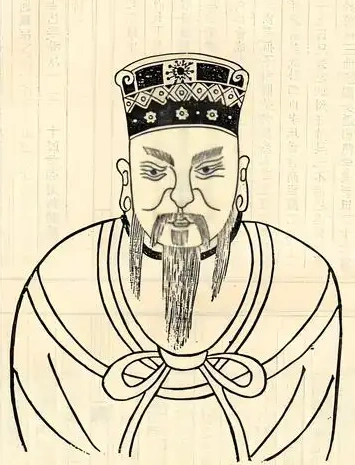
Li Gao, 351 – 417 · founder of Western Liang
The Hexi corridor is a trough of gravel and irrigated green between the Qilian Mountains to the south and the lower ranges to the north, running some thousand kilometres from the Yellow River toward the desert. The Han empire cut it into four commanderies: Wuwei, Zhangye, Jiuquan and Dunhuang. The last of these lay at the western end, where the Dang River comes down from the snows and spreads into a fan of fields before the desert closes in. The Han made it a commandery in 111 BC. In the census of 2 CE it counted 11,200 households and 38,335 persons, a small population for a place that had become the gate of the western roads. Two passes guarded the gate: Yumen, the Jade Gate, to the northwest, and Yang to the southwest. Beyond them the road split. The northern road went by Jushi, Karashahr, Kucha and Kashgar; the southern road went by Shanshan, Qiemo, Jingjue, Khotan and Shache, and then over the Pamirs. For five centuries Dunhuang was where an official changed horses, a merchant changed camels, and a pilgrim changed languages.
In 400 a provincial official named Li Gao was proclaimed duke at Dunhuang and began to date documents by a reign title of his own. He ruled from 400 to 417, never took the title of king, and died in 417 as the posthumous Prince Wuzhao. His state is called Western Liang. At its core were two oases, Dunhuang and Jiuquan, strung along the last habitable stretch of the corridor, with a few frontier counties and a long, contested border. It had the revenues of a frontier garrison and the ceremonies of a capital: a hall for council, a school for the sons of great families, erudites of the Five Classics, an examination for cultivated talents, a calendar, a genealogy, a historiography. The question this life raises is not how a small state survived in a time of larger ones. It is what a small state thought it was doing when it behaved as if the empire had not ended. The evidence is uneven: the fullest life is in the Book of Jin, compiled under Tang patronage in the 640s and placed among the ordinary biographies, apparently because the Tang house counted Li Gao as an ancestor, while the History of Wei gives a shorter notice from the rival side of the corridor. What follows holds to what those texts say, and to what the documents of the oasis show.
1. The Last Oasis
The corridor is not a road so much as a series of oases connected by one. Each oasis is fed by a river coming out of the Qilian snows: the Shiyang at Wuwei, the Hei River at Zhangye, the Shule at Jiuquan, the Dang at Dunhuang. Between them are gravel plains, salt flats and low hills. An army can cross the gaps, but it cannot live in them. This is why the history of the corridor is a history of towns, and why a state that held two towns could call itself a state.
Dunhuang sits where the Dang River fan meets the desert, with the Mingsha dunes to the south and the Sanwei hills to the east. The site is not generous: the growing season is short, the water is finite, and the fields are thin. But it is the last place west of the corridor where a large population can be fed, and the first place east of the desert where a caravan can rest. That double position made it a town of officials, soldiers, monks and merchants rather than a town of great landowners.
Yumen and Yang are about ninety and seventy kilometres from the town, in opposite directions. They were not merely gates but custom posts and garrison towns. From Yang the southern road followed the northern foot of the Kunlun range through Shanshan, Qiemo, Jingjue, Khotan and Shache; from Yumen the northern road followed the southern foot of the Tianshan through Jushi, Karashahr, Kucha and Kashgar. The two roads met again in the Pamirs. Dunhuang was the place where a traveller chose, and where the choice could be reversed if the desert or the politics changed.
The commandery's later reputation is summed up in a phrase preserved in a note on the Geography of the Later Han: Dunhuang was where the Chinese and the peoples of the west met, a single great city. The phrase is a cliché, but the archaeology supports it. The Han slips from the frontier posts record envoys from the western kingdoms, merchants with bolts of silk, soldiers with rations of millet, and the constant traffic of horses and camels. By the fourth century the population was no longer only local. The Former Qin had moved more than ten thousand households from the Han River valley to Dunhuang at the end of its Jian Yuan period, and seven thousand more from the central plains; when Guo Nun raided Wuwei, several thousand households from Wuwei and Zhangye fled west to Dunhuang and Jinchang. These are the figures the Book of Jin gives when it explains where Li Gao's manpower came from. They are registration figures, not a census, but they describe a town that had become a refuge.
What made Dunhuang more than a garrison was a habit of teaching. The town had no famous academy, but it had families who copied the classics, recluses who took pupils, and a local market for calligraphy. Zhang Zhi, who died around 192, was a Dunhuang man and became the model of cursive script for the next thousand years; his younger brother Zhang Chang wrote in the same hand. In the next century Suo Jing, a Dunhuang man who died in 303, was one of the five young men from the commandery who went to the imperial academy and were called the five dragons; he became a master of cursive and a general, and his name stayed in the record when the empire that employed him did not. The town also produced Suo Dan, who wrote on the interpretation of dreams, and Suo Xi, who refused office and lived in the hills.
The fourth century added a second layer. Song Xian, a Dunhuang man, retired to the southern hills near Jiuquan and taught three thousand pupils; he annotated the Analects and wrote poems and eulogies by the ten-thousand-word mark. Guo Yu, also of Dunhuang, studied with Guo He, buried his teacher with the rites of a son, and taught a thousand pupils in the caves at Linsong, in the hills above Zhangye; he wrote on the Spring and Autumn and on the Classic of Filial Piety, and refused the invitations of Former Liang and Former Qin alike. Liu Bing, Guo Yu's pupil, served Li Gao as libationer for the forest of scholars and wrote the Record of Dunhuang, the Book of Liang and a large Brief Record; Kan Yin, another Dunhuang man, wrote an Account of the Thirteen Provinces and annotated the Changes. These men were not a court. They were a network of teachers and pupils, and they were the reason a frontier town could supply a government with secretaries, ritual specialists and historians.
The network had names. The Suo, the Fan, the Zhang, the Linghu, the Song and the Yin supplied officials to every regime that held the corridor. Suo Xian and Suo Si were on opposite sides of the same quarrel in 399; Zhang Miao and Zhang Tishun served Li Gao; Song Yao was his half-brother and his chief minister; Linghu Qian, Linghu Yi and Linghu He held generalships and commanderies; Fan Deyu was a general and a governor; the Yin supplied a governor. A state in Dunhuang did not have to invent an elite. It had only to persuade the families that their future lay with it rather than with Zhangye or Guzang.
The town was also a Buddhist door. Dharmaraksa, a Dunhuang man of Yuezhi descent, translated the Lotus Sutra into Chinese in the third century and became the first great translator of the tradition in the north. The cave temples at Mingsha were begun in 366, when a monk named Yuezun settled in a hollow in the cliff; by Li Gao's time there were already caves with painted walls and copied sutras. A pilgrim coming from the west could find a monastery, a scribe and a caravan in the same town. This mattered to a state that wanted to be more than a garrison: the Buddha was another universal order, and Dunhuang was one of the places where it had learned to speak Chinese.
The same geography that made Dunhuang a gate made it a dead end. The corridor is narrow; an enemy who holds Zhangye can cut the road at any of a dozen places. A capital at Dunhuang is a capital at the end of a road, and a government at the end of a road learns about its enemies late. Li Gao's move east to Jiuquan in 405 was an admission of this. Jiuquan is closer to the Zhangye frontier and to the richer oases of the centre; it is also closer to the enemy. The move did not solve the problem. It only moved the capital from the far end of the corridor to the middle of it.
2. A Name in the Western Province
The Li of Longxi were not kings. They were a provincial aristocracy whose men had served the Han, the Wei and the Jin as governors, generals and marquises, and whose women married into the same circle. The Book of Jin begins Li Gao's life with a genealogy that reaches back to Li Guang, the Han general who lost his way in the desert and took his own life rather than face a military tribunal. The History of Wei makes the same claim, without the generation count. The claim gave the family a place in the imperial past, which was useful in a century when the imperial present had broken into pieces.
The claim needs to be handled carefully. It is not a record of what Li Gao said about himself. It is a family genealogy, repeated by histories written long after his death, and probably codified in the historical work of his own state: Liu Bing, his libationer, wrote the Record of Dunhuang and the Book of Liang, and a genealogy would have been part of that enterprise. Whether Li Gao asserted the Li Guang line in his own voice cannot be shown from any surviving text. What can be shown is that the family had every reason to maintain it, and that the histories accepted it. The Tang claim is a separate layer: in the seventh century the imperial house made Li Gao its ancestor. The imperial title of 743 is a third layer still, and it belongs to the eighth century.
Within the family, the offices were modest and real. Li Gao's great-great-grandfather Li Yong, and Li Yong's son Li Rou, who was Li Gao's great-grandfather, held commandery posts under Jin. His grandfather Li Yan served Zhang Gui, the founder of Former Liang, as a guard general and held the title Marquis of Anshi; a later tradition adds that he was administrator of Tianshui. His father Li Chang had a good name and died young; one tradition says at eighteen. Li Gao was born after his father's death. The household that raised him was one in which the men went out to govern and the boys were taught to read, and in which the difference between serving a dynasty and serving a province was a matter of daily arithmetic rather than of principle.
The year of his birth is not recorded. The Book of Jin says he was sixty-seven when he died in 417; 351 is the arithmetic of that figure. The date is consistent with the rest of his life, since his sons were old enough to command troops in 399, but it is a reconstruction, not a citation. He was born into the generation that grew up after the Western Jin collapse and the division of the north, and he was already middle-aged when he became a magistrate. That is late for a founder, and it explains something about him: he had spent most of his life as an administrator before he became a sovereign, and he governed like an administrator.
The biography describes him as quiet, intelligent, generous in temper, handsome in bearing, and learned in the classics and histories; it adds that he was good at letters, and that as he grew older he practised arms and read the Sunzi and the Wuzi. The combination was not unusual among the frontier elite, but the proportion was. Most of the men who founded states in this period were soldiers who had learned to use clerks. Li Gao was a clerk who had learned to use soldiers.
The biography also preserves a prophecy. Li Gao and Song Yao, his half-brother on his mother's side, once shared a room with Guo Nun, the astronomer of Later Liang. Guo Nun rose in the night and said to Song Yao that he would stand at the top of the ministers, and that Li had the lot of a state; when the mare foaled a white-fronted colt, that would be the time. The story is a literary device, the kind of anecdote that biographies use to make a life look fated. It is worth keeping for what it shows about the circle around Li Gao: astronomers, half-brothers, and a household in which a man's future was discussed before he had one.
By the 390s the Later Liang of Lü Guang was failing. Its commanderies were held by men who had begun to calculate their own futures. One of them was Duan Ye, a Later Liang officer who set himself up at Jiankang in Hexi in 397 as governor of Liangzhou. Li Gao, who had been serving the provincial administration, was appointed magistrate of Xiaogu. The appointment was small. It put him in the eastern approaches of Dunhuang, on the road between the oasis and the frontier, and it made him the official through whom the local families dealt with the new government at Zhangye.
3. The Clerk of Xiaogu
Xiaogu was a small county east of Dunhuang, on the road that ran from the oasis toward Jiuquan and the frontier. Its magistrate was responsible for taxes, corvée, irrigation, the granary and the register of households; he was also the first official a traveller met after leaving the Dunhuang basin. Li Gao's biography says that he governed with warmth and firmness and that the people remembered his kindness. The phrase is a set piece, but the position was not: a magistrate who could keep the water rights straight and the granary full was a magistrate whom the local families would trust with more.
Duan Ye had taken the title of governor of Liangzhou at Jiankang in 397. In 398 the administrator of Dunhuang, Meng Min, died. The commandery's garrison commander Guo Qian and the provincial assistant Suo Xian, with the local families, proposed Li Gao as the new administrator. The proposal was not submitted to Zhangye for approval; it was presented to Li Gao, who accepted it, and Duan Ye later ratified it. The sequence is important. Li Gao did not seize Dunhuang from outside. He was chosen by the men who held the oasis, and the nominal overlord had to accept the choice.
The choice was a statement about the future of the corridor. The families of Dunhuang had watched the Later Liang dissolve and the Zhangye government try to inherit its authority. They chose a man who was one of them, who had administered a frontier county, and who had a network of relatives and clients in the oasis. Duan Ye could have resisted. He did not, because he needed Dunhuang more than he needed a nominee of his own. The result was a negotiated autonomy: Li Gao held the commandery, Duan Ye held the title of governor, and both sides pretended that the arrangement was ordinary.
In 399 Duan Ye took the title of king. His right-guard general, Suo Si, a Dunhuang man, warned him that Li Gao should not be left at Dunhuang and offered to take the commandery himself. Duan Ye sent him west with five hundred horsemen. Suo Si stopped twenty li from the town and sent word that Li Gao should come out to welcome him. Li Gao prepared to go. Zhang Miao, the magistrate of Xiaogu, and Song Yao stopped him. They argued that the Later Liang was failing, that Duan Ye was weak, that Suo Si was proud and his soldiers few, and that a single battle could settle the matter. Li Gao hesitated; he said that he had no ambitions of his own and had been pushed into the post by the local gentlemen. Song Yao went out to meet Suo Si, flattered him, came back and reported that his troops were poor. Li Gao then sent his sons Li Xin and Li Rang, with Zhang Miao, Song Yao and the commander Yin Jianxing, against him.
Suo Si was defeated and fled back to Zhangye. Li Gao had been his friend; the biography says they had sworn a friendship of the kind that is supposed to survive anything, and that Suo Si's attack was therefore a betrayal. Li Gao sent a memorandum of charges to Duan Ye. A general at the Zhangye court also pressed for Suo Si's death. Duan Ye had him killed, sent an apology, and tried to repair the relationship by dividing three counties from Dunhuang and Jinchang to create a new commandery of Liangxing, and by advancing Li Gao to holder of the tally, commander of all military affairs west of Liangxing, Zhenxi general, and protector of the western Yi.
The titles were the ones a frontier commander would need if he were to act on his own, and the new commandery gave him a legal frontier. But the decisive fact was the battle. A magistrate of a frontier county had defeated the nominee of a king and had kept his commandery. After 399 no one in the corridor could doubt who held Dunhuang. The proclamation of 400 did not create his power; it named it.
4. The Proclamation of 400
In 400 Tang Yao, the administrator of Jinchang, sent a circular to the six commanderies of Dunhuang, Jiuquan, Jinchang, Liangxing, Jiankang and Qilian. He proposed that Li Gao take the titles of grand commander, grand general and duke, with the governorship of Qin and Liangzhou and the protectorate of the Qiang. The circular was an act of rebellion against Duan Ye, but it was framed as a request from the commanderies. Li Gao accepted it, pardoned his territory, and took the reign title Gengzi.
At least two of the six commanderies in the circular were not his. Jiuquan was held by the Zhangye government, and Jiankang was the seat of that government. The titles were equally ambitious: Qin was the province of Longxi and the upper Wei valley, held by the Later Qin; Liangzhou was the province that stretched from the Yellow River to the desert, of which Li Gao held the western end. A proclamation that claims six commanderies and two provinces is not a description of a state. It is a programme for one. The men who signed it were not fools; they were announcing that the corridor should be governed from Dunhuang rather than from Zhangye, and that the man in Dunhuang should be the one to do it.
The enterprise had a province for a name and a direction for an address: Liangzhou was the province, and west was where its last habitable corner lay. A man in Chang'an or Guzang would have located the enterprise by its direction; a man in Dunhuang said the province, and meant the state he had just made. The direction was not a claim to the whole province. It was a description of where the claimant stood.
He did not take the title of king. The title he took was duke, a rank inside the imperial nobility rather than a royal title; this was a choice, and it was repeated in 405 when he moved east and took a new reign title but kept the ducal style. His state had a court, a calendar, a school and an army, but it did not have an emperor. The throne was left empty, as if the empire were only temporarily absent.
The reign title was stranger. Gengzi is not a motto or a blessing; it is a term of the sexagenary cycle, the name the calendar gave to the year 400. For five years the state dated its documents by the name of the year itself. A reign title taken from the calendar is the smallest possible declaration of independence: it says that the count of years begins here, and says nothing about a throne. In 405, after the move to Jiuquan, he took a formal reign title, Jianchu, the beginning established. The change marks the moment when a frontier autonomy began to think of itself as a government.
He appointed a court. The list preserved in the biography includes a left and a right long historian, a master of the archives, army commanders, and governors for Xiping, Guangwu, Wuwei, Wuixing and other commanderies. Some of those places were in other men's hands. The appointments were claims, and the men who received them were being told what the state intended to be. A court is a list of offices; a state is a list of counties that pay. In 400 Li Gao had the first, and only part of the second.
He also did what a new house does: he honoured his dead. His grandfather Li Yan became Duke Jing, his father Li Chang Duke Jian. The titles were ducal, not imperial, and the ritual was the ritual of a provincial lord rather than of a dynasty. The message was consistent with the rest: the Li family was taking its place in the order, not replacing the order.
The first year of the new state was spent securing the oasis. Li Gao sent Song Yao east to take Liangxing and west to reduce the towns beyond Yumen; he established military farms at Yumen and Yang, wide fields and stored grain for an eastern campaign. He also sent a memorandum to the Later Qin, which in 402 rewarded him with the title of Anxi general and Marquis of Gaochang. The titles from Chang'an were a recognition that the corridor had a new master, and a reminder that the new master was still someone's subordinate.
5. The Hall by the South Gate
In 401, the second year of Gengzi, Li Gao built a hall by the south gate of Dunhuang, facing the water. He called it Jinggong, quiet reverence. It was not a palace. It was a place for council and for the review of troops, and its walls were covered with portraits: sage emperors and wise kings, loyal ministers and filial sons, martyrs and chaste women, each with a preface and a praise written by Li Gao himself. The officials of the court were painted on the walls too. A white sparrow was seen in the hall, and the biography records it as an omen.
The hall was a curriculum in stone and pigment. A man who attended council walked past the whole moral history of the empire before he reached the seat of government. The portraits were not decoration; they were arguments. They said that the virtues that had made the Han great were still legible, that the men who practised them were known by name, and that the government of a frontier oasis was continuous with the government of the centre. Li Gao added a second hall in the rear garden, the Jiana, with portraits of the men he hoped to resemble. The state had no ancestral temple of the imperial kind, but it had a gallery of exemplars, which served a similar purpose.
In 404 he founded the Pan Palace. The name comes from the Record of Rites: the pan was the school of the lords, the place where the sons of the nobility learned the odes, the rites and the arts of government. Li Gao raised the enrolment of sons of great households by five hundred. He also set up erudites of the Five Classics in the commanderies. The school was founded in the last year before the move to Jiuquan, which means that it was founded in Dunhuang and moved with the court. It was not a gesture. A school needs teachers, texts, rooms, stipends and a register, and the biography's numbers imply all of them.
In 408, at Jiuquan, he presided over an examination of cultivated talents. The examination was the old route into the bureaucracy of the Han and the Wei, and it had almost ceased to function in the north. A roll from that examination was found at Astana in Turpan. It is about seventy lines long and preserves the question and three answers. The question concerns Zhi Bo, the minister of Jin who besieged Zhao Xiangzi at Jinyang and was destroyed when his allies turned against him. The candidates answered with citations from the Classic of Filial Piety, the Book of Songs, the Zhouyi and the Spring and Autumn, and with arguments about virtue and its limits. One of them called himself the emperor's dung and earth in the formula of subjection. The roll is a small thing, but it is a contemporary document, and it shows that the examination was an administrative act, not a literary flourish in a later biography.
The school and the examination were staffed by a network of Dunhuang scholars. Liu Bing, the libationer, had been a pupil of Guo Yu; he wrote the Record of Dunhuang and the Book of Liang, and he was the state's memory. Kan Yin wrote the Account of the Thirteen Provinces and annotated the Changes. Song Yao, the half-brother, ran the government. The presence of these men in the same court is the strongest evidence that the state was not only a military camp. A camp does not need a libationer, an examination, a library and a historiography. A court does.
At the spring purification in the third month, he held a banquet by a winding stream and asked his officials to compose poems; he wrote the preface himself. The practice was old: the spring gathering, the cup floating down the stream, the poem written on the spot. In a frontier town it was an imported ritual, and the import was the point. The same court that could not control Zhangye could still perform the calendar of the literati. He also copied out Zhuge Liang's admonitions for his sons and gave them to his own sons, and he wrote a handwritten order of advice that survives in the biography.
The order is a list of small disciplines: be sparing of wine and careful of speech; in anger and in pleasure, think first; love and know the fault, dislike and know the good; forgive when you can; do not be quick to believe what everyone dislikes; examine men and test words; keep away from flatterers and near to the honest; lighten punishments and do not be annoyed by trouble; honour the old and pity the sick; read the files and hear the lawsuits; do not let favour leak to the distant or punishment spare the near; do not use your power to make others afraid. At the end he says: when the court is done, read. A man who stands facing a wall has not become a man.
None of this made the state stronger. A school does not pay for a garrison, and a poem does not hold a pass. The point is not that the culture was useless. The point is that Li Gao chose to spend on it when he could have spent on horses. The choice was deliberate, and it is the clearest statement of what he thought a state was for.
6. The Move to Jiuquan
In 401 the two commanderies of Jiuquan and Liangning turned from the Zhangye government to Li Gao. The acquisition of territory was small, but it changed the geometry of the state. Jiuquan is the central oasis of the corridor, closer to Zhangye and to the richer counties of the centre. A government at Jiuquan could reach the frontier in days rather than weeks. A government at Dunhuang could not.
In 405 Li Gao moved his capital east. The move was debated. The biography has him tell his officials that the Jin remnant east of Zhangye, though held by foreign garrisons, looked toward the south and toward the old order more ardently than the men of Yin looked toward King Wen; the enterprise required a capital closer to the enemy. Only the long historian Zhang Miao agreed; the rest were silent. The silence is understandable. Jiuquan was closer to Zhangye, and Zhangye was where Juqu Mengxun was.
He took the reign title Jianchu and pardoned his territory. He made Zhang Tishun administrator of Jiankang and stationed him on the eastern approach; he made Song Yao a general and protector of Dunhuang, and left his son Li Rang as administrator of Dunhuang. The west was not abandoned. It was delegated. The arrangement recognized that a state with two centres could not be governed from one of them, and it gave Dunhuang a viceroy who was also a son.
He moved 23,000 households east and settled them in five new commanderies. Five thousand southerners, from the Han River valley, were settled in Kuaiji; five thousand central-plains people in Guangxia; the remaining thirteen thousand in Wuwei, Wuxing and Zhangye. The names are a map of the immigrants' origins: Kuaiji is in the lower Yangzi, Guangxia is a name taken from the central plains, Wuwei and Zhangye were new counties reusing old corridor names, not the existing commanderies. A state that names its new counties after the places its people came from is a state made of remembered places.
The figure is the largest single number in Li Gao's biography, and it is the best index of what he had. If a household is reckoned at four or five persons, the moved population is on the order of a hundred thousand. The figure is a registration total, not a census, and the multiplier is a guess. But even a sceptical reading leaves a state with a substantial labour force, concentrated in a few irrigated oases, and with a tax base that could support a court, a school and an army of twenty or thirty thousand men. That is not nothing. It is also not the base of an empire.
He repaired the old frontier works at Dunhuang, building two enclosures east and west and two to the southwest, to guard against the northern and southern approaches. He kept military farms at Yumen and Yang. He received an envoy from the king of the front division of Shanshan after a frontier tour, and he exchanged missions with Southern Liang. The state was securing its rear while it looked east.
In 405 he sent a mission by a side road to the Eastern Jin court at Jiankang with a memorandum; no answer came. In 407 he sent the monk Faquan again, also without result. The silence from the south was one of the fixed conditions of his reign. A legitimate emperor existed, far away, and could not help. The Later Qin was closer and could help, but its help was a title and a patron's interest. The Southern Liang was a neighbour with its own troubles. The only power that could seriously threaten him was the Northern Liang, and the only power that could seriously protect him was too far away to matter.
Hu Sanxing, commenting on the Comprehensive Mirror in the thirteenth century, observed that Li Gao moved to Jiuquan to press on Juqu Mengxun, and was pressed by him instead. The observation is fair. The move was an offensive gesture made by a state that could not afford an offensive. It brought the capital closer to the enemy and closer to the tax base, and it exposed the government to the raids that followed.
7. War on the Corridor
Juqu Mengxun held Zhangye after 401 and Guzang after 411. He was the strongest of the corridor's rulers, and he understood that the corridor is a road: whoever holds the middle can cut the ends. His wars with Western Liang were not wars of conquest in the first instance. They were raids designed to take households, grain and horses, and to keep the western oasis from becoming a rival centre.
In 406 Li Gao rode east with twenty thousand horsemen as far as Jiankang in Hexi. It was a demonstration, not a siege. Mengxun avoided battle, raided the town's hinterland and carried off three thousand households. Li Gao turned back, caught him at Anmi, broke him, and recovered the households. The campaign is a summary of the military balance: Western Liang could raise a large force for a short raid, could defend its own ground, and could not hold the middle of the corridor.
In 407 Mengxun came west against Jiuquan. He was within sixty li of the city before Li Gao knew he was coming. Li Gao came out, was defeated, and shut the gates; Mengxun withdrew. The raid did not take the city, but it showed how thin the frontier was. A state that learns of an invasion at sixty li has no depth.
In 410 Mengxun broke the agreement and invaded again. Li Gao sent his son Li Xin, who defeated the Northern Liang army and took the general Juqu Bainian prisoner. A raid in 411 also failed. After that the two states kept an uneasy peace until Li Gao's death. The peace was not a settlement. It was a recognition by both sides that neither could destroy the other without a long war, and that a long war would be fought over the same households and the same granaries.
The pattern of the war is clear. Western Liang won when it fought near its own oases, with its back to a wall and its supply lines short. It lost when it tried to project power toward Zhangye. Its army was large enough for defence and too small for conquest. Its diplomacy was active but thin: a memorandum to the Eastern Jin that went unanswered, a title from the Later Qin, a mission to the Southern Liang, a tribute from Shanshan. None of these could change the balance in the corridor.
The cost was paid in households. A raid that carried off three thousand households was a raid on the tax base; a campaign that moved twenty thousand horsemen was a campaign that took the farmers from the fields. The state's response was to move people east, into the new commanderies, where they could be protected and taxed. That response worked for a while. It also concentrated the population in the part of the corridor that the enemy could reach.
The peace of the last years was the most productive period of the reign. The court was at Jiuquan, the schools were open, the examination was held, the histories were written, and the frontier works were repaired. It is tempting to say that Li Gao used the peace to build the things that outlasted him. It is more accurate to say that the peace was the condition of the building, and that the building was the way he used a peace he could not prolong.
8. The Written State
The Rhapsody on Stating the Will is the longest surviving text from his hand, and the most revealing. Its most famous passage is the ruin of the old order: the fall of the Zhang house of Former Liang, the collapse of the world it had kept, the dust that hides the sun, the fire that burns the plain, the great cities standing empty and the thousand villages without smoke. It is a historian's panorama written by a man who had lived through it. Then it turns to the writer himself: Long is the road of his province, and steeped in want; small is my person, and far is the western land.
The rhapsody's ambition is not personal. He wants to restore the order that has collapsed, and he measures himself against its heroes. He thinks of the Marquis of Liu, who met his lord as if by heaven, and of Zhuge Liang in his thatched hut, turning the deep plan without delay. The models are ministers, not emperors: the man who advises, the man who plans, the man who holds a broken state together. That is the self-image of the whole reign. Li Gao did not write himself as a founder. He wrote himself as a servant of an order that had lost its throne.
The rhapsody was written after the Southern Liang took Guzang and the Northern Liang began to expand. The biography says that he had once thought the Zhang house's work could be completed in a few years, and that the ten commanderies of Hexi could be united in a short time; the rise of his rivals made him write the rhapsody instead. The text is therefore a political document as well as a literary one. It admits that the programme of 400 has not been fulfilled, and it converts the admission into a statement of endurance.
His other famous composition is the Rhapsody on the Sophora. The catalpa, the sophora, the cypress and the lacquer tree did not grow in the lands west of the Yellow River. In the time of Zhang Jun of Former Liang they were brought from Qin and Long and planted, and all died. Then a sophora came up at the northwest corner of the Jiuquan palace, and Li Gao wrote a rhapsody about it. The biography says the piece sighs that a remote place is no place to make a name. The tree is the state: a transplant from the centre, growing in thin soil, alive but not flourishing. The image is the best one he left.
The Rhapsody on the Great Wine Vessel was written when the wars were frequent and the age was loud, to show a mind at ease. The Dirge for Lady Xin, his first wife, was written by his own hand. The Inscription for the Jinggong Hall and the prefaces to the portraits are lost, but the Sui bibliography preserves their titles. The biography says he wrote several dozen poems and rhapsodies; only a handful survive. The loss is part of the evidence. A state that writes and then loses its writings is a state whose culture was carried by a very small number of people.
His prose includes the memorandum he sent to the Eastern Jin court in 405. It is the letter of a governor, not of a rival. He addresses the emperor as the legitimate sovereign, explains the troubles of the corridor, and asks for recognition. The letter is a claim to be part of the empire, and it is also an admission that the empire cannot reach him. The silence that followed was the answer of a court that had its own frontier to worry about.
The written state was staffed by writers. Song Yao, the half-brother, was the chief minister and later served the Northern Liang court; Liu Bing was the libationer and the historian; Kan Yin was the geographer; Zhang Miao and Zhang Tishun were the administrators. These men did not merely decorate the court. They produced the registers, the titles, the letters and the histories that made the state legible to itself. A state without a chancery is a warband. A state with a chancery is a government, even if its territory is two oases.
The written state was not a substitute for power. It was a wager that power without legitimacy is temporary, and that legitimacy can be manufactured out of schools, calendars, genealogies and histories. The wager was not absurd. In the long run, the men who wrote about the corridor shaped what later ages thought it was. In the short run, the wager was expensive, and the expense fell on the same taxpayers who had to feed the army.
9. The Second Month of 417
In the first month of 417 Li Gao fell ill. The biography gives his deathbed charge to Song Yao in full. He says that he left home young and tasted every hardship, that in the middle of the ruin he was pushed forward by the region, that his ability was small and his wisdom shallow, and that he could not unite the lands west of the Yellow River. He says that death is the law of things and that he does not grieve for it; what he regrets is that his ambition was not extended. He asks Song Yao to guide Li Xin as if he were his own son, to remind him of his father's experience, and to keep him from arrogance. He gives the military and civil government to Song Yao's hands.
He died in the second month. The biography says he was sixty-seven. The men of the state gave him the posthumous title Prince Wuzhao, the temple name Taizu, and buried him in the Jianshi tomb west of Jiuquan. The title is a princely title, not an imperial one; the temple name is the name of a founder; the tomb is the tomb of a man who expected his descendants to keep the sacrifice. His son Li Xin succeeded.
The state did not collapse at once. Li Xin inherited a court, an army, a school and a frontier, and he inherited the advice his father had left: be careful of war, keep the border, wait for the time. The story of the last years, and of what became of that advice, belongs to the pages of Li Xin and Li Xun; it is enough here to say that the state outlived its founder by four years.
The Tang connection is later. Li Yuan, the first Tang emperor, was reckoned Li Gao's seventh-generation descendant; Li Longji, Xuanzong, was reckoned the eleventh. The chain ran through Li Xin and a son of Li Xin named Li Chong'er, and then through a line of officials who served the northern dynasties. It has gaps, and modern scholarship has doubted it; the Li of Longxi were a useful ancestry for a new dynasty that had risen in the north and needed a Chinese pedigree. In 743 Xuanzong gave Li Gao the posthumous imperial title Emperor Xingsheng, an act of the eighth century that did not make him an emperor in his own lifetime or change the titles his own state had given him.
The tomb west of Jiuquan is the last fixed point. The state that buried him had two oases, a school and a genealogy; the tomb had a mound and a name. The contrast is the reign in miniature: a large ceremonial shell around a small material base. The men who built it knew what they were doing. They were burying a founder in the style of a dynasty, in a place that had never been a capital of one.
10. The Arithmetic of a Small State
The state's revenues came from two oases. Its ceremonies were those of an empire. That is the arithmetic of Western Liang, and it explains almost everything about the reign. A court needs salaries, a school needs stipends, an examination needs examiners and paper, a historiography needs libraries and copyists, an army needs horses and grain, and a frontier needs walls. The 23,000 households moved east in 405 were the tax base that paid for all of it. They were also the population that the Northern Liang raids tried to take.
The mismatch was not a failure of intelligence. Li Gao knew how large his state was; the biography's numbers are his own government's numbers. The mismatch was a choice about what a state is for. He could have run a leaner government, with fewer offices, no school, no examination and no history, and he might have held the corridor longer. He chose the full ceremonial shell because the shell was the point. A state that behaves like an empire is making a claim about the order it belongs to, even if it cannot defend the claim on a map.
The glory of the choice is that the things he built did outlast him. The school, the examination, the historiography and the genealogy were carried east by the men who served him and by the next generation of Dunhuang scholars. The Northern Wei, which conquered the corridor in 439, took the scholars to Pingcheng and used them to rebuild its own ritual and administrative order. The habits survived the state. In that sense the wager paid.
The cost of the choice is that the state could not survive its founder's son. A government that spends like a capital and taxes like a frontier garrison has no reserve for a bad year or a bad king. Li Xin inherited the shell and the advice; the reserve did not last. The end belongs to the pages that follow. What can be said here is structural: the state was not killed by a single defeat. It was killed by the difference between what it claimed to be and what it could pay for.
It is tempting to call Western Liang a cultural state, as if its culture were a substitute for its army. That is too simple. The culture was not a substitute; it was a programme. The schools trained the officials, the examination selected them, the histories gave the regime a past, and the genealogy gave it a future. These were instruments of government, not ornaments. They were also expensive, and the expense was the price of legitimacy in a time when legitimacy was scarce.
The sophora at Jiuquan is the right emblem. It was a tree from the centre, planted in thin soil, and it lived. It did not make the desert fertile. It only showed that a tree could live there. Li Gao's state did not unite the corridor, restore the empire, or defeat the Northern Liang. It showed that a government could still keep a school, an examination, a calendar and a history at the far end of the corridor, in a century when the centre could not. That is a smaller achievement than he wanted. It is not a small one.
He was buried west of Jiuquan in the style of a founder, and the state he founded lasted twenty-one years. The habits of the school, the examination and the history lasted longer, though not in the form he intended. The histories remember him as a name in a genealogy; the genealogy remembers him as the ancestor the Tang claimed. Both are part of the record, and neither is the whole of the man who wrote that the road of his province was long and the western land was far.