Home / Emperors / Sixteen Kingdoms
Prince Wuxuan of Northern Liang
北凉武宣王
Juqu Mengxun, 368 – 433 · ruler of Northern Liang
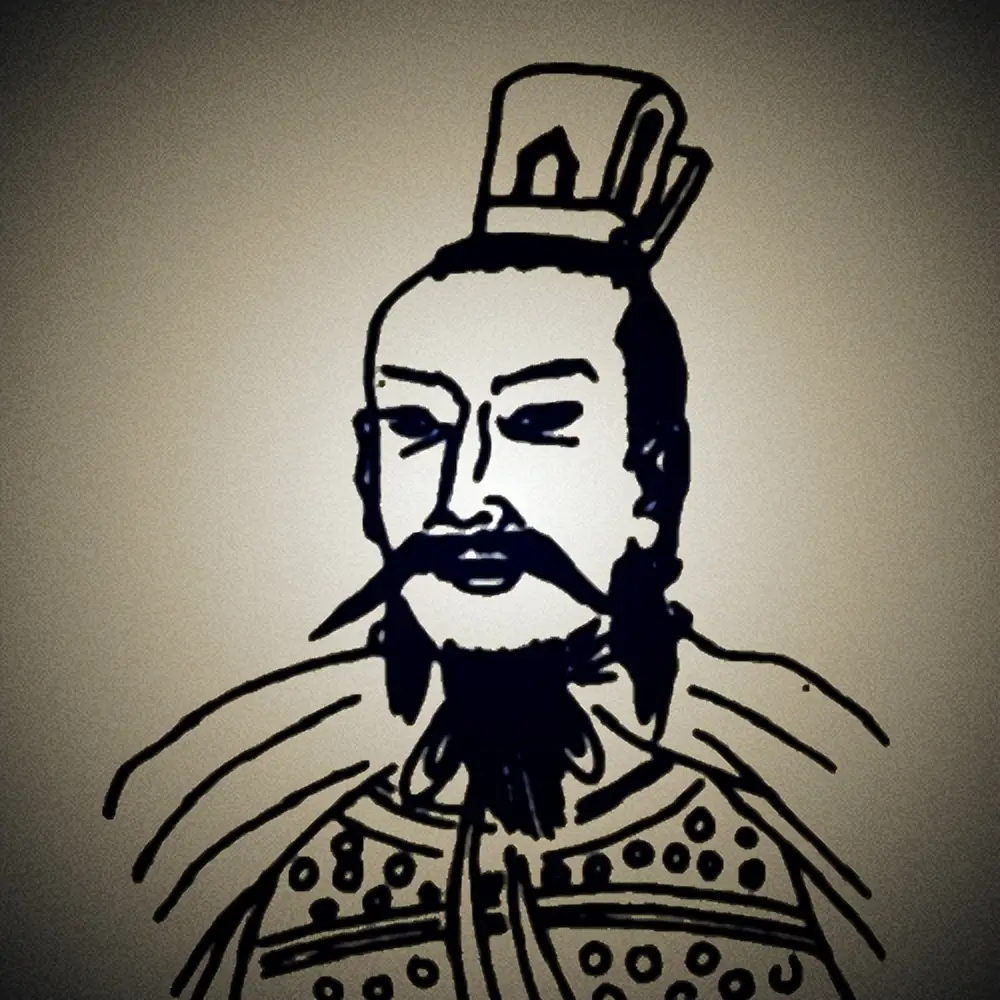
In the fifth month of 401 the gate of Zhangye was opened from the inside, and Duan Ye, who had been pushed forward as the ruler of the province four years earlier, was killed in his own hall by the general who had been let in. The killer was Juqu Mengxun, a chief of the Lushui Hu, and the killing was the last move in a plan he had begun to lay on the day his uncles were executed. He was not yet master of the corridor. He held one town, a tribal following, a handful of officials, and a title he had just taken for himself; the garrisons of the province still answered to other men. Eleven years later he would hold the old provincial capital and call himself Prince of Hexi. Twenty years later he would destroy the last rival house in the corridor and receive envoys from the oasis states beyond Dunhuang. Thirty-two years later he would die in his bed at the head of the strongest state in the corridor, with the succession already out of his hands.
Those two facts are the subject of this life. The first is a story of wars won: against Later Qin's claim to the corridor, against Southern Liang for the provincial capital, against Western Liang for the western end of the road. The second is a story of a house emptied from within: a cousin killed at the founding, two uncles forced to suicide, brothers posted to garrison commands and lost there, two sons made heirs and killed by the wars that made the state. He was not a man who killed for pleasure. He killed because he had no other way to make a following loyal, and the method worked for as long as he lived. The sources that tell the story were written by other courts, and they disagree about almost everything except the killings; that disagreement is where the life has to begin.
1. The valley of the black river
The Hei River comes out of the Qilian Mountains south of Zhangye and crosses the corridor in a single braided channel before turning north into the desert. In the foothills, where the river is still a mountain stream, there is a district the sources call Linsong. It is not a town of any size. It is a stretch of gravel terraces and irrigated fields at the mouth of a valley, with pasture above it and a road to the highlands running through it, and in the fourth century it was the seat of a group of families whom the Chinese records call the Lushui Hu.
Hu was a word the Chinese used for people who were not Chinese and not clearly Xianbei. It described a frontier and a way of life rather than a nation. The Lushui Hu were herders and farmers and caravan men, organised in households that followed a chiefly line, and they had lived in the Hei River valley long enough to give it their name in the records. The name says where they lived and that they were not Chinese. It does not say what they were, and the sources do not settle the question. Modern scholars have argued for Xiongnu descent, for Yuezhi descent, and for a local mixture of both with the Chinese and Qiang populations of the corridor. The argument cannot be closed, because the people themselves left no statement of identity except the one their chiefs made when they were dealing with a Chinese court.
That statement is a claim about an office. The Juqu, the family into which Mengxun was born, said that their ancestors had held the post of Left Juqu under the Xiongnu chanyu. The Xiongnu had two such officers, left and right, and the men who held them came from the Bu clan, one of the four noble houses that supplied the chanyu's ministers. The post was a great one in the steppe empire, and when the empire broke up the title remained, attached to families who had once held it. The Juqu took the title as a surname. A family that had once been an office became a name, and the name became a people.
The southern court, which had never seen them, understood the name differently. The Song shu explains that the Juqu were so called because their ancestors held the office, and adds that the chiefs of the frontier peoples were addressed as "great", so that the proper style was Great Juqu. Its chapter calls him the Great Juqu Mengxun throughout. This is what a clerk in the southern capital wrote when he had a file but no map: an office, an honorific, and a surname, compounded into a title that sounds like a kingdom and was probably never used in Guzang.
The genealogy the sources give him is shallow. It runs back four generations: a great-great-grandfather named Huizhonggui, a great-grandfather named Zhe, a grandfather named Qifuyan who was titled King of Dadi, and a father named Fahong who inherited the title and served the Former Qin as colonel of Zhongtian, an office connected with a military agricultural colony. Four generations is not a dynasty. The titles are frontier titles: a kingship over a district, a colonelcy over a garrison farm. This was a chiefly line that had learned to hold Chinese offices without becoming a Chinese family. It had a following, a name, and a place in the local order of things. It did not have a claim to a throne.
What it had, more concretely, was land and men. When Fahong died, Mengxun took over his father's followers, the households that lived on the family's land and fought under its chiefs. The Chinese word for that following is a military one, but the thing itself was older than any army: tenants, servants, herders, and their sons, who obeyed the family because their fathers had obeyed it. A man who inherited such a following inherited a small army that could be fed from its own fields. He did not need a court to raise it, and a court could not take it away.
Mengxun was literate in a way that was unusual on the frontier and not unusual at all among the chiefs who dealt with Chinese officials. The Jin shu says he had read widely in the histories, understood astronomy, had a bold and able mind, and was humorous and skilled at changing with circumstances. The last phrase is the important one. It describes a man who could be different things to different people, and the sources say that Liang Xi and Lü Guang both recognised his ability and feared him, which is why he spent his youth hunting and drinking in public and keeping his counsel in private. The performance of laziness is the oldest strategy of a man who knows he is being watched. He also read the sky, which in a frontier court was part of government: the calendar, the omens and the reading of a drought were as useful as cavalry, and he rarely let either kind of evidence override the other.
The event that made him a rebel was a defeat and a scapegoat. In 397 Lü Guang, the ruler of Later Liang, sent an army against the Western Qin. The campaign went badly; Lü Guang's brother was killed, and the retreat turned into a disaster. The Juqu uncles, Luochou and Quzhou, had commanded part of the force. They had warned that the campaign was ill-judged and that a defeated army would need a culprit, and they were right. Lü Guang had them executed for the defeat. It removed two experienced commanders and left their nephews with a grievance, a following, and a reason.
The funeral was the beginning of the rebellion. More than ten thousand kinsmen and tribal people came to Linsong to bury the two men, and Mengxun stood in front of them and made a speech. The record has him say that when the Han dynasty was failing, his ancestor had helped Dou Rong keep Hexi for the throne, and that it would be a disgrace to let the two uncles go to the underworld without avenging them. It is a strange legitimacy for a rebel. He did not say that the empire was dead and that he was free. He said that the empire's frontier had been betrayed and that he was the man to restore it.
The speech was followed by an oath and an oath by a killing. Mengxun executed the Later Liang colonel of Zhongtian, the officer who held his father's old post, and the magistrate of Linsong, and used their blood to bind the assembly. Within ten days he had more than ten thousand men. He camped at Jinshan, in the hills south-west of Zhangye, and waited for the province to rise.
It did not rise. Lü Zuan, Lü Guang's son, brought regular cavalry against the tribal levies in the fifth month and broke them. Mengxun escaped with six or seven men into the mountains, and his household was scattered. The first rebellion lasted a few weeks. It is the part of the story his admirers leave out, and it is the part that explains everything he did afterwards. He had learned that a funeral could raise ten thousand men and that ten thousand men could not defeat a trained army. He needed a state, not a rising.
2. The cousin
He went west to the man who could give him one. Juqu Nancheng was his elder cousin, or his elder brother; the two Chinese accounts disagree, and the disagreement is a reminder that among the Juqu the order of seniority mattered more than the exact degree of kinship. Nancheng was holding Jinchang with troops when he heard that Mengxun had risen. He brought his men back, killed the governor of Jiuquan, and made a decision that changed the corridor: instead of setting himself up, he pushed Duan Ye forward as the ruler of the province.
Duan Ye was the Later Liang governor of Jiankang commandery, a small administrative district northwest of Zhangye, down the Hei River, and he was not a soldier. He had no tribal following of his own. That was the point. The Juqu needed a front man who could hold the Chinese counties and the old Later Liang officer corps, and Duan Ye needed the Juqu because he had nothing else. He was made commissioner with the staff of authority, grand commander, general of the soaring dragon, shepherd of Liang province and Duke of Jiankang, and he changed the era to Shenxi. The era name was the act that turned a coalition into a state. A rebel who dates documents by his own calendar is claiming the calendar of heaven.
The sources disagree about the year. The Song shu dates the whole sequence to 399. The Jin shu dates it by Lü Guang's era, Longfei 2, which is 397, and the Shenxi era begins there. The chronicle follows 397. The earlier date is the right one, and the Song shu's two-year error is a useful warning about how the southern chancery handled frontier chronology.
With Nancheng's troops and Duan Ye's name, the coalition took Zhangye. Duan Ye made Mengxun governor of Zhangye and Nancheng general, and the three of them settled into the arrangement that would last four years: a figurehead with a title, a soldier with the tribe's confidence, and a planner with neither. Nancheng was the man the tribal chiefs trusted. Mengxun was the man who could read a map and a sky. Duan Ye was the man whose name was on the documents. It was a stable arrangement only as long as the three men wanted different things.
For three years Mengxun served the state he had helped to make, and served it well. He took the Western commandery by damming its water supply and flooding the town, and brought its governor back a prisoner; he was made Marquis of Linchi. When Duan Ye wanted to pursue a retreating Later Liang army, Mengxun advised against it, quoting the rule that a cornered enemy should be left a way out; Duan Ye ignored him, was defeated, and told his court that he had failed to use Zifang's advice. When Later Liang and its allies moved against Zhangye, Mengxun advised waiting, and the enemy withdrew. The record gives him the credit for every sensible decision in those years, which is what a court history does for a founder, but the military logic is too consistent to be invention.
He was also the man Duan Ye feared. The governor began to move him away from the capital, giving him a frontier post and replacing him at Zhangye with a favourite named Ma Quan. Ma Quan had a reputation for courage and no judgment, and he made the mistake of treating Mengxun with contempt. Mengxun complained to Duan Ye that Ma Quan was the only man in the province worth worrying about, and Duan Ye had Ma Quan killed. The pattern is worth stating plainly, because it repeats: Mengxun did not kill his rivals himself when he could arrange for the ruler to do it. He had discovered that Duan Ye's fear was a weapon that could be pointed.
Then he made his proposal. He told Nancheng that Duan Ye was a fool who could not hold the province together, that the only men worth fearing, Suo Si and Ma Quan, were dead, and that he wanted to remove Duan Ye and serve Nancheng as the ruler. The record has Nancheng refuse with a sentence that is the moral centre of the whole story: Duan Ye was a wanderer whom the Juqu had made, and the Juqu were the water he swam in; a man who turns on the person who trusts him is not lucky. Nancheng was not a fool. He understood that the coalition's legitimacy depended on the fiction that Duan Ye was its head, and that a cousin who broke the fiction would break the only thing that held the Han counties and the tribal chiefs together.
Mengxun did not argue. He asked for the post of governor of Xi'an, a frontier command, and left the capital. It looked like withdrawal. It was the preparation of an alibi.
3. Lanmen Mountain
In the fourth month of 401 Mengxun agreed to sacrifice with Nancheng at Lanmen Mountain. Before the appointed day he sent his aide Xu Xian to Duan Ye with a warning that Nancheng would use the pilgrimage to rebel, and the proof was to be the request for leave; the request came, as arranged, and Duan Ye had his own general killed. The reasoning on both sides is set out in the life of Duan Ye. What belongs here is the use Mengxun made of the death.
Mengxun wept in front of the tribe. He said that Nancheng had been loyal to Duan Ye and had been murdered for it, and asked who would avenge him. The tribe answered because Nancheng, not Mengxun, was the man it trusted. The Jin shu says that Nancheng had long been known for his generosity and that the chiefs wept and followed him. That sentence is the key to the next thirty years. Mengxun's authority at the founding moment was borrowed from the man he had just killed. He had converted the tribe's grief into an army, and he would spend the rest of his life converting grief into authority.
The army grew quickly. By the time he reached Dichi he had more than ten thousand men; the garrison commander Zang Mohai joined him; the Qiang and the other frontier peoples rose in his support. Duan Ye sent his right general Tian Ang against him, and Tian Ang came over with five hundred cavalry. Tian Ang's nephew opened the gate of Zhangye from the inside, and Duan Ye's guards dispersed. The record has Duan Ye ask for his life, saying that he was a lone man whom the Juqu had raised and that he wanted to go east and see his wife and children. Mengxun killed him.
In the fifth month the assembly at Zhangye pushed Mengxun forward as commissioner with the staff of authority, grand commander, general-in-chief, shepherd of Liang province and Duke of Zhangye, and he changed the era to Yongan. The state is called Northern Liang, but the title he took in 401 was Duke of Zhangye: Liang was still the name of a province he claimed, and Zhangye was the name of the town whose gate had just been opened to him. He was a duke of a city, not a king of a country, and the distinction is the most accurate description of his position in 401. He held one town and the tribes that had followed Nancheng. The rest of the province was a set of garrisons, and the other rulers of the corridor had no reason to think he would last.
The coalition that made him was three-sided. There were the Juqu and the other Lushui Hu chiefs, who supplied the cavalry and the legitimacy of a chiefly house. There were the Qiang and the smaller frontier groups, who joined because a rising against Later Liang was a chance to settle older scores. And there were the Chinese officials of the old provincial administration, men like Liang Zhongyong, Fang Gui and Tian Ang, who needed a protector and could supply the paperwork. Mengxun was the only man who could stand at the point where the three met. He was a tribal chief who could read a Chinese dispatch and write an edict, and he had just proved that he was willing to kill anyone, including his own cousin, to keep the coalition together.
The Jin shu's verdict on him is delivered at the end of the chapter, in the voice of the Tang historian: he saw profit and forgot right, he harboured trouble and destroyed his kin, and he was furnished with every evil quality. The judgment is moral, and it is also political. The men who wrote it governed an empire that had learned to distrust frontier generals, and they were describing a man who had made himself a state by the same methods that had made their own dynasty. The facts they preserve are more interesting than the verdict. They say that he killed Nancheng because Nancheng was the only man who could have held the tribe without him, and that he used the killing to inherit Nancheng's following. That is not a crime of passion. It is a founding.
4. Duke of Zhangye
Zhangye was the first irrigated fan west of the corridor's narrowest stretch, a town that existed because the Hei River came down out of the Qilian and because the road had to pass it. It had a wall, a garrison, a set of county offices, and an irrigation system that could feed an army if the water was managed. It did not have the prestige of Guzang or the wealth of Dunhuang. What it had was the road, and for eleven years the road was enough.
The state Mengxun built on that fan was a Chinese province with a tribal army on top of it. He kept the commanderies, the county offices, the registers, and the titles. He appointed a chief secretary, a staff, and the kind of officials who could write a dispatch and collect a tax. He also kept the tribal chiefs, who brought their own horsemen and expected to be consulted. The two halves of the state spoke different languages and had different ideas about what a ruler was for. The Chinese officials wanted a protector who would keep order and pay them. The chiefs wanted a war leader who would bring them plunder and revenge. Mengxun was the only man who could stand in the middle, and the middle was a narrow place.
The first test of the arrangement came from the east. In 403 the Later Qin general Qi Nan received the surrender of Guzang from the last ruler of Later Liang, and the whole corridor became a question of who would inherit the pieces. Mengxun had already sent an envoy to Yao Xing, the Later Qin ruler, and he now received a set of titles: general of the west, inspector of Sha province, Marquis of the Western Sea. He was a marquis on the edge of an empire that had just acquired the provincial capital, and he did not like it.
The interview with the Later Qin envoys is one of the few scenes in which his voice can be heard without a battle in the background. Yao Xing had also made Tufa Rutan of Southern Liang a duke, and Mengxun asked the envoys why a man like Rutan should be a duke while he was only a marquis. The envoy Zhang Gou answered smoothly that Rutan's loyalty was unproven and Mengxun's was not. Mengxun then asked the real question. Why had the court not made him Duke of Zhangye, instead of giving him a distant sea? Zhang Gou said that Zhangye was already within his planning, that he already held it, and that the distant sea was meant to enlarge his domain. The record says Mengxun was delighted and accepted the title. He wanted a deed, not a compliment, and he would spend the rest of his reign turning the second into the first.
The second test came from within his own court. Yao Shide offered to escort the population of the Zhangye region east, under Later Qin protection, and Mengxun's chief secretary Zhang Qian urged him to accept. Mengxun killed Zhang Qian. The killing was the real declaration of independence. A vassal who will not move his people is not a vassal. The population was the state; the fields needed hands, the army needed households, and a ruler who let his people be resettled in the east would be a governor again, not a prince.
He could be generous when generosity was cheaper than force. When his administrator Liang Zhongyong fled to Western Liang, Mengxun laughed and sent the man's wife and children after him, saying that Zhongyong had not trusted him and had only himself to blame. The gesture was either magnanimity or a message, and in a court of exiles the two are hard to tell apart. It told every official in the corridor that defection would not be punished, which was a way of making defection pointless. A man who leaves and is welcomed back has less reason to leave.
The two uncles were a different matter. Juqu Qinxin, the colonel of Zhongtian, and Juqu Kongdu, the governor of Linsong, were corrupt and preyed on the population. Mengxun said that the two who ruined his state were his two uncles, and ordered them to kill themselves. The record presents this as good government, and in part it was: a ruler who executes his own relatives for extortion is a ruler whose law is credible. But the same act removed the two senior men of the family, the only people who could claim authority over him by age and generation. He had already killed the cousin beside him. Now he had killed the generation above him. The family was becoming an instrument rather than a check.
The war with Southern Liang gave him the provincial capital. In 410 Tufa Rutan pursued a raiding column to Qiongquan, and Mengxun turned on him before the Southern Liang camp was fortified. The record says he told his officers that Rutan would think him tired from a long march and would not expect an attack, and that a camp without walls could be broken in one charge. He was right. The Southern Liang army broke, and Mengxun followed it to Guzang, where more than ten thousand households submitted. Rutan asked for peace, and Mengxun accepted, moved several thousand households back to his own territory, and withdrew.
Rutan moved his capital south to Ledu, and a local strongman named Jiao Lang seized Guzang. Mengxun came back with thirty thousand men, took the city, and spared him. He feasted his officers in the Qiangguang hall and appointed the Dunhuang scholar Zhang Mu as his confidential secretary. The sequence is characteristic: a hard fight, a calculated mercy, a banquet, and a scholar.
In 412 he moved his own court to Guzang, took the title Prince of Hexi, changed the era to Xuanshi, created a full bureaucracy on the model of the princely court that Lü Guang had once kept, built palaces and gate-towers, and named his son Zhengde heir. The title ladder was complete. He had begun as a duke of a town and ended as a prince of a corridor. The move to Guzang was also a move into the old provincial seat, the city where the Zhang house had ruled and where the Later Liang had ruled after them. A capital is a claim in stone, and Guzang was the strongest stone in the corridor.
Not long after the move an assassin came close to ending the story. A eunuch named Wang Huaizu attacked him while he was sleeping in the Xintai palace and wounded him in the foot. Mengxun's wife, Lady Meng, killed the man and had his clan exterminated. The record notes the extermination without comment. The man who had built a state out of kinsmen and servants was nearly killed by a servant and was saved by his wife; a court is a household before it is a government, and a household is the easiest place to hide a knife.
5. The court at Guzang
Guzang was the old provincial seat at the eastern gate of the corridor. It had been the capital of the Zhang house and of the Later Liang, and it came with the things a capital needs: a market, a granary, government halls, and a population that expected to be governed. Mengxun added the things a new dynasty needs. He rebuilt the palaces, raised gate-towers, and used the Qiangguang hall for the ceremonies that turn an officer into a sovereign. He also built a tomb for himself outside the city, which later accounts call Yuanling. A man who builds a tomb is a man who intends his house to last.
He had a set of court rules drafted, and the record says they restored order among the officials within ten days. The most revealing documents of the reign, however, are the edicts. In a drought he wrote that the fault might be in his own government, that unjust prisons or heavy taxes could have angered heaven, and that the blame was his alone. When his mother, Lady Che, was dying, he scattered coins to the people from the South View gate and issued a general amnesty, asking whether the prisons were unjust or the taxes too heavy. The language is that of the Han Confucian state: the ruler as the responsible centre, the drought as a verdict on his conduct. It is also good politics. A ruler who takes the blame can claim the credit when the rain comes, and the record says that on one occasion the rain came the next day.
The same man killed a courtier for a look. In 417, when the news came that Liu Yu had taken Chang'an and destroyed the Later Qin, Mengxun was furious. A palace secretary named Liu Xiang came in to report business, and the record has Mengxun say, "You hear that Liu Yu has entered the pass and you dare to look pleased," and then order him killed. The record adds that this was how harsh and violent he could be. The killing is not policy. It is the reflex of a man whose horizon had just shrunk. The Later Qin had been the great power of the north-west, and its destruction by a southern general meant that the corridor was now open to a new kind of threat, one that did not need to cross the mountains to reach him.
He answered the threat with astrology. He told his court that the Yao were descendants of Shun and that the planet Jupiter stood in Xuanyuan, so Liu Yu could not hold the pass for long. In a court where the calendar was a political instrument, an omen could do the work of an army: it told his officials that the new conqueror was temporary and that the corridor was still the centre of the world. He could not send troops east. He could read the sky, and the sky said that he did not have to.
The southern court was a cheaper kind of legitimacy. In the middle of the 410s the inspector of Yi province, Zhu Lingshi, sent an envoy to Guzang, and Mengxun sent an answer by the hand of his secretary Huang Xun, with a memorial offering to lead the warriors of Hexi as the right wing and vanguard of a Jin campaign to recover the two capitals. The letter is a fiction with a use. The Jin court could not reach Hexi and Mengxun had no intention of marching east, but the exchange gave the southern court a loyalist on the frontier and gave him a title that his neighbours could read.
The compliments became more concrete after the Jin gave way to the Song. In 421 the Song court made him inspector of Liang province; in 423 it raised him to Prince of Hexi; in 426 it made him general of chariots and cavalry. None of these titles cost the Song a man or a coin, and all were recorded in the southern annals as if they described a real relationship. The only trace of his mind in that record is a book order. His heir Xingguo asked for the Zhou yi and other works and received four hundred and seventy-five scrolls; Mengxun himself asked the minister Wang Hong for a copy of the Sou shen ji, and Wang Hong had it copied. A frontier prince who wanted a book of marvels and a canon of divination was a prince the southern court could understand.
The war with Western Qin was less polite. Mengxun attacked Qifu Chipan's Guangwu commandery, fought a series of actions around the Lejie ridge, and captured seven hundred men. Chipan retaliated against Hehuang, where Mengxun's brother Hanping held the frontier. Hanping's officers opened secret contacts with the enemy, and Hanping surrendered bound. One of his officers, Wei Ren, held the south gate tower with a hundred men for three days, was captured, and spent five years in Western Qin before he was allowed to return. Mengxun took his hand and called him "my Su Wu", the Han envoy who had been held by the Xiongnu, and made him governor of Gaochang.
The story is a small study of the state he had built. Hanping was his brother, and Hanping surrendered. Wei Ren was a subordinate, and Wei Ren held. The family was not a reliable army, and the army was not a family. Mengxun rewarded the man who had held and kept the brother who had not. By the middle of the 410s the court at Guzang had the titles, the scholars, the books, the translators, and the army. It had everything a state needs except time.
6. The western war
The western end of the corridor was held by the house of Li. Li Gao had founded Western Liang at Dunhuang in 400, and in 405 he moved his capital east to Jiuquan, leaving Dunhuang as a secondary seat and a cultural centre. The two states were natural rivals. They competed for the same oasis towns, the same trade, and the same claim to be the legitimate government of the corridor. For Mengxun the western question was simple: as long as an independent house held Jiuquan and Dunhuang, his control of the road to the Western Regions was a permission, not a right.
The war did not go smoothly at first. In the late 410s Li Xin, Li Gao's son and successor, defeated Mengxun at Xianzhi creek. Mengxun wanted to rally his scattered troops and fight again; his general Juqu Chengdu told him that a defeated army should be allowed to come home, and that a retreat now would leave him free to fight another year. Mengxun listened, rebuilt a frontier town, and withdrew. It was the one clear battlefield defeat of his mature career, and it taught him the lesson that shaped the next campaign. He did not need to beat Li Xin in the field. He needed to make Li Xin move.
In 420 he got the chance. He was attacking Haomen, a Western Qin position in the upper Yellow River, when Li Xin took the opportunity to march on Zhangye. Mengxun was on his way back and had reached Chuanyan when the news came. He did not turn openly. He published a report that Haomen had fallen and that he was advancing on Huanggu, and he moved his army secretly. Li Xin, believing his enemy was still far to the west, kept coming. Mengxun fell on him at Huai city and broke him; a remnant rallied at Liaoquan and was broken there. The western field army did not come back.
The histories differ on the place of his death. The Jin shu names Huai city in the conqueror's chapter and Liaoquan in the chapter on the man who died there; the chronicle joins the two into one sequence. The difference is small and instructive. A chapter built around a conqueror records the battle that ended a state; the biography of the defeated records where he fell; only the annalist, who had to fit every event into a year, needed both in one place.
Jiuquan fell without a massacre. Mengxun appointed his son Juqu Mujian as governor, reappointed the Western Liang officials who were willing to serve, and left the administration of the oasis intact. The annexation was a takeover of a government, not a sack. This was the pattern he preferred: a quick campaign, a lenient settlement, and the local elite incorporated into his own. It had worked at Guzang and it worked at Jiuquan. The population was the prize, and a population that is governed is worth more than a population that is punished.
Dunhuang was different. Li Xin's brother held the city, and the city was the westernmost of the old Han commandery towns, a place of monasteries, copyists, merchants, and the archives of the western route. Mengxun came against it with twenty thousand men in 421 and took it by damming its water. The siege is told in the life of Li Xun; what belongs here is the order that followed it.
For the sequel the sources divide: the Jin shu describes the slaughter, the Wei shu records the death and says nothing of the town. One account wanted to explain the end of a state, the other the character of a conqueror. Dunhuang had been the western capital of letters, the place where the manuscripts of the corridor were copied and kept, and the generation that had made it a cultural centre was killed or dispersed. The city survived as a garrison and a caravan stop. It did not survive as the thing it had been.
This is the cost of the western war, and it is the cost that the story of the reunification usually leaves out. By 421 Mengxun held the whole corridor from the Yellow River to the edge of the desert, and the oasis states beyond Dunhuang sent envoys to Guzang. The road was open and the title of Prince of Hexi was no longer a compliment. He had also destroyed the city that had been the western capital of letters. A frontier state needs more than a garrison at the end of the road; it needs copyists and clerks, and he had killed the people who made them.
He had won every war he fought: he had lost battles, at Xianzhi creek and in the first rising of 397, but he had never lost a campaign. He was patient, he picked his ground, and he was willing to spend a year making an enemy move before he struck. The campaigns had given him a corridor, a capital, a title, and a revenue. They had also given him a family problem that no campaign could solve. The sons who were supposed to inherit the state were the same men he sent to hold its frontiers, and the frontiers were where the state spent its people.
7. The translator
The most influential book produced in his state was not written by him and owed its survival to others, but it would not have existed without him. In the last years of the fourth century a monk from central India named Dharmakshema left home, studied in Kashmir, passed through Kucha, and came east along the trade road with a bundle of manuscripts. He carried the first part of the Mahaparinirvana sutra, the scripture that would give fifth-century Chinese Buddhism its doctrine of the Buddha-nature, and he carried it to Dunhuang, where he spent several years learning Chinese and translating a bodhisattva precept text.
When Mengxun took Dunhuang in 421 he found the monk and brought him to Guzang. The date is disputed. The monastic biography puts him in Guzang by 412 and has him spend three years learning the language before he began the Nirvana translation; the preface written by the editor of that translation says he came after the conquest of Dunhuang, which points to 421. The difference is nine years and it cannot be settled from the sources. What is certain is that by 421 he was in the capital and at work.
The translation was a collective enterprise. Dharmakshema read the Sanskrit and dictated; the monks Hui Song and Dao Lang took down the Chinese and polished it; several hundred monks and laymen sat in the hall, raised difficulties, and argued the wording. The record says the master answered without hesitation and that the result was rich in literary colour, which is the kind of praise a Chinese editor gives a translation that does not read like one. The received text runs to forty scrolls; the oldest catalogue says thirty-six. The difference does not matter for the history of the doctrine.
What mattered was the doctrine. The Nirvana sutra taught that every sentient being has the Buddha-nature, including the man who has committed the five deadly sins and the icchantika who has no roots of goodness. That was a universal claim, and it changed the terms of Chinese Buddhist argument. The book travelled south, where Xie Lingyun and a committee of monks re-edited it into a southern version and the sixth-century southern court produced a collected commentary on it. The Nirvana school became one of the great scholarly traditions of the sixth century. None of that happened in Guzang. It happened because a frontier prince wanted a holy man in his capital and a holy man wanted a patron who could pay for a translation hall.
Mengxun's Buddhism was not a private devotion. It was a department of state. A ruler who had come to power by killing his cousin needed a source of legitimacy that was not genealogical, and a translated scripture was better than a genealogy because it could be displayed. He built monasteries, supported the translation, and gave the monk the kind of honour that a court gives a man who can make it legible to the outside world. The court's Buddhism was a family project. In 426 his heir Xingguo sponsored the translation of the Upasaka sila sutra, a text on the lay precepts, and the colophon names the prince and five hundred laymen as the sponsors.
The other monument is in stone. Tang monastic gazetteers say that Mengxun cut a great image into a cliff a hundred li south of Guzang, with caves and cells for monks, and the site is usually identified with the Tiantishan caves above the Huangyang river. Art historians speak of a Liangzhou mode in cave design, a set of forms that travelled east to the caves of Yungang and Longmen. The attribution is scholarly rather than documentary, and the caves have been repaired and repainted many times. But the impulse is clear enough. A state that could not build a lasting dynasty could build a lasting image, and an image on a cliff is harder to burn than a palace.
The Northern Wei court told the story differently. Its history says that Dharmakshema was a magician who could command spirits and cure illness, that he taught sexual techniques to the women of the palace, and that Mengxun's daughters and daughters-in-law went to him for instruction. When the Wei ruler Tuoba Tao sent for him, Mengxun refused to let him go, exposed his practices, and had him tortured and killed. The monastic biography gives a cleaner version: Mengxun feared that the monk would serve a rival, and when Dharmakshema set out to the west to look for the missing part of the sutra, the prince sent assassins after him. He died on the road in 433, aged forty-nine.
The two accounts agree on the essential fact. Dharmakshema died because he was worth more to Guzang than he was to himself. A translator who could produce a scripture was a strategic asset, and a strategic asset that might defect was a danger. The Wei account's obscenity is the voice of a court that wanted the monk and could not have him; the monastic account's martyrdom is the voice of a community that needed a saint. Neither is a neutral report, and the political core is the same in both.
He died in the same year as the prince. The sutra crossed the river to the south, where it was re-edited, commented on, and made the centre of a school; the man did not. It was the last of the northern translation courts: after Guzang, the centre of Buddhist scholarship moved east to the Wei capital, and the corridor became a province again.
8. The house he left
In 433 the state was at its height. It held the corridor from the Yellow River to Dunhuang, it had the title of Prince of Hexi from the Song and the title of king from the Wei court, it received envoys from the oasis states, and its capital had palaces, monasteries, scholars, and a scriptorium. The one thing it did not have was an heir whom the founder had chosen, trained, and placed beyond challenge.
The first heir had been Zhengde, named in the first year of the new era. He was a working prince, not a palace ornament. In 423 he took Jinchang from a rebel commander and drove him west into the desert, and in the eighth month of the same year he was sent against a Rouran raid and was killed. The heir was a general because the frontier was the family's business. The family had been reduced to a few adult men, and the ones who could ride were the ones who had to fight.
The second heir was Xingguo, Zhengde's younger brother. In 429 Mengxun sent him against the Western Qin, and the Western Qin ruler Qifu Mumo captured him. Mengxun offered three hundred thousand bushels of grain for his return and was refused. He then made Xingguo's younger full brother Puti heir, while Xingguo, in the enemy capital, was given a title and married to Mumo's sister. When Western Qin fell, Xingguo passed into the hands of Helian Ding, who used him as a hostage in a campaign against Northern Liang. He was wounded in the fighting that destroyed Helian Ding, and died of the wound in 431. A prince who had been the heir of one state, the son-in-law of a second, and the prisoner of a third had spent his adult life as a token in other men's wars.
The third choice was Puti, who was young. In 433, when Mengxun died, the assembled officials set Puti aside and chose Mujian, the third son, who was then governor of Jiuquan. The record says the assembly pushed him forward because Puti was young, and that Mujian took the title. The wording matters. The founder had not chosen his successor. The court had.
The family ledger explains why. Nancheng, the cousin who had made the state possible, was killed at the founding. Two uncles were forced to die for corruption. His brother Na was posted to Guzang and died there within ten days. His brother Hanping was posted to Hehuang and surrendered to Western Qin. His cousins Chengdu and Shan were posted to frontier commanderies; his cousin Guangzong and his senior kinsman Yizi were posted to others. Every one of those postings was a sign of trust, and every one of them removed a man from the centre. The family was the administration. The administration was finite.
This is the structure of the life, and it is not a story about cruelty. It is a story about a man who solved every problem by making it a family problem, and then ran out of family. He trusted kin because he had killed the one man who could hold the tribe, and after that he could not trust a governor who was not a Juqu. He posted kin to the frontier because a frontier command was the only place where a kinsman could be useful without being a rival. The wars he won were fought by those kinsmen, and the wars killed them. By the time he was old, the house was a few sons and a council of officials who had learned that they could choose.
He had won every war and lost the succession. The wars consumed the heirs, and the method that won the wars consumed the kin who might have supported one. A state built by one man can be handed over only through a network of people who owe their position to the heir as well as to the founder, and Mengxun had spent thirty years making sure that no one owed anything to anyone but him. What happened when the Wei army came six years later belongs to the life of his son. The point here is that the men who might have held the corridor against it were already dead, and the man who had killed them had done it to keep them from holding it against him.
He died in the fourth month of 433, in the third year of Yihe, at the age of sixty-six. His own eras ran Yongan from 401, Xuanshi from 412, Chenxuan from 428 and Yihe from 431. The histories give the age, not the birth year; 368 is arithmetic from that age. The Wei court sent an envoy to supervise the mourning and gave him the posthumous title Prince Wuxuan. In the following year his son petitioned the Song court for the same title, and the Song court granted it. Two enemies, who agreed on nothing else, agreed on the word. Later handlists add a temple name, Taizu, and place his tomb at Yuanling. He had built a tomb for a house that would not last, and the titles came from the men who outlived it.
9. The archive of the last state
Northern Liang was the last of the northern houses to fall. When the Wei army took Guzang in 439, the registers, the court papers, and much of the city's population were carried north to Pingcheng, and the history of the corridor was written in the victor's office. That is the first fact about the sources for this life, and it explains the shape of everything that follows.
The fullest account is the 129th chapter of the Jin shu, the section the Tang editors called records of illegitimate rulers. Its narrative is built from a Northern Liang court history, which is why it preserves whole edicts, the interview with the Later Qin envoys, the letter to the Jin court, the names of offices, and the exact sequence of the 401 coup. It is also framed by a moral verdict: he saw profit and forgot right, harboured trouble and destroyed his kin. The chapter calls his reign a false position of thirty-three years. The result is a double filter: a favourable documentary base under a hostile moral frame. The documents are his; the judgment is theirs.
The Wei shu is the voice of the court that destroyed him. It calls his regime a private appointment and ends with a sentence on his household that no modern historian would repeat without a warning: lustful and jealous, cruel in punishment, with no order in his inner rooms. The same chapter turns Dharmakshema into a magician and a corrupter of the palace. It also records the Wei investiture of 431 and the posthumous title of 433. The source that condemns him is the source that honours him, and the contradiction is the most useful thing in it. A victor's history is not a record of what the victor believed; it is a record of what the victor needed to say.
The Song shu gives the house a genealogy and a sequence of titles, but its interest is the relationship: who was invested, when, and with what. Its chapter on the frontier peoples explains the name Great Juqu, lists the Song titles of 421, 423 and 426, and preserves the book traffic: four hundred and seventy-five scrolls for the heir, and a copy of the Sou shen ji for the prince. It reports the killings of 397 and 401 in a few lines and does not describe the court at Guzang. The south saw a distant vassal with a library, and the library is what it chose to dwell on. That is not a failure of the source. It is a precise description of the relationship.
The fourth book needs the most care. Cui Hong's history of the period was a Northern Wei work, and the original was lost by the Northern Song. The hundred-chapter text that bears its name is a Ming reconstruction, put together from the same Jin shu, Wei shu and chronicle that a reader already has. It cannot be cited as an independent witness. Where it contains a detail absent from the earlier books, the detail is likely an editorial stitch. It is evidence of what later ages wanted the period to look like, not of what happened in it.
What the archive cannot settle is as revealing as what it can. The date of Dharmakshema's arrival is either 412 or 421. The year of the Hehuang campaign is not fixed. The place of Li Xin's death is Huai city in one book and Liaoquan in another. Dated fragments from Turfan and inscriptions from Gansu pagodas show the court using a rival's era names in the 420s, which the transmitted histories do not mention; the calendar was a diplomatic instrument, not a simple count of years. The birth year is arithmetic. The last state's file is not thinner than the files of its neighbours. It is differently distributed: rich in documents, poor in chronology, and written by men who had reasons to remember some things and to forget others.
Against that, one fact is repeated by every source that has an interest in the man. The Tang moralist, the Wei prosecutor, and the southern annalist who counted his titles all tell the same story about Juqu Nancheng. The cousin was killed so that the founder could inherit his following, and the founder wept in public and used the grief as an army. The agreement is the strongest evidence in the file, and it is also the key to the life. The killings were not the aberrations of a cruel man. They were the method of a man who had no other way to make a following loyal, and the method worked until there was no family left to use it on.
That is what makes Northern Liang the clearest case of its period for the study of how history was written. The state lasted to the end of the age, and the men who ended it wrote its file. Its own words survive because the victors kept them as evidence, in the same archive that recorded its crimes. A reader can hear Mengxun in his edicts and in his interviews, and can see him in the verdicts of three courts that never met him. The state fell six years after his death. The file outlasted the state, and the file is the only thing of his that has come down at all.