Home / Emperors / Sixteen Kingdoms
Prince Jing of Southern Liang
南凉景王
Tufa Rutan, ? – 415 · ruler of Southern Liang
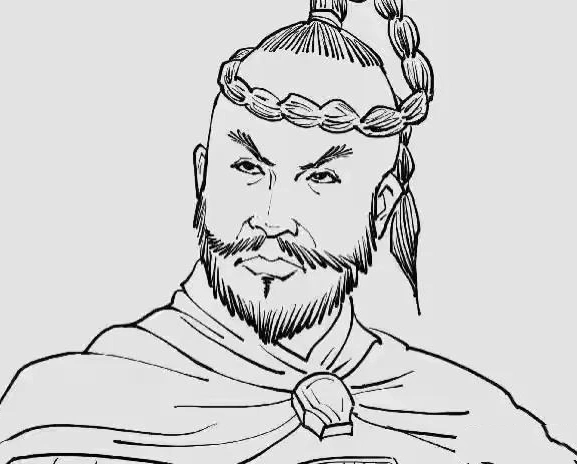
In the winter of 406 the new master of Guzang sat at a banquet in a hall that was already old and said what the record keeps: the man who builds a house does not live in it, and the man who lives in it did not build it. The hall was the Hall of Proclaimed Virtue, raised by Zhang Jun of Former Liang. By the reckoning of the guest who answered him it was nearly a century old and had passed through twelve masters. The guest, a former governor named Meng Yi, listed them for him: the Zhang house that built it and lost the province to an army that crossed the river; Liang Xi, who held the whole of it with a hundred thousand men and died on the road; the Lü family of Later Liang, who ruled from this city and carried its seals into surrender at another court. A building outlives its owners, he said, and only trust and righteousness hold anything together. Rutan thanked him for the honest words and went on as he had begun.
His state is remembered as Southern Liang, and he was its third ruler in six years. Tufa Wugu, the eldest of the brothers, raised it in 397 and died in 399 of a fall from a horse. Tufa Lilugu, the second, held it for three years and gave it offices and a school. Both passed the throne sideways rather than down, by an arrangement their father had intended and their chiefs accepted, so that the ablest of the three would end with it. What Rutan inherited in 402 was a confederation of herding tribes with a Chinese secretariat, a muster of some fifty thousand riders, and a claim on the best farmland in the Hexi corridor. In twelve years he lost the farmland, then the city, then the state, and at last his life. He was not a fool. The record has him out-arguing an envoy of Later Qin on the classics of statecraft, and preserves that envoy's judgement that a man of his quality need not be born to a great Chinese clan. What he could not do was make the two halves of his inheritance pay for each other: his soldiers were paid in herds and prisoners, his province in grain, and every campaign fought to defend the second was financed by spending the first. To the end he read his fall as a turn of fortune and the envy of men he had once held in his hand, and the record, which is not kind to him, lets him say so in his own words.
1. The Blanket
The family name was an accident of a cold night. The eighth ancestor Pigu had brought the tribe south out of the desert in the third century and settled it on the upper waters of the Huang Shui, in country that ran from Maitian and Qiantun in the east to Shiluo in the west, with the desert at its back and Jiaohe to the south. Pigu's son was born under a blanket, and in the Xianbei tongue a blanket was called tufa, so the word became the surname of a chiefly line. A dynasty can be named for a piece of bedding and still be taken seriously for two hundred years; the name is the least of what such a house carries.
What it carried first was a memory of power. In the 270s Tufa Shujineng killed the governor of Qinzhou at Wanhudui, beat the governor of Liangzhou at Jinshan, and held the whole of the province for a season, until the Jin court found a general who could beat him and his own followers cut off his head. The family kept the country and lost the province, and the lesson it took was not that the province could not be held but that it had been held once. The chapter also has the tribe claim common origin with the Tuoba house that later built the Wei — a claim that cost nothing then and paid, a century later, in fiefs for the survivors.
By the end of the fourth century the tribe had a chief again worth following. Tufa Sifujian rebuilt the herds and the following, and he had sons. The chapter gives his judgement of them in one line: Rutan, he said, understands men and affairs; the rest of you are not his kind. It is the sort of sentence a court puts into a founder's mouth afterward, though the brothers acted as if it were true. Tufa Wugu, the eldest, took the title King of Xiping in 397 and beat the armies of Later Liang in the field; when he lay dying in 399 of a fall from a horse, he said that with troubles unsettled the state needed an older man, and left the throne to his brother. Tufa Lilugu moved the seat to Xiping, took the title King of the Hexi Country in 401, and spent his years building the furniture of a state: offices and a school with two erudites. Then, in the third month of 402, he died, and his order was that the chariot-and-horse general should take up the work.
The chariot-and-horse general was Rutan. He was the youngest of the three, quick-witted, and by the chapter's account already the one who had been doing the work: while Tufa Lilugu reigned, the chapter says, he folded his hands, and military and state affairs were all given to his brother. There is no birth year for him anywhere in the record, and this article will not manufacture one from the age the chapter gives at his death.
One episode from those years comes back at the end. When the Western Qin ruler Qifu Gangui was beaten and fled to the Tufa court with a few hundred riders, he left his heir Qifu Chipan as a hostage at Xiping, then fled again to the Later Qin. Chipan ran after his father, was caught by the Tufa cavalry, and Tufa Lilugu ordered him killed. Rutan argued against it: a son returning to his father is the oldest of obligations, Cao Cao let Guan Yu go, the king of Qin forgave the king of Chu, and a state that kills such a man advertises the size of its heart. The boy was spared. He escaped a second time, and Rutan sent his wife and children after him. That boy married his daughter, took his capital in 414, and in 415 had him poisoned.
2. The Borrowed Years
A man who takes a throne in a crisis has two choices about how loudly to sit on it. Rutan, in 402, chose loudly. He changed the royal title from his brother's King of the Hexi Country to King of Liang — a larger word, the province's name rather than the ground's — moved the seat back down the valley to Ledu, took the era name Hongchang, and raised the walls of Ledu. He had exchanged a corner for a province: his title named the whole corridor, and what he governed was its eastern end.
The loudness lasted two years, and then he sold it. In the second month of 404 he abolished his era and his ministerial offices and sent an envoy to the court of Later Qin. The reasoning was not complicated. Later Qin held Guzang, the only city in the corridor worth having, and its armies were the largest in the north; a vassal's letter cost nothing, and a war cost everything. What he gave up were the two marks of a sovereign, a calendar of his own and a cabinet of his own. What he kept was the army.
The interview that followed shows how the bargain was understood on both sides. Yao Xing asked whether a vassal who raises troops on his own authority and throws up great walls is behaving like a vassal. The envoy answered that a prince sets up defences, that his master sat far off between strong enemies, and that the walls were outer gates for the Qin state. Yao Xing laughed and let it pass. A year later Rutan asked for the province outright and was refused, and given a court title and two thousand households instead. The Qin court knew what it had: a frontier chief who would take a rank and ignore it.
In 406 he stopped asking and paid. He raided Juqu Mengxun's country, cut the standing grain, rode as far as Chiquan and came back; then he sent Yao Xing three thousand horses and thirty thousand sheep. The herd bought the province. Yao Xing made him commissioner with credentials, commander of all military affairs west of the river, general of chariots and horse, protector of the Xiongnu, and governor of Liangzhou, stationed at Guzang, and recalled his own governor to Chang'an.
He entered the city with thirty thousand horse and foot. The Qin governor went out by the Qingyang gate; Rutan's brother Wenzhi came in by the Liangfeng gate. Zong Chang, the departing governor's aide, escorted his old master back toward Chang'an and, at the parting, did the thing that able officials do at the end of a regime: he handed the new master a list. Duan Yi and Meng Yi of Wuwei, Xin Chao and Peng Min of Qin and Long, Zhang Chang of an old provincial house, and a dozen others: the families whose names made a government work in the corridor. Cultivate both war and agriculture, he said, and provide for letters and instruction as well. Rutan was pleased, feasted the officials in the Hall of Modest Light, and in the eleventh month moved his seat to Guzang.
The Book of Jin gives no month for the grant; the Southern Liang chronicle, in a fragment a Song encyclopedia preserved, dates it to the fourth year of Hongchang, which by its own count is 405, while the Comprehensive Mirror puts it in 406, the year this article follows.
What he had bought was the richest city in the Hexi corridor, and he had not fought for it. That was the whole attraction and the whole defect. A city taken by appointment does not transfer the loyalty of the people inside its walls; it transfers the tax rolls, the granaries, and the gentry, none of whom had been consulted. Rutan understood the gentry well enough to ask Zong Chang for their names. What he never acquired was a reason for them to prefer him to the next man with an army.
3. The Hall of Proclaimed Virtue
Guzang sits where the Shiyang river comes out of the Qilian foothills into the desert, on the irrigated shelf that made the corridor a road. It had been a provincial seat since the Han, and its wealth was in ditches and fields and in the families who owned them, the opposite of everything the Tufa homeland was: the Huang Shui produced riders, the Shiyang produced grain, and grain requires walls, registrars, and years of peace in a row.
The Tufa had thought about this problem before they owned it. When Tufa Lilugu took his royal title in 401, one of his own commanders warned him against the whole enterprise in terms that amount to a constitution. The old way, he said, was no fixed cities and no stores: the tribe moved, and that was its defence. Now, if they were going to sit still, then put the Chinese in the towns and set them to farming, so that the army and the state would have grain; keep our own people at war; for granaries and silk breed an enemy's appetite, and to sit at ease on good land is not a plan for one's heirs. Tufa Lilugu accepted the advice. What it describes is not a fusion of two peoples but a division of labour: the fields to one, the fighting to the other, and the state in the middle taking a share of each.
The arrangement has a virtue and a vice, and they are the same property. It is cheap. It requires no conquest of the countryside, no land survey, no county administration reaching into villages; it requires only that the riders keep winning and that the fields stay behind the walls. And it is brittle, because the two halves are paid in different currencies and cannot be converted. When the riders lose, the fields have no protectors; when the fields fail, the riders have no wages. A herding army on farming land is not a contradiction until it has to stand still.
The chapter contains a critique of the system from inside the palace. Shi Hao told Tufa Lilugu that the state did not put pacification first but made the moving of households its business, and that this was why it killed generals and took cities while its territory did not grow. He was describing the habit that Rutan inherited and doubled. In his first year in the province Rutan made a pretended excursion to Jiaohe, turned aside, and deported more than thirty thousand Qiang households from Xiping and Huanghe into four commanderies of the conquered country. By the accounting of the steppe it was a gain: people were wealth, and wealth that could be counted and moved. By the accounting of a province it was a loss, because a household moved from its ditches and its graves produces less than one left where it was, and remembers the man who moved it.
Then came the muster. He levied the fighting men of both peoples, more than fifty thousand, and reviewed them at Fangting. The number is the chapter's and cannot be checked, but its meaning is plain: this was not a contingent or a raiding party. It was every man the state could put in the field at once. There was no second army behind it, and no reserve of horses, and no treasury that could replace either. From the day of that review, every campaign he fought was fought with the same men, and every loss was permanent.
4. The Country Emptied into the City
In 407 he used the army twice. The first use was to the west, against Northern Liang: he took the western pass country, met Juqu Mengxun at Junshi, and was beaten; he brought twenty thousand riders carrying forty thousand shi of grain to hold Xijun, and Mengxun took Xijun. So much for the western front, in the chapter's three sentences.
The second use was to the east, against the Xia riders who had come through his eastern districts and gone back with people and herds. What the Southern Liang chapter records of that battle is one line: he fought at Yangwu, was defeated, lost more than ten of his officers, fled to the Nanshan with a few riders, and was nearly taken by the men chasing him. It does not describe the ground, the orders, or the mistake. The silence is not modesty: a court that has lost a battle it expected to win has nothing to narrate, and the annalists had the other side's victory account to read and none of their own.
The defeat matters less than the order he gave in the week after it. Fearing that enemies would now come from both directions at once, he brought the whole population within three hundred li of Guzang inside the walls. It was a soldier's decision, and the moment the state admitted that it could not hold its own countryside. A government that gathers its farmers behind walls has chosen to eat stored grain it cannot replace, and it has converted a population of taxpayers into a crowd — a crowd with no fields to return to, no harvest to look forward to, and no reason to love the man who gave the order. The chapter says the country was shocked and resentful, and then shows what shock and resentment look like.
A Tuge chief named Cheng Qi'er rose at the north city with three hundred men. He offered the leadership to a notable named Liang Gui, who shut his door and refused; by morning the crowd was several thousand anyway. The palace officer Zhang Meng then did the one thing that worked. He stood up and shouted that the defeat at Yangwu had come from trusting numbers, that a ruler who examines his own faults is what a good ruler means, and that the guards were already on their way. The crowd dispersed. Cheng fled and was killed on the road.
The state survived the winter, and then spent it killing its own. Seven men, among them the army's director of counsel and a general's aide, were executed for plotting. The chapter does not say what they had planned, or for whom; it does not need to. After a lost battle, an emptied countryside and a riot in the capital, the men around the throne had begun to calculate odds, and the ruler with them. This is what a state looks like when its army has been spent and its fields have been emptied in the same season: it is reduced to counting the loyalty of the people standing nearest.
5. The Examination
In 408 Yao Xing sent an envoy to look at him. The envoy, Wei Zong, was a secretary of the imperial secretariat, a man of the court's own kind, sent to measure not the walls but the man. The chapter stages the interview as a contest and lets Rutan win it. They talked about the alliances of the Warring States and the strategies of the Three Kingdoms, about the rise and fall of the mandate and the success and failure of men; his answers came without hesitation and his sentences were clear. It is a scene written by admirers, and the best evidence that the Tufa house had produced more than a cavalry chief.
Wei Zong came out and said what the chapter wants remembered. A talent that settles an age, he said, need not come from a great Chinese clan; a man who can cut through trouble and clear the world need not have read the old books. Beyond the Five Classics and outside the ranks of office there are other men. The general of chariots and horse is a great man of his generation, and the two frontier-born ministers whom antiquity had turned into proverbs are not his equals.
His report to Yao Xing was more careful and exactly right. The province is ruined, he said, but its manners are not; Rutan is crafty in many directions and holds the mountains and rivers; he cannot be taken. Yao Xing answered with the sentence that all strong states say: Bobo beat him with a rabble, and I have the army of the empire. Wei Zong answered as staff officers do. Circumstances shift, he said. The man who attacks is easily beaten and the man who defends is hard to take. At Yangwu he lost because he underestimated Bobo. Bring a great army and he will certainly defend himself, and none of your officers is his match.
Yao Xing came anyway. Yao Bi and Lian Cheng led thirty thousand horse and foot, with Yao Xian behind them, and the Qin court sent a letter ahead explaining that the troops were only posted on the river to intercept Helian Bobo if he fled west. Rutan believed it and set no defences. It is the one plain blunder of his career, and worth noticing what produced it: not stupidity but the habit of a vassal, who had spent four years being told that the great court's letters were explanations rather than orders.
Su Ba, governor of Changsong, held his city and refused to surrender — he would rather be a ghost of Southern Liang than a subject of Qin — and was killed when it fell. Yao Bi came on and camped in the garden outside Guzang.
Then the city's own people made their choice, and it was not Rutan's. Three men of the province, Wang Zhong, Song Zhong and Wang E, were in correspondence with the besiegers; a lookout caught their messenger and brought him in. Rutan wanted to kill the ringleaders only. His forward commander argued that with a strong enemy outside and traitors inside, the whole group should be buried to steady the city, and he followed the advice: more than five thousand people killed, and the women given to the soldiers. The figure is the chapter's and grows in the telling; what does not depend on it is the decision, which was to buy the loyalty of the many by killing a great number of them.
The battle, when it came, was won by a trick that a herdsman would have thought of before a general. Cattle and sheep were driven out into the fields of the surrounding commanderies; Lian Cheng's men broke ranks to take them; Rutan sent Juyan and nine other columns of horse into the gap and cut them up, seven thousand heads by the chapter's count. Yao Bi kept to his rampart. Rutan cut the stream above the camp to besiege him by thirst, and heavy rain broke the dam and let the Qin army recover. Yao Xian came up by forced marches and sent five archers to challenge at the Liangfeng gate; they were killed before they drew. Yao Xian blamed Lian Cheng for the plundering, sent an apology, and withdrew. Rutan sent an envoy to Chang'an to apologize in turn, for having beaten the imperial army.
That reflex is the position of a vassal in one gesture, and the reason the victory could not be turned into anything. In the eleventh month of 408 he went to the southern altar, took the royal title a second time, proclaimed the era Jiaping, and set up the full offices: a queen from the Zheju clan, his heir Hutai — Wutai in the Tang history, where the dynastic name Hu was taboo — as crown prince with the supervision of the secretariat, left and right directors, a grand commandant. He had beaten the army of the largest state in the north, in the year after losing two campaigns.
He had also taught Guzang what its master was. Two years later, when the Northern Liang cavalry came, the chapter says the people remembered the slaughter in the garden and scattered, and the city that had been acquired without a battle was lost without one. The sentence is the shortest and most complete account of his reign.
6. Three Hostages
The northern war was a staircase down. In 410 he went out with fifty thousand riders against Juqu Mengxun. His astrologer, Jing Bao, read the stars and told him not to go. Rutan had him locked in a cart and said that if he won he would kill him as an example and if he lost he would make him a marquis of a hundred households. At Qiongquan the army broke and he came back on a single horse. Jing Bao was taken by the enemy, who compared him to the two famous counsellors of antiquity whose advice had been refused, one rewarded and one executed, and let him go. Rutan met him, apologized, said the man had been his tortoise shell and his yarrow, and that not to have followed him was his own deep fault, and gave him a fief.
It is the most attractive scene in the chapter and the most damning. A ruler who could see his own error clearly, name it, reward the man who had been right, and then do the same thing again two years later was not a man blinded by pride. He was a man who had already spent the option of caution. The state's finances had one source, and the source was the raid; to stop raiding was to stop paying the army, and to stop paying the army was to stop being a state.
Mengxun followed the victory to Guzang. The people remembered the garden and scattered; three tribes of the frontier went over to him; Rutan asked for peace and sent a colonel-director and a son as hostages. The officer ran away on the road and came home, which is a small farce inside a large disaster, and the son was taken. Mengxun moved eight thousand households out of the country and went back.
Then a frontier commander revolted in the mountains south of the city. Rutan, fearing Mengxun in the north and the loss of the southern districts behind him, made the decision that ended the first half of his reign: he abandoned Guzang and moved back to Ledu, leaving a minister to hold the city. He left, and the gates shut behind him. The men who had been waiting for the right moment raised a new governor, declared for Li Gao of Western Liang, and held the city; Mengxun took it a year later by force, killing him. The officer sent to crush the revolt was beaten and killed.
This is what the Hall of Proclaimed Virtue had been trying to tell him. A city is not a herd. It cannot be driven, and it does not follow the man who holds its tax rolls; it follows the man who can keep its ditches running and its markets open. He had held Guzang for four years, had never fought for it, had killed five thousand of its people to keep it, and lost it in the week he stopped standing inside it.
In 411 Mengxun came against Ledu with the prestige of the captured city and besieged it for thirty days. Rutan refused to send a hostage — let the outcome rest on your own strength, he said; you have broken faith, what hostage is owed to you — and then yielded to his ministers and sent his son Anzhou. In 412 his brother Wenzhi, governor of the Huanghe commandery, surrendered his commandery and five thousand households to Mengxun; Mengxun came again, and Rutan sent the grand commandant Juyan. Three hostages in three years, and the price did not fall with the supply. By 413 the state was two cities, a hungry population, and an army that had learned to lose.
7. The Last Raid
The end came out of the arithmetic. The harvests had failed for years, the country was hungry inside and pressed outside, and the people had abandoned their work. The officer commanding at Hanchuan told him plainly what to do: make an alliance with Qifu Chipan, buy grain across the border, conciliate the mixed tribes, build up the stores, and move when the time came. Rutan answered that he was going to take ground and that the man should not discourage the troops.
His reasoning to his heir is the reasoning of a bankrupt household. Nothing has been planted for years, he said; the country is at the end of its resources; the campaign is the way out. Mengxun has just gone home and cannot come back at once. The only danger is Chipan, whose name is small and whose following is thin; give me a month and I will be back. Hold Ledu, and do not let it fall. Then he rode west with seven thousand men against the Yifu and broke them, and took more than four hundred thousand head of cattle, horses and sheep. The raid was not strategy. It was the harvest, taken from someone else's country because his own had none.
Chipan came on the empty capital with twenty thousand horse and foot. Inside, his officers offered Hutai the defence that the state's own constitution implied: concentrate the Tufa people in the inner city and put the Chinese on the outer wall, so that if the outer wall fell the inner one still stood. He refused it, and then did something worse. Fearing that the Chinese had two minds, he shut the men of reputation and courage inside the inner city instead of arming them. An officer wept and said that the men were ready to serve and asked what suspicion this was. The city fell in ten days.
The heir and more than ten thousand households were moved to Fuhan. The new master of the province had been a hostage in this country as a boy, had been spared by the man whose capital he had just taken, and had married that man's daughter.
Rutan heard the news from his nephew Fanni, who rode over from Xiping. What he said to the army is one of the few speeches in the chapter that sounds like a man rather than a ruler. The men of Ledu are killed, he said, and the women are given away; there is nothing to go back to. If you help me take the Qihan country with what the Yifu raid brought, we can buy our families back. If not, go over to Chipan and be slaves, for I will not see my wife in another man's arms. The army left in the night. He sent a general after the deserters, and the general did not come back either.
Four men stayed: Hunbo, Luogong, Fanni and Yin Lilu. Fanni was Tufa Wugu's son, the hope of the clan, and the households of their people in the north were nearly ten thousand; he was to go west to Mengxun, who was gathering up the fragments of dead houses, and Hunbo and Luogong went with him. As for himself, he said, he was old, there was nowhere that would take him, and he would rather die looking at his wife and children.
Only Yin Lilu went east with him. On the road he asked the man why. Going from danger to safety is human nature, he said; my kin have all scattered; why do you alone stay? The answer was that the man's old mother was at home and his heart was not steady, but that loyalty and filial duty cannot both be complete, and to hold the bridle was his portion. Rutan said that to know men is hard and to be known is hard, that his ministers and his relatives had all left him and this one man had not failed him, and that one sees such a thing in a man as one sees the pine in cold weather.
At Xiping, Chipan sent an escort, received him as an honoured guest, and gave him the title of general of swift cavalry and the duchy of Zuonan. For a year he was kept in the style of a retired king. Then the poison came. His attendants urged him to take the antidote; he said, is this an illness that ought to be cured, and died. The chapter puts the posthumous name in the same sentence and calls it a false one, the phrase by which the Tang historians marked a title granted outside the legitimate line. It does not say who granted it. The honour and the drug come from the same hand in the chapter's arrangement, and the arrangement is all the record gives.
His son Hutai outlived him by eight years. In 423, with his sister, who was Chipan's queen, he was caught in a plot against the Western Qin court, betrayed by a secondary wife, and killed with a dozen others of the family. The Southern Liang had lasted eighteen years from the proclamation of 397 to the surrender of 414; the chapter's summary says nineteen, and its own collation note observes that the Southern Liang chronicle, quoted in a Song encyclopedia, says eighteen, which is what the years give.
8. The Verdict
The historian who closes the chapter is not interested in the structure. He begins with the family's long run as frontier chiefs, drawing their bows at the Jade Gate and galloping at the Gold Mountain, untouched by rites and unreached by instruction; he credits Tufa Wugu with drilling troops on a general's advice and Tufa Lilugu with building a school on a scholar's, and says that this is how they opened territory west of the river. The way depends on men, he concludes, and this is what that means.
Then the verdict turns. Rutan inherited the edge of accumulated victories, the historian writes, and relied on what his two elder brothers had made. He broke the Lü house with a calculation that never missed and took Guzang without blooding a blade; his military skill and his great design matched his predecessors. Then, having come into a great position, his fullness came due. He exhausted his armies to satisfy his will and indulged his vices to bring on his own ruin. His land was taken by Mengxun, his power broken by Helian, and the fall of his state and the loss of his life were, even so, a mercy. The encomium adds only the summary: Rutan stood out and rode above the talents of his time; he exhausted his armies in war, lost his state, and left a fallen name.
Two things in that verdict deserve to be separated. The first is the phrase the historian uses as praise and which is in fact the diagnosis: he took Guzang without blooding a blade. A city acquired without a battle has not been acquired; it has been rented, and the rent falls due when the tenant can no longer pay. The second is the charge of exhausting the armies, which the historian treats as appetite. The record he compiled does not support the psychology. The state had no land tax worth the name, no county administration that reached the villages, and an army recruited by tribe and paid by results. In such a state war is not a vice added to the constitution; it is the constitution, and a year without a campaign is a year of default.
What he could not do was change the machine, and the record shows him trying. He took a Chinese title, a Chinese era, a Chinese capital, a bureaucracy, and a Chinese clan for his heir's mother. Every step moved the state toward the form of a court and away from the chiefs who supplied its riders; the defection of his brother Wenzhi with a commandery and five thousand households is the price of that, and so is the drift of tribes to Mengxun in the last four years. He was too Chinese for the chiefs and too much a chief for the gentry of Guzang, and in 408 he killed five thousand of the gentry. So he ended with neither: the riders gone home, the gentry dead or changed sides, the peasants gathered behind walls and then left outside them.
He died calling the poison an illness, which is of a piece with the reading he had offered on the road: that the momentum had gone against him, that the two men who broke him were men he had once held in his hand, and that the fault, if there was one, lay in the turn of things. It is the one consolation the record allows him, and he took it. The hall in Guzang outlived him, and outlived the state; the city passed to Northern Liang, the province to Western Qin, and the surname he carried, which had begun as a word for a blanket on a cold night, ended as a handful of fiefs in a foreign court. What he left was not a ruin but a demonstration: that the best farmland in the west could be taken by a horseman and could not be kept by one, and that the bill for a state paid in plunder comes due in a single season, to the last man who can be made to pay it.