Home / Emperors / Sixteen Kingdoms
Prince Ai of Northern Liang
北凉哀王
Juqu Mujian, ? – 447 · ruler of Northern Liang
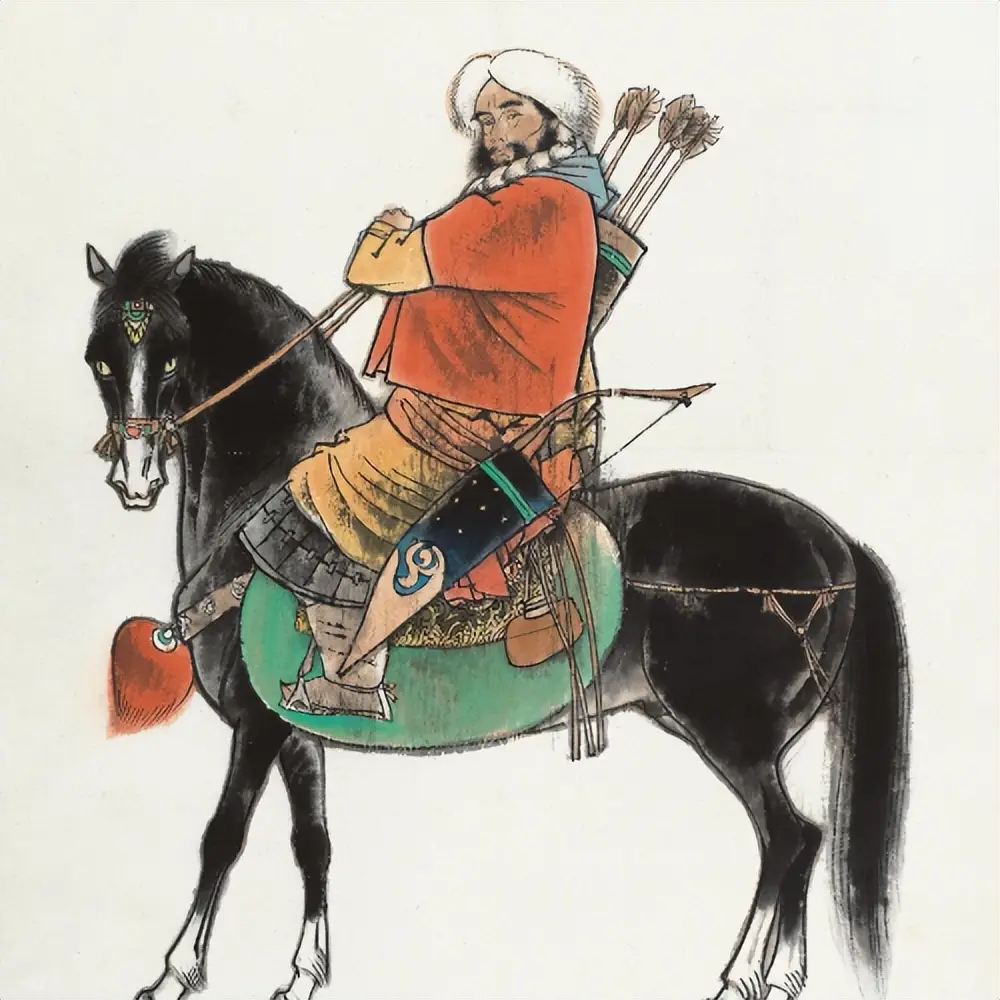
The last ruler of Northern Liang was not the man his father chose. Juqu Mengxun died in the fourth month of 433, and the heir he had settled on was a boy; the officials and the tribal chiefs who met in the palace set the boy aside and sent for his elder brother, who was governing a commandery at the western end of the corridor, and put him in the seat. The histories call this a deliberation. What it was, in practice, was a decision by the men who would have to live with the answer, and Mujian knew from his first day that he owed the throne to them and not to the dead man. A ruler made in that way begins his reign with a debt that cannot be paid off, only renewed.
What he inherited was the widest territory the house had ever held and the least room to move in it. The Hexi corridor, the inhabited strip between the Qilian Mountains and the northern desert, ran from the Yellow River to the sand beyond Dunhuang, and every oasis town in it answered to Guzang, the old provincial seat. But the map outside the corridor had closed while his father was still alive: the Western Qin and the Xia had gone under, and within three years the Northern Yan would follow, leaving his as the only government in the north that was not the Wei court's. He was a king of a place that had already been measured by the men who would take it. Everything he did in the next seven years was correct, and every correct thing made him smaller. He took the northern title, married the northern princess, sent his heir north as a hostage, kept the southern channel open, fortified the capital, and in the end gave up the city rather than burn it. Not one of those decisions was a mistake. Together they were the reign. Northern Liang was not broken at the wall in 439; it was waited out, by a court that could afford to wait and against a state that could not afford another year. The mistakes he did make — a brother's wife, a refused order, a treasury opened one night — did not cause the fall. They set its date.
1. The third son
He was the third son. Two elder brothers had died before him, and the heir his father settled on at the end was a boy named Puti, younger than Mujian. Mujian was therefore neither the eldest nor the designated heir, and the distinction matters more than the genealogy. In a house that had never fixed the rule of succession, the death of a ruler was always an auction, and the bidders were the men who held troops. The record says that the heir was young and weak and that the assembly installed his elder brother, and it uses a phrase that means something closer to pushing a man forward than to electing him. Nobody voted. A group of officials and chiefs agreed, in front of each other, that the boy would not do, and then agreed on the man who would.
What recommended Mujian was partly his record and partly his distance. The southern annals put him at Jiuquan, the chronicle puts him at Dunhuang; the two books disagree, and the disagreement is a small lesson in how thin the file is at its edges. Either way he was governing the far end of the corridor, which is where a son who is not going to inherit is usually posted. He had been there long enough to learn how the western oases were taxed, how envoys from the states beyond Dunhuang were received, and how much of the revenue never reached the capital. He came back with that knowledge and with no faction in Guzang of his own. To the men who chose him, that must have looked like the best of both.
The character sketch that survives is flattering: clever, fond of learning, mild in manner, generous by temperament, able to hold a conversation with scholars and with soldiers. It reads like the minutes of the meeting that made him. A court that has just passed over a dying man's chosen heir has an interest in describing the man it chose instead as the obvious choice, and the description is repeated by every later book without a single anecdote to support it. There is no story of Mujian as a young man, no exploit, no quarrel, no friendship that the sources preserve. He enters the record at the moment he is needed, already equipped with the qualities the moment required. That is not evidence that the qualities were invented. It is evidence that nobody wrote about him until he was useful.
He took the throne, declared an amnesty, made his son Fengtan heir, and sent an envoy north to ask the Wei court to confirm him. The last act was not a formality. A new ruler in the corridor had always notified whichever northern power was strongest, and by 433 there was only one. The era he took is given as Yonghe in the chronicle and in the lost court history, and as Chenghe in the Wei biography: one character apart, and no document settles which is right. The uncertainty is trivial in itself and useful as a warning. Even the name of the year in which he began to rule is not fixed, and the men who wrote his file had reasons to prefer one syllable to another.
At Guzang, Liang province was the name of the administration and Hexi was the name of the throne; the province was the administration and the throne was something else. That is worth keeping in view, because the whole of his reign is a negotiation between the two words. The province was an administrative fact that the Wei court could appoint and the Song court could claim to appoint. The throne was a claim that had been made by his father and could be inherited, but not transferred. He held both, and the two were not the same thing, and the difference is where the space for manoeuvre was supposed to be. It turned out to be very small.
2. Two sets of seals
In the same year he took the throne, a Wei envoy arrived at Guzang with a commission. It made him commissioner with the staff of authority, palace attendant, commander of the armed forces of the three provinces of Liang, Sha and He and of the Western Regions and the Qiang and Rong peoples, general of chariots and cavalry, supervisor of the Western Rong, inspector of Liang province, and Prince of Hexi. Two of the three provinces in that string were places he had never governed and could not reach; the Western Regions were a set of oasis states that paid him homage when the road was open and looked elsewhere when it was not. A title that describes a frontier is a job description written by a man who is not on the frontier.
His father had held a royal title from the same court. The son was given a smaller name at the same rank, and the reduction was the message. He answered it with a request that reads, at this distance, like a small masterpiece of self-abasement: he had done nothing to earn so much, he said, and would be content with one of the general's titles, east or west, and asked that the greater commission be reduced. The court refused. It is hard to know whether the refusal was contempt or policy. What is clear is that he tried to refuse a title he could not decline, and that the attempt was recorded, which means somebody wanted it remembered.
In the following year the southern court sent its own commission, and the words were almost the same. Inspector of Liang province, general of the west, Prince of Hexi. The Song court added the office of supervising the Xiongnu, which was the Han title for the officer who managed the steppe peoples, and which a family that traced its surname to a Xiongnu office might have found either an honour or a joke. Both courts were handing out titles they could not enforce to a man who could not refuse them — the givers paid nothing, and the receiver paid in the only currency that mattered, which was the public record of obedience to each of his neighbours' enemies.
The two commissions were not symmetrical in what they cost him. The southern court wanted books, and books were cheap; a copyist could produce them and a caravan could carry them. The northern court wanted a presence. In 433 Mujian sent his sister, Princess Xingping, to the Wei court, where she became a junior consort. In 437 he received the Wei ruler's sister, the princess titled Wuwei, as his queen. The exchange was equal in bodies and unequal in everything else: his sister entered a palace as one of several women, and the Wei princess entered his as the first. He also sent his son and heir to the northern capital as a companion of the court, which is the polite word for a hostage, and the polite word is the one the sources use.
The two relationships had different textures, and the difference is easy to miss. To the south he wrote. To the north he gave. The Song court answered his letters with titles and sent him the books he asked for; it never sent an army, never demanded a hostage, and never asked him to appear in person. The Wei court took his sister, his son, and his bed, and in return left him a title that described a province he governed and a country he did not. A vassal with two suzerains is not a man balancing between them. He is a man whose obedience has been divided into two documents, and the stronger of the two will eventually ask him to produce the other.
3. The queen in two cities
The first wife was a Li. She was a daughter of Li Gao, who had founded Western Liang at Dunhuang and moved it east to Jiuquan, and she had married into the house that destroyed her father's state. The marriage was probably made after 421, when the last Western Liang holdouts were gone; the sources do not date it, and the omission is itself informative. It was not a match that anyone needed to commemorate. It was the domestic form of an annexation, and until 437 it worked in the way such arrangements work: the western families who had served Li Gao served his daughter's husband, and the corridor had one elite instead of two.
In 437 the Wei princess arrived, and the first wife was moved out. The chronicle says she went to Jiuquan with her mother, Lady Yin, and died there soon afterwards. It also preserves a scene that no court would have invented. Lady Yin looked at her daughter's body and did not weep. She said that a woman whose state had been destroyed had taken a long time to die. The sentence is one of the few in the file that sounds like a person rather than a document, and it belongs to the losing side of two wars at once. Li Gao's daughter had been married to the man who took her father's country, and then set aside for the sister of the man who was taking hers.
The protocol question came next, and it is more revealing than the wedding. Mujian sent his chancellor, Song Yao, to the Wei court to ask how the new queen was to be addressed. The answer was a small constitution: his mother was to be queen dowager of the kingdom of Hexi, his wife was to be queen in Guzang and princess in Pingcheng. In her husband's city she was his consort; in her brother's city she was the ruler's sister. The same woman carried two ranks in two places, and neither cancelled the other. That is what a marriage alliance between a great power and a small one actually looks like: not a union but a jurisdiction, with the border running through the bedroom.
The rest of the story is ugly, and it is told by the court that profited from it. The chronicle says that Mujian took up with his elder brother's widow, a woman also called Li, that three brothers shared her, that she and one of Mujian's sisters poisoned the Wei princess, that the Wei ruler sent a physician by fast carriage and the princess recovered, that he demanded the woman be handed over, and that Mujian refused and sent her to Jiuquan with money and an escort. The Wei biography tells the same story at greater length, and a court that needed a reason to cross a desert could hardly have asked for a better one. It may be accurate. It is certainly useful. A modern reader should hold both judgments at once, which is what the sources themselves invite by telling the story twice, in two different keys.
Why he refused is the question the record cannot answer. He had conceded every public point for seven years: the title, the marriage, the hostage, the books, the envoys, the language of the memorials. The one thing he would not give up was a woman who was not his wife, in a household that was already the most observed in the corridor. It is possible that the refusal was sentimental. It is also possible that it was the last place where he could be a sovereign rather than a client, and that he knew it. Either way it was the only act in the file that looks like a choice rather than a payment, and it was the act that gave the northern court its pretext.
This is the point at which the two halves of his position met. As Prince of Hexi he was a vassal with a household; as a vassal he was a household with a garrison. The Wei princess was both his wife and her brother's representative, and the woman he refused to surrender was both his brother's widow and a subject he had promised to govern by his own law. There was no way to be a king in the inner rooms and a client in the outer ones. The court at Pingcheng had found the one demand that could not be met without admitting that his household was not his own, and it made the demand.
4. The hall and the clerks
His government is the least recorded part of the reign, and the little that is recorded is unremarkable in the way that working administration is unremarkable. The commanderies and counties went on collecting, the registers were corrected, the granaries at Guzang were filled, and the roads were patrolled by garrisons whose officers were appointed from the capital. None of it produced an anecdote. What the file preserves is the exceptional — a title, a marriage, a scandal, a siege — and a reader should remember that the seven years were mostly made of ordinary months, worked by men who had done the same jobs under his father.
The man who had made Guzang a name in the Buddhist world died on the road in the year Mujian took the throne. Dharmakshema had come out of central India, worked in Kucha and Dunhuang, and spent the last decade of his life turning the Mahaparinirvana sutra and a shelf of other texts into Chinese in a hall paid for by the state. He was gone within the year, and nobody replaced him. The translation of scripture in Guzang did not decline over the next six years. It stopped, and the hall became a room where the manuscripts were kept.
What remained was scholarship of a different kind. The court still had the men who had been collected over the previous two decades, and it used them. Liu Bing, a Dunhuang scholar who had served Western Liang before he served Northern Liang, was made national teacher. The investiture was not a formality: the record says that Mujian bowed to him in person and ordered every official below him to face north and study at his feet. The gesture is worth pausing over. A ruler who bows to a subject in front of his own officials is doing something that a Chinese court normally does not do, and it tells us where legitimacy was thought to come from in a state that had lost its translator. It came from the book, and the book had a keeper.
Kan Yin was the other pillar. He had been set to collate the philosophers under Mengxun, with thirty clerks and a commission to produce a corrected text of some three thousand scrolls, and under Mujian he was promoted again. One book makes him master of ceremonies and then chancellor; another makes him governor of the capital. The discrepancy is not worth resolving, because both versions say the same thing: the bibliographer was now governing men. When the clerks become ministers, a court has stopped growing and started conserving.
The clearest evidence of what the court thought it was doing is a shipment. In 437 a Northern Liang embassy reached the Song capital with a hundred and fifty-four scrolls, among them a geography of the empire's provinces, a history of the province, a record of Dunhuang, a calendar, and a set of essays and literary collections. The embassy also asked for books the south had and the corridor did not, including the court diaries of the Jin house and of the Zhao state that had once held the north. That request is the most revealing item in the exchange. He was asking a southern court for the daily records of governments that had already fallen, as if a full set of other men's papers might tell him how a small state survives a large one.
The answer was yes. The Song court sent the books, and the transaction was recorded in the south as an act of cultural generosity, which it may have been. But the traffic ran both ways, and the direction of value is not obvious. The south received a complete copy of the corridor's learning, including works that would otherwise have been lost, and gave in return duplicates from its own library. Shipping the archive abroad suggests either that it was safer abroad or that there was nothing else to trade.
There is no reason to think Mujian saw it that way. He was doing what the house had always done, which was to buy standing with books when it could not buy it with armies. His father had collected the library of Western Liang and had asked the south for a book of marvels; the son catalogued what the father had collected and asked the south for court diaries. The difference between the two reigns is not taste. It is margin. A court that is still translating is a court with a future; a court that is correcting other men's books is a court with a past.
The end of the hall is known. When Guzang fell, the scholars were deported with the rest of the administration, and the Wei court, which had its own reasons for wanting them, put several of them to work. Liu Bing was over seventy and was allowed to stay in his own country; he set out for home and died on the road, in a cave, within a year or two of the surrender. Kan Yin stayed in the conquered province in the household of the Wei prince who governed it, and after that household was destroyed he went to Pingcheng, where he lived in poverty, ate enormously, and died without an heir. The library outlived the state by centuries. The men who made it did not outlive the peace.
5. The siege
A letter from the Wei court reached Guzang before its army did. It listed twelve offences and offered three courses: come in person and meet the army on the road, and be received as a vassal who had submitted in time; wait until the army was at the wall and come out with hands bound and a coffin, and be received as a defeated man; or hold the city, and be destroyed with his house. The record has him say, when he heard that the army was coming, a single sentence of genuine surprise: why has it come to this. He then took the advice of his left assistant and chose the third course.
The choice was not absurd. A walled capital with a granary, a water channel fed by mountain snow, and a garrison is a hard problem for an army that has crossed a desert, and the history of the corridor is full of sieges that failed. His brother took ten thousand men out to fight south of the city and the force broke without a battle worth the name. That was the last field action of Northern Liang. After it, the war was between the wall and the camp, and the wall had one weakness that no engineer could repair: the men inside it were his family.
The siege lasted about two months. Then a nephew, the son of one of Mujian's brothers, came over the wall and gave the Wei camp what it needed to know. A second nephew, Wannian, brought his own troops out and surrendered. The city came apart. The Wei biography says the city was taken; the chronicle says it collapsed; the southern annals say that Wannian acted from inside and that Mujian was seized. None of the three describes a breach won by assault. What they describe is a government whose own kinsmen opened the gates, one after the other, in the space of a few days.
Mujian came out with five thousand officials and soldiers, his hands bound behind him, and the Wei ruler had the cords untied. Northern Liang was the last of the sixteen states to fall, and it fell by surrender. The army that had marched from Pingcheng had done very little fighting. The wall had held. The household had not. A state that had been built out of a family was undone by two members of it who calculated, correctly, that the family's future lay on the other side of the wall.
The terms were better than the letter had promised. He kept his title, received a general's commission, and was taken north with the court, the registers, the craftsmen, and the population that the victors thought worth moving. The Wei biography counts more than thirty thousand households deported; the lost court history, quoted in a later encyclopedia, says a hundred thousand. The difference is a factor of three and neither figure can be checked. What is not in doubt is the scale of the thing: a capital was emptied into a road, and the road ended at a city most of the deportees had never seen.
6. Pingcheng
In the northern capital he was treated well, and the good treatment was part of the sentence. The Wei ruler kept him as a brother-in-law, confirmed him in the title Prince of Hexi, and gave him a general's rank without a command. His mother died and was buried with the rites of a queen dowager. Thirty households were set aside to tend his father's tomb in the corridor, which was both a courtesy and a way of saying that the tomb, and not the state, was what remained. He was a king in a city where the only thing a king could do was be seen at court.
His brothers did not come in. Wuhui and Anzhou held Jiuquan and Dunhuang, then lost them, then crossed the desert and took Gaochang, where they kept a Northern Liang of the western oases for another eighteen years. The sources do not say what Mujian thought of this, and it is unlikely that he could have joined them even if he had wanted to. A hostage who is treated as a brother-in-law is still a hostage. The state had two futures for a few years, one in a desert garrison and one in a northern palace, and neither of them was a country.
The end came in 447. The accusations were cumulative. He had opened the treasury before the surrender, and goods from it were said to have been found in his possession afterwards; poisons and instruments of a kind that courts called magical were said to have been found in his house; and finally he was said to be in correspondence with his former subjects. The Wei biography dwells on the treasury, the chronicle adds the letters, and no source records a trial. The court ordered him to die. He was buried with royal rites, and the handlists that survive give him the posthumous name Prince Ai, which is the name a court gives a man it has killed and wishes to file quietly.
The timing is not explained. Eight years is a long time to wait for a charge that could have been brought in 440, and a short time for a plot that had supposedly been running since the surrender. It is possible that the court's tolerance lasted as long as the last resistance in the desert, and ended when that resistance became an embarrassment rather than a threat. It is also possible that the accusation was manufactured, as such accusations usually were, to solve a problem of protocol: a defeated king who is also a brother-in-law is an awkward person to have at court once there is no reason to keep him. The sources do not say, and the silence is the most honest part of the file.
The household did not end with him. The Wei princess was remarried to a northern nobleman, and a daughter of the marriage later gave the family name to her own son so that someone would go on making the offerings to the Juqu dead. The boy's descendants took their own surname back later. That is the last trace of Northern Liang in the record: not a restoration, not a tomb, but a name carried for a while by a child who had never seen the corridor, at the request of a woman who had been queen in a city that no longer had a king.
7. The arithmetic of a small state
The case for saying that Northern Liang was not defeated in 439 rests on three ledgers that no source balances, and that a reader can balance for himself.
The first is revenue. The corridor was a road with fields on it. Its wealth came from irrigated oases, from the transit trade between the Yellow River and the Western Regions, and from the labour of populations that had been moved into it by force or by fear. All three were fragile. A change in the road's politics, a drought in the Qilian Mountains, or a season of raids could remove a third of the revenue without a battle. The state had no hinterland to fall back on, no second valley, no province that could be taxed when the corridor was cut. It lived on a single artery and called the artery a country.
The second is manpower. The army was tribal at its core and conscripted at its edges: the households of the Lushui Hu, the tribal groups of the Hei River valley, and their allies supplied the cavalry, the county registers supplied the infantry, and the refugee elite supplied the staff. That mixture had won every war the house fought, and it had one defect that no victory could cure. The men who commanded it were the same men who might claim the throne. Every campaign put a kinsman in charge of troops; every posting put a cousin on a frontier with a garrison; every victory made a potential rival more valuable and more dangerous. The house had been emptied before he inherited it — his father had killed the cousin who made the state, forced two uncles to die, and buried the two sons he had named as heirs — and the emptying was less a series of crimes than a method of government, which is why the men who could have defended the corridor in 439 were already gone. That is the one sentence about the previous reign that this life needs, and it is also the explanation of this one.
The third is legitimacy. A Northern Liang ruler had three sources of it. He had the tribal following, which wanted a war leader; he had the Chinese county administration, which wanted a protector who paid salaries and kept order; and he had the titles of two empires, which wanted a vassal. The three pulled in different directions, and the reign that held them together was over. Mujian inherited the arrangement at the moment when the third source had become the strongest and the first two had begun to look to it for their futures. An official who held a Wei title did not need a Juqu prince. A tribal chief who had seen the Wei cavalry did not believe in the wall.
Set against those three ledgers, his decisions stop looking like choices and start looking like transfers. Accepting the Wei commission made his officials into clients of Pingcheng. Marrying the princess made his household a second embassy. Sending Fengtan as a hostage made his succession a northern decision. Keeping the Song channel gave the northern court a file of his double obedience. Fortifying Guzang and refusing to meet the army in the field was the correct military judgment, and it ensured that the war would be decided inside a city where his family was. Each was right. Each moved a piece of sovereignty out of Guzang and into someone else's hands. A ruler who makes the correct concession every year ends with nothing left to concede, and the process looks like prudence for as long as it lasts.
His errors are a different order of thing. The affair, the refusal to hand over the woman, the treasury opened before the surrender — none of them caused the fall. They gave it a date, a pretext, and a set of exhibits. A state that is going to be swallowed will be swallowed on some excuse; the excuse is a detail in the record and a catastrophe in the life. It is worth saying plainly that the moral question and the structural question have different answers. He was careless in his household, and his carelessness cost him the one thing he had left, which was the benefit of the doubt. But a state that counted its households in the tens of thousands could not have withstood the northern army in 439 if its prince had been a monk.
Could he have done otherwise? He could have fought in the field, and his brother did, with ten thousand men who broke at the first contact. He could have gone west, and his brothers did, and kept a garrison where the road ended for eighteen years, which is another way of saying that escape was possible and kingship was not. He could have come out to meet the army at the frontier and submitted in the first degree, and he would have lost his state a few months earlier with better manners. None of these is a strategy. They are variations on a single outcome, and the variation he chose — hold the wall, then surrender — at least kept the city from being sacked. That may be the strongest thing that can be said for him, and it is not nothing: the population of Guzang survived the end of Northern Liang, and the prince who might have turned it into a fortress chose not to.
The file that records all this is the Jin shu chapter built from a court history kept by his own officials and carried north with the court, the Wei shu biography written for the power that had destroyed him, and the Zizhi tongjian, put together six hundred years later to fit both into a single calendar; they disagree about the name of his era, the size of the deportation, and the reason for his death, and they agree, which is more telling, that the city fell from the inside. The agreement is the one fact that no version of the story can lose, and it is the fact that makes the life legible. He did not lose a battle. He ran out of the people who would have fought one.
Northern Liang lasted thirty-nine years from the day his father took Zhangye, and the last seven of them were spent converting a kingdom into a title. The registers went north, the scholars went north, the craftsmen went north, and the corridor was governed again as a province, from a city that most of its people would never see. His grave was in Wei territory, dug with royal rites by the court that had ordered him to die. The wall at Guzang was repaired and garrisoned by the men who had taken it; the town went on, and the state did not.