Home / Emperors / Sixteen Kingdoms
Emperor Zhaowen of Cheng-Han
成汉昭文帝
Li Shou, 300 – 343 · ruler of Cheng-Han
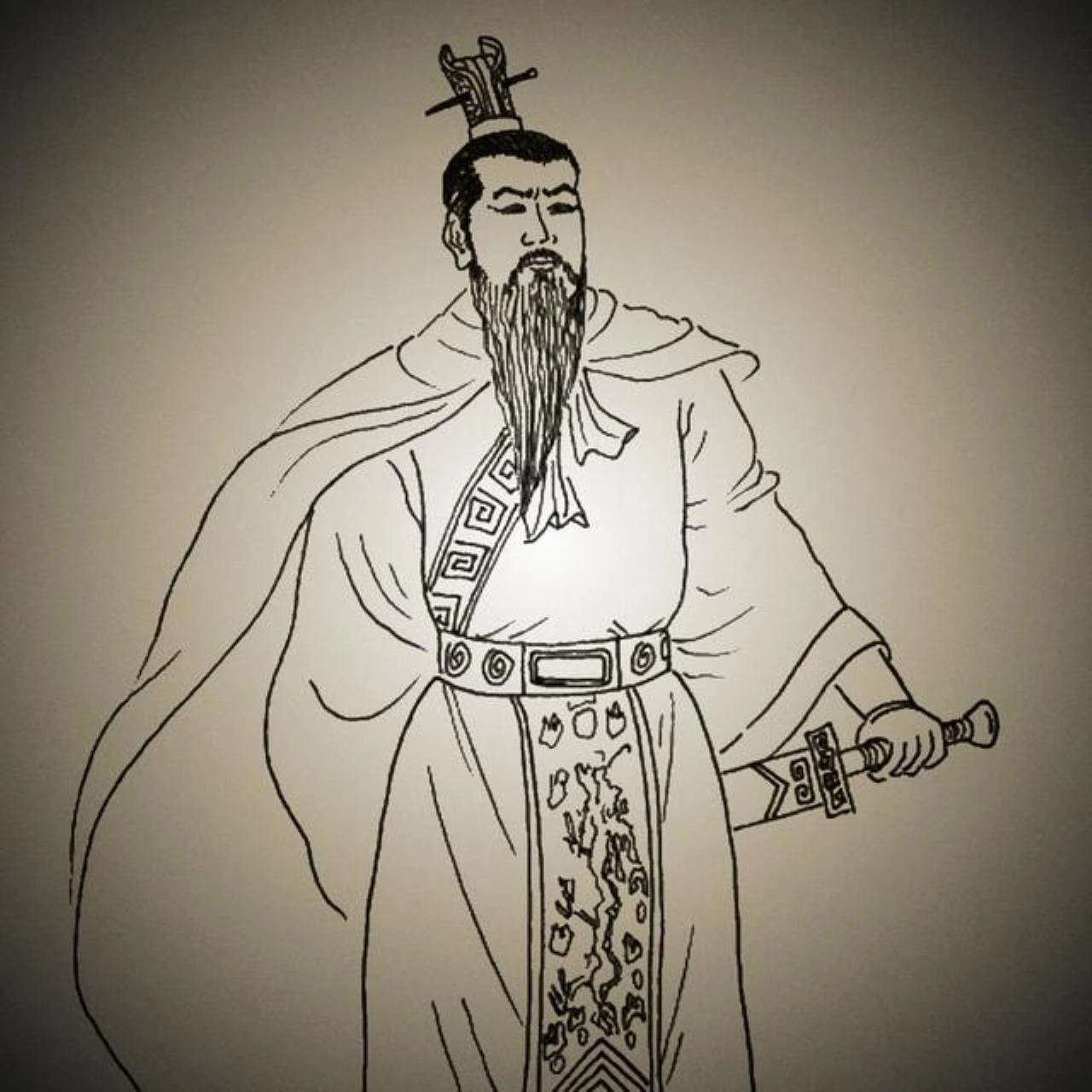
The first act of the new dynasty was a removal. In the summer of 338, some weeks after he took the throne at Chengdu, Li Shou had his father's tablet carried into a temple of its own and proclaimed him the founding ancestor of Han. The father, Li Xiang, had never ruled. He was Li Te's younger brother, and he had died a general. The state his son governed had been called Cheng for a generation. It was called Han now, and its first ancestor was a man who had never worn a crown.
The transaction cost one character. Everything else in Li Shou's five years follows from how little that character cost and how much it was asked to do. He had taken power by force from a young man of his own family. His branch of the house was cadet, so blood gave him nothing that a dozen other cousins did not also have. His military record was respectable but provincial. He had, in the end, nothing to offer the province except a name with five hundred years behind it, and he paid for the name while leaving almost everything else where it was. What the name bought, and how quickly it was spent, is the subject of this account.
1. A Younger Son
Li Shou was born around 300. The date is not recorded as such. The chapter that tells his life says he was forty-four when he died in 343, and that is the whole of the evidence; the same chapter puts him at nineteen at the time of his first great appointments, which is the only other fixed point in his early years. What can be known of him comes chiefly from the chapter of the Book of Jin devoted to the house of Li, which carries the diction of a court record kept inside Shu, and from Chang Qu's Records of Huayang, a regional chronicle written by a man who had served the same house, though its text is patched in the last years it covers. His father, Li Xiang, was a younger brother of Li Te, and Li Xiong, Li Te's son and the first ruler of the state in Shu, was therefore his cousin. Li Qi, Li Xiong's fourth son, was his cousin's son. The distinction matters more than it looks. In a house that had made itself royal within a single lifetime, the sons of the founder's brothers were princes with commands and revenues, but they were not in the line, and everyone at Chengdu knew it.
The house of Li had held Sichuan since the first years of the fourth century, and Li Xiong had ruled it for thirty years, lightly taxed and, by the standards of the time, quietly. Li Shou was the bookish one of the family. The chapter describes him as quick, fond of learning, generous in temper, careful of ceremony, and unlike the other men of his generation in the house. Li Xiong thought him capable of weight and gave him, at nineteen, the forward general's title and the military supervision of Baxi, the commandery east of Chengdu where the family had its oldest connections.
At Baxi he did what a competent prince was expected to do. He took a recluse named Qiao Xiu as his guest, followed his advice, and acquired, according to the chapter, a reputation for both authority and kindness. When his father died he returned to the capital and rose through the ranks that mattered: grand general, grand commander, palace attendant, duke of Fufeng, and then the office that gave him a view of everything, the supervision of the imperial secretariat. He campaigned in Ningzhou in the south, besieged its towns for more than a hundred days, and reduced the commanderies one by one. Li Xiong was delighted and made him prince of Jianning.
The chapter's judgment on this part of his life is unusually warm. It calls him a worthy minister, says he read constantly, and notes that when he came across the deeds of good generals and good chancellors he read them over and over. That is the portrait of a man who was excellent at the second rank. He knew how a province was administered and he knew the frontiers, which is not the whole of statecraft but is more of it than most princes bother to learn. His later failure was not incompetence. It was the discovery, which he made slowly and at other people's expense, that the qualities which make a good minister do not make a sovereign, and that the difference between them is not a difference of ability.
2. The Garrison at Fucheng
Li Xiong died in 334. A nephew held the throne for four months, and by the end of that year Li Qi, Li Xiong's fourth son, was emperor. The new reign began with a promotion for Li Shou and a warning inside it. Li Qi made him prince of Han, gave him the revenue of five commanderies in Liangzhou, appointed him governor of that province, and sent him north to hold Fucheng in place of a kinsman who had fled. Fucheng sits on the Fu river, on the road that climbs from the Chengdu plain toward the northern passes. It was a real command and a real garrison, and it was also, in the geography of court politics, exactly where a dangerous cousin is kept.
The title deserves a pause. It was Prince of Han. Four years later, when he needed a name for his state, the name was already on his own seal, granted by the man he would overthrow. Whether he noticed the convenience at the time cannot be known. It is enough to record that the word was in his household before it was on his documents.
He had served Li Qi well enough in the field. Sent against the Jin garrison at Nanzheng, he had taken the city and left his own officers to hold it. The pressure came quickly all the same. Li Qi's brothers and his chief ministers had troops of their own, and they feared Li Shou's reputation. The emperor sent an attendant named Xu Fu north, again and again, to watch him. Li Shou stopped coming to court, pleading that the frontier could not be left unguarded. Then Li Qi poisoned Li You, Li Shou's foster-brother, and the excuse for caution became an excuse for war. The chapter says plainly that Li Shou was afraid. It does not pretend that he was moved by principle.
What moved him, or what he allowed himself to be moved by, was a recluse from Baxi named Gong Zhuang. Gong Zhuang's father and uncle had been killed by Li Te, and he had refused office under the family for years, wearing mourning long past the term. Li Shou had tried to hire him repeatedly; Gong Zhuang had refused the office but not the visits. When the mountain above the Min river broke and the water in the river fell, Li Shou took it as an omen and asked him, as he had asked before, how a man in his position might be safe. Gong Zhuang's answer was the hinge of the whole business: give up the small and follow the great, exchange danger for safety, and the reward will be a state, a fief, and a name above that of the ancient lords of Qi and Jin.
The advice had a shape. Gong Zhuang wanted Li Te's sons dead, and he wanted it done by a Li. But the program he offered was not a new dynasty. It was the restoration of Jin order in Shu: Li Shou was to take Chengdu, hold it in the name of the eastern court, and send the deposed emperor downriver to Jiankang. That is what the conspirators agreed to in the first version of the plan, and it is what the two men closest to him, Luo Heng of Lueyang and Xie Siming of Baxi, understood themselves to be serving. Xie Siming would spend the rest of his life trying to hold Li Shou to that promise. In the fourth month of 338 the promise was still intact, and the only thing settled was that Li Qi had to go.
3. The Fourth Month
Li Shou came down from Fucheng with ten thousand men, and the gate was opened from inside by his own son, whom Li Qi had given troops in the capital. The memorial he sent named Li Qi's ministers and accused them of treason; Li Qi approved it, and his own household was arrested and killed on his authority. Only then did Li Shou produce the document that mattered, an order in the name of the empress dowager Ren deposing Li Qi as duke of Qiongdu and confining him to a separate palace. The chapter calls the order a fabrication, and it was one; it was also the only instrument in the palace that could make a deposition look like a decision rather than a killing. The troops plundered the city for several days, and the account records what they did in the family's own courtyards and then moves on.
Li Qi lived a few weeks. Confined, stripped of the throne, told that he was now a county duke, he said that the ruler of the world had become a little county duke and that it would be better to die. In the fifth month he hanged himself. Li Shou gave him a posthumous name, You, and buried him with the rites of a prince. The courtesy was cheap, and it was also necessary: a dead man with a title is a dead man whose claim has been settled.
The settlement was completed in the ninth month. Ren Yan, a brother of the empress dowager, raised a revolt; it failed, and Li Shou killed him. Then he killed the rest of Li Xiong's sons. The chapter disposes of them in one short line at the end of Li Qi's obituary, as though they were an administrative detail. The chronicle is more explicit and places the killing after Ren Yan's rising. Either way, by the winter of 338 no adult male of Li Xiong's line was left alive at Chengdu. He had removed the emperor, the emperor's ministers, the emperor's mother's family, and the emperor's brothers. What remained was a throne with no other claimant, which is exactly the kind of throne that needs a name.
4. The Divination
The conspirators had agreed on a vassal state. They discovered, once Chengdu was theirs, that they disagreed about what they had agreed on. Luo Heng, Xie Siming, Li Yi and Wang Li proposed that Li Shou take the titles of western general, governor of Yi province and prince of Chengdu, and submit to Jin, sending Li Qi downriver as evidence of good faith. Ren Diao, the master of horse Cai Xing, a palace attendant, and Zhang Lie proposed that he take the throne. The first program made him a legitimate subordinate of a legitimate emperor. The second made him a legitimate emperor in his own right. Both were theories about where a warrant to rule comes from, and the men who held them had ridden in the same column weeks earlier.
The argument turned on a divination, which is another way of saying that it turned on nothing. The diviner said that he could be Son of Heaven for several years. Ren Diao said that one day would be enough, and several years far more. Xie Siming asked the only question that mattered: several years as Son of Heaven, against a hundred generations as a lord? Li Shou answered with a quotation. If a man hears the Way in the morning, he may die in the evening. Lord Ren's plan, he said, was the best.
It is a strange answer to a serious question, and it is worth noticing what it does. The quotation is Confucian and it sounds like wisdom, but in his mouth it means that the content of the years does not matter, only that they are his. He did not argue that emperorship would serve the province better than vassalage. He did not argue that Jin was too weak to protect him. He said, in effect, that he would rather be emperor for a short time than a lord for a long one, and he dressed the preference in a sentence from the classics. The men around him understood him perfectly. Ren Diao had already said the same thing without the quotation.
He took the throne in 338, pardoned the province, and changed the era to Hanxing, Han Rising. Then he paid his debts. Dong Jiao became chancellor, Luo Heng became director of the secretariat, Ma Dang and Li Yi were given commands, Ren Diao was made governor of Liangzhou, and Xie Siming, who had argued for vassalage, was made governor of Guanghan, a respectable post at a distance from the court. Every office below them was filled from Li Shou's own staff. The old ministers of Cheng, the relatives of the fallen house, and the gentry of the six commanderies were dismissed or pushed aside. That was the real revolution of 338: not the name, not the temple, but the personnel. A state can keep its laws and change its mind about who belongs to it, and Li Shou changed his mind about everyone who had served his cousin.
Gong Zhuang was offered the office of grand master, with a carriage and silks. He refused the office and the gifts, accepted a plain cloth cap and belt, and took the position of a friend and teacher rather than a minister. He had wanted his revenge, and he had it. What he did not want was to help govern the state that revenge had produced.
5. What the Name Bought
The change did not require a new coinage, a new capital, or a new law. It required a scribe to write a different character at the top of the same formulas, and a herald to shout a different word at the gate.
In 338 Cheng became Han, and the price was one character: five hundred years of prestige came loose from the family that had earned it, and he picked it up because it was lying there.
That is what the name bought, and it is worth being precise about why the price was so low. A claim of descent has to be defended. It can be checked against genealogies, challenged by kinsmen, and mocked by the courtiers who know the family's real origins. Li Shou's family were Ba Di from Dangqu in the east of the province; their own origin story began with Lin Jun and a cave, not with a prince of the Han house, and no one at Chengdu would have believed a sudden claim to Liu blood. He did not make one. He took the word and left the genealogy alone. The name Han was detachable from the house of Liu, and that was exactly what made it affordable: prestige that no longer belonged to anyone in particular could be picked up by anyone who could hold the city where it had once ruled.
In Sichuan the word meant something specific. It meant the Han that had ruled from Chengdu in the third century, the one whose founder had made a kingdom in the basin, the one that had fallen to a northern army and was remembered afterward with more affection than the courts that replaced it. That memory was the real asset. It was local, it was old, and it was not attached to the family that had produced it.
What he changed was small in extent and large in meaning. He built a temple for his father and called him the founding ancestor of Han, with the posthumous title Xian. He moved Li Te and Li Xiong into a temple named after the old state, Dacheng, so that the two men who had actually founded the family's power became the ancestors of a name that no longer existed. And he published a statement that his own line and the line of Li Qi and Li Yue were different clans. The three acts are one act. He could not inherit from Li Xiong, because he had killed Li Xiong's sons; so he declared that there had never been an inheritance, only two houses that happened to share a surname and a grandfather. The rename gave the separation a public form.
What he did not change is more telling. The capital stayed at Chengdu. The offices stayed as Li Xiong had left them: chancellor, director of the secretariat, the six armies, the provincial governors. The law stayed. The taxes stayed, until the building program of 340. The army stayed. No edict recorded in the chapter creates a new office, a new rank, or a new code. The only new things in the first year were a temple, an era name, and a list of appointments. Two of those are names for time and for ancestors, which is to say that they look backward; the third is a change of personnel, which is to say that it looks at who is standing in the room. Nothing looked forward.
This is the arithmetic of cheap legitimacy. A name is a good that can be taken without being transferred. Taking it deprives no one else of it, so no one has to consent to the taking. That is why it costs almost nothing, and it is also why it binds almost nothing. A genealogy would have required the clan's agreement; a conquest would have required the province's submission; a reform would have required the gentry's cooperation. The name required only that the scribes be told. And because no one had agreed to it, no one owed it anything. The gentry of the six commanderies could accept the word Han and still refuse the man who had written it. Jin could read the word and still call him a rebel.
He had bought an antiquity, not an authority. The distinction is easy to miss because antiquity is one of the things authority is made of, and in the first months the purchase looked like a bargain. For five years the state had a name that no one could argue with. That is not nothing. It is simply not enough to run a government.
6. The Palace and the Fleet
The name did not stop the borders from moving. In 339 the administrator of Jianning, Meng Yan, seized the governor of Ningzhou, Huo Biao, and handed him to Jin, and the whole of Jianning went with him. Jin's western commander sent troops into Ba and Jiangyang, and the governor of Jingzhou, Li Hong, was taken and shipped downriver to Jiankang. Li Shou replaced him and did nothing else. The south and the east were peeling away, and the court at Chengdu was occupied with a more interesting question: whether it could enter the war of the north as a great power.
In 340 Shi Hu, the ruler of Later Zhao, wrote to him proposing a joint attack on Jin and a division of the south. Li Shou was delighted. He sent two envoys to the Zhao court, and he asked for the return of Li Hong, who had escaped from Jiankang to Ye. Shi Hu's letter was a document from a northern court that treated him as a sovereign rather than a usurper, and he answered it the way a man answers a compliment: with a fleet. He built ships, repaired armour, and gathered grain. In the ninth month he put Ma Dang in command of the six armies, assembled more than seventy thousand men on the water, and held a review at Chengdu. The river was full of boats and noise. Li Shou climbed the wall to watch, and the chapter says he had it in mind to swallow the south.
The men around him talked him out of it, and the way they did it is the clearest surviving statement of what his position actually was. Xie Siming said that the state was small, the army weak, and Wu and Kuaiji far away over difficult ground. Gong Zhuang put it more bluntly. Which is better, he asked, to be joined to the Hu or to Jin? The Hu are wolves. If they destroy Jin, you will have to serve them; and if you quarrel with them over the world, the strong and the weak are not matched, and the end of that road is the story of Yu and Guo, where the stronger ally swallowed the weaker once the common enemy was gone. The ministers agreed, knelt, and wept. Li Shou stopped. The soldiers shouted that he should live ten thousand years, which was their way of cheering a war that would not happen.
The fleet never sailed. What sailed instead was the report of his envoys, who came back from Ye saying that Shi Hu's palaces were beautiful, his storehouses full, his punishments severe, and his control of his territory complete. Li Shou listened and began to imitate the parts he could afford. After that he killed men for small faults, to establish what the chapter calls his authority. He moved households with three or more adult males from the neighbouring commanderies into Chengdu to fill a capital that he thought too empty. He set up imperial workshops, conscripted craftsmen from the provinces, built halls, brought water into the city, and enlarged the academy. The chapter calls the result extravagance, and its summary is exact and unfriendly: the people were exhausted by the labour, the roads were full of complaint, and the phrase it uses is that nine households in ten were thinking of rebellion.
The two chief administrators objected. Cai Xing, the left director, remonstrated and was executed for slander. The right director had been blunt too often; he was accused of something else, imprisoned, and killed. These were not frontier generals or rival princes. They were the senior civil officers of the state, and he killed them for talking. In the same years Li Yan, writing from Yuexi, sent up a memorial urging him to return to the original plan, give up the imperial title, and call himself a king again. Li Shou had him killed, and the chapter says the execution was meant to frighten Gong Zhuang and Xie Siming into silence. It worked on one of them. Gong Zhuang faked deafness and a withered hand, went home, and spent the rest of his life with his books, never returning to Chengdu.
The sequence is worth stating plainly. The man who had made the coup possible had asked for a vassal kingdom and a hundred generations. The man who had made the emperor possible had asked for revenge and then walked away. The minister who kept insisting on the original promise had been posted to a province, away from the court. By 341 the court of Han contained no one who could say out loud what everyone knew: that the state had bought a name it could not afford to use, and that the bill for the palace and the fleet was being paid by the households that the chapter says were thinking of rebellion.
7. The Fifth Year
He died in 343, in the fifth year of his reign, at the age of forty-four. The chapter says that in his illness he saw Li Qi and Cai Xing, the deposed emperor and the executed minister, and that their ghosts troubled him. It is the kind of detail that a court historian writes when he wants to say something that cannot be said directly, and it is also, perhaps, simply what the attendants reported. Either way, the two names are the right two: the man he had replaced and the man he had killed for telling him the truth.
He was buried in the Anchang tomb and given the posthumous title Zhaowen, with the temple name Zhongzong. The Jin history calls the posthumous name false, which is the victor's grammar rather than a fact about the tomb. His eldest son, Li Shi, succeeded him without incident.
The arithmetic of the reign is simple and it is the whole of the argument. Han was five hundred years older than Cheng, and he used it up in five. He had bought the oldest name available in the province, and he had paid for it with a character, a temple, and a declaration that his cousins were not his kin. He had not paid for it with a reform, a campaign, or an agreement with anyone who mattered. So when the five years were over, the name was still on the documents and the documents were still being written in a state whose southern and eastern commanderies had already gone over to Jin. A name that costs nothing does not collect rent. It only makes the paperwork look older than the state.
The ships he built were still in the river when he died. The temple he built for his father was still standing. His son inherited the ships, the temple, the title, and the habit of killing ministers who spoke. What he did not inherit was the thing his father had actually bought: the five hundred years. They had been spent, year by year, on a palace, a review, and a war that was called off on the advice of the only man in the state who had told the truth from the beginning.
Gong Zhuang lived out his life in the country, deaf by his own arrangement, and never came back to the city. The reign is left with two pictures that do not quite belong to the same story: the recluse walking away from the state he had invented, and the emperor on the wall above the river, watching seventy thousand men row past in a fleet that would never leave the province.