Home / Emperors / Three Kingdoms
Emperor Zhaolie of Shu Han
汉昭烈帝
Liu Bei, 161 – 223 · founding emperor of Shu Han
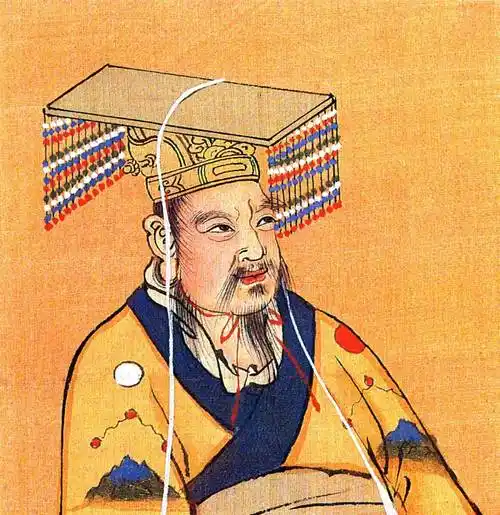
For forty years Liu Bei held no city that could not be taken away from him. He was born into a cadet line of the Han imperial house so remote that his grandfather and his father had been minor officials in the provincial administration, and so poor that he and his widowed mother made their living weaving straw mats and selling sandals. He raised his first soldiers with money given to him by horse traders. He was handed a province and lost it, given an army and lost it, sheltered in turn by four stronger men, and more than once had his wife and children captured while he escaped on horseback. The one thing he never lost was a name. He was a Liu, and the Han histories traced him to an emperor, and in the last decades of the Han that claim was worth more than a province and harder to take away.
He ended as the founder of one of the three states into which the empire broke apart, and the way he got there is a story about what a claim can be made to do. He had no land, so he traded on lineage. He had no army that lasted, so he traded on a reputation for decency that made men stay with him when he had nothing to pay them. He had no strategy at all until he was forty-six, when a recluse in a thatched cottage in the hills of Xiangyang dictated one to him. And when the Han was finally extinguished by a usurper, he took the throne in the name of the house that no longer existed, because the name was the one asset he had never had to give back. That is the historical Liu Bei, half hero and half politician. The other Liu Bei, the one almost everyone knows, is the creation of a novel written eleven centuries after his death, which gave him a sworn brotherhood he never swore, moved one of his own violent deeds onto a subordinate to protect his image, promoted a fifth marshal the records do not mention, and turned him into the most familiar ruler in Chinese literature. This account keeps the two apart, and says which is which.
1. The Mulberry Tree by the Fence
He was born in 161, in Zhuo county in the far north of the empire, in a village that later tradition would name for the tree beside his mother's house. The family's standing rested on a claim that the official history sets out in its first sentence: he was a descendant of Liu Sheng, prince of Zhongshan, a son of Emperor Jing. The connection was real enough to be recorded and ancient enough to be worthless. Liu Sheng, who by the count of the Han history had more than a hundred and twenty sons, had been rewarded for loyalty with a rich and idle principality; one of his sons, Liu Zhen, was enfeoffed as marquis of Lucheng in Zhuo, and then lost the title when the gold he contributed to the ancestral sacrifices was found to be short in weight and poor in colour. It was one of the mass degradations by which Emperor Wu stripped the princes of their power, and its consequence for Liu Bei's line was a fall into ordinary life. From the year of that forfeiture to the year Liu Bei was made a marquis himself, roughly three hundred years passed, and in all that time no ancestor of his is recorded to have held a title.
There is a difficulty in the record here, and it is worth naming because it shows how thin the ground under the famous claim actually is. The biography in the Records of the Three Kingdoms says that Liu Zhen was enfeoffed in the sixth year of Yuanshou, which is 117 BC, and calls him marquis of Lucheng ting — a marquis of a village. The History of Han, which keeps the register of noble houses, has him enfeoffed in the second year of Yuanshuo, 127 BC, ten years earlier, and gives him no such junior rank; and the grade of ting marquis did not in fact exist in the Former Han at all. The two accounts of a single small man disagree about his date and his title. Later scholars of the Qing period noted both errors and concluded that the family's own genealogy had been tidied up somewhere along the way. What can be said with confidence is only this: the ancestor who fell out of the nobility did fall out of it, and the line spent the next three centuries as commoners with a distinguished surname. When Liu Bei's enemies wanted to deny his claims they were on solid enough ground; when the historian Pei Songzhi annotated the biography he observed drily that although Liu Bei came out of Emperor Jing's line, the generations were so far off that the proper order of the ancestral temples could not be worked out.
His grandfather Liu Xiong had been recommended for the civil service and had risen as far as magistrate of Fan in Dong commandery. His father Liu Hong served in lesser posts and died while Liu Bei was a child. The household that remained was his mother, a loom, and a market stall. For the rest of his life, and for the whole of the legend built on him afterwards, this was the fact that mattered: the descent was aristocratic and the childhood was not.
The one story his biographer chose to tell about that childhood is set by the mulberry tree at the south-east corner of the family's fence, which grew to a height of five zhang and was said, seen from a distance, to spread like the canopy of a carriage. The tree stood on a poor man's ground, but that shape belonged to the ceremonial carriage of a ruler, and the chance resemblance was read as an omen by everyone who passed. It was under that tree, as a boy playing with the children of the clan, that Liu Bei said he would one day ride in a carriage with feather canopies. An uncle heard him and told him to be quiet, or he would bring ruin on the family. The anecdote is the kind a biographer invents for a man who turns out to be important, and what is authentic in it is the tone: a poor relation who has been told what he is worth and has decided not to agree.
At fifteen his mother sent him away to study, and he went to Lu Zhi, a scholar from the same commandery who had served as governor of Jiujiang, together with a boy of his own clan named Liu Deran and a man from Liaoxi named Gongsun Zan. It was a school of a certain kind: the tuition was paid for the poorer pupil by a wealthy kinsman named Liu Yuanqi, whose wife complained at the expense and was told that there was something unusual in the boy. Gongsun Zan was older, and Liu Bei treated him as an elder brother; the two of them would meet again, on opposite sides of several wars. Of the education itself the record says something more revealing than any list of books. Liu Bei did not much care for study. What he liked was dogs and horses, music, and fine clothes. He spoke little, was good at putting himself below other men, and did not let pleasure or anger show on his face. He was tall, and it was remembered of him that he had long arms and ears he could see himself — details that belong to physiognomy rather than to history, and were repeated because they made him look like a man marked out for something. He was good at making friends among the bold young men of the region, and they attached themselves to him.
The two merchants came later, from Zhongshan, men named Zhang Shiping and Su Shuang whose fortune lay in raising money and trading horses around the frontier. They met the young Liu Bei, took an interest in him, and gave him sums of money large enough that he could begin to gather followers. That is how he raised his first command: not by imperial appointment, not by inheritance, but by the generosity of two travelling horse traders with an eye for a man who might be worth backing. He was, at the start, exactly what he would remain for thirty years — a leader without territory whose only capital was a name, a following, and the judgement of other people that he was worth a gamble.
2. The Men He Raised at Zhuoxian
The Yellow Turban rebellion broke out in 184, and in the general arming of the provinces that followed, the local governments raised militia to put it down. Liu Bei, then in his early twenties, took his followers into the service of a commandant named Zou Jing and fought in one of these campaigns, and the record of what he did there is the record of a man who was prepared to be a hired soldier. The campaign against Zhang Chun in the north, according to a note Pei Songzhi preserves, left him wounded in the field and left for dead, and it was his companions who carried him home in a cart. For the services he rendered he was appointed commandant of Anxi county, a small policing post, and then one event in his first official job fixed the way he would be remembered.
A provincial inspector, an officer called a duyou, came to the county on business. The duyou was not a magistrate's subordinate; he was a supervisor sent out by the commandery to examine the conduct of the counties, and a county official who received him ill treated him at his own risk. Liu Bei asked for an audience and was refused. He went back to his office, took up a clerk or two and some soldiers, walked into the inspector's post-house, claimed that he had secret orders from the governor to arrest the man, and tied him to a post. He beat him with the rod two hundred strokes, unstrapped his own head-band and hung it around his neck as a mark of degradation, and then abandoned his post and fled the county.
That is the story as the Records of the Three Kingdoms tells it: it is Liu Bei himself who hands out the beating. A later note adds the motive, that a court order had arrived to purge the officer corps of men who had risen by military merit alone, that Liu Bei believed himself among those to be dismissed, that the inspector refused to see him when he went to plead, and that he was angry. In that version he did not mean to kill the man; the inspector begged for his life and was let go. Whichever detail belongs to which authority, the deed is his. What the Romance of the Three Kingdoms does with it is almost perfect as an illustration of its method: since a hero of Liu Bei's moral stature could not be shown flogging an official and running away, the novel transfers the beating to his hot-tempered brother Zhang Fei, supplies the inspector with a demand for a bribe, and has Liu Bei arrive only in time to stop the killing. The violence is preserved, the culpability is reassigned, and a good deal of what the reader thinks he knows about Liu Bei is made out of that reassignment.
He drifted after that. A general of the capital named Wuqiu Yi was sent to raise troops in Danyang, and Liu Bei went with him; on the road they met bandits, he fought and did well, and he was given the post of deputy magistrate of Xiami, which he soon gave up. He held a magistracy at Gaotang, was driven out of it by bandits, and went north to Gongsun Zan, the schoolfellow of his boyhood, who was now a warlord of the north and gave him a minor command under the inspector of Qing province. In these years he took part in campaigns against Yuan Shao, won enough small victories to be entrusted first with an acting magistracy and then with the government of Pingyuan commandery, and it was as chancellor of Pingyuan that the man who would be remembered for winning hearts displayed the quality that kept men with him across every defeat.
The evidence for it comes in two pieces. A local named Liu Ping, who looked down on Liu Bei and was ashamed to be governed by him, hired an assassin to kill him. The assassin came, was received with the courtesy that the story insists was habitual, and could not bring himself to do it; he told Liu Bei what he had been hired for and left. The Records draws the moral in four characters: this was how he won men. The second piece, preserved from a contemporary history, describes his government in a time of famine, when the country was full of armed bands living off the land: he defended the commandery against them, spent generously to relieve the poor, and, in the words of the note, had no chair reserved for himself — he would sit at the same mat and eat from the same bowl as the least of his soldiers. This was not only virtue. In a countryside where armed men changed masters easily, a commander who shared his table was buying something invaluable, and the cheapest way to buy it was to be genuinely, visibly, careful of people.
3. The Province Offered and Lost
In 194 the warlord Cao Cao attacked Xu province, and its governor Tao Qian sent to the north for help. The man who answered was Liu Bei, with, by the record's own account, about a thousand of his own troops, some cavalry borrowed from the Wuhuan and assorted tribesmen of the northern frontier, and several thousand starving peasants he had gathered on the road. Tao Qian gave him four thousand men of the Danyang militia and made him inspector of Yu province, and Liu Bei took up station at Xiaopei and transferred his allegiance to the man who had just armed him.
Later that year Tao Qian fell ill. He had not chosen a successor and his confidence in his own line was low; on his deathbed he told his chief assistant that the province could not be settled by anyone but Liu Bei. The assistant led the provincial officials to offer it, and Liu Bei, who had spent his career under other men's orders, declined, proposing instead the powerful Yuan Shu of the Yuan family, whose ancestors for four generations had held the highest offices of the state and to whom the whole world looked. The answer he got was contempt. A local official told him that Yuan Shu was arrogant and extravagant and no man to hold a province together; the official offered, if Liu Bei would take the commission, to raise a hundred thousand foot and horse for him. The scholar and governor Kong Rong, who happened to be in the region, added the colder argument: the matter belonged to whoever could hold it, and heaven did not give twice. Liu Bei took Xu province.
What followed is the pattern of the next fifteen years in miniature. He had barely settled when Yuan Shu attacked from the south. Cao Cao, who wished to check Yuan Shu and to make a friend of the new governor, had Liu Bei confirmed as General of the East and enfeoffed him as marquis of Yicheng — the first title of nobility his line had held since the Former Han — and in 196 Liu Bei held Yuan Shu off in a standoff that lasted a month. While he was away, the warlord of the moment, Lü Bu, took his capital at Xiapi. The officer left in charge of the city let him in; Lü Bu captured Liu Bei's wife and children, and Liu Bei, cut off from his base, fell back with what troops he had left. What the contemporary record says of these weeks is that his little army came apart in hunger, and that his officers and men began eating one another. He sent to Lü Bu and asked for terms, and Lü Bu, who for his own reasons preferred a weak neighbour to a fugitive ally, gave him back his wife and children and let him camp at Xiaopei again, where Liu Bei gathered more than ten thousand more men.
Lü Bu soon regretted the arrangement. He attacked Xiaopei himself and Liu Bei, beaten again, went to Cao Cao. Cao Cao treated him with unexpected warmth, made him governor of Yu province, gave him grain for his troops and men to fill out his ranks, and sent him back east to help besiege Lü Bu in Xiapi — the campaign in which his wife and children were taken a second time, by Lü Bu's general Gao Shun in the field. The campaign ended in 198 with the fall of the city and the execution of Lü Bu, and Liu Bei recovered his family and went back to the capital at Xu with Cao Cao, who had him made General of the Left and treated him with a regard that the record is at some care to describe: the two rode in the same carriage and sat on the same mat.
The rank he held in that year is the exact measure of what he possessed: General of the Left, one of the four great generalships of the Han, and marquis of Yicheng. Great titles, and no territory. He was a guest with a title, and he was about to learn how quickly a host can withdraw his hospitality.
4. A Guest of the Court
The conversation that fixed Liu Bei in the imagination of the court took place in the capital around this time. Cao Cao, who had just won the north from his rivals and was in the mood to take the measure of the men around him, said to Liu Bei in an easy moment that the heroes of the empire were himself and Liu Bei, and that men like Yuan Shao did not count. Liu Bei was eating, and the Records says that he dropped his chopsticks. A later chronicle adds that a thunderclap obliged him at that moment, and that he explained his start as fear of the thunder. However it was managed, the scene does the work of a whole volume of character: Cao Cao reads his guest correctly, and his guest understands that to be understood by this man is to be in danger. The Romance of the Three Kingdoms would make of that single exchange the famous episode of the wine and the plums, one of the most quoted scenes in Chinese fiction, and it is worth marking that the whole of its detail beyond those few characters belongs to the novel; the histories give the sentence and the dropped chopsticks and nothing more.
The danger was not theoretical. Before he left the capital, Liu Bei was drawn into a plot against Cao Cao. A general of the court named Dong Cheng, an imperial relative, claimed to have received a secret order concealed in his belt and sent out of the palace by the Emperor, calling for Cao Cao's destruction, and Liu Bei joined the conspiracy with several officers of the guard. The plot did not reach the point of action; Liu Bei left the capital on a commission of Cao Cao's own, and when the business was discovered the conspirators were executed. Here too the novel has added to the record: the Emperor's blood written into the belt, and the presence among the conspirators of the far-western general Ma Teng, are invention. The histories name a handful of provincial officers, and not the ruler and not the famous general. And here a second famous scene has to be separated, because it is built on a fragment and a whole episode has grown around the fragment. One note, quoted by Pei Songzhi and found nowhere else, says that Liu Bei and Cao Cao once went hunting together, that they became separated from their attendants, and that during the hunt, when the party had scattered, Guan Yu urged Liu Bei to kill Cao Cao then and there, and Liu Bei would not. There is no emperor at that hunt, no borrowed imperial bow, no arch of the imperial carriage, no bare-armed dash at Cao Cao by his subordinate, no rebuke from Liu Bei. All of that is the novel's, and the novel built it out of one sentence in a note. The sequel, which the note does preserve, is worth more than the scene. Years later, when Liu Bei had been driven out of Jing province and was stranded across the river at Xiakou, Guan Yu reminded him of the hunt and said that if Liu Bei had listened to him then, they would not be in this pass. Liu Bei answered that at the time he had been sparing Cao Cao for the sake of the realm, and that if heaven favoured the right cause, no one could say this would not turn out well. Pei Songzhi, the annotator, refused to let that pass: Liu Bei had already joined Dong Cheng's conspiracy to kill Cao Cao, so the excuse about sparing him was an invention after the fact, and the real reason he had not struck was that Cao Cao's partisans were everywhere and a single stroke would have cost Liu Bei his own life. The little exchange is the clearest surviving specimen of the two Liu Beis, the one who gave noble reasons and the one who later gave military ones, and the annotator chose the second.
In 200 Cao Cao turned on him. Liu Bei had gone back to Xu province, killed the inspector Cao Cao had installed there, left Guan Yu to hold Xiapi, and drawn enough of the region to himself that his forces numbered in the tens of thousands; when Cao Cao's own generals failed to fetch him, Cao Cao came himself, contrary to Liu Bei's expectation that he would not leave the standoff with Yuan Shao to do it. Liu Bei's army was destroyed, his wife and children were captured for a third time, and Guan Yu was taken; Liu Bei escaped north on horseback with a handful of men.
He found shelter with the man he had just been fighting. Yuan Shao, then at war with Cao Cao in the great contest on the Yellow River, sent officers to meet Liu Bei on the road and went himself two hundred li out from his capital at Ye to welcome this homeless guest, which is a fair measure of the prestige the imperial surname carried. The month Liu Bei spent in the north restored something to him: his scattered men began to come back, Guan Yu rejoined him from Cao Cao's camp, and when Yuan Shao sent him south with a band of local rebels to raid in the direction of the capital, Liu Bei fought there independently of the main war. But he had already seen whose side the wind was on. When Cao Cao's general Cao Ren broke up the raiding force, Liu Bei went back to Yuan Shao's camp and began quietly looking for a way out; he suggested to Yuan Shao that he was better employed raising the south against Cao Cao, and Yuan Shao let him go.
He went to Liu Biao, the governor of Jing province, and this was the longest of his exiles: eight years in the south, from 201 to 208. Liu Biao met him outside the walls of his capital, treated him as an honoured guest, gave him men, and stationed him at Xinye on the northern frontier, which was a way of both using him and keeping him at a distance. The able men of Jing began to attach themselves to Liu Bei, and the governor, watching this, grew uneasy and kept him short of real authority. It was in this long idle interval that the story most often placed as the emblem of the middle of his life was recorded: sitting at Liu Biao's table, going out to the privy, and noticing that the flesh had grown back on his thighs where once there had been nothing but the saddle. He came back in tears, and when Liu Biao asked why, he said that in the old days he had never been off a horse and had had no flesh on his thighs, and that now he was no longer riding, the flesh had returned, and the days and months were running out, and he was growing old, and nothing had been accomplished. That complaint is the honest inventory of a man of forty-odd who had held three provinces and a generalship and still governed nothing. He was not entirely idle: he beat off a probing attack by Cao Cao's generals Xiahou Dun and Yu Jin at Bowang by burning his own camp in a feigned retreat and trapping them in an ambush, which is the one tactical success of these years the record attributes to him personally. In 207 he advised Liu Biao to strike at Cao Cao's capital while Cao Cao was on campaign in the far north, and Liu Biao refused; the opportunity passed, and Liu Biao afterwards told him so.
5. Three Visits and a Plan
The thing that changed Liu Bei's life was a conversation, and it came about because a young scholar who had newly joined him insisted that he was overlooking the one man worth having. His name was Xu Shu, and he told Liu Bei that a man in the hills a short distance away, Zhuge Liang, was the dragon in his sleep, and that Liu Bei ought to go and see him. Liu Bei said to bring him. Xu Shu said that this man could be visited but not summoned, and that Liu Bei would have to go to him.
Liu Bei went three times before he was received. That is the account, and the account is brief: the biography of Zhuge Liang says only that he went, and went again, and went a third time, and was then seen. What he did once he was inside the cottage the biography reports in full, because it is the founding document of the state he would later make. Dismissing his attendants, Liu Bei said that the Han house was falling, that the treacherous and usurping men held power, that he was not the man to measure his own strength against the situation, that he wished to proclaim the great cause to the whole world, but that his judgement and his means were shallow, and so he had been defeated and reduced to this, and that, though he still wished it, he did not know how it was to be done. He asked what plan there was.
The answer Zhuge Liang gave him became known as the Longzhong plan, and it is the first document in Liu Bei's life that deserves the name of strategy. He told him that Cao Cao had a million men and the Emperor, and could not be contested directly; that Sun Quan held the east through three generations, with a secure country and a loyal people, and could be used as an ally but not taken; that Jing province, which lay across the Han and the Mian rivers, with its wealth running to the southern sea and its roads leading east to Wu and west to Shu, was the country of armies whose ruler could not hold it, and looked like heaven's gift to Liu Bei; and that Yi province beyond the gorges, walled by mountains and rich beyond measure, ruled by a weak kinsman, was the country whose capable men were already looking for a wise master. If Liu Bei held both, he said, kept the passes, allied with the tribes of the west and south, made terms with Sun Quan, and reformed his government at home, then whenever the empire should move he could send one general from Jing province toward Wan and Luoyang and lead the armies of Shu out through the Qin mountain passes himself, and the people would come out to welcome him with food and drink. Then the enterprise would succeed and the Han would rise again.
The value of the plan to a man in Liu Bei's position is not that it was brilliant, though it was clear and correct, but that for the first time he had one at all. He had spent twenty years being handed commanderies and losing them, serving patrons and outliving their usefulness. He now had a destination, a sequence of steps, and a reason to want particular pieces of ground rather than whatever he could hold. From this conversation to the end of his life, not one campaign he fought is off that road. Liu Bei went home with his general and grew closer to him by the day, and his two oldest followers objected to the newcomer's place; he told them that with this man he was like a fish that had found water, and to say no more about it. It means what it says: a man who had been groping for twenty years had finally found the thing he could not do without.
6. The Road South
The plan had barely been made when the situation moved. In the autumn of 208 Cao Cao came south with the whole of the north behind him, and Liu Biao of Jing province died before the campaign reached him. His son Liu Cong, who had been chosen over his elder brother and who knew what he was worth in a war, sent envoys to surrender without telling Liu Bei. Liu Bei was camped at Fan on the northern border of the province; the first he knew of the invasion was the arrival of Cao Cao's army at the town of Wan, already inside the province, on the way. He got his troops out and fell back south toward the provincial capital at Xiangyang, and someone at his elbow, with the plan of Longzhong in view, told him to seize Liu Cong and take the province for himself. Liu Bei said he could not bring himself to do it, and the record gives his reason elsewhere: the father had entrusted him with the son, and he would not betray the trust to save himself, and would not be able to face the dead man. He rode to the walls of Xiangyang and called on Liu Cong to come out; the son was too frightened to come. But his officials and a great part of the population of the province turned out to follow Liu Bei.
So began the retreat that made him famous, and this part of the legend rests on something real. By the time the column reached Dangyang, its numbers had grown to more than a hundred thousand, with thousands of baggage carts, moving at about ten li a day; Liu Bei had sent Guan Yu ahead with several hundred boats to meet him at Jiangling. His officers told him that this was mad, that with a hundred thousand souls and few armed men he could not stand against Cao Cao if Cao Cao caught him, and that he should abandon the people and ride for Jiangling. He answered that the great enterprise required men to be its foundation, and that the people had come to him, and that he could not bear to leave them. It is a decision that cost him almost everything, and it was not only sentiment: a hundred thousand people who had chosen him over the usurper were also the claim to legitimacy by which he meant to contend for the empire, and the story that he would not abandon them was worth to him more than the speed he lost. The East Jin historian Xi Zuochi, who admired him, wrote that even in extremity, when his affairs were desperate and his position dangerous, he did not lose his footing morally, speaking always in the right way; but the cost of that footing was the battle. Cao Cao, discovering that Jiangling held the provincial arsenals and fearing Liu Bei would reach them, abandoned his own baggage and came on with five thousand cavalry, covering more than three hundred li in a day and a night, and caught Liu Bei on the long slope at Changban in Dangyang.
What happened there is over in a sentence in the record. Liu Bei abandoned his wife and children, and with Zhuge Liang, Zhang Fei, Zhao Yun and a few dozen riders got away. Cao Cao took the whole column and everything it carried, and it is worth marking that the two daughters of Liu Bei were among the prizes, taken by a Cao cavalry commander and heard of afterwards no more. That is the historical Changban: a rout, a family left behind, and a hundred thousand people lost. The Romance of the Three Kingdoms would make of it the great set piece of Zhao Yun riding alone through the enemy to rescue Liu Bei's infant son, through an army of impossible odds, and would add the scene in which Liu Bei, handed the child, throws it to the ground and says that he was nearly lost for the sake of a suckling. Both are the novel's, and the throwing away of the child is the more revealing invention, because it invents for Liu Bei a virtue out of what the histories record only as a catastrophe.
From Changban he turned aside toward the Han river crossing, where Guan Yu's boats were waiting, and so got over the water with a few men. On the other side of the river he met the eldest son of Liu Biao, who held Jiangxia, and they went together to the fortress at Xiakou. It was on the way that an envoy of Sun Quan found him. The envoy was Lu Su, sent to condole with the sons of the dead governor and to sound out Liu Bei, and he came upon him on the road at Dangyang. Lu Su told him plainly that to run off to the far south as he had been planning would be the end of him, and that Sun Quan held six commanderies, with good troops and plentiful grain, and was the ally he needed. Liu Bei agreed, and sent Zhuge Liang back with Lu Su to make the alliance.
The rest of the year belongs to the most famous battle of the period, and Liu Bei's part in it was a part: he joined his forces to the fleet Sun Quan sent, under Zhou Yu and Cheng Pu, several tens of thousands of men, and the allies met Cao Cao's armada on the river at Red Cliff, broke it, and burned his ships. Cao Cao's army was already sick with an epidemic, and he withdrew north. Liu Bei went up the river with the Wu fleet in pursuit to Nan commandery. The fire that destroyed the fleet was set by a Wu officer named Huang Gai on his own proposal; the victory was Wu's, and the histories do not pretend otherwise. What Liu Bei took from the battle was the chance to convert an alliance into a country. He pushed south and received the surrender of the four commanderies of Jing province south of the river — Wuling, Changsha, Guiyang and Lingling — whose governors came over to him, and drew in a provincial magnate with several tens of thousands of retainers besides. When Liu Biao's eldest son died, his subordinates by common consent made Liu Bei governor of Jing province, and he established his headquarters at Gong'an on the south bank. Sun Quan, who was beginning to find his ally formidable, gave him his own sister in marriage to bind the alliance. It was a real marriage and not a happy one — the bride had a large retinue of armed guards, and Liu Bei is said to have gone in to her with some trepidation — but it made him a kinsman of the ruler of the east.
One piece of the settlement has been misremembered for centuries, and it is worth stating plainly. What Liu Bei "borrowed" from Sun Quan was Nan commandery, the province's central district around Jiangling, which the Wu general Zhou Yu had just taken from Cao Cao's armies after a long siege. He did not borrow the four southern commanderies; he had taken those himself. The histories say that he complained his territory was too small to settle the people who had followed him, that after Zhou Yu's death the Wu strategist Lu Su urged Sun Quan to let him hold Nan commandery, on the argument that a Liu Bei planted on the northern frontier would take a share of Cao Cao's attention that Wu would otherwise have to take alone, and that Sun Quan agreed. The transfer of that one commandery, made in 210, is the whole of the transaction. The phrase "borrowing Jing province" is a later contraction, and the grievance built on it, that Liu Bei took a whole province and never gave it back, rests on the contraction. Zhuge Liang's plan required both Jing and Yi, and Nan commandery, with the great river crossing and the road west, was the piece that connected the southern commanderies he already held to the province beyond the gorges. He asked for it, he got it, and from then on the alliance had a debt in it.
7. The Guest Who Took the House
The next piece of the plan was Yi province, the rich basin beyond the Three Gorges, and it was handed to Liu Bei by its own ruler. In 211 the governor of Yi, Liu Zhang, a weak and anxious kinsman of the imperial house, heard that Cao Cao was about to move against the region through Hanzhong and was frightened of it. His advisor Zhang Song told him that the way to be safe was to invite Liu Bei in and set him against the northern threat, since Liu Bei was a kinsman of the imperial house and Cao Cao's personal enemy and a good soldier. Liu Zhang agreed, and sent a general named Fa Zheng east with four thousand men to bring Liu Bei, with gifts beyond counting, and Fa Zheng, who had decided that his own master was not worth serving, took the opportunity to tell Liu Bei that the province could be taken. Liu Bei left Zhuge Liang and Guan Yu to hold Jing province and went west with several tens of thousands of foot soldiers.
At Fu city Liu Zhang came out to meet him, and the two men took each other's measure over a season of feasting. Liu Zhang treated him as a superior and proposed him as acting grand marshal and colonel-director of the capital region; Liu Bei proposed Liu Zhang in turn for a western generalship and the government of the province. Both accepted, which meant in practice that Liu Zhang was confirming a guest who had already gathered three tens of thousands of men, with chariots, armour, weapons and stores in abundance. Liu Zhang gave him reinforcements and sent him north against the warlord of Hanzhong, and Liu Bei went as far as Jiameng, and there he stopped. He did not attack Hanzhong. He spent his time distributing favours and building goodwill among the people of the province, gathering support the way he had gathered it all his life, and the record uses the four characters that describe a man preparing to stay.
The break came the following year, and it came over a request for more troops. Cao Cao had turned east against Sun Quan, and Sun Quan called on Liu Bei for help; Liu Bei asked Liu Zhang for ten thousand men and the supplies to march, and Liu Zhang gave him four thousand and half of what he had asked for. It was the answer of a man who had begun to understand what he had let into his house. Zhang Song, who was in the conspiracy, wrote to Liu Bei and Fa Zheng in alarm that the enterprise was within reach and must not be abandoned; his elder brother, an official of Liu Zhang's, denounced the plot to save himself, and Liu Zhang had Zhang Song executed and ordered the frontier posts to have no more dealings with Liu Bei. Liu Bei's answer was to summon the commander of the garrison at Baishui, upbraid him before the assembled officers for discourtesy, and have him killed, taking his troops; it was the trick he had used on the inspector at Anxi, at a larger scale. He took Fu city and turned the army around.
He had a strategist for this campaign, and the strategist had made him a list. Pang Tong, who had come into Liu Bei's service from the east and who had been recommended as the phoenix chick to Zhuge Liang's sleeping dragon, put three courses before him: to pick his best troops, march by night, and seize the capital at Chengdu in a single stroke, which would settle the province at once; to lure the two commanders of the frontier garrison into an ambush, take their troops, and march on the capital in force, which would work but cost time; or to withdraw to the east and come back another day, which was safe and would settle nothing. Liu Bei took the middle course. He fought through the province, and at the city of Luo his advance stopped. The siege lasted the better part of a year, and in it Liu Bei lost Pang Tong, shot by a stray arrow while leading an assault, at the age of thirty-six. The loss of the one man who had given him this province was the price of taking it. Liu Bei's army sat outside Luo through 213 and into 214, and word went back east for help; Zhuge Liang came up the river with Zhang Fei and Zhao Yun, taking the river towns of Baidi, Jiangzhou and Jiangyang in a separate campaign, and from that point on Guan Yu held Jing province alone.
In the summer of 214 the city of Luo fell, and Liu Bei invested Chengdu. It held out for several tens of days and then Liu Zhang came out and surrendered; the historian adds that the surrender was attended by no killing, and that Liu Zhang was moved east, to Gong'an, and was not killed. Liu Bei took the province and held a great feast for his troops, and distributed the gold and silver of the city to the officers and the grain and cloth back to the people. He made himself governor of Yi; he gave Zhuge Liang the government, Fa Zheng his plans, Guan Yu, Zhang Fei and Ma Chao his commands, and the scholars and old officials of the province the roles of guests and friends. And then he did the thing that is most characteristic of him and least like a conqueror: the men who had served Liu Zhang — the officials Dong He, Huang Quan, Li Yan; the relatives by marriage Wu Yi and Fei Guan; Peng Yang, whom Liu Zhang had driven out; and Liu Ba, whom Liu Bei himself had once hated — all of them were given conspicuous posts and used according to their capacity, and the record says that every able man in the province competed to be of use. A man who had just taken a country by a trick made its old servants into the servants of the new order, and it cost him nothing but his own grudge.
The province had one more adjustment to make on its northern border, and that one belonged to the alliance. In 215 Sun Quan, hearing that Liu Bei had taken Yi, sent for the commanderies he considered his due; Liu Bei, who was not ready to give up any of the ground his own plan required, answered that he would discuss it when he had taken Liang province, far to the northwest, and Sun Quan, who knew a refusal when he heard one, sent an army into the south and took three commanderies by force. The two allies came within a battle of fighting each other. What stopped them was Cao Cao, who had taken Hanzhong in the meantime and was now on Liu Bei's own northern doorstep. Liu Bei made peace with Sun Quan and bought the peace with land, dividing Jing province along the Xiang river: Changsha, Jiangxia and Guiyang to the east for Sun Quan, Nan commandery, Lingling and Wuling to the west for himself. The alliance survived, the debt was rescheduled, and Liu Bei turned north to deal with the man who had taken Hanzhong.
8. The Mountain at Dingjun
Hanzhong was the northern gateway to Yi, the country on the upper Han river between the Qinling mountains and the Sichuan basin, and whoever held it held the road into the province from the north. Cao Cao had taken it in 215 from the warlord Zhang Lu, and in 218 Liu Bei moved to take it back. The first year went badly. He sent two generals, Wu Lan and Lei Tong, up into Wudu commandery to the northwest, and both were destroyed with their commands. He brought his main force to the Yangping pass and faced the two Cao generals there, Xiahou Yuan and Zhang He, across the mountains for the better part of a year, with nothing gained.
The change came in the spring of 219. Liu Bei crossed the Mian river south of the Yangping pass and moved his troops up along the high ground, and he established his camp on the hill called Dingjun, an eminence that overlooked the enemy's position. Xiahou Yuan came out to contest the ground. Liu Bei put the old general Huang Zhong on the high slope, who beat the drums and charged downhill, broke Xiahou Yuan's army, and killed him, together with the inspector of Yi province whom Cao Cao had installed. It was the greatest single loss Cao Cao's side had suffered in years: one of his two senior commanders in the west, killed in the open on an exposed hill.
Cao Cao came himself. He marched south from the capital at Chang'an with the whole of the army he had in the region, through the Xie valley, and Liu Bei did not meet him. The record says that when he heard Cao Cao was coming, Liu Bei said that Cao Cao might come, but that it would do him no good, and that Liu Bei would certainly have the Han river country; and that this is what happened. When Cao Cao arrived, Liu Bei drew his troops together behind the natural obstacles and refused battle, and the two armies sat facing each other for months, while Cao Cao's men died of sickness and want and the position could not be forced. In the summer Cao Cao took his army home. Liu Bei had Hanzhong. He sent Liu Feng and Meng Da east to take the three commanderies beyond the mountains, and the northern frontier of the new state was settled.
In the seventh month of that year, Liu Bei's officers and officials put a petition before the Emperor and then, at a place on the Mian river, built an altar, drew up the troops, and put the cap of a king on his head. The petition had more than a hundred and twenty names on it, from Guan Yu and Zhang Fei and Ma Chao through Zhuge Liang, and it made a case that is worth reading as the early version of a document Liu Bei would issue again two years later: the Emperor was in the hands of Cao Cao, the Han house was in danger, and a member of the imperial clan must be raised to a position from which he could defend it. He was made king of Hanzhong, with the government of Hanzhong, Ba, Shu, Guanghan and Jianwei as his kingdom, on the model of the kings of the early Han; and he formally returned to the Emperor the seal and ribbon of a General of the Left and marquis of Yicheng, trading the titles of a subject for the title of a king of the blood. It was the highest step short of the throne, and he had reached it from a mat weaver's stall, on the strength of a claim and forty years of not giving up.
Two things must be said here and no more. The first concerns his oldest general. As king, Liu Bei appointed Guan Yu his General of the Vanguard and gave him the staff and battle-axe, the insignia of a commander with the power of life and death in the field, and left him in charge of Jing province, which was the whole of the eastern half of the plan. It was the greatest trust he had to give, and it was given to the man he had known longest; the disaster that followed belongs to the war on the central front, which this account does not follow, and it is enough here to note that Liu Bei had put his eastern strategy into the hands of one commander and given him the authority to act alone. The second concerns the famous five. The four generals whom Liu Bei raised to the highest rank of the army as king were Guan Yu as General of the Vanguard, Zhang Fei as General of the Right, Ma Chao as General of the Left, and Huang Zhong as General of the Rear — the four directional generalships of the Han, the summit of a soldier's career. Zhao Yun, the fifth of the familiar names, was given the title of General of the Winged Army, which was a title of honour with no place in the ranking of the four. There were never five marshals of equal standing. The names and the equality belong to a much later tradition, made out of the accident that the historian Chen Shou wrote the five biographies together, and fixed in the public mind by the Romance of the Three Kingdoms, which supplies the phrase "the five tiger generals" and, in one edition, moves Zhao Yun up to third place among them. The histories record four great generalships and a fifth man who was not one of them, and both the promotion and the title are the work of the story.
9. The Name of Han
In the winter of 220, Cao Cao having died, his son Cao Pi took the throne of the Han from the last Emperor and founded a new dynasty of his own under the name Wei. The Han, which had ruled for four hundred years, was formally at an end. Liu Bei, in Chengdu, received a report that the Emperor had been killed. The report was false; the last Emperor of the Han lived on for another fourteen years as a pensioner of Wei. Liu Bei did not know that, or chose not to, and he did what the situation required of him if he was to be anything more than a provincial warlord: he held a funeral for an emperor who was not dead, put on the white mourning clothes of a subject, and gave him a posthumous name. That act is the hinge on which the rest turns. A pretender claims a dead man's throne; Liu Bei, by declaring the Emperor dead, became not a claimant against a living sovereign but the heir of a finished house, and the whole legal basis of his own accession followed from that single fiction.
What followed was an unusually explicit campaign of signs and texts, and it is worth setting out because it shows the machinery of legitimacy assembled and oiled. The officials and officers, from the chief minister down, reported that the auspices of the state had gathered, month after month, in the form of clouds and stars; they produced the prophetic books and matching passages that a court of this period was expected to produce, in which the coming of a ruler named Bei was foretold in the language of the Five Phases and the chambers of heaven; they recalled that a banner of vapour had been seen over the province trailing from west to east. It was the standard apparatus of a Chinese accession, no more cynical and no more sincere than any other, and it served to demonstrate that heaven had given a sign and that to receive it was obedience, not presumption.
In the fourth month of 221 Liu Bei took the throne, at a spot south of the Wudan hill in Chengdu, and issued a proclamation to heaven and earth in his own name in which he described the fall of the Han and declared himself its rightful successor. He named his realm the Han — not a new dynasty, but the old one, continued. He took the era name Zhangwu, established a court and a temple, and sacrificed to the founders. He appointed Zhuge Liang his chancellor; he raised Zhang Fei to the rank of general of chariots and horse, and assigned the other great commands; he created the palace offices of a full court. He made his wife of the Wu family, a woman of good family in the province and the sister of a general, his empress, and he made his son Liu Shan his heir. The kingdom he now ruled was a single province, and a name that no longer had an empire behind it. But the name was his, and it was the fruit of forty years. A man with no home had become the one ruler in the empire whose right to rule did not depend on the land he held, because it depended on the house whose blood he shared, and that house had just been extinguished and could no longer contradict him.
The title changed him from a warlord into a sovereign, and the first thing he did as a sovereign was make a decision he had spent his life avoiding. He had lost Jing province, and with it the eastern arm of the Longzhong plan and the general to whom he had entrusted it; what followed was the act of a man of sixty deciding not on strategy but on grief.
10. The Fire in the Gorge
In the seventh month of 221, three months after he took the throne, Liu Bei led his armies east against Sun Quan, to take back Jing province. Sun Quan wrote to him asking for peace; the record says that Liu Bei, in a great rage, would not consent. What he was angry about was the death of Guan Yu and the loss of the province, and it is fair to say that he was following neither the plan of Longzhong, which required Sun Quan as an ally, nor the plain logic of his own position, which required that Cao Pi in the north be kept busy and not obliged to watch a war between two states he could eat separately. He was told so. The general Zhao Yun, one of the oldest, argued that the enemy of the Han was the Wei of the north and not the Wu of the east, and that if Wei fell, Wu would come in of its own accord, which is exactly what his own chancellor had said years before. It is not recorded that Zhuge Liang pressed him; it was afterwards reported that the chancellor lamented that if the emperor's dead counsellor Fa Zheng had been alive, he could have held Liu Bei back, or at least that a defeat would not have gone so badly. The campaign went ahead against the counsel of almost everyone who mattered, and it went ahead with the whole national army, and it was the last campaign Liu Bei would lead.
The advance was a success at first. His forward generals, Wu Ban and Feng Xi, attacked the Wu advance posts at Wu and Zigui, beat them, and opened the gorge. At Zigui he was joined by envoys from the tribes of the southern hills, the Five Streams peoples, who offered him their troops. In the first month of 222 he brought his main body forward and put his fleet on the river at Yiling with the two banks held, and in the second month he moved up along the mountain tracks and encamped at Xiaoting, with the road south open to Wuling, and sent an officer to confirm the tribes in their support. He detached the general Huang Quan with the northern armies to hold the north bank and keep Wei from intervening.
It was a campaign of fixed positions, and this was the first thing that went wrong. The Wu commander, a young general named Lu Xun whose name the Shu record gives in the older form Lu Yi, refused to fight. He fell back and fell back again, giving up hundreds of li of country, and sat behind his lines while his own officers complained that he was letting the enemy into the heart of the state. For six months Liu Bei could not bring him to battle. The mountain country on the upper Yangtze does not allow a great mass of troops to deploy: the gorge is narrow, the roads along it are tracks, and an army can only move as a column. So Liu Bei did what an army must do in that country, which was to fortify where it stood, and a later age would fix on this as the fatal error, calling it the chain of camps seven hundred li long, a phrase that comes from Cao Pi, who read the Wei intelligence reports and laughed that any commander who strung seven hundred li of camps was asking to be destroyed. It is a piece of northern mockery and not a measurement; the Three Gorges are about two hundred kilometres in total, and the number belongs to a report that was meant to belittle. But the underlying fact the report pointed at was real. Liu Bei's army was strung along the gorge in a great many separate fortified camps, supply was difficult, the weather was the worst of the summer, and as it grew hotter the men could not bear their armour in the sun.
In the sixth month of 222 Lu Xun attacked. He had waited through the spring until the Shu troops were worn down by the heat and their water and their own immobility, and when he judged the moment right he sent his men forward with bundles of straw, setting fire to one camp and then another along the wind. The camps burned; the officers who had been complaining about Lu Xun's patience charged into the smoke, and the Shu line, which had been persuaded it was defending strong ground, collapsed all at once. Several tens of forts were overrun. The generals Feng Xi and Zhang Nan and the tribal chief of the Five Streams were killed; two more surrendered; the pursuit was pressed all night and into the next day. Liu Bei gathered what was left on the hill called Ma'anshan and was surrounded there, and the remnant broke and scattered; the record says the army was shattered beyond recovery, and the shipping and the stores were all lost. His general Fu Rong, bringing up the rear, refused to surrender, shouting at the Wu officers that there was no such thing as a general of the Han who surrendered, and died where he stood. Liu Bei got away over the mountains with what men he could hold and made for the city of Yufu, at the head of the gorge, which he renamed Yong'an, or Lasting Peace. He had gone east at the head of the whole military strength of his state and come back with a fragment of it. The figures given for the army are of no use: Sun Quan, writing to Cao Pi, put Liu Bei's force at forty thousand with two or three thousand horses, which is the figure of one side; the novel would inflate it to three quarters of a million, which is a figure from a story. What can be said is that the armored strength of Yi province was destroyed in a morning, and that it was the last army Liu Bei would command.
One thing in the disaster has been quoted ever since, and it is the sentence that closes the account of Liu Bei's public life. On the north bank, Huang Quan's command, cut off from the retreat by the Wu fleet, could not get back to Shu and did not choose to surrender to Wu. Huang Quan had been an official of Liu Zhang's whom Liu Bei had used and trusted; he had advised against the eastern campaign, and had been given the northern army to guard against Wei. He took his men over to Wei. The officials of Shu asked that his wife and children be punished, and Liu Bei refused: the sentence he gave was that he had failed Huang Quan and Huang Quan had not failed him, and he treated the family as before. It is the last decision we see him make as a man in command, and it is consistent with everything the histories say about him. Whatever the eastern campaign had been, a decision of pride and grief, the way he took its cost was the way he had always taken his own failures: he owned them, and he would not make someone else pay.
11. Yong'an
The armies went back over the gorge to the province, and Sun Quan, who had won and who now had to think about Cao Pi, sent to ask for peace, and Liu Bei agreed. Through the winter he stayed at Yong'an and did not go home. In the second month of 223 Zhuge Liang came up the gorge from Chengdu to him, and Liu Bei, who was ill and knew it, set his affairs in order. He put the government of the state into the hands of the chancellor, with the official Li Yan, the master of writing, as his second in command — a division that balanced the men who had come south with Liu Bei against the men of the province he had conquered, and that would keep the two factions of his court from tearing at each other while his son was young.
The sentence he said to Zhuge Liang is one of the most discussed in Chinese history. He told him that his ability was ten times that of Cao Pi, that he would certainly be able to secure the state and in the end accomplish the great work, and that if the heir could be assisted, he should assist him, and that if the heir proved incapable, he could take the throne himself. Zhuge Liang, weeping, answered that he would do all that his strength could do in the service of the throne, and keep faith to the end, and die at his post. Liu Bei then issued an order to his heir: that he should serve the chancellor as a father. To his younger son he said the same, that after his death the brothers were to treat the chancellor as their father. The words "if he proves incapable, take it yourself" have been argued over for eighteen hundred years, and the argument is a reasonable one, but the thing that is not in doubt is what Liu Bei was doing. He was handing his state, and a boy of seventeen, to the ablest man in it, and by naming the possibility of a transfer of the throne he made that man's loyalty to the boy the only honorable course left to him, which is the policy of a man who understood both his minister and his son.
He also left, in the last days, a private set of instructions to the boy that the later compilers of the documents of the period preserved, and which is the closest thing to Liu Bei's own voice that survives. He said that his illness had begun as a looseness of the bowels and had turned into other complaints that he would not recover from; that a man of fifty was not counted as dying young and that he was past sixty years, that he had no regrets; that what he could not put out of his mind was his son and his brothers. He said that Zhuge Liang had told him the boy was making progress beyond expectation, and that if this was true he had nothing left to worry about. He told him to do nothing evil because it was small, and to do nothing good because it was small, and that only virtue could win men. He told him that his own virtue was thin and that the boy should not imitate him. And he told him to read the histories and the books of rites, and in his leisure the philosophers and the military texts, and that these would open his mind. It is a deathbed letter from a soldier to a schoolboy, and the two sentences at its centre — that a small evil must not be done and a small good must not be left undone — have been quoted by schoolmasters ever since, sometimes without the fact that the same man had, weeks earlier, been going to war to avenge a friend.
On the twenty-fourth day of the fourth month of 223, in the palace at Yong'an, Liu Bei died. The histories give his age as sixty-three, which is the year that yields the birth year of 161 that is used for him, though the Records never state his birth. His coffin was carried home up the river to Chengdu in the fifth month, and he was given the posthumous name of the emperor Zhao Lie, the Illustrious and Ardent; in the autumn of that year he was buried in the Hui mausoleum outside the city. He had asked, at the end, that his affairs be managed by his chancellor, and in this, his last order, he was obeyed more completely than in any other. What happened after belongs to the history of the son and not of the father, and this account ends where the father's ends.
12. What the Histories Made of Him
The verdict of the historian who wrote his life a generation after his death has held its place longer than any other judgment of him, and it is worth reading in full, because it holds both of him at once. Chen Shou wrote that Liu Bei was magnanimous and generous by nature, and understood men and knew how to treat them, so that he had something of the manner of the founding Emperor Gaozu of the Han and the capacity of a hero; that when he committed his whole state and his orphan son to Zhuge Liang and was of one heart with him without a doubt, it was truly the greatest fairness between ruler and minister and the finest pattern of any age; that his skill in expedients and command fell short of Cao Cao, which is why the base of his state was narrow; and that he bent but did not break, and to the end would not bow to any man, because he judged that the measure of the man above him could never contain him, and so it was not only that he contended for advantage but that he took steps to avoid harm. That last sentence is the coldest and wisest thing written about him: it says that Liu Bei's stubborn refusal to serve anyone, which the story reads as high principle, is explained by the simple calculation that a man of his ambition could not safely exist under a suspicious master, and that much of the heroism consists of having no other decent option.
Around this verdict the later tradition divided. The historian had placed the three states side by side, giving Wei, Shu and Wu each their due and calling no one usurper; he had written the biography of Cao Cao as the annals of an emperor, and given the biography of Liu Bei the title "the first sovereign." But the question of which of the three was legitimate became, in the centuries after, a matter of politics as much as of history. In the fourth century the historian Xi Zuochi, writing under a dynasty that had yielded north China to invaders, argued that the legitimate line ran through Shu and not through Wei, since Liu Bei carried the blood of the Han. Through the Tang and the Northern Song the official reckoning still ran through Wei; from the Southern Song, when half of China was again lost to a northern invader and the analogy of Shu against Wei became irresistible, the accepted account turned, and the Han of the southwest became the claimant whose cause was just. The division is not really about Liu Bei, who did what he did, but about the dynasties that came after and needed an example.
Then there is the book. The Romance of the Three Kingdoms, a novel of the fourteenth century, took the histories of the period and made of them the most widely read work of Chinese fiction, and in doing so it made Liu Bei the central good man of a story with a villain at its centre. The method was not to invent a saint from nothing — Liu Bei was, by the verdict of his own historian, a man of real generosity and real judgement — but to redistribute the blame and the credit. The beating of the inspector at Anxi was moved from Liu Bei to Zhang Fei, and supplied with a pretext. The killing of Cao Cao at the hunt was turned from a scattered conversation between two guests of the court into a public scene with the Emperor present and a general's drawn blade, so that the refusal not to strike became a lesson in restraint instead of the calculation the annotator exposed. The retreat to the south was kept — it did happen, and the words about the people as the foundation of the enterprise are in the histories — but around it were gathered scenes of weeping and self-sacrifice, and beside it the child thrown on the ground, which is not in any history and which no one who wants the true Liu Bei should remember as his. The five marshals of equal rank are the novel's as well. And the story gave him a bond of sworn brotherhood with Guan Yu and Zhang Fei that no history records, because a man whose greatness is made to consist in virtue rather than in power needs brothers, not subordinates, to show it.
The real man was less tidy. He was a descendant of an emperor who spent his youth at a loom; a soldier who was beaten and run off the field more often than he won; a guest who ate at four tables and left at the fourth with his host's province; a ruler who took a country from a kinsman by a trick and then set the former servants of that kinsman over his own court; a man who refused to abandon a hundred thousand followers to a massacre and then, old and grieving, destroyed the army he had built to avenge a friend. The two habits of his life, the cultivation of a claim and the winning of men, made him a state out of nothing, and in the end neither could save him from his own decision. What is left of him is a name that would not have existed were he not so far from the throne, an empire taken by a corpse he invented, and a story that made him, for six hundred years of readers, the man China remembered as its most decent ruler. His family was small, and it is worth setting down plainly because the story has enlarged it too. He had four women in his life: Gan, the concubine taken when he was stationed at Xiaopei, who bore his heir Liu Shan; Mi, the sister of a rich official who was given to him in the year his household was destroyed at Haixi; the sister of Sun Quan, who was married to him to seal the alliance and who went home to Wu and is nameless in every history, the name by which the opera knows her being the opera's; and Wu, the sister of a general of the province, whom he took to wife in his fifties and who outlived him as dowager empress and died in 245. He had three sons by name — Liu Shan, the heir, and Liu Yong and Liu Li, whose mother is not recorded — and an adopted son, Liu Feng, a boy of another family whom he took in when he had no heir and who, in the last years of Liu Bei's life, was made to die for failing his father's oldest general and for being too hard a man to leave alive behind a young throne. It was a family such as any soldier of the age might have had, and it is remembered only because the soldier is, and the soldier is remembered as the story made him rather than as the histories record him.