Home / Emperors / Sixteen Kingdoms
Emperor Yiwu of Later Liang
后凉懿武帝
Lü Guang, 337 – 399 · founder of Later Liang
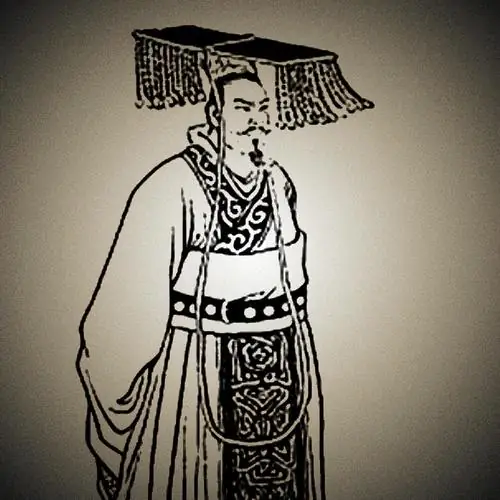
In the ninth month of 385 a column came out of the desert west of Dunhuang and turned east along the foot of the mountains. It had left Chang'an three years earlier with seventy thousand men and five thousand armored horse, a train of pack animals, a siege train, and a commission from the emperor of Qin to bring the oasis kingdoms of the Tarim under one hand. It came back smaller, slower, and carrying what armies are not built to carry: two thousand camels, more than a thousand kinds of foreign goods, horses from the far west, musicians out of Kucha, a monk out of Kucha, and a rumour that had been gaining on it for a year — that the emperor who sent it was dead, and the state that paid for it had come apart behind its back.
The man at the head of the column was in his late forties and had spent his adult life doing what the Qin court asked of a soldier of the second rank: putting down the revolts of princes, riding the long roads, arriving where the maps ended. He had been sent west to add a province to an empire. He came back to a province that had no empire, and over the next fourteen years he did the one thing that was left, which was to turn the expedition into a state. That state is the subject of this essay: how an army becomes a government, what it can and cannot carry with it, and why the most valuable thing its general took out of the west was a man he had no idea how to use.
1. The Light at Fangtou
Lü Guang was born in 337 at Fangtou, the Yellow River crossing in Ji commandery where the Di of the Fu clan had been settled by the Later Zhao a few years before, and where the whole clan was still close enough to the edge of power to be watched. His family was of the Di of Lueyang, the upland country of the upper Wei valley, one of the clans that had followed the Fu through every change of master since the wars of the 320s. His father, Lü Polou, is not a stranger to this series: he was the colonel of the capital who brought his troops to the palace gate in the coup of 357 and put Fu Jian on the throne, and he ended his career as grand commandant of Qin. The reader who has come from the essay on Fu Jian should hold the two men together. The son inherited from the father the one asset that mattered in that world and could not be earned quickly, a place in the emperor's confidence; he inherited also the father's ceiling, which was to be trusted with armies and never with the state.
The memoir makes his birth an omen. A strange light burned in the room, it says, and the child was named for it. It gives him a double pupil, a seal of flesh on the left elbow, and a height of eight feet four, which in the measures of the time is close to two metres. These are the marks the memoir supplies for founders, and a reader should take them as the memoir's opinion of the reign rather than as observation. The one detail in the chapter that reads like memory rather than manufacture is a game. At ten, it says, he was drilling the boys of the ward in the evolutions of a camp, and they let themselves be drilled. The age is one of the very few the chapter gives, and it is worth keeping, because it fixes the shape of the man's competence: he was good at making other people move together.
Wang Meng, the minister who had been found in retirement at Huayin and who had an eye for instruments, saw him and told the emperor that this was no ordinary man. The recommendation produced a magistracy at Meiyang and then a general's title, and the title was justified in 358 at Tongbi, where a commander of the fallen Later Zhao named Zhang Ping had raised the north in revolt. Zhang Ping had an adopted son, Zhang Hao, who was called the match for ten thousand men and who rode through the imperial lines more than once to show it. Lü Guang rode at him and put a spear through him. Zhang Hao survived, which the record notes without comment, and later commanded cavalry for the same emperor; the two men served in the same army for twenty years afterwards, and the record does not say what either thought of the other.
The rest of his career before the west was the ordinary work of a dynasty's armed gentry. A Di noble of the second rank was two things at once: an officer in the imperial army and the head of a household of retainers, herdsmen, and armed tenants who went where he went. The Qin state was built on that double identity. Its armies were not conscripted from a population but assembled out of the households of the great clans, each of which brought its own riders and expected to be paid in land, office, and loot. A man like Guang therefore commanded two things that only looked like one: a formation in the imperial order of battle, and a following that was his because of who his father was. The difficulty of telling those two things apart runs through the rest of his life.
In 380 a cousin of the emperor, the duke of Xingtang, raised the northeast from Helong, and Guang rode him down; it was the fourth armed revolt of the Fu clan in seventeen years, and the court noticed that the man who ended them was not of the clan. He was, by then, exactly what a court wants for a distant errand: connected enough to be given an army, not connected enough to be missed. In 382, when the emperor decided to restore the Han protectorate over the western regions, the choice of commander was not difficult. The decision itself, and the argument against its cost, belong to the essay on Fu Jian. What belongs here is the army.
2. The Army That Went West
The army that marched out of Chang'an in 382 was a slice cut out of the Qin state and sent ten thousand li away. The memoir gives it seventy thousand troops and five thousand armored horse, and does not make clear whether the horse are counted inside the seventy or added to it; the difference is five thousand men, and no decision of the campaign turned on it. Four commanders are named under him — Jiang Fei, Peng Huang, Du Jin, Kang Sheng — and the names matter less than what they represent, which is a full chain of command with no gaps. An expedition of that distance is not a raid. It has to carry its own government: paymasters, scribes, interpreters, farriers, smiths, a market, and a set of rules for what to do with a city that opens its gates and a city that does not.
The emperor's instructions survive in the memoir and have the flat, administrative sound of a man who had thought about the problem. The west, he told Guang, was not a country of rites. The way to hold it was to take it and then forgive it, to show it the majesty of the centre and teach it the method of royal transformation, and not to exhaust soldiers in the pursuit of a glory that would not pay. It is a sentence from a ruler who had spent twenty years turning conquest into government and knew that the second was the harder half. His general is unlikely to have been comforted by it. The instruction assumes that the centre will still be there to do the forgiving.
The composition of the force is the first thing to notice, because it explains everything that happened later. The mounted core were Di, the emperor's own people, drawn from the households of the capital region — the same households that the court was, in those same years, distributing among the princes and sending out to garrison the frontiers. The infantry were drawn from the old Qin heartland and from the levies of the northwest. The guides and the interpreters were men of the corridor, who had done this road for the Former Liang and for every government before it. In other words, the expedition was a small working model of the Qin: a Di command, a Chinese base, a frontier staff, and a paymaster who expected to be repaid out of the loot.
The road ran west along the Wei, up through the Lanzhou loop, past the edge of the Tibetan upland, and into the chain of oases that made the corridor. Each oasis was a day or two of water from the next, and each had a garrison, a market, and a memory of the last army that had come through. At Gaochang, the last Qin outpost, the expedition left the jurisdiction it understood. Beyond that everything was negotiation: the kings of the oasis states were not enemies to be destroyed but landlords to be persuaded, and the army's progress depended on how quickly the news of its size ran ahead of it.
The precedent the court had in mind was the Han protectorate, and the precedent was misleading. The Han had held the western regions with a few thousand men, a chain of garrisons, and a system of subsidies that made the oasis kings prefer Chinese protection to steppe extortion. That system had required constant attention and had collapsed twice. What the Qin proposed in 382 was different in scale and similar in ambition: a single deep stroke that would put the whole Tarim under one command and then leave. The difference between a protectorate and a raid is not the size of the army but the presence of a permanent administration, and the expedition carried none. Everything it did was therefore reversible, including the submission of the kings who came out to meet it.
Then the desert. The memoir gives three hundred li without water, and the panic that any column would feel at the point where the last well is behind and the next is a rumour. It has Guang steady the men with the story of Li Guangli, the Han general who had marched this way against Dayuan and whose sincerity, the old books said, had drawn water out of the sand. It then has the sky open and the rain come down, which is the sort of weather a memoir arranges for its founders. The rain is the first of two signs in this story that the west was on his side; the second would come three years later, in a gorge, and would be credited to somebody else.
3. Karashahr and Kucha
The first kingdom to meet him was Karashahr, the state between the desert and the mountains, whose king came out with the kings of his neighbours and submitted without a battle. That submission is the reason the campaign worked: the corridor of the Tarim is a chain of small states that survive by reading the balance of power correctly, and one clean submission is worth more than a siege. The second kingdom did not read it correctly. Kucha, the largest of the northern oases, closed its gates under a king the memoir calls Bo Chun, and waited behind its walls for the horse of the far west.
Kucha was not a barbarian camp. It was a city of towers and shrines, with a royal house that had ruled for centuries, a script of its own, a coinage, and a Buddhist establishment large enough to make it one of the two or three centres of the religion north of the mountains. Its king had married into the horse peoples beyond the Ili, and when he sent for help he got it. The memoir gives the relief army two hundred thousand horse from the Kuai Hu, a people of the far west, and then adds the levies of Wensu and Weitou and arrives at a total above seven hundred thousand. These numbers are not usable. They are the arithmetic of a frontier report in which the enemy is counted by the smoke on the horizon, and they have been repeated by every later book because nobody in China could check them. What can be said is that the relieving force was large, that it was cavalry, and that it arrived after the siege had already begun.
The battle is described as a problem of formation, which is the one technical passage in the memoir and therefore the one most likely to preserve something real. The problem was that infantry in the open cannot survive a charge of horse; the solution the memoir calls hooks and locks, a way of chaining the units to one another so that a charge could not open a lane between them. The description is vague, because the men who wrote it had never seen the device, but the principle is clear enough: he made his army into a wall with archers behind it, and let the horse break itself against the wall. The relief army broke. The pursuit went on for a day and a half, and the king of Kucha abandoned his city and went west.
The city that opened to him was not a treasure house in the sense his soldiers understood. Its wealth was in institutions: monasteries with endowments of land and water, scriptoria, schools where the canon was copied and commented on in a script that nobody in the Qin army could read, and a clergy that ran the calendar, the hospitals, and a good part of the credit. A Chinese army entering Kucha in 384 was entering a society more literate than its own in everything except history. The memoir notices the towers and the palaces, because those were what its authors could describe. The deeper fact is that the expedition had walked into the eastern edge of a world of texts, and had brought with it one man who could read them and no institution that wanted them read.
What Guang did in Kucha is the measure of the man. He did not burn it. He walked through the palace, which the memoir describes as built on a scale that reminded his officers of the imperial palaces at home, and he did something that no purely military commander would have thought of: he asked the literary man on his staff, Duan Ye, to write a poem about it. The poem is lost. Its existence is the point. A general who has just taken the richest city in the west and who wants a fu on the palace is a man who understands that a state needs a culture, and who has none of his own to bring.
The settlement he imposed was equally revealing. He set a king of his own choosing on the throne, took hostages, collected the tribute of the neighbouring states, and prepared to go home. He did not garrison the oases. He did not take a census, appoint governors, or link the cities by roads and post stations. The Han had done those things, and the Tang would do them later; the Qin in 384 did not have the men or the years. What Guang had won was not a province but a source — of horses, of goods, of musicians, of prestige — and he spent the rest of his life trying to convert the proceeds of a raid into the revenue of a state.
The loot alone would have made the campaign famous. The memoir counts two thousand camels, more than ten thousand horses, and a collection of foreign goods, instruments, and performers that later entered the inventories of the Liang courts. It also records the thing that mattered most and is easiest to overlook: he brought back the musicians. The music of Kucha, with its modes and its drums, would outlast every institution he founded, and would be written into the history of Chinese music under the name of the music of Liang.
4. The Monk
Among the prisoners taken at Kucha was a man of about forty, slight, shaven, with no household and no treasure, and worth more than the city. His name was Kumarajiva. He had been born there, traditionally in 344, to an Indian father who had renounced a minister's career and a mother who was the king's sister; he had been taken as a boy to Kashmir and to Kashgar, had mastered the doctrine of the Middle Way under teachers who had themselves studied in the west, and had come home to be the teacher of his own city. By the 370s his name had reached Chang'an. The emperor of Qin had asked for him in the instructions to Guang, and had asked in the language of a man who collected learned monks the way other men collected horses.
Guang looked at him and saw nothing. This is not a moral judgment; it is a description of a category. A Di general from the upper Wei valley had a working knowledge of horses, grain, fortification, and the temper of soldiers. He had no way of measuring a man whose only possession was a text. The memoir says he found the monk young for his reputation and treated him as an ordinary man, and the Buddhist biographies fill in what that meant. He had the king's daughter brought to the monk's quarters; the monk refused; Guang had wine brought and shut the door. The record says the monk submitted. It does not describe the night, and this essay will not supply what the record leaves out. Later he made him ride a bull, and then a horse that had not been broken. The monk fell. The general laughed.
The story is told at length in the monk's biographies and briefly in the dynastic history, and it is a story with work to do. It explains how a monk under vow came to have a wife, which the communities that venerated him needed explained. It also makes the man who held him a boor, which the communities that venerated him had every reason to do. Both purposes can be served by a true story, and neither proves it false. What is certain is the shape of the year: the most learned Buddhist in the Tarim spent his first year of captivity being taught that his learning counted for nothing.
Then something changed, and the change is recorded in the only idiom a soldier respects. On the road home, in the mountains, the column camped in a gorge. The monk said the camp would be swept away and asked that it be moved to the high ground. Guang did not move it. In the night the storm came down the valley, the water rose several fathoms, and several thousand men drowned. After that the general listened to him — not as a teacher, but as a man listens to a diviner who has been right once. It was the beginning of sixteen years in which the monk was consulted about weather, omens, and the timing of marches, and never once about the meaning of a text.
5. The Road Home
The news that turned the expedition around reached Kucha late. In 383 the emperor had taken the southern war to the Fei river and lost it, and the Qin state had begun to come apart at a speed that no one in the west could imagine. The news arrived in fragments: first that the southern campaign had failed, then that the north was in revolt, then that the emperor's own generals had turned on him. Guang's army was, by 385, the last intact field force the Qin had. He had a decision to make that no commander in his position had made before, which was whether to keep the west.
The monk advised going east, and the advice has the ring of a man who wanted to leave. The west, he said, was a land of ill omen; it was not a place to linger; on the road there would be a place of blessing. Whether the advice was strategy or home-sickness cannot now be separated. What is clear is that the army was not equipped to govern what it had taken, and that its general had begun to understand that a state built at Kucha would have to be built out of oasis revenue and oasis soldiers, with a Chinese staff and a Di command, ten thousand li from any reserve of either. He turned back.
The return march is the part of the story the memoir tells worst, because it was a retreat and the memoir has no interest in retreats. We know the shape of it: the column came back through the northern oases, past Karashahr, to Gaochang, and then along the corridor toward Dunhuang and Guzang, with the loot and the prisoners and the musicians, and with a growing sense that the country ahead had changed. At Gaochang the local governor, a Qin appointee, sent word east that the returning army was strong and should be stopped at the border. The warning reached Guzang before the army did.
Liang Xi, the Qin governor of Liang province, had held the corridor for a decade and had done it well; the memoir, which has no reason to flatter him, says the province was at peace under him. He refused to recognize a general who had come back from the west without orders. It is the correct constitutional position, and it was also a sentence of death. Guang beat the provincial troops in the field west of the city, appeared before Guzang, and waited. The city was opened from inside by its own officers. Liang Xi was taken and killed.
The killing is the hinge of the whole story and the memoir passes over it quickly, because the memoir is on the winner's side: it is a chapter of the Jin shu, put into its present form in the seventh century out of histories kept by the houses that came after him. A Qin general had destroyed a Qin governor with a Qin army, in a province he had no commission to govern, in the name of an emperor whose authority he was in the act of replacing. Everything that followed — the titles, the reign names, the posthumous honors — was an attempt to make that act look like a homecoming. In the ninth month of 385 he called himself governor of Liang province, a title that still belonged to a state which no longer existed.
The province he had taken was the most Chinese place in the northwest. The Zhangs had ruled it for seventy years, had kept the Jin calendar and the Jin offices, had built schools, and had made Guzang a city of palaces, granaries, and markets. Its population was layered like the strata of a tell: the old Han households of the four commanderies; the descendants of the exiles and refugees who had come west during the collapse of the Jin; a merchant class that ran the caravan trade and included families from Sogdiana and the oases; a Chinese gentry that supplied the clerks; and, around them, the pastoral peoples of the corridor and the mountains, who supplied the horses. The Zhangs had ruled this society by being more Chinese than their neighbours and more local than any Chinese court. Guang arrived with an army and a commission, and inherited the administration without inheriting the marriage alliances, the local cults, and the seventy years of routine that had made the Zhangs acceptable.
The next year the news of the emperor's death caught up with him. He put the army in white at the south of the city and mourned a man who had been dead for months, and he gave the dead emperor a posthumous name of his own, Wenzhao, the Cultured and Luminous, which no other court would use. Then he took the titles of regional lord and duke of Jiuquan, and began to count years from a reign of his own, Tai'an, the Great Peace. The sequence is exact and entirely legible: mourning first, because the mourning was the source of his authority; the new titles second, because the authority had to be transferred from the dead man to himself; the reign name third, because a reign name is what a state has instead of a permission.
6. A State Called Liang
The state that took shape at Guzang between 386 and 396 was built in stages, and each stage was a response to something outside. In 386 he was a duke and a regional lord with a reign name; in 389 he was king of the Three Rivers, with a full set of central offices; in 396 he was Heavenly King, and his state had a name of its own. The titles climb, and the climb tracks the disappearance of alternatives: as the Qin remnant in the east lost its last coherence, the man in the west had less and less reason to describe himself as anyone's officer. It is the ordinary rhythm of a frontier succession, and it produced an unordinary result — a state whose name was a province.
The reign names carry the same story in three steps: Tai'an, the Great Peace, from 386; Linjia from 389, the year of the royal title; Longfei, the Flying Dragon, from 396, the year of the heavenly one. Each name is a claim about the times rather than a date, and each was chosen at a moment when the times visibly contradicted it. That is normal. What is not normal is the last title. In 396 he took the style of Heavenly King rather than emperor, which was the choice Fu Jian had made before him and which the northern courts made when they wanted the substance of the mandate without the sacrifices that went with the name. A Heavenly King rules; an emperor also performs. By stopping one step short of the emperor's title, Guang kept the form of a man who might still, one day, be confirmed by somebody else, and he died without ever having been confirmed.
What he declared in 386 was not a dynasty but a piece of ground: Liang was the name the Jin registers had given the corridor, and he took it because it was the only word under which the Di officers, the commandery gentry, and the caravan towns would all answer to one man; the state he later called Great Liang kept that word. A name that belongs to a place is cheap to take and hard to make sacred: it tells the soldiers where they are, not why they should die there.
The Three Rivers are not in the west. Sanhe, in the older usage, means the metropolitan commanderies of Henan, Henei, and Hedong — the heartland of the old dynasties, the country between the capitals. A man who had spent three years beyond the desert and who now ruled a corridor from Guzang chose for his royal title the name of the region he had left. It may have been a title taken because it was honorific and available. It is also a precise piece of evidence about what he thought he was doing: he was not the king of a new country in the west, he was a claimant to the old country in the east, temporarily resident in a province.
The institutions were copied from the Qin, which is to say from the Chinese state as it had been administered in the fourth century. There were central offices, an heir apparent, a household, a treasury, and a staff of literary attendants whose job was to produce the documents a state needs. The men who filled the civil offices were largely the gentry of the corridor, the families that had served the Zhangs and before them the Jin and before them the Wei; they were competent, literate, and loyal to the office rather than the man. The men who commanded the armies were Di, and increasingly they were his sons and brothers. That division of labour is the classic frontier arrangement, and it works as long as the two halves need each other.
The revenue was the corridor's, which is to say the tolls and markets of a road between China and the oases, plus the agricultural surplus of the Wuwei oasis, plus whatever the western campaigns had brought home. The memoir is not interested in finance, and this is itself information: a state that had solved its fiscal problem would have left traces of how. What the record does show is a government living off a stock rather than a flow — the treasure of Kucha spent on donatives, the horses of the west used up in cavalry charges, the prestige of the western victory thinning with every year that no new victory came.
The ceremonial side of the state is almost invisible. There is no account of sacrifices to heaven, no great ancestral temple with its registers, no law code, no examination, no academy. This may be an accident of the sources. It is more likely a fact. A regime founded by a soldier in a frontier city, staffed by local clerks and Di officers, at war on three sides for most of its life, did not have the leisure for the theatre of legitimacy, and the absence of the theatre is why its legitimacy never became routine. The Heavenly King of 396 was still, in the eyes of his neighbours and probably in his own, a general who had done well.
7. The Monk in the Courtyard
For sixteen years Kumarajiva lived at Guzang. The Buddhist biographies give the figure as seventeen, counting from the sack of Kucha in 384 to his entry into Chang'an in 401; counting from his arrival at Guzang in 385 it is sixteen. The difference is a year and a definition, and the sources support both. What matters is that the years were spent in a city that had no use for him.
He was not imprisoned. The memoir and the biographies agree that he moved about, was consulted, and was treated with the respect owed to a valuable object. He learned Chinese, which he had not known before, and learned it well enough to spend the rest of his life making one of the great translations of the tradition; the years at Guzang are the years in which the language was acquired. He had no congregation of his own, no scriptorium, no commission, and no patron who wanted a book. He had a courtyard, a staff, and the occasional request for a prediction.
The language is the part of those years that can be measured. Chinese Buddhist vocabulary in the fourth century was still being made. Translators before him had worked in the south and in the north, had coined terms by borrowing from Daoist metaphysics, and had produced versions that were sometimes elegant and often wrong; the great project of the fifth century would be to replace those coinages with a technical language that could carry an Indian argument without dissolving it into Chinese poetry. A man who spent sixteen years in a frontier city, speaking the dialect of the corridor to soldiers and merchants, was doing the apprenticeship for that project without knowing it. He was also learning what a Chinese court would and would not accept in a text, which is a thing no translator can learn from books.
The reason is structural rather than personal. Translation is a state enterprise. It requires a patron who wants the text for reasons of his own, a college of monks and scribes, a supply of paper and ink, a fixed budget, and years of peace. The Later Qin would eventually assemble all of it at Chang'an, under an emperor who wanted the Buddhist church for the same reason he wanted the Confucian schools, because a state needs a doctrine. Guang wanted none of it. His court wanted to know whether the harvest would hold and whether the western campaign would pay, and a monk who could read the sky was useful in a way that a monk who could read Nagarjuna was not.
There is a second reason, which the sources do not state and which the pattern of the reign suggests. A translator's authority is independent of the throne. He speaks for a text that the king did not write and cannot amend, and the community that gathers around him owes its first loyalty to the doctrine. A general who had spent his life making other men move together had every reason to prefer a holy man who told him about the weather. The one kind of power he understood was command; the one kind he could not absorb was scripture. The monk was kept, fed, consulted, and left unread, like a library in a language nobody at court had learned.
The end of the arrangement belongs to another essay. In 401 the Later Qin's army came down the corridor; the last of the Lü submitted as a vassal and sent the monk east. The city itself was handed over two years later, where within a year he was at work. This essay stops at the handover, and notes only the symmetry: the state that held the man for sixteen years produced no book, and the state that took him produced the books that made his name. The Later Liang had the most valuable intellectual property in Asia in its courtyard, and used it to forecast rain.
8. Three Frontiers
The military history of the reign is a history of three small wars that could not be won and could not be avoided. To the south and west, in the loop of the Yellow River above Lanzhou, the Western Qin of the Qifu had been building a state out of the ruins of the Qin since 385. To the south-west, in the valley of the Huangshui, the Tufa, a Xianbei people who had guarded the passes for every dynasty in turn, were watching the corridor's weakness. To the north, beyond the wall and the Zhangye plain, the Juqu, a frontier people whose chiefs claimed a Xiongnu office and had served the Qin as nobility, were the natural leaders of any rising among the horsemen of the Hexi.
With the Western Qin the war was a long attrition over the river towns: his armies went up the Yellow River and came back, the Qifu raided the oases and withdrew, and at least one of his brothers was killed in an ambush in the hills. With the Tufa the war was quicker: their chief declared himself a king in 397, took Ledu for his capital the next year, and within two years had pushed the Later Liang's garrisons back to the river and closed the southern road. With the Juqu the war was made by an act of his own. When a campaign against the Qifu failed and a brother was killed, he executed the Juqu elder who had ridden with the army, Juqu Luochou, and his brother; within months the Juqu had risen north of Zhangye behind a Chinese official of his own government, Duan Ye, the man who had written the fu on the palace at Kucha.
The execution was an ordinary thing for a frontier general to do, and it was the most expensive decision of the reign. It told every noble house in the corridor that service in his army was a risk to be hedged, and it handed the rising a leader who was not a Juqu at all but a clerk of his own, which made the new state look less like a barbarian revolt and more like a government. The pen of the regime became the lord of its enemies.
By the end of 397 the corridor had four governments on it: the Later Liang at Guzang, the Northern Liang at Zhangye, the Southern Liang in the Ledu valley, and the Western Qin at Jincheng. Two of them had been created within twelve months, and both had been created out of the Later Liang's own frontier. This is the point at which the structural argument of the reign becomes visible. A state that rules through a mobile army can survive one frontier war. It cannot survive three, because each one consumes the same reserve of men, and the reserve is not being replaced. The Di households that had marched west in 382 were now the only loyal population the regime had, and they were finite.
The four states that now shared the corridor were not a system. They were a queue. Each of them wanted the whole corridor and none of them had the strength to take it, so each spent its diplomacy on the same two moves: marry a neighbour's daughter and ask the strongest power in the east to recognize its title. The strongest power in the east was the Later Qin at Chang'an, which had inherited the Qin's central administration, its claims, and its appetite, and which understood that the corridor could be had by waiting. Guang understood this too, which is why the last years of his reign are a series of embassies and titles rather than a series of battles. He was looking for a great power to be confirmed by, at the same time as the great power was looking for a pretext to come west. In 401 it found one.
The internal history of the last years is thin in the sources and unpleasant in what it does show. The army was commanded by the royal house: sons, nephews, brothers, each with a wing and a following. The civil government was in the hands of corridor families whose loyalty was to the office. Between the two stood the old man, who had been a good commander and was not a good politician, and who dealt with the rivalry of his sons the way he had dealt with frontier nobles, by executing the one he suspected. The memoir records the executions without commentary. The effect was to teach every man in Guzang that proximity to the throne was dangerous and that the throne was worth having.
9. The Last Year
He fell ill in 399, and the arrangements he made are the clearest statement of what he thought he had built. He named his heir, the son of his wife, and then took the title of retired emperor — a title that in the usage of the age meant a living ancestor rather than a retired official, and one that says a great deal about a man who could not imagine ceasing to be the centre of his own government. To his eldest son, born of a concubine and already at the head of the troops, he gave the command. To another of his kin he gave the seals and the paperwork. To the heir he gave the instruction to do nothing, and to let his brothers do the work.
The memoir has him say it in the flat imperative of a man giving orders on a dying bed: the three enemies are watching from three sides; after I am gone, let one brother command the armies and the other hold the government, and do you keep still and let them. It is a plan of remarkable honesty. It admits that the heir is not able to govern, that the army belongs to a brother, and that the administration belongs to another. It is also, as a constitution, a description of a coup. Three men were told in advance exactly what each of them had, and none of them was told that he had less than the others.
He died at sixty-three, which is the figure from which this essay's birth year is calculated, and was given the posthumous name Yiwu, the Benign and Martial, with the temple name Taizu. The memoir does not name the hand that conferred them. The grant belongs to the weeks after the death, when the heir held Guzang, and it is safe to say that it was made by the court that the dead man had arranged and not by any authority outside the corridor. The title is a fair summary of the life: benign in intention, martial in method, and unable to make the transition from one to the other.
The four years that followed are the subject of another essay. It is enough here to record the arithmetic. The state he founded in 386 outlived him by four years and lasted seventeen in all, and it was destroyed not by any of the three enemies on its frontiers but by the arrangement he had made for his own succession. The sons he had told to share the government killed each other in the order he had predicted, and the last of them handed the city to the Later Qin in 403. A state built out of an army dissolved in the way armies do, by a quarrel over the command.
10. What the Army Brought Back
The problem of the Later Liang can be stated in one sentence: its army was the army of a western expedition, its household was the household of a western expedition, and the country it ruled was neither. The Di who made up the mounted core had come with the army and had no farms, no shrines, and no cousins in the villages around Guzang. The Chinese staff had been recruited from the corridor's gentry, who had served every regime and would serve the next. The craftsmen, the musicians, the monks, and the merchants were imports. A state can be built out of such materials, but it has to be built deliberately, over generations, by men who understand that an army is not a society.
He never made that transition, and the reasons were structural rather than personal. The first was demographic. The Di of the capital region had been scattered by the emperor in 380 and destroyed as a political community by the wars of 384 to 394; there was no reserve of Di households in the east to reinforce the colony at Guzang. The second was fiscal. The corridor's revenue came from transit, and transit requires peace on the roads, and the roads were at war from 395. The third was legitimacy. His authority came from a commission granted by an emperor who had ceased to exist, and every title he took afterwards was an attempt to launder that commission into something that could be inherited. The laundering did not work. A state whose founder's mandate is a dead man's letter has no way to make the second generation legitimate.
The city itself outlived the state, as cities do, and changed hands without changing character. Guzang passed to the Northern Liang, then to the Wei, and the foreign quarter that Guang's campaigns had filled went on trading and playing. What did not survive was the community that had made the Later Liang possible: the Di households of the western expedition. Cut off from the Di of the capital region after 385, surrounded by a population that had its own gentry, its own cults, and its own memory of the Zhangs, they did what garrisons do when they stop being an army. They dispersed into the society they had conquered, took local wives, took local names, and disappeared as a political body within two generations. The state had been their estate. When the estate was divided among the heirs, there was nothing left to inherit but the name.
The imports are another matter, and they are what the reign is remembered for. The music of Kucha came back with the army and stayed in Liangzhou, where it was blended with Chinese and other western modes; the Sui shu's chapter on music traces the music of Western Liang to the end of the Fu house, when Guang and Juqu Mengxun held the province and modified the Kuchean modes. That music entered the repertoire of the northern courts and, through them, of the Tang. It is a strange and entirely characteristic legacy: a state that could not produce a law code produced a scale.
The other import was the monk, and the symmetry of his fate is the last thing this essay wants to leave in the reader's mind. Guang took him out of a city that had venerated him, kept him for sixteen years in a courtyard, and used him to predict the weather. The Later Qin took him and gave him a workshop, and the books that came out of that workshop are among the foundations of Chinese Buddhism. It would be easy to make this a moral about the general's philistinism. The point is colder. A state is a machine for converting power into institutions, and the Later Liang had the power and not the machine. It could take Kucha and could not make a province of it; it could take the greatest scholar of the age and could not make a text of him; it could take the corridor and could not make a country of it. What it could do was march, and it marched well, and that was not enough.
The last image belongs to the road. The column that had come out of the desert in 385 carried camels, horses, musicians, and a prisoner, and behind it the west was already closing again, the oasis kings returning to their own quarrels, the Qin dissolving, the corridor about to divide into four. The man at its head had fourteen years left, and he spent them doing the hardest thing a soldier can be asked to do, which is to build something that will stand when the marching stops. He did not manage it. The state he built lasted long enough to be counted among the Liang, and long enough to hand its monk to a better-equipped rival, and not long enough to be remembered for anything except the two things it carried out of the west: a tune and a man it did not read.