Home / Emperors / Three Kingdoms
Emperor Xiaohuai of Shu Han
汉孝怀帝
Liu Shan, 207 – 271 · second and last emperor of Shu Han
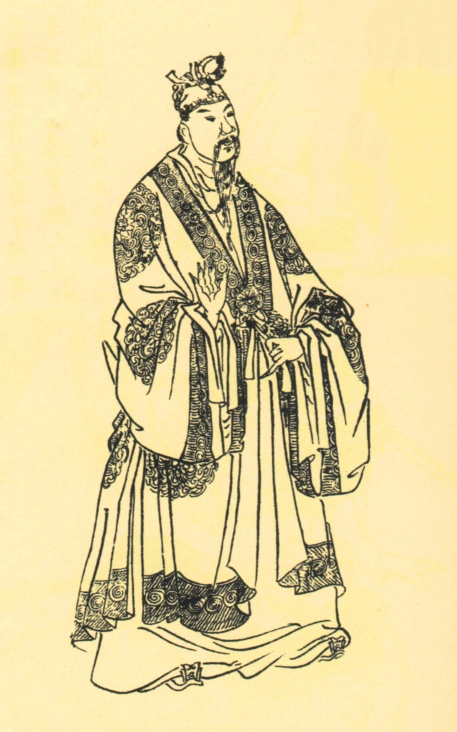
In the fifth month of 223, a boy of seventeen took the throne of a state that was two years old. His father had died in a palace at the mouth of the Yangtze gorges in the fourth month, and the boy was in Chengdu, where the court had been left. He reigned for forty-one years. In that time he never led an army, never left his own territory on a campaign, never moved his capital, never carried out a proscription, and of the ministers he put to death the record remembers one. He surrendered in the winter of 263, at the approach of an enemy column that had marched seven hundred li through uninhabited mountains and was by then close to starving. He was taken to Luoyang, given a fief and a title, and died there eight years later at sixty-five, which in the third century was old.
The verdict of his own historian is unusually gentle and unusually damning. Chen Shou wrote that he was a lawful ruler under a wise minister and a benighted one under a eunuch, and quoted an older saying to explain it: plain silk has no fixed colour, and takes whatever it is dipped in. It is a judgement about a man who is not there. Liu Shan's one political skill was the transfer of authority to somebody else, and he exercised it four times. Each transfer was, at the moment it was made, the reasonable thing to do, and each left Shu Han weaker than the one before. This is the record of the four, and of the country that was spent paying for them.
1. The Heir of a Year-Old Kingdom
He was born in 207, in the part of Jing province where his father was then a guest of Liu Biao, and his mother was a concubine of the household named Gan. Of his childhood nothing is recorded that can be trusted. The Wei Lue, a Wei compilation of the next century, has a long story in which the boy was separated from his father in a rout, carried west into Hanzhong, sold, bought by a man of Fufeng, brought up as a son, married, and only recovered years later through a neighbour who knew his father's style-name; it is a good story and almost certainly false. Pei Songzhi, annotating Chen Shou a century and a half later, took it apart point by point: the boy was born in Jing province according to the memoir of the consorts, he was seventeen when he took the throne according to his own memoir, and therefore born in 207, which is seven years after the rout at Xiaopei in which the Wei Lue has him lost; and neither the histories nor the collected papers of Zhuge Liang show that Zhuge Liang was ever his tutor in the way the story requires. Pei's conclusion is blunt. He calls the passage a fabrication of more than two hundred characters, and notes that the Wei Lue has got even the tutoring wrong.
The same compilation is the only source for the sentence with which his reign has always been described. In 219 his father took the title King of Hanzhong and made him heir; in 221, when the king took the imperial title, he was made heir apparent, and the patent was carried to him by the chancellor. The Wei Lue says that when he came to the throne the government was handed over to Zhuge Liang with a formula that has never been forgotten: the administration belongs to the Ge family, and the sacrifices belong to me. Pei Songzhi's demolition of the surrounding passage is the reason historians handle the sentence with tongs. Chen Shou, who had no interest in the Wei Lue's inventions, put it plainly in his account of the chancellor: affairs great and small were all decided by Liang.
He came to power inside a crisis that nobody had yet mastered. Shu Han had declared itself in 221; in 222 its army had been destroyed on the Yangtze; the disaster and the testament that followed it belong to the life of his father. What belongs here is the second half of that testament. In the sentence most often quoted from it, the dying man told his chancellor that if the heir could be supported he should be supported, and if he was not fit for it, the chancellor should take the state himself. The boy who inherited that sentence was seventeen and had spent his life in a house that was at war. He had one minister who had governed the state, one minister who had commanded its armies, and a court full of men whose provinces had been attached to the house only within the last decade.
The arrangement that was made was not a regency in name. Zhuge Liang was chancellor, held the secretariat, carried the staff of authority, and in the second year of the reign was given the governorship of Yi province, the office that carried the actual administration of the territory; he had been made marquis of Wuxiang and permitted to open his own office.
A second man had been named in the testament. Li Yan, who had commanded in the east and was left to hold Yongan, was given the office of chief guard, the command of the armies inside and outside the capital, and the defence of the gorge. For four years the two of them worked together, and then for five the arrangement decayed; in 231, with a campaign stalled and the supply of grain broken, Liang had Li Yan's conduct examined, and Li Yan was stripped and sent as a commoner to Zitong, where he died. The emperor, then twenty-four, neither prevented it nor is recorded to have questioned it.
The first year shows what the court was up against. In the summer of 223 the administrator of Zangke, Zhu Bao, rose in his commandery and killed the provincial officer who had come to examine him; in the same months a great clan of Yi province, the Yong of the old capital commandery, turned against the governor, drove him into the hands of Wu, and refused to submit; and in the far south-west the Yi chief Gao Ding also revolted. That same year, in the middle of it, Liu Shan made his wife empress: the eldest daughter of Zhang Fei, whom he had married two years before. And that same year he sent an officer to Wu, Deng Zhi, to patch together the alliance that his father had broken, because without Wu there was no eastern flank and no trade.
In the second year he did the other thing a new government can do. The entry in his memoir for 224 is four words long: work the fields and gather grain, close the passes and let the people rest. The chancellor took the governorship that year and wrote to a scholar of the old school in Zitong to invite him to court, and the letter contains the only description of the young emperor written by a man who was working with him: the court's lord is eighteen this year, of a humane and quick nature, a lover of virtue and deferential to scholars. He was eighteen in 224 by Chinese reckoning, which confirms the birth year Pei Songzhi had reconstructed.
2. The Regent's Eleven Years
The southern campaign came first, because the south had to be settled before the north could be attempted. In the third month of 225 the chancellor took four commanderies in the south-west, and by the autumn they were pacified, and in the twelfth month he was back in Chengdu. The commanderies were reorganised afterwards: the old Yi province commandery, the one that had produced the revolt, was cut up into new units and given new names. The memorial the chancellor wrote to the throne two years later, on the eve of the northern campaigns, contains the line that is the only surviving description of the march: in the fifth month we crossed the Lu, and went deep into country that does not grow grain.
The tradition that has attached itself to this campaign is the seven captures and seven releases of the southern chief Meng Huo, and it needs to be kept separate from the record. Chen Shou's biography of the chancellor says only that the south was pacified in the autumn. The anecdote comes from the Han Jin Chun Qiu, a chronicle written in the Eastern Jin by Xi Zuochi and preserved through Pei Songzhi's notes, and it also appears, in another form, in the Records of Huayang by Chang Qu, a man of Shu writing in the fourth century. Both are a century or more after the event. The tradition may record something real, the more so because a pacification that ends in the employment of the defeated chief as a local governor is exactly what the record does show. But the number seven is a number no early source gives, and it should be understood as belonging to the story and not to the reign.
The northern campaigns are the heart of the eleven years and the source of the country's exhaustion. Five of them are usually counted, spread across seven years. In the spring of 228 the chancellor went out to Qishan and was defeated at Jieting, where his forward commander Ma Su disobeyed his orders and lost the position, and the commander was executed. In the winter of the same year he went out by the San Pass and besieged Chencang, and came away because the grain ran out, though he turned on his pursuer and killed the general Wang Shuang. In 229 he took Wudu and Yinping by a subordinate, and the two commanderies in the mountains north-west of the capital became Shu Han's for the rest of its life. In 230 the Wei court sent three columns against Hanzhong and the rain broke the roads, so that the campaign ended without a battle. In 231 he went again to Qishan, moved his grain by the wooden ox, the mechanical carrier the histories credit to him, and on the retreat killed the Wei general Zhang He with an arrow. In 233 he collected grain at the mouth of the Xie valley, and in the second month of 234 he came out through the valley for the last time, with the flowing horse, the second of his carriers, and sat down on the plain of Wuzhang to wait for the Wei army to come out and fight it.
They did not come out. The Wei commander Sima Yi took the defensive, and the two armies faced each other across the plain through the summer while the Shu troops grew grain in the fields beside their camp. In the eighth month of 234 Zhuge Liang died in camp. He was fifty-four.
The emperor put on plain cloth and mourned for three days. He gave the dead man the posthumous name of Loyal and Martial, and the patent he issued says that the man had received the orphan from the former emperor and upheld the line, and that a man's merit and conduct should be recorded so that it could be published to the future. Then a minister of Yi province named Li Miao sent up a memorial whose argument was that the chancellor had held a strong army and looked on the court like a wolf or a tiger, that a minister with that kind of power in the field is a danger the classics warn against, and that his death was therefore a matter for congratulation and a cause for general rejoicing. The emperor's reaction is recorded in a single line of the local history: he was angry, and had him put in prison and killed.
Chen Shou did not include the killing in his memoir; the story survives only because Chang Qu, the historian of Shu, thought Li Miao worth a notice.
The other matter that year is smaller and has been read as evidence of resentment. The chancellor died in the eighth month; the court refused, when the request came, to authorise a shrine to him in the capital, on the ground that the rites provide temples for rulers and not for their ministers. The people of the districts went on sacrificing to him in the lanes and at the crossroads, and the court could not stop them. Years later two officials, Xi Long and Xiang Chong, argued that a private cult at the corners of the streets was worse disorder than a sanctioned one, and asked that a shrine be allowed at Mianyang, near the grave in the hills. In the spring of 263, twenty-nine years after the death, the emperor gave the order. By then the state had nine months to live.
Two things died with the chancellor and have to be separated, because the emperor handled them differently. The first was the office. No one after Zhuge Liang was made chancellor of Shu Han. The chancellorship was not abolished by an edict and no historian says it was; it was simply not filled again, and the highest offices of the rest of the reign were the secretaryship, the grand generalship and the grand marshalship. The arrangement dates from the first month after the death. The second thing that died was a quarrel. The two men who had commanded the retreat from the Wuzhang plain wrote to the capital accusing each other of treason, the general Wei Yan and the chief secretary Yang Yi, and before the matter was settled Wei Yan was dead and his head was sent in, and Yang Yi was made a commoner the next year and killed himself in exile. The emperor, then twenty-eight, confirmed the outcome and appointed nobody to the office that had caused it.
3. The First Successor
The man who took over was chosen by the dead chancellor. Zhuge Liang had sent the emperor a secret memorial naming Jiang Wan as his successor some time before the end, and the court's first act was to make Jiang Wan director of the secretariat with the conduct of affairs; in the following spring he was made grand general, and in 239 grand marshal. He held the government for twelve years, from 234 to 246.
What the appointment produced was a change of method rather than of objective. Jiang Wan moved the headquarters of the state's military effort to Hanzhong, on the northern frontier, in 238, and kept it there; the great campaigns stopped. The line in the memoir that the first year of the era Yanxi is given to the grand general's move north is followed by seven years in which Shu Han fought almost no one. He had a plan of his own and it was not the chancellor's: instead of climbing the Qinling passes and starving on the way, he proposed to build boats and come down the Han river eastward against the Wei commanderies of Weixing and Shangyong, taking the war into the valley behind the mountains. The court did not accept it, and Chen Shou records the plan without recording who refused it. In 244 the Wei regent Cao Shuang did come against Hanzhong with a large army, and was held at the Xingshi barrier by the frontier commander Wang Ping until a relieving force under Fei Yi arrived and the Wei army withdrew. That was the last great attack on Shu Han's frontier for nineteen years, and Jiang Wan spent most of it ill in camp, and in 246 he died.
The second of the three men who governed in these years is the one Chen Shou chose to describe as the standard of the court's good order. Dong Yun was made attendant of the palace and given the command of the guards before the northern campaigns began, and the reason is in the record: the chancellor judged the emperor, who was then in his twenties, too young to tell the colours apart, and wanted a man at his elbow who would not flatter him. Dong Yun took the office and used it exactly as intended, correcting the emperor to his face and rebuking the eunuch Huang Hao in front of the court. In all the years Dong Yun lived, the histories say, the highest post Huang Hao ever obtained was keeper of the yellow gate; the eunuch came into the palace, saw the attendant's face, and did nothing.
Dong Yun died in the ninth year of the era Yanxi, which was 246, in the same winter as Jiang Wan. Fei Yi had been director of the secretariat since 243 and became grand general the next year; after Jiang Wan's death he was the government.
In 236 he went out of the capital once, to a place called Jian in the commandery of Shu, where he climbed the observation slope and looked at the river for ten days, and the entry is preserved because it was the only trip of the kind in fifty years of record; the same year's dossier notes the resettlement of some four hundred households of a Di chieftain from Wudu to the capital. In 238, on the occasion of taking a new empress and naming an heir, he changed the era name for the first time in fifteen years and issued a general amnesty. In 249 the Wei general Xiahou Ba, whose family had been destroyed in the coup that put Sima Yi in control of Wei, came over the mountains to defect, lost his way and had to walk; the emperor sent men to bring him in, and then told him, in a sentence the histories thought worth keeping, that his father had died in battle and not by the hand of anyone in this house, and he pointed to his own son and said the boy was of Xiahou blood.
The Wei Lue preserves an entry under the ninth year saying that after Jiang Wan died the emperor took the government into his own hands; Chen Shou does not corroborate it.
4. The Second Successor
The third transfer was forced by a murder, and it is the one that changed the country's direction. In the first month of 253, at the new-year assembly at Hanshou, the grand general Fei Yi was drinking and got drunk, and a man of Wei called Guo Xun, who had come over and been taken into the service, killed him with a knife. Guo Xun was himself killed afterwards. He had come into Shu Han as a defector, and the Wei histories spell his name differently and treat him as a loyalist who had volunteered for the work.
The exchange between them has come down from the Han Jin Chun Qiu. Jiang Wei, the general who had come over from Wei as a young officer in the first campaign and had risen by merit to command the frontier, wanted to raise a great army and take the west. Fei Yi restrained him, and the restraint was measured out in troops: the histories say that whenever Jiang Wei wanted to move, Fei Yi held him back and never gave him more than ten thousand men. His reason, preserved in a speech, was this: We are not the equal of the chancellor and that is a long way off, he said; the chancellor himself could not settle the middle of the empire, and how should we? Better to keep the state and govern the people, to hold our own borders with care, and to wait for someone capable of the enterprise; and not to stake the outcome of everything on a single throw out of hope. If it goes wrong, he said, it will be too late to mend.
In 253 Jiang Wei took several tens of thousands of men against Nanan and came away when the grain failed. In 254 he went out into Longxi, took Xiangwu, killed the Wei general Xu Zhi and brought back the populations of three counties. In 255 he went out again from Didao and met the Wei governor Wang Jing on the western bank of the Tao, and destroyed his army; the histories give the Wei dead as several tens of thousands. He surrounded Didao and was driven off by the Wei relief column. In 256 he was made grand general, the highest military office in the state, and went north again, and at Duangu, because the general Hu Ji failed to make the rendezvous at Shanggui, he was destroyed by Deng Ai; the phrase used of his army is that it was scattered and broke apart, and of the dead, that they were very many.
The histories say that the people murmured against him and that the whole western part of the frontier became unsettled, and that Jiang Wei, acknowledging the fault, asked to be demoted; he was reduced to general of the rear and allowed to act as grand general, and in 258 he was restored. The campaigns did not stop. In 257 he went out by the Luo valley while a rebellion in Wei drew the enemy's forces east. In 262, with the Wei court again in disorder, he took the field a last time against Deng Ai at Houhe and was beaten, and he withdrew not to the capital but to the valley of Tazhong, on the upper reaches of the Bailong river, where he quartered his army on the land.
What happened in the capital while he was out there is the decisive fact of the reign. Dong Yun had died in 246 and been replaced as palace attendant by a man named Chen Zhi, who held his instructions from the emperor above and dealt with the eunuchs below. Chen Zhi was on terms with Huang Hao, and it is under his tenure that the histories date the eunuch's entry into politics. He was also the man Jiang Wei could work with, and the two of them were connected in a way the record describes in a sentence of comparison: though Jiang Wei's rank stood above Chen Zhi's, his actual authority did not.
Chen Zhi died in the first year of the era Jingyao, which is 258, and the entry in the emperor's own memoir for that year is not about him. The astronomer of the court reported the appearance of a fortunate star; the emperor proclaimed an amnesty and changed the era name; and, in the same line, the eunuch Huang Hao began to conduct the government.
5. The Third Successor
Jiang Wei had come to fear the eunuch, and he asked the emperor to have him killed. The reply is preserved in the Records of Huayang and quoted in Pei Songzhi's notes. Huang Hao, the emperor said, is a little running servant; earlier Dong Yun used to grind his teeth at him, and I have always resented it. Why should you mind him? Then, because the general was not satisfied, the emperor had the eunuch go and make his apologies to him. Jiang Wei, seeing that the eunuch's roots ran through the whole court and that a word out of place would ruin him, made a polite withdrawal and asked to be posted out to grow wheat in Tazhong, which is what he did, and the histories give his motive in four characters: to get away from the pressure inside.
In the same period the men around the throne made their own attempt on the army. The Records of Huayang is the source for a memorial in which Zhuge Zhan, the son of the chancellor, and Dong Jue, then the senior minister, proposed to recall Jiang Wei, give him a provincial governorship, and take the troops out of his hands in favour of a general named Yan Yu, who was thought to be pliant and who was thought to be the eunuch's man. The memorial is the last piece of policy produced by the Shu Han court, and it came from the son of the founder's minister, and it did not succeed. The old men of Shu, Chang Qu adds, still remembered the story of Zhuge Zhan's memorial in his own day.
What the emperor's memoir records for 262 is smaller and stranger. The king of the Western River had died in the first month. Jiang Wei went out against Houhe in the winter and was beaten by Deng Ai and went to Tazhong. And there the record stops, because the next entry is the invasion.
Jiang Wei had been warned by a report out of Wei that the enemy was assembling in the passes, and he sent a memorial asking that the frontier commanders be moved to the two gates that mattered, Yang'an and the bridge at Yinping, before it was too late. Huang Hao consulted the spirits, was told that the enemy would not come, and advised the emperor to let the matter lie. The petition was not acted on and the court did not know it had been sent. The reason the advice was not passed on is not that the eunuch was treacherous to Shu Han. It is that the government had no practice at all of passing anything on, because for twenty-eight years the state had been run by whoever happened to be nearest the throne.
6. The Wars and the Ledger
The cost of the last thirty years is visible in a document drawn up in the winter of 263. When the emperor's officers handed over the registers to the Wei general, the inventory they gave him recorded the realm as 280,000 households, 940,000 men and women, 102,000 under arms, and 40,000 officials. The grain in store was more than 400,000 hu; there were two thousand jin each of gold and silver and two hundred thousand bolts of brocade, silk and coarse cloth.
The document is generally called the Shu Ji, and it is preserved because the Eastern Jin historian Wang Yin copied it and Pei Songzhi put it in his notes. Its nature has to be stated before its numbers are used. It is a surrender inventory, which means it counts what the treasury was responsible for rather than what people existed; the dependants and retainers of the great houses, who were the largest single block of population in the province, are not in it. The proportion of mouths to households in it, under three and a half, is far below the six or seven that the Wei and Jin registers show, which means it is not a census and cannot be treated as one. And there is a further caution. The modern scholar Ren Naiqiang argued that the figures cannot describe Shu Han at all, on the ground that a state controlling the Sichuan basin and a dozen frontier commanderies could not have been that small, and proposed that Wang Yin's document really belongs to the Cheng Han state of the fourth century, two generations later. The argument has not been accepted, and Ge Jianxiong, weighing it, found it possible but unsupported. It is fair to say that the numbers are the best available and are probably an undercount of some unknown size.
With that said, the comparison they invite is stark. The Wei registers of the same decade, as computed by Du You in the Tong Dian by subtracting the conquered Shu figures from the combined total, give some 663,000 households and 4,430,000 mouths. Shu Han, in other words, had a population under a quarter of its enemy's and a treasury that was supporting roughly one man in every seven in uniform or on the government payroll.
The military ledger of the same period is a list of expeditions that cost more than they returned. Between 238, when Jiang Wei first went out with a detached force from Hanzhong, and 262, when he was beaten at Houhe, Shu Han's armies went north perhaps a dozen times. The victories are two, and neither can be held. In 255 the battle on the Tao destroyed a Wei provincial army and is the largest field victory of the state's history, and it produced no territory and was followed within a year by the disaster at Duangu. In 254 the three counties of the upper Tao were stripped of their people and the population was moved back into the Shu plain. Against these are set the defeats, of which Duangu in 256 is the one the histories treat as decisive, because it turned the province against the war and it happened in the same year that the general was promoted to grand general.
The country's own diagnosis is preserved in a document that has nothing to do with the court. In the years when the campaigns were running, Qiao Zhou, a scholar of Baxi who had been made a palace official, wrote a short piece in the form of a debate between two invented states, one old and small and one new and large, and their spokesmen, one of whom is called the Venerable Fool. Its subject is the northern war, and its argument is that a small state lives by good government and a large one by carelessness, and that the small state cannot win by attacking. It cites the precedents the age would have accepted, Goujian of Yue and King Wen of Zhou, and then rejects the obvious counter, the example of Liu Bang, on the ground that the Qin had destroyed the old order first and the Han founder had taken advantage of a world in which nobody knew whom to follow; the present world, it says, is a world of six settled kingdoms, not a world of collapse. The conclusion is that a state in Shu Han's position can be King Wen and cannot be Liu Bang. And then the proverb: a man who shoots for luck will soon enough fall on his face, and it is better to shoot only when the mark is certain.
Qiao Zhou's other surviving memorial, sent to the emperor in the same years, is the only direct criticism of the emperor's private conduct in the whole record. He complained that the emperor had taken to going out to view the gardens and waters and to adding to his music; he reminded him that the founder's work was unfinished; and he asked him to reduce the number of musicians and the buildings added to the palace. The emperor's answer is not recorded.
The report on the state of the country that has become proverbial does not come from Shu Han at all. In 260 the Wu court sent an officer of the palace, Xue Xu, to Shu Han to ask for horses. On his return the Wu emperor asked how the government of Shu had seemed. The answer, recorded in the same Eastern Jin chronicle that carries the story of the seven captures, is in four clauses. The ruler is benighted and does not know his own faults; the ministers look after their own skins and seek to avoid blame; in their court one hears no straight words; and in the countryside the people have the colour of vegetables. Then he adds a picture from the Kong Congzi: swallows nesting in a hall, mother and chicks happy and satisfied, while the chimney cracks and the beams begin to burn, and still they are content, because they do not know what is coming.
7. The Household
Liu Shan's mother was the concubine Gan, who had borne him in Jing province in 207 and who died before his father took the throne; she was later given posthumous rank and moved to the ancestral burials. His father's empress, the lady Wu, widow of a general, was given the title of empress dowager at his accession and died in 245.
He had two wives and both of them were daughters of the same man. In 221 he took the elder daughter of Zhang Fei as his consort while he was heir, and in 223, in the first year of his reign, he made her empress. She died in 237 and was buried in the southern tumulus of the capital. Within the year he took her younger sister into the palace as a lady of honour, and in the first month of 238, on the same day that he named an heir and changed the era, he made her empress. She survived the fall of the state and went with him to Luoyang.
His first son was born in 224 to a woman of the Wang family who had been a servant of the first empress, and was made heir in 238 at the age of fifteen, with a patent that the memoir records in full and which describes the office of an heir in the phrases the classics give it. Six more sons followed. The second was made king of Anding in 238, on the same day as the heir; the third was made king of the Western River in 252; the fourth king of Xinping in 256; and in the summer of 259 the last three were made kings of Beidi, Xinxing and Shangdang on a single day. The eldest of the second rank, the third son, died in the first month of 262. Of none of them, except the one who died with a sword in his hand and the one who inherited the empty title, does the record preserve a single word.
The household's one recorded act of dignity belongs to a woman who is in the histories for a single sentence. In 264, when the Wei court gave the women of the Shu palace to its generals as wives, a lady of the Li family who held the rank of consort said that she could not be humiliated twice, and killed herself. The sentence is from the Han Jin Chun Qiu, and it stands beside the emperor's own conduct in the same year.
The record is so thin that even his name is uncertain. He was Liu Shan, styled Gongsi, and the histories also preserve a different form derived from a Wei proclamation of 228 which calls him Liu Shengzhi; the name by which he has always been known to ordinary people, Adou, appears in a single hostile letter quoted in the histories, and the Qing scholars who edited the texts argued in detail that the second character is a copyist's error for the character meaning a pint measure, so that the familiar name was really Asheng. The man who ruled the south-west for forty-one years is remembered, in the Chinese language, by a nickname that may be a scribe's mistake.
8. The Last Autumn
The campaign that ended the state was decided in Luoyang in the summer of 263. Sima Zhao had taken the title of duke of Jin the previous year and was two steps from the throne; the conquest of a rival would settle the succession he was preparing. The court was against it, on the ground that the terrain made the supply of an army impossible and that no commander could be trusted with as great an army as the enterprise required. The one senior man who supported it was Zhong Hui, who had been made inspector of the capital and who had, the histories note, his own reasons. The decision was taken. The disposition the histories give is three columns: Deng Ai with some thirty thousand from Didao against the valley of Tazhong, to hold the Shu general in place; Zhuge Xu with some thirty thousand from Qishan against the Wujie pass and the Yinping bridge, to cut off his retreat; and Zhong Hui with the main body, more than a hundred thousand, by the Xie valley, the Luo valley and the Ziwu road into Hanzhong.
The frontier they met had been reorganised by Jiang Wei himself six years before. The old system, laid down by Wei Yan and confirmed in the defence of the Xingshi barrier in 244, had garrisoned every pass in the mountain wall and made the enemy fight for each one. Jiang Wei thought that this stopped an enemy without defeating him, and had the garrisons pulled back into the two fortified cities of Han and Yue with their grain, leaving the forward passes lightly held and the roads open, on the theory that an enemy deep in the mountains with no grain and a supply line a thousand li long would come apart on his own. The theory worked against a raid. Against three columns it meant that the first obstacle Zhong Hui met was a single pass, and the pass was lost from inside. The officer commanding Yang'an, a man called Jiang Shu who had grievances, went out to the Wei camp and surrendered; the other commander, Fu Qian, fought where he stood and was killed. Zhong Hui took the pass and marched into the plain of Hanzhong without a battle, and the two fortified cities held out behind him while the road to the capital lay open.
Jiang Wei came back from Tazhong, outmanoeuvred the column sent to cut him off and joined the men sent north to meet him, and fell back on the Jian Ge pass, which is the narrowest place in the road from the north into the Shu plain. Zhong Hui attacked it and could not take it; his supply over the mountains failed; and in the eleventh month he was considering withdrawal. The invasion had failed.
What saved it was the fourth move in the campaign, which was made without permission and against orders. Deng Ai proposed to leave the pass alone, take a small force through the uninhabited country west of it, and come out behind the Shu army into the plain. He took his column across seven hundred li of mountains, opening the road as he went, and when the grain was nearly gone and the way down was a cliff he wrapped himself in felt and rolled. His force came out at Jiangyou in the plain, where the commander surrendered. He then went on to Fucheng, and the Shu response came up too late and stopped in the wrong place.
That response was led by Zhuge Zhan, the son of the chancellor, who held the guard of the capital and was sent north with the men that remained. He reached Fu and halted. His second, Huang Chong, the son of an old Shu general, told him repeatedly to push on and seize the defiles before the enemy came out of the hills, and was not heeded; the vanguard was broken; and Zhuge Zhan fell back on Mianzhu to stand there. Deng Ai offered terms and he killed the envoy and formed for battle. The battle went badly for Wei at first; Deng Ai's own son and his second in command attacked and were driven back, and Deng Ai threatened them with execution and sent them in again, and the Shu army was destroyed. Zhuge Zhan was killed and his head sent to the capital. With him died his son, then nineteen, and the sons or nephews of three of the founders' officers: Huang Chong, Li Qiu, and Zhang Zun, the grandson of Zhang Fei whose two aunts had been this emperor's two empresses. The nineteen-year-old's recorded words before he charged are the only sentence from the battle that anyone kept: that his father and he had held high office under the state and had not managed to have Huang Hao killed in time, and that there was no longer any use in living.
Chengdu was now open, the court had no field army, and the survivors met to decide. The memoir of Qiao Zhou preserves the debate. Some argued for flight to Wu, on the ground that the two states were allies; some argued for flight south to the seven commanderies of Nanzhong, on the ground that the country there was broken and defensible. Qiao Zhou answered both. There has never been a ruler who went to another state and remained a ruler, he said; going to Wu means becoming its subject; and if Wu is afterwards swallowed by Wei, the humiliation happens twice. It is the same subjection, and better to be subject to the greater than the lesser; one humiliation is better than two. As for the south, he said, that plan had to be made long ago to have any chance. The enemy is close, the disaster is at hand, and of the small men's hearts not one can be relied on; on the day we set out, something unforeseen will happen. There is no south left to go to. The court adopted his advice.
The emperor had one son who would not consent. The king of Beidi, the fifth of the seven, came into the conversation and said that if the case was hopeless and the collapse at hand, then father and son, ruler and minister, should shut the gates and fight once, and die together for the altars of the state, and so be able to face the founder. The emperor did not accept it. That day the king went and wept in the temple of his grandfather, killed his wife and children, and killed himself, and the people who saw it are said to have wept with him. The histories give him one sentence, and it is the sentence that the story of his father's surrender has been told against for seventeen centuries.
Two other offers were refused in the same days. The officer commanding the south, who had several thousand troops in the frontier commanderies, asked permission to march to the capital and was told not to come. And the general in the pass, who had the only intact army in the state and did not know yet what had happened, was sent a warrant by the emperor ordering him to lay down his arms, which he did. The men in his camp, when they understood it, cut at the rocks with their swords.
The formal surrender was managed with a competence that is oddly comforting. The document was drafted by Xi Zheng, a palace secretary who had spent thirty years in the secretariat beside Huang Hao and had never once risen above six hundred bushels of salary because he had neither flattered the eunuch nor offended him. The emperor sent an attendant of the palace, the man who had argued for surrender, and his own son-in-law to carry the seals of state to Deng Ai, and met them at Luoxian. Then he came out: the histories say he bound himself and carried a coffin on his back and went to the gate of the enemy camp. Deng Ai untied him, burned the coffin, and received him courteously, and then, acting on his own authority as a commander in the field, made him general of chariots and horsemen. A later note adds a detail that the annalists thought significant. He came in a mule cart. He did not perform the ceremonies of a conquered king.
The principality had lasted forty-three years and the emperor forty-one. It ended in the eleventh month of 263, in a year the court had renamed Hope for Revival three months before.
9. Luoyang
In the first month of 264, before the transfer of the court to the east was complete, the state came apart a second time. Zhong Hui, who had the main army and the surrendered Shu troops under the general who had been his enemy, declared against Sima Zhao in Chengdu, and the rebellion failed in three days; the histories record that Zhong Hui and Jiang Wei were killed together, and that Jiang Wei's plan, whatever it was, died with him. What followed was worse than the invasion. The troops of the two Wei armies looted Chengdu, and the dead lay unburied in the streets for several days before order was restored. Among the dead was the heir, the son of 224 who had been made heir in 238 and was then forty. He was killed by stragglers in his own city.
In the third month of that year the emperor, his household and what remained of the court came east to Luoyang, and the young Wei emperor, at the direction of Sima Zhao, issued the patent that made him duke of Anle. The document is a long piece of court prose which recounts the history of the Han and remarks that the people had not been able to live in peace for nearly five decades; it praises him for not having been too proud to bend, for having valued the preservation of the people above his own position, and for having submitted at the right time, and then sets out the terms: a fief of ten thousand households, ten thousand bolts of silk, a hundred servants, and a rank that his sons could succeed to. Fifty or more of his sons and grandsons were given the rank of commandant and fiefs. Five of the men who had come east with him were made marquises, among them the old director of the secretariat, the man who had argued for surrender, and Xi Zheng, who had drafted the surrender.
Of the whole court, two men made the journey in attendance on him. One was the officer of the palace guard. The other was Xi Zheng, who left his own wife and children behind to go. It was Xi Zheng who taught him the forms of the new court, so that when he met the Wei officials he did not commit the kind of error that a former sovereign in a strange capital is not forgiven, and the histories record that the emperor was grateful and said he had learned to know the man too late.
He lived in Luoyang for eight years, in a house on the north side of the imperial way two li outside the eastern Yang gate of the city, in a ward called Huiwen, which a later gazetteer of the ruined capital still locates, and where in the sixth century a grand tutor of the Northern Wei built his own house. He was fifty-seven when he arrived and sixty-five when he died. In the same span the throne of Wei was taken by Sima Yan; the last emperor of Wu would be brought to the same city in 280, nine years after Liu Shan was dead.
The one thing that is always said of those eight years comes from a single source, and the source has to be named. It is the Han Jin Chun Qiu of Xi Zuochi, a chronicle written in the Eastern Jin, in which the Wei house is recorded under the years of Shu Han, and it survives because Pei Songzhi copied it into his notes on the memoir of the reign. The story is this. Sima Zhao gave a banquet for the duke of Anle and had the music and the dances of the old Shu court performed. Everyone present who had come from Shu was moved to grief; the duke laughed and enjoyed himself as usual. Sima Zhao said to Jia Chong that a man could hardly be more without feeling, and that even if Zhuge Liang had lived he could not have kept such a one whole for long, and that Jiang Wei had no chance at all. Jia Chong said that if it were not so, the prince would have had no way to take him. Some days later Sima Zhao asked him whether he missed Shu, and he said, this place is pleasant and I do not think of Shu. When Xi Zheng heard of it he asked to see him and told him that if the question came again he should weep and answer that the tombs of his ancestors were far away in the west, in Long and Shu, and that his heart grieved westward and he had not a day without thinking of it; and he should shut his eyes while he said it. The question came again, and he answered as he had been taught. Sima Zhao said, that sounds like something Xi Zheng would say. The duke opened his eyes in astonishment and said, it was exactly as you say. And the court laughed.
Nothing in the words Chen Shou chose to write, or in the Han histories, or in the annals of the Jin, contains this scene. It has one witness, an Eastern Jin historian writing a century and a half after the event, in a chronicle whose whole design is to treat the Shu Han line as the legitimate continuation of the Han, which gives its author reasons of his own to be interested in what a Shu emperor was like after the fall. In the strict sense it is a single source, and the sentence everyone quotes is the sentence out of it. The story has been believed for seventeen hundred years, and it has never been corroborated, and both of these facts belong in the record of the man.
He was given the posthumous name of Si, which can be rendered as the Thoughtful or as the Grieving Duke, and it is the name under which the Chinese histories list him. He was succeeded in the title by a younger son of his own choosing, against the advice of an old minister of the house, an officer named Wen Li, who told him that the elder should have it and was not listened to. His other sons were moved into the interior, and the histories lose them there; one later collection records only that they were all resettled, and one of the sons is said in another line to have perished in the collapse of the north. In 304, thirty-three years after his death, a descendant of the Xiongnu chiefs who had spent his youth as a hostage at the Wei court declared himself king of Han at Lishi, and gave the dead man in Luoyang the posthumous imperial title of Xiaohuai, the Filial and Sorrowful Emperor, and set up tablets for the Han founders and for him and sacrificed to them together. It is the only imperial name he ever had. It was given to him by the founder of a dynasty that had no relation to him except a claim, and it is the last thing the histories say about him.
10. The Judgement of the Histories
Chen Shou had been a young official of Shu Han, a pupil of Qiao Zhou, and he wrote the memoir of the reign in the generation after its fall, and his verdict has never been replaced. Liu Shan, he wrote, was a lawful ruler when he employed a worthy minister and a benighted one when he was misled by a eunuch; and the old text says that plain silk has no fixed colour and takes whatever it is dipped in, and that is the truth. The observation is from the Mozi, where it is a statement about the company a man keeps, and Chen Shou, by quoting it of an emperor, moved a ruler out of the category of persons who have natures and into the category of things that have environments. It is not an insult. It is the denial of a biography.
He goes on to three things which are more explicit, and which are usually quoted less. The first is a criticism of form: the court changed the era name in the third year of the reign without waiting the proper year, which the rites forbid, and no historian of the state was appointed and no record of events kept, so that the acts of the court were largely lost and the portents were not written down; even Zhuge Liang, though he understood government, had not attended to these things. The second is praise: in the twelve years of the chancellor's era the year name was not changed and the army went out repeatedly and no amnesty was granted without cause, and was that not a noble thing? The third is the sentence that closes the appraisal: after Zhuge Liang died, this standard decayed. He does not say the emperor decayed. He says the standard did.
The other ancient judgements have a distance that is interesting. Sun Sheng, writing in the Eastern Jin, held that the last emperor was dark and weak but not suspicious of his ministers and not a tyrant, and that under him the state, for all its defeats, never came apart from within. Chang Qu, who wrote the local history of the province and had the records of Shu in front of him, put it in a phrase that is unanswerable and almost kind: he was not the instrument of a revival. And the finest of them was made by a man of the Shu administration to a Jin minister, in the form of a comparison that only a contemporary could have risked. Li Mi, who had been an official of the last court and was now serving the dynasty that had destroyed it, was asked what the duke of Anle had been like, and said he was next after Duke Huan of Qi. Asked to explain, he said that Duke Huan became hegemon with Guan Zhong and lay unburied and rotting with Shu Diao, and that the duke of Anle stood off Wei while he had Zhuge Liang and lost the state while he employed Huang Hao, and that the same lesson about success and failure applied to both. That judgement puts the whole responsibility for the reign onto the men in the palace.
The popular verdict is a different instrument. The phrase by which Chinese children learn to despise him, the Adou who cannot be lifted up, is not ancient. The nickname is; the refusal to lift him is not, and it is worth noticing where the idea comes from. The sentence in the Han Jin Chun Qiu in which Sima Zhao says that even if Zhuge Liang had lived he could not have held this man up for long is the founding text of the phrase, which means that the most famous common saying about Liu Shan rests on the same single unattested source as the sentence it is about. What made it permanent was not the histories but the novel and the stage, where a chancellor is the hero and the man on the throne is the obstacle, and where the whole second half of the century is compressed into the story of a wise man and a stupid boy. The histories know no such boy.
The modern defence of him runs along two lines and both have to be met. The first is that the scene in Luoyang, if it happened, was the performance of a survivor and not the forgetfulness of a fool, and that a man who wanted to keep his household alive in the capital of the state that had just taken his country had no better means. This is possible; it is only possible that the scene happened. The second is the argument from the record of the reign itself, and it is stronger. For forty-one years Shu Han was not torn by a proscription, not divided by a disputed succession, not shaken by a coup, and not brought down by a general who decided to make himself king; and in the same century, in the same three kingdoms, Sun Quan destroyed three of his own sons and a succession of his ministers in the quarrels of his old age, the Wei house was twice taken by its own servants, and the last Wu emperor killed his ministers on the least pretext for sixteen years and surrendered at the end without a battle. Judged against the standard of his contemporaries, Liu Shan's record is nearly clean. He did not kill his generals, he did not murder his rivals, he did not build palaces or hunt, and he did not spend the last years of his life in blood. He simply did nothing, in a state so small and so much at war that doing nothing was a policy with a date on it.
He outlived almost everyone in the story. Zhuge Liang died in 234, when he was twenty-seven; Jiang Wan in 246, when he was thirty-nine; Fei Yi was killed in 253, when he was forty-six; Dong Yun in 246, Chen Zhi in 258, and Huang Hao disappears from the record in the same year the state does, which is the last that can be said about him with certainty. Qiao Zhou, who made the case for surrender and was rewarded with a fief, followed the court east and died at sixty-nine. Xi Zheng governed a commandery for the Jin house until 278 and left several hundred pieces of prose. The heir was killed in Chengdu in 264 at forty. The king of Beidi killed himself in the temple of his grandfather in the last month of the state. And the man they all belonged to, who handed his country four times to somebody else and got a fief out of it, lived eight more years in a house by the eastern road in Luoyang, and died at sixty-five, and was buried there.