Home / Emperors / Sixteen Kingdoms
Emperor Xianwu of Southern Yan
南燕献武帝
Murong De, 336 – 405 · founder of Southern Yan
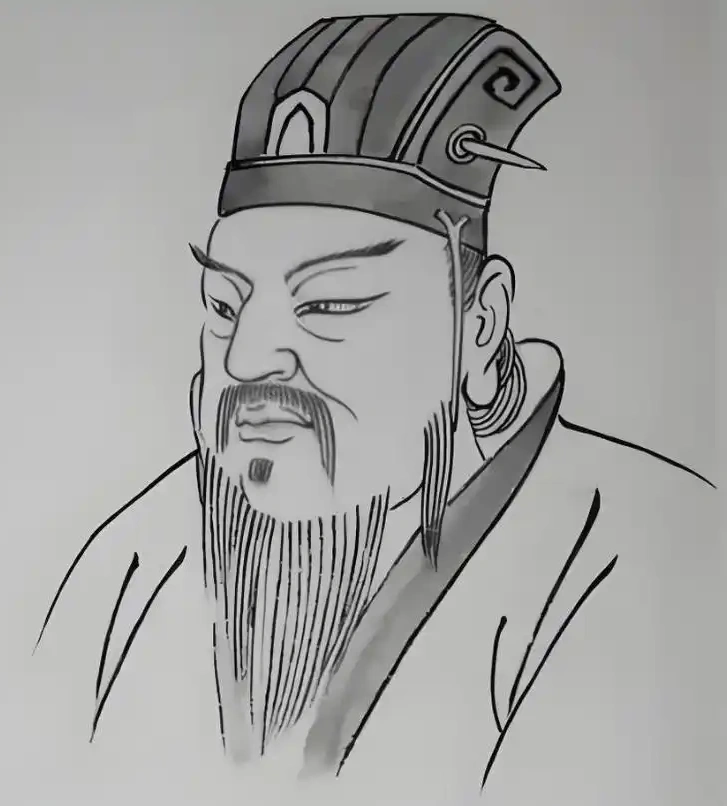
The ice at Liyang formed in the night. Murong De had brought forty thousand households and twenty-seven thousand carts to the ford, and a squall had taken the boats; the Wei cavalry was close enough that his council wanted to fall back on Liyang town. The chapter says the floating slush closed across the water, that the column crossed in the dark, and that by morning, when the Wei riders reached the bank, the ice had opened again. He renamed the crossing the Heavenly Bridge. A court that had lost its capital and was running for its life took the event as a mandate, which is what courts do. What could not be argued with was the column itself: forty thousand households, with their carts, their grain, their children and their grandparents, had left Ye and could not go back.
The year of his birth is not recorded. The chapter gives his age at death as seventy in 405, and 336 is counted back from those two figures by the Chinese count; the article uses the year but does not present it as a recorded date. He was the youngest son of Murong Huang, a prince of the Former Yan, a minister and governor under his brother's restoration, the viceroy of the south when the Later Yan began to come apart, and then the founder of a state that called itself Yan. The name Southern Yan is a later label, added because his court stood south of the Yellow River while the other Yan held the north, and no document of his reign uses it. His brother Chui, the family's greatest soldier, had been driven out of the Former Yan, had restored the Yan in 384 and had died in 396, leaving a state that was already breaking. Chui rebuilt a state and died before the bill came due; De built a smaller one out of the pieces and made it work for as long as he lived. The spine of what follows is his chapter in the Book of Jin, compiled at the Tang court in 648 from the archives of states that had already fallen, whose speeches are the composition of that tradition and are marked here with the formula that the record has him say them, while the Comprehensive Mirror of 1084 is used only for dates and for additions marked as its own.
1. The Youngest Son
His mother, a Lady Gongsun, is said to have dreamed that the sun entered her navel before he was born. The chapter begins the lives of great men with such dreams, and it is worth noticing that it gives De one, because his life was spent making a claim that needed signs. He was the youngest of Huang's sons, and the record's portrait is of a man who read widely, kept himself in hand, and had many skills; it is not the portrait of a horseman.
The offices fit the portrait. Under his brother Murong Jun he was made Duke of Liang, then administrator of Youzhou and general of the left guard. Under Murong Wei he was changed to Prince of Fanyang, moved to be governor of the capital district, and given the rank of cavalier attendant. The capital district was the richest and most difficult post in the state: it contained the old capital at Ye, the granaries, the canals and the great families who had served every government that had held the plain. A prince sent there was being tested as an administrator, not as a general.
He was also Chui's brother, and that was a career of its own. In 369 he fought at Fangtou as general who conquers the south, under Chui. The battle belongs to the Eastern Jin and to Chui; what belongs here is the consequence. When Chui fled to the Former Qin, De was dismissed from office because he was Chui's brother. A court that could not punish the man punished the man who shared his name, and De learned what a family name was worth in a state that had stopped trusting it.
The Former Qin gave him a second career. After the Former Yan fell in 370, Fu Jian sent him to Zhangye, in the Hexi corridor, as its administrator. It was a frontier commandery of garrisons, caravans and mixed populations, far from the Murong heartland and far from the court that had dismissed him. He held it for several years, was dismissed, and returned to Chang'an. The post matters because it shows that he had governed a frontier commandery, far from the Murong heartland, before he governed a state.
The years in the Former Qin were not wasted. Chang'an in the 370s held the households of several fallen dynasties, and De, like his brother, had a place among them. He saw how Fu Jian held a conquest together: titles for the conquered lords, residences near the capital, marriages between the houses, and no hereditary command. The method was generous and it was also a cage. De would remember both halves when he had conquered a province of his own. Fu Jian could pay in grain and appointments; De could pay only in his own name.
In 383 Fu Jian made him a general and took him south. The Fei River is the Eastern Jin's to tell. What De did with the defeat is his own. At Xingyang he urged Murong Wei to raise the family's banner while the Qin army was broken, and Wei refused. The advice was the first sign that De thought in terms of opportunities. It was also, in its way, loyal: he was offering the legitimate emperor a restoration before anyone else had thought of one.
When Chui took the royal title in 384, De was made general of chariots and cavalry, restored as Prince of Fanyang, and kept at court to guard the capital and share in decisions. Later he was made minister over the masses. He was the minister in a military court, the man who could speak for the state rather than for a regiment. In 394, when Chui debated the war against Murong Yong of the Western Yan and the court hesitated, De spoke for the war. Yong had taken the Yan name, he said, and the Yan lords of the plain would follow the man who destroyed him. Chui said the minister's view was his own and decided. The Western Yan was destroyed, and De's standing rose with it.
Chui, dying in 396, told his heir Bao to entrust Ye to De. Bao did more than obey. He made De commissioner with credentials, commander of the military affairs of six provinces, governor of Ji, and colonel of the southern barbarians, stationed at Ye. He abolished the southern branch secretariat that had supervised him and gave him sole charge of the southern half of the state. The grant was not a reward. It was a confession that the dynasty could not hold the south from the capital, and it made De a sovereign in everything but the title.
The branch secretariat had been the dynasty's way of supervising the south without giving one man full charge of it. Bao abolished it because he had no choice. The south was where the grain was, and the only man who could hold it was the uncle who held Ye. A grant made in fear is still a grant, and De governed the six provinces as a viceroy who did not need to be told twice.
2. The Governor of Ye
Ye in 397 was the southern capital of a state that was losing its north. Tuoba Zhang came down the plain and put the city under siege. De did not offer battle. He sent Murong Qing out at night, beat the Wei vanguard, and pulled back inside the walls.
His aide-de-camp Han Zhuo argued against pursuing the beaten enemy. The record has him set out the case as a staff exercise: the Wei are far from home and want a field battle; they are deep in our country with nowhere to retreat; their vanguard is broken but their main body is still solid; they are more numerous. We are fighting on our own ground, a defeat would shake the army, and our walls and moats are unrepaired. Deep ditches, high walls, and time. De called the advice the policy of Zhang Liang and Chen Ping, and recalled the pursuit.
Then Helai Lu came with more cavalry and the siege became serious. De sent Liu Zao west to Yao Xing of the Later Qin to ask for help and to ask after his mother and his brother in Chang'an. No help came. The army began to talk about surrender. De did what a commander can do when he has no reinforcements: he feasted the men himself, gave away what he had, and spoke to them. The record says they were willing to die for him. The two Wei commanders then quarrelled and withdrew by different roads. Ding Jian, one of their marshals, came over and told him the enemy was stale; De chased and broke them. The city held.
A siege is a test of temper as much as of supply. De passed this one by listening. He had a soldier's reputation and the habits of a minister, and the men who served him noticed. The same man who could call a junior officer's advice the equal of Zhang Liang could also, a year later, have a general's marshal killed for failing to pursue an enemy. The two habits belonged together: he wanted counsel, and he wanted results.
While Ye held, the north collapsed. Zhongshan fell to the Wei in the tenth month of 397, and the Later Yan ceased to be a single state. Bao fled north towards Longcheng; Murong Xiang and then Murong Lin usurped the title in the besieged city; Lin, De's nephew, fled from Yitai to Ye. The fall of the city belongs to Bao and to the joint chapter on the two usurpers; what matters here is the effect on De: the capital of his brother's state was gone, and the man who held the southern capital was now the most substantial Yan commander left.
The signs began to arrive. A jade seal came from Gao Lu, the astronomer of Yao Xing, with a text that read: the virtuous flourish, the virtueless perish; De has received Heaven's command, soft and then hard. A rhyme circulating in the north said that when the four seas boiled and Zhongshan fell, only the man of virtue would hold the Three Terraces. The court read the words as an invitation. De refused, on the ground that Bao might still be alive. A report came that Bao was alive, and the proposal stopped.
The refusal was prudent, and it was also a measurement. De would take the throne when the legitimate man was dead or gone, not while he could still be brought forward. Then Bao, from exile, named him chancellor and governor of Ji with authority to act in the south. The legitimate emperor had signed the paper that made his replacement possible. De accepted it, and the last restraint on him was removed by the man it was meant to protect.
Murong Lin argued for the south. Zhongshan was gone, the Wei would come for Ye, the city was too large to hold, and the people were shaken. Cross the river, join Murong He at Huatai, gather soldiers and grain, and wait. Murong He had already sent the same advice. De agreed, and the decision was taken in the winter of 397 for the spring of 398. It was not a flight in panic. It was a strategic withdrawal from a city that could not be defended to a crossing that could be held, and it was argued by the two men who knew the ground.
3. The Crossing
The column left Ye in 398 with forty thousand households and twenty-seven thousand carts, in the chapter's figures. A household is not a regiment. It is a family with a cart, a stove, a grandmother and a claim on the man who leads it, and forty thousand of them made a moving city that could not move fast. A squall wrecked the boats at the crossing; the Wei army came up; the council wanted to fall back on Liyang. That night the floating ice closed, the column crossed in the dark, and by morning, when the Wei riders reached the bank, the ice had opened. The chapter says it was as if a god had done it. De renamed the ford the Heavenly Bridge.
At Huatai there were more signs: a bright star, and a piece of white jade taken from the Zhang River, shaped like a seal. A court that has lost its capital needs signs, and the signs arrived. De took the title King of Yan and, following the precedent of his brother's first era, declared a first year. He pardoned capital offenses, set up a court, and appointed Murong Lin as minister of works and director of the secretariat, Murong Fa as general of the center, Muyu Ba as left director, and Ding Tong as right director. The chapter gives no era name for the next two years. Jianping begins in 400, when he took the imperial title, and the later handbooks that supply a name for the Huatai years are not supported by the chapter.
One of the new court's first acts was to kill Murong Lin. He had seen a unicorn and thought the omen was his; he plotted a rising; the plot was discovered and he was ordered to kill himself. Lin was the nephew who had argued for the crossing, and he was the first man De executed as a king. A new state often begins by killing the man who made it possible. Lin had also taken the title at Zhongshan in the last months before the city fell, and he had come to Ye with a following and a reputation. A new king could use such a man or kill him; he could not leave him at the head of a faction. The unicorn was only the occasion.
Bao was coming south. He had fled from Longcheng, reached Liyang, and sent his eunuch Zhao Si to summon Murong Zhong to come and receive him. Zhong, who had been the first to urge De to take the throne, imprisoned the envoy and sent word to Huatai.
De summoned his court and made a speech which the record preserves. The record has him say that they had urged him to act for the state, that he had done it because the emperor had fled and the people had no lord, and that now Heaven had relented and the emperor was returning. He would prepare the carriage, go to the camp, apologize, and retire to a private house. What did they think?
The record has Zhang Hua answer for the court. In a time of contention, he said, only a hero can restore a state; if De kept a woman's kindness and gave up a heaven-sent enterprise, then once the power left his hand his head would not be safe. There was no way back to a private house.
The record has De answer with the sentence that explains him better than any other in the chapter. The ancients, he said, took by irregular means and held by regular means; he was not sure the way was sufficient, and so he hesitated. The formula was old and respectable. It assumed that the irregular act could be closed, that a founding crime could be followed by a founding order, and that the men who had seen the crime could be made to forget it.
He sent Muyu Hu north with Zhao Si and several hundred men to kill Bao. Bao had already fled; Hu found nothing and brought the envoy back. De then tried to employ Zhao Si, who knew the old ceremonies. The record has Zhao Si refuse. He compared himself to Guan Yu, who had been honoured by Cao Cao and had still gone back to his first lord, and to Shen Xu, who had wept in the Qin court for his own invaded state. De insisted. Zhao Si answered angrily that a man in De's position, an uncle and a chief minister, should be supporting the dynasty rather than profiting from its fall. De had him killed.
The killing of Zhao Si is the act that makes the later verdict legible. He was a eunuch, a servant, and he refused the new court in the name of the old one. De could have imprisoned him, or exiled him, or ignored him. He killed him, and the killing made the theory visible: the irregular seizure had not been closed, and the man who insisted that it had been closed was the man who had to destroy the witness.
Bao was killed at Longcheng that summer by Lan Han, not by De's men. The record does not give De's response, and the omission is a kind of answer. The crossing was complete. He had a river behind him, a court in front of him, and no legitimate claimant alive to whom he could yield.
4. The Narrow Base
Huatai was a bad capital. It stood on the river's south bank where the roads from Hebei, Henan and the Huai country met. That was its value as a crossing and its weakness as a seat. The chapter says the territory was fewer than ten towns and the army no more than a few tens of thousands. North was the Wei, west was the Qin, south was the Jin. A state in that position could tax the roads and could not defend the horizon.
The first test came from a remnant of the Former Qin. Fu Guang, brother of Fu Deng, had surrendered with his people and had been settled at Qihuo Fort as a general. A portent appeared in the Well mansion, men said the Qin would rise again, and Fu Guang took the Qin title and beat Murong Zhong. The border people began to go over to him. De left Murong He at Huatai, campaigned in person and killed him.
The episode was small, but it showed the base. A single claimant with an omen and a few thousand followers could shake a state of ten towns. De's answer was personal: he went out himself, because a new king who sends a general against a rival king has admitted that the rival is a king.
Then the base was lost. Li Bian, Murong He's chief secretary, had tried to bring Bao into Huatai; Murong He refused. Li Bian then brought Jin troops to Guancheng to provoke a rising, and when De did not come out he grew afraid. During the Fu Guang campaign Li Bian urged Murong He to rebel; Murong He refused; Li Bian killed him and surrendered Huatai to the Wei.
De's soldiers' families were inside the city. Han Fan told him not to attack. The Wei are now the hosts, he said, and we are the guests; the people's hearts are shaken; we cannot fight. Murong Yun, a palace guard commander, killed Li Bian and brought out more than ten thousand of the soldiers' families, and the army was glad. De had lost the city and saved the families. A state is not a wall; it is the people who can be moved, and the people who can be moved are also the people who can be lost.
The loss also taught him what a capital was for. Huatai had been a seat because the roads met there, not because the country around it could be held. A seat that depends on the roads belongs to whoever controls the roads. Guanggu, when he saw it, belonged to whoever held the mountains.
He held a council. Zhang Hua proposed Pengcheng, the old Chu capital, rich and defensible. Murong Zhong and the generals urged the recovery of Huatai. Pan Cong proposed Qing and Qi.
The record gives Pan Cong the best strategic statement in the chapter. Huatai, he said, is open on four sides: north to the Wei, west to the Qin, south to the Jin, and it has never been a capital. Pengcheng is empty, flat, close to the Yangtze and the Huai, and the Jin will fight for it; water war is their strength and our weakness. Qing and Qi are rich soil, called the East Qin, two thousand li square, more than a hundred thousand households, with the sea's wealth and the mountains' defence. The men of the three Qi are waiting for a lord. Guanggu, in the hills of what is now central Shandong, was built by Cao Yi; its terrain is steep and it can be an imperial capital. This is your Guanzhong and Henei.
De hesitated. The monk Lang, who knew portents, confirmed Pan Cong. A comet had risen in Kui and Lou and swept Xu and Wei, the signs of Lu and Qi, the image of removing the old and spreading the new. First take Yan province, visit Langya, then turn north to Qi in autumn. The Comprehensive Mirror adds a private question about the dynasty's span and an answer that the Yan would decline in a gengxu year, after one cycle of years and within the second generation. The prophecy is worth giving once because it is a good example of its kind: it reads as though it was written after the event, and it is exact.
De marched south. The decision was the making of the state. Huatai was a crossing; Guanggu was a fortress with a province behind it. The Yellow River had not been a frontier at Huatai, because an enemy could cross it anywhere. In Qi the river was the northern wall, the mountains were the western wall, the sea was the eastern wall, and the pass at Daxian was the southern gate. A state that cannot defend a line can still defend a block.
5. The Road to Guanggu
The campaign of 399 was fast. The northern counties of Yan province surrendered; De appointed governors and magistrates, inquired after the old, and forbade plunder. The chapter says the people were at ease and brought wine and cattle to the road. An army that does not plunder is making a claim about the future, and the claim was addressed to the gentry of a province that had been fought over by every northern state in turn.
At Langya the figures become large. The chapter gives more than a hundred thousand men of Xu and Yan provinces attaching themselves to him, and more than forty thousand coming out to welcome him from the north as he moved up from Langya. The numbers are the record's. They measure hope, not a census, and hope was the raw material of a new state.
Qing and Qi were not an empty conquest. The province was a patchwork of walled seats and great households that had survived the collapse of the Jin and the passage of the Later Zhao, the Former Yan, the Former Qin and the Jin reconquest. Each wall had a head, each head had clients, and each client family had a field. The men who ruled the province ruled through those heads. A conqueror who wanted the province had to make terms with them, and the terms were recognition, a title and a place in the new order, in exchange for grain, men and the roads.
Pilu Hun, the Jin officer at Guanggu, refused an envoy. De sent Murong Zhong with twenty thousand horse and foot. Before the army arrived, Zhong sent a proclamation to the Qi commanderies. It is a piece of political writing worth reading as politics. The Yan had suffered since Yongkang, the state had been divided, and the usurper Pilu Hun's father had joined Duan Kan in rebellion and had been destroyed. Hun had been spared from the overturned nest and now stole the East Qin and attached himself to Wu and Yue. The emperor had risen; the army of the seven provinces, more than two hundred thousand, was touring Mount Tai to punish Qi. The proclamation claimed one hundred and twenty thousand officers and men, all Wuhuan shock cavalry and strongmen of the Three Rivers.
The last phrase is the state's self-description. The army that took Qi was a northern army, and it said so. It was made of the cavalry of the old Yan heartland and the fighting men of the metropolitan region, with the Murong princes at their head. The men of Qi were not being asked to become northerners; they were being asked to accept a northern lord who would keep their walls, their fields and their gods.
Pilu Hun moved more than eight thousand households inside Guanggu. His officers Cui Dan and Zhang Huo surrendered on receiving the proclamation. Hun fled toward the Wei with his wife and children; De sent Liu Gang after him and killed him at Jucheng.
His son Pilu Daoxiu came to De and asked to die with his father. De said that the father was disloyal but the son was filial, and spared him. Hun's staff officer Zhang Ying, who had written the insolent reply to the proclamation, was brought before De and answered with a comparison to Kuai Tong, the man who had advised Han Xin and had been spared by the Han founder. De had him killed.
Mercy and severity were both performances, and both were addressed to the same audience. The gentry of Qi were watching to see what kind of conqueror they had. De showed them a man who honoured a son's piety and punished a secretary's pen. The first was a gesture toward the family; the second was a warning to the clerks. A new state needs both, and it needs them to be seen.
De entered Guanggu and made it his capital. He had a fortress, a province that could feed an army, and a population that had not chosen him. The first two were enough to make a state. The third was the problem that would occupy the rest of his reign.
6. The Temporary Temple
In 400 De took the imperial title at the southern suburb, pardoned the realm, and changed the era to Jianping. He set up a temporary ancestral temple south of the palace and sent envoys with the text of the accession to announce it. A temporary temple is a temple without the ancestral tablets. A state that has lost its capital and its old shrines performs the rites in a borrowed building, and the borrowing is the point: the form is complete, and the substance is a camp.
The era name was shared. Jianping had been used by Shi Le of the Later Zhao, by Murong Yao of the Western Yan in 386, and by Bao's son Murong Sheng in the Later Yan from 398. De's Jianping was the Southern Yan's, and the histories distinguish them by the state, not by the name. The name was shared; the state was not. A calendar was a claim, and there were several claimants. The Comprehensive Mirror calls him Beide from this year, explaining that he added a character to his name when he took Qi; the Book of Jin keeps the older form, and so does this article.
The court was a mixture. Murong Zhong was made minister over the masses, Muyu Ba minister of works, Feng Fu left director, and Muyu Hu right director. Feng Fu was a scholar of the Bohai Feng, a family that had served the old Yan, and he had come over at Jucheng. The Bohai Feng share their romanization with the Feng of Longcheng, the Han family that would rule Northern Yan a few years later; the two are unrelated, and this is the only appearance of either in the Southern Yan chapters. The Murong and the old Yan officers held the army and most of the great offices; the local gentry supplied some of the clerks and the ritual. It was a version of the same division of labour that had made the Later Yan, with a smaller scale and a better-defended province.
De established a school office and selected two hundred sons of officials and of families of the second rank as students of the imperial academy. The chapter says he assembled the students and examined them in person. The school was not a school for the province. It was a school for the official families, the sons of the men who already served, and its purpose was to make sure that the next generation could read the rites and write the documents the court needed. A state that trains its own clerks is doing something real, but it is not opening a door. The register, not the school, would decide who belonged. It was a reproduction of the elite, not a ladder into it, and that was enough for a state that expected to last.
He also established an iron works at Shangshan and a salt office at Wuchang Marsh to broaden the army's and the state's resources. This was the most solid material thing the state did. Qing and Qi had salt and iron, and a state with salt and iron has a treasury; a state with a treasury can pay soldiers without giving away the province. The Later Yan had lived on the tribute of the walls and on what its armies could take. The Southern Yan had a revenue.
In 401 he went to the old city of Qi and climbed Yingqiu. He looked at the tomb of Yan Ying and asked why a wise minister of the old state had been buried so close to the city, against the rule that a great officer should be buried away from the city. Yan Mo, a local scholar, answered that Yan Ying had lived near the market and died near the city because the ducal house had lost its power and he wished to correct the age by frugality; he had not chosen his ground. De took him to the shrine of the King Jing of Chengyang, feasted the elders at Shenchi, climbed Mount Sheshou, looked toward Niu Mountain, and said that since antiquity no man had not died. The chapter says he felt he could end his days there.
Then he asked Yan Mo about the mountains, rivers and worthies of Qi. Yan Mo answered in detail and drew a map on the ground. De made him a document secretary.
The map is the true image of the reign. A scholar of the conquered province drew the country for the conqueror in the dust: the rivers, the mountains, the passes, the towns, the graves of the old worthies. It was accurate about the land and silent about the people between the towns. De had an army, a genealogy and a calendar. What he needed was a country, and the country had to be described to him by someone who had been born in it.
The court anecdotes of these years are the record's portrait of a ruler who wanted to be told the truth. At a banquet De asked what sort of ruler he was. The governor of Qing province, Ju Zhong, compared him to Shao Kang and Guangwu. De gave him a thousand bolts of silk as a joke and said that since the answer was flattery the reward was a joke too. Han Fan said that the son of Heaven does not jest and that both sides had been wrong. De was pleased, gave Han Fan fifty bolts, and the chapter says frank speech advanced at court. The story is charming and it is also staged. The ruler chose the man who corrected him, and the correction became a proof of the ruler's virtue.
Wang Shi, a rebel on Mount Tai, gathered several thousand men, called himself the Great Peace Emperor, made his father retired emperor and his brothers generals, and was taken by Murong Zhen and executed. At the scaffold he was asked where his father and brothers were. He said the retired emperor was in exile and the generals had been killed, and that he alone was left. His wife told him it was his mouth that had brought them there. He answered that since antiquity there had been no family that did not break and no state that did not perish, and refused to change his title. De laughed when he heard it.
The story is a joke, and the joke is about the state. A man with a family, a few thousand followers and a title had made himself an emperor in the same hills. He had a court, a father, a wife and a defeat. De's laughter is the laughter of a man who knows how thin the line is between a founder and a rebel, and who has just been told that the line is thinner than he thought.
7. The Register
The state needed money. The army had to be fed, the garrisons had to be paid, and the court, though small, had the usual expenses of a court. The province was rich. The problem was that the province's wealth was not in the state's hands.
In 403 a director of the secretariat, Han Zhuo, sent up a memorial that is the clearest piece of statecraft in the chapter. The people, he wrote, suffering the misrule of Qin and Jin, had attached themselves to the great households. Some hundred families made one household; some a thousand men shared one register. They relied on the walls and the local shrines, feared no fire, avoided taxes and service, and the law could not reach them. The remedy was to search out the hidden, fix the registers, and return the clients to the counties.
He knew what he was asking. The Former Yan had tried the same policy in 368, found more than two hundred thousand hidden households, and the great families had hated the man who did it; the count had been a success and the reformer had not survived it. Han Zhuo cited Shang Yang, who had paid for reform with his life, and Yue Wan, that earlier reformer, and said he would not refuse the same risk. He was telling De that the policy worked and that it cost a life. De accepted. He sent Murong Zhen with three thousand cavalry to patrol the border and prevent the hidden households from fleeing, and made Han Zhuo commissioner with credentials, cavalier attendant and acting director of the branch secretariat, to tour the commanderies and verify. Han Zhuo found 58,000 hidden households. The chapter praises him as upright and says the places he passed were not disturbed.
The figure is large. The province was said to have more than a hundred thousand households, and 58,000 was a real gain, though it was not the whole of the hidden population. The great households lost clients and kept estates. The count was enforced by cavalry on the border, which shows how little routine administration reached the villages. A count that needs three thousand horsemen to keep the counted at home is not an administration; it is a raid on the register.
The structure behind the count is the answer to the question of how a refugee army governed Shandong. The Southern Yan was not a Shandong state with a northern army. It was a northern army with a Shandong tax base. The households that crossed with De in 398 became the army's families and the court's core. In Han Zhuo's memorial the phrase is precise: the immigrants had lost their land, and the state pitied them and allowed them a long exemption from service. They were the army, the garrison and the court. The households of Qi were the taxpayers, and most of them were reached through the great households, who held the land and the clients.
The state taxed the second population to pay the first. That is the whole of its political economy. It worked because the first population was loyal to the man who had led it across the river, and because the second population was too divided to refuse. It worked, but it was not a system that could be handed over. The loyalty was personal, and the division was the magnates' power, not the throne's.
The army had the same shape. Murong Zhong's proclamation described it as Wuhuan shock cavalry and strongmen of the Three Rivers. The cavalry was the state; the infantry was the province. In 404, at the review west of the city, the chapter gives 370,000 infantry, 17,000 carts and 53,000 armoured cavalry. The last figure is the mobile core; the first is the paper levy, the population counted as soldiers for a day. The gap between them is the gap between the ruling corps and the ruled population, and the parade put both on the same field where anyone could see it.
A state of that kind can be very strong for one generation. The men who crossed in 398 had no other home; the women who came with them had the same memory; the children born in Guanggu had a claim to the province but not the habit of the camp. The founder's authority was the only thing that made the two populations one system. He was the man who had led the crossing, the man who had fed the soldiers at Ye, the man who had taken the province. None of that could be bequeathed.
8. The War That Was Not Fought
War with the Jin came in two forms. The first was a raid that was beaten. In 398 the Jin administrator of Nanyang, Luqiu Xian, and the general Deng Qifang brought twenty thousand men to Guancheng. De sent Murong Fa and Murong He; the Jin army was beaten. De was angry that Fa did not pursue and had Fa's marshal Jin Gui killed. The harshness is worth recording because it is the same man who had listened to Han Zhuo at Ye. He wanted counsel before the battle and results after it.
The second form was a conquest that was kept. The campaign of 399 took Qing and Qi from the Jin and gave the state its province. After that the border was quiet for a few years, because the Jin court had its own civil war and because the Southern Yan had what it wanted. A state that has just taken a province does not look for another war until it has counted the first.
The chance came in 404. Huan Xuan had usurped the Jin throne, and a group of Jin officers who would not serve him fled to Guanggu: Liu Gui, governor of Ji province; Sima Xiuzhi, administrator of Xiangcheng; Liu Jingxuan, a general; Gao Yazhi, chancellor of Guangling; Zhang Dan, magistrate of Jiangdu. De received them. The refugees were a gift. They gave him intelligence, a claim to be the protector of the Jin order, and a grievance to arm. They were also a problem. Men who have lost a state are useful soldiers and dangerous courtiers; they know the enemy's country and they have their own claims on the future. De gave them titles and kept them close, which was what Fu Jian had done with him twenty years before.
Han Fan urged him to use them. The Jin had been in civil war for seven years, he wrote; Huan Xuan had usurped and was worse than Dong Zhuo; ten thousand horse and foot could take the river; the south would fall; the chance must not be lost. The record gives De a sentence that is half strategy and half autobiography. He held the three Qi and the strength of five provinces, he said; he had taught the people war and courtesy, and he had been waiting. He wished first to settle the Central Plain and then water his horses in the Yangtze, but the time had not come. The council said Huan Xuan was new and could not be attacked, and the campaign stopped.
He reviewed the army instead. The chapter gives 370,000 infantry, 17,000 carts and 53,000 armoured cavalry; the flags covered the marshes and the drums shook the earth. De climbed a height and told the Jin refugees about Xi Ke, who had turned a humiliation into a victory, and Wu Zixu, who had turned a family's murder into a state's revenge. He was offering a war of revenge to men who had lost a civil war. It was the right speech for the audience and the wrong army for the war.
Then news came that Huan Xuan had been defeated. De prepared Murong Zhen as vanguard and Murong Zhong as commander, with twenty thousand foot and five thousand horse. The army was ready to march when De fell ill and the campaign was cancelled. The only chance to change the map passed through a sick man's body, and a state that depends on one body has only that body to lose.
The body failed at the worst moment. Murong Da revolted while De was ill. He sent Huang Qiu against the palace gate, and Hou Chimei opened the gate from inside. De escaped over the wall with a eunuch, Sun Jin, and hid in Sun's house. Duan Hong and others held the four gates; De re-entered the palace, killed the conspirators, and Murong Da fled to the Wei. Murong Fa fought the Wei at Biaoyu Valley in Jibei and beat them.
The state could win a border battle and could not survive a month of the founder's illness. The court was one palace gate away from a coup. The army was loyal to the man, not to the office, and the man was old.
9. The Heir
De had no surviving son. His sons and his full elder brother Na had been killed by Fu Chang at Zhangye after Chui rose in 384. Na's son Chao, De's nephew, survived, raised by his grandmother Gongsun and his mother Duan in exile among the Qiang, then in Liangzhou, then in Chang'an, where he pretended to be mad and begged in the streets to avoid being used by the Later Qin. De sent for him, and Chao arrived at Guanggu as a stranger who had spent years pretending to be mad. The court received him because there was no one else. He had a genealogy, a mother and a grandmother's story; he had no regiment, no clients and no record. An heir of that kind is a compromise before he is a ruler.
The chapter explains the succession with a dream. The chapter has De dream that his father said: you have no son; why not make Chao heir before someone else thinks of it? He woke, told his wife that the former emperor's spirit had instructed him and that he would die, and issued the order making Chao crown prince. He pardoned the realm and gave two ranks of nobility to sons who had succeeded their fathers. The last measure is the record's quiet irony. The man who had taken his nephew's throne honoured the principle of sons succeeding fathers.
He died that month, in 405, aged seventy by the chapter's count. He had reigned five years, counting from the imperial title. The five years were the whole of the imperial title; the seven years from the crossing were the whole of the state. The difference mattered to the record, which counted reigns from the higher title, and it matters to the argument, because the state was made in the two years before the title and was handed to a man who could not hold it five years later. The chapter says more than ten coffins were made in the night and carried out of the four gates, and he was buried secretly in the hills; no one knows where the body lies. The posthumous name was Xianwu. The founder who had spent his life reading signs made his grave a secret. The funeral was the first test. Ten coffins went out by four gates, and no one knew which held the body. A court that cannot make a pilgrimage to its founder loses the one place where a dynasty's legitimacy can be touched; Chao had the title, but he did not have the tomb.
The succession was the structural flaw, and it was already visible in the court he left. Chao had a genealogical claim and nothing else. The Hebei generals had no bond with him; the Qi magnates had no reason to prefer him; he had been in Chang'an while the state was being made. A state held together by the founder's person could not be handed over like a seal. The founder had built a court, a school, a calendar and a register, but he had not built a second founder.
Chao's reign and the fall of the state in 410 belong to another article. What belongs here is the choice. The founder, having no son, chose the nephew who would lose the state, and the record explains the choice with a dream because the only reason for it was legitimacy, and legitimacy was the one thing Chao had.
10. The Verdict
The verdict is not at the end of De's chapter. It is at the end of Chao's, because the Tang editors treated the Southern Yan as one dynasty and judged the house as a whole. It begins with the charge.
Holding the weight of Ye as the emperor's youngest uncle, the verdict says, he showed no fidelity when the dynasty was in danger; while the ruler lived he hastily took his place. Is this human principle?
The charge is precise. De was not accused of ambition in general. He was accused of a particular failure. He had been given the heaviest command in the south by a nephew who had no choice but to rely on him, and when the dynasty was in danger he did not defend it; when the nephew was still alive he took his seat. The record had already shown him killing Zhao Si, the servant who said the same thing in plainer words.
Then the verdict turns. Yet he had a free and heroic bearing and a far-reaching strategy; in a time of disintegration he made himself a contender; he held all of Qi, seized the sacred vessel, sharpened his sword against Qin and Wei, and trained his armour with his eyes on Jing and Wu. He honoured Confucian learning to improve the customs and welcomed frank speech to correct himself. Looking at how he governed, there is much to praise.
The encomium is shorter. De was indeed a heroic villain; he turned defeat into achievement; he possessed the land of Qi and spread his illegitimate name through the realm. The word is jianxiong, a villain with the scale of a hero. It is not a contradiction. It is a description of a man who was disloyal to his nephew and good to his people. The posthumous name is part of the verdict. Xianwu joins wisdom to martial power, and it was given by the court he had founded. The Tang historians call it false because they did not recognize the state, but the name is accurate about the part of him that everyone could see. It says nothing about the school, the register or the temple, which were the parts he would have wanted judged. The Tang court knew how thin the line between a founding and a usurpation could be, and its historians were at ease with the combination.
The modern judgement is warmer and less exact. The Southern Yan, it is often said, was a state only in the years of De's reign. The grounds are real: a capital, a school, a calendar, a temple, a counted register, salt and iron, a defended border, and a court that could receive refugees and send envoys. The limits are equally real: no lasting institution, no wide base, no successor. The state had a state's forms and a province's revenue, and it had one man who could hold the two together.
His brother's case was the other way round. Chui rebuilt a great house and left it to sons who could not hold it; De built a small one and left it to a stranger. The difference is not talent but scale. Chui had a coalition of princes, and it broke after him. De had a column of refugees, and the column had no other leader. A column is easier to command and harder to inherit.
The last image belongs to Yan Mo. The scholar drew the country for the king in the dust at Yingqiu: the rivers, the mountains, the passes, the towns, the graves. The map was accurate about the land and silent about the people between the towns. The register was the attempt to put the people on the map. It found 58,000 households and left the rest under the magnates, and the state that counted once did not count again in the founder's lifetime. The ten coffins and the secret grave closed the circle. A state that began with a sign at a ford ended with a grave no one could find.