Home / Emperors / Sixteen Kingdoms
Emperor Wuzhao of Later Qin
后秦武昭帝
Yao Chang, ? – 393 · ruler of Later Qin
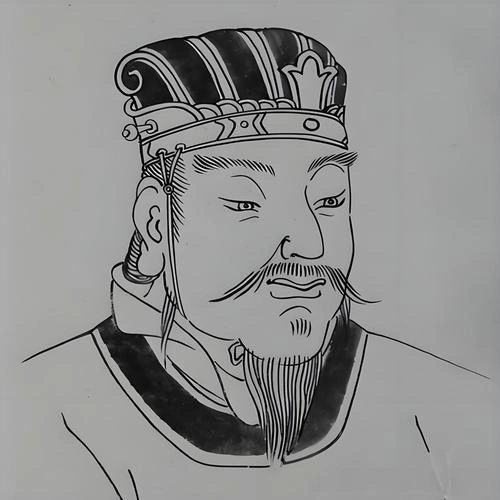
Yao Chang killed the sovereign he had served and then spent the remaining nine years of his life fighting that sovereign's ghost. The ghost fought back through living men: through Fu Deng, a kinsman of the dead emperor who marched with the imperial spirit-tablet at his head, and through the dead man himself, who arrived at the end in dreams the chronicle was careful to keep. Between those two fronts the new king of Qin built a state, and the two fronts shaped what he built, because every defeat had to be explained and no explanation was available that did not lead back to the temple at Xinping. He knew the arithmetic of his act. A tyrant is killed and men are grateful; a ruler whom the countryside had loved, who had spared where he might have slaughtered, is killed, and the killing becomes a debt that compounds. The record keeps him saying so, in effect, for the rest of his life.
This article follows the debt, not the ghost. It begins with the family the record introduces — a Qiang lineage of the Chiting country, a father who served the Later Zhao and died telling his sons to be loyal subjects of Jin, an elder brother whose charisma drew the displaced of two empires after him — and then follows Yao Chang through the service that ended in the flight to the pastures north of the Wei, the rising of 384, the death of the old master, the empire at Chang'an, the war against the tablet, and the dreams. The state he left behind was an army camp with a treasury of grievances, and clearing the ledger took the next generation. That outcome was not accidental. Everything about the founding — its name, its calendar, its omen, its founding crime — was chosen to argue that the killing had been a succession, and nothing about the following decade was allowed to forget it.
1. The Tribe at Chiting
The annals open the family story in the county of Chiting in Nan'an, in the upper Wei valley, and give the Yao house a pedigree that runs back past the Qiang chieftains to the sage-kings themselves: a son of Shun enfeoffed among the western Rong, his line ruling the Qiang for generations, an ancestor who led his people inside the frontier in Han times and was settled at Chiting with Chinese titles. The genealogy is the family's own. It reached the compilers through the histories the Yao court kept about itself, and it tells the reader how the house wished to be read — not as newcomers from the steppes but as an old frontier aristocracy, Chinese in descent, Qiang in command. Other houses of the period made similar claims, and the pattern matters more than the genealogy's truth. A family that could say it had been settled under Han patents for centuries was a family that could be offered, and could offer, a place in the Chinese order of things.
Whatever the ancestry, the man who made the family matter was Yao Yizhong, and the record draws him bluntly: careless of dress and ceremony, frank to the point of insult, respected and feared at the Later Zhao court of Shi Hu, where he held commands over the non-Chinese peoples and was consulted on the great decisions. He was a warlord of the old school, a leader of tribes rather than of provinces, and when the Later Zhao tore itself apart after Shi Hu's death he moved through the wreckage as its nominal defender, fighting the upheavals of 349 to 351 from one side and then another while the center dissolved. In 351 or 352, with the Shi house gone, he submitted to Jin — the dynasty in the south that the northern warlords were forever serving and never obeying. The patent the Jin court sent back is recorded in full: an envoy's staff of authority, chief command over the Six Yi peoples, chief control of military affairs along the Huai, grand general of chariots and cavalry, honors equal to the three excellencies, the title of grand chanyu, and the dukedom of Gaoling. It was a large patent for a chieftain who never traveled south, and both sides understood it as what it was: a name in exchange for a restraint.
The restraint was spelled out in the deathbed scene the record preserves. The record has him say that the Shi house had treated him well, that he had meant to repay them, that now the Zhongyuan had no master — and that from the beginning of things no man of the Rong and Di had ever been Son of Heaven. His sons, therefore, were to go to Jin and keep a subject's faith, and do nothing unrighteous. He died in 352, the record giving his age as seventy-three, and was buried in the west by the hands of enemies, with royal honors, years before his sons returned to the valley. Of his sons the record says there were forty-two. The twenty-fourth of them, a boy named Chang, whom the elder brothers found remarkable — quick, full of schemes, careless of the disciplined virtues, given in youth to none of the pursuits a family in his position should have cultivated — was not the heir of anything. The heir was the fifth son, Yao Xiang, and the record's deathbed charge, with its absolute sentence about the Son of Heaven, became in time the most quoted line in the family's history, because the twenty-fourth son broke it.
2. The Brother
Yao Xiang inherited the following, not a state: the record describes him concealing his father's death while he led sixty thousand households — the figure is the chronicle's, the size of a small migration — south through the broken country of Hebei, and only mourning when the column reached the Bian. The record gives his age at death as twenty-seven, five years later. The Jin court confirmed him in the family's command and gave him the civil packaging that went with it — pacernorth general, governor of Bingzhou — and for five years he lived the strange life of a submitted warlord inside the Jin system: honored by the men who met him, plotted against by the generalissimo Yin Hao, who sent assassins that came and confessed, and expeditionary forces that came and were beaten. After Hao's great northern expedition collapsed in 354, Yao Xiang stood exposed, defeated by Huan Wen on the Yi river, and the record keeps what it clearly wants remembered about him: that when the rumor spread that he had died of his wounds, the captured civilians wept as they looked north; that after each of his defeats the people came to him again, old and young, abandoning their villages; that a Jin officer who had served him rated him above Sun Ce. He moved north to the passes, tried Luoyang for a year, failed, and in 357 turned toward Guanzhong with the Qiang of the border country joining him by the tens of thousands of households.
He was beaten at Sanyuan in the summer of 357. The Qin armies of Fu Sheng — with Fu Huangmei in the chief command, Deng Qiang provoking the fight with a feigned retreat, and the young Fu Jian among the column commanders — drew him out of his entrenchments, and in the running battle his horse was killed under him and he was taken and put to death. The record gives his age as twenty-seven. Fu Sheng buried him with a duke's rites, an act of courtesy between enemies that the sources note because it was unusual, and it was the last courteous act of the story. Yao Chang, who at Matian had given his brother his own horse and got away alive, now led the remnants, his own brothers among them, in submission to the Qin.
For the family's politics the death of Yao Xiang was the decisive fact. He had been the man around whom the displaced gathered; the record's language for him is the language of popular allegiance, of followers who could not be driven away. Yao Chang inherited the name without the magnetism, and he knew it. He knew it, and said so: the record gives him a list of his brother's superiorities, recited late in life to his own officers — the height that made men fear him at sight, the command that moved a hundred thousand at his banner, the learning and the speech and the eye for men, and a following that crossed broken country and never wished to be elsewhere. Whatever those words are worth — and they are the victor's tribute to a dead rival and elder brother, composed by historians who had choices — the outline of the family's story is clear. The following was real; the name of the fifth son was the thing that held it; and the twenty-fourth son, who had neither the height nor the charisma, would hold it by other instruments.
3. The Dragon Dragoon
Under the new sovereign the family's submission became a career. Fu Jian, who took power in 357 in the coup that removed Fu Sheng, kept the Qiang where the previous reign had used them and gave Yao Chang a sequence of commands and governorships that reads like an officer's record: general who displays martial valor, left guard general, governor of seven commanderies scattered from the Wei valley to Gansu and the upper Yangzi, governor of three frontier provinces, colonel of infantry, a dukedom. Two details matter more than the list. One is from 367: when a Qiang chieftain in the Long country rebelled, the tribes that had once belonged to Yao Yizhong came over to Yao Chang on sight of him — the record explains it simply, that their fathers had been his father's men. The family's real capital was not office but the network of tribal allegiance in the west, and Fu Jian's government was building its frontier policy on that network. The other detail is the portent the annals attach to the Shu campaign of the early 370s, a glow of light over the sleeping general, which the record offers and the reader may file where such things go.
The third detail is the title. In 383, on the eve of the southern war, Fu Jian named Yao Chang dragon-dragoon general and controller of the military affairs of Yizhou and Liangzhou, and spoke the words the record was waiting eighty years to use. The record has Fu Jian say that he had made his fortune under the dragon-dragoon banner, that the title had never been given to another man, and that the south was now Chang's to manage. The left general Dou Chong stepped forward and warned that the words of kings are not idle things, and that this was the shape of an ill omen; and Fu Jian, the record says, said nothing. The story is the record's own, kept through all its versions because it was too exact to lose: the title that made an emperor, given away for the first time, given to a man of a subject race, with the warning spoken and the warning unheeded. Whether Fu Jian ever said it matters less than the fact that the Later Qin court let the story stand in its own annals. The founder's dynasty had an interest in the tale — it made the regicide a destiny — and the tale is therefore the first piece of evidence about how the founding wanted to be understood.
The southern war broke the world the career had been built in. The great army was destroyed in the south in 383; in the spring of 384 the Xianbei of the old Yan house rose in the east and in Guanzhong. Fu Jian sent his son Fu Rui against the rising at Huayin, with Yao Chang as his second, and gave him, on the record's telling, the same advice about caution that the proud ignore: stay behind the entrenchments, let their spirit spend itself. Fu Rui hurried, fought, and died. Yao Chang sent his chief clerk to Chang'an to apologize for the disaster, and Fu Jian killed the messenger. Whatever the balance of fault — and a court in crisis does not weigh fault — the act ended the relationship. A general whose sovereign executes his envoys has two options, and Yao Chang took the one the country offered: he fled north across the Wei into the pasture lands, where the record loses him for a few weeks and finds him at the head of a rebellion.
4. Wannian
The rebellion was handed to him. The magnates of the western country — men with the names of old Qiang chieftainships and old Han commanderies mixed together — came to the pastures with their dependents, and the record counts the households that pressed him to be their chief at more than fifty thousand. He hesitated, on the record's telling, and was persuaded by Yin Wei, a man of Tianshui who became the strategist of the whole enterprise, that the fortune of Qin had run out and the moment would not wait. In 384 — the ninth year of the Jin era Taiyuan, in the reckoning the southern annals use — he proclaimed himself grand general, grand chanyu, and King of Wannian Qin, declared an amnesty, and took the era name Baique, the white sparrow, a bird of omen. He was calling himself Qin. The name under which the man he had fled from reigned was Qin, and the son of the Qiang chieftain now claimed it for his own line — Wannian, ten thousand years, the word both an auspicious boast and, as it happens, the name of a county hard by the capital — and the books, having one Qin already in that generation, print his kingdom as the other one, Later Qin. The claim was not a legal argument but an act of appropriation: the state that had trained, employed and finally driven him to rebellion had made the name Qin mean mastery of the west, and he took the meaning and left the man.
The calendar and the court came before the territory, which is the pattern of the age: the record lists the staff of the new kingdom by name, chiefs of staff and secretaries and commandants, nearly all men of the Qiang country and the Long valley, the little aristocracy of the pastures that had waited a generation for this. What followed was less a war than a transfer of allegiance. Yao Chang made peace with Murong Chong's besieging army — his own son went east as a hostage — and moved to Beidi, where he farmed, stored grain, and waited; the record says the Qiang and Hu of Beidi, Xinping and Anding came over in numbers it counts by hundreds of thousands of souls. Fu Jian attacked his camp and could not take it; the Comprehensive Mirror keeps a siege in which the wells were stopped and the water failed, and the rain that saved the camp was read, by the men inside it, as a verdict. Asked by his officers to strike at once for the capital, the record has him refuse with a general's argument: the Yan men had risen out of homesickness, and if they won they would go home; the Qin should move to the hills north of the ridge, grow strong on what the others abandoned, and take the prize when the tigers had wounded each other. Xinping fell to him, then Anding, then the fort towns of the north ridge. By the end of 384 he held the country north and west of a capital that was starving, and the two claims on it — the Xianbei army from without, the Qiang kingdom from the uplands — had divided the inheritance between them in advance.
5. The Old Master's Death
In the fifth month of 385, with Murong Chong's army closing on a starving city, Fu Jian rode out with a few hundred horse toward the hills of Mount Wujiang, where a local prophecy had told him he would be safe; the city fell to Chong a month later. The prophecy was known, and Yao Chang acted on it: he sent the general Wu Zhong with cavalry to close the mountain. The guards scattered; the emperor sat still and called for food while the ring closed, the record says, and was taken to Xinping and kept in a separate room. Officials of the fallen court came over to the victor in the hundreds, the record counts them, and what had been a rebellion now held the person of the Son of Heaven, or of what remained of him.
What followed is set out, at length and for its own sake, in the chapter that belongs to Fu Jian, and the scene is his, not this article's. But the account of why he died belongs here, because the account is a ledger. A captive emperor was worth exactly two things to his captor: the seal, and the ceremony. The seal — the state seal of the emperors, the object whose possession made a claim into a title — was the first ask, and the record has Yao Chang say that his turn had come in the order of fate and that the old sovereign might show him this favor. He asked for the seal and was refused, on the ground that the ordered sequence of the five Hu had no place in it for the name of Qiang. He then sent Yin Wei to propose what the age called the affair of Yao and Shun, the abdication formula that had served transfers for two thousand years, and was refused again, more briefly: the usurper was not to rank himself with the ancients. Between the two refusals every road out of the killing closed. A man who proclaims himself King of Qin while the Son of Heaven lives in his custody has, from that day, only one way to be King of Qin, and the record is honest about the sequence: the prisoner raged and demanded death, and in the autumn of 385, in a Buddhist temple at Xinping, Yao Chang had him strangled. The dead man's end, his age, his household, belong to his own article. Here it is enough that the killing was not passion but policy — the last move available in a negotiation about legitimacy — and that the policy failed in the very hour of its success.
The failure can be watched in the record. First the courtly lie: the record says that Yao Chang wanted to hide the fact of the killing, and gave the dead man a posthumous name, Zhuanglie — the ardent, the heroic — as Heavenly King. A murdered sovereign was thereby converted into a fallen hero, and the man who gave the honor kept the act quiet; the formula is the chronicle's, and it is as close as the sources come to an admission that the founder of the Later Qin had a reputation problem. Then, years later, the collapse of the lie: beaten in the field, holding less than the war required, Chang had the corpse exhumed and flogged, stripped of its clothing, wrapped in thorns and buried in a pit. The record does not reconcile the two acts, and this article will not reconcile them either. What they show together is the shape of the debt: a founder who needed the old master to be dishonored in one season and honored in another, and who could manage neither for long, because the dead man's prestige — the thing the killing had failed to transfer — kept escaping from his control and working, apparently, for the enemy.
6. Emperor at Chang'an
The Xianbei army did not stay. Murong Chong was murdered in the spring of 386 and the great column of the Western Yan marched east out of the pass, toward the country it had been trying to reach for two years; its march, and the murders that paced it, are told in their own article. It left the imperial capital empty, and an empty imperial capital in that decade was a throne sitting in the open. A leader of the Lu Shui Hu proclaimed himself emperor in Chang'an while the Qiang were still north of the ridge. Yao Chang moved on the city, broke the force of a rival warlord on the road at Mawei, took the surrender of the self-made emperor, and entered Chang'an before the summer of 386 was out. There, in the eleventh year of Taiyuan, he took the imperial title, changed the era to Jianchu, and sealed the change with a ceremony of virtues: his house would rule by the power of fire, which succeeds wood, as the wood had been the virtue of the Fu house. The grammar is the interesting part. He did not present himself as the annihilator of the former Qin but as its successor by the natural order of the elements, a flame rising from the tree it had consumed; the murder was thereby converted, on paper, into an inheritance. In the same act he renamed the capital — the record notes the change of one character, the character for long exchanged for its near-homophone meaning lasting — made his consort empress and his son Yao Xing heir, and established the offices of an empire.
The empire, for the first years, was the shape of the camp that had won it. Its effective capital was wherever the ruler was, and the ruler spent most of his reign at Anding, in the fortified country north of the ridge, closer to the enemy than to his own palace; the record preserves the name his soldiers gave the ruler's own command, the Grand Camp, which became the word for the center of the state. What state-building there was, was done between campaigns: the record lists, in the ledger idiom of the annals, the frugality edicts — the ruler eating from a single dish, the treasures of the palace sold to pay the army — and the schools established in Chang'an and ordered in every garrison town, the sacrifice to the soil and grain set up, the aged worthies of the villages enrolled with stipends and gifts of wine, the blood feuds of the refugee years banned by edict, the sons of dead officers provided for. It is a thin list beside what a settled dynasty would leave, but it was not nothing, and its direction is the interesting thing: a Qiang king of the horse tribes was advertising himself as the patron of the scholar class and the restorer of the village order of the Wei valley, because the country he now claimed could only be held by men who had been taught to read the claim.
There was fighting that was not against Fu Deng — the submission of the Qinzhou garrison, the punitive campaigns against the chieftains of the north — and in one of them the record keeps a scene that explains the man better than the institutional list. The surrendered general Jin Chui had turned his coat; Yao Chang rode into his camp with a few hundred horse, against the pleading of his officers, and the record has him answer that a man received with submission must be trusted, or the ruler is not worth following; and the plotters in the camp, the record adds, were stopped by the news that he had come unarmed among them. Boldness as a political instrument, distrust managed by display, a life lived at a canter inside other men's fortifications: the founder of the Later Qin never quite stopped being a raiding commander, and the state he made kept the habit.
7. The Tablet in the Enemy's Camp
Fu Deng, a clansman of the imperial house, took up the war of the former Qin in the winter of 386, and his army carried the spirit-tablet of Fu Jian into battle. What that tablet was worth in the field is not this article's subject — it belongs to the other man's story — but what it did to Yao Chang's army is his. The record is unusually frank: Chang was beaten again and again, and men at a distance, the annals say, were weighing whether to change sides. A king who loses often enough stops being a king, and the tablet was the answer to the question his defeats kept raising — why Heaven permitted the house of the man he had killed to win. In one of the episodes the record keeps, Deng's army surrounded Chang's camp and wept at it from four sides, mourning the dead emperor at the top of their voices, and Chang ordered his own army to weep back; the enemy withdrew. It is the darkest comedy in the annals of the period, and its point is exact: the war had become a contest over the meaning of the dead man, and both sides knew that the side he wept for would win.
Chang's answer was to claim the dead man too. He set up a tablet and an image of Fu Jian in his own camp, and prayed to it, and the record gives the prayer at length, in words the court could not have printed if it had not wanted them kept. The record has him say that the killing at Xinping had not been his doing but his brother's — that Yao Xiang had been returning west to see his old country, that the dead emperor had blocked the road, and that the brother had commanded the deed and the guilt was the brother's. The calendar made the claim impossible: Xiang had been dead twenty-eight years, and the record keeps the accusation as the court's official version. He reminded the spirit of the dragon-dragoon title, of the words spoken with the imperial mouth on the eve of the southern war, and asked whether a spirit could have forgotten its own promise to serve the memory of the dead emperor against a distant clansman. The theology is shameless and the psychology is legible: a man who had told the world one story about a killing now tells it to the victim. It did not work. The battles stayed lost, the camp was frightened at night, and at the last the record says he had the image's head struck off with drums beating and sent it to Fu Deng — the enemy who had taunted him from a tower to come out and fight, the record says, and whom he had not dared to answer. The chronicle keeps every step of this because the Later Qin court kept it: a dynasty does not preserve its founder groveling to a spirit-tablet unless the preservation serves something, and what it served was the explanation. The founder had not been defeated by the house of Fu; he had been haunted. The record of the haunting is the record of the anxiety, dressed for the archive.
The war itself, on his side of it, ran on maneuver, night marches and the seizure of grain, with fortune swinging hard both ways. In 389 he destroyed Deng's great camp at Dajie in a night raid, killing the enemy's consort and sons and carrying off, the record says, fifty thousand and more of the camp's people — the figure is the chronicle's, and the act was the act of a raider-king, not of an empire's sovereign. He could lose as hard as he won: Matouyuan, which his own court's record counts as a defeat and which, he afterward told his astonished brother Yao Shuode, he had brought on himself to break a plot in time; a spring of defeats that emptied the country of his prestige and left the record counting the commanders who stayed loyal. Two of the victories belong to the character file. Against the rising of the chieftains Wei Hefei and Lei Edi he marched with under two thousand men, delighted each time another band of the enemy arrived — the record has him say that the more of them gathered, the more complete the one blow would be — and broke them with the counterstroke. And after the great victory east of Anding, the officers drank and said that if the Wei Wu King were alive — the posthumous name Chang himself had given Yao Xiang — this enemy would never have lasted so long; and the record has Chang answer with the four superiorities of the brother, and add, as the annals put it, that he had won what he had won by one slice of the dead man's stratagems. It is the most self-aware sentence any founder of the period is given, and whether or not he said it, the court that kept it was saying something: the state knew its founder had been the second-best man in his own family, ruling by calculation what a better man had ruled by the love of strangers.
8. The Dreams and the Ledger
In 393, ill and carried in a litter toward Chang'an, the founder stopped at a fort called Xin zhi, and there the record sets the last scene. The record tells a dream: Fu Jian came at the head of the officers of heaven and several hundred ghost soldiers into the camp, and the dreaming Chang fled to the palace, where an attendant striking at the ghosts wounded him in the groin, and the ghosts said to one another that the death spot had been struck; and he woke, the record continues, and found himself swollen, and the physician's lancet drew blood as in the dream. Then the delirium, in words the record gives: Your servant Chang — it was my brother Xiang who killed you — it was not my offense — do not wrong me. He was carried the rest of the way to Chang'an, named the men who were to hold the state for his son, and gave Yao Xing the four instructions the annals preserve — be kind to your kin, be correct with your ministers, be faithful in what you promise, be gracious to the common people — and died in the winter of 393. The record gives his age as sixty-four; his birth year it does not give, and this article does not compute it. It counts his reign as eight years, which is to say from the empire of 386; from the white sparrow's proclamation at the pastures in 384 the count is ten, and the subtitle of this article keeps the longer figure, with the two reckonings distinguished here so that they cannot be confused later.
Of the dream scene the most careful thing to say is that it is a report, not a fact. It reached the compilers through the annals the Later Qin kept on itself, and it is a strange thing for a dynasty to keep: a founder dying in horror of his victim, confessing in delirium, his body publicly wounded where the dream had wounded it. Dynasties do not archive such scenes unless the material was already fixed — already told, already believed, already part of what everyone knew — and so the passage is best read as the court's concession to a story it could not suppress. What it documents is not the physiology of guilt but the politics of it. The founder's legitimacy problem did not end with the exhumation and the prayers and the severed image-head; it ended only with the founder, and the record's version of his death says, in the idiom of its time, that the debt was real, that everyone knew it was real, and that the dynasty's own historians had decided the only safe account of it was the one in which the dead emperor was given his victory. The five-character parenthesis of the delirium — the killing was the brother's — is the same sentence the prayer had used, and by the end of the reign it had hardened into the official version of Xinping. No reader then or now has believed it, which was never the point. The point was to have a version.
The ledger at his death read as follows. On the asset side: an imperial title that had survived its maker for a decade of hard war, a capital with schools and a bureaucracy, the Qiang country of the west and the fortified north ridge organized under his brothers — Yao Shuode, the best of the next generation's commanders, already tested — and a sovereignty recognized, in the way these things were recognized, by the submission of chieftains and the flight of officials. On the liability side, three entries that outweighed the assets. The first was the name: founder-regicide, the only man in the period who had killed a sovereign the world had liked, and the defeats of a decade had welded the name to the dynasty. The second was the base: a tribal army of the pastures, loyal to the house of Yao because Yizhong's men's men were in it, with no class of literate landlords underneath it to speak of, and a capital ringed by enemies on every side but held by nothing that could be called a frontier. The third was the unfinished enemy: Fu Deng still in the field, still carrying the tablet, with a decade of proof that he could beat the Qiang in the open field. Yao Chang spent ten years turning a camp into a state, and the clearing of the last entry, the war-name and the tablet, fell to his son and heir, who finished it in 394 — a sentence only, because that reign is another article. The founder had killed the one man whose death could not be balanced; the estate he left was the attempt to balance it, and the attempt, over ten years, is the history of the Later Qin.