Home / Emperors / Sixteen Kingdoms
Emperor Wu of Later Zhao
后赵武帝
Shi Hu, ? – 349 · third ruler of the Later Zhao
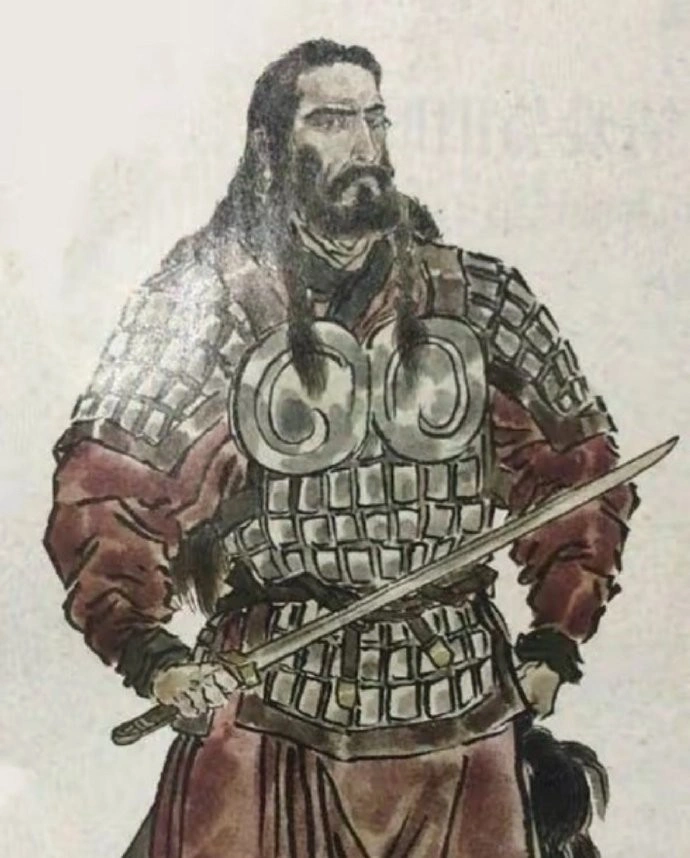
In 338 a convoy came down the road from Luoyang to Ye carrying a bronze camel, a winged horse, nine dragons, a set of guardian figures and several bronze bell frames. The bell frames were the difficult part. One bell had fallen into the Yellow River, and the men who raised it worked from a barge with three hundred divers, a hundred oxen and a windlass of bamboo cable; the cart that carried it north had four wheels bound with iron, with ruts four feet wide and two feet deep. The man who ordered the move had made Ye his capital three years earlier. He was not the founder of the dynasty. He was the founder's nephew, and the histories call him Shi Jilong, using his courtesy name because, the record says, his personal name fell under a dynastic taboo. The state he ruled called itself Zhao. The prefix Later was added by historians who needed to distinguish it from the Zhao of Liu Yao in the west, and the phrase Sixteen Kingdoms, which now covers the whole period, was coined long afterwards; no court of the fourth century used either term.
His reign is usually remembered as a list of cruelties, and the list is not short. It is more useful to see him as the man who tried to turn a conquest into a state by building. He moved the capital, moved the population, moved the bronze furniture of the old capital, called out labour by the hundred thousand, and sent armies to three frontiers. The Later Zhao reached its greatest extent under him and began to come apart under him, and the two facts belong together. A regime that governs by requisition can raise an army and a palace; it cannot raise a successor. What follows depends chiefly on the record of Shi Jilong in the Book of Jin. A Tang commission finished that history in 648, working from archives that the northern courts had kept. The chapters on the sixteen states are headed records rather than annals, and they reproduce the biases of both the archives and the dynasty that commissioned them. Their speeches are literary compositions, their figures are round, and their verdicts belong to the victors. The Comprehensive Mirror of 1084 gives the clearest chronology, but it is a secondary work. The Biographies of Eminent Monks is a work of hagiography, not a state record, and is used here only for what it is.
1. The Nephew
Wuxiang lay in the upland of Shangdang, in the hills west of the Hebei plain, among the eastern folds of the Taihang range, where the valleys were fit for sheep and horses rather than for a dense peasant population. The county had already produced one dynastic founder. Shi Hu came from the same villages as Shi Le. His father is given in the record as Koumi, but Shi Le's father, Zhu, took the boy into his own household and raised him, which is why the histories hesitate between two labels. The Book of Jin calls him Shi Le's congzi, a nephew of the clan, and then adds that because of the adoption some people called him Shi Le's younger brother. The confusion is not a scandal. In a frontier household, fostering and adoption were practical arrangements, and a boy raised at an uncle's hearth could be both things at once.
The record's portrait of the child is a catalogue of violence with one proverbial detail. He was cruel, idle, devoted to hunting, and unusually good with a sling, which he used on people. The army came to regard him as a pest. Shi Le wanted to kill him, and would have done it if his mother had not intervened. Lady Wang produced a proverb: a fast calf, before it is broken to the yoke, tends to smash the cart; the family should wait. The boy was spared. The story has the shape of a prophecy, and it is the sort of childhood scene that a court history likes to supply. It also records a real decision. A commander who needs cavalry officers cannot afford to kill the one who may turn out to be his best.
In early manhood he changed his manner. He was tall and quick, a first-rate horseman and archer, and his relatives and officers learned to fear him. Shi Le made him General Who Conquers the Caitiffs. The same record that notes his courage notes the price of it. He killed officers whose bravery or judgment rivaled his own, and when he took a city he did not distinguish between soldiers and civilians. Shi Le reproved him more than once. He did not change. What the record insists on, in the same breath, is that he commanded well: his discipline was strict without being petty, his orders were obeyed, and where he pointed the army went. Shi Le therefore gave him the eastern theatre and trusted him with independent campaigns.
The offices came in step with the trust. At Xiangguo he was Administrator of Wei commandery and held the Three Terraces at Ye; he was made Marquis of Fanyang. When Shi Le took the titles Grand Chanyu and King of Zhao in 319, Shi Hu became Yuanfu of the Chanyu, commander of the palace guards, Palace Attendant and Duke of Zhongshan. The Chanyu's office was the second crown of the Later Zhao. It gave him command of the Hu half of the state, with its own courts, its own judges and its own soldiers, alongside the Chinese bureaucracy. In 330, when Shi Le took the imperial title, Shi Hu became Grand Commandant, acting Director of the Secretariat and Prince of Zhongshan with a fief of ten thousand households. He had commanded the armies that destroyed the Han Zhao. He expected the Chanyu's title to follow.
It went to Shi Le's own son. The Book of Jin puts a speech in Shi Hu's mouth, addressed to his son Shi Sui. For more than twenty years, he said, the emperor had sat at the centre and pointed while Shi Hu stood in the line of arrows. He had taken Liu Yue in the south, driven the Suotou back in the north, pacified Qi and Lu in the east and settled Qin and Yong in the west; he had conquered thirteen provinces, and the state was his work. The Chanyu's title should have been his, and instead it went to a child with milk on its lips. Every time he thought of it he could not sleep or eat. When the emperor died, he said, there would be no seed left. The speech is a composition of the court historians, not a transcript, and it is also the clearest statement of the motive that the next two years would confirm.
Shi Le died in 333. Shi Hong succeeded him, and Shi Hu became Chancellor, Prince of Wei, Grand Chanyu and holder of the nine bestowals. In a single year he took the title he had been denied, and more. In the eleventh month of 334 he had Shi Hong deposed as Prince of Haiyang and took the title Administrator-in-Regency, Heavenly King of Zhao; the deposed emperor, the empress dowager and two princes were killed soon afterwards. The record gives him a dignified scene on the way to the carriage, and that belongs to the appendix to his father's record.
One man refused to congratulate him. Yao Yizhong, the Qiang commander, stayed away and came only when summoned repeatedly. He told Shi Hu to his face that men had called the king a hero of the age, and that it was strange for a man entrusted with an orphan at the bedside to take the orphan's throne. Shi Hu answered that he had not wanted it, but the boy was young and could not manage the household, so he had taken his place. He was angry and did not punish him. The scene is a useful correction to the image of the pure tyrant. He could tolerate a blunt soldier who spoke the truth to his face, and he killed the sons of the man who had raised him.
The pattern was now set. He had won the state for a founder who would not give him the second title, and he had taken the whole title from the founder's son. In 335 he proclaimed the era name Jianwu and moved the government east. What followed was not an interlude between two wars. It was a programme.
2. The Move to Ye
Xiangguo was a hill town that Shi Le had made a capital because it could be held. Ye was the old city on the Zhang River, with the Three Terraces, the granaries of the Hebei plain and a name that reached back to the Warring States. To move from the first to the second was to claim the old royal centre rather than the frontier fortress. The record preserves a small argument about the ritual. The president of the secretariat asked that the grand master of ceremonies announce the move at the ancestral temple. Shi Hu replied that the ancients announced great affairs at the temple but did not include the altars of soil and grain, and told the ministers to discuss the matter properly. They proposed that the grand commandant announce it at the altars. He agreed. A man who had taken the throne by force wanted the forms of a legitimate transfer, down to the order in which the gods were informed.
When he entered the Ye palace, a soaking rain fell. He was delighted, took it as an omen, and proclaimed a general amnesty. The building programme began at once. At Xiangguo he raised the Taiwu Hall: a base two zhang eight chi high, faced with patterned stone, with an underground chamber holding five hundred guards, seventy-five paces from east to west and sixty-five from north to south, with lacquered tiles, gold door-knockers, silver and gold columns, pearl blinds and jade walls. At Ye he built the Eastern and Western Palaces and, behind the Xianyang Hall, the Lingfeng Terrace with nine halls. The rear palace held more than ten thousand women in silk and jewels. He created eighteen grades of female officials, taught palace women astrology and archery, set female astronomers on the terrace to check the reports of the male astronomers, and formed female bands and guards to match the male ones. He forbade the commanderies to study astrology or prognostication privately, on pain of death. The palace was a model of the cosmos and a labour camp at the same time, and the two functions were not separated in his mind.
In 337 more than five hundred officials petitioned him to take a higher title. He staged the ceremony at the southern suburb and took the name Great Heavenly King of Zhao, sacrificing to heaven, posthumously enthroning his grandfather and father as emperors, making Lady Zheng queen and Shi Sui crown prince. The ceremony was nearly ruined by an accident. An artisan named Cheng Gongduan had built a great torch stand for the courtyard, more than ten zhang high, with a pan of oil at the top and a lower platform with men to work the ropes. Shi Hu tried it and was pleased. As the five hundred officials entered, the oil from the upper pan poured down on the lower one and seven men were killed. Shi Hu was disgusted, had the artisan beheaded at the palace gate, and went through with the ceremony. The omens were already mixed. A court that read omens for a living could not have missed the message.
The works continued through the 340s. At Ye the record counts more than forty towers and terraces; at Chang'an and Luoyang it gives four hundred thousand workers for the two palaces, a figure that overlaps with other notices and should be read as a programme rather than a payroll. What is not in doubt is the scale. A northern state whose registers had been shattered by the previous generation's wars was moving earth and cutting timber for two capitals at once.
The bronze convoy was the emblem of the programme. Shi Hu had not inherited the old capital; he had taken its furniture, and the taking was the point.
Other projects were less successful. South of Ye he proposed a flying bridge across the river, on the advice of an artisan named Xie Fei. The cost was reckoned in the thousands of millions; the bridge was never built; the workers starved before the project was stopped. In 347 he built the Hualin Park and a long wall north of Ye with a hundred and sixty thousand men and women and a hundred thousand carts. The wall was to run for tens of li, with three towers and four gates, three of the gates opening onto the Zhang River with iron doors. A storm killed tens of thousands. The record has him say that the wall might be finished in the morning and collapse at night and he would not regret it. A section of the city wall collapsed and killed more than a hundred. The sentence is the best description of his relation to building. He did not want the wall. He wanted the building of the wall.
The remonstrances are equally revealing. The Palace Attendant Wei Xiao wrote that the son of a rich house does not sit beneath the eaves, and that an emperor should not walk among the axes and hammers; that the ancient kings built only in the slack season of the fields; that the present works were being pushed in the months of weeding and harvest; that the dead lay along the roads and the sound of complaint filled them. Shi Hu read the memorial, praised it, gave the man grain and silk, and increased the works. The pattern would repeat. He did not punish most of his critics; he rewarded them and ignored them. The cruelty was not in the punishment of advice. It was in the steady, good-humoured refusal to be deflected by it.
The strangest notice belongs to these years. The murals in the Taiwu Hall showed the sages and worthies of antiquity. In the 340s, the record says, the painted figures all turned into Hu; within ten days their heads had shrunk into their shoulders. Shi Hu was horrified. Fotucheng wept. A court that had built its legitimacy on the classical past was being told, by its own wall, that the past had changed its face. The omen is a literary device, and it is also a precise description of the regime's problem. The Later Zhao could reproduce the forms of a Chinese state, but the forms would not stay Chinese.
3. The Ledger of Labour
Shi Le's fiscal settlement had been light. A household owed two bolts of cloth and two hu of grain; the Hu were exempt from the household tax and enrolled in the army. Shi Hu did not repeal that settlement. He added requisitions, and the difference matters. A tax is a rate that a household can plan for. A requisition is a demand that arrives in the same season as the harvest and takes the ox, the cart, the grain and the man together. The registers could survive a rate. They could not survive a demand.
In 340 he ordered the seven provinces of Si, Ji, Qing, Xu, You, Bing and Yong to supply three men from every five, and two from every four, and with the old Ye garrison the total came to five hundred thousand. Ten thousand boats were built, and eleven million hu of grain were moved to Anle. The figure is a paper total and should be read as such: a paper army is what a government writes on the order, not what stands in the field. The proportion is the real information. Three of every five adult men were called out in the same year, in the provinces that fed the capital.
Two years later the demands were larger. More than four hundred thousand workers were employed at Ye, and at Chang'an and Luoyang on the two palaces. Five hundred thousand men were set to making armour. A hundred and seventy thousand boatmen were pressed into service, of whom one third died by drowning or by wild animals. Seven of every ten households were reported out of work. Forty thousand horses were confiscated from private owners, and anyone who hid one was to be executed at the waist. The record adds that the emperor's officials competed with one another in private enterprise and that the roads were full of the dead.
In 345 the programme reached its height. One hundred and sixty thousand men from Yong, Luo, Qin and Bing were sent to rebuild the Weiyang Palace at Chang'an; two hundred and sixty thousand were sent to the Luoyang palace. Thirty thousand women were levied for the rear palace, and ten thousand more were taken privately by the princes. The record says that there were three thousand cases of husbands killed or of men who killed themselves rather than lose a wife, and that fifty officials were executed for failing to keep order. The remonstrance of the grandee Lu Ming was answered with his death.
The conscript's kit is preserved in a single sentence. Every five men were to provide one cart and two oxen, and each man fifteen hu of rice and ten bolts of silk; a shortfall was punished by death. The record says that families sold their children and still could not meet the demand, and that men hanged themselves beside the roads. This is the language of a memorial, not of a ledger, and the exact figures cannot be checked. The mechanism is credible. A conscript who must bring his own cart and ox is not a soldier on state pay; he is a household carrying the state's expenses on its own back. When the household has no ox, it sells the child. When it has no child, it hangs itself.
The famine notices belong in the same ledger. In one year a jin of gold bought two dou of rice. Eight commanderies of Ji were covered by locusts. Hail ruined the autumn grain. The emperor issued a decree blaming himself, opened the granaries, and remitted the tax for the worst districts. In 347 he performed the ritual ploughing in his own mulberry park, and his wife performed the silkworm rite, and then he went to Xiangguo to bow at Shi Le's tomb. The ritual and the requisition were part of the same government. The emperor who ploughed was the emperor who called out the labour, and the ploughing was a way of saying that the labour was agricultural in its purpose.
The extraction had a logic. The Later Zhao did not have a land survey, a treasury that could pay for a war in cash, or an administration capable of measuring a harvest. It had grain, cloth, horses and men, and it took them directly. A state that wants a palace, a fleet and an army in a poor and partly depopulated country must take those things from the household, because the household is the only unit that produces them. The cost was borne by the same population that the state was trying to attach to the land. Every levy gave a peasant a reason to leave the register. The exits were three: flight to a great family as a client, flight south across the river, or ordination as a monk. All three removed a man from the tax roll. The state could close one exit at a time, and it could not close all three without closing the army and the church.
The works and the villages were two sides of one policy. The palaces were built to impress the present; they were paid for by the future.
4. Moving People
Shi Hu moved populations on a scale that few northern rulers had attempted since the Han. The unit was the household, and the register was the instrument. A conquest produced prisoners; a register produced households; a household could be marched, settled, taxed and conscripted. It was not settlement for its own sake. It was deportation with a fiscal purpose: to fill the capital, to empty a frontier that might shelter an enemy, to break the local networks of a conquered elite, and to put a new population on land that the state could count.
The policy began before he took the throne. In 329, as the Han Zhao collapsed, nine thousand refugees and leading families from Qin and Yong were settled at Xiangguo. The largest movement came at the beginning of his reign. In the years around 334, more than a hundred thousand households of the Qin-Yong region, including Di and Qiang, were moved east of the passes. One of the deported leaders was Fu Hong, who was settled with his people at Fangtou and given the title of refugee commissioner. His descendants would found the Former Qin. The connection is not a digression; it is the longest consequence of the policy. A state that moves a people creates a constituency with no local roots and a leader with a grievance. In one generation the constituency becomes an army, and the army becomes a dynasty.
The later movements were smaller and more regular. In 338, after the defeat of Duan Liao, twenty thousand households were moved to Yong, Si, Yan and Yu, and men of talent among them were given office. In 339, from the Jin frontier, seven thousand households were moved to You and Ji, or seventy thousand, depending on which text one follows; the Comprehensive Mirror has the smaller figure and the Book of Jin the larger, and the tenfold gap is a reminder that these numbers are administrative claims, not censuses. In 340 ten thousand households from Liaoxi, Beiping and Yuyang were moved to Yan, Yu, Yong and Luo. In 347 seven thousand households from Wujie were moved to Yongzhou. A small notice records that five hundred households of deported Taiyuan people rebelled and fled into the Hei Qiang. The notice is easy to miss. It is the only trace of the people who refused.
The register had a long memory. The great families of the Guanzhong who had been moved east in 334 were still enrolled for military service years later. In 340 Wang Zhuo petitioned that the old leading families of Yong and Qin, men of famous clans, should not be treated as ordinary conscripts. Shi Hu agreed. Seventeen surnames, including the Huangfu, Hu, Liang, Wei, Du, Niu and Xin, were removed from the military register, given the status of the old families, and allowed to return home if they wished. The episode shows how resettlement worked in practice. A family was moved as a unit, kept on the register as a unit, and could be reclassified as a unit. The household number is a fiscal entry, not a head count. A register entry could cover a single family or a clan of fifty, and it told the tax office nothing about how many people actually slept in the house.
The effects were four. The capital and the new commanderies were filled with dependants and labour. The frontier was emptied of the men who might have defended it. The army gained new units, but those units were made of uprooted men with no local loyalty and no land of their own. And the state created a class of enemies who knew the roads: the deported, the returned, the men who had lost a homestead twice. The Later Zhao was not unique in this. Most northern states of the fourth century moved people. What was distinctive was the scale and the speed, and the fact that the movements were not followed by a settlement policy. The households were moved; they were not given a secure place in the new country.
The deported were also the labour force for the works. The connection between the two policies is direct. A household that has been moved from Qin to the neighbourhood of Ye has no land, no local patron and no way to refuse a summons. It is available. The great building campaigns of the 340s were staffed by exactly this population, and the frontier garrisons were filled from the same pool. The state did not need to invent a labour policy. It needed only to move people and then call them.
5. The Three Frontiers
The Later Zhao army was a cavalry army with a Chinese infantry, a corps of engineers and a river fleet. Its core was the Guoren cavalry, mounted, armoured and maintained by the state. Its auxiliaries were the troops of submitted chiefs, the deportees, the frontier levies and the Chinese infantry. Its engineers built bridges, roads and siege works, and its fleet was large enough to move a hundred thousand men across the Yellow River but not large enough to cross the Yangzi. The army could raid, break a frontier force, take a city and carry off its population. It could not annex a country that had a fortified capital, a mobile cavalry and a distance behind it.
The northern war began well. In 338 Shi Hu attacked Duan Liao with a hundred thousand marines and a hundred thousand infantry and cavalry. More than forty cities surrendered. Duan Liao fled to Mount Miyun; Shi Hu captured his mother and wife, killed three thousand and moved twenty thousand households to four provinces. It was the most successful campaign of the reign, and it destroyed the buffer between the Later Zhao and the Murong. The record notes that the able men among the Duan were given office, which was the correct policy and the exception rather than the rule.
Shi Hu then turned on Murong Huang, who had promised to join the campaign and had not. The record gives him several hundred thousand men and says that thirty-six cities of the frontier defected to him. He besieged Jicheng for more than ten days and could not take it. Murong Ke, the enemy's son, came out at dawn with two thousand cavalry; the record says that banners appeared at every gate as if an army were issuing from each. Shi Hu's camp panicked. He abandoned his armour and fled. The Yan account claims more than thirty thousand killed. The Book of Jin adds a detail that is almost a parable. Before the campaign the astronomer Zhao Lan had warned that the year star protected the Yan capital and the expedition would fail. Shi Hu had him flogged and demoted. After the defeat he called him back and restored his office. He punished the prediction and then accepted it.
In 339 he sent Ma Qiu with thirty thousand men to receive Duan Liao's surrender. Murong Ke hid seven thousand cavalry at Miyun and destroyed the column; six or seven of every ten were killed; Ma Qiu escaped on foot. The record says Shi Hu was eating when the news came and spat out his food. In the same year Li Nong and Zhang Ju attacked Fancheng with thirty thousand men; Yue Wan held it with a thousand; after more than ten days the Zhao army withdrew. The defender's speech in the record is a summary of the frontier's logic: one man on a wall is worth a hundred in the field. In 340 he ordered the great mobilization: five men to supply three, four to supply two, five hundred thousand under arms, ten thousand boats and eleven million hu of grain. Murong Huang did not wait. He raided You and Ji, burned the stores and carried off more than thirty thousand households. The five-hundred-thousand-man army never crossed the frontier.
The southern campaigns were raids. In 335 Shi Hu led a column to Liyang on the Yangzi and withdrew; the Jin capital panicked. A detached force under Shi Yu besieged Huan Xuan at Xiangyang for twenty days and withdrew when famine and disease broke out. In 339 Kui An led five generals and fifty thousand men, or seventy thousand by the Book of Jin's count, into Jing and Yang. The Zhao forces defeated the Jin at Mianyin, took Zhu city, killed six thousand, and Mao Bao and Fan Jun drowned in the river. Huang Chong and Zheng Jin surrendered. Kui An then besieged Shicheng, was defeated by the governor of Jingling with five thousand killed, and withdrew, carrying off seven thousand households to You and Ji, or seventy thousand in the Book of Jin's tally. A raid that takes a city and then leaves it is not a conquest. It is a harvest.
The strategy was debated at court. When the envoy of Former Liang behaved arrogantly, Shi Hu wanted to kill him. The Palace Attendant Shi Pu told him that the real enemy was Danyang, the Jin capital, and that a western war would divide the southern army. Shi Hu let the envoy go. The exchange states the priority: the south was the enemy, the west was a nuisance. But the priority was never converted into a plan. A southern conquest required a fleet, a siege train and a supply system that could hold the rice country through a summer. The Later Zhao had boats for a river crossing and cavalry for a raid. It did not have the rest.
The western war is the clearest case of the limit. In 346 Ma Qiu took Daxia and Jincheng. In 347 Shi Hu reinforced him with Shi Ning and twenty thousand men from Bing and Si. Song Qin, a Former Liang general, defected with twenty thousand households. Wang Zhuo took Wujie and moved seven thousand households to Yongzhou. Then Zhang Chonghua's general Xie Ai met him at Linhe, and the Zhao army was broken there: thirteen thousand killed by the record's count, and Ma Qiu riding back to Daxia alone. A second army under Sun Fudu and Liu Hun crossed the river and joined him at Changzui, and that too was beaten. Ma Qiu took some revenge by defeating Zhang Mao and killing three thousand; Li Kui surrendered with seven thousand men; the Di and Qiang south of the river submitted. But Former Liang survived.
The campaign did not destroy Former Liang. Zhang Chonghua remained on the throne until 353. Zhang Tianxi ruled from 363 to 376 and surrendered to the Former Qin, not to the Later Zhao. What the 347 campaign demonstrated was that the Later Zhao could not project power beyond the river valleys.
Three frontiers, three different failures. In the north, a fortified enemy with a mobile cavalry and a short supply line. In the south, a river and a fleet the Zhao never built. In the west, distance, desert and a defenders' army that could choose its ground. The army was a machine for extracting from the plain, and it worked best within a few weeks' march of the granaries. Beyond that range it became a crowd of men and animals eating the country it had come to take. The record's numbers, five hundred thousand here and a hundred thousand there, measure the ambition and the supply problem at the same time.
6. The Monk and the Register
Fotucheng was a monk from Kucha, or more vaguely from the Western Regions, surnamed Bo. The hagiography says that he was ordained at nine in Udyana, studied twice in Kashmir and arrived at Luoyang in 310 at the age of seventy-nine. He met Shi Le at Gebi in 312 through the general Guo Heilue, predicted the outcome of campaigns and acquired a reputation as a man who could see what others could not. The hagiography claims that he rescued eight or nine out of every ten men under sentence of death. That ratio belongs to the conventions of saints' lives; the underlying pattern is plausible, since a commander who took omens seriously would find it hard to deny a holy man's request for a prisoner.
His position became extraordinary. The dynasty had called him a great treasure of the state, and under Shi Hu the honours increased. On assembly days he was carried into the hall in a sedan; the attendants helped lift it; the crown prince and the princes supported him up the steps; the master of ceremonies called out "Great Monk", and the whole court rose. The Minister of Works Li Nong visited him daily; the princes came every five days. No Chinese minister and no general had such access. A foreign dynasty with a foreign god had found a ritual that put both above the Chinese gentry.
The most important document of the reign is the debate over ordination. A Chinese official, Wang Du, submitted a memorial. The Buddha was a god of the Western Regions, his power did not reach the Chinese people, and the Son of Heaven of China should not worship him. Since the Han, only Westerners had been allowed to build temples in the capitals, and Chinese had not been allowed to become monks. The Zhao should forbid all its subjects to burn incense or bow in temples, and should return Zhao monks to the four occupations. The Director of the Secretariat, Wang Bo, agreed. The memorial was a statement of the old order: the ritual of the state belonged to the Chinese gentry, and a foreign god had no place in it.
Shi Hu's answer is a founding charter of Chinese Buddhist establishment. He had been born on the frontier, he said, and now ruled the Xia; sacrifices should follow his own custom as well as the Chinese. The Buddha was a god of the Rong, and it was right that he should worship him. Let all the Yi, the Zhao and the hundred barbarians who wished to abandon their sacrifices and serve the Buddha be ordained. The edict has been read as the first official permission for Chinese ordination, and the reading is probably right. It is also a political statement of great economy. A foreign dynasty and a foreign god legitimated each other against the Chinese gentry's monopoly of ritual. The emperor did not have to become a Chinese scholar to be legitimate. He could be a Rong emperor with a universal god.
The same record shows the fiscal problem. Shi Hu asked whether men without rank or office should be allowed to worship, and whether the monks, many of whom were criminals avoiding corvée, should be examined. He protected the church and complained about its labour exemption in the same breath. The monasteries were outside the register. That was their attraction and their threat. A peasant who ordains ceases to be a taxable household; a monastery that accumulates land and tenants becomes a rival jurisdiction. The state could tolerate a church that prayed for it. It could not tolerate a church that absorbed its taxpayers. The review of the sangha was an attempt to tell the two apart.
The hagiography credits Fotucheng with 893 monasteries in the territories he passed through. The figure covers a whole missionary career, not a single census, and it belongs to the literature of sanctity. It is still evidence of something. A network of that size, with patrons among the ministers, represented a substantial transfer of wealth and labour out of the register. The record notes that two of Shi Hu's ministers, Zhang Li and Zhang Liang, built great towers at their own expense, and that Fotucheng rebuked them for hoarding wealth. The church had rich patrons and a landlord's future. The monk's own teaching, as the hagiography reports it, was a rebuke to the court: lavish giving does not cancel unjust killing. It is the one line in the Buddhist material that sounds like a verdict on the reign.
Fotucheng died on the eighth day of the twelfth month of 348, which by the Western calendar falls in the first weeks of 349, at the Ye palace temple. The hagiography makes him a hundred and seventeen. One version of the story says that after his death a monk saw him travelling west, that Shi Hu opened the coffin, and that only a stone was inside. In that version Shi Hu says, "The stone is me; I am going to die." The story is an invention, and it is also an accurate omen. The dynasty's name was Stone. Its emperor had built a state out of stone and labour, and the only relic in the monk's coffin was a stone.
The longest consequence was a pupil. Dao'an came to Ye, met Fotucheng and was recognized at once. He became the leading Buddhist scholar of his age; his pupil Huiyuan carried the tradition across the Yangzi. The chain from the Zhao court to the monasteries of the Yangzi was not planned by Shi Hu. It is the one legacy of his patronage that outlived the state by centuries, and it is a legacy of the school, not of the throne. The emperor protected a monk; the monk taught a scholar; the scholar made a religion that the emperor would not have recognized.
7. The Heir
The Later Zhao had been built on a division of labour. The Hu soldiered; the Chinese farmed and paid. The Chanyu commanded the soldiers; the crown prince stood for the civil service. Shi Le had left the succession and the army in separate hands, and his nephew had taken the army. Shi Hu made himself Grand Chanyu in 333 and later gave the title to his son Shi Xuan, which solved the constitutional problem in the short term and created a new one. The heir now commanded the army as well as the succession. A crown prince with an army is a rival before he is a successor.
The first heir was Shi Sui, made crown prince in 337. The record's portrait is of a drunk given to cruelty: he killed palace women for amusement and plotted to kill his father. The political facts are simpler. He was the heir, he had a staff of some five hundred retainers, and he was afraid of his father. He consulted his attendants about doing what Modu did, the Xiongnu precedent of killing a father and taking his place. The plot leaked. Shi Hu killed him, his wife and twenty-six of his household in a single night, buried them in one coffin, executed more than two hundred of his staff and deposed his mother, Lady Zheng. The lesson was not lost on the next heir.
Shi Xuan was made crown prince in the same year, after his brother's death. In 339 he was made Grand Chanyu and given imperial banners. In 347 he was sent to pray at the mountains and rivers and used the occasion for a hunt with sixteen armies and a hundred and eighty thousand men. The column moved through three provinces and fifteen commanderies, stripped their stores and left soldiers dead of cold and hunger. Shi Hu watched from a tower and said that with sons like these, unless heaven fell and earth sank, what was there to worry about; he would hold his grandsons and enjoy his old age. A father who watches a hundred and eighty thousand men hunt through three provinces and sees a family picnic is a father who has confused the state with his household.
Shi Tao, Duke of Qin, was the favourite. He built a hall at the office of the Grand Commandant called the Xuanguang Hall with a beam nine zhang long. Shi Xuan saw it, was furious, killed the carpenter and cut the beam. Shi Tao raised the beam to ten zhang. The quarrel over a beam was a quarrel over precedence, and the father's favour was the real beam. Shi Xuan had Shi Tao murdered in a Buddhist chapel, by men who entered over the roof with a rope ladder and left the knife and arrows behind. He then went to the funeral, did not weep, lifted the coverlet, looked at the corpse and laughed.
Shi Hu suspected him. He summoned him on the pretext that his mother was ill and had him seized. An informer, a man named Shi Ke, told the story of the murder. Shi Hu had Shi Xuan put in a storehouse with an iron ring through his jaw, and then had him taken to a pyre north of Ye and killed in a manner designed to reproduce the wounds of Shi Tao. The record describes the execution in detail and says that Shi Hu watched from a tower with his consorts. This article does not repeat the detail. What matters is the political sequence. Shi Xuan's wife and nine children were killed; three hundred of his staff and fifty eunuchs were killed; a hundred thousand Eastern Palace guards were sent to garrison Liangzhou; his mother, Lady Du, was deposed.
The exile of the Eastern Palace guards was the most consequential act of the year. In 349, when they reached Yongcheng on the road to Liangzhou, they learned that they were excluded from a general amnesty. The governor took their horses and made them pull carts. They revolted under a leader named Liang Du, who took the title General Who Conquers the East of Jin. Their numbers grew to a hundred thousand; they took Chang'an, crossed the Tong Pass and reached Luoyang. Li Nong with a hundred thousand men was beaten twice. Shi Bin, with ten thousand cavalry, and the generals Yao Yizhong and Fu Hong destroyed them at Xingyang. The revolt was the bill for the purge. A state that sends a hundred thousand of its own soldiers into exile has created an army that knows the road back.
In 349, with Shi Xuan dead and the adult princes suspect, Shi Hu made his young son, still a child, crown prince. The boy's mother was Lady Liu, a daughter of Liu Yao taken in the conquest of Shanggui. Zhang Chai, the officer who had captured her, urged the child's appointment because the mother would be regent and he would be chancellor. Shi Hu's answer is the most revealing sentence in the record. He would like to wash his belly with three hu of pure ash, he said, because it was foul, and that was why he bred bad sons. A son of twenty wants to kill his father. Shi Shi is ten. By the time the boy is twenty, Shi Hu will be old. The Grand Minister of Agriculture, Cao Mo, refused to sign the petition: the enterprise of the realm was heavy, and a child should not be set up. Shi Hu said that Cao Mo was a loyal minister but did not understand his mind. The loyal minister was right. The emperor knew he was right and did it anyway.
The choice was not irrational in the narrow sense. An adult heir with an army would have been a rival at once; a child gave the emperor a regency he could shape. The calculation failed because the regency was contested before the body was cold. Lady Liu and Zhang Chai moved against Shi Bin, the one adult who could have held the state together, and the three-power testament lasted less than a month.
8. The Last Year
In the first month of 349 Shi Hu took the imperial title at the southern suburb, changed the era to Taining and gave every official a rank. It was the full form at last, after fifteen years of kingship. The occasion was also the moment when the bill for the purges came due: Liang Du's revolt, the omens, the illness. The record lists the omens with the care of a court that read them professionally. Mars entered the accumulating corpses and the Pleiades, and then moved north against the River Drum; the city wall by the Hualin Park collapsed; the painted sages in the Taiwu Hall had turned into Hu. The emperor was ill, and the sky was full of messages.
The testament, as the record gives it, named three men. Shi Zun, Prince of Pengcheng, was to be General-in-Chief and hold the west. Shi Bin, Prince of Yan, was to be Chancellor and recording secretary. Zhang Chai was to be General of the Palace Guard, commander of the capital army and Personnel Director. All three were to assist the government. It was a balance of three men who did not trust one another, and it had no mechanism for deciding between them. A regency of rivals is not a constitution. It is a delay.
Lady Liu and Zhang Chai moved first. Shi Bin was the capable adult, and if he became regent they would lose everything. They sent him a message that the emperor was better and that the prince, who loved hunting, might wait a little; he went hunting and drank. They then forged an order stripping him of office and put him under guard with five hundred Longteng soldiers. Shi Zun arrived from Henei; they had him received at court, gave him thirty thousand palace troops and sent him back to the west. He wept as he left. On the same day Shi Hu, briefly better, asked whether Shi Zun had come. The attendants said he had gone long ago. Shi Hu said, "I regret not seeing him."
Then two hundred Longteng officers and generals came before him and asked that the Prince of Yan be brought into the palace to command the guards, or made crown prince. Shi Hu did not know that Shi Bin had been deposed. He said, "Is the Prince of Yan not in the palace? Call him." The attendants said the prince was ill with drink and could not come. Shi Hu said, "Bring a sedan and carry him here; I will give him the seals." No one moved. He became dizzy and went inside. The scene is the precise image of his reign. A state built on commands had reached the point where the commands no longer connected to the men who were supposed to execute them. The emperor could still issue an order. He could not make it travel.
Zhang Chai had his brother forge an order in Shi Hu's name and killed Shi Bin. Lady Liu forged an order making Zhang Chai Grand Protector, commander of all armies and recording secretary, with a thousand guards and a hundred riders, on the model of Huo Guang. The Palace Attendant Xu Tong said that disaster was coming and that he would not wait for it; he took poison. Shi Hu died in the fourth month of 349.
Shi Shi succeeded. Within ten months three more men held the title, and the state did not outlive the last of them. That sequence belongs to the joint biography of the last four rulers. This article stops at the accession, because the story it has to tell ends there. The machine that Shi Hu had built, the registers and the levies and the palaces and the commands, continued to run for a little while after his death. It ran without a hand on the lever.
9. The Verdict
The Book of Jin places its verdict on the whole Later Zhao at the end of Shi Hu's record, not at the end of Shi Le's. The verdict on Shi Le is the famous one that grants him greatness while calling him cruel. The verdict on Shi Hu is unrelieved. The text says that his heart knew no virtue or righteousness; from youth he was light and dangerous; he borrowed the shape of a leopard for a sheep's substance and galloped with an owl's heart in a wolf's nature. He began in resentment and ended in usurpation. Then luxury reached its limit, labour services multiplied, spades and shovels followed one another, and weapons never rested. Punishments were severe and men were killed at a word. The surviving people had nowhere to beg for mercy. Among the Rong and Di, was anyone more brutal than this? Father and son suspected each other, brothers were enemies, they butchered one another and were laughed at by the world. The earth on his grave was not dry before disorder came; the trouble began with Zhang Chai and ended with the destruction of the clan. Accumulated evil brought destruction; is there no way of Heaven? The verse summary adds that the Shi began as bandits and ended with a great name, and that Jilong's usurpation and cruelty spread his reputation abroad; his body died and his state perished because his evil was full.
The verdict has three layers. The first is Confucian. Luxury, labour and the loss of the agricultural season are the classic marks of a bad ruler, and the text lists them in the classic order. The second is ethnic. The same chapter calls the Shi a stupid breed and a monster, and describes the Rong and Di as savage beyond measure, treating their entry into the Central Plain as a pollution. The third is dynastic. The Tang house claimed the mandate that the Shi had denied, and its historians wrote the northern states into records rather than annals. The shelf was for powers that had existed and were not to be granted legitimacy. The form of the text was itself a judgment.
What in the verdict is fact? The labour services, the resettlements, the campaigns, the purges and the Buddhist policy are all documented in the same record, often in dry administrative detail that no moralist needed to invent. The register figures, the dimensions of the Taiwu Hall, the number of households moved, the names of the seventeen surnames exempted from military service: these are the kinds of thing a bureaucracy records for its own use. They survive because they were written down before the verdict was composed.
What is rhetoric? The ethnic slurs are rhetoric, and so is the language of the way of Heaven. The cannibalism and the mutilation stories are the rhetoric of horror, and they belong to the same literary market as the hagiography's miracles. The exact figures for the dead are round numbers, and the tenfold discrepancy between seven thousand and seventy thousand households in 339 shows how little the round numbers can bear. None of this means the record is false. It means the record is a composition, and that the historian has to separate the administrative core from the moral frame.
The administrative achievement was real. He held the north for fifteen years, longer than most reigns of the period. He kept the registers, expanded the schools, patronized the classics and made Ye a capital that later dynasties would use. He integrated the deported elites by giving them office and by exempting their leading families from conscription. He protected a church that would shape Chinese Buddhism for centuries. None of this appears in the verse summary, because a verse summary is a moral judgment, not an audit. A ruler can be a bad man and an effective administrator, and the Tang historians knew it; they simply did not think the second fact was the one worth preserving in an encomium.
The structural failure was the succession. He had three heirs and killed two. The third was a child. The state was a machine for extracting labour, and it could not reproduce a political nation. The army was loyal to commanders, the bureaucracy to offices, the church to its own law. When the founder died, there was no institution that could choose a successor without a fight. Shi Le had built a dual state and left the succession and the army in different hands. Shi Hu seized the army, made himself the succession, and spent fifteen years showing that force could not supply what the constitution had failed to provide. The man who had taken the throne because the heir was young left a child on the throne, and the men around the child did what he had done to Shi Hong.
The last image is the convoy of 338. The bell was raised from the river with three hundred divers and a hundred oxen. The camel crossed on a barge of ten thousand hu. The cart with the iron-bound wheels left ruts two feet deep in the road to Ye. The capital was filled with palaces, the palaces with women, the villages with levies, and the frontiers with soldiers who had been moved from somewhere else. None of it was a succession. The state that called itself Zhao did not survive him by two years. The name the historians gave it, Later Zhao, has survived him by seventeen centuries, and it survives because they needed a prefix to tell one Zhao from another.