Home / Emperors / Sixteen Kingdoms
Emperor Pingwu of Hu Xia
胡夏平武帝
Helian Ding, ? – 432 · last ruler of Hu Xia
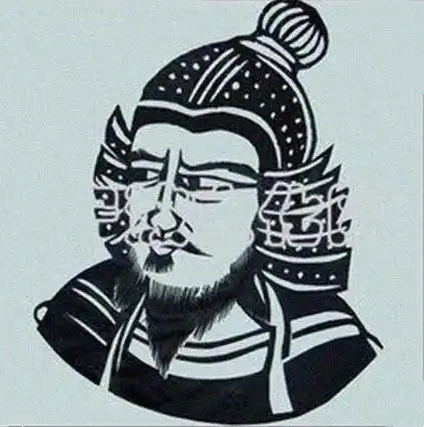
In the sixth month of 431 a column the Comprehensive Mirror counts at more than a hundred thousand came down to the Yellow River at Zhicheng and began to cross. It was not an army on campaign. It was the state of Hu Xia — a court, its remaining riders, and the peasants of the Western Qin, whose last ruler Helian Ding had killed that summer — and it was moving west because there was nowhere else to go. The crossing was slow. While half the column stood in the water the Tuyuhun horse came out of the west and fell on it, and Helian Ding was pulled from the river and carried away.
He had held the title a little over three years, in a country that no longer had a capital. Tongwan had fallen eight months before his accession. What he inherited was a court on the road and a cavalry that had been beaten twice, and in three years he won one battle, lost two seats, destroyed a neighbouring dynasty, and led what was left of his people to a river he could not cross. The usual way to tell this is as a defeat, and it was one; but no single campaign delivered it. Hu Xia was not broken at a wall or in a field. It ran out of country.
1. The Fifth Son
The date of his death rests on a single entry in the Wei annals, and almost everything before it on the same northern archive that recorded his capture; the Book of Jin gives the Hu Xia section a closing clause, and the Comprehensive Mirror of 1084 is what lets the two be read together.
The Wei life opens with two facts and an insult. He was Helian Chang's younger brother and Helian Bobo's fifth son, and he was, in its phrase, violent and worthless. It gives no birth year, and none can be recovered. The Jin chapter lists the sons enfeoffed in 413 and puts Helian Ding after Helian Chang; the Wei life calls him the fifth son. The two traditions disagree about where Helian Chang stood and agree about where Helian Ding stood. That is a firmer foundation than most men of his generation have.
He was not a spare prince when the throne came to him. In his brother's reign he held the offices of Grand General, acting Minister over the Masses, and Prince of Pingyuan — the army and the civil administration in one man's hands. When Helian Chang was taken at Anding in the second month of 428, there was no court left with the power to choose anyone. Helian Ding gathered the remnant, some tens of thousands of men, and brought them back to Pingliang, where he took the imperial title, with an amnesty and a new era, Shengguang.
Pingliang was a seat, not a capital. It stood on the road between the Wei valley and the upper Yellow River, with mountains behind it and one good field around it; it could hold a court and feed a garrison, and it could not replace what had been lost. The distinction governs everything that follows. For two years he ruled a state whose address was a fortress and whose revenue was the next district.
His state was called Great Hu Xia, and it is one of the few northern houses whose name later writers left alone: no other state of the period claimed it, so nothing had to be added in front.
2. Mamao Ridge
In the same spring the Wei commander at Anding did him the service of a proud man's mistake. Helian Chang had been taken, but a subordinate had made the arrest, and the credit belonged to a junior officer. Ashamed of it, the commander left his baggage, took three days' rations, and came north by the hill road to cut the Pingliang road before the new ruler could settle. At Mamao Ridge a deserter entered the Hu Xia camp with the intelligence that the Wei horses had no water.
Helian Ding divided his force and struck the column from front and rear. The line broke; the Mirror counts six or seven thousand dead and three commanders taken, the senior of them the man who had planned the march. The Wei baggage guard abandoned Anding and rode for Chang'an, and the Hu Xia flag went back up over the old southern capital. For two years the city was his, though the record never has him go to it.
This was his father's method exactly: the retreat that is not a retreat, the enemy strung out on a road, the blow at the point where supply fails. It worked because the force was small and the country open. It was the last time it worked. The southern account of the same weeks differs in every particular — an ambush in a valley of the Long mountains, the Wei commander killed, his army buried — while the northern record has the man alive and retrieved two years later, and the Mirror follows the north. A victory this convenient was told more than once.
In the fourth month he sent an envoy to ask the Wei court for peace. The answer was an order to surrender. He did not answer it, and for the rest of that year and the next the western front was quiet.
3. The Mountain
In the tenth month of 429 he tried to take Tongwan back. He marched east as far as a place called Houni, looked at the country ahead, and turned around. The record does not say what he saw. A ruler who stops short of his old capital has usually done the arithmetic: the garrison was behind walls, his own force was the only field army left, and a siege he could not finish would end him faster than the loss of the city had.
Later in the same month he hunted at Yinpan and climbed Kelan Mountain, and the Wei life, which had called him worthless in its first sentence, gives him the only interior scene the record allows. He looked toward Tongwan and wept, and the record has him say that if the former emperor had given him the succession, it would not have come to this. Tongwan lay beyond any horizon visible from that mountain, so the scene is a composition, and its purpose is double. It lets him grieve, and it makes the grief a complaint against his brother, which is the least dignified shape grief can take. It is also the nearest thing to a claim on the throne that he ever put into words. He did not say that the Wei had taken his country. He said that his father had chosen the wrong son.
The next year he tried again, and the timing was not foolish. The Song had come north in force in the third month, and the Wei court had to choose which war to fight. In the ninth month Helian Ding sent a younger brother east with a column, took the main body east himself, and sent an envoy to the Song to propose a joint campaign. The brother's column was caught and destroyed, with more than ten thousand dead in the Mirror's count. The main body got no further than a town on the eastern road before the Wei ruler came west himself; why he came, and what the Wei court argued before he did, belongs to another history.
At Anding the Wei general in front of him gave ground on purpose, and Helian Ding, who had won his one battle by trusting a deserter's report, followed a retreat that had been designed to be followed. The Wei had brought steppe cavalry, which came in on his flank. He got the remnant onto the Qianshui plain and formed a square, and the Wei sat around it and cut the water. When he came down the slope the square came apart: more than ten thousand dead in the Mirror, and Helian Ding wounded, on a single horse, with the pursuit behind him.
He collected fifty thousand soldiers and civilians and went west to Shanggui. In the twelfth month Pingliang surrendered. Two of his brothers had held it; they came out and surrendered. The garrisons of Chang'an, Linjin and Wugong left their walls without a fight, and the Wei took the whole of the Guanzhong plain. The three commanders he had taken at Mamao Ridge were found in the city and sent home after more than two years in his keeping.
By the end of 430 he was the ruler of one town on the upper Wei and of the road west.
4. The Neighbor
In the tenth month of 430, while Helian Ding's war in the east was ending, the last ruler of the Western Qin burned his cities and started east. Qifu Mumo had inherited a state that had been losing ground for years, and the Wei court had told him he might have Pingliang and Anding, which were not the Wei's to give. He took it literally and marched for Shanggui with fifteen thousand households.
That was the one thing Helian Ding could not allow. Shanggui was the last town he had.
In the first month of 431 he struck first. He beat a Western Qin general in the field, then sent ten thousand men under one of his uncles against Nan'an, where Qifu Mumo had shut himself in. The town was starving before the siege closed. Three of its ministers came out and surrendered; the ruler came out after them in a cart carrying a coffin, the old ceremony of a man who expects to be killed. He was taken back to Shanggui and kept alive five months. In the sixth month Helian Ding killed him and five hundred of his clan.
The record gives no reason for the delay or for the killing. A column about to cross a river cannot carry a king, and a ruling house with a claim older than his own is a standard around which someone else's loyalty can form. The five hundred were not a massacre in the field. They were the removal of a rival line, done at the moment when he could no longer afford to keep it.
With the Western Qin went its people. The Mirror puts the column he took west at more than a hundred thousand, and almost all of them were Qin peasants, not Hu Xia riders. That is the fact that explains what happened at the river. His own army had been counted in the tens of thousands in 428; after the Qianshui plain he had fifty thousand soldiers and civilians together. The only large body of people left in the corridor was the population of the state he had just destroyed. He had set out to take a neighbour's land and had taken its famine instead.
Expansion is the motive the sources give, and it was part of it. Longxi was the last farmland in his reach, and an army that lives off the country must keep moving to fresh country. But the sequence in the Mirror is tighter than that. Qifu Mumo was coming east into the same corridor with fifteen thousand households, and the Wei was pressing from the east. Helian Ding did not choose a victim. He met a competitor on the only road left, and he was the stronger of the two dying men.
5. The River
In the sixth month of 431 he left Shanggui and marched west with the whole column. The ostensible object was the Northern Liang: Juqu Mengxun held the Hexi, and Juqu Xingguo, his son and once his heir, had been a prisoner in Helian Ding's train since the fall of Nan'an. The real object was distance. The Mirror says plainly that he feared the Wei; he was not marching to a war; he was marching away from one.
The road ran down the Wei and into the Yellow River country, and at Zhicheng the column began to cross. A migration is slow, and a crossing is the one moment when a cavalry state stands still. The Tuyuhun king Murong Mugui had been waiting for exactly that. Tuyuhun is not one of the states this history counts, and it enters the record here for one reason: its pastures lay on the flank of the only road left. Mugui sent thirty thousand horse, in the Mirror's count, and they took the column while half of it was in the water.
The crossing broke. Juqu Mengxun's son was wounded in it and died a few days later, which is the only thing the Northern Liang contributes to this story. Helian Ding was taken alive and carried back to the Tuyuhun country.
In the eighth month Mugui sent an envoy to the Wei court offering to hand him over. The delivery came in the following spring; he remained in Tuyuhun hands through the autumn and the winter. In the third month of 432 he was brought to Pingcheng, and the Wei killed him. The record gives the delivery and the death, and says nothing about how he died. The Wei court had made Mugui King of Western Qin for the capture, giving him the name of the state Helian Ding had extinguished that summer.
The state ended in the sixth month of 431 and the man in the third month of 432. The two dates are usually collapsed into one, and they should not be. Hu Xia held no town after the crossing: its last one had been left behind, its people were in other men's camps, and its title had no city to attach to. What was taken at Zhicheng was a ruler without a state. What was killed at Pingcheng was a man without a court. A few summaries end him at the river, which is defensible as the end of the reign and wrong as the end of the life.
6. The Road
The dynasty's seats came in a sequence that was really a retreat: Tongwan to 427, Pingliang from 428 to 430, Shanggui for a year, and then the road. Each move carried fewer of his own soldiers and more of other people's peasants; by 431 the column was mostly Western Qin. The movement was not a policy he chose. It was the inheritance. His father's design had been sound while there was still another district ahead. The design carried a condition that no one wrote down: the next district had to belong to someone else, and the force had to stay small enough to reach it.
By 431 neither condition held. What moved was a hundred thousand civilians; the next district had been the Western Qin's, and he had eaten it; and beyond it lay a river, a desert, a real state in the Hexi, and a Tuyuhun kingdom that had chosen its side. A raiding state can cross a map. It cannot cross a map that has ended.
This is the limit of the kind of polity the Helian house built, and it is a limit of geography rather than of character. The method that took Chang'an in 418 and broke a Wei army at Mamao Ridge in 428 required surprise, and a column of refugees is visible; it required speed, and a column of refugees is slow; it required a place to come back to, and there was none. The crossing at Zhicheng was not an accident of war. It was the point at which the state's only strategy met the one obstacle that strategy could not absorb.
What came out of the river was not an army and not a court: a hundred thousand people on a bank, a ruler in a stranger's keeping, and a title with no city behind it. Hu Xia ended in the sixth month of 431; the order it belonged to lasted eight years more, until the Northern Liang fell in 439.