Home / Emperors / Sixteen Kingdoms
Emperor Ming of Later Zhao
后赵明帝
Shi Le, ? – 333 · founder of the Later Zhao
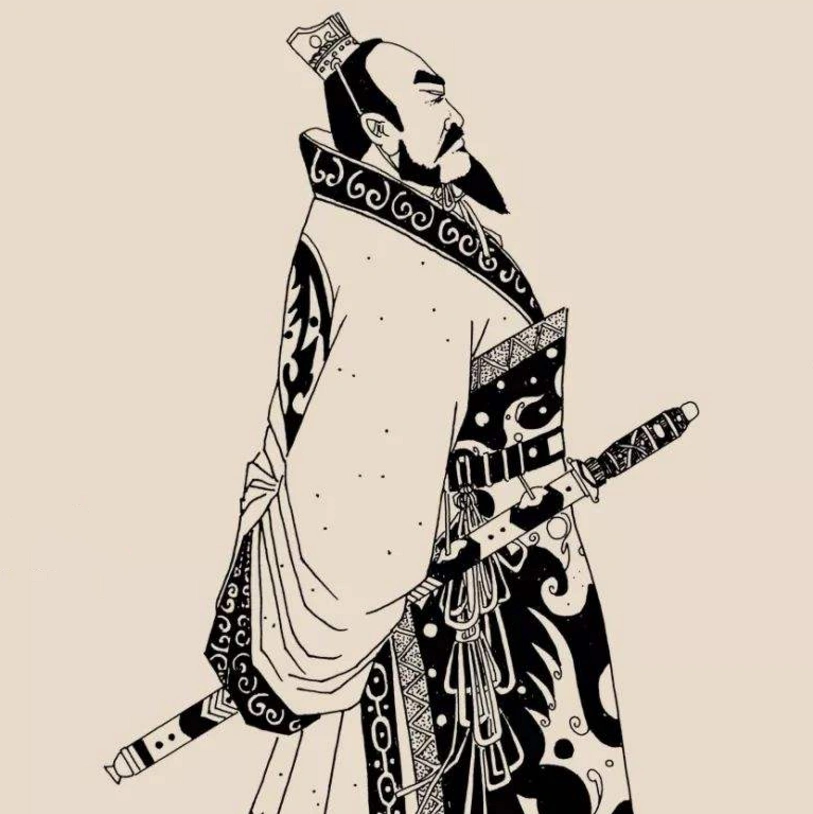
In the eleventh month of 319, in a walled town on the western edge of the Hebei plain, a man of the Jie put on the cap and sash of a king and took the title King of Zhao. The town was Xiangguo, a former capital of the old Zhao state, now a garrison with a burnt suburb, a grain market and a wall. The title was not a promotion from any higher authority. It was a seizure, announced in the presence of a hundred and twenty-nine of his officers, and it was aimed as much at Chang'an as at the Jin court across the river. In Chang'an another man, Liu Yao, had just renamed his dynasty Zhao. Two Zhaos now stood in the north, each denying the other's name. Historians would call them Former and Later, and they would call the whole period the Sixteen Kingdoms; both names are later conveniences. The men who fought under them knew only one word, Zhao.
The man who took the title had been sold as a slave. The road he travelled as a boy ran east from Bingzhou through the passes, and the record of it is one of the few details of his early life that the histories preserve without ornament: two Hu fastened to a single wooden collar, driven with other captives towards the markets of the plain. The empire that sold him was the empire whose titles he now refused. His life is usually told as a rise, and the rise is real, but the interesting thing is not that a slave became a king. It is that the state he built had to be two states at once. He called the Hu the Guoren, the people of the state, and gave them their own courts, their own judges and their own commander. He kept the Chinese registers, the Chinese law and the Chinese schools. The separation began as a convenience of conquest. By the time he died it had become a constitution, and the men who came after him inherited both its strength and its fault. The narrative that follows rests mainly on the Book of Jin, compiled by a Tang commission in 648 from the histories kept by the northern courts; its chapters on the sixteen states are called records, not annals, and they carry the prejudices of both the archives they used and the dynasty that ordered them written.
1. The Upper Eastern Gate
Wuxiang was a county of dry hills and narrow valleys in the high country of Shangdang commandery, where the land rises from the Hebei plain towards the Taihang range. It was good country for sheep, horses and hard men, and poor country for a large population. The people who lived there were a mixture of Chinese farmers, Xiongnu herdsmen and smaller groups that the histories lump together under the name Jie. The Jie were not a nation with a royal house and a treasury. They were a frontier people, scattered across Bingzhou and the neighbouring provinces, useful to the Jin as cavalry and feared by the Jin as a fifth column. Their origin was disputed even then. The Tang historians who wrote Shi Le's record say that he came from the Qiangqu, a Xiongnu noble lineage; other notices treat the Jie as a separate people, perhaps descended from Central Asian merchants or soldiers settled on the frontier. What matters is that the Jie were a minority among minorities, and that the man who would rule the north began life as a member of a group that had no state of its own.
His father, Zhou Hezhu, was a minor chief. The title is impressive in translation and modest in fact: he could raise a following of perhaps a hundred riders, settle disputes among his kin, and negotiate with the county officials. The family was not poor in the way of the Chinese peasantry, but it was poor in the way of the frontier aristocracy, which measured wealth in horses and followers rather than in land. The year of Shi Le's birth is not recorded, and the later tables that give one are guessing backwards from the age reported at his death. Shi Le grew up illiterate. The histories say this plainly, and they do not apologize for it. He worked in the fields as a boy, and the record preserves a story that his mother used to tell: he would come home saying that he had heard drums and bells in the fields, and she would answer that it was only the ringing in his ears from labour. The story is a portent. It announces, at the beginning of the life, that the boy would one day hear the instruments of an army.
The first scene that fixes him in a landscape is a journey to Luoyang. He went, the record says, to sell goods, and he stopped at the Upper Eastern Gate, one of the great gates of the imperial capital, and whistled. The whistle was a long, carrying sound, the kind of call a herdsman uses across a valley, and it was not a sound that respectable travellers made in the capital. Wang Yan, the grand commandant, was passing in his carriage. He heard it, looked at the boy, and said to his attendants that this barbarian child had a strange look and a stranger voice, and that he should be arrested before he became a danger. The attendants went after him. Shi Le escaped in the crowd.
The story is almost certainly shaped after the fact. It is the kind of anecdote that a court history invents to show that the great man was recognized before he was great, and Wang Yan is the perfect foil: the most famous of the Jin gentlemen, the master of pure conversation, the man who could talk about the void for a whole afternoon and never once mention a tax register. But the story is also true to a real situation. The Jin elite knew that the frontier peoples were dangerous. They had hired them, settled them, taxed them and despised them, and they had no plan for what would happen when the hiring stopped. Wang Yan saw the danger in a boy at a gate and could not see it in the army he was about to lead to its destruction. Years later, at Ningping, he would meet the same boy again, and the meeting would end with a wall pushed over on top of him.
What the anecdote leaves out is the ordinary machinery of the frontier. The Jin princes had been recruiting Hu cavalry for years; a chief who could deliver a hundred horsemen could get a title, and a boy who could handle horses could get work. Shi Le's skills were the skills of the border: he could judge a horse, ride, shoot, and hold a following with pay, food and personal example. These were not the skills of a Chinese scholar, and they were not supposed to be enough to found a state.
The world that made him was the world of the Jin princes' war. For sixteen years the imperial house fought itself, and each prince borrowed cavalry from the frontier to fight the others. The Xiongnu chief Liu Yuan, who had been educated at the Jin court and held a Jin title, was one of those borrowers. In 304 he stopped borrowing and declared himself King of Han. The Jin governors in the north, cut off from the capital, began to treat their provinces as private estates. Famine followed the armies. When the granaries failed, the governors sold people. This was the trade that took Shi Le east.
2. Two Hu to a Cangue
The famine in Bingzhou was not a single bad harvest. It was the collapse of a provincial economy under the weight of armies, taxes and refugees. The governor, Sima Teng, a prince of the Jin house, had to feed his troops and had no money. He began to seize Hu families, who had no protectors at court, and sell them east of the mountains. The Book of Jin says that the captives were fastened two to a wooden collar, and that Shi Le was one of them. He was sold at Pingyuan, in the plain east of the mountains, to a landowner named Shi Huan of Chiping.
Shi Huan freed him. The record says that he was impressed by the young man's appearance, and that the slaves had heard strange drum sounds at night and reported them to their master. The explanation is a portent again, but the act was practical. A strong, healthy Hu who could judge horses was worth more as a client than as a field hand, and a master who freed a capable slave could count on his loyalty. Shi Le stayed in the neighbourhood, worked as a hired labourer, and became friendly with the officer of the state horse pastures, a man named Ji Sang. The pastures were the military economy of the frontier: horses for the Jin armies, horses for the princes, horses for anyone with silver. Ji Sang was the kind of officer who knew every horse thief and every deserter within a hundred miles. He gave Shi Le his surname and his name; the courtesy name Shilong was added later. The founder of the Later Zhao did not begin with the name by which he founded it.
The first following was small. The record lists eighteen riders, and the list is worth reading because of what it shows about the frontier. The first eight were Wang Yang, Kui An, Zhi Xiong, Ji Bao, Wu Yu, Liu Ying, Tao Bao and Lu Ming. Ten more joined: Guo Ao, Liu Zheng, Liu Bao, Zhang Yipu, Huyan Mo, Guo Heilue, Zhang Yue, Kong Tun, Zhao Lu and Zhi Quliu. Some of the names are Xiongnu, some are Central Asian, some are Chinese; several of the men would later command armies and govern provinces. They were not a peasant revolt. They were a band of pasture hands, horse thieves and minor chiefs, mounted, mobile, and loyal to a leader rather than to a cause. In a country where the roads were unsafe and the villages were walled, a band of eighteen horsemen could live very well.
The band attached itself to the wars of others. In 304, Gongshi Fan, an old general of the prince Sima Ying, raised a revolt in the Zhao and Wei country with several thousand men. Shi Le and Ji Sang joined him with several hundred horsemen from the pastures. Gongshi Fan was defeated and killed by the Jin general Gou Xi. In 307, Ji Sang raised a larger revolt of his own, claiming to avenge Sima Ying, and marched on Ye. Shi Le was his forward commander. They took the city, killed Sima Teng, the governor who had sold Shi Le into slavery, and massacred more than ten thousand people. The record's figure is a round one, and the massacre is not in doubt. It was the first time Shi Le's name was attached to a large killing, and it set a pattern that would repeat: a rapid march, a broken wall, a massacre, and a withdrawal before the relief army arrived.
Gou Xi caught Ji Sang on the plain and destroyed him. Ji Sang was killed at Pingyuan. Shi Le fled west with a handful of men to Leping, where he joined a Hu chief named Zhang Beidu. Zhang Beidu had several thousand men and no strategy. Shi Le persuaded him that the only way to survive was to submit to the rising power of Liu Yuan, who had declared himself King of Han and was gathering every malcontent on the frontier. Zhang Beidu agreed. In 307, Shi Le entered Liu Yuan's service and was appointed General Who Supports the Han and Prince Who Pacifies Jin.
The titles were a promotion and a definition. He was no longer a bandit. He was an officer of a dynasty, with a commission, a theatre of operations and a claim on the loyalty of other officers. The Han court gave him what a frontier chief could not make for himself: a name that sounded like a government. He gave the Han court what it lacked: a commander who could fight in the eastern plain, where the Xiongnu cavalry of Pingyang did not know the roads. It was a bargain between a dynasty that needed a general and a general who needed a dynasty. Both sides understood that it was temporary. Neither side said so.
The eighteen riders became the nucleus of something larger. A following of that kind is not an army; it is a household with weapons, and it grows by absorbing other households. Shi Le's early campaigns in Hebei were campaigns of absorption. He did not hold cities; he emptied them of horses, grain and men, and moved on. The Jin commanders called him a bandit, and in the military sense they were right. What they did not see was that every village he spared was a small addition to a state that did not yet exist.
3. The General of Han
Between 307 and 311, Shi Le fought in Hebei as a Han general. The record of those years is a list of raids, sieges and surrendered strongpoints. In 309, it says, he took more than a hundred fortified settlements and his following grew to a hundred and fifty thousand. The figure is not a troop count. It counts the households that submitted, the camp followers who attached themselves to a successful army, and the prisoners who were enrolled. A mobile army in a broken country carries its population with it, and the line between soldier, servant and refugee is thin. What the figure measures is not the size of his army but the speed with which the social landscape of Hebei was dissolving into bands that attached themselves to the strongest leader.
The most important recruit of those years was a Chinese scholar named Zhang Bin. He was a native of Nanhe in Zhao commandery, a man of modest office and large ambition, and he had watched the generals of the Jin and the Han come and go. He said, according to the record, that among all the commanders he had seen there was only one worth serving, and that was the Hu general. The remark has the polished shape of a later anecdote, but the choice was real. Zhang Bin was the kind of man whom a frontier army could not produce and could not do without: he knew the tax registers, the families, the precedents and the language of legitimacy. He became Shi Le's right senior secretary, then his Grand Administrator, and for more than a decade he was the second mind of the enterprise. Shi Le called him the Right Marquis, and when he died in 322 Shi Le wept and asked why Heaven had taken him so early.
With Zhang Bin came a wider policy. After the conquest of Hebei, Shi Le separated the captured gentry from the ordinary prisoners and housed them in a separate camp, which the histories call the Camp of Gentlemen. The name was an honour and a restraint. It protected the scholars from the soldiers, and it made them available to the conqueror. They became his clerks, his teachers, his masters of ritual, his negotiators with the surviving Jin officials. The Camp of Gentlemen was the first civil service of the Later Zhao, founded before the state itself. It was also a recognition that a Hu army could not govern a Chinese population with Hu officers alone.
The great test came in 311. Sima Yue, the Jin prince who had dominated the court for a decade, had marched out of Luoyang in 310 with the last field army of the empire and the leading families of the capital. He died at Xiang in the fourth month of 311. His commanders, led by the grand commandant Wang Yan, decided to escort his coffin east to his fief in Donghai. The column that set out was not an army in any useful sense. It was a court on the move: princes, ministers, clerks, servants, wagons, women and children, with a thin screen of soldiers. It numbered, the Book of Jin says, several hundred thousand people.
Shi Le caught it at Ningping, in Ku county, south of the Yellow River. He had light cavalry and the column had no order. The riders surrounded the mass and shot into it. The record says that the dead trampled one another, that the pile of bodies was like a hill, and that more than a hundred thousand of the royal, official and common families died. The figure appears in the biography of Sima Yue as well as in Shi Le's record, and both were written by the same Tang commission. It is a literary tally of a catastrophe, not a body count. What is certain is that the last organized field force of the Western Jin ceased to exist in a single afternoon, and that the families who had governed the empire for a century were killed or captured in the open.
Shi Le burned Sima Yue's coffin. The gesture was political theatre: he announced that the prince had ruined the world, and that he was burning the body on behalf of the world. Then he turned to the prisoners. Wang Yan was brought before him. The grand commandant, who had spent his life in conversation and had never commanded an army in the field, said that he had never taken part in policy and that the fall of the empire was not his fault. Shi Le answered that Wang Yan's name filled the world, that he had held the highest offices from youth to white hair, and that if he had never taken part in policy, then what was a minister for. The ruin of the empire, he said, was precisely Wang Yan's crime. He added that he would not use a blade on a man of such rank. That night his soldiers pulled down a wall on the prisoners.
The fall of Luoyang followed in the sixth month. The city was taken by the Han armies under Liu Yao and Wang Mi, and the details of the siege and the sack belong to the history of the Western Jin. For Shi Le the important fact was that the Han victory left him the most powerful Han commander in the east, with a veteran army, a Chinese staff and no superior within reach. The court at Pingyang could give him titles. It could not give him orders.
The last obstacle in the east was Wang Mi. Wang Mi was a great man of Donglai, a bandit leader who had made himself a power on the coast before he joined Liu Yuan. He and Shi Le had fought side by side at Luoyang, and they were rivals for the same recruits and the same territory. The record says that Wang Mi planned to kill Shi Le first. That may be true, and it may be the justification that a victor's historians wrote afterwards. What is certain is that Shi Le invited Wang Mi to a banquet in his own camp, killed him with his own hand, and took over his army. The Han court was angry, but it confirmed Shi Le in Wang Mi's command, because it had no way to punish him. The method was now clear. An ally could be converted into a province, and a title from a distant court could be made to ratify the conversion.
4. The Rain at Gebi
The southern campaign of 312 was not a raid. Shi Le had spent five years fighting for a dynasty whose capital lay in the mountains of Shanxi, and he had begun to think like a founder. The north was a ruin of burnt cities and half-empty registers. The south, behind the Yangzi, was intact: its granaries were full, its gentry families were rich, and its court at Jianye was weak. He marched into Yu province, reached the river, and camped at Gebi, in the wet low country north of the Huai. There he built houses, set his soldiers to farming, and began to build a fleet. The plan was to cross the Yangzi and take Jianye.
The plan was plausible. The Jin court concentrated its troops at Shouchun under Ji Zhan. Then the rain came. It rained for three months. The camp at Gebi turned into a swamp; the grain rotted; the horses sickened; disease moved through the tents. The Book of Jin says that more than half the army died of hunger and illness. An army that loses half its men without a battle has already been defeated.
Shi Le called a council. The proposals were the three classical answers to a hopeless position. Diao Ying, the senior civil aide, proposed sending an envoy to the Jin court to offer submission, promising to clear the north for the dynasty in exchange for peace; once the Jin army withdrew, the situation could be reconsidered. Kui An proposed moving the camp to higher ground and waiting. Kong Chang, Zhi Xiong and more than thirty generals proposed a night attack: three hundred men in each of thirty boats, landing at Shouchun, killing the Jin commander, taking the city and feeding the army on its granaries. They promised to finish the war in the south within the year and bring back the Sima family in chains.
Shi Le laughed at the last proposal and called it the plan of brave generals. He gave each of the thirty a horse and a suit of armour, which was a way of praising them without accepting their advice. Then he turned to Zhang Bin. Zhang Bin did not offer a tactic. He offered a political fact. Shi Le had taken the imperial capital, imprisoned the Son of Heaven, killed princes and taken their wives and daughters. If he counted his crimes on his hairs, there would not be enough hairs. How could he go back to being anyone's minister? The Jin court might accept a defeated rebel's submission, but it could not accept his. The rain was a sign that he should not stay in the south.
The argument went further. Ye, the old capital of the state of Zhao, had the Three Terraces and a wall that could be held. West of it lay the road to Pingyang, the Han capital; the mountains and rivers closed the plain behind it. If he went north and held that country, he could wait for the Jin court to become distracted and for the Han court to weaken. The Jin army at Shouchun would be relieved to see him go and would not pursue. The retreat should be covered: the baggage train by the northern road, the army marching towards Shouchun as if it intended to attack, and then turning north after the baggage was safe.
Shi Le rolled up his sleeves and stroked his beard. "Zhang Bin's plan is right," he said. He demoted Diao Ying, promoted Zhang Bin to right senior secretary and general of the central garrison, and gave him the title Right Marquis. The title became the name by which the army knew him for the rest of his life. It was also a public statement that the civil strategist, not the brave generals, had his ear.
The retreat was a disaster. Shi Hu, Shi Le's nephew, took two thousand cavalry towards Shouchun and was caught by a Jin ambush at Julingkou; more than five hundred men drowned, and the survivors fled a hundred miles back to the main army. The country through which the army passed had been cleared by the Jin authorities: no grain, no animals, no boats. The Book of Jin says the army starved and that the troops ate one another. At Fangtou, on the Yellow River, a local chief named Xiang Bing held a fleet of boats. Zhang Bin's plan was to seize the boats by a night crossing before Xiang Bing could bring them behind his walls. Zhi Xiong and Kong Chang crossed on rafts, took the fleet, and the army passed the river.
At Ye, the Three Terraces were too strong to storm, and Zhang Bin advised leaving them. The decisive place was not the old capital but Xiangguo, a walled town in the hills to the west, a former Zhao capital with a defensible site and a road to the Shanxi passes. In the seventh month of 312, Shi Le entered Xiangguo and made it his base. Liu Cong confirmed him as commander of the four provinces of Ji, You, Bing and Ying, governor of Ji, and Duke of Shangdang. For the first time, Shi Le held a city that was his own, not a city he was passing through.
The founding moment of the Later Zhao was therefore a decision not to fight. It was made in a swamp, by a man who had just lost half his army, on the advice of a Chinese scholar who told him that he could never be pardoned. The state began as a retreat, and the retreat gave it the one thing a mobile army cannot manufacture: a fixed point. From Xiangguo, Shi Le could tax, recruit, build and wait. The rain that ruined his southern campaign also saved him from a war he could not win. He never again tried to take the south by crossing the river.
5. The Cattle at the Gate
In 313, Xiangguo was a hungry town. The harvest had failed, the granaries were empty, and the price of grain rose until the records stop being useful as economics and become a measure of panic. Wang Jun, the Jin governor of Youzhou, saw his chance. He was the most powerful Jin commander left in the north, the holder of Ji and the ally of the Duan Xianbei and the Wuhuan. He marched on Xiangguo with fifty thousand men and expected to end the Hu general's career.
Shi Le did not meet him in the open. He held the walls and prepared a surprise. The Book of Jin says he built a hidden gate in the north wall, a tunnel mouth covered with earth and boards, and kept a column of cavalry behind it. When the besiegers came close enough to be committed, the gate opened and the cavalry came out into their flank. The attack broke the siege and captured Duan Mopei, a prince of the Duan. Shi Le treated him as a guest, gave him a horse and a banquet, and sent him home. The release was the most profitable act of the year. Duan Mopei returned to his people with a debt of honour, and the Duan began to withdraw from Wang Jun's coalition. A man who could not be trusted with a city could be trusted with a favour.
Wang Jun was a different kind of enemy. He was a Jin loyalist in name and a separatist in fact, a man who had built his own court at Ji, appointed his own officials, and begun to talk about the mandate. He was vain, and his vanity was the door through which Zhang Bin proposed to enter. The plan was a masterpiece of flattery. Shi Le would send gifts and a letter declaring that he had long admired Wang Jun, that he was a barbarian unfit to rule, and that he wished to come in person to Ji to support Wang Jun's accession as emperor. He would bribe Wang Jun's son-in-law, Zao Song, with a promise of high office. When one of Wang Jun's officers, You Tong, secretly offered to submit, Shi Le would kill You Tong's envoy and send the head to Wang Jun as proof of his own loyalty. Every gesture would confirm Wang Jun in the belief that the most dangerous man in the north was his client.
The deception worked because it told Wang Jun what he already believed. Wang Jun's envoy returned from Xiangguo with a report that Shi Le's troops were few and poor and that he had no ambition beyond serving the governor. Wang Jun stopped preparing for war. In the second month of 314, Shi Le marched north by night. At Boren he sent a letter and a hostage to Liu Kun, the Jin governor of Bingzhou, offering to atone for his past by destroying Wang Jun. Liu Kun hated Wang Jun more than he feared Shi Le, and he did nothing. The diplomatic rear was covered with a letter and a boy.
In the third month, Shi Le reached the Yi River and then the walls of Ji. Wang Jun still did not believe that the army at his gate was hostile. When his officers asked permission to defend the city, he refused and said that Shi Le had come to support him. Shi Le drove several thousand cattle and sheep through the gates on the pretext of a gift. The animals filled the streets and blocked the movement of the garrison. Then the infantry came in behind them.
Wang Jun was taken in his own hall. The exchange between the two men is one of the set pieces of the Book of Jin. Wang Jun cursed him as a barbarian slave and asked how he dared commit such treason. Shi Le answered that Wang Jun held the highest office in the empire, commanded a strong army, and had watched his dynasty fall without raising a hand; that he had appointed corrupt officials and ruined the province; and that he now wanted to make himself emperor. Which of them, he asked, was the traitor? Wang Jun was sent to Xiangguo and executed in the market. The histories put the dead at ten thousand, the palace was burned, and the accumulated treasure of the north was carried away.
The conquest of Youzhou gave Shi Le something more valuable than treasure. It gave him the granaries of the north-east, the horse country, the passes towards the steppe, and the surviving Jin administration of the province. It also gave him a test of what kind of conqueror he intended to be. After the city fell, the officials and generals queued at his gate to congratulate him and to offer gifts. Two men did not come. Pei Xian and Xun Chuo, both of them old Jin officials, stayed at home. Shi Le summoned them and demanded to know why they alone had refused to congratulate the man who had punished a tyrant.
They answered that they had served Jin all their lives, that Wang Jun, however violent, had been a Jin governor, and that they could not pretend to rejoice at his death. They expected to be killed. Shi Le dismissed them, then called them back, apologised, and treated them as honoured guests. He said that he did not rejoice at getting Youzhou; he rejoiced at getting these two men. The sentence is one of the most quoted of his life, and it is also one of the most revealing. A man who had just killed ten thousand soldiers understood that a state could not be built out of soldiers alone.
6. The Kingdom of Zhao
The years between 314 and 319 were spent turning a province into a state. Shi Le took the remaining Jin positions in Hebei, fought the Duan and the Wuhuan, and by 317 controlled Ji, You, Bing and most of the north China plain. In 318 the Han emperor Liu Cong died. His son Liu Can was killed in the coup of Jin Zhun, and the Han house fell into a civil war that ended with Liu Yao on the throne at Chang'an. Shi Le marched to Pingyang, the old Han capital. He burned the palaces, but he repaired the two imperial tombs and buried Liu Can and more than a hundred of the Liu clan. The gesture was deliberate. He was not a looter. He was the heir of the house he was about to leave.
The break came in 319. Liu Yao, who had renamed the dynasty Zhao, offered Shi Le the office of grand preceptor with the nine bestowals, the ceremonial package that preceded a usurpation. Shi Le's envoy, Wang Xiu, went to Chang'an to accept. A member of his suite, Cao Pingyue, stayed behind and told Liu Yao that Shi Le was preparing to make himself independent. Liu Yao believed him, killed Wang Xiu, and cancelled the honours. The murder of an envoy was an insult that could not be negotiated. Shi Le's answer is preserved in the Book of Jin: King of Zhao, Emperor of Zhao, he said, I will take them myself. What business is it of yours what I am called?
The sentence is the founding sentence of the Later Zhao. It is not a claim to a particular title; it is a claim to the right to name oneself. In the eleventh month of 319, a hundred and twenty-nine of his officers, led by Shi Hu, Zhang Jing, Zhang Bin, Zhang Quilu and Cheng Xia, petitioned him to take the titles General-in-Chief, Grand Chanyu, governor of Ji and King of Zhao. The petition proposed a kingdom of twenty-four commanderies and two hundred and ninety thousand households, on the precedent of the King of Wei at Ye, and it defined the territory in the language of the ancient tribute system: south to the Meng ferry, west to the Dragon Gate, east to the Yellow River, north to the frontier wall.
Shi Le accepted. He built the altars of soil and grain and the ancestral temple, opened the eastern and western palaces, and dated the year as the first year of the King of Zhao. The dating was a deliberate archaism. He did not take an imperial era name. He followed the Spring and Autumn practice by which a vassal lord counted the years of his own reign, and he kept that reckoning until 328, when he finally proclaimed the era Taihe. In 330, on taking the imperial title, he changed it to Jianping. The sequence matters because it shows what kind of legitimacy he wanted: first a principality inside the old order, then a kingdom with its own calendar, then an empire.
The name of the kingdom was a weapon. Liu Yuan had called his dynasty Han, claiming the inheritance of the Han imperial house. Liu Yao had changed the name to Zhao, claiming the old Zhao territory of the north. Shi Le now claimed the same name. He did not call his state Jie, or Later Zhao, or anything that would have marked it as a foreign foundation. He called it Zhao, and by doing so he denied that Liu Yao's Zhao was the real one. Historians, needing to tell them apart, called Liu Yao's state the Former Zhao and Shi Le's the Later Zhao. The prefixes are later conveniences. Contemporaries knew only Zhao, and the war between the two Zhaos was fought as a war between two claims to the same name.
The title package carried a second crown. Shi Le was King of Zhao and Grand Chanyu at the same time. The royal title placed him in the Chinese sequence of dynasties; the Chanyu title placed him at the head of the Hu peoples who had settled inside the empire. The Chanyu was the older title, the one that the Xiongnu had used for centuries and that Liu Yuan had taken before he took the imperial name. The King of Zhao was the newer title, the one that could be written in Chinese and recognized by Chinese officials. In one person, the two titles made one state out of two populations. The whole institutional history of the Later Zhao follows from that fact.
The sources for this period need a warning. The Book of Jin was compiled in 648 by a Tang commission, and its chapters on the northern states are called records rather than annals. They were assembled from the state histories kept by the courts themselves, from the lost Spring and Autumn of the Sixteen States, and from earlier compilations, and they were edited by men whose dynasty claimed the mandate that Shi Le had denied. Their speeches are literary compositions, not transcripts; their numbers are round; their judgments are those of the winning side. The Comprehensive Mirror, completed in 1084, gives the clearest chronology but is a secondary compilation. The Spring and Autumn of the Sixteen States itself survives only in a Ming reconstruction, pieced together from the Book of Jin, the Book of Wei and the Comprehensive Mirror, and it cannot be used as an independent witness. This article does not use it as one.
7. Two Peoples, One State
The institutions of 319 were issued in a single season, and they are best read as one document rather than a list. Shi Le built the altars of soil and grain and the ancestral temple, the two structures that turned a town into a capital. He opened an eastern and a western palace. He appointed three libationers, one for the Classics, one for Law and one for History, each with a staff of scholars. He appointed two libationers for household affairs, whose business was the lawsuits of the Hu. He appointed four chief clerks for household clients, whose business was the admission and discharge of Hu personnel and the enforcement of the rule that they must not insult Chinese gentry families. He ordered that the Hu be called the Guoren, the people of the state. He made Zhang Bin Grand Administrator, with authority over the civil government, and Shi Hu Yuanfu of the Chanyu, with command of the palace guards. He appointed a director of military training to teach the sons of the state archery, swordsmanship and horsemanship.
The Chanyu's office was not an invention of Shi Le. Liu Yuan had taken the title of Grand Chanyu before he took the imperial title, and the Han Zhao court had developed a Chanyu administration alongside its Chinese ministries. The model was a government within a government: a Grand Chanyu at the head, a Yuanfu as his chief assistant, Left and Right Assistants beneath him, and a hierarchy of commandants for the six kinds of frontier peoples. The Later Zhao inherited the model and made it permanent. The Book of Jin names Shi Hu as Yuanfu and describes the household offices, but it does not give a full table of the Chanyu's subordinates for 319; the left and right assistants appear in the Han Zhao record; the Later Zhao record names a Yuanfu, household libationers and chief clerks, and no assistants. What is certain is the principle. The Hu had their own courts, their own judges and their own commander, and that commander was the second man in the state.
The civil offices were Chinese in form and personal in purpose. The libationers for the Classics, Law and History were not a department of culture; they were the staff of a government that needed precedents, rituals and a legal language. The Grand Administrator was the head of the bureaucracy, the keeper of the seals and the man who turned the emperor's decisions into instructions. The law enforcers defined the gentry and managed the recommendation system. The recommendation system was the old Han and Wei device by which local officials nominated men for office; in a state without examinations it was the main road into the civil service. Every province and commandery was required to recommend a flourishing talent, a filial and incorrupt candidate, a man of plain integrity, an outspoken man, a man of good judgment and a man of courage, one of each every year. The categories were Chinese. The purpose was to create a class of officials whose status depended on the emperor rather than on the old Jin families.
The word Guoren did the cultural work. It meant, literally, the people of the state, and it turned an ethnic label into a political one. The Hu were not merely Hu; they were the nation. The Chinese were not merely Chinese; they were the taxpayers, the subjects, the population that the nation defended. The change was enforced by a taboo. The word Hu was forbidden in official speech, and the prohibition was severe enough to produce two anecdotes that the Book of Jin preserves with obvious relish. In one, a drunken Hu rode his horse through the palace gate; the gate officer, frightened, forgot the taboo and told the emperor that a drunken Hu had ridden in. Shi Le laughed and said that Hu were indeed hard to talk to, and did not punish him. In the other, a Chinese official appeared before the throne in ragged clothes. Shi Le asked what had happened. The man forgot himself and said that the Jie bandits had stolen everything. Shi Le laughed again, said that the Jie bandits would be made to pay, and then observed that his law was meant to guard against the vulgar, not against old scholars like him.
The two stories are usually read as evidence of Shi Le's good humour. They are better read as evidence of how the taboo worked. It was a boundary marker, but the emperor himself could cross it. The gate officer and the scholar were forgiven because they were not challenging the order; they had merely forgotten its vocabulary. The law was aimed at the ordinary Hu soldier who might use the word as an insult, and at the Chinese magnate who might use it as a slur.
The legal order followed the same line. The Xin Hai Statutes, five thousand articles drafted by the law clerk Guan Zhi, were used for more than ten years before a fuller code replaced them. The five-grade and nine-grade rankings were revised, and the left and right law enforcers were charged with defining the great families and assisting selection. The Guoren were judged by the household libationers, the Chinese by the regular courts. The difference was not a difference of severity; it was a difference of jurisdiction. The two courts served one throne, and the throne stood above both. This is what a dual constitution means in practice: not two states, but two legal persons under one sovereign.
The fiscal order was the other half of the same design. The sources do not preserve a statute that says "Hu shall soldier and Chinese shall farm." They preserve a pattern that is unmistakable. The Guoren were enrolled in the army, mounted, maintained by the state, and exempt from the household tax. The Chinese were enrolled in the registers, taxed at two bolts of cloth and two piculs of grain per household, and required to feed the army. The state's soldiers came from one population and its revenue from the other. The arrangement was not a theory of racial division. It was the cheapest way to govern a conquered country with a small conquering people. The Guoren could not be taxed without destroying the army; the Chinese could not be armed without destroying the state. The division of labour was the price of both.
The civil service was recruited through personal networks rather than examinations. The chief clerks for household clients were the formal trace of a wider practice: a great man gathered clients, students and former subordinates around him, and the state used those relationships as a channel for appointments. The Camp of Gentlemen was the first version of this. The resettlement of three hundred gentry households in the Chongren ward of Xiangguo was the second. The three thousand magnate households moved from Si and Ji were the third. The families came to the capital, received offices and rank, and in return gave the state their clerks, their local knowledge and their sons. The recommendation system formalized the exchange. It was a patronage state with a Chinese face, and it worked because the gentry preferred office to extinction.
The state even commissioned its own past. Three historical projects were set up in 319: the Record of the Shangdang State, which was the history of the dynasty; the Daily Register of the General-in-Chief, which was the record of the ruler's acts; and the Record of the Grand Chanyu, which was the history of the Hu half of the state. The third is the most revealing. A dynasty that expects to last commissions a history of its ruling people. The Later Zhao was less than a year old, and it already had an archive for the Guoren. The two histories, the Chinese and the Hu, were meant to run in parallel, like the two courts.
The model outlived him. The dual chancery, with a Chanyu's office for the soldiers and a Chinese bureaucracy for the taxpayers, reappeared in the Yan, Qin and Liang states. It was the common solution of the northern conquerors, and the Later Zhao gave it its clearest form. When the strongest northern state tried to abolish the Chanyu's office in the 370s and govern all its subjects through one administration, the attempt did not last, and later rulers went back to the old dual system. Shi Le's constitution became the default of the age.
Its flaw was built into its strength. A state with two populations needs two constituencies, and a succession can satisfy only one. The Guoren army was commanded by Shi Hu, the Yuanfu of the Chanyu, a man of the imperial clan with a personal following and a record of victories. The Chinese civil service was loyal to the crown prince, Shi Hong, a young man raised in the palace with a taste for letters and no military base. The Chanyu title, which might have balanced the two, was given in 330 to another son, the King of Qin. The result was a crown without a sword and a sword without a crown. Shi Le had built a state that could conquer the north and could not survive its founder. He knew it, or half knew it, and he refused to act on the knowledge. That refusal is the subject of his last years.
8. The Register and the Granary
The fiscal policy of the Later Zhao began with a famine. In 313 and 314, before and after the conquest of Youzhou, Xiangguo was full of refugees and short of grain. The Book of Jin records prices that are meant to show panic rather than to measure a market. Shi Le's answer was not a requisition. It was a register. He ordered the provinces and commanderies to verify the households, and he fixed the household tax at two bolts of cloth and two piculs of grain.
The rate was deliberately light. The Western Jin had taxed land and adults at a much higher rate, and the Cao Wei settlement in the north had taken four sheng per mu and two bolts and two catties of silk floss per household. Shi Le's two bolts and two piculs were within the range of the old northern settlement, and in a country where half the fields were out of cultivation, a light tax was the only way to attract labour back to the land. The point was to make the register worth entering. A peasant who fled the tax would become a client of a great family or a bandit; a peasant who entered the register would get a claim to his fields and a measure of protection.
Agriculture was promoted with the usual instruments. Commissioners toured the provinces to inspect the harvest and the mulberry trees. A director of agricultural encouragement was appointed, with a staff of inspectors, to verify the registers and reward the most productive villages. The best farmers were given the rank of fifth-rank grandee, a title that carried tax exemptions and social precedence. The state also banned brewing. Grain was too precious to be turned into wine, and the Hu aristocracy's drinking habits were a standing drain on the harvest. The ban was enforced for several years, and the record says that at the end of it no one brewed; the ancestral sacrifices were performed with weak wine instead.
The coin was a failure. Shi Le cast a coin inscribed "Abundant Goods" and ordered that public and private payments be made in cash. The north had reverted to barter during the wars; cloth, grain and salt were the real currencies, and a copper coin with a hopeful inscription could not replace them. The experiment was abandoned. A state can fix a tax rate by decree, but it cannot create a monetary economy by decree. The Later Zhao remained a grain-and-cloth state, and its fiscal strength was measured in granaries, not in treasuries.
Resettlement was the other instrument of population policy. Shi Le moved three hundred households of gentry officials to the Chongren ward of Xiangguo and appointed a grandee of the ducal clan to supervise them. He moved three thousand households of great families from Si and Ji provinces to fill the capital. He moved thirty thousand households of Wuhuan from Pingyuan to the neighbourhood of Xiangguo. The numbers are administrative, not demographic: a household in the register might be five people or fifty, and the figure records the unit that the officials counted. The purpose was political. A capital filled with the sons of the great families is a capital that can be governed, because the families have hostages in the city and offices in the court.
Education was the most Chinese part of the enterprise. Shi Le founded a grand academy for three hundred sons of officers and officials. He founded four ward schools at the gates of Xiangguo, named for culture, instruction, Confucian learning and training, for the sons of generals and local magnates. He ordered every commandery to establish a school with two libationers and a hundred and fifty students. The students were examined three times before promotion, and the best were sent to the provincial and central offices. The emperor himself visited the schools, questioned the students on the Classics, and rewarded the best with silk. He also revived the old recommendation categories of flourishing talent and filial and incorrupt, and required the provinces to send candidates to the capital for examination.
The school system was not a decoration. It produced the clerks who staffed the registers, the courts and the embassies. It gave the sons of the Hu aristocracy a Chinese education without requiring them to become Chinese. It gave the sons of the Chinese gentry a route to office without requiring them to serve the old Jin. The curriculum was Confucian, but the purpose was dynastic: a literate official class whose loyalty was to the school and the throne, not to the great families of the old regime. In a state where the army was Hu and the taxpayers were Chinese, the schools were the meeting point. They were also the weakest point, because a school can teach a language but cannot create a shared political nation in one generation.
The civil half of the state was real, and it was never strong enough to protect itself. That was the limit of the whole design.
9. The Monk in the Camp
In 310 a monk from the Western Regions, probably Kucha, arrived at Luoyang. His name was Fotucheng. He was said to be very old, to have studied in Kashmir, and to have travelled through Dunhuang to the Chinese capital with the intention of founding a monastery. The capital was in the last months of its peace. The Jin princes had ruined the provinces, the Han armies were at the gates, and the city was filling with refugees. Fotucheng did not found his monastery. He withdrew into the countryside and waited.
He came out of the countryside in 312, at Gebi. Shi Le's army was camped in the wet low country, dying of disease and killing prisoners, and one of his generals, Guo Heilue, had become a Buddhist and taken the five precepts. Guo Heilue had been predicting the outcome of campaigns with suspicious accuracy. Shi Le asked him how. Guo Heilue said that a monk he sheltered knew. Shi Le sent for the monk.
The first meeting is recorded as a contest of miracles. Shi Le asked what proof there was of the Buddhist doctrine. Fotucheng asked for a basin of water, burned incense over it and recited a spell, and a blue lotus grew out of the water, its light dazzling the tent. Shi Le was impressed. The monk then gave him a lecture on political cosmology: when a king's virtue reaches the seas, the four auspicious creatures appear; when government decays, comets appear in the sky. The lecture was a warning disguised as a compliment, and it was the beginning of a relationship that lasted twenty years.
Fotucheng's political role was to restrain the killings. The Book of Jin says that of the men condemned to death, eight or nine out of ten were saved by his intervention. The figure is a hagiographic convention, but the pattern is credible. A monk who could predict the weather, cure a wound and read a campaign could ask for a prisoner's life, and a commander who believed in omens could not easily refuse. The monk did not denounce the war. He worked inside the tent, one case at a time, and he made mercy look like a form of luck.
The stories about him are a catalogue of the marvellous. At Xiangguo the spring that supplied the city moat dried up; Fotucheng prayed at the source for three days, the water returned, and a small dragon came out with it. On another night Shi Le, testing him, put on armour and sent a man to ask where the general was; before the messenger could speak, Fotucheng asked why the camp was under night alert. Once, in a rage, Shi Le decided to harm the monks; Fotucheng disappeared, and when Shi Le regretted it he returned, saying that he had hidden from the anger and come back for the repentance.
The most consequential prediction came before the Luoyang campaign of 328. Fotucheng told Shi Le that if the army marched, it would take Liu Yao. The Biographies of Eminent Monks preserves the prophecy as a chant in the Jie language, a string of syllables that later copyists could no longer understand. The chant is one of the few traces of the Jie tongue, and its survival is a reminder that the Jie were a people with a language of their own, not simply a label for a mixed frontier population. Shi Le marched, and the prophecy was fulfilled. Whether the monk spoke because he had read the stars or because he had read the politics of the Han Zhao court cannot now be known. The effect was the same.
Buddhism served the Later Zhao in a way that neither the Chinese rites nor the Hu customs could. It was a third thing, foreign to both, and its foreignness matched the dynasty's own. A Jie emperor who worshipped a Buddha from the Western Regions was not pretending to be Chinese, and he was not confined to the old Hu religion of the steppe. He was the patron of a universal law that had its own books, its own clergy and its own sacred places. The monk's presence at court told the Chinese gentry that the dynasty was not merely a war band, and told the Hu soldiers that their emperor had access to powers older and larger than the steppe.
The limits of the relationship were equally clear. Shi Le never made Buddhism a state religion in the way that later rulers did. He patronized the monk, consulted him on campaigns, and allowed monasteries to be built, but he did not endow a church, reform the clergy or use the sangha as an arm of government. The Biographies of Eminent Monks credits Fotucheng with 893 monasteries across the Zhao territories, a figure that covers the whole of his mission, which ended in 348 under Shi Hu, and belongs to the literature of sanctity rather than to the tax registers. The historical core is smaller: a foreign monk, a foreign court, a shared language of omens, and a restraint on killing that was real even if the numbers are not.
The longest consequence was a pupil. A young Chinese monk named Dao'an came to study with Fotucheng at Ye, and Fotucheng, according to the biography, recognized him at once as a man of unusual understanding. Dao'an became the greatest Buddhist scholar of the fourth century and the teacher of Huiyuan, who carried the tradition into the south. The chain from the Jie camp at Gebi to the monasteries of the Yangzi is one of the unplanned routes by which Buddhism became a Chinese religion. Shi Le would not have understood the effect of his patronage. He understood the cause: a holy man in the camp was useful, and a useful man should be kept.
10. The Border and the River
The southern border was the one front Shi Le could not solve by conquest. In 313 the Jin court had given Zu Ti a commission to recover the north, and by 317 Zu Ti had built a line of forts and alliances along the Yellow River. He was not strong enough to take the north, and Shi Le was not free enough to take the south. The Han Zhao in the west was the greater danger, and a two-front war was the one thing a new state could not survive.
Shi Le therefore chose a border that could be bought. He allowed markets on the frontier, exchanged envoys, and treated Zu Ti as a neighbouring commander rather than a rebel. The arrangement was profitable for both sides. The market gave the north salt, iron and horses, and gave the south grain and silk. The border became a zone of exchange rather than a line of battle, and the local chiefs on both sides learned to hold two commissions at once.
In 321 Zu Ti died. The Jin court replaced him with his brother Zu Yue, a man of less ability and less prestige. Shi Le waited a year, then moved south. In 322 his armies took the Henan lands that Zu Ti had held, and Zu Yue retreated to Shouchun. The retreat was not a rout. The Jin court was distracted by the rebellion of Wang Dun, and the local chiefs, who had lived on the double commission, changed sides when the market changed. By the end of 322 the Later Zhao held the line of the Huai, and the south held the line of the Yangzi.
In 323 Shi Le turned east to Qingzhou. The province had been held for a decade by Cao Yi, a former Han general who had made himself an independent warlord. Shi Hu attacked Guanggu with forty thousand men. Cao Yi surrendered, was sent to Xiangguo and executed, and the city was punished with a massacre. The Book of Jin says that thirty thousand prisoners were buried and that seven hundred men and women were left to the new governor. The number is the chronicler's, and the massacre is not in doubt. Qingzhou gave Shi Le the coast, the salt and the road to the Shandong peninsula. By 325 he held Si, Yu, Xu and Yan as well, and the Later Zhao bordered the Eastern Jin along the Huai.
The decision not to cross the Huai was made on the same ground as the decision at Gebi. A northern cavalry army could raid the Huai country, but it could not hold the rice fields and canal towns of the south, where every village was walled and every river was a line of boats. Shi Le had tried the river once and lost half his army to rain. After 322 he was content to take the northern bank, tax the market, and leave the crossing to a later generation. The war with the Han Zhao gave him a better reason to stop. A southern campaign would have required a fleet, a siege train and years; a western campaign would settle the north. He chose the west, and the choice was right. The Eastern Jin survived, in part, because he never came.
The border did not settle the question of legitimacy. The Jin court called Shi Le a rebel and refused to recognize his state. Shi Le called the Jin emperors the sons of a house that had cheated orphans and widows, and refused to recognize their mandate. The two positions were symmetrical and incompatible. In 312, when Liu Kun found Shi Le's mother and sent her back with a letter offering him a Jin title, Shi Le answered with a sentence that defines his politics: deeds and merit have their own road, which a pedant cannot know; Liu Kun should keep his integrity for his own court, and Shi Le, being a barbarian, would find it hard to be of service. The refusal is polite, and it is absolute. He would not be a Jin minister, because a Jin minister is a man who can be pardoned. He would be a Zhao king, because a Zhao king is a man who can be fought.
11. The Two Zhaos
The war between the two Zhaos began in 324 and ended in 329. It was fought along the line where the north China plain meets the mountains of Shanxi and Henan, in the commanderies of Hedong and Hongnong, and it was a war of raids, fortified passes and captured households. In 324 Shi Sheng, Shi Le's commander in the west, attacked the Han Zhao frontier at Xin'an and carried off five thousand households. In 325 Shi Hu defeated the Han Zhao general Liu Yue and buried nine thousand prisoners; the Han Zhao allies Wang Teng, Li Ju and Guo Mo were destroyed or driven south. By the end of 325 Shi Le held Si, Yu, Xu and Yan, and Liu Yao held the west.
The decisive campaign came in 328. Shi Hu attacked Puban with forty thousand men. Liu Yao, the Han Zhao emperor, came out of Chang'an with his best troops, defeated Shi Hu at Gaohou, and pursued him east. Instead of marching on Xiangguo, he turned against Luoyang and besieged the fortress of Jinyong. He cut the dike that supplied the city with water and settled down to starve it. His officers urged him to move faster. He drank.
Shi Le called a council at Xiangguo. Most of his advisers, led by Cheng Xia, told him not to go in person: the king should not risk himself in a distant battle, and the frontier commanders could hold. Xu Guang, the scholar who had become his closest civilian adviser, argued the opposite. Liu Yao had a hundred thousand men and had besieged one city for a hundred days. His troops were stale. A first-rate army striking a stale one could take him in a single battle. If Luoyang fell, the road to Hebei was open. Shi Le agreed. He put the court under martial law, forbade further remonstrance, and marched.
The campaign was a study in speed. Shi Le's columns concentrated at Chenggao in the twelfth month: sixty thousand infantry and twenty-seven thousand cavalry, according to the Comprehensive Mirror. He looked at the empty passes and said that Liu Yao had three options. If he held Chenggao, that was the best; if he blocked the Luo River, that was next; if he sat in Luoyang, he would be captured. Liu Yao sat in Luoyang. Shi Le crossed the river by night, entered the city with forty thousand men, and attacked from three directions at the Xiyang gate. Liu Yao, who had been drinking, fell from his horse into a stone channel and was taken by a junior commander. The killed were counted at more than fifty thousand.
The two men met as former allies. Liu Yao asked whether Shi Le remembered the oath they had sworn at Chongmen, in the days when they were both generals of the Han. Shi Le sent Xu Guang to answer that what had happened was the work of Heaven, and that there was nothing more to say. Liu Yao was sent to Xiangguo and treated with the honours of a captive king. Shi Le asked him to write to his son and order the surrender of Chang'an. Liu Yao wrote instead that the son should hold the state and not change his mind for his father's sake. Shi Le had him killed.
The Han Zhao did not survive him. In 329 Shi Hu took Shanggui, the last stronghold, and captured Liu Xi, Liu Yao's son. The Han Zhao was extinguished. Shi Le now held the whole of the north China plain, the Guanzhong and the approaches to the northwest.
In the second month of 330, Shi Le took the title Great Heavenly King of Zhao and acted as emperor. In the ninth month he took the imperial title and changed the era to Jianping. He gave the title Grand Chanyu to another son, the King of Qin, and made Shi Hu Grand Commandant and Prince of Zhongshan. The grant was the most consequential act of his later reign. Shi Hu had commanded the armies that won the war. He had expected the Chanyu's title, the second crown of the state. He received a civil honour instead, and the military title went to a younger prince. The insult was not forgiven.
The empire at its height was a northern state with two capitals and two populations. Xiangguo remained the seat of government. Luoyang was made the southern capital in 331, with a branch administration and a garrison. The palace at Ye was begun, and the court talked of moving east, but the move was never completed in Shi Le's lifetime. The court claimed ten of the nineteen provinces of the old Jin. The claim was exaggerated, as such claims are, but the core was real: the Later Zhao ruled the richest and most populous part of the north, and its emperor was the first man since the Jin collapse to make the claim stick.
12. The Last Banquet
In the first month of 332, Shi Le gave a banquet for the envoys of Goguryeo and the Yuwen. He had held the Zhao title for more than a decade, and the wine was good. He turned to Xu Guang and asked what kind of ruler he was, compared with the founders of the past.
Xu Guang gave the answer that courtiers give. The emperor's military genius surpassed the Han founder; his talents surpassed Cao Cao; since the Three Kings there had been no one to compare with him; he was second only to the Yellow Emperor. Shi Le laughed and said that a man should know himself, and that the flattery was too much. Then he gave the speech that the histories have preserved as his self-portrait. If he had met the Han founder, he would have served him and competed with Han Xin and Peng Yue for the first place in his armies. If he had met the Guangwu emperor, he would have contested the Central Plain with him, and no one could have said in advance where the deer would die. A great man acts openly, like the sun and the moon. He does not cheat orphans and widows, as Cao Cao and Sima Yi did, and take the empire by charm. He placed himself between the two Lius.
The speech is a piece of self-dramatization, and it is also a political argument. Shi Le is saying that his legitimacy rests on open conquest, not on inheritance and not on court intrigue. He came out of the pasture and the slave market, and he took the north with a cavalry army. He did not take the throne from a child. The comparison with Cao Cao and Sima Yi is a jab at the Jin dynasty, whose founders had done exactly what he describes.
The Book of Jin says that although he never studied, he liked to have scholars read to him, and he judged what he heard with a practical intelligence that surprised them. The story may come from an older collection of anecdotes. Once he heard the passage in the Han Shu where Li Yiji advises the Han founder to restore the descendants of the six kingdoms. He was alarmed. This policy, he said, would have ruined the founder; how did he nevertheless win the empire? Then he heard Zhang Liang's objection, and he said, "We were saved by this." The story is told to show that an illiterate man could grasp the logic of statecraft. It also shows what he grasped: that a conqueror must not share the conquest, and that a state must be built on a single centre.
The last years were dominated by the question he had refused to answer. The crown prince, Shi Hong, was a gentle young man who liked letters and the company of scholars. Shi Le himself said that the boy did not look like the son of a general. Cheng Xia, the prince's maternal uncle, and Xu Guang warned him that Shi Hu was cruel, controlled the army, and would not be a minister to a young heir. They asked him to remove the prince of Zhongshan while he still could. Shi Le refused. The empire was not yet settled, the heir was young, and he needed a strong kinsman. Shi Hu was his flesh and blood, and he had founded the state. He accused Cheng Xia of fearing for the privileges of the empress's family. Cheng Xia wept and said that he feared for the state. Shi Le did not listen.
The refusal was not simply weakness. Shi Hu commanded the Guoren army, the military half of the constitution. To remove him, Shi Le would have had to split the army, and a split army in a state surrounded by enemies was a death sentence. The Chanyu's title had already gone to another son, the King of Qin, and the crown prince had no military base of his own. The constitution had produced two heirs and one sword. Shi Le chose to believe that the sword would protect the heir. It was the one calculation of his life that the sources unanimously call a mistake.
In the seventh month of 333 he fell ill at the Feng River palace and returned to Xiangguo. Shi Hu took control of the inner court. He forged orders, kept the crown prince and the senior officials out of the emperor's chamber, and recalled the princes who were stationed in the provinces. Shi Le noticed one son's return and was angry; Shi Hu lied and said the prince had already been sent back. The man who had built a state out of two peoples could not control the door of his own bedroom.
He died soon after, leaving a decree that was a last act of statecraft. Bury him in three days. Let the officials take off their mourning after the burial. Do not forbid marriages, sacrifices, drinking or meat. The governors and commanders are to stay at their posts and not come to the funeral. Dress him in ordinary clothes, carry him in an ordinary cart, put no gold or jewels in the tomb, no fine vessels. The crown prince is young and may not bear his ambitions; the princes and officials must hold together. The house of Sima is their mirror. The Prince of Zhongshan should think of the Duke of Zhou and Huo Guang, and not give future ages a pretext. The decree was a programme for a peaceful succession: no splendid funeral, no provincial generals in the capital, and a public appeal to the regent's better nature.
It did not work. Shi Hu had already taken the palace. Shi Le died, and that night his body was buried secretly in the hills; no one knows where. A dummy funeral was staged at the Gaoping tomb, with a cortege of sixty sons of officials, bolts of brocade and the full insignia of an emperor. The court gave him the posthumous name Ming, "bright", and the temple name Gaozu, "high ancestor". His son Shi Hong succeeded him, and the reign that followed belongs to another chapter. The man who had been sold on the road east had chosen to vanish from the earth. The state he left behind was visible to everyone.
13. The Verdict of the Histories
The Book of Jin's verdict is double. It is placed at the end of the record of Shi Hu, not at the end of his own, because the Tang editors treated the Later Zhao as a single dynastic unit and reserved their summary for its last ruler. The opening is pure abuse: the northern peoples are "a stupid breed", their entry into the Central Plain a pollution, and Shi Le a "monster" who "devoured our cities and cut down our people". Then the tone changes. The same encomium praises his nerve in battle, his generosity to his followers, his refusal to imitate Cao Cao and Sima Yi, and his transformation of a war band into a state. The sentence that carries the whole judgment is short: "Though called cruel, he was a hero of his time."
The praise is concrete. He "doffed the felt garment, put on the cap and sash, laid down the armour and opened the schools". He gave the north a government, a coin, a calendar, a code and a history. The blame is equally concrete. He "entrusted the succession to the wrong man, had no plan for what came after, and his person and his heir were destroyed, the work passing to the nephew he had raised; this was his blindness about men". The phrase is the official verdict, and it is hard to escape. He had been warned, twice, by the two men who knew Shi Hu best, and he had refused to act.
The structural judgment is in the form of the text. Shi Le is in the records, not the annals. The Tang state that compiled the history ruled from Chang'an and claimed the mandate; a northern conqueror could be described, but he could not be enthroned in the imperial sequence. The record form is a shelf for states that were real but not legitimate. The emperors of the Later Zhao are given their own chapters, their own dates and their own historians, and they are denied the one thing that would have made them successors: a place in the annals of the dynasty. The form is the verdict.
Was the verdict fair? On the succession, partly. Shi Le's refusal to remove Shi Hu was a calculation, not a blind spot, and the calculation was defensible at the time. The Guoren army was Shi Hu's creation as much as his own; a purge might have produced a civil war before the Han Zhao was destroyed. But the constitution Shi Le built made the purge almost impossible. He had separated the army from the taxpayers and given the army a prince. A state with two peoples can survive a strong founder; it cannot survive a weak heir. The fault was in the design, and the design was his.
The later image has been kinder than the Tang historians. The older tradition saw a barbarian who had learned the forms of civilization; the modern tradition sees a slave who rose. The "slave emperor" is a modern phrase, and it has made him a symbol of mobility, of the frontier, of the possibility that a man with no name can found a dynasty. The image is not false. He was sold, he was illiterate, and he died in a palace. But the symbol flattens the story. The interesting man is not the slave who became an emperor; it is the emperor who spent his life translating between the pasture and the chancery, and who built a state that could hold both only by keeping them apart.
The template outlived the state. The dual chancery, the Chanyu's office for the soldiers and the Chinese bureaucracy for the taxpayers, became the common inheritance of the northern courts. The Later Zhao was the first to give it a stable form, and the states that came after it copied the form even when they changed the names. Later northern courts moved toward a single civil administration, and that movement was a rejection of Shi Le's settlement. His failure made the rejection look like a mistake. The wall between the two peoples was Shi Le's monument, and it stood longer than his dynasty.
The tomb is empty. The Gaoping tomb is a stage set, and the real grave is somewhere in the hills above Xiangguo, unmarked and unfound. The man who had been fastened to a cangue on the road east chose to leave no place for pilgrims. What he left instead was a name, a coin, a code, a school system and a constitution. The name was the one thing the Tang historians would not give him without a prefix. They called his state the Later Zhao, and they called him a hero of his time. He had asked, at the banquet, to be judged between the two Lius. The historians judged him between the two Zhaos, which was the only place he had ever really stood.