Home / Emperors / Sixteen Kingdoms
Emperor Huiyi of Northern Yan
北燕惠懿帝
Gao Yun (Murong Yun), ? – 409 · first ruler of Northern Yan
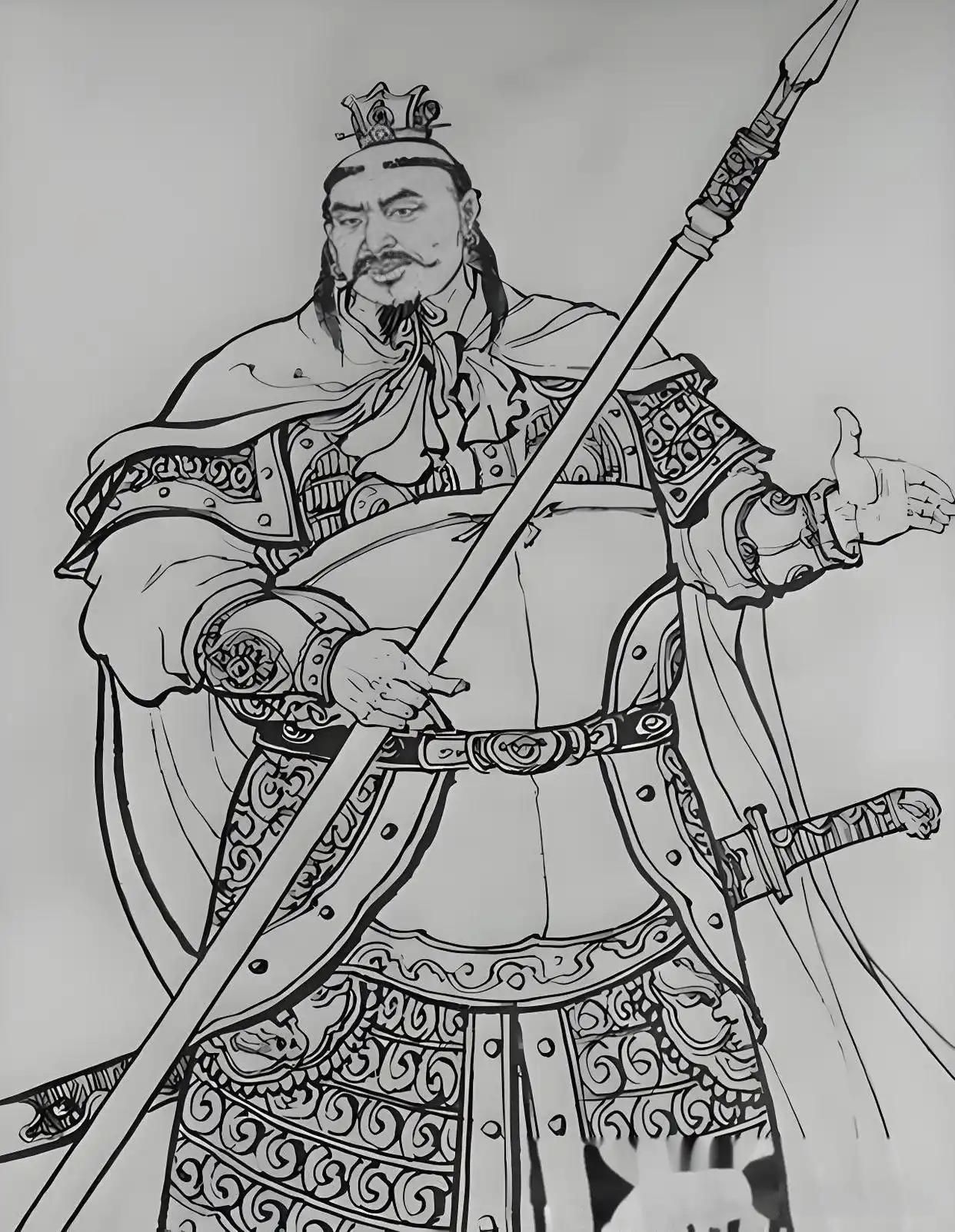
The two men came into the Eastern Hall carrying a document. It was the tenth month of 409. Li Ban and Tao Ren commanded his guards, ate at his table, and were paid, by the record's count, in tens of millions a month. They said they had something to report. The swords were under their robes. Li Ban struck first, and the paper was never read. The record preserves the swords and the order of the two blows, and does not invent a text for the document.
His name was Gao Yun. For two years and three months he had been the Heavenly King of Yan, and he is counted as the first ruler of the Northern Yan, a state whose name he did not invent and whose government was never his. The record does not agree with itself about what he was: a cadet of the Goguryeo royal line, a Murong by adoption, or a Gao with a Chinese pedigree reaching back to high antiquity. All three stand in the record, and the argument among them is the most useful thing about him. Almost all that can be said rests on a Tang notice of 648, which set his life after those of the three Murong rulers before him, and on the Mirror of 1084, which supplies most of the days; both were written by men for whom his court was a two-year interruption. No source gives his birth year, and the chapter that supplies the age of the man he replaced does not supply his. He was put in place by one man, killed by two of his own, and named by the first.
1. The Surname
The sentence that opens his life contains a contradiction no later writer has removed. He was, it says, Murong Yun, style Ziyu, the adopted son of Murong Bao. His grandfather He had been a cadet of the Goguryeo royal line; the family said of itself that it descended from the Gao Yang clan, and had therefore taken Gao as its surname.
Both halves cannot be literally true, and the annalist has marked the difference in one word: the Chinese pedigree is reported as something the family said of itself, while the Goguryeo descent is stated in the historian's own voice. That is not a neutral sentence. It has already chosen which half to believe and left the other in quotation marks.
The contradiction is softer than it looks. Gao is the surname the Goguryeo royal house bore; a cadet of that house would carry it before he carried any Chinese genealogy, and the descent from Gao Yang explains the same character by another route. The two accounts agree about the name and disagree about what it means. What cannot be maintained is that Gao was a state. It was a surname, borne by a border family that had learned to give it a classical ancestry.
The adoption is the one part of the story that is dated and explained. In 397, when Bao's son Murong Hui besieged Longcheng in his revolt, Yun was a palace attendant. The record says he took a hundred-odd men out at night, surprised the besiegers and broke them. Bao made him a son, gave him the surname Murong and made him Duke of Xiyang.
An adoption of a grown officer is not a childhood. It was a reward with a genealogy attached, and everyone at Longcheng could read it as one, which is why he could take the surname off again ten years later without anyone calling it apostasy. At the decisive hour the argument made to him was not that he was a Murong but that he was a Gao of a famous house, and that such a man should not spend his life as another man's son. The qualification and the humiliation were the same fact.
Men of the time thought him dull; the record says so, and adds that Feng Ba alone saw something in him. A man with three names and no following is legible to everyone and owned by no one, and useful in exact proportion to how little he can do without his patrons.
2. The Offer
In the seventh month of 407 Murong Xi, the emperor, whom the record still calls the Prince of Hejian, was outside the walls of Longcheng at the funeral of his empress. The taking of the city belongs to Feng Ba's story; what belongs here is the visit.
Feng Ba was not a stranger. The two had been friends since the years when Yun was nobody, and Feng Ba was a former General of the Central Guard who had been sentenced under the Prince of Hejian and had fled; he came back into the city with twenty-two men bound to him by oath.
Yun refused. The record has him say that he had been ill for years, that they knew it, and that they should find another man. Feng Ba's reply is preserved as a speech, which means it was written up afterwards, and it has three parts. The Murong were finished. The Prince of Hejian was a tyrant whom nine households in ten wanted to see overturned. And Yun was a Gao of a famous house, who could not go on being another man's adopted son. Then he took him by the arm and led him out.
Yun refused again, in the language of the throne: his poor virtue, he said, could not save the people, and his hesitation was not for himself. It is the correct formula, and the formula of a man who knows a second refusal is the last. They pressed him. He agreed.
The forms were observed in the only place they could be: a room, in front of men who had already taken the city. A refusal is a ceremony, and a ceremony needs an alternative. There was none.
He took the title of Heavenly King, not emperor. The distinction was not modesty. Heavenly King was the title the northern courts used when they meant to rule as sovereigns without taking the name of emperor; it claimed the rites and the armies and stopped there. For a man who had founded nothing, it was the highest thing that could be taken without being asked what he had founded.
He declared an amnesty, changed the era to Zhengshi, and took back the surname Gao. The era name had been used by the Wei of the Three Kingdoms and would be used again by the Northern Wei; this one was the Northern Yan's, and it lasted three years. He also declared the state's name to be Yan. It was not a new name — the Murong had carried it for seventy years — and Northern Yan is a later historians' label, added to tell this Yan from the one that had held the plain and the one still holding the Shandong peninsula.
Then came the appointments, and they are the constitution of the reign. Feng Ba was made palace attendant, commander of all military affairs inside and outside the capital, supervisor of the secretariat, Duke of Wuyi, with the right to open a staff office and the honours of the three excellencies. The supervisor's post mattered most in a small court, because it put the papers of state in his hands. The commander's mattered in any court, because it put the armies in them too.
Yun kept the throne, the title, and the right to grant. He gave away the two things that decide what a throne is worth.
The rest was cheaper. More than fifty men were made earls, viscounts, barons and marquises of townships and villages; the soldiers were given grain and cloth; and the officials of the previous court were confirmed in their ranks. A new ruler usually begins with a purge. This one began by restoring the positions of the men who had served the man he replaced, which is what a government does when it has no faction of its own to reward and cannot afford to lose the one it has inherited.
He made his wife Lady Li queen and his son Peng heir apparent. In the record the act sits between the distribution of titles and the execution of a plot, with no interval that anyone thought worth describing.
3. The Arrangement
In the seventh month of 408 he made Murong Gui Duke of Liaodong and gave him the sacrifices of Yan. The sentence is easy to pass over, and it is the most revealing in the reign. The Heavenly King of Yan did not perform the ancestral rites of the state he ruled. He appointed a Murong to perform them.
The rites of the ancestral temple are not a private devotion. They are the constitution of a house, and the man who stands in them is the house. A Gao in the Murong temple would have been a claim the court was not ready to hear. So the office was sublet: he held the title, a Murong held the ancestors, and the man who appointed the sacrificer owned the rite.
What else the reign did can be put briefly. A colonel of the Yueji cavalry, Muyu Liang, plotted, and Yun had him killed. There is no campaign, no building, no tax, no census, no embassy, and no appointment of a provincial governor that the record troubled to preserve. In two years a government issues a great many documents; of his, the record kept the amnesty, the titles, the marriage, the heir, one execution, and the payments made to his own guard.
The silence is not proof that nothing was done. A short reign can be busy and badly reported. But the record of the six years before is full of parks, campaigns and the price of earth, and the record of these two years is full of titles. The earlier court was the whole public life of the state; this one was a settlement among the men who had taken it. An archive keeps what a court generates, and this court generated appointments.
Beyond the mountains the Northern Wei, which would end the state in 436, was not the danger in these two years; the danger was inside the walls.
4. The Guard
The record gives his reason for what he did next in a clause that is also a confession: he knew that he had no merit and had been raised by men of weight, and he was afraid. So he kept strong men about him and made them his heart and his claws.
The two who mattered were Li Ban and Tao Ren. They were given sole charge of the palace guards. Their rewards, the record says, came to tens of millions a month; their food, clothes, sleep and rising were the same as the king's. The figure is not to be trusted as an accountancy — the chapter deals in round and enormous numbers — but its direction is unambiguous. He did not merely pay them. He lived with them.
A ruler with a secure title can afford a guard that is an institution: several units, commands that rotate, kinsmen in the capital, officers whose rivalry is the safeguard. Yun had none of these, because all of them require a following, and a following requires time and a cause. He had two years and no cause. The only men he could bind were men he could pay and keep close, and a guard kept close is a guard within reach. That is not a flaw in his character. It is the arithmetic of a man who has to buy what other men inherit.
Then the record adds the sentence that decides the case and explains nothing: the two were never satisfied, and still resented something. It does not say what. A gift has a price, and a man paid to be loyal has a standing reason to ask what his loyalty is worth; the answer rises, and a king who cannot raise it has taught his household what a king is worth.
On the day in the tenth month of 409 they came into the Eastern Hall with the swords and the paper. A king is not accessible; a document is. The only things that could pass the doors of the inner palace were the men who guarded them and the papers they carried, and on that day the two were the same object. Li Ban's blow was caught on a table. Tao Ren's was not.
Hu Sanxing, annotating the Mirror two centuries later, drew the moral that a man who had risen by his own strength would trust strong men to preserve him. It is a fair reading of the man and an insufficient one of the position. He did not prefer muscle to law. He had no institutions to choose. The guard was the only body in the state that answered to him alone, and that is why it was the body that could kill him.
5. The Name He Was Given
Feng Ba moved the body to the Eastern Palace and gave it a posthumous name: Emperor Huiyi. The Book of Jin calls the name false in the same sentence that records it, using for him the adjective it uses for the whole northern succession. The Mirror repeats the grant without the adjective. Both attribute it to the man who took the throne the same day, and no other source adds anything.
The giver is therefore on record. The grant is not. There is no edict, no report of the board of rites, no discussion of the name, and no temple name. The title exists in one clause at the end of an accession, and it has the standing of everything else a victor says on the day he wins: official because he said it, doubtful because he was the one who said it. Whether the words were ever spoken in a rite is unknown, and in that sense the origin of the name is unknown.
What can be said is what the words mean. Hui is mildness, the kindness that does not press. Yi is the fine and the good, a virtue catalogued for consorts and for private men. There is no Wu in the name, no Jing, no Xuan, no Guang. A founding court gives a founder the characters of what he did; this name gives him the characters of what he did not do. It is the name of a man spoken well of because there is nothing to say.
The same chapter calls the name given to the man he replaced false as well, so the word is the Book of Jin's judgement on the northern succession and not a charge against Yun. Nobody accused him of anything. The doubt is whether a name conferred by a usurper on the man he had replaced, in the sentence that announces his own accession, is a rite or a receipt.
Later ages have repeated the name because there is nothing else to repeat.
6. The Interval
In the chapter that contains him he is the fourth life. Bao, Sheng and Xi each have a narrative with a shape; Yun has a few hundred characters at the end, no separate appraisal, and no anecdote that is not about how he entered or how he left. The historians' judgement is passed on the house of Murong, not on the man made its last king. He is mentioned in the obituary of a family.
That shape is not an accident of survival. A court writes down what it does, and what it writes down is what it expects to be cited. Of this reign the record kept the transfer, and kept it twice, once in the account of the coup and once in the account of the death; between them there is nothing, because between them there was no government anyone needed to justify.
His shortness, then, is not only two years and three months. It is that the state he is said to have founded had no use for him. The man who gave it a new era name and a founder's cult was Feng Ba; the man who gave it a name and a title was Gao Yun; and the narrative gave the founding to the survivor and a posthumous name to the man in the way. Modern lists cannot agree whether he was the last ruler of the Later Yan or the first of the Northern Yan, and the disagreement is the most exact description of him that exists. He was the seam.
Yun kept the name and gave away the offices. Feng Ba kept the name and took them back.
No tomb is recorded for him. What is recorded is the paper. The two men came into the Eastern Hall with a document, and the document was never read. Two years earlier he had been that document: a name that admitted other men, and that could be set down once they were inside.