Home / Emperors / Sixteen Kingdoms
Duan Ye of Northern Liang
北凉段业
Duan Ye, ? – 401 · ruler of Northern Liang
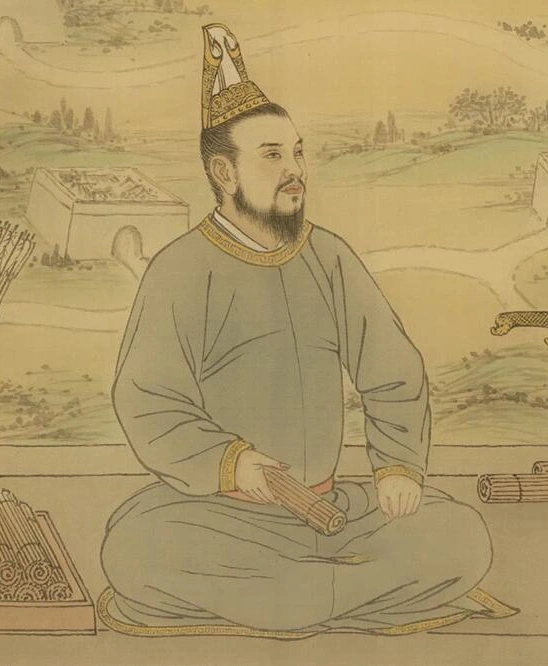
Nothing Duan Ye wrote has come down. A catalogue keeps the titles of three works; the account of his death keeps a few sentences of his speech, and the longest of them is a request to be allowed to go home. He had been a secretary on a frontier campaign, a court librarian, and the author of a fu that mocked a king's palace at his master's bidding. He ruled a province for four years, and the only words of his that a reader can still hear are those of a man asking for his life.
He was put there by soldiers who needed a name, and the interest of his career is how much he did right once he had one. He kept the provincial offices, employed the men who could write, refused a battle he could not win, and declined the royal title for two years. What ruined him was one decision, taken on the word of the man he had most reason to distrust. It was the decision of a ruler who believed that authority could be spent like an army. In Hexi it could not. The men who held the gates had to be paid in something else.
1. The clerk of the western expedition
Jingzhao was the metropolitan commandery whose seat was Chang'an, and to be a man of Jingzhao was to belong to the world of offices, libraries and formal conversation. It was not to belong to Hexi. Duan Ye had no kinsmen in the corridor, no tenants on its fields, no families who had followed his grandfather. Everything he brought west was a skill with documents and a reputation for using it well. He began as recorder to Du Jin, a general under Lü Guang, and went with the western expedition that crossed the desert in 384 and took Kucha. A recorder writes what his commander cannot write himself: the report, the proclamation, the sentence that makes a hard decision sound considered. It is a post of confidence and no power.
At Kucha, when the city fell, Lü Guang feasted his officers in the king's palace, composed a poem to declare his ambition, and then, looking at the palace, ordered Duan Ye to write a fu about it in mockery. A fu is a description with a hinge in it: it praises a thing so exactly that the praise turns into a judgement. The mockery was commissioned. That is the whole position of a literary man at a frontier court. His dissent was wanted, provided it was beautiful, and provided somebody had asked for it.
The argument about the law shows the same talent at a higher pitch. At a banquet Duan Ye said that severe punishment was not the way of a wise ruler; Lü Guang answered with Shang Yang and Wu Qi. The record has Duan Ye reply that a man who means to rule the empire should take Yao and Shun as his models, not the devices of two ministers of a broken age. Lü Guang thanked him and turned to milder government. It is the last time an argument of his changed anything.
He became keeper of the court's books, an office with a fine title and no troops, and then took himself to Tianti Mountain to be treated for an illness, where he wrote sixteen poems called "Nine Laments" and "Seven Satires" against the government. Lü Guang read them and was pleased. The satire was received with enjoyment, which is the usual fate of criticism made into literature. In 397 Duan Ye was administrator of Jiankang, a walled town downstream from Zhangye, the kind of post to which a capital sends a clever man whose conversation it has stopped enjoying.
2. The middle of the road
The Hexi corridor is not a country. It is a road with four wells in it, and the wells are the only reason anyone lives there. South of the road the Qilian range rises above five thousand metres and holds snow all year; north of it the Heli and Longshou hills and then the desert close the way to Mongolia. Between the two lies a shelf of gravel and loess, some fifty miles wide at its broadest, running north-west from the Yellow River toward the Tarim basin. The road runs along it because there is nowhere else to run.
Each of the four great oases is fed by a different river coming down from the southern mountains. Guzang, the provincial seat, lives on the Shiyang. Zhangye lives on the Hei. Jiuquan lives on the Taolai, Dunhuang on the Dang. No canal joins one watershed to another, and no governor can move water from his neighbour's district by ordering it. This is the first fact of Hexi politics: the map of loyalty follows the map of irrigation.
The Hei is the largest of the four. The Chinese called it the weak water, because it was said to be too feeble to float a boat, and the Documents already knew it: the ancient geography has the weak water conducted to Heli, its surplus flowing away into the shifting sand. It rises in the high country, runs some five hundred miles, passes Zhangye, and ends in a lake in the desert at Juyan. It is the only great river in the classic that ends in sand rather than in the sea.
Zhangye stands on the fan where that river leaves the mountains. The Han made it a commandery in 111 BC and named it for a gesture rather than a people: to spread the arm and open the armpit, so that the road to the western regions should not be closed. The town had a wall, granaries, county offices and channels that could keep a garrison fed. Guzang was the seat of government, Dunhuang the door to the trade. What Zhangye had was the middle.
At Zhangye the corridor narrows. The mountains on the south and the hills on the north come down and leave a lane, and the road, the river and the wall are forced into it together. Eastward, a hundred and fifty miles away, Guzang commands the road to Chang'an. Westward, a hundred and thirty miles away, Jiuquan holds the next oasis, and beyond it another two hundred and forty miles to Dunhuang. South of the town a pass through the Qilian, the old Dadouba pass, leads to the high plateau and its herds; north are the Heli range and the desert road to Juyan.
That is why a state can be founded there, and why it cannot be a great one. Zhangye has its own water, so it does not need Guzang's permission to eat. It has the road, so it can tax what passes. Its fields can support horsemen, the pastures under Yanzhi Mountain can supply remounts, and the southern pass can bring in Qiang herders short of a patron. What it lacks is depth. The corridor is a line, not a territory. An enemy who holds either end can starve the middle, and the middle has one harvest and one wall. A man who holds Zhangye holds the middle of a sentence that begins at Chang'an and ends in the desert. He can interrupt it. He cannot finish it alone.
3. The shepherd of the province
The offer came in the fourth month of 397, from the camp of Juqu Nancheng, who had risen against Lü Guang and was besieging Jiankang. His envoy did not offer a throne. He offered a diagnosis: the Lü house was failing, its ministers did as they pleased, punishments fell without rule, rebels were visible in every district, and the people had nowhere to look. Would a man of Duan Ye's ability spend it on a state that was already dead, or consent to govern the province and give the exhausted districts a little air?
Duan Ye refused. He refused for about twenty days, and while he refused the siege went on and no relief came. The town's leading men pressed him to accept, and he was afraid of what two enemies at the capital might do to him if he went back. So he consented. He was not won by the offer of a province; he was won by the impossibility of returning to the room where his enemies sat.
They made him Duke of Jiankang and shepherd of Liang province, with the staff of authority and the rank of grand commander and general of the soaring dragon, and changed the era to Shenxi. The dukedom was named for the little town he had been governing. His title came from the place where the rebels found him, not from a fief his family had held or a conquest he had made, and the province in it was one he did not yet control. He was a duke of his own posting and a shepherd of other men's garrisons. His own documents said Liang, the name of the province; the Northern is a compass word from an age that had five Liangs on its maps and three directions to place them in.
Juqu Mengxun brought his followers over and was made general of the west and administrator of Zhangye, a title to a town still held by Lü Hong. In that first year he dammed a river against the Western commandery and took it, and the administrators of the west came over. In the sixth month Lü Hong abandoned Zhangye and went east, and Duan Ye moved his seat there. The ablest soldier in the coalition was now the administrator of the ruler's capital, because there was no one else to give it to.
In the second month of 399 he took the title of prince of Liang and changed the era to Tianxi. He had waited two years, and the wait was not indecision. A shepherd governs a province that belongs to someone else; a king governs a country that belongs to him. In 397 a royal title would have been a claim against a living dynasty; by 399 the dynasty at Guzang was old, and its court was divided among brothers who would soon be killing one another. Both era names end in the word for a seal: the first was the seal of a duke, the second the seal of a king. He kept the offices and the registers, and put the soldier on his left as assistant and a scholar on his right.
No school is credited to him, and no coinage; the two things the histories praise in the better-run Liang courts are missing from his. What the record does say is that he trusted divination, prophetic books, shamans and omens, and was misled by flatterers. That is a hostile summary, and also a description of a ruler who had no other way of learning what his generals intended. His orders, the same passage says, did not run. The county clerks were his; the garrisons were the households of chiefs who had followed Nancheng, and after Nancheng they would follow whoever inherited him. A ruler in that position can appoint, promote, honour and dismiss. He cannot command.
4. The general he could not dismiss
Juqu Mengxun was the ablest man in the province and Duan Ye knew it. The Jin shu says that he feared Mengxun's martial temper and wanted him far away, and the policy that followed was the ordinary policy of a weak ruler toward a strong subordinate: move him, flatter him, give him the next town, and hope that distance does the work of a knife. Mengxun was sent to Linchi, his senior kinsman to Jiuquan, and the capital was given to a favourite, Ma Quan, a palace attendant with a reputation for dash and none for judgement. Ma Quan showed contempt for the man he had replaced. Mengxun went to Duan Ye with a sentence any ruler should have recognised as a trap: the empire is not worth worrying about, the only man to worry about is Ma Quan. Ma Quan was killed on Duan Ye's order.
The pattern would repeat: when Mengxun wanted a rival dead, he asked the ruler to do it. By the spring of 401 the list of men who could have opposed Mengxun was short. He proposed to Nancheng that they remove Duan Ye and set Nancheng in his place. Nancheng refused. His argument was not that Duan Ye was wise; it was that the Juqu had made him, that Duan Ye had trusted them, and that a family which broke its word to the man it had raised would have nothing left that anyone would believe. Nancheng was defending the arrangement, not the man.
Mengxun asked for the post of administrator of Xi'an, a frontier town, and Duan Ye was glad to let him go. A ruler who is relieved to see a general leave has already conceded the question of who is dangerous.
Then came the affair of Tian Ang, which is the whole state in a single exchange. Duan Ye had suspected his right general Tian Ang and had him confined. In the spring of 401, with Mengxun in arms, he summoned him, apologised, pardoned him, and sent him out with the guard general Liang Zhongyong to fight. A general named Wang Fengsun warned him: the Tian of Xiping have produced rebels in every generation; this one is respectful in appearance and vicious underneath, not a man to trust. Duan Ye answered that he had suspected him for a long time, but that without Tian Ang there was no one to send against Mengxun. He knew, he had no alternative, and he said so. That sentence is the most honest thing in his record, and it is also his death warrant.
The trap closed in the fourth month. Mengxun arranged to sacrifice with Nancheng at Mount Lanmen, a mountain whose position the old geographies dispute, and before the day he sent his adjutant Xu Xian to the capital with a warning: Nancheng intends to rebel, and will use the leave granted for the sacrifice as his occasion; if he asks to go to the mountain, my word is proved. On the day, Nancheng asked. Duan Ye had him arrested and ordered him to die.
The proof was not evidence but a coincidence arranged to look like evidence, and it worked because it was the kind a frightened ruler is half expecting. He had been told that his most popular general would ask for leave, and the general asked; only one of the two available stories left his authority intact, and he chose it.
Nancheng gave him a way out, and it was a good one. He said that Mengxun had come to him with the plot, and that he had kept silent for kinship's sake, and that his own death would be the signal for Mengxun's rising before nightfall. He proposed a counterscheme: declare Nancheng dead and publish his crimes, wait for Mengxun to rise, and then fall on him with the troops who believed him wronged. Duan Ye refused. The plan asked him to publish a lie, permit a rebellion, and then arm the man he had just condemned. A frightened ruler will always choose the quiet death over the loud test.
So Nancheng died, and with him died the only Juqu leader who had refused to betray Duan Ye. It converted the one asset Duan Ye still owned, the belief that he was the man the Juqu had raised and had not injured, into a grievance that belonged to somebody else.
5. The gate
Mengxun wept where the tribe could see him and asked who would avenge a loyal man murdered by his lord. The chiefs came because they had trusted Nancheng, not the man who mourned him. By Dichi he had ten thousand men. Zang Mohai, whom Duan Ye had installed in the new town of Xi'an, brought his troops over without a fight, and the Qiang and other frontier peoples rose. The town had been built as a fortress; Mengxun had said at the time that it was a tomb, because its commander was brave and had no judgement. He was right twice.
Duan Ye sent Tian Ang and Liang Zhongyong against him. At Houwu, Tian Ang went over with five hundred cavalry, and the army dissolved without a battle. Liang Zhongyong surrendered too. That is the decisive fact of the campaign, and it is not a military fact. An army that disperses when five hundred men change sides was never an army; it was a coalition of households, and the households had decided.
In the fifth month Mengxun appeared before Zhangye. The gate was held by Tian Ang's nephew Cheng'ai, who cut the bar and let him in. Duan Ye's attendants scattered. There was no siege, because there was nothing to besiege with: the field army had melted at Houwu, and the wall was manned by men who could count as well as anyone. A wall is a promise that somebody inside will not open the gate. Duan Ye had spent four years teaching the men inside that his promises were the one thing he could not keep.
He asked Mengxun for the remainder of his life and for the road east, to his wife and children. He did not ask for the province. The answer was the sword. He was killed in the town he had made his capital, and no tomb is recorded.
The history calls him a plain scholar and an elder, with no craft or strategy, whose authority did not run and whose subordinates did as they pleased. It does not add that the qualities it despises were the ones that had made him useful. He had been chosen because he could write, because he was known, because he had no following that could threaten the men who chose him.
6. The seal and the sword
His case is usually told as the failure of a weak man. It is more useful as a demonstration that in Hexi the right to rule and the power to rule were two different properties, which could be held by two different people and could not be exchanged. He had the first: the title, the clerks, the seal, the recognition of officers who had served the old regime. Mengxun had the second: the households, the horses, the chiefs, and the willingness to kill. For four years the first was enough, because the second was divided between Nancheng and Mengxun and a third man could stand between them.
His policies were not the problem. He kept the provincial administration when he could have replaced it, employed the literate men who were the only people who could run a district, avoided a battle he could not win, waited two years before taking a royal title, and built a new garrison town at Xi'an. A man who did those things in a strong state would be remembered as a good minister. The one act that cannot be defended is the killing of Nancheng, and it cannot be defended not because it was cruel but because it spent the only thing he owned.
Before that fourth month his legitimacy was a fact that other men had to work around. After it, it was a grievance that other men could use. Authority that rests on being the man everyone agreed to accept lasts exactly as long as the agreement, and the agreement is kept by men who have something to lose by breaking it. Duan Ye never gave the chiefs anything to lose. He gave them offices, which they could take from him, and he gave them a ruler, which they could replace.
The chapter that preserves him is the Jin shu's life of the man who killed him, written by a court that had no great opinion of scholars on thrones. The names of three of his works survive because a bibliographer copied them; the works themselves are gone. The man who wrote for a living left nothing, and the man who killed him got a chapter.
He had asked, at the end, to go east. The east was the capital district, the offices, the libraries and the men who read the same books; it was where he had learned to write the sentences that made him useful. He had never asked for Zhangye. It was given to him by men who needed a name, and it was taken from him by a man who no longer did.