Home / Emperors / Han Dynasty
Emperor Zhi of Han
汉质帝
Liu Zuan, 138 – 146 · tenth emperor of the Eastern Han
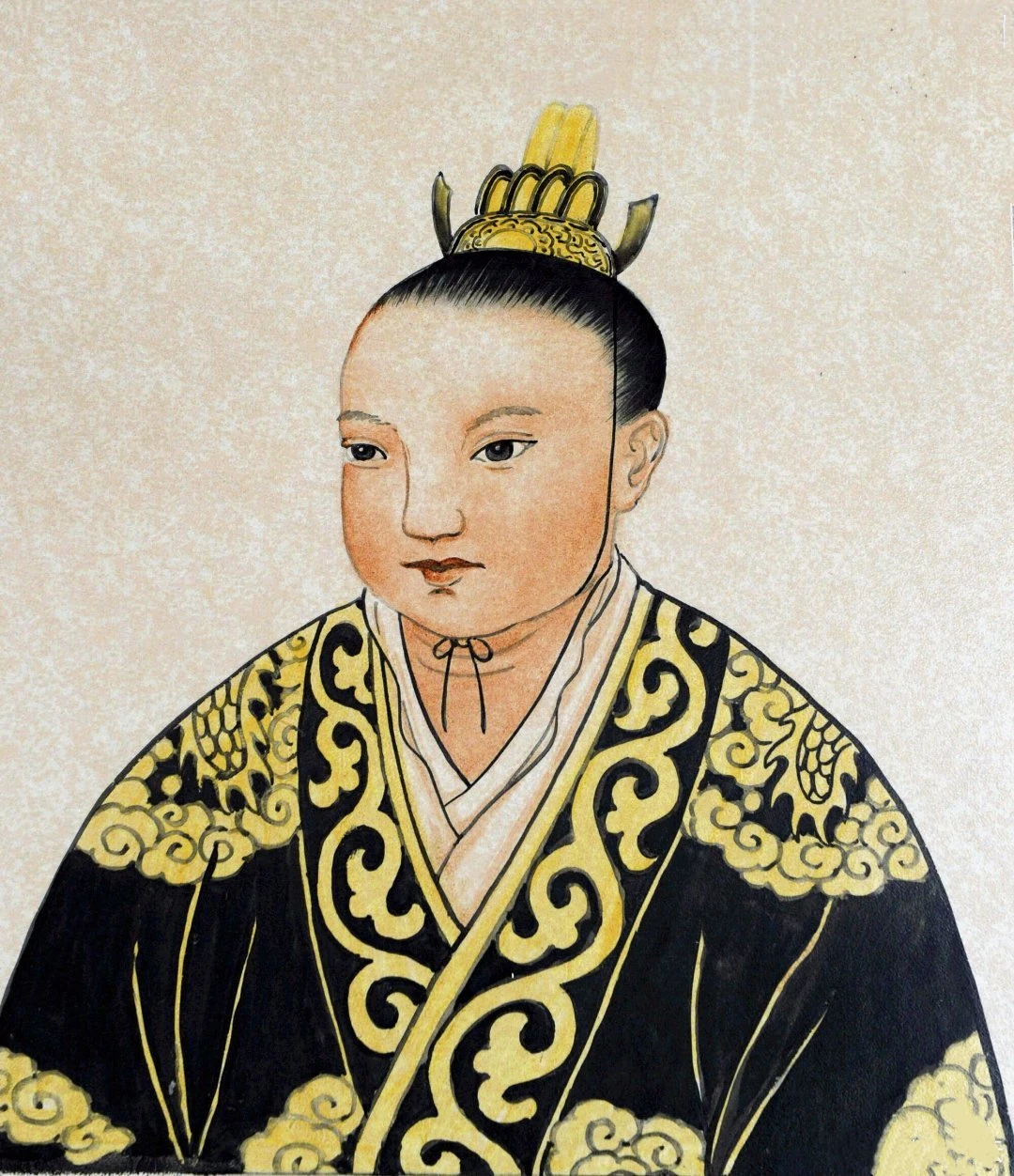
At a court audience a boy of eight turned to the general-in-chief and said, in front of the assembled ministers, that this was a domineering general. The phrase was repeated for two thousand years. Within months the boy was dead, and the men who had heard him say it went on with the business of choosing his successor.
His reign is one of the thinnest in the dynastic record. It lasted some seventeen months, and the standard annals give it, besides the dates of its beginning and its end, a handful of provincial campaigns, three edicts, and a list of princes who died in office. Nothing in it is the work of a ruler, because the ruler was a child. What the record does show, with unusual clarity, is a mechanism: the household of the general-in-chief had become the place where the throne was filled, and the child was chosen for that household's convenience. He died because he stopped being convenient. This is the account of that short reign, and of the sentence that outlived it.
1. The Heir from Le'an
Liu Zuan was born in 138, in his father's principality. He was a great-great-grandson of Emperor Zhang. The line he came from had been passed over once already. Emperor Zhang's eldest son, the founder of the family, had a mother the histories do not name, and the throne went instead to a younger half-brother, the emperor He. The eldest son was given the small kingdom of Qiancheng in 79 and honored in his brother's reign; his son held Le'an, which the court renamed in 95, for twenty-eight years; and his grandson, Liu Hong, was the prince of Le'an when Liu Zuan was born. A family of the imperial house two steps off the main stem, comfortable, obscure, and entirely without a claim until somebody needed one.
The claim was called in during the last illness of the emperor Chong. The child on the throne was three years old, and the general-in-chief Liang Ji, without waiting for him to die, had Liu Zuan brought down to the Luoyang rest-house outside the palace, so that a successor would be standing by. The annals state the fact in a single clause and do not comment on it. There is the whole of the year's politics in that clause.
The ministers were told, and objected. Li Gu, the grand commandant, went to Liang Ji and argued that the choice should fall on a man of years, wise and of good repute, able to handle the government in person; he held up the examples of Zhou Bo and Huo Guang, who had set up emperors of mature age, and asked Liang Ji to take warning from the empress dowagers Deng and Yan, who had profited by putting children on the throne. Liang Ji would not hear it. There was a better candidate by every formal measure. Liu Suan, prince of Qinghe, was grave and measured in his conduct and the officials of the court looked to him; he and Liu Zuan were cousins, both grandsons of the same prince of Le'an, and Liu Suan was the elder, which made him senior in the one thing that mattered in a succession without a son. He was summoned to the capital for the deliberation and then sent home again.
In the first month of 145 Liang Ji went with the imperial tally and the blue-canopied carriage of a prince's rank and brought Liu Zuan into the Southern Palace. On the following day the boy was made marquis of Jianping, and on that same day he took the throne. He was eight years old. His father, still the prince of Le'an, was moved in the fifth month of the following year to the fief of Bohai, because Le'an was low and damp and its revenues thin. It was the only promotion the family received from the elevation, and it came late.
2. The Regency and Li Gu
The empress dowager Liang Na held the court, as she had since the death of her husband, and the government was put into the hands of the senior ministers. Zhao Jun was grand tutor, Li Gu grand commandant, Hu Guang excellency over the masses and Zhao Jie excellency of works. Of the four it was Li Gu who mattered, and the record is unusually warm about the months that followed. The empress dowager had been overtaken by one calamity after another, it says, and she entrusted the government to her chief ministers; what Li Gu corrected or proposed was almost always adopted; the yellow-gate eunuchs were dismissed from the palace entirely; and the empire began to expect an orderly peace. The sentence carries its own explanation of why the expectation failed. Liang Ji, being suspicious and monopolizing by temper, resented Li Gu at every turn.
Li Gu's first act of housekeeping was to audit the appointments of the previous reign. Under the emperor Shun, posts had often been given out of order, and once Li Gu was in charge he had more than a hundred officials removed. The men he removed were not grateful. They had a patron available. Writing together, they sent up a sealed denunciation of the grand commandant, and the text of it survives.
It is a strange document, worth attention for one likeness in particular. Li Gu, it says, was a man who used public office for private ends, who promoted his own clients, and who had forty-nine of his relatives and dependants inscribed on the register of officials; he chose shopkeepers for clerks and bought fine horses to show off at his window; he walked about in lavish carriages; and while the late emperor lay in state and the people of the streets were weeping, Li Gu powdered his face, posed and preened, and went about with no sign of grief. It also advances a charge about the state of the realm: since Li Gu took office, the southeast has been bahu, lawless and beyond control, two provinces and a number of commanderies reduced to desolation.
That word is the one to keep. The gloss on it is simply that it means violent and ungovernable, and it is the word the eight-year-old emperor would later use to the face of Liang Ji. It had been used first, and in writing, by Liang Ji's own clients against Liang Ji's enemy. The vocabulary of this court, it seems, was minted in the household of the general-in-chief.
Li Gu read the memorial, and so did Liang Ji, who took it to the empress dowager and asked that it be sent down to the courts for trial. She would not allow it. Li Gu kept his office and his life, for the time being.
3. The General-in-Chief
Liang Ji held the office of general-in-chief by inheritance from his father. He was, by the description the histories give him, a man of sloping shoulders and jackal's eyes, who could barely write and reckon, who drank, who was skilled at full-draw archery and at the board games of the day, and who liked to carry falcons on his arm and run dogs and race horses. It is not an impartial portrait, but it is specific, and nothing in his record of these years contradicts it.
The clearest single act belongs to the years before the regency, and it was done while his father was still alive to be deceived. Lü Fang, prefect of Luoyang and a client of the family, had told Liang Shang a number of unflattering truths about his son. Liang Shang rebuked him. Liang Ji had Lü Fang killed on the road, then shifted the suspicion onto Lü Fang's enemies, asked that Lü Fang's brother be made prefect of Luoyang to hunt them down, and saw to it that more than a hundred of those men, their kin and their retainers, were destroyed. The cover-up was the crime. What the record preserves about Liang Ji is chiefly this, that he was willing to kill to prevent his father from knowing what he had done.
With the regency the scale changed and the manner did not. The annals say that although he declined the trust formally, his extravagance and violence only increased, and that he was suspicious and monopolizing and resented Li Gu at every turn. There is no programme of government in this, only a household with an army and a monopoly on access to the throne, and a grand commandant who was trying, with the empress dowager's ear, to make it answerable.
4. The Business of the Reign
The reign had business, as any reign did. In the second month of 145 the court proclaimed a general amnesty, restored to the princes the household registers and revenues it had earlier cut, and received the submission of a body of rebel Qiang who came in to Liang Bing, the administrator of Zuopingyi. In the third month a man of Jiujiang named Ma Mian took the title of Yellow Emperor. The commandant of Jiujiang, Teng Fu, attacked and killed him together with two of his captains, and the head, the jade seal, the deerskin cap and the yellow robe were sent to Luoyang and hung outside the city gate as a warning.
The southeast was unsettled through the year. Zhang Ying, whose band had been brought in by persuasion years before, rose again and killed the magistrates of Tangyi and Jiangdu; Xu Feng killed the magistrates of Quyang and Dongcheng; Lu Gong besieged a town in Danyang; and in the eleventh month a man of Liyang named Hua Meng took the title of Black Emperor and killed the governor of Jiujiang. The throne recruited commanders, made Teng Fu commandant of Jiujiang and then commander of the forces of the two provinces of Yang and Xu, and offered rewards for the heads of the leaders. A man of Xiapi named Xie An answered the call, laid an ambush with his kinsmen, and killed Xu Feng. Teng Fu broke Zhang Ying and then Hua Meng; by the record's count his men took some fifteen hundred heads in one engagement, more than a thousand in another, and three thousand eight hundred in the last, with seven hundred prisoners, after which the history says that the whole southeast was at peace. A commander named Zhao Xu, who had hung back from the fighting and then reported victories he had not won, was recalled and executed.
The year also carried off three princes in their fiefs: the prince of Pengcheng in the second month, the prince of Jibei in the fourth, and the prince of Fuling in the seventh. The north sent the usual news, which was that the Xianbei raided the commandery of Dai in the sixth month. And in the ninth month the grand tutor Zhao Jun died.
Three documents were issued in the emperor's name, and they are the best evidence for what his government was. In the fifth month, after a spring and summer of drought had damaged the winter wheat, an edict acknowledged that the government had failed to keep the seasons in order, and drew the conclusion the dynasty always drew from withheld rain. The commanderies were to pray at the famous mountains and great rivers; the prisons were to release every prisoner not under sentence of death whose case was not yet closed, to wait for autumn; and, since years of war and labour service had left the dead unburied and the coffins of the poor unclaimed, commissioners were to go out and see that the bodies were gathered and the destitute given what they needed, so that the lonely spirits should be comforted.
Another edict, issued soon after, addressed with a surer grasp of the question the order of the imperial tombs. The arrangements of earlier generations had left the tomb of the emperor An placed above the tomb of the emperor Shang, who had reigned only months and whom An had succeeded; and the tomb of the emperor Shun above An's. The generations thus lay out of sequence in the burial ground. The court now ordered that Shang's tomb should come first, then An's, then Shun's, so that the order of kinship should be plain and the rule fixed for ten thousand generations. And in the first month of 146 a third edict took up the conduct of the provinces, complaining that the commanderies had grown loose in their observance of the law and were competing in cruelty, inventing regulations of their own to entrap the innocent, and that suits from the aggrieved had been coming up to the capital without pause. It quotes the oldest of the classics, the Book of Documents: be enlightened in virtue and cautious in punishment.
The hand that signed these documents held no brush. Their language is the secretariat's, and their subjects, the seasons, the prisons, the ranking of tombs, were the ordinary business of a Chinese government. What is unusual is only that all three were issued over the seal of a boy of eight. The emperor is present in his own reign as an absence, and the edicts he signed are a record of other men's competence.
5. "This is a domineering general"
At some point in the reign, at an audience of the assembled ministers, the boy looked at Liang Ji and said what he thought. The words the history gives him are these: this is a domineering general. The commentator glosses the adjective as meaning violent and ungovernable, and notes that it was Liang Ji who heard it and hated him for it. The child was not punished for it. He was dealt with by other means.
The biography of Li Gu states the reason plainly: Liang Ji feared the emperor's cleverness and thought that it would create trouble for him later. He was a child. He had years to grow into the office, a court full of men like Li Gu, and a memory of having said this out loud. The indictment there is not of Liang Ji's wickedness, which no one doubted, but of the structure: a child had been installed precisely because he could be governed, and the defect in the plan was that he might one day notice.
In the intercalary sixth month of 146 the emperor died in the front hall of the Jade Hall, which was the room in which his predecessor had also died. The annals record it in a single line: on the day jiashen, the general-in-chief Liang Ji secretly administered poison, and the emperor died, in his ninth year. The line fixes the fact and withholds the manner. It is the biographies that supply the rest, and they disagree in a way that has never been settled. One version has it only that poison was sent in. The other has the poison put into boiled cakes, and it is this version that preserves the emperor's own words, which are the last he ever spoke.
Li Gu was summoned in haste. He came to the bedside and asked what had brought on the illness. The emperor could still speak. He had eaten the cakes, he said, and his belly was heavy with them, and if he could have water he might yet live. Liang Ji was standing at the bedside. Water might make him vomit, he said; he was not to be given any. The sentence was not finished before the boy was dead.
What Li Gu did next is recorded because of its consequences. He fell on the body and wept aloud, and he laid a charge against the physicians who had attended the emperor, which in the practice of the court was a demand for an inquiry into what had been done to him. Liang Ji, the histories say, feared that the affair would come out, and conceived a lasting hatred for him. No inquiry followed. The attending servants were not examined, the kitchens were not questioned, and the general-in-chief remained in his office. An emperor of the Han had been poisoned in his own palace, in the presence of his grand commandant, and the official response to the grand commandant's protest was silence.
He was nine years old by the Chinese count, which makes him eight by ours. He had been emperor for some seventeen months.
6. The Succession, Again
The throne was filled within six days, and the filling of it is the clearest view the record gives of how the empire was actually governed. Li Gu, with Hu Guang and Zhao Jie, the other two of the three excellencies, wrote first to Liang Ji to ask that the choice be made by the assembled officials rather than settled in the palace. Liang Ji received the letter and convened the council, the three excellencies, the officials of the second rank, and the marquises, to deliberate on the succession.
The deliberation went against him. Li Gu, Hu Guang, Zhao Jie and the grand herald Du Qiao all held that the prince of Qinghe, Liu Suan, was the man: his reputation for virtue was known, and by both seniority and closeness of blood he stood first. They were right on the forms of it. Liang Ji wanted the marquis of Liwu, Liu Zhi, and his reason was a marriage. The empress dowager had already summoned Liu Zhi to the pavilion at the Xiamen gate, intending to give him her younger sister.
The council would not move, and Liang Ji could find no argument to move it. What changed the votes came to him at night, from a eunuch of the regular attendants who had not forgotten a slight at the hands of the prince of Qinghe. In the morning the general came back fierce and loud, and the council broke before him, and by the next morning he had the emperor he wanted.
Li Gu wrote again, urging the prince of Qinghe on Liang Ji, and Liang Ji's anger rose with each letter. He persuaded his sister the empress dowager to strip Li Gu of the office of grand commandant, which removed the one voice in the council that could not be intimidated, and then Liu Zhi was brought into the Southern Palace and made emperor. He was fifteen.
The pattern of the year should be stated plainly. In the first month of 145 a council of ministers had asked for an adult on the throne and been overruled. That summer the same council asked again, in greater numbers and with better reasons, and was overruled again, this time with the removal of the man who led it. In between, the emperor they had not chosen had been poisoned for saying something true. The office of general-in-chief did not merely influence the succession; it decided it, twice. The officials' words that day, that they had only to be told what the general-in-chief commanded, are the reign's second epitaph, and a colder one than the child's.
7. Jingling and the Verdicts
He was buried in the seventh month, on the day yimao, in the Jing tomb, east of Luoyang in the southern group of the imperial graveyards. The description preserved by the antiquaries gives the mound as a hundred and thirty-six paces square and five zhang five chi high, with a moving barrier and gateways on four sides, a sleeping hall and bell-frames within the barrier, the park officials' quarters north of the hall, and twelve hundred and fifty-four mu of endowment land. There was no separate shrine building. The sleeping hall did duty as the temple, in the phrase of the record.
Everything about it reads as work done in a hurry, which it was. An emperor who dies at nine has no tomb begun in his lifetime. The stone blocks of the underground chamber at Jing carry the reign-names of the emperor Shun, which is taken to mean that the builders used up the material left over from his tomb. The site itself is not firmly identified. It lies within the southern group south of the Luo and has been under state protection since 2013 as one of the Later Han imperial graves; a survey in 2016 measured a mound some twelve metres high with a base circumference of a hundred and eighty-two metres, and identified it as a candidate rather than a certainty.
The verdicts on him are few, and they run together. The court history written while the dynasty lasted says that at eight he was of fine and gentle nature, fond of learning, respectful to his teachers, and of good repute in the principalities. Fan Ye, writing three centuries later, put the whole of it into two lines in his encomium: Chong died too young to know anything, and Zhi was murdered for his cleverness. Sima Guang, passing the same judgment in the eleventh century, says only that the emperor was clever from childhood. The Qing emperor Kangxi, who thought about such things, added the moral that a boy so clever should have known how to hide it, and that his cleverness, unhidden, was exactly what destroyed him.
There is something to be said for that reading, and something it leaves out. The boy did not die for lack of prudence. He died because a household that had twice chosen the emperor could choose again, because the one man willing to investigate his death could be dismissed within the month and was, and because a court that had said aloud that it had only to be told what the general-in-chief commanded had already given up the power that might have saved him. The word he found for his murderer had been used before he said it, in a forged memorial drawn up by the general-in-chief's clients against Li Gu. In the standard gloss it meant violent and ungovernable. In his mouth it became the name of the government he lived under, and then of the government that killed him. He was eight years old when he found the right word, and that, and not the edicts signed in his name, is what is left of Emperor Zhi.